
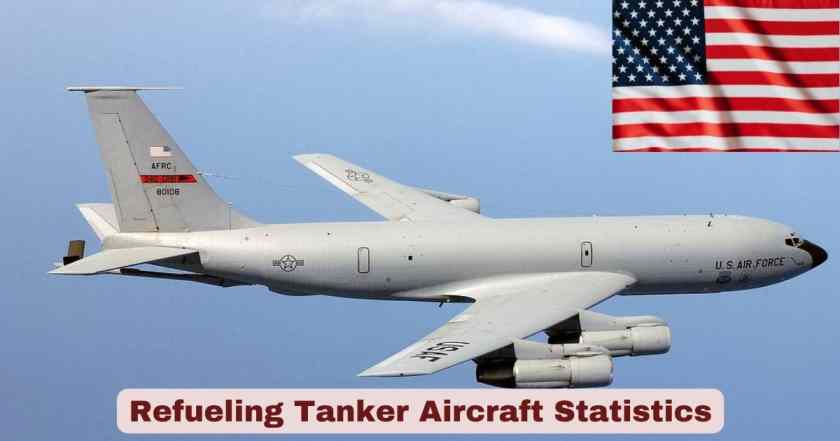
What is Refueling Tanker Aircraft?
Aerial refueling tanker aircraft are the silent force multipliers behind every major U.S. military operation in modern history — without them, no long-range strike, no strategic bomber mission, and no sustained naval aviation campaign is possible. The United States operates by far the largest and most capable tanker fleet on earth, a force built around three core platforms: the Boeing KC-135R/T Stratotanker, which has been the backbone of American aerial refueling since 1957; the Boeing KC-46A Pegasus, the next-generation replacement currently entering service in growing numbers; and the Boeing KC-130J Super Hercules, operated by the U.S. Marine Corps and Navy for tactical and expeditionary refueling missions. As of the start of FY2025, the total U.S. tanker fleet stood at a projected 466 aircraft across all components — active duty, Air National Guard, Air Force Reserve, Marine Corps, and Navy — making it roughly 75% of the entire global tanker fleet, a statistic confirmed by Flight International’s World Air Forces Directory 2026. That remarkable dominance reflects decades of sustained investment in a capability that is the ultimate enabler of American power projection, and in 2026 that investment is accelerating through the largest tanker modernization program since the Cold War.
The defining story of the U.S. refueling tanker fleet in 2026 is the gathering momentum of the KC-46A Pegasus transition. On December 3, 2025, the U.S. Air Force accepted its 99th and 100th KC-46A Pegasus aircraft at Travis Air Force Base, California — a milestone celebrated by Air Mobility Command Commander Gen. John D. Lamontagne as representing “the continued strengthening of our nation’s global reach and readiness.” As of January 2026, approximately 105 KC-46As have been delivered or formally accepted into service, and the Lot 12 contract signed on November 25, 2025 — worth $2.47 billion for 15 more aircraft — keeps the production line active through June 30, 2029. Just weeks later, on February 28, 2026, KC-135 Stratotankers and KC-46A Pegasus aircraft were among the approximately 86 combined tankers deployed in Operation Epic Fury — the largest U.S. military operation in a generation — where they provided the aerial refueling lifeline that allowed B-2 Spirit stealth bombers, F-15 Strike Eagles, F-35 Lightning IIs, and every other aircraft in the strike package to reach and strike targets deep inside Iran. That single operation demonstrated, more dramatically than any peacetime exercise ever could, exactly why the United States has invested hundreds of billions of dollars in its tanker fleet across seven decades.
Interesting Key Facts — U.S. Refueling Tanker Aircraft 2026
| Fact Category | Key Fact |
|---|---|
| Total U.S. Tanker Fleet (FY2025 Start) | 466 aircraft — projected across all components |
| U.S. Share of Global Tanker Fleet | ~75% of the entire world’s tanker fleet — per Flight International World Air Forces Directory 2026 |
| Primary New Tanker | Boeing KC-46A Pegasus — replacing KC-135 and KC-10 |
| Primary Legacy Tanker | Boeing KC-135R/T Stratotanker — in service since 1957 |
| KC-135 Total Fleet (2025) | ~396 Stratotankers — approx. 153 active, 171 ANG, 72 AFRC |
| KC-135 Youngest Airframe | Built 1965 — youngest KC-135 in 2026 is ~60 years old |
| KC-135 Oldest Active Aircraft | 57-1419 — in service with 161st Air Refueling Wing, Goldwater ANGB, AZ |
| KC-135 Planned Retirement | Service life extended to ~2050 — some may fly near 100 years |
| KC-46A Delivered to USAF (Jan 2026) | ~105 aircraft delivered or formally accepted |
| 100th KC-46A Delivery Date | December 3, 2025 — Travis AFB, California |
| KC-46A Total on Contract (Global) | 183 aircraft — USA, Japan, Israel |
| KC-46A Planned Total Fleet (New Goal) | 263 aircraft — approved July 2025 acquisition strategy |
| KC-46A Maximum Possible Fleet | 288 aircraft — if all Tanker Production Extension options exercised |
| KC-46A Lot 12 Contract | $2.47 billion — 15 aircraft — signed November 25, 2025 |
| KC-46A Fuel Capacity | 212,299 lbs (96,162 kg) — 10% more than KC-135 |
| KC-46A Boom Transfer Rate | 1,200 gallons per minute |
| KC-46A Certified Receivers | 28 boom and drogue receivers including F-35, F-18, P-8A |
| KC-46A Service Life Target | Into the 2070s |
| KC-10A Extender Retirement | Retired 2024 — replaced entirely by KC-46A |
| Marine Corps Tanker Fleet | 70+ KC-130J Super Hercules |
| Navy Tanker Fleet | 10+ KC-130T Hercules (Reserve) |
| MQ-25A Stingray (Future) | USN unmanned carrier tanker — IOC delayed to FY2027 |
| MQ-25A Total Planned | 76 aircraft — $1.3 billion program |
| NGAS (Future Stealth Tanker) | Next Generation Air-Refueling System — to replace KC-135 fleet |
| Operation Epic Fury (Feb 28, 2026) | ~86 KC-135 and KC-46A tankers deployed — refueled B-2s, F-35s, F-15s striking Iran |
| B-2 Round-Trip to Iran (2026) | B-2s flew missions from Whiteman AFB, Missouri — only possible with KC-46A refueling |
| KC-46A Combat Debut | 2022 — first combat mission in CENTCOM AOR |
| KC-135 Combat History | Vietnam, Desert Storm, OIF, OEF, Libya, Syria, Yemen, Iran — every major USAF operation since 1957 |
| Flight Hours Achieved (KC-46A fleet) | Surpassed 150,000 flight hours — per Boeing official data |
Data Sources: The Aviationist — “Air Force Tanker Fleet Faces Major Restructuring Under 2026 NDAA” (October 28, 2025); Flight Global — “US Air Force Accepts 100th KC-46A Pegasus Tanker” (December 5, 2025); Stars and Stripes — “Air Force Marks Delivery of Its 100th KC-46A Tanker” (December 5, 2025); Boeing Official KC-46A Pegasus Page (boeing.com); Aerospace Global News — “Operation Epic Fury: How the US & Israeli Attack on Iran Unfolded” (March 2, 2026); Wikipedia — Boeing KC-46 Pegasus (Updated March 2026); Simple Flying — “How Many KC-46 Tankers Are Left?” (January 19, 2026); Simple Flying — “How Many KC-135 Stratotankers Are Left?” (November 2025); Army Recognition — “US Air Force to Receive 15 New KC-46A Pegasus Tankers” (December 2025).
The fact table above captures the full scope of American refueling tanker dominance in 2026. The statistic that the United States controls roughly 75% of the entire global tanker fleet is extraordinary — no other single nation comes close to this level of aerial refueling capacity, and it directly explains America’s unique ability to project combat power to any point on earth with minimal notice. The KC-135 Stratotanker’s continued dominance of the fleet — with ~396 aircraft still flying despite the youngest being 60 years old — reflects both the soundness of the original 1950s design and the extraordinary cost of replacing nearly 400 aircraft simultaneously. Meanwhile, the KC-46A’s 100th delivery in December 2025 and the Lot 12 contract for 15 more confirm that the transition to a modern tanker fleet is gathering irreversible momentum, validated by the aircraft’s decisive role in Operation Epic Fury just 87 days after that historic delivery milestone.
U.S. Refueling Tanker Fleet Size Statistics 2026
| Fleet Metric | Data |
|---|---|
| Total U.S. Tanker Fleet (FY2025 Start) | 466 aircraft — projected across all components |
| KC-135R/T Stratotanker (Active Duty) | ~153 aircraft |
| KC-135R/T Stratotanker (Air National Guard) | ~171 aircraft |
| KC-135R/T Stratotanker (Air Force Reserve) | ~72 aircraft |
| KC-135R/T Total Fleet (2025) | ~396 aircraft |
| KC-46A Pegasus (USAF, Jan 2026) | ~105 delivered / accepted |
| KC-46A Pegasus (Japan ASDF) | 6 delivered (4 original + deliveries ongoing; authorization for 9 more) |
| KC-46A Pegasus (Israel Air Force) | 4 on contract; deliveries 2025–2026 |
| KC-46A Total Global Fleet (Jan 2026) | ~115+ aircraft across all operators |
| KC-130J Super Hercules (USMC) | 70+ aircraft |
| KC-130T Hercules (USN Reserve) | 10+ aircraft |
| KC-10A Extender | RETIRED 2024 — 59 aircraft retired; replaced by KC-46A |
| USAF AMC Bases with KC-46A (2025) | 8 operational bases — 2 additional for testing/training |
| AMC’s Required Fleet Size | 479 tankers — per TRANSCOM/AMC 2019 Congressional testimony |
| FY2025 Fleet vs. Required | 466 vs. 479 — below AMC’s stated minimum requirement |
| U.S. Share of World Tanker Fleet | ~75% per Flight International World Air Forces Directory 2026 |
| Total KC-46As on Contract (All Lots) | 183 worldwide (98 USAF delivered + 6 Japan + 4 Israel + under production) |
| KC-46A New Acquisition Goal (Jul 2025) | 263 USAF aircraft total |
Data Sources: The Aviationist — “Air Force Tanker Fleet Faces Major Restructuring Under 2026 NDAA” (October 28, 2025, theaviationist.com); Aerospace Global News — “USAF 100 KC-46A Pegasus” (December 4, 2025); Army Recognition — “US Air Force to Receive 15 New KC-46A Pegasus” (December 2025); Stars and Stripes — “100th KC-46A Delivery” (December 5, 2025); Simple Flying — “How Many KC-46 Tankers Are Left?” (January 19, 2026); U.S. Air Force Official Fact Sheet — KC-46A Pegasus (af.mil); GlobalSecurity.org — KC-135 Fleet Data.
The fleet size statistics for U.S. refueling tankers in 2026 tell a story of transition — a fleet that is simultaneously the largest in the world and one that is operating below its own required minimum size. The 466 projected aircraft at the start of FY2025 falls short of the 479 tankers that TRANSCOM and Air Mobility Command told Congress in 2019 was the absolute minimum to execute the National Defense Strategy. The gap is partially explained by the 2024 retirement of all 59 KC-10A Extenders — a deliberate decision to redirect the billions in operating costs toward the KC-46A program — but the math remains challenging: the KC-135 fleet of ~396 aircraft is aging faster than the KC-46A fleet of ~105 aircraft is growing. The July 2025 approval to grow the KC-46A program from 179 to 263 aircraft — and potentially to 288 with the Tanker Production Extension — is the Air Force’s direct response to this structural shortfall, but at current production rates, the full benefit of that decision will not be felt until the late 2020s and early 2030s.
KC-46A Pegasus Tanker Statistics 2026
| KC-46A Metric | Data |
|---|---|
| Aircraft Designation | KC-46A Pegasus — Multi-Role Tanker Transport |
| Developer / Builder | Boeing Defense, Space & Security — Everett, Washington |
| Airframe Basis | Boeing 767-200ER freighter derivative |
| Competition Won | February 2011 — selected over Airbus A330 MRTT in KC-X competition |
| First Production Flight | September 25, 2015 |
| First USAF Delivery | January 2019 — McConnell AFB, Kansas, 22nd Air Refueling Wing |
| First Combat Mission | 2022 — first operational deployment in CENTCOM AOR |
| Delivered (Jan 2026) | ~105 aircraft — including 99th and 100th on December 3, 2025 |
| Lot 12 Contract | $2.47 billion — 15 aircraft — signed November 25, 2025 |
| Lot 12 Delivery Deadline | June 30, 2029 |
| Lot 11 Contract | ~$2.38 billion — 15 aircraft |
| Total USAF Program of Record (Baseline) | 179 aircraft (first increment) |
| Updated Total USAF Goal (Jul 2025) | 263 aircraft |
| Maximum Possible Fleet (w/ Extension) | 288 aircraft |
| 183 on Contract Globally | USA (domestic) + 6 Japan + 4 Israel |
| Total Fleet Flight Hours (to date) | Surpassed 150,000 hours |
| Fuel Offload (Boom) | 1,200 gallons per minute |
| Fuel Offload (Drogue) | ~400 gallons per minute |
| Fuel Capacity | 212,299 lbs (96,162 kg) — 10% more than KC-135 |
| Max Fuel Transfer Load | 207,672 lbs |
| Certified Receivers | 28 receiver types — including F-35, F/A-18, F-15, F-16, P-8A, AV-8B, B-52 |
| Refueling Systems | Fly-by-wire boom + wing hose-and-drogue pods (WARPs) + centerline drogue |
| Boom Receiver Envelope | 3x larger than KC-135 boom envelope |
| Cargo Capacity | 18 pallet positions — max 65,000 lb |
| Passenger Capacity | 58 standard; up to 114 for contingency ops |
| Aeromedical Evacuation | 54 patients (24 litters + 30 ambulatory) + 5 medical crew |
| Service Life | Into the 2070s |
| Mission Capable Rate (Target) | 90% — fleet currently falls significantly short of this target |
| Operational Testing Completion | FY2026 — per USAF plan |
| RVS 2.0 (Remote Vision System) | Retrofit flights from Boeing Field begun 2025; full retrofit in 2026 |
| Cost Efficiency | 4 KC-46As = operating cost of 3 larger tankers — per Boeing |
Data Sources: Air & Space Forces Magazine — KC-46 Fact Sheet (airandspaceforces.com, Updated 2025); Boeing Official KC-46A Pegasus Tanker Page (boeing.com); Army Recognition — KC-46A Lot 12 Contract (December 2025); Stars and Stripes — 100th KC-46A Delivery (December 5, 2025); Flight Global — 100th KC-46A (December 5, 2025); Simple Flying — “How Many KC-46 Tankers Are Left?” (January 2026); Wikipedia — Boeing KC-46 Pegasus (Updated March 2026).
The KC-46A Pegasus statistics for 2026 reflect an aircraft that has moved firmly from troubled newcomer to operational workhorse in the span of just a few years. The 100th delivery in December 2025 — celebrated with a ceremony at Travis AFB where AMC’s four-star commander personally piloted the aircraft in — marked a psychological as well as numerical milestone for a program that spent years in the headlines for the wrong reasons: boom injuries, Remote Vision System deficiencies, and cargo bay contamination issues. The $2.47 billion Lot 12 contract for 15 more aircraft signed just days before that delivery, combined with the July 2025 decision to grow the fleet from 179 to 263 aircraft, signals that the Pentagon’s confidence in the KC-46A is now firm enough to expand the program by 47% beyond the original order. The 150,000+ flight hours already accumulated confirm that whatever deficiencies remain — including the Remote Vision System still being retrofitted with the 2.0 upgrade starting in 2026 — they are manageable within an operational context, as proven by the aircraft’s confirmed role in Operation Epic Fury.
KC-46A Pegasus Technical Specifications 2026
| Specification | Data |
|---|---|
| Length | 165.5 ft (50.5 m) |
| Wingspan | 156 ft (47.6 m) |
| Height | 52.8 ft (16.1 m) |
| Maximum Takeoff Weight | 415,000 lb (188,240 kg) |
| Propulsion | 2x Pratt & Whitney PW4062 turbofan engines |
| Thrust Per Engine | 62,000 lbf |
| Maximum Speed | 650 mph (Mach 0.86) |
| Service Ceiling | 43,000 ft |
| Range | 7,350 miles (farther with air-to-air refueling) |
| Fuel Capacity (Total) | 212,299 lb (96,162 kg) |
| Maximum Fuel Transfer (Boom) | 207,672 lb at 1,200 gpm |
| Maximum Fuel Transfer (Drogue) | ~400 gpm per hose |
| Crew | 2 pilots + 1 boom operator + up to 12 additional crew (15 crew seats total) |
| Cargo Pallets | 18 pallet positions |
| Cargo Payload | Max 65,000 lb |
| Passenger Seats | 58 standard; 114 contingency |
| Aeromedical Load | 54 patients (24 litters + 34 ambulatory) |
| Refueling Boom Type | Fly-by-wire with independent disconnect and automatic load alleviation |
| Boom Operator Station | Remote — Aerial Refueling Operator Station — behind cockpit; dual-display system |
| Countermeasures | Large Aircraft IR Countermeasures (LAIRCM) — radar warning receiver — chaff/flare |
| Nuclear / CBRN Hardening | Yes — nuclear, chemical, biological hardening |
| Flight Deck Armor | Yes |
| Advanced Battle Management System | ABMS integration — connectivity hotspot at tactical edge |
| Can Receive Fuel (Receiver Capable) | Yes — unique capability extending global flexibility |
| Cockpit | Boeing 787-style cockpit — large 15-inch displays |
| Electrical Generation | 120 kVA per engine |
Data Sources: Air & Space Forces Magazine — KC-46A Fact Sheet (airandspaceforces.com); Boeing Official KC-46A Pegasus Tanker Page (boeing.com); U.S. Air Force Official Fact Sheet — KC-46A Pegasus (af.mil); NAVAIR — Certified Receivers List.
The KC-46A’s technical specifications in 2026 establish it as a transformational leap over the KC-135 it is gradually replacing. The PW4062 engines generating 62,000 lbs of thrust each on a 415,000-lb airframe that cruises at Mach 0.86 up to 43,000 feet give the KC-46A the speed and altitude to keep pace with the fighter and bomber aircraft it serves — a critical advantage over older tankers that forced fast jets to slow down and descend to refueling altitude. The fly-by-wire refueling boom with a receiver envelope three times larger than the KC-135’s makes contact easier in turbulence and reduces the risk of the boom-related damage incidents that plagued early KC-46A operations. Perhaps the most operationally transformative feature, however, is the KC-46A’s own receiver capability — the ability to take fuel from another tanker mid-flight, which the KC-135 cannot do. This single capability dramatically extends strategic reach: in Operation Epic Fury, it enabled B-2 Spirit bombers to fly from Whiteman AFB, Missouri, refuel multiple times en route, strike targets deep in Iran, and return — a round trip of thousands of miles that would have been impossible without every KC-46A in the refueling chain performing exactly as designed.
KC-135 Stratotanker Statistics 2026
| KC-135 Metric | Data |
|---|---|
| Aircraft Designation | KC-135R/T Stratotanker |
| First Flight | August 31, 1956 |
| Entered Service (IOC) | 1957 — Castle AFB, California |
| Total Produced | 732 aircraft (all variants) |
| Total Active Fleet (2025) | ~396 aircraft |
| Active Duty Aircraft | ~153 |
| Air National Guard Aircraft | ~171 |
| Air Force Reserve Aircraft | ~72 |
| Average Fleet Age (2025) | Youngest aircraft ~60 years old — built 1965 |
| Oldest Active Aircraft (2025) | 57-1419 — 161st Air Refueling Wing, Goldwater ANGB, AZ |
| Engines (Current Configuration) | 4x CFM International CFM56 turbofans (F108 in USAF service) — re-engined 1980s–1990s |
| Original Engine (Retired) | Pratt & Whitney J57 turbojet — last KC-135E retired September 2009 |
| KC-135R Fuel Capacity | ~200,000 lb (90,718 kg) of transferable fuel |
| Max Transfer Rate | ~900 gallons per minute (boom) |
| Maximum Takeoff Weight | 322,500 lb |
| Maximum Speed | ~580 mph (Mach 0.75) |
| Service Ceiling | 50,000 ft |
| Crew | 3 — 2 pilots + 1 boom operator |
| Cargo Capacity | Up to 83,000 lb |
| Refueling System | Flying boom (primary); some aircraft have MPRS hose-drogue wing pods |
| MPRS-Equipped Aircraft | 20 KC-135Rs — hose/drogue pods for simultaneous NATO/Navy refueling |
| Fatigue Life (KC-135R) | 39,000 flight hours — vast majority have 12,000–14,000 hours flown |
| Current AMC Retirement Plan | Gradual retirement as KC-46As arrive — “a squadron a year” |
| Projected Final Service Year | ~2050 — possibly beyond (service life may approach 100 years) |
| Combat History | Vietnam, Desert Storm, Bosnia, Kosovo, Afghanistan, Iraq, Libya, Syria, Yemen, Iran 2026 |
Data Sources: U.S. Air Force Official Fact Sheet — KC-135 Stratotanker (af.mil); Air & Space Forces Magazine — KC-135 Fact Sheet (airandspaceforces.com); Simple Flying — “How Many KC-135 Stratotankers Are Left?” (November 2025); The Aviationist — “KC-135 Could Fly Past 100 Years in Service” (March 24, 2025); National Interest — “No Retirement in Sight for the KC-135 Stratotanker” (March 24, 2025); Wikipedia — Boeing KC-135 Stratotanker (Updated March 2026).
The KC-135 Stratotanker statistics for 2026 reveal an aircraft that defies every conventional expectation of what an operational military fleet should look like. At a time when the average commercial airliner is retired after 25–30 years of service, the U.S. Air Force continues to fly KC-135 airframes built in 1957–1965 — aircraft now between 60 and nearly 70 years old — as frontline combat assets. The secret to this longevity lies in a program of continuous modernization that has fundamentally transformed the aircraft over its lifetime: the entire fleet was re-engined with CFM56 turbofans in the 1980s and 1990s, delivering a 14% fuel efficiency improvement and dramatically increased offload capacity; structural reinforcements and avionics refreshes have kept the airframes compatible with modern receivers; and fatigue life studies confirm that the vast majority of KC-135Rs have consumed only 12,000–14,000 of their rated 39,000 flight hours — meaning the airframe structure itself is far from exhausted. When AMC Commander Gen. Lamontagne states that the Air Force is “retiring KC-135s at a squadron a year,” and then acknowledges the replacement timeline may see them flying into the 2050s, that tells the full story: the United States cannot afford to fly its missions without every one of those 396 Stratotankers remaining operational.
U.S. Tanker Aircraft Cost & Budget Statistics 2026
| Cost / Budget Metric | Data |
|---|---|
| KC-46A Unit Cost (Flyaway) | ~$164–$230 million per aircraft (varies by lot and configuration) |
| KC-46A Lot 12 Contract Total | $2,469,937,348 (~$2.47 billion) — 15 aircraft — Nov 25, 2025 |
| KC-46A Lot 11 Contract Total | ~$2.38 billion — 15 aircraft |
| KC-46A Per Aircraft (Lot 11/12) | ~$160–165 million per aircraft |
| KC-46A Tanker Extension Program | Up to 75 additional aircraft — potential total contract value billions |
| KC-46A Original SDD Contract Cap | $4.9 billion — Boeing exceeded this; absorbed overruns |
| Boeing Total KC-46 Cost Overruns | Exceeding $7 billion in cumulative charges — borne by Boeing |
| KC-135 Average Annual Operating Cost | Significantly higher per flight hour than KC-46A as fleet ages |
| KC-46A Operating Efficiency | 4 KC-46As = operating cost of 3 larger tankers |
| KC-10A Retirement Savings | Retirement of all 59 KC-10As redirected billions to KC-46A program |
| MQ-25A LRIP Unit Cost (FY2026) | $161.5 million per drone — per FY2026 budget request (3 aircraft) |
| MQ-25A Total Program Goal | 76 aircraft at ~$1.3 billion (original estimate; now higher) |
| FY2025 MQ-25 Budget Request | $898 million — for MQ-25A + UMCS control systems |
| NGAS (Next-Gen Stealth Tanker) | No production contract yet — concept and competition phase |
| 2026 NDAA — Tanker Provisions | House and Senate competing visions on tanker fleet structure; under negotiation |
| KC-46A Contractor | Boeing Defense, Space & Security — Everett, WA |
| KC-46A Supply Chain | 650+ American businesses; 37,000 workers in 40+ U.S. states |
| Israel KC-46 FMS Approval (2020) | $2.4 billion — State Dept. approved sale of 8 KC-46s (4 contracted) |
Data Sources: Army Recognition — “US Air Force to Receive 15 New KC-46A Pegasus Tankers” (December 2025); Flight Global — 100th KC-46A Delivery (December 5, 2025); Boeing Official KC-46A Page (boeing.com); Defense One — “Navy’s Drone Refueler Delayed Again” (July 31, 2025); CRS Report — MQ-25 Stingray: Background and Issues for Congress (Congress.gov, 2025); Wikipedia — Boeing KC-46 Pegasus (March 2026).
The cost and budget picture of U.S. refueling tanker programs in 2026 is dominated by the extraordinary financial history of the KC-46A program — a program in which Boeing has absorbed more than $7 billion in cumulative cost overruns above the fixed-price SDD contract cap of $4.9 billion. That Boeing, not the U.S. taxpayer, bore these overruns reflects the fixed-price nature of the development contract — a deliberate USAF strategy to protect the government from exactly the cost explosion that happened on programs like the KC-10A. Yet even with those overruns absorbed, the KC-46A at roughly $160–165 million per aircraft in recent production lots represents strong value compared to the Airbus A330 MRTT (its primary competitor) at comparable or higher costs, particularly given the KC-46A’s deep integration with USAF systems, domestic production base, and Advanced Battle Management System (ABMS) connectivity capabilities. Meanwhile, the $161.5 million per drone price tag for the MQ-25A Stingray in its FY2026 LRIP lot — for an aircraft that carries no weapons and whose sole primary mission is passing fuel — reflects the cost of pioneering a genuinely new operational concept: the first carrier-based unmanned aircraft in U.S. naval history.
U.S. Tanker Aircraft Bases & Squadrons Statistics 2026
| Base / Unit | Aircraft | Component | Wing / Unit |
|---|---|---|---|
| McConnell AFB, Kansas | KC-46A + KC-135 | Active Duty | 22nd Air Refueling Wing — first KC-46A base (2019) |
| Travis AFB, California | KC-46A | Active Duty | 60th Air Mobility Wing + 349th AMW (AFRC) |
| Altus AFB, Oklahoma | KC-46A + KC-135 | AETC (Training) | 97th Air Mobility Wing — KC-46A training base |
| Seymour Johnson AFB, NC | KC-46A | Active Duty | 916th Air Refueling Wing (AFRC) |
| Pease ANGB, New Hampshire | KC-46A | ANG | 157th Air Refueling Wing |
| Fairchild AFB, Washington | KC-135 | Active Duty | 92nd Air Refueling Wing |
| RAF Mildenhall, UK | KC-135 | USAFE | 100th Air Refueling Wing — NATO/Europe operations |
| Kadena AB, Okinawa, Japan | KC-135 | PACAF | 909th Air Refueling Squadron |
| MacDill AFB, Florida | KC-135 | Active Duty | 927th Air Refueling Wing (AFRC) |
| March ARB, California | KC-135 | AFRC | 452nd Air Mobility Wing |
| Grissom ARB, Indiana | KC-135 | AFRC | 434th Air Refueling Wing |
| Multiple ANG Bases | KC-135 | ANG | 171 ANG KC-135s across numerous state wings |
| NAS Miramar / Beaufort | KC-130J | USMC | Various Marine aviation groups |
| NAS Jacksonville (Reserve) | KC-130T | USN Reserve | VP-62 / reserve tanker |
| Edwards AFB, California | KC-46A | AFMC (Test) | Developmental testing |
| Paine Field, Washington | KC-46A | Boeing / AFMC | Production acceptance / testing |
Data Sources: Stars and Stripes — 100th KC-46A (December 5, 2025); Air & Space Forces Magazine — KC-46 (airandspaceforces.com); U.S. Air Force Fact Sheet — KC-46A; Military.com — KC-135 Base Assignments; Boeing KC-46A Official Page.
The base and squadron structure of the U.S. tanker fleet in 2026 reveals a force that deliberately layers its capacity across both active duty and reserve components, and across both the continental United States and forward-deployed positions in Europe and the Pacific. The 100th Air Refueling Wing at RAF Mildenhall, UK and the 909th Air Refueling Squadron at Kadena AB, Japan represent the forward tanker presence that makes rapid power projection possible without requiring days of ferry flights from American soil. The McConnell AFB Kansas position as the home of the 22nd Air Refueling Wing — which received the first KC-46As in 2019 and now operates both KC-135s and KC-46As in transition — makes it the intellectual and operational center of tanker modernization. The 97th AMW at Altus AFB, as the KC-46A training wing, is the institutional pipeline through which every future Pegasus crew must pass, and its dual role training both KC-135 and KC-46A aircrews simultaneously reflects the hybrid fleet reality that will persist well into the 2030s as the transition from one platform to the other continues at “a squadron a year.”
U.S. Tanker Aircraft — Operation Epic Fury Iran Combat Statistics 2026
| Operation Epic Fury Metric | Data |
|---|---|
| Operation Name | Operation Epic Fury (U.S.) / Operation Roaring Lion (Israel) |
| Operation Start | February 28, 2026 — 1:15 a.m. ET |
| CENTCOM Description | “Largest regional concentration of American military firepower in a generation” |
| Total Targets Struck (First 48 hours) | 1,250+ targets in Iran |
| Tankers Deployed (Confirmed) | ~86 KC-135 and KC-46A tankers — per FlightGlobal and Aerospace Global News |
| KC-46A Specific Deployment | KC-46 Pegasus tankers deployed to Israel and provided aerial refueling support — per Wikipedia/official sources |
| CENTCOM Tanker Role (Naval Today) | “Refueling tanker aircraft and refueling ships ensured sustained operational reach” |
| B-2 Spirit Refueling Mission | B-2s flew from Whiteman AFB, Missouri — refueled en route by USAF tankers for round-trip Iran strikes |
| Aircraft Refueled by Tankers | B-2 Spirit, F-15E Strike Eagle, F-35 Lightning II, F/A-18 Super Hornet, F-22 Raptor, A-10 Thunderbolt II |
| Total Aircraft in Operation (incl. tankers) | 125+ combat aircraft — largest single-operation concentration since Iraq War |
| KC-46A Historical Note | Operation Epic Fury confirmed as one of “several major operations” the KC-46A has supported since its 2022 combat debut — per FlightGlobal |
| KC-135 Combat Role (Epic Fury) | Continued to provide bulk aerial refueling alongside KC-46As |
| Operation Duration (Stated) | ~4 weeks — per President Trump |
| B-2 Sortie Scale | 7 of 19 B-2s (previous June 2025 Midnight Hammer mission) → larger B-2 commitment in Epic Fury |
| Tanker Strategic Importance | Without tankers, no long-range strike is possible — tankers enabled the Iran campaign from CONUS |
| Combined Tanker-Strike Architecture | KC-46A ABMS connectivity enabled data-link coordination with B-2s, F-35s, and EA-18G Growlers during strikes |
Data Sources: Aerospace Global News — “Operation Epic Fury: How the US & Israeli Attack on Iran Unfolded” (March 2, 2026, aerospaceglobalnews.com); Naval Today — “Operation Epic Fury: US Details First 48 Hours” (March 3, 2026, navaltoday.com); Flight Global — “US Air Force Accepts 100th KC-46A” (December 5, 2025); Wikipedia — Boeing KC-46 Pegasus (Updated March 2026); Wikipedia — 2026 Iran Conflict (Updated March 4, 2026); Gulf News — “Operation Epic Fury: From B-2s to HIMARS” (March 2026).
Operation Epic Fury wrote the most dramatic chapter yet in the history of American aerial refueling. The deployment of approximately 86 KC-135 and KC-46A tankers — a number larger than the entire tanker fleets of most nations — provided the essential enabling capability for what CENTCOM called “the largest regional concentration of American military firepower in a generation.” The operational logic is simple but profound: without those 86 tankers, the B-2 Spirit bombers that flew from Whiteman AFB, Missouri, thousands of miles from Iran, could not have reached their targets, released their ordnance, and returned safely. The F-15 Strike Eagles, F-35 Lightning IIs, and F/A-18 Super Hornets operating from USS Abraham Lincoln and USS Gerald R. Ford extended their combat radius and time on station through repeated contacts with orbiting tankers, multiplying the number of sorties and the weight of ordnance that could be delivered against 1,250+ targets in the opening 48 hours alone. The KC-46A’s ABMS connectivity — its ability to serve as a “connectivity hotspot” relaying data between fifth-generation aircraft and the broader joint force — added a command-and-control dimension to the tanker mission that no previous generation of aerial refueler was capable of providing.
MQ-25A Stingray & Future Tanker Program Statistics 2026
| Future Tanker Metric | Data |
|---|---|
| Program Name | Boeing MQ-25A Stingray — Unmanned Carrier-Based Aerial Tanker |
| Purpose | First carrier-based unmanned aircraft; relieve F/A-18s from tanker duty |
| Primary Mission | Aerial refueling — extend carrier air wing strike range to 500+ nm |
| Secondary Mission | ISR — Intelligence, Surveillance, and Reconnaissance |
| Developer | Boeing Defense, Space & Security — MidAmerica Airport, IL production |
| Boeing Contract (2018) | $805 million — first 4 aircraft |
| Total Planned Procurement | 76 aircraft |
| Total Program Cost (Goal) | ~$1.3 billion (original estimate; costs have grown) |
| LRIP Unit Cost (FY2026 Request) | $161.5 million per drone (3 LRIP aircraft) |
| FY2025 Budget Request (Stingray + UMCS) | $898 million |
| Engine | Rolls-Royce AE 3007N turbofan |
| Dimensions | ~15.5 m length; 22.9 m wingspan extended / 9.5 m folded |
| Fuel Delivery Capacity | ~14,000–16,000 lb at 500 nautical miles |
| Refueling System | Cobham Aerial Refueling Store (ARS) — same system as F/A-18 buddy tankers |
| Platforms Refueled in Testing | F/A-18F, F-35C, E-2D Hawkeye — all tested successfully by T1 prototype |
| First Successful Air-to-Air Refueling | June 4, 2021 — T1 prototype refueled F/A-18F Super Hornet |
| First Flight (Production Aircraft) | Expected early 2026 — Boeing ground tests underway (July 2025) |
| IOC (Original Target) | 2024 — slipped to 2025 — slipped again to 2026 — now delayed to FY2027 |
| Current IOC Target | FY2027 (Q3) — per FY2026 Navy budget documents |
| IOT&E Start | FY2028 (Q2–Q4) |
| Carrier Integration | Carrier flight tests 2026 (still planned) — aboard USS Theodore Roosevelt (CVN-71) |
| UMCS Control System | Unmanned Carrier Aviation Mission Control System — Lockheed Martin MDCX software |
| UMCS Installations Complete | USS George H.W. Bush (CVN-77) + shore sites — 2024–2025 |
| Boeing Production Facility | $200 million facility at MidAmerica Airport, Illinois — opened 2024 |
| Navy Strategic Goal | 60% of carrier air wing unmanned by 2040 |
| NGAS (Next-Gen Stealth Tanker) | Lockheed Martin / JetZero concept phase — will fully replace KC-135 fleet |
| NGAS FY2026 NDAA Status | Congress debating provisions to mandate stealth tanker procurement plan before KC-135 retirement |
Data Sources: Congressional Research Service (CRS) — “MQ-25 Stingray: Background and Issues for Congress” (Congress.gov, 2025); Defense One — “Navy’s Drone Refueler Delayed Again” (July 31, 2025, defenseone.com); The Aviationist — “Boeing’s MQ-25 First Flight Delayed to 2026” (December 10, 2025); USNI News — “MQ-25A Stingray 2026 Debut Will Unlock Unmanned Aviation for Carrier Strike Group” (January 29, 2025); Army Recognition — “US Navy MQ-25A Stingray Tanker Drone Anchors Future Carrier Operations in FY2026 Plan” (2025); The Aviationist — “US Navy Will Fly MQ-25 in 2025, Integrate it on Aircraft Carriers in 2026” (January 29, 2025).
The MQ-25A Stingray and future tanker program statistics for 2026 reveal a program of immense strategic importance that has been frustratingly slow to reach the fleet. The repeated IOC slippage — from an original 2024 target to the current FY2027 expectation — has not fundamentally undermined the program’s rationale, which remains as compelling as ever: 20–30% of all F/A-18 Super Hornet sorties are currently consumed by buddy-tanker missions, and every one of those sorties is a fighter that cannot carry weapons or fly combat missions. When 76 MQ-25As are eventually flying from U.S. carriers, they will collectively free up hundreds of Super Hornet sorties per deployment — a profound multiplication of carrier strike capacity that no amount of new F/A-18 procurement can replicate. The KC-46A’s ABMS connectivity — already proven in Operation Epic Fury — foreshadows the direction in which the NGAS Next Generation Air-Refueling System is heading: a future stealth tanker that is not merely a fuel truck with wings but a networked node in the joint kill chain, capable of penetrating denied airspace and refueling low-observable strike aircraft where no current tanker can safely operate.
Disclaimer: This research report is compiled from publicly available sources. While reasonable efforts have been made to ensure accuracy, no representation or warranty, express or implied, is given as to the completeness or reliability of the information. We accept no liability for any errors, omissions, losses, or damages of any kind arising from the use of this report.