
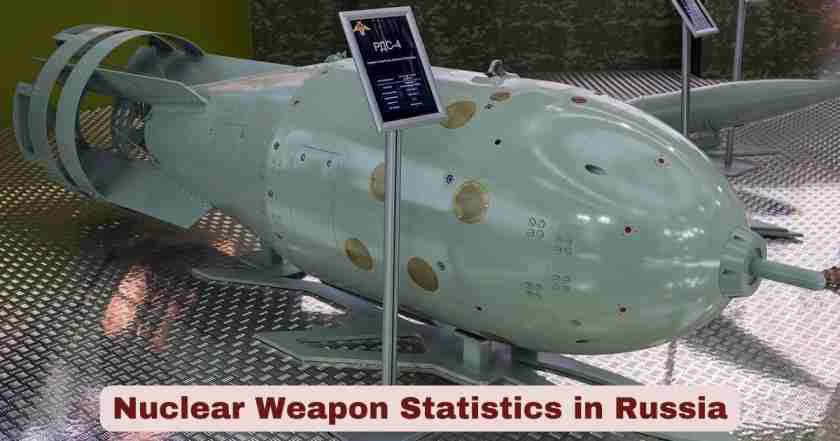
Nuclear Weapons in Russia 2026
The Russian Federation maintains the world’s largest nuclear weapons arsenal, representing a fundamental pillar of its national defense strategy and global military standing. As the inheritor of the Soviet Union’s massive nuclear infrastructure, Russia possesses approximately 5,460 nuclear warheads in 2026, positioned as the world’s foremost nuclear power alongside the United States. The Russian nuclear arsenal encompasses a fully operational nuclear triad of land-based intercontinental ballistic missiles, sea-based submarine-launched ballistic missiles, and strategic bombers, all currently undergoing comprehensive modernization to replace Soviet-era systems with advanced capabilities designed to ensure strategic deterrence well into the mid-21st century.
Russia’s nuclear forces in 2026 reflect decades of strategic investments in modernization programs initiated under the State Armament Programme for 2011-2020, which prioritized nuclear capabilities during a period when conventional forces lagged significantly behind Western militaries. With approximately 1,710 deployed strategic warheads and an estimated 1,000-2,000 nonstrategic (tactical) nuclear weapons, Russia maintains the most diverse nuclear inventory of any nation, designed to provide flexible deterrence options across the full spectrum of potential conflicts. The modernization effort, now entering its advanced stages, has replaced approximately 88 percent of strategic forces with post-Soviet systems, including the RS-24 Yars ICBM, Borei-class submarines, and upgraded strategic bombers, establishing Russia as a formidable nuclear power even as the New START treaty expired in February 2026 without a successor agreement in place.
Interesting Facts About Nuclear Weapons in Russia 2026
| Fact Category | Statistic | Details |
|---|---|---|
| Total Warheads in Russia 2026 | 5,460 | World’s largest nuclear arsenal |
| Deployed Strategic Warheads in Russia 2026 | 1,710 | Warheads on operational delivery systems |
| Active Military Stockpile in Russia 2026 | 4,380 | Warheads assigned to military forces |
| Retired Warheads Awaiting Dismantlement in Russia 2026 | 1,200 | Non-operational warheads queued for disposal |
| Nonstrategic Nuclear Weapons in Russia 2026 | 1,000-2,000 | Tactical nuclear weapons in central storage |
| Historical Testing Record in Russia | 715 | Total nuclear tests conducted 1949-1990 |
| Reduction from Soviet Peak in Russia | 88% | Decrease from maximum of 45,000 warheads in 1986 |
| Strategic Force Modernization Rate in Russia 2026 | 88% | Percentage of post-Soviet systems deployed |
| Land-Based ICBMs Deployed in Russia 2026 | 310 | Silo and mobile intercontinental missiles |
| Ballistic Missile Submarines in Russia 2026 | 12 | Nuclear-powered SSBNs in service |
| Strategic Bombers in Russia 2026 | 67 | Tu-160 and Tu-95MS aircraft |
| Borei-Class Submarines in Russia 2026 | 8 | Modern fourth-generation SSBNs |
| RS-24 Yars ICBMs in Russia 2026 | 206 | Silo and mobile MIRVed missiles |
| New START Treaty Status Russia 2026 | Expired February 5, 2026 | No arms control limits in effect |
| Global Nuclear Share Russia 2026 | 44% | Percentage of world’s total warheads |
Data Source: Federation of American Scientists, Stockholm International Peace Research Institute, U.S. Defense Intelligence Agency, Congressional Research Service, Russian Ministry of Defense statements
The data presented reflects the most authoritative estimates available from independent research organizations and intelligence assessments regarding Russia’s nuclear arsenal as of 2026. With 5,460 total nuclear warheads, Russia possesses approximately 44 percent of the world’s nuclear weapons, maintaining numerical parity with the United States and collectively holding 86-90 percent of global nuclear inventories between the two nations. The 1,710 deployed strategic warheads represent those immediately available on intercontinental ballistic missiles, submarine-launched ballistic missiles, and at bomber bases, providing Russia with a robust second-strike capability that forms the cornerstone of its strategic deterrence doctrine. This deployed force operates alongside 1,000-2,000 nonstrategic nuclear weapons stored at central facilities, offering tactical options for regional scenarios.
The modernization achievement of 88 percent post-Soviet systems represents significant progress in Russia’s multi-decade effort to replace aging Soviet-era platforms with modern capabilities. The 310 land-based ICBMs include a mix of silo-based and road-mobile systems dominated by the RS-24 Yars, which has largely replaced older SS-25 Topol missiles. The 12 ballistic missile submarines comprise 8 modern Borei-class vessels and 4 remaining Delta IV-class boats, collectively providing continuous at-sea deterrence through strategic patrols in the Arctic and Pacific oceans. The strategic bomber force of 67 aircraft consists of Tu-160 Blackjack and Tu-95MS Bear H platforms, both capable of carrying nuclear-armed cruise missiles and gravity bombs. The expiration of the New START treaty on February 5, 2026, marks the first time since 1972 that Russia operates without bilateral arms control limitations, potentially enabling expansion beyond previous treaty-constrained levels.
Russia Nuclear Weapons Stockpile Composition in Russia 2026
| Stockpile Category | Number of Warheads | Percentage of Total |
|---|---|---|
| Deployed Strategic Warheads | 1,710 | 31.3% |
| Nonstrategic/Tactical Warheads | 1,000-2,000 | 18.3-36.6% |
| Reserve/Nondeployed Strategic Warheads | 970-1,970 | 17.8-36.1% |
| Retired Warheads (Awaiting Dismantlement) | 1,200 | 22.0% |
| Total Inventory | 5,460 | 100% |
| Active Military Stockpile | 4,380 | 80.2% |
Data Source: Federation of American Scientists Nuclear Notebook May 2025, Stockholm International Peace Research Institute, U.S. State Department assessments
Russia’s nuclear weapons stockpile composition in 2026 reflects a layered approach to nuclear deterrence spanning strategic and tactical capabilities. The 1,710 deployed strategic warheads represent those mounted on intercontinental ballistic missiles in silos and mobile launchers, submarine-launched ballistic missiles aboard operational submarines, and nuclear weapons assigned to strategic bomber bases. These weapons maintain Russia’s assured second-strike capability, with a significant portion kept on high operational alert status enabling launch within minutes of receiving orders. The strategic force is complemented by 1,000-2,000 nonstrategic nuclear weapons—also known as tactical nuclear weapons—which are stored at approximately 12 main storage facilities operated by the 12th Main Directorate (12th GUMO) of the Russian Ministry of Defense but can be mated to delivery systems within hours if required.
The 4,380 warheads in the active military stockpile represent 80.2 percent of Russia’s total inventory, a figure that has remained relatively stable in recent years despite gradual reductions through the dismantlement of retired weapons. The 1,200 retired warheads awaiting dismantlement demonstrate Russia’s continuing commitment to arms reduction, though the pace of dismantlement has slowed compared to the rapid drawdown of the 1990s due to infrastructure capacity constraints and competing modernization priorities. Russia’s reserve and nondeployed strategic warheads—estimated at 970-1,970 weapons—are maintained in storage facilities in operational condition, providing reconstitution capability if strategic circumstances require an increase in deployed forces, particularly relevant now that New START limitations no longer constrain force levels. This stockpile composition gives Russia flexibility across the escalation spectrum, from low-yield tactical options to high-yield strategic weapons capable of targeting hardened facilities and cities.
Nuclear Triad Delivery Systems in Russia 2026
| Delivery System Type | Platform | Quantity | Warheads |
|---|---|---|---|
| Land-Based ICBMs | RS-24 Yars (silo/mobile) | 206 | ~720-824 |
| Land-Based ICBMs | RS-12M Topol-M (silo/mobile) | 78 | 78 |
| Land-Based ICBMs | RS-28 Sarmat (initial deployment) | Limited/testing | Variable |
| Land-Based ICBMs | UR-100N UTTKh + Avangard HGV | 12-24 | 12-24 |
| Sea-Based SLBMs | Borei-class SSBNs (RSM-56 Bulava) | 8 submarines, ~128 missiles | ~512-768 |
| Sea-Based SLBMs | Delta IV-class SSBNs (R-29RMU) | 4 submarines, ~64 missiles | ~256 |
| Air-Delivered Weapons | Tu-160 Blackjack | ~17 | Variable |
| Air-Delivered Weapons | Tu-95MS Bear H | ~50 | Variable |
| Total Deployed Strategic Systems | Combined Triad | ~540 | ~1,710 |
| Nonstrategic Nuclear Weapons | Various tactical systems | ~1,500 | 1,000-2,000 |
Data Source: Federation of American Scientists, Bulletin of the Atomic Scientists, Russian Ministry of Defense, U.S. Defense Intelligence Agency
Russia maintains its strategic deterrent through a robust nuclear triad configuration, with land-based intercontinental ballistic missiles forming the backbone of the force and accounting for the majority of deployed strategic warheads. The 206 RS-24 Yars ICBMs represent the most numerous modern system, deployed in both silo-based configurations at divisions in Kozelsk and Tatishchevo, and road-mobile variants at divisions including Teykovo, Novosibirsk, Tagil, and others. Each Yars missile can carry up to 4-10 warheads depending on configuration, though most are believed to carry 4 warheads to maintain compliance with expired New START limits. The 78 Topol-M missiles include 60 silo-based weapons at Tatishchevo and 18 road-mobile launchers at Teykovo, each carrying a single warhead. The new RS-28 Sarmat heavy ICBM faces development challenges but is intended to replace aging R-36M2 missiles, while 12-24 UR-100N UTTKh missiles have been retrofitted with Avangard hypersonic glide vehicles.
The sea-based leg consists of 12 nuclear-powered ballistic missile submarines divided between the Northern Fleet and Pacific Fleet. The 8 Borei-class submarines represent Russia’s most modern strategic platforms, each carrying 16 RSM-56 Bulava SLBMs with 6 warheads per missile, providing approximately 768 warheads when fully loaded, though operational loadings may be reduced. At any given time, approximately 2-3 submarines conduct strategic deterrence patrols under the Arctic ice, making them virtually undetectable to adversary antisubmarine warfare capabilities. The 4 remaining Delta IV-class submarines supplement the Borei boats with R-29RMU Sineva/Layner missiles carrying 4 warheads each. The bomber force of approximately 67 strategic aircraft includes 17 Tu-160 Blackjack supersonic bombers and 50 Tu-95MS Bear H turboprop bombers, both capable of carrying Kh-55/Kh-101/Kh-102 nuclear-armed cruise missiles with ranges exceeding 2,500 kilometers. Additionally, Russia maintains 1,000-2,000 nonstrategic nuclear weapons for delivery by tactical aircraft, dual-capable missiles including Iskander-M, Kalibr cruise missiles deployed on surface ships and submarines, and potentially air defense systems, providing flexible escalation options below the strategic threshold.
Nuclear Weapons Modernization Programs in Russia 2026
| Modernization Program | System/Platform | Status in 2026 | Key Features |
|---|---|---|---|
| RS-24 Yars ICBM | MIRVed road-mobile/silo ICBM | Operational deployment ongoing | 206 deployed, replaces SS-25 Topol |
| RS-28 Sarmat | Heavy ICBM | Development/limited testing | Intended to replace R-36M2, 10+ warheads |
| Avangard HGV | Hypersonic glide vehicle | Operational on UR-100N missiles | 12-24 systems, Mach 27 capability |
| Borei/Borei-A SSBN | Strategic submarine | 8 operational, 2+ under construction | 16 Bulava missiles per boat |
| RSM-56 Bulava SLBM | Submarine-launched missile | Operational production | 6-10 MIRV warheads, 8,000 km range |
| Tu-160M/M2 | Strategic bomber upgrade | Modernization/new production | Enhanced avionics, Kh-101/102 capability |
| PAK DA Stealth Bomber | Next-generation bomber | Development | Stealth technology, projected 2026-2030 |
| Kh-101/102 Cruise Missile | Air-launched cruise missile | Operational deployment | ~4,500 km range, conventional/nuclear |
| Poseidon Nuclear Torpedo | Autonomous underwater vehicle | Testing/initial deployment | Nuclear-powered, 100+ megaton yield |
Data Source: Russian Ministry of Defense, Federation of American Scientists, Jane’s Strategic Weapon Systems, Carnegie Endowment reports
Russia has implemented a comprehensive nuclear weapons modernization program spanning over a decade, with approximately 88 percent of strategic forces now utilizing post-Soviet systems. The RS-24 Yars program represents the most successful component of ICBM modernization, with 206 missiles deployed as of 2026 across seven missile divisions in both silo-based and road-mobile configurations. Yars missiles feature improved accuracy, penetration aids to defeat missile defenses, and multiple independently targetable reentry vehicles (MIRVs) carrying 4-10 warheads depending on mission requirements. The system is designed to remain in service through 2050, providing the backbone of Russia’s ground-based deterrent. However, the RS-28 Sarmat program has experienced significant difficulties, with multiple test failures and production delays preventing full operational deployment, though official statements claim the system has entered service with limited numbers.
The sea-based modernization centers on the Borei and Borei-A class submarine program, which will ultimately field 10-12 boats to replace all Soviet-era Delta and Typhoon-class submarines. As of 2026, 8 Borei-class submarines are operational, with the most recent additions including Imperator Aleksandr III commissioned in December 2023 and Knyaz Pozharsky expected in mid-2025. Each submarine carries 16 RSM-56 Bulava SLBMs, three-stage solid-fuel missiles with ranges of approximately 8,000 kilometers and payloads of 6-10 warheads per missile. The Northern Fleet and Pacific Fleet each operate Borei submarines, with extensive infrastructure upgrades underway at bases including Gadzhiyevo and Rybachiy to accommodate increased warhead storage requirements. For the air leg, Russia is modernizing existing Tu-160 bombers to the Tu-160M/M2 standard with improved avionics, navigation systems, and weapons integration, while developing the PAK DA next-generation stealth bomber projected for introduction in the late 2020s or early 2030s, though development has faced engine-related delays. Unique systems including the Avangard hypersonic glide vehicle capable of Mach 27 speeds and the Poseidon nuclear-powered autonomous torpedo demonstrate Russia’s pursuit of novel delivery methods designed to circumvent missile defense systems.
Nuclear Testing History in Russia 2026
| Testing Period | Type of Tests | Number Conducted | Test Sites |
|---|---|---|---|
| 1949-1990 Total (USSR) | All nuclear explosive tests | 715 | Multiple sites |
| Atmospheric Tests (USSR) | Above-ground detonations | 219 | Semipalatinsk, Novaya Zemlya, others |
| Underground Tests (USSR) | Below-ground detonations | 496 | Primarily Semipalatinsk, Novaya Zemlya |
| First Test (RDS-1) | Plutonium implosion device | August 29, 1949 | Semipalatinsk, Kazakhstan |
| Last Test | Underground test | October 24, 1990 | Novaya Zemlya |
| Largest Test (Tsar Bomba) | Thermonuclear bomb | October 30, 1961 | Novaya Zemlya, 50 megatons |
| Post-1990 Moratorium | No explosive testing | 1990-present | Subcritical experiments only |
| Comprehensive Test Ban Treaty | Signed 1996 | Ratified June 2000 | In force for Russia |
Data Source: Comprehensive Nuclear-Test-Ban Treaty Organization, Natural Resources Defense Council, Soviet/Russian Ministry of Defense, Federation of American Scientists
The Soviet Union and subsequently Russia conducted an extensive nuclear weapons testing program spanning 41 years from the first RDS-1 test on August 29, 1949, through the final test on October 24, 1990. Official records indicate 715 nuclear tests were performed, making the Soviet program the second-largest after the United States in terms of total tests conducted. Of these, approximately 219 were atmospheric tests conducted before the Soviet Union joined the 1963 Partial Test Ban Treaty, which prohibited above-ground testing after the agreement entered into force. The most powerful nuclear weapon ever detonated was the Tsar Bomba, tested on October 30, 1961, at Novaya Zemlya with a yield of approximately 50 megatons—originally designed for 100 megatons but reduced to limit fallout—producing a mushroom cloud 64 kilometers high and causing seismic shock equivalent to magnitude 5.0-5.25 detected globally.
The primary Soviet test sites included Semipalatinsk in Kazakhstan, which hosted 456 tests including 116 atmospheric and 340 underground detonations between 1949 and 1989, and Novaya Zemlya in the Arctic Ocean, which conducted 224 tests including 87 atmospheric and 137 underground tests, serving as the primary site for high-yield testing and remaining under Russian control after the Soviet dissolution. Additional testing occurred at Totskoye military exercise site, the Chagan test near Semipalatinsk used for a “peaceful nuclear explosion” to create a reservoir, and other locations for specialized experiments. Russia has maintained a nuclear testing moratorium since October 24, 1990, the longest of any nuclear power, and became the first nuclear weapons state to ratify the Comprehensive Nuclear-Test-Ban Treaty on June 30, 2000. Despite ratification, Russia continues to maintain test readiness at Novaya Zemlya and conducts subcritical experiments that do not produce self-sustaining nuclear reactions, allowing weapons scientists to maintain stockpile confidence through the Science-Based Stockpile Stewardship approach similar to that employed by the United States.
Arms Control Treaties and Status in Russia 2026
| Treaty/Agreement | Status in 2026 | Key Provisions | Russia’s Position |
|---|---|---|---|
| New START | Expired February 5, 2026 | 1,550 deployed strategic warheads; 700 delivery systems | Suspended participation 2023, no successor |
| Nuclear Non-Proliferation Treaty (NPT) | In force | No transfer to non-nuclear states; pursue disarmament | Original nuclear weapons state |
| Comprehensive Test Ban Treaty (CTBT) | Ratified by Russia 2000 | Zero-yield nuclear testing | First nuclear state to ratify |
| Partial Test Ban Treaty | In force since 1963 | No atmospheric, space, underwater tests | Compliance maintained |
| INF Treaty | Withdrawn 2019 | No intermediate-range missiles | Both US and Russia withdrew |
| Presidential Nuclear Initiatives (1991-1992) | Political commitment | Tactical weapons reductions | Large reductions implemented |
Data Source: Russian Ministry of Foreign Affairs, U.S. State Department, Arms Control Association, United Nations Office for Disarmament Affairs
The New START treaty, which limited deployed strategic warheads to 1,550 and deployed delivery systems to 700, expired on February 5, 2026, marking the end of bilateral strategic arms control between Russia and the United States for the first time since 1972. Russia suspended its participation in the treaty in February 2023 following tensions over the Ukraine conflict, halting data exchanges and on-site inspections while declaring it would continue adhering to central limits through expiration. President Putin stated in September 2025 that Russia would maintain compliance with New START central limits after expiration if the United States did likewise, though as of early 2026 no formal verification mechanism exists to confirm either side’s force levels. Russian officials have characterized bilateral arms control as inadequate in the current strategic environment, particularly given China’s rapid nuclear expansion, and have called for multilateral frameworks addressing all nuclear-armed states.
Russia remains a party to the Nuclear Non-Proliferation Treaty as one of five recognized nuclear weapons states, with obligations to pursue good-faith negotiations toward nuclear disarmament while preventing proliferation to non-nuclear states. Russia became the first nuclear weapons state to ratify the Comprehensive Nuclear-Test-Ban Treaty on June 30, 2000, though the treaty has not entered into force globally due to non-ratification by required states including the United States, China, and others. The Partial Test Ban Treaty of 1963 remains in effect, prohibiting nuclear tests in the atmosphere, outer space, and underwater, a commitment Russia has honored since 1963 with all subsequent tests conducted underground until the voluntary moratorium began in 1990. The Intermediate-Range Nuclear Forces (INF) Treaty, which prohibited ground-launched missiles with ranges between 500-5,500 kilometers, collapsed in 2019 when both Russia and the United States withdrew amid mutual accusations of violations, removing constraints that had eliminated an entire class of nuclear delivery systems and enabling Russia to develop systems like the 9M729 cruise missile and potentially intermediate-range ballistic missiles.
Nuclear Weapons Production and Storage Facilities in Russia 2026
| Facility | Location | Primary Function | Status |
|---|---|---|---|
| VNIIEF (Arzamas-16) | Sarov, Nizhny Novgorod Oblast | Warhead design and development | Active modernization |
| VNIITF (Chelyabinsk-70) | Snezhinsk, Chelyabinsk Oblast | Warhead design and testing | Active operations |
| Avangard Production Association | Sarov | Warhead assembly | Active production |
| Mayak Production Association | Ozersk, Chelyabinsk Oblast | Plutonium production and processing | Active, legacy contamination |
| Electrochemical Plant | Zelenogorsk, Krasnoyarsk Krai | Uranium enrichment | Active operations |
| 12th GUMO Storage Sites | Multiple locations nationwide | Warhead storage and maintenance | ~12 main facilities |
| Strategic Rocket Forces Bases | Multiple ICBM divisions | ICBM deployment | 21 missile regiments |
| Naval Bases | Gadzhiyevo, Rybachiy, Vilyuchinsk | Submarine operations and warhead storage | Major infrastructure upgrades |
Data Source: Russian Federal Nuclear Center, International Panel on Fissile Materials, Federation of American Scientists, Satellite imagery analysis
Russia’s nuclear weapons complex comprises a network of design laboratories, production facilities, and storage sites spanning the country. The All-Russian Scientific Research Institute of Experimental Physics (VNIIEF) in Sarov, historically known as Arzamas-16, serves as Russia’s premier nuclear weapons design laboratory, responsible for developing most modern warhead types including those for the Yars, Bulava, and Sarmat systems. The facility employs thousands of scientists and engineers conducting weapons physics research, computer simulations, and subcritical experiments to maintain stockpile reliability without nuclear testing. The All-Russian Scientific Research Institute of Technical Physics (VNIITF) in Snezhinsk functions as the second weapons design laboratory, providing independent assessment and verification of warhead designs, with both laboratories maintaining advanced computational capabilities for weapons certification.
The 12th Main Directorate (12th GUMO) of the Russian Ministry of Defense operates approximately 12 major nuclear weapons storage facilities distributed across Russia, responsible for storing, maintaining, and transporting nuclear warheads. These highly secure facilities employ multiple security perimeters, specialized storage bunkers, and dedicated military guard units, with recent satellite imagery indicating ongoing infrastructure improvements and expansions at several sites to accommodate modernized warhead types and potentially increased storage capacity following New START expiration. The Mayak Production Association in Ozersk continues plutonium processing operations despite significant legacy contamination issues from decades of weapons production, while the Electrochemical Plant in Zelenogorsk provides uranium enrichment services for both weapons and naval reactor programs. The Strategic Rocket Forces maintain 21 ICBM regiments at missile bases across Russia equipped with extensive underground command posts and hardened silos, while submarine bases at Gadzhiyevo on the Kola Peninsula and Rybachiy on the Kamchatka Peninsula have received major upgrades including new underground warhead storage facilities designed to accommodate the larger warhead inventories required for Borei-class submarines equipped with MIRVed Bulava missiles.
Nuclear Weapons Budget and Costs in Russia 2026
| Budget Category | Estimated Amount | Timeframe | Percentage of Defense Budget |
|---|---|---|---|
| Total Nuclear Weapons Spending | ~$8-12 billion annually | 2024-2026 | ~10-15% |
| Strategic Forces Modernization | ~$4-6 billion | Annual | Major acquisition programs |
| Nuclear Warhead Development/Production | ~$1.5-2 billion | Annual | VNIIEF, VNIITF, Avangard |
| Strategic Rocket Forces Operations | ~$2-3 billion | Annual | Personnel, maintenance, training |
| 12th GUMO Operations | ~$0.5-1 billion | Annual | Storage, transport, security |
| Naval Nuclear Forces | ~$2-3 billion | Annual | SSBN operations, base upgrades |
| 2011-2020 State Armament Program | ~$32.5 billion | 10-year total | ~10% of total procurement |
| Projected 2025-2035 Investment | ~$100+ billion | 10-year estimate | Ongoing modernization |
Data Source: Stockholm International Peace Research Institute, Russian Federal Budget analysis, Carnegie Endowment, Jane’s Defence Budgets, Expert estimates
Russia’s nuclear weapons budget for 2026 is estimated at approximately $8-12 billion annually, representing roughly 10-15 percent of total defense spending, though exact figures remain classified and estimates vary significantly among independent analysts. Under the State Armament Programme for 2011-2020, Russia allocated approximately 10 percent of the 19 trillion rubles ($325.7 billion) designated for Ministry of Defense procurement to nuclear forces modernization, translating to roughly $32.5 billion over the decade. This massive investment prioritized nuclear capabilities during a period when Russia’s conventional forces remained weak, reflecting the strategic decision to rely on nuclear deterrence as an offset to NATO’s conventional superiority and perceived threats from missile defense deployments.
Annual spending categories include $4-6 billion for strategic forces modernization encompassing development and procurement of systems like Yars ICBMs, Sarmat missiles, Borei submarines, Bulava SLBMs, and bomber upgrades; $1.5-2 billion for nuclear warhead development, testing, production, and life extension activities at VNIIEF, VNIITF, and production facilities; $2-3 billion for Strategic Rocket Forces operations including personnel costs for approximately 50,000 personnel, maintenance of ICBM systems, training exercises, and infrastructure support; $0.5-1 billion for 12th GUMO operations covering warhead storage, maintenance, transport, and security at nuclear weapons storage sites; and $2-3 billion for naval nuclear forces including SSBN operations, crew training, submarine maintenance, and major infrastructure upgrades at Northern Fleet and Pacific Fleet bases. Looking forward through 2035, Russia is projected to invest $100+ billion in continued modernization as Sarmat deployment proceeds, additional Borei submarines enter service, PAK DA bomber development continues, and warhead production ramps up to support MIRVed systems. These investments reflect Russia’s commitment to maintaining strategic parity with the United States and ensuring its nuclear forces remain technologically competitive despite economic pressures from sanctions and competing defense priorities related to conventional force modernization and ongoing military operations.
Global Nuclear Context in Russia 2026
| Country | Total Inventory | Deployed Warheads | Comparison to Russia |
|---|---|---|---|
| Russia | 5,460 | 1,710 | Baseline |
| United States | 5,177 | 1,770 | -5% total, +3.5% deployed |
| China | 600-680 | 280 | -88% total, -84% deployed |
| France | 290 | 280 | -95% total, -84% deployed |
| United Kingdom | 225 | 120 | -96% total, -93% deployed |
| Pakistan | 170 | 0 | -97% total |
| India | 172 | 0 | -97% total |
| Israel | 90 | 0 | -98% total |
| North Korea | 30-50 | 0 | -99% total |
| Russia + USA Combined | 10,637 | 3,480 | 86% of global total |
Data Source: Federation of American Scientists, Stockholm International Peace Research Institute, International Panel on Fissile Materials, Arms Control Association
Russia and the United States together possess approximately 86-90 percent of the world’s nuclear weapons, maintaining overwhelming nuclear dominance despite substantial reductions since Cold War peaks. Russia’s inventory of 5,460 warheads represents the world’s largest nuclear arsenal, slightly exceeding the U.S. total of 5,177 warheads by approximately 5 percent. The global inventory of approximately 12,321 warheads as of early 2026 represents a dramatic 83 percent decline from the estimated 70,300 warheads that existed at the 1986 Cold War peak, when the Soviet Union alone possessed approximately 45,000 warheads. However, the pace of reductions has slowed considerably, and the trend toward smaller arsenals has reversed in recent years as several nuclear-armed states including Russia, China, India, Pakistan, and potentially others are increasing their stockpiles.
Russia’s strategic position reflects both quantitative superiority in total warheads and qualitative advantages in certain delivery systems, particularly heavy ICBMs capable of carrying large numbers of warheads and hypersonic delivery vehicles like Avangard that complicate missile defense. However, China’s rapid nuclear expansion represents the most significant shift in the global nuclear landscape, with its arsenal growing from approximately 350 warheads in 2020 to 600-680 in 2026, potentially approaching 1,000-1,500 warheads by 2030-2035 according to U.S. intelligence assessments. This growth is transforming the strategic environment from U.S.-Russian bipolar competition to a three-party dynamic requiring new deterrence approaches. Of Russia’s 5,460 total warheads, approximately 1,710 are deployed with operational forces on high alert, meaning they can be launched within minutes, representing the largest deployed force globally alongside the United States. France and the United Kingdom maintain much smaller but highly capable arsenals of 290 and 225 warheads respectively, while India, Pakistan, Israel, and North Korea possess modest arsenals primarily focused on regional deterrence rather than global strategic missions.
Nuclear Warhead Types and Capabilities in Russia 2026
| Warhead System | Delivery Platform | Yield Range | Status |
|---|---|---|---|
| Warheads for RS-24 Yars | ICBM (MIRV) | 100-300 kilotons per warhead | Active, 4-10 warheads per missile |
| Warheads for RS-28 Sarmat | Heavy ICBM (MIRV) | 100-750 kilotons per warhead | Development, 10+ warheads capacity |
| Warheads for RSM-56 Bulava | SLBM (MIRV) | 100-150 kilotons per warhead | Active, 6-10 warheads per missile |
| Warheads for R-29RMU | SLBM (MIRV) | 100-500 kilotons per warhead | Active, 4 warheads per missile |
| Avangard HGV | Hypersonic glide vehicle | ~2 megatons | Active on UR-100N missiles |
| Kh-55/101/102 | Air-launched cruise missile | 200-250 kilotons | Active on strategic bombers |
| Gravity Bombs | Strategic bombers | Variable yields | Active inventory |
| Tactical Warheads | Iskander-M, Kalibr, aircraft | 1-100 kilotons | 1,000-2,000 in storage |
| Poseidon | Autonomous torpedo | 2-100+ megatons | Testing phase |
Data Source: Federation of American Scientists, Nuclear Weapons Databook, Russian Ministry of Defense statements, Intelligence assessments
Russia maintains a diverse portfolio of nuclear warhead types spanning strategic high-yield weapons to low-yield tactical options, providing flexible deterrence and escalation management capabilities. Modern ICBM warheads for systems like the RS-24 Yars typically feature yields in the 100-300 kiloton range, with each missile carrying 4-10 warheads configured as MIRVs capable of striking separate targets hundreds of kilometers apart. These warheads incorporate advanced features including hardening against nuclear effects, penetration aids to defeat missile defenses, and maneuvering capabilities to complicate interception. The future RS-28 Sarmat heavy ICBM is designed to carry 10+ warheads with yields potentially reaching 750 kilotons for the largest variants, providing capability to attack hardened targets including deeply buried command bunkers and ICBM silos.
The submarine-launched ballistic missile force relies on RSM-56 Bulava warheads yielding 100-150 kilotons each, with 6-10 warheads per missile depending on mission requirements and treaty constraints, while older R-29RMU missiles on Delta IV submarines carry 4 warheads with yields up to 500 kilotons. The Avangard hypersonic glide vehicle represents a unique capability, featuring a ~2 megaton warhead mounted on a vehicle capable of Mach 27 speeds and maneuvering during atmospheric reentry, making interception extremely difficult with current missile defense technologies. Air-delivered weapons include Kh-55/101/102 cruise missiles with yields of 200-250 kilotons and ranges exceeding 2,500-4,500 kilometers, enabling strategic bombers to strike targets while remaining outside air defense engagement zones, plus gravity bombs of various yields for tactical and strategic missions. Russia’s estimated 1,000-2,000 nonstrategic nuclear weapons include low-yield warheads in the 1-100 kiloton range for delivery by Iskander-M ballistic missiles, Kalibr cruise missiles deployable on ships and submarines, tactical aircraft, and potentially air defense systems, providing options for limited nuclear use in regional conflicts. The exotic Poseidon nuclear-powered autonomous torpedo, currently in testing, is reported capable of carrying a warhead yielding 2-100+ megatons designed for coastal targets and aircraft carrier battle groups.
Nuclear Command and Control in Russia 2026
| C3 Component | System/Organization | Function | Capabilities |
|---|---|---|---|
| National Command Authority | President of Russian Federation | Ultimate launch authority | Sole authority to authorize use |
| Nuclear Briefcase | Cheget system | Presidential command link | 3 briefcases: President, Defense Minister, Chief of General Staff |
| Strategic Command | Kosvinsky Kamen, alternate sites | Operational control | Hardened underground facilities |
| Early Warning | Oko/Tundra satellites, radars | Missile attack detection | Global coverage, 15-20 minute warning |
| Communications | Kazbek system | Secure command transmission | Redundant links to all forces |
| Dead Hand | Perimetr system | Automated retaliation | Ensures second-strike if leadership destroyed |
| Strategic Rocket Forces HQ | Moscow Oblast | ICBM force command | 21 missile regiments |
| Naval Command | Northern/Pacific Fleet HQs | SSBN force control | Continuous submarine operations |
Data Source: Russian Ministry of Defense, Carnegie Endowment, Federation of American Scientists, Open source intelligence
Russia’s nuclear command, control, and communications (C3) system provides the President of the Russian Federation with the sole authority to authorize nuclear weapons use through a highly secure and redundant architecture designed to ensure effective command even under attack. The Cheget system, often referred to as the “nuclear briefcase,” comprises three portable terminals carried by the President, the Minister of Defense, and the Chief of the General Staff, allowing transmission of launch authorization codes to strategic forces from anywhere in Russia. The system provides real-time information on the status of nuclear forces, early warning data, and secure communications channels to military command centers, with all three terminals required to participate in the authorization process though only the President can order employment.
Russia operates a sophisticated early warning system combining space-based infrared satellites of the Oko and Tundra constellations with ground-based radar networks including the Voronezh-class radars deployed around Russia’s periphery, providing 15-20 minute warning of ICBM launches and several minutes warning of SLBM launches from submarines near Russian coasts. The Strategic Command operates from hardened underground facilities including the famous Kosvinsky Kamen complex in the Ural Mountains, designed to survive nuclear attacks and maintain command functions during and after a nuclear exchange. The Perimetr system, known in the West as “Dead Hand,” provides an automated second-strike capability by detecting nuclear detonations on Russian territory and enabling launch of strategic forces even if national leadership is destroyed, though the system’s current operational status remains unclear. These redundant C3 capabilities, combined with forces maintained on high alert and continuous SSBN patrols, ensure Russia retains assured second-strike capability under virtually all scenarios, forming the foundation of its strategic deterrence posture.
Strategic Nuclear Doctrine in Russia 2026
| Doctrine Element | Policy | Threshold | Implications |
|---|---|---|---|
| Basic Principle | Nuclear deterrence of aggression | Prevent attack on Russia or allies | No first use commitment absent |
| Employment Scenario 1 | Ballistic missile attack on Russia/allies | Receipt of reliable data on launch | Launch on warning possible |
| Employment Scenario 2 | WMD use against Russia/allies | Nuclear or other WMD attack | Nuclear response authorized |
| Employment Scenario 3 | Attack on critical government/military targets | Threatens nuclear response capability | Expanded in 2024 doctrine |
| Employment Scenario 4 | Conventional aggression | Threatens state existence | Expanded in 2024 doctrine |
| Employment Scenario 5 | Attack on Belarus | Joint defense with ally | Nuclear umbrella extended |
| Escalate to De-escalate | Limited nuclear use | Regional conflict scenarios | Tactical weapons employment |
| Declaratory Updates | November 2024 doctrine revision | Lowered thresholds | More permissive use scenarios |
Data Source: Russian Federation Basic Principles of State Policy on Nuclear Deterrence 2020/2024, Ministry of Foreign Affairs statements, Expert analysis
Russia’s nuclear doctrine as articulated in the Basic Principles of State Policy on Nuclear Deterrence establishes the conditions under which Russia reserves the right to employ nuclear weapons, with significant revisions announced in November 2024 that lowered thresholds and expanded scenarios for potential use. The fundamental principle remains that nuclear weapons serve to deter aggression against Russia and its allies, providing a defensive capability rather than an offensive tool, though Russia has never adopted an unconditional “no first use” pledge. The doctrine identifies specific circumstances authorizing nuclear employment: (1) receipt of reliable data about a ballistic missile attack against Russian or allied territory, potentially enabling launch on warning before incoming warheads arrive; (2) use by an adversary of nuclear weapons or other weapons of mass destruction against Russia or its allies; (3) adversary actions against critical government or military targets that could undermine Russia’s nuclear response capability; and (4) conventional aggression that threatens the existence of the Russian state.
The 2024 doctrinal revision significantly expanded scenarios (3) and (4), broadening what constitutes threats to nuclear response capability and lowering the threshold for nuclear response to conventional attacks. Russian officials have emphasized these changes enable nuclear response to large-scale conventional strikes on critical infrastructure, massed drone or missile attacks, or conventional military operations that threaten Russian territorial integrity. The doctrine explicitly extends Russia’s nuclear deterrence umbrella to Belarus, authorizing nuclear response to attacks on Russia’s ally under their Union State framework. Western analysts assess that Russian military planning includes “escalate to de-escalate” concepts involving limited employment of tactical nuclear weapons in regional conflicts to compel negotiated settlements, though Russian officials dispute this characterization. The combination of declaratory policy revisions, deployment of tactical nuclear weapons to Belarus announced in 2023, and increasingly explicit nuclear rhetoric from Russian leadership signals a more permissive nuclear posture than at any time since the Cold War, intended to deter Western support for Ukraine and demonstrate resolve in the absence of arms control constraints following New START expiration.
Nuclear Modernization Progress in Russia 2026
| Platform/System | Soviet-Era Legacy | Modern Replacement | Modernization Rate |
|---|---|---|---|
| ICBMs | SS-18, SS-19, SS-25 | Yars, Sarmat, Avangard | ~75-80% |
| SLBMs/SSBNs | Delta III/IV, Typhoon | Borei/Borei-A | ~65-70% |
| Strategic Bombers | Tu-95MS, Tu-160 | Tu-160M, PAK DA (future) | ~40-50% |
| Tactical Systems | Multiple legacy types | Iskander-M, Kalibr, modernized | ~60-70% |
| Early Warning | Soviet-era radars/satellites | Voronezh radars, Tundra satellites | ~70-80% |
| Overall Strategic Forces | Cold War systems | Post-Soviet systems | ~88% |
| Warhead Production | Soviet-designed types | Life extension/new production | Active modernization |
| Infrastructure | Soviet facilities | Upgraded complexes | Ongoing improvements |
Data Source: Russian Ministry of Defense statements, Federation of American Scientists, Carnegie Endowment analysis, Satellite observations
Russia’s nuclear forces modernization has achieved approximately 88 percent replacement of strategic systems with post-Soviet platforms as of 2026, representing substantial progress in the multi-decade recapitalization effort initiated under the 2011-2020 State Armament Programme. The ICBM force shows the highest modernization rate at roughly 75-80 percent, driven by successful deployment of 206 RS-24 Yars missiles replacing the now-retired SS-25 Topol fleet and some older systems, supplemented by Avangard hypersonic glide vehicles on upgraded UR-100N missiles. However, the RS-28 Sarmat program has encountered substantial difficulties preventing full replacement of aging R-36M2 missiles, with development delays, production problems, and test failures limiting operational deployment. The silo-based Topol-M missiles at Tatishchevo, originally deployed 1997-2012, are approaching 27-30 years of service and will require replacement by Yars variants or next-generation systems.
The submarine fleet modernization stands at approximately 65-70 percent completion, with 8 Borei-class submarines operational and 2-4 additional boats under construction or planned, while 4 Delta IV-class submarines remain in service pending final Borei deliveries expected through the early 2030s. Major infrastructure investments at submarine bases including new underground warhead storage facilities at Gadzhiyevo and Rybachiy support the expanded MIRV capability of Borei boats carrying Bulava missiles. The strategic bomber force shows slower modernization at 40-50 percent, with upgrades of existing Tu-160 bombers to Tu-160M standard and modernization of Tu-95MS aircraft, while the next-generation PAK DA stealth bomber remains in development with first flight now projected for 2026 at earliest, delayed from original 2019 target due to engine development challenges. Tactical nuclear systems have undergone approximately 60-70 percent modernization through deployment of dual-capable Iskander-M missiles, Kalibr cruise missiles on naval platforms, and upgraded tactical aircraft. The comprehensive modernization effort reflects Russia’s determination to field technologically competitive nuclear forces capable of penetrating advanced missile defenses while maintaining assured second-strike capability well into the mid-21st century.
Disclaimer: This research report is compiled from publicly available sources. While reasonable efforts have been made to ensure accuracy, no representation or warranty, express or implied, is given as to the completeness or reliability of the information. We accept no liability for any errors, omissions, losses, or damages of any kind arising from the use of this report.