
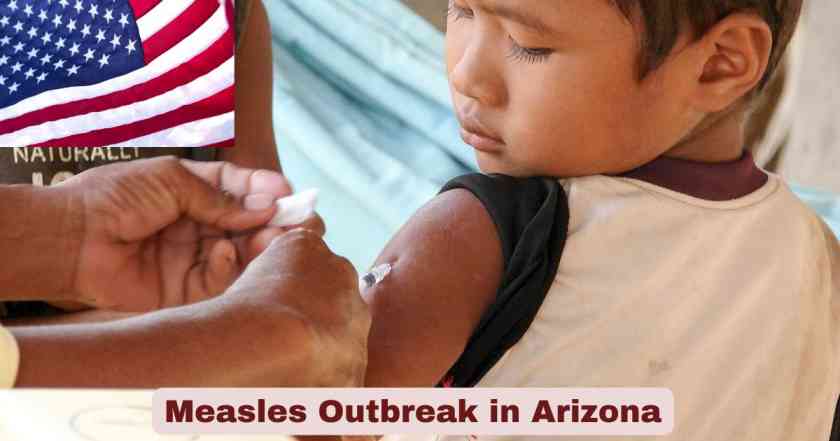
Measles Outbreak in Arizona, America 2025
Arizona is experiencing the largest active measles outbreak in the United States as of December 2025, with 176 confirmed cases reported statewide. This outbreak represents the worst measles crisis Arizona has faced in decades and has become ground zero for a potential national catastrophe—the loss of United States measles elimination status. The overwhelming majority of cases—172 out of 176—are concentrated in Mohave County, specifically in and around the remote border community of Colorado City, which sits adjacent to Hildale, Utah. This twin-city area along the Arizona-Utah border has become the epicenter of what public health officials now call the “Arizona-Utah outbreak,” comprising a combined 254 cases across both states as of early December.
The 2025 measles outbreak in Arizona began in early August when the first case was identified in Mohave County, though earlier isolated cases were reported in Navajo County in June related to international travel. What started as a localized outbreak quickly exploded through the fall months, with health officials reporting 21 new cases in the week ending December 10 alone. The outbreak has resulted in six hospitalizations statewide, though mercifully no deaths have been reported. Crucially, 97% of Arizona’s measles patients are unvaccinated, and 66% are under 18 years old, reflecting both the concentration of vaccine-hesitant families in the outbreak zone and the vulnerability of children in schools and community settings. With the United States facing a critical January 2026 deadline to prove it has stopped sustained measles transmission—or lose the elimination status achieved in 2000—Arizona’s outbreak represents more than a local crisis. It threatens to fundamentally alter America’s public health standing for the first time in over two decades.
Interesting Facts About Measles Outbreak in Arizona 2025
| Fact Category | Details |
|---|---|
| Total Confirmed Cases in Arizona 2025 | 176 cases as of December 10, 2025 |
| New Cases in Last Week | 21 cases reported |
| Outbreak-Associated Cases | 172 cases in Mohave County outbreak |
| Non-Outbreak Cases | 4 isolated cases (including Navajo County) |
| Most Affected Region | Mohave County, specifically Colorado City |
| Hospitalizations in Arizona 2025 | 6 people hospitalized |
| Deaths in Arizona 2025 | 0 deaths reported |
| Unvaccinated Cases | 97% unvaccinated or unknown status |
| Age Distribution | 66% of cases involve people under 18 |
| Mohave County Kindergarten MMR Rate | 78.4% with two doses (2024-25 school year) |
| Arizona Statewide Kindergarten MMR Rate | 88.7% with two doses (2024-25 school year) |
| Required Herd Immunity Threshold | 95% coverage needed |
| Arizona-Utah Combined Outbreak | 254 total cases across border region |
| Emergency State Funding | $100,000 allocated to Mohave County |
| Outbreak Start Date | August 2, 2025 (first Mohave County case) |
| National Rank | Largest active outbreak in United States |
| US Elimination Status Risk | At risk by January 20, 2026 |
| Outbreak Strain | Different from Texas outbreak strain |
| Measles Contagiousness | 90% of exposed unvaccinated people infected |
Data source: Arizona Department of Health Services (ADHS), December 2025; Centers for Disease Control and Prevention (CDC), December 10, 2025; BNO News, December 2025
The data reveals an outbreak with alarming velocity and concentration. The 176 confirmed cases in Arizona represent the second-highest state total in the nation for 2025, trailing only the approximately 800 cases from the West Texas outbreak that was declared over in August. The near-total concentration in Mohave County (172 of 176 cases) demonstrates how measles exploits geographic pockets of low vaccination coverage. The 78.4% kindergarten vaccination rate in Mohave County falls catastrophically short of the 95% threshold needed for herd immunity—a gap of more than 16 percentage points that has created ideal conditions for explosive transmission.
The 21 new cases reported in the first week of December indicate that the outbreak shows no signs of slowing as winter approaches, with health officials warning that holiday gatherings could accelerate spread further. The 97% unvaccination rate among cases is remarkably high, even compared to other 2025 outbreaks, suggesting deep-rooted vaccine resistance in affected communities. The 66% pediatric concentration reflects both the demographics of large families common in the region and the reality that children with unvaccinated parents face greatest exposure risk in schools and community activities. Arizona’s 88.7% statewide kindergarten vaccination rate—while better than Mohave County—still falls 6.3 percentage points below the protective threshold, leaving the entire state vulnerable should measles spread beyond its current geographic boundaries. The $100,000 emergency allocation from state officials to Mohave County underscores the resource-intensive nature of outbreak response, funding contact tracing, case investigation, vaccination outreach, and additional staffing critical to containment efforts.
Geographic Distribution and Outbreak Epicenter in Arizona 2025
| Location | Number of Cases | Percentage | Key Details |
|---|---|---|---|
| Mohave County (Total) | 172 cases | 97.7% | Primary outbreak zone |
| Colorado City | Majority of cases | — | Concentrated area; Arizona–Utah border community |
| Navajo County | 4 cases | 2.3% | Early June cases; travel-related |
| Other Arizona Counties | 0 cases | 0% | No spread beyond outbreak area |
| Adjacent Utah Counties | 82 cases (Utah total: 115) | — | Combined cross-state outbreak; Washington & Iron Counties |
| Maricopa County | 0 cases | 0% | Phoenix metro area unaffected |
| Coconino County | 0 cases | 0% | Northern Arizona unaffected |
| Apache County | 0 cases | 0% | Eastern Arizona unaffected |
| Yavapai County | 0 cases | 0% | Central Arizona unaffected |
Data source: Arizona Department of Health Services (ADHS), December 2025; Utah Department of Health and Human Services, December 2025
The geographic distribution of Arizona’s 2025 measles outbreak is remarkably concentrated, with 172 of 176 cases (97.7%) occurring in Mohave County, the state’s fifth-largest county by area but one of its least populous, with approximately 200,000 residents. The outbreak’s epicenter is Colorado City, a remote community of roughly 4,800 people located in the extreme northwestern corner of Arizona on the Utah border. Colorado City is unique in both its geography—situated in a rugged, isolated region known as the “Arizona Strip”—and its demographics, with many residents belonging to fundamentalist religious communities known to have high rates of vaccine exemption.
Colorado City shares more than just a border with Hildale, Utah—the two communities function as a single social and economic unit, with families, schools, churches, and businesses operating across state lines. This interconnection explains why public health officials view this as a unified “Arizona-Utah outbreak” rather than separate state outbreaks. The combined 254 cases (172 in Arizona’s Mohave County, 82 in Utah’s Washington and Iron Counties) make this the second-largest outbreak in the United States for 2025, exceeded only by the earlier West Texas outbreak. Several schools in the region have experienced multiple exposures, including Water Canyon Elementary School in Hildale, Utah, which lies directly across from Colorado City and has had students from both states.
The only other Arizona county reporting measles cases in 2025 is Navajo County, which confirmed four cases in early June. These cases involved unvaccinated individuals with recent international travel history who were all exposed through a single source—a classic measles importation scenario. Public health authorities successfully contained these cases before significant secondary transmission occurred. Remarkably, despite Arizona’s 88.7% statewide vaccination rate falling below protective levels, no other county has reported cases. Maricopa County, home to Phoenix and containing more than 60% of Arizona’s population, has seen no outbreak-associated cases despite one measles exposure being identified at Phoenix Sky Harbor Airport on June 10, when an infectious traveler passed through Terminal 4. The containment of measles to Mohave County—while fortunate—also highlights how the outbreak exploits the particular vulnerability of Colorado City’s exceptionally low vaccination rates rather than reflecting statewide immunization patterns.
Vaccination Coverage and Community Demographics in Arizona 2025
| Metric | Rate/Percentage | Population Group |
|---|---|---|
| Mohave County Kindergarten MMR Rate | 78.4% | 2024-25 school year |
| Arizona Statewide Kindergarten MMR Rate | 88.7% | 2024-25 school year |
| Maricopa County MMR Rate | 87.5% | 2024-25 school year |
| National Kindergarten Average | 92.5% | 2024-25 school year |
| Required Herd Immunity Threshold | 95% | Needed to prevent outbreaks |
| Mohave County Gap | 16.6 percentage points | Below herd immunity |
| Arizona Statewide Gap | 6.3 percentage points | Below herd immunity |
| Colorado City Population | ~4,800 residents | Outbreak epicenter |
| Mohave County Population | ~200,000 residents | Entire county |
| Unvaccinated Cases | 97% | Of known vaccination status |
| One Dose MMR Cases | 3% | Partially vaccinated |
| Two Dose MMR Cases | 4% | Vaccine breakthrough rare |
| Children Under 18 | 66% of cases | Age distribution |
| Colorado City Religious Community | Majority | Fundamentalist population |
Data source: Arizona Department of Health Services (ADHS), December 2025; Centers for Disease Control and Prevention (CDC); Census Data
The vaccination coverage data for Arizona in 2025 reveals a stark geographic divide that explains why Mohave County became the outbreak epicenter. While Arizona’s statewide kindergarten MMR coverage of 88.7% falls below the ideal 95% threshold, it’s significantly higher than Mohave County’s catastrophic 78.4% rate—one of the lowest county-level vaccination rates in the United States. This 16.6 percentage point gap below herd immunity means that in a typical elementary school with 500 students in Mohave County, approximately 108 children lack complete protection against measles, creating clusters of vulnerability where the virus can spread explosively once introduced.
Colorado City’s demographics further explain the outbreak dynamics. The community has historically been associated with fundamentalist religious groups that practice plural marriage and maintain separation from mainstream society. Many families in the area hold strong religious objections to vaccination, viewing it as contrary to their beliefs about divine providence and bodily autonomy. Educational research has documented that some schools serving these communities report MMR vaccination rates as low as 70-75%, even lower than the county average. These beliefs, combined with large family sizes (families with 8-12 children are common), close-knit community structures where extended families live in proximity, and frequent gatherings at churches and community events, create perfect conditions for measles transmission.
The 97% unvaccination rate among Arizona measles cases is exceptionally high, indicating that the outbreak is almost entirely contained to deliberately unvaccinated populations rather than reflecting vaccine failures or breakthrough cases. The 4% of cases occurring in fully vaccinated individuals is consistent with the 3% failure rate of the two-dose MMR vaccine—a reminder that while the vaccine is 97% effective, no vaccine provides absolute protection. The 66% pediatric case concentration reflects both the demographic reality of the affected community (large families with many children) and the fact that unvaccinated children face greatest exposure in school settings. Dr. Rebecca Sunenshine, medical director of Arizona State University’s Health Observatory, explained the situation bluntly: “Unfortunately, it hit a community where a lot of folks are unvaccinated, and that’s why it spread so quickly.” The $100,000 emergency funding allocated by Arizona to Mohave County represents an acknowledgment that standard public health resources are insufficient for an outbreak of this magnitude in a community with such low baseline vaccination rates.
Timeline and Outbreak Progression in Arizona 2025
| Time Period | Cases Reported | Key Events | Locations / Details |
|---|---|---|---|
| June 9, 2025 | 4 cases | First Arizona measles cases of 2025 | Navajo County; travel-related |
| June 10, 2025 | Exposure event | Infectious traveler identified | Phoenix Sky Harbor Airport, Terminal 4 |
| July 2025 | 0 cases | Successful post-Navajo containment | No new activity reported |
| August 2–7, 2025 | 1 case | Mohave County outbreak begins | Colorado City area |
| August–September 2025 | Gradual increase | Early outbreak phase | Limited initial spread |
| October 2025 | Significant growth | Outbreak acceleration | Schools and households |
| November 2025 | Major surge | Rapid rise in cases | 137 total by mid-month |
| November 25, 2025 | 149 cases | Post-Thanksgiving count | Concentrated in Mohave County |
| November 26, 2025 | Emergency funding | $100,000 state allocation | State outbreak response |
| December 1–7, 2025 | 155 cases | Continued active transmission | Schools, churches, households |
| December 10, 2025 | 176 cases | 21 new cases reported in one week | Latest statewide total |
| Ongoing | Active outbreak | No signs of slowing | Heightened holiday season risk |
Data source: Arizona Department of Health Services (ADHS), July-December 2025; News Reports, December 2025
The timeline of Arizona’s 2025 measles outbreak shows a pattern of initial containment success followed by explosive uncontrolled spread once the virus reached vulnerable populations. Arizona’s year began with four measles cases confirmed in Navajo County on June 9—all unvaccinated individuals with recent international travel who were exposed through a single source. Public health officials aggressively traced contacts, identified potential exposures, and successfully prevented secondary transmission, keeping these cases isolated. A day later, on June 10, an infectious measles patient traveled through Phoenix Sky Harbor Airport Terminal 4, creating another potential exposure event in Arizona’s largest metro area. Again, rapid public health response prevented an outbreak in Maricopa County, demonstrating that swift action can contain measles when vaccination rates are higher and contact tracing resources are adequate.
The situation changed dramatically when measles reached Mohave County in early August. The first case was identified between August 2-7, 2025, involving an unvaccinated individual in the Colorado City area with no significant travel history—suggesting either an unidentified imported case or undocumented community transmission. From this index case, measles began spreading through families, schools, and religious gatherings in the close-knit community. By mid-November, Mohave County had reached 137 confirmed cases, representing one of the fastest outbreak progressions public health officials had seen in recent years. The outbreak surged to 149 cases by November 25—just after Thanksgiving—prompting Arizona to allocate $100,000 in emergency funding on November 26 to support Mohave County’s overwhelmed public health department.
The pace has not slowed. Arizona reported 155 cases in early December, then 176 cases by December 10, meaning 21 new infections were confirmed in a single week—the highest weekly total since the outbreak began. Deputy State Epidemiologist Shane Brady told The Center Square that “for the last two weeks, we have seen an increase of 22 cases,” acknowledging the outbreak’s continued acceleration. Public health officials warn that holiday gatherings, winter indoor activities, and travel during December 2025 could further accelerate transmission, potentially pushing case counts well above 200 by year’s end. The outbreak shows no signs of being contained, with new cases continuing to emerge from exposures at schools, churches, and within households throughout the Colorado City area.
Age Demographics and Hospitalization Data in Arizona 2025
| Age Category | Number/Percentage of Cases | Details |
|---|---|---|
| Children Under 18 | 66% of cases | Primary affected age group |
| Children Under 5 | High-risk group | Most vulnerable to complications |
| School Age (5-17) | Majority of pediatric cases | School exposure settings |
| Adults | 34% of cases | Secondary household spread |
| Total Hospitalizations Arizona | 6 people | 3.4% hospitalization rate |
| National Hospitalization Rate 2025 | 11% | Arizona rate lower than national |
| Under-5 National Hospitalization | 21% | Highest risk age group |
| Total Deaths Arizona | 0 deaths | No fatalities reported |
| National Deaths 2025 | 3 deaths | 2 Texas children, 1 NM adult |
| Unvaccinated Cases | 97% | Of known status |
| One-Dose MMR Cases | 3% | Incomplete protection |
| Two-Dose MMR Cases | 4% | Vaccine breakthrough |
Data source: Arizona Department of Health Services (ADHS), December 2025; Centers for Disease Control and Prevention (CDC), December 2025
The age distribution of Arizona’s measles cases in 2025 reveals that children under 18 account for 66% of all infections, with the remaining 34% occurring in adults. This pediatric concentration reflects both the demographics of affected families in Colorado City—where large households with many children are common—and the reality that schools have served as major amplification sites for the outbreak. Children spend extended periods together indoors in classrooms, share spaces during lunch and recess, and engage in close physical contact during play, making schools ideal environments for measles transmission when vaccination rates are inadequate.
The six hospitalizations in Arizona represent a 3.4% hospitalization rate—significantly lower than the 11% national rate for measles in 2025. This lower hospitalization rate could reflect several factors: the relatively young age of many patients (school-age children typically fare better than infants or elderly patients), prompt medical care seeking once symptoms develop, or simply good fortune that more severe complications haven’t yet emerged. However, health officials remain concerned, particularly given that 21% of children under five nationally who contract measles require hospitalization. If the outbreak continues spreading, Arizona could see hospitalizations increase, potentially straining rural healthcare facilities in Mohave County that are not equipped to handle multiple complex pediatric cases simultaneously.
Mercifully, no deaths have been reported in Arizona, contrasting with the three measles deaths nationally in 2025—two unvaccinated children from the West Texas outbreak and one unvaccinated adult from New Mexico. The absence of deaths in Arizona thus far is fortunate but not guaranteed to continue, as measles complications can include pneumonia (the leading cause of measles death in young children), encephalitis (brain inflammation occurring in approximately 1 in 1,000 cases), and subacute sclerosing panencephalitis (SSPE), a rare but always-fatal neurological condition that emerges 7-10 years after apparent recovery from measles. The 97% unvaccination rate among Arizona cases means that nearly all patients lack the partial protection that even a single MMR dose could provide, placing them at higher risk for severe complications. The 4% of cases in fully vaccinated individuals (vaccine breakthroughs) typically experience milder symptoms and are less likely to require hospitalization or suffer long-term complications.
Public Health Response and Containment Efforts in Arizona 2025
| Response Measure | Details | Implementation |
|---|---|---|
| Emergency State Funding | $100,000 | Allocated to Mohave County Nov 26 |
| Funding Purpose | Outbreak surveillance | Case investigation, contact tracing |
| Vaccination Outreach | Expanded campaigns | Mobile clinics, community events |
| Staffing Support | Additional personnel | Public health nurses, epidemiologists |
| Contact Tracing | Intensive investigation | Every case traced |
| Exposure Notifications | Public announcements | Dates, times, locations published |
| Healthcare Provider Alerts | Issued statewide | Suspect, isolate, report guidance |
| School Notifications | Letters to families | Multiple schools affected |
| ASU Health Observatory | Disease Insights website | Real-time outbreak information |
| State-County Coordination | ADHS-Mohave County | Joint response efforts |
| Media Briefings | Regular updates | Public information campaigns |
| Quarantine Measures | For exposed unvaccinated | 21-day isolation |
| Vaccination Availability | Free vaccines | Health departments, pharmacies |
Data source: Arizona Department of Health Services (ADHS), December 2025; Arizona State University Health Observatory, November 2025
The public health response to Arizona’s measles outbreak has mobilized state and county resources, though the response has been hampered by the geographic remoteness of the outbreak zone, deep-rooted vaccine hesitancy in affected communities, and limited public health infrastructure in rural Mohave County. On November 26, 2025, Arizona allocated $100,000 in emergency funding to Mohave County through an amendment to an existing immunization services agreement with the Arizona Department of Health Services (ADHS). The Mohave County Board of Supervisors approved accepting these funds on December 1, directing the money toward outbreak surveillance, case investigation, vaccination outreach, and critical staffing to control the spread.
Arizona State University’s Health Observatory launched Disease Insights, a dedicated website providing up-to-date information on the measles outbreak to help residents understand regional and statewide activity and protect themselves. Dr. Rebecca Sunenshine, medical director of the Health Observatory, has been a prominent voice in explaining the outbreak and urging vaccination. The website links to public health resources, vaccine location finders, and immunity verification tools. The Arizona Department of Health Services (ADHS) has issued multiple healthcare provider alerts reminding clinicians to maintain high suspicion for measles in patients with fever and rash, especially those who are unvaccinated or have known exposures.
Contact tracing for each confirmed case is intensive and labor-intensive. Public health nurses interview patients to identify every person and location they visited during their infectious period (four days before through four days after rash onset), then notify potentially exposed individuals and advise them to monitor for symptoms and consider vaccination if unvaccinated. For the 176 cases confirmed in Arizona, this represents hundreds of hours of investigative work. Despite these efforts, health officials acknowledge that measles has outpaced their response capacity in Colorado City, with Deputy State Epidemiologist Shane Brady stating Arizona is “very fortunate that we have not spread outside of Mohave County” given the state’s overall low vaccination rates. The implication is clear: containment has succeeded more through geographic luck than comprehensive public health intervention. Free MMR vaccines are available at Mohave County Department of Public Health clinics, Arizona health departments statewide, and most pharmacies, yet vaccine uptake in the outbreak zone remains low despite intensive outreach, reflecting the deep-seated vaccine resistance in the affected community.
National Context and Elimination Status Risk in Arizona 2025
| Jurisdiction/Metric | 2025 Cases/Details | Significance |
|---|---|---|
| United States Total | 1,912 cases | Highest in 30+ years |
| Arizona State | 176 cases | Largest active outbreak |
| Utah State | 115 cases | Connected to Arizona outbreak |
| Arizona-Utah Combined | 254 cases | 2nd largest outbreak overall |
| South Carolina | 129 cases | 3rd largest outbreak |
| Texas (Declared Over) | ~800 cases | Largest 2025 outbreak |
| Total US Outbreaks | 47 outbreaks | 88% outbreak-associated |
| 2024 US Total | 285 cases | 16 outbreaks |
| US Elimination Status Achieved | Year 2000 | 25 years of elimination |
| Elimination Status at Risk | January 20, 2026 | 12-month transmission threshold |
| Americas Region Lost Status | November 2025 | Including Canada |
| Canada Lost Status | November 2025 | Endemic transmission resumed |
| National Deaths 2025 | 3 deaths | 2 TX children, 1 NM adult |
| National Hospitalization Rate | 11% | 212 hospitalizations |
Data source: Centers for Disease Control and Prevention (CDC), December 10, 2025; Arizona Department of Health Services, December 2025
The Arizona measles outbreak exists at the center of a national public health crisis that threatens to fundamentally alter America’s disease control status for the first time in a generation. The United States has recorded 1,912 confirmed measles cases as of December 10, 2025—the highest annual total in more than 30 years and a nearly seven-fold increase from the 285 cases in 2024. Arizona’s 176 cases make it the largest currently active outbreak in the nation, with the Arizona-Utah combined total of 254 cases representing the second-largest outbreak of 2025, exceeded only by the West Texas outbreak that peaked at approximately 800 cases before being declared over in August.
The most alarming aspect of Arizona’s outbreak is its timing and potential implications for US measles elimination status. The United States achieved measles elimination in 2000, meaning measles was no longer spreading continuously within the country—new cases occurred only when travelers brought the virus from abroad and were quickly contained. Elimination status requires the absence of endemic transmission for 12 consecutive months. If measles transmission continues unbroken through January 20, 2026, the United States will reach a 12-month mark of sustained transmission dating back to the Texas outbreak that began in January 2025, potentially triggering loss of elimination status. Dr. Rebecca Sunenshine warned: “These pockets of communities that have low vaccination rates — if we’re not able to get them vaccinated before the holidays, we are very much at risk of going into 2026 and losing U.S. measles elimination status.”
The Americas Region already lost its regional elimination status in November 2025 after endemic transmission reemerged, particularly in Canada, which individually lost its elimination status that same month. The United States now faces joining Canada in this backward step. While countries can regain elimination status after losing it, the loss represents a profound public health failure and indicator that vaccination rates and disease surveillance systems have deteriorated to the point where measles can establish sustained transmission chains. The CDC’s acting director has confirmed that preliminary analysis shows the Arizona-Utah outbreak is not directly linked to the earlier Texas outbreak (the viral strain is different), but both outbreaks share the common thread of spreading through communities with vaccination rates well below the 95% threshold. The 47 outbreaks reported in 2025 represent a nearly threefold increase from the 16 outbreaks in 2024, with 88% of cases being outbreak-associated—indicating that measles is no longer just sporadic importations but rather established community transmission. The three deaths nationally (two Texas children, one New Mexico adult) serve as tragic reminders that measles remains a potentially fatal disease when it finds unprotected populations.
Exposure Sites and High-Risk Locations in Arizona 2025
| Location Type | Number/Examples | Details |
|---|---|---|
| Schools | Multiple schools | Colorado City area, Hildale, UT |
| Water Canyon Elementary | Major exposure site | Hildale, UT (border community) |
| Churches | Significant transmission | Religious gatherings |
| Households | Primary spread | Family clusters |
| Phoenix Sky Harbor Airport | 1 exposure event | Terminal 4, June 10, 2025 |
| Healthcare Facilities | Multiple clinics | Emergency departments, urgent care |
| Retail/Public Spaces | Undisclosed | Community transmission |
| Cross-Border Locations | Arizona-Utah | Colorado City-Hildale |
| Concert Venue | 1 exposure | Downtown Phoenix, November |
Data source: Arizona Department of Health Services (ADHS), November-December 2025; News Reports, November 2025
The exposure sites identified during Arizona’s 2025 measles outbreak span educational, religious, healthcare, and public venues, though specific location details have been less publicly disclosed than in some other state outbreaks. Schools have been significant transmission sites, particularly in the Colorado City area and across the border at Water Canyon Elementary School in Hildale, Utah. This school serves students from both Arizona and Utah families, creating a binational exposure risk that complicates public health response due to separate state jurisdictions coordinating efforts. Multiple exposures at Water Canyon Elementary have been documented throughout the fall, with students from both sides of the border attending during infectious periods.
Religious gatherings have played a major role in transmission, though specific church names have not been widely publicized, likely reflecting sensitivity about targeting religious communities. The close-knit nature of fundamentalist communities in the Colorado City-Hildale area means that church services, weddings, funerals, and other religious events bring together large extended family networks in indoor settings where measles spreads efficiently. Households represent the primary transmission setting once the virus is introduced, with unvaccinated family members facing near-certain infection when living with an infected person due to measles’ ability to remain airborne for up to two hours.
One of the most concerning exposure events occurred in early November 2025, when thousands of people attending a concert in downtown Phoenix were alerted to potential measles exposure. This exposure, while contained without apparent secondary cases, demonstrated how easily the outbreak could spread beyond Mohave County to Arizona’s populous urban centers. The earlier June 10 exposure at Phoenix Sky Harbor Airport similarly represented a high-risk scenario—airports concentrate people from diverse geographic areas in enclosed spaces, making them ideal amplification sites for disease spread. That exposure involved an infectious traveler passing through Terminal 4 during the midday hours, potentially exposing hundreds of travelers, airport workers, and passengers connecting to destinations nationwide. The successful containment of both Phoenix-area exposures without major secondary transmission reflects both higher vaccination rates in urban Maricopa County (87.5% vs. 78.4% in Mohave County) and rapid public health response identifying and notifying potentially exposed individuals.
Challenges and Barriers to Outbreak Control in Arizona 2025
| Challenge Category | Details | Impact on Response |
|---|---|---|
| Geographic Isolation | Colorado City remoteness | Difficult to access and serve |
| Low Baseline Vaccination | 78.4% in Mohave County | Far below 95% needed |
| Religious Objections | Fundamentalist beliefs | Deep-rooted vaccine hesitancy |
| Community Insularity | Closed social networks | Limited outside health information |
| Large Family Sizes | 8-12 children common | Rapid household transmission |
| Cross-Border Complexity | Arizona-Utah boundary | Dual jurisdictions complicate response |
| Limited Healthcare Access | Rural facility constraints | Few hospitals, long travel distances |
| Resource Constraints | Overwhelmed health department | Required $100k emergency funding |
| Low Public Health Trust | Historical skepticism | Reluctance to engage with authorities |
| Holiday Timing | December surge | Travel and gatherings accelerate spread |
| Outreach Resistance | Low vaccine uptake | Despite free availability |
Data source: Arizona Department of Health Services, December 2025; Public Health Analysis, 2025
The challenges facing public health officials attempting to control Arizona’s measles outbreak are formidable and multifaceted. Colorado City’s geographic isolation in the remote Arizona Strip makes the community difficult to reach and serve. Located more than 100 miles from Kingman, the Mohave County seat, and accessible primarily via a winding two-lane highway through desert terrain, the area has limited infrastructure and services. The nearest major hospital is over an hour away, complicating care for patients requiring hospitalization.
Deep-rooted vaccine hesitancy based on religious beliefs presents perhaps the greatest barrier. Many families in Colorado City belong to fundamentalist religious communities that view vaccination as interfering with divine providence or violating bodily autonomy principles. These beliefs are reinforced by insular social structures where most information comes from within the community rather than mainstream sources. Health officials report that vaccination outreach efforts have met with limited success, with many families declining vaccines even when offered for free.
Disclaimer: This research report is compiled from publicly available sources. While reasonable efforts have been made to ensure accuracy, no representation or warranty, express or implied, is given as to the completeness or reliability of the information. We accept no liability for any errors, omissions, losses, or damages of any kind arising from the use of this report.