
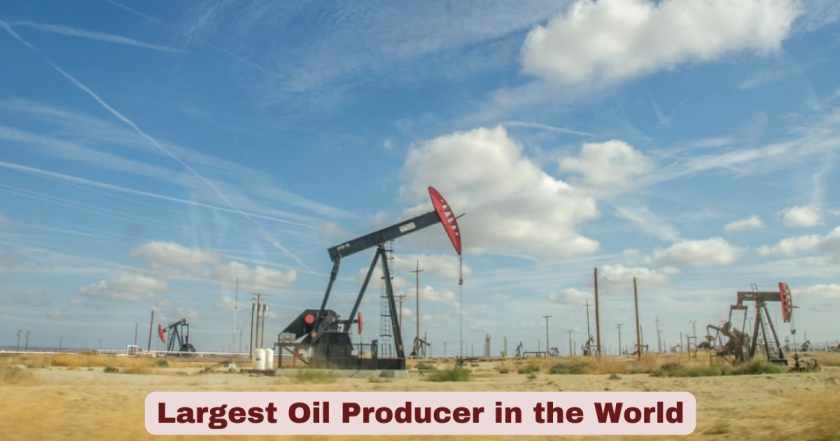
As of 2026, the United States holds its position as the undisputed number one largest oil-producing country in the world, outpacing traditional powerhouses like Saudi Arabia and Russia by a margin that continues to widen. This is a verified energy fact backed by the latest data from the U.S. Energy Information Administration (EIA), the most authoritative source of domestic and global energy statistics. This dominance did not happen overnight — it is the result of decades of technological innovation, geological advantage, and aggressive domestic energy policy, which has transformed America’s energy landscape beyond what analysts once thought possible.
What makes the U.S. position in global oil production in 2026 especially significant is the timing. With the ongoing geopolitical conflict involving Iran disrupting the Strait of Hormuz — a chokepoint through which roughly 20% of the world’s oil supply flows — global energy markets have entered a period of acute stress. Oil prices briefly breached the $100 per barrel mark in early March 2026, the highest since 2022. In this environment, America’s status as the world’s top oil producer is not merely an economic statistic. It is a strategic asset that shapes foreign policy, drives revenues, and determines energy security for the country and its allies.
Interesting Facts About the Largest Oil Producer in the World 2026
Before diving into the deeper statistics, here are some headline facts that explain just how dominant the United States is as an oil-producing nation in 2026.
| Fact | Detail |
|---|---|
| #1 Ranked Oil Producer in the World 2026 | United States, producing 13.6 million barrels per day (b/d) |
| Record U.S. Oil Output | 13.6 million b/d set in July 2025 — an all-time production record |
| Permian Basin Dominance | The Permian Basin alone produces approximately 6.6 million b/d, accounting for nearly 50% of all U.S. output |
| Permian Basin Size | Covers roughly 86,000 square miles across West Texas and southeastern New Mexico |
| Strategic Petroleum Reserve (SPR) | Rebuilt to 415 million barrels by February 2026 following a strategic refill program |
| 2026 SPR Release | U.S. authorized release of 172 million barrels amid Middle East conflict |
| Projected Oil Revenue Windfall | At $20/barrel price increase, U.S. producers stand to gain roughly $100 billion more in revenue over a year |
| Daily Extra Revenue at Higher Prices | Oil Change International estimates approximately $280 million in additional revenue every day at elevated prices |
| U.S. LNG Exports 2026 | On track to reach 16 billion cubic feet per day (Bcf/d) — a record high |
| World’s Largest LNG Exporter | The United States surpassed Australia and Qatar to become the #1 LNG exporter globally |
| Brent Crude Price — March 9, 2026 | Settled at $94 per barrel, up approximately 50% from the beginning of 2026 |
| U.S. Lead Over Saudi Arabia | U.S. produces 13.6 million b/d vs Saudi Arabia’s 11.17 million b/d — a gap of over 2.4 million b/d |
| Permian Basin Projected Gross Product | Expected to generate $325–$350 billion in gross product and 1.2 million jobs by 2050 |
Source: EIA Short-Term Energy Outlook, March 2026; GlobalFirepower.com (2026); Oil Change International; U.S. Department of Energy Fact Sheet
The numbers tell a story that is both economically compelling and geopolitically significant. The United States is not merely ahead of Saudi Arabia and Russia — it is ahead by a margin that no OPEC or non-OPEC country can currently close. The Permian Basin alone, if counted as a standalone nation, would rank in the top five oil-producing countries in the entire world. That is the scale of American energy production in 2026.
The timing of the surge in global oil prices in 2026 came against a backdrop of escalating tensions in the Middle East, driven by the Iran conflict and the closure of the Strait of Hormuz. The recognition that rising oil prices benefit the U.S. because of its production scale represents a fundamental shift in how America’s energy dominance is understood — not as a vulnerability to price shocks, but as a revenue-generating advantage. With the EIA’s latest Short-Term Energy Outlook projecting that U.S. output will rise to 13.8 million b/d in 2027, this advantage is only expected to grow.
Top 10 Largest Oil-Producing Countries in the World 2026 | Rankings & Data
The global hierarchy of oil-producing nations in 2026 is clear. The United States sits firmly at the top, with Saudi Arabia and Russia trailing significantly. Below is the latest ranking of the top 10 largest oil producers in the world 2026, measured in barrels per day.
| Rank | Country | Oil Production (barrels per day) 2026 | Region |
|---|---|---|---|
| 1 | United States | 13,600,000 (13.6 million b/d) | North America |
| 2 | Saudi Arabia | 11,174,000 | Middle East |
| 3 | Russia | 10,879,000 | Europe/Asia |
| 4 | Canada | 5,688,000 | North America |
| 5 | China | 4,984,000 | Asia |
| 6 | Iraq | 4,448,000 | Middle East |
| 7 | Brazil | 4,221,000 | South America |
| 8 | United Arab Emirates | 4,146,000 | Middle East |
| 9 | Iran | 4,112,000 | Middle East |
| 10 | Kuwait | 2,910,000 | Middle East |
Source: GlobalFirepower.com (2026); EIA Short-Term Energy Outlook, March 2026
The gap between the United States at 13.6 million b/d and second-place Saudi Arabia at approximately 11.17 million b/d is striking — a production lead of more than 2.4 million barrels every single day. That difference alone is larger than the total daily oil output of Kuwait, the 10th largest producer in the world. Russia, in third place at just under 10.9 million b/d, sits even further behind. The U.S. produces roughly 25% more oil per day than Russia, which tells you everything about where the center of gravity of global energy production has moved.
Looking further down the list, Canada at fourth place (5.69 million b/d) has benefited enormously from oil sands development, while China at fifth (4.98 million b/d) remains a massive producer despite being one of the world’s largest consumers. What is particularly notable in this table is that three of the top 10 — Iraq, UAE, and Iran — are located in the Middle East, a region currently experiencing one of its most severe geopolitical disruptions in decades. This further amplifies the strategic importance of the United States as the dominant, stable, Western producer in a volatile global oil market.
U.S. Oil Production 2026 – EIA Data & Statistics
The EIA’s March 2026 Short-Term Energy Outlook (STEO) — released on March 10, 2026 — provides the most authoritative and current picture of American oil output. This is the definitive data source confirming U.S. oil dominance at a global level.
| Metric | Data (2026) |
|---|---|
| U.S. Crude Oil Production Forecast 2026 | 13.6 million barrels per day (b/d) |
| U.S. Crude Oil Production Forecast 2027 | 13.8 million b/d (upward revision of +0.5 million b/d from prior forecast) |
| Record U.S. Output (July 2025) | 13.6 million b/d — all-time production high |
| WTI Crude Oil Price Forecast 2026 (average) | $74 per barrel |
| Brent Crude Spot Price (March 9, 2026) | $94 per barrel (up ~50% from start of year) |
| Brent Forecast — Q2 2026 | Average of $91 per barrel |
| U.S. Net Crude Oil Imports (2025) | Decreased to 2.2 million b/d (down from 2.5 million b/d in 2024) |
| Permian Basin Production (2025–2026) | Approximately 6.6 million b/d — ~50% of total U.S. output |
| Bakken Basin Production | Approximately 1.3 million b/d |
| Eagle Ford Basin Production | Approximately 1.1 million b/d |
| Gulf of America (Offshore) Production | Average of approximately 1.89 million b/d in 2025, stabilizing ~1.8 million b/d in 2026 |
| U.S. LNG Export Forecast 2026 | 16 Bcf/d (up from 12 Bcf/d in 2024) |
Source: EIA Short-Term Energy Outlook, March 10, 2026; EIA Press Release, October 2025; U.S. Department of Energy Fact Sheet 2025
The EIA’s March 2026 STEO makes one thing unambiguous: higher oil prices are leading to more U.S. crude oil production, not less. When prices rose dramatically following the onset of military action in the Middle East, the EIA revised its 2026 production forecast upward to 13.6 million b/d and further increased the 2027 forecast by 0.5 million b/d compared to the prior month’s projection. This is the fundamental economic logic of U.S. energy dominance — because U.S. oil production is in private-sector hands spread across thousands of independent operators, higher prices translate almost automatically into higher revenues for American producers.
The breadth of America’s production base is what makes it uniquely resilient. The Permian Basin alone at 6.6 million b/d — which, as noted, would rank it among the world’s top five producers if it were a country — is only part of the story. Add in the Bakken at 1.3 million b/d, Eagle Ford at 1.1 million b/d, and offshore Gulf of America production at approximately 1.8 million b/d, and you see a geographically diverse, multi-layered production system that no geopolitical disruption can easily knock offline. This structural advantage, more than any single statistic, explains why the United States has been the world’s largest oil producer for several consecutive years and shows no sign of relinquishing that title.
Permian Basin 2026 – The Engine Behind U.S. Oil Dominance
If the United States is the world’s largest oil producer, the Permian Basin is the engine behind that title. The numbers are extraordinary.
| Metric | Permian Basin Data |
|---|---|
| Daily Oil Production (2025–2026) | Approximately 6.6 million barrels per day |
| Share of Total U.S. Oil Output | Expected to account for ~50% of U.S. oil output by 2026 |
| Basin Geographic Size | Approximately 86,000 square miles across West Texas and southeastern New Mexico |
| Number of Fields in Basin | More than 7,000 fields |
| EIA Forecast: Basin Share of U.S. Production Growth | Top 10 Permian counties averaged 4.8 million b/d in 2024, representing 37% of U.S. total |
| Projected Gross Product by 2050 | $325–$350 billion in gross product |
| Projected Jobs by 2050 | More than 1,200,000 jobs nationally |
| LNG/Oil Trade Contribution 2024 | More than $119 billion in contributions to U.S. Balance of Trade |
| Taxes Collected (Texas & New Mexico) | $24.5 billion in taxes collected across both states |
| GHG Emissions Ranking | Ranked lowest in GHG emissions per barrel of oil equivalent among major onshore basins globally |
| Methane Intensity Reduction (2011–2023) | Down nearly 83% even as production rose 482% in the same period |
| ExxonMobil Permian Target by 2030 | Approximately 2.3 million barrels per day following Pioneer acquisition |
Source: Permian Strategic Partnership (PSP); EIA Drilling Productivity Report; Texans for Natural Gas (2025); World Oil; EIA (2025)
The Permian Basin’s contribution to America’s oil dominance cannot be overstated. When the PSP reported $24.5 billion in taxes collected across Texas and New Mexico — doubling oil and gas severance taxes compared to the prior year — it underscored how deeply the basin has embedded itself into the fiscal structure of two of America’s largest states. The figure of $119 billion in contributions to the U.S. Balance of Trade in 2024 from LNG and oil originating in the Permian alone puts the basin on par with some of the world’s largest individual export sectors.
Perhaps the most remarkable data point in the entire table is the combination of a 482% rise in production alongside an 83% reduction in methane intensity between 2011 and 2023. This directly counters the narrative that domestic oil expansion comes at the cost of environmental responsibility. Operators in the Permian have driven these improvements through longer lateral drilling, optimized well spacing, and enhanced fracturing designs that produce more oil from fewer wells. As ExxonMobil targets 2.3 million b/d from the Permian alone by 2030 — following its landmark acquisition of Pioneer Natural Resources — the basin’s role as the anchor of U.S. energy dominance is only going to deepen into the next decade.
U.S. Oil Revenue & Economic Impact 2026 | What Rising Prices Mean for America
The economic case for U.S. oil dominance in 2026 is straightforward — with the country producing more oil per day than any other nation on earth, elevated global prices translate directly into a massive revenue windfall for American producers and the broader economy.
| Economic Metric | 2026 Data |
|---|---|
| Additional Revenue at +$20/barrel (estimated) | Approximately $100 billion more in revenue for U.S. oil producers over a year |
| Additional Daily Revenue at Elevated Prices | Approximately $280 million per day based on ~14 million b/d crude production |
| WTI Average Price Forecast 2026 | $74 per barrel (revised sharply upward from prior $53/b forecast) |
| Brent Price — Peak March 2026 | Approximately $100+ per barrel (briefly breached $100 mark) |
| Permian Basin GDP Contribution | $181.8 billion in GDP contribution reported by Perryman Group |
| Share of New Mexico Private-Sector GDP | Permian accounts for 25.9% of New Mexico private-sector GDP |
| Share of Texas Private-Sector GDP | Permian accounts for 8.1% of Texas private-sector GDP |
| U.S. LNG Export Revenue Growth | LNG exports surged from 0.5 Bcf/d in 2016 to 15 Bcf/d in 2025 — a 30x increase in a decade |
| Projected U.S. LNG Exports by 2027 | EIA forecasts exports to exceed 18.1 Bcf/d |
| U.S. Natural Gas Production 2025 | Expected to reach 109 billion cubic feet per day — a new all-time high |
| SPR Strategic Value Released (2026) | 172 million barrels authorized for release — equivalent to roughly $16+ billion in oil value at current prices |
Source: Oil Change International (March 2026); EIA STEO March 2026; EIA LNG Export Data; Perryman Group / PSP Economic Report; U.S. Department of Energy
The economic arithmetic here is blunt and significant. At current 2026 production levels of approximately 13.6 million b/d, every $1 increase in the per-barrel price of oil translates to roughly $13.6 million in additional gross revenue per day for American oil producers, or approximately $5 billion per year. The EIA’s upward revision of the WTI forecast from $53 per barrel to $74 per barrel for 2026 — a shift of $21 per barrel — therefore represents a revenue windfall of well over $100 billion annually for the domestic industry. This is the financial reality of being the world’s largest oil-producing nation in a period of elevated global prices.
What is equally important is that this revenue circulates through the broader U.S. economy in ways that extend far beyond oil company balance sheets. Tax revenues collected across Texas and New Mexico from the Permian Basin alone hit $24.5 billion, funding schools, roads, hospitals, and local governments. The $119 billion in trade balance contributions from Permian LNG and oil exports helps offset America’s trade deficit in other sectors. And with U.S. LNG exports on course to hit 16 Bcf/d in 2026 — up from just 0.5 Bcf/d in 2016 — the energy sector is now one of the most powerful drivers of American export earnings globally, a transformation that has happened almost entirely within the last decade.
U.S. vs OPEC+ Oil Production 2026 – Strategic Comparison
Understanding the U.S. position requires seeing it clearly against OPEC+ members and other key global producers.
| Producer / Group | Production (barrels per day) 2026 | Key Notes |
|---|---|---|
| United States | 13,600,000 | World #1; EIA March 2026 STEO confirmed |
| Saudi Arabia | 11,174,000 | OPEC leader; Strait of Hormuz disruption impact |
| Russia | 10,879,000 | Under Western sanctions; production constrained |
| Canada | 5,688,000 | Oil sands; North American ally |
| Iraq | 4,448,000 | OPEC member; Gulf region vulnerability |
| UAE | 4,146,000 | OPEC member; behind closed Strait |
| Iran | 4,112,000 | Directly involved in 2026 Middle East conflict |
| Kuwait | 2,910,000 | Behind Strait of Hormuz; supply disrupted |
| OPEC+ (combined key members) | Significant but constrained by quota and conflict | EIA: OPEC+ production expected to remain below announced targets |
| Non-OPEC+ Growth (including U.S.) | Leading global supply growth in 2026 | EIA: Growth led by countries outside OPEC+ |
Source: GlobalFirepower.com (2026); EIA Short-Term Energy Outlook, March 2026
The strategic picture painted by this table is one of sharp divergence. While OPEC+ nations — particularly Saudi Arabia, Iraq, UAE, Kuwait, and Iran — are all impacted to varying degrees by the closure of the Strait of Hormuz, the United States sits on the opposite side of the world, producing at record levels with no direct maritime supply disruption affecting its domestic output. The EIA’s explicit statement that “oil production growth is led by countries outside OPEC+” is a direct reference to the sustained rise of U.S., Canadian, and Brazilian production that has fundamentally reduced OPEC’s ability to dominate global energy pricing the way it did in previous decades.
Russia’s position at 10.87 million b/d is notable, but it comes with significant caveats. Western sanctions imposed following the invasion of Ukraine have disrupted financing, technology access, and export markets for Russian crude. Russia’s trajectory over the coming years is downward by most forecasts, while the EIA projects U.S. output rising to 13.8 million b/d by 2027. The gap between these two countries — already nearly 2.7 million barrels per day in 2026 — is expected to widen further. In a world where energy has become one of the most powerful tools of geopolitical leverage, that gap represents a fundamental shift in global power dynamics that no single OPEC decision can easily reverse.
U.S. Strategic Petroleum Reserve (SPR) 2026
A critical dimension of U.S. oil power in 2026 is the Strategic Petroleum Reserve — the world’s largest emergency crude oil supply.
| SPR Metric | Data |
|---|---|
| SPR Level — February 2026 | 415 million barrels (rebuilt following aggressive refill program) |
| SPR Low Point (2023) | Approximately 347 million barrels — lowest since 1983 |
| Biden-Era Drawdown (2022) | Approximately ~180 million barrels drawn down |
| SPR Refill (2023–2026) | Rebuilt by approximately +68 million barrels from 2023 low to Feb 2026 level |
| 2026 Authorized Release | 172 million barrels — part of IEA-coordinated international release of 400 million barrels globally |
| SPR After 2026 Release | Will fall significantly below current 415 million barrel level |
| SPR Total Capacity | Approximately 714 million barrels (current level = ~58% of capacity) |
| DOE Contract (Nov 2025) | Awarded contracts for delivery of 1 million barrels to Bryan Mound site for SPR refill |
| U.S. Replacement Commitment | Arranged to replace approximately 200 million barrels — 20% more than will be drawn down — at no cost to taxpayer |
Source: U.S. Department of Energy; EIA Weekly Petroleum Status Report (February 2026); The World Data (March 2026); NPR, Bloomberg (March 2026)
The SPR data reveals both the strength and the complexity of America’s oil position in 2026. On one hand, the U.S. successfully rebuilt the reserve from its 2023 low of 347 million barrels to 415 million barrels by early 2026 — a meaningful recovery that represents years of patient acquisition through strategic purchase contracts at lower price points. On the other hand, the authorization to release 172 million barrels as part of the IEA’s coordinated global response to the Middle East supply shock — out of a total international release of 400 million barrels — means the SPR will once again be drawn down significantly.
What makes this particularly notable is the scale of the commitment. The U.S. is contributing 172 million barrels out of 400 million globally — meaning America alone is providing 43% of the world’s emergency oil response. That is not the action of a country that is merely one of many producers. It is the action of the country that functions as the world’s energy backstop — the producer of last resort that the global economy turns to when the Middle East is in crisis. The U.S. government also committed to replacing these reserves with approximately 200 million barrels at no cost to taxpayers, demonstrating that even as the reserve is drawn down, American energy infrastructure is expected to replenish it more abundantly than what was released.
Disclaimer: This research report is compiled from publicly available sources. While reasonable efforts have been made to ensure accuracy, no representation or warranty, express or implied, is given as to the completeness or reliability of the information. We accept no liability for any errors, omissions, losses, or damages of any kind arising from the use of this report.