
Heat Stroke in the United States 2026
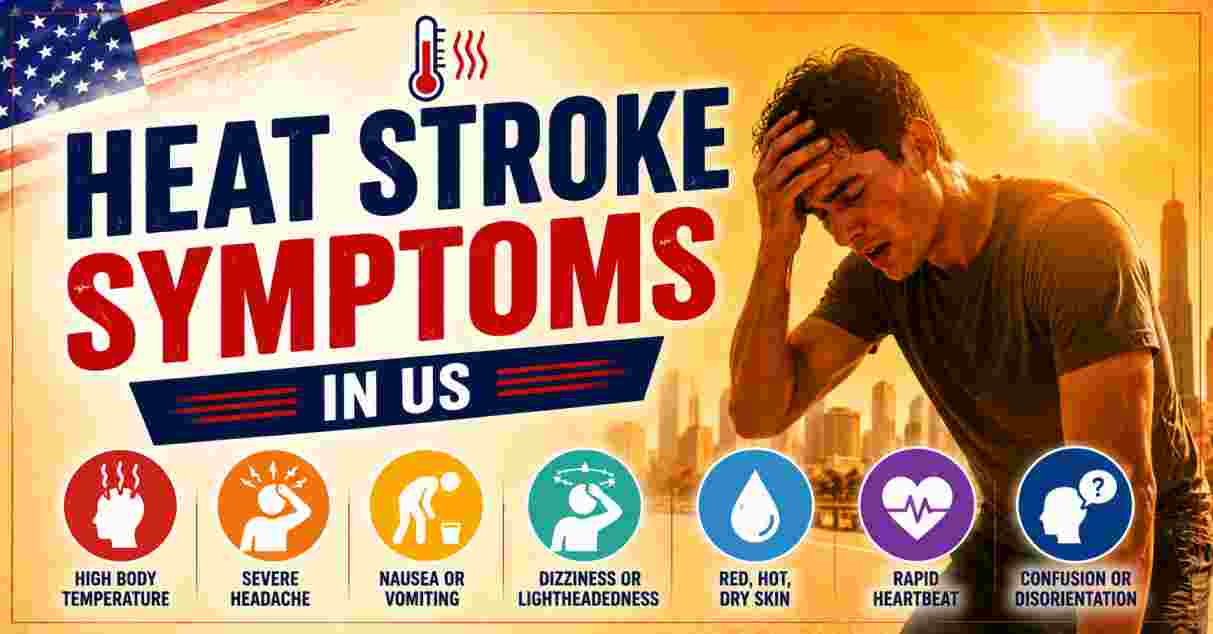
Heat stroke symptoms in US are being tested in real time this Fourth of July weekend, as a deadly, record-breaking heat wave grips the eastern United States. Washington, DC hit 102°F on 3 July 2026, breaking a 154-year-old record of 101°F set in 1872, while the CDC reported “extremely high” rates of heat-related emergency department visits across the Northeast and Mid-Atlantic. Heat stroke, defined clinically as a core body temperature exceeding 40°C (104°F) combined with central nervous system dysfunction, remains the most severe and most lethal form of heat-related illness, and recognizing its symptoms early can be the difference between full recovery and permanent organ damage or death.
This report compiles verified heat stroke symptoms and statistics in US from UpToDate, NIH StatPearls, MedLink Neurology, peer-reviewed research published via the National Center for Biotechnology Information (NCBI), and the CDC’s ongoing heat surveillance data. It covers the critical distinction between classic and exertional heat stroke, the specific warning signs clinicians look for, mortality and complication rates, treatment protocols, risk factors, and how this year’s ongoing heat emergency is already producing confirmed heat stroke cases across the country.
Interesting Facts About Heat Stroke in US 2026
| Interesting Fact | 2026 Figure |
|---|---|
| Clinical heat stroke temperature threshold | 40°C (104°F) or higher |
| Classic heat stroke temperature (often exceeds) | 40.5°C (105°F) |
| Classic heat stroke ICU mortality (untreated/severe) | Up to 63.2% |
| Overall classic heat stroke fatality rate (all cases) | ~65% |
| Neurologic sequelae rate, hospitalized exertional cases | 24.4% |
| Heat wave clinical definition | 3+ consecutive days above 32.2°C (90°F) |
| DC broke a temperature record set in | 1872 (154 years ago) |
| US heat-related deaths, 2024 (most recent final data) | 2,394 |
| Gold-standard cooling method | Ice-water immersion |
Source: Wikipedia (Heat Stroke); MedLink Neurology; UpToDate; CDC WONDER, 2026
As a heat stroke symptoms in US 2026 starting point, these figures reveal just how dangerous this specific condition remains even with modern medical care available. Classic (non-exertional) heat stroke carries a documented fatality rate near 65%, and intensive-care mortality can reach as high as 63.2% in the most severe presentations, since even the healthiest person, left in a heat-stroke-inducing environment without medical attention, will continue deteriorating toward death regardless of underlying health status. Among hospitalized patients who survive exertional heat stroke specifically, nearly 1 in 4 — 24.4% — experience lasting neurologic sequelae, underscoring that survival alone doesn’t guarantee a full return to baseline health.
This year’s record-breaking conditions are producing exactly the kind of environment where heat stroke risk spikes sharply. With Washington, DC’s 3 July 2026 high of 102°F breaking a record that had stood since 1872, and CDC already flagging unusually elevated rates of heat-related ER visits across multiple states, this holiday weekend meets the clinical definition of a genuine heat wave — three or more consecutive days above 90°F — creating ideal conditions for both classic heat stroke among vulnerable residents without adequate cooling access and exertional heat stroke among people attending outdoor Independence Day events despite the extreme conditions.
Classic vs. Exertional Heat Stroke Statistics in US 2026
| Comparison Point | Classic Heat Stroke | Exertional Heat Stroke |
|---|---|---|
| Typical population affected | Elderly, chronically ill, young children | Healthy, physically fit individuals |
| Onset speed | Gradual (days) | Rapid (can be sudden) |
| Sweating present | Usually absent (anhidrosis) | Usually present, sometimes excessive |
| Cause | Passive environmental heat exposure | Strenuous physical exertion in heat |
| Core temperature threshold | Often exceeds 40.5°C (105°F) | Exceeds 40°C (104°F) |
| ICU mortality (severe cases) | Up to 63.2% | Lower, but still significant |
| Common triggering scenario | Multi-day heat wave, poor housing cooling | Athletics, military training, outdoor labor |
Source: NCBI/PMC Heat Stroke Pathophysiology Review; MedLink Neurology, 2025-26
Heat stroke presents in two clinically distinct forms that share the same dangerous core-temperature threshold but differ dramatically in who they affect and how quickly they develop. Classic heat stroke, also called non-exertional heat stroke, typically strikes elderly individuals, young children, and people with chronic illness during passive environmental heat exposure — often unfolding gradually over multiple days of a heat wave, frequently in homes lacking adequate air conditioning. Critically, sweating is usually absent in classic heat stroke, a phenomenon called anhidrosis, which can mislead bystanders into thinking the affected person’s skin feeling dry and hot is a less urgent sign than it actually is.
Exertional heat stroke, by contrast, can strike otherwise healthy, physically fit people — athletes, military trainees, and outdoor laborers — engaged in strenuous activity in hot, humid conditions, with onset that can be sudden rather than gradual. Unlike classic heat stroke, sweating is usually present in exertional cases, sometimes profusely, right up until the point of collapse, since the body’s thermoregulatory failure happens abruptly rather than through gradual depletion. Both forms share the same defining feature — elevated core temperature combined with central nervous system dysfunction — but the speed of recognition required differs significantly, since exertional cases can progress from first symptoms to life-threatening crisis in a matter of minutes.
Heat Stroke Warning Signs and Symptom Statistics in US 2026
| Symptom Category | Specific Signs |
|---|---|
| Neurological/behavioral | Confusion, delirium, agitation, combativeness |
| Speech/motor | Slurred speech, ataxia (loss of coordination) |
| Gastrointestinal | Nausea, vomiting |
| Skin (classic type) | Hot, dry skin; red/flushed appearance |
| Skin (exertional type) | May remain sweaty until collapse |
| Severe/late-stage | Seizures, loss of consciousness, coma |
| Vital sign changes | Tachycardia, tachypnea, widened pulse pressure, hypotension |
| Rare additional signs (exertional) | Sphincter incontinence |
Source: Wikipedia (Heat Stroke); UpToDate Nonexertional Heat Stroke Guidelines, 2026
Recognizing heat stroke symptoms early requires watching for a specific cluster of neurological and physical warning signs rather than relying on temperature alone, since field thermometers often cannot accurately capture the true core body temperature a person is experiencing. Early symptoms typically include behavioral changes, confusion, dizziness, weakness, and agitation, sometimes progressing to combativeness or slurred speech — signs that can easily be mistaken for intoxication or an unrelated medical event if the environmental heat context isn’t immediately considered by bystanders or first responders.
As the condition worsens, vital sign abnormalities become more pronounced, including sinus tachycardia (rapid heart rate), tachypnea (rapid breathing), a widened pulse pressure, and hypotension (low blood pressure), frequently accompanying the hallmark elevated core temperature. In the most severe presentations, patients may experience seizures, loss of consciousness, or progress into a coma, and in some exertional heat stroke cases, researchers have specifically documented sphincter incontinence as an additional, less commonly discussed late-stage symptom — a reminder that heat stroke’s presentation can vary meaningfully between individuals even as the underlying thermoregulatory failure remains consistent across cases.
Heat Stroke Mortality and Complication Statistics in US 2026
| Mortality/Complication Measure | Figure |
|---|---|
| Classic heat stroke fatality rate (untreated/severe) | ~65% |
| Classic heat stroke ICU mortality (documented cases) | Up to 63.2% |
| Neurologic sequelae, hospitalized exertional cases | 24.4% |
| Common complications | Seizures, rhabdomyolysis, kidney failure |
| Additional documented complications | Coagulopathy, myocardial injury, ARDS, liver failure |
| Long-term risk after recovery (14-year follow-up study) | Higher risk of MI, ischemic stroke, chronic kidney disease |
| Key predictors of neurologic sequelae | Duration of hyperthermia, low Glasgow Coma Scale score |
Source: NCBI/PMC Case Reports and Cohort Studies; MedLink Neurology, 2025-26
Heat stroke’s danger extends well beyond the acute emergency itself, since the condition frequently triggers cascading multi-organ complications even among patients who ultimately survive. Documented complications include rhabdomyolysis (muscle tissue breakdown), acute kidney failure, coagulopathy (blood clotting abnormalities), myocardial injury, acute respiratory distress syndrome (ARDS), and liver failure — any combination of which can develop as the body’s cytotoxic response to sustained elevated core temperature spreads across multiple organ systems simultaneously, explaining why even specialized intensive care cannot guarantee survival in the most severe cases.
A retrospective cohort study of patients hospitalized with exertional heat illness identified the duration of recurrent hyperthermia, the duration of central nervous system injury, and a low Glasgow Coma Scale score within the first 24 hours of admission as independent risk factors for developing lasting neurologic sequelae, which occurred in 24.4% of the cohort studied. Separately, a 14-year follow-up study of 150 heat-related illness patients found survivors faced meaningfully elevated long-term risk of myocardial infarction, ischemic stroke, and chronic kidney disease compared with a matched control group, indicating that heat stroke’s health consequences can persist for years after the initial medical emergency has resolved.
Heat Stroke Risk Factor Statistics in US 2026
| Risk Factor Category | Specific Risk Factor |
|---|---|
| Age | Under 5 and over 65 face highest risk |
| Chronic illness | Heart disease, diabetes, kidney disease |
| Medication-related | Beta-blockers, diuretics, certain psychiatric medications |
| Housing-related | Lack of air conditioning access |
| Athletic factor | Sickle cell trait (exertional heat stroke) |
| Environmental | High humidity above 60% (reduces evaporative cooling) |
| Social factor | Living alone (delayed discovery/help) |
| Occupational | Outdoor labor, military training, endurance athletics |
Source: CDC; NIH StatPearls; peer-reviewed heat stroke risk factor literature, 2026
Heat stroke risk concentrates disproportionately among specific, well-documented groups. Age remains one of the strongest risk factors, with both young children under 5 — whose thermoregulatory systems remain immature — and adults over 65 facing substantially elevated risk, particularly when combined with social isolation that can delay discovery and emergency response during a heat event. Chronic conditions including heart disease, diabetes, and kidney disease all impair the body’s ability to dissipate heat effectively, while certain medications, notably beta-blockers and diuretics, can further compromise the cardiovascular and fluid-regulation responses needed to prevent dangerous overheating.
Environmental and social factors compound these individual medical risk factors significantly. High humidity above 60% dramatically reduces the effectiveness of evaporative cooling — the body’s primary defense against overheating — meaning identical air temperatures can pose far greater heat stroke risk on humid days than dry ones. Access to air conditioning itself functions as a critical protective factor, since households lacking reliable cooling face substantially higher heat stroke risk during multi-day heat waves, a disparity that disproportionately affects lower-income households and directly explains why public cooling centers remain a core component of municipal heat emergency response in cities experiencing conditions like this week’s eastern US heat wave.
Heat Stroke Treatment and Cooling Statistics in US 2026
| Treatment Measure | Detail |
|---|---|
| Gold-standard cooling method (exertional) | Ice-water immersion |
| Also effective for classic heat stroke | Ice-water immersion |
| Alternative in-hospital methods | Cold IV fluids, ice packs, wet gauze, fanning |
| Primary determinant of outcome | Degree and duration of hyperthermia |
| Recommended action while awaiting EMS | Begin cooling immediately, do not wait |
| Fluids for unconscious/confused patients | Do NOT give orally (aspiration risk) |
| Fan effectiveness threshold | Only helpful below heat index ~90s°F |
Source: Wikipedia (Heat Stroke); National Weather Service; clinical cooling outcomes research, 2026
Aggressive, immediate cooling remains the single most important treatment intervention for heat stroke, regardless of whether the case is classic or exertional in origin, since clinical research consistently identifies the degree and duration of hyperthermia — not any other single factor — as the primary determinant of patient survival. Ice-water immersion stands as the gold-standard cooling method specifically for exertional heat stroke, and clinicians increasingly apply the same technique for classic heat stroke cases as well, given its superior cooling speed compared with alternative approaches like fanning or wet gauze application.
In hospital settings, additional mechanical cooling methods include infusion of cold intravenous fluids, strategically placed ice packs, and wet gauze combined with fanning to maximize evaporative heat loss. Critically, bystanders and first responders should begin cooling measures immediately upon recognizing heat stroke symptoms, rather than waiting for emergency medical services to arrive, since every additional minute of untreated hyperthermia worsens the eventual clinical outcome. One important caution applies universally: patients showing confusion, agitation, or loss of consciousness should never be given fluids by mouth, due to serious choking and aspiration risk — hydration in these cases must wait for IV administration by trained medical personnel.
Emergency Department and Hospitalization Statistics in US 2026
| Healthcare Utilization Measure | Figure |
|---|---|
| Heat-illness ED visit rate increase, extreme heat days | +66.3% relative risk |
| Excess absolute heat-illness ED visits per extreme heat day | 24.3 per 100,000 people |
| Highest ED visit demographic (2023 CDC data) | Males, adults aged 18-64 |
| US heat-related deaths, 2024 | 2,394 |
| US heat-related deaths, 2023 (all-time high) | 2,415 |
| Cumulative heat deaths since 2020 | 9,436+ |
| Share of Americans under heat alerts, 2023 | Over two-thirds |
| CDC alert level, Northeast/Mid-Atlantic (3 July 2026) | Extremely high (per CDC) |
Source: CDC WONDER; CDC MMWR; BMJ Ambient Heat ED Visits Study, 2026
Heat stroke and its milder counterparts drive substantial, measurable surges in emergency department utilization during extreme heat events. National research analyzing nearly 22 million ED visits found extreme heat days associated with a 66.3% excess relative risk of heat-illness-specific ED visits, translating to roughly 24 additional visits per 100,000 people every single day compared with typical warm-season conditions. CDC’s 2023 surveillance data identified males and adults aged 18 to 64 as the demographic group with the highest ED visit rates, a pattern researchers link to greater outdoor physical exertion rather than any inherent biological vulnerability exceeding that of older adults.
Heat-related mortality, largely driven by heat stroke specifically as the most lethal category of heat illness, reached 2,394 deaths in 2024, the second-highest annual total on record after 2023’s peak of 2,415, with cumulative deaths since 2020 now exceeding 9,436. This week’s live CDC alert, flagging unusually elevated rates of heat-related ED visits across the Northeast and Mid-Atlantic as of 3 July 2026, suggests the region is currently tracking well above typical warm-season baselines, consistent with the kind of acute healthcare surge researchers have documented during comparable record-breaking heat events in prior years.
Current 2026 Heat Wave and Confirmed Case Statistics
| Current Event Detail | 3-4 July 2026 Figure |
|---|---|
| Washington, DC record high (3 July) | 102°F (broke 1872 record of 101°F) |
| DC forecast high (4 July) | 102°F (hottest July 4th on record) |
| Philadelphia/NYC forecast high | ~100°F (heat index ~105°F) |
| Confirmed heat-related death (Pennsylvania) | 68-year-old man, Bethel Township, 2 July |
| Cities breaking records (late June, single day) | 20+ |
| Locations tying/breaking Friday records | 12+ (Mid-Atlantic/Northeast) |
| Independence Day events canceled | DC and Philadelphia parades |
| Attribution finding (World Weather Attribution) | Intensity “virtually impossible” without fossil fuel pollution |
Source: CNN; Associated Press; Berks County Coroner’s Office; World Weather Attribution, 3-4 July 2026
This week’s confirmed heat-related death illustrates classic heat stroke risk playing out in real time: the Berks County Coroner’s Office confirmed a 68-year-old man died on 2 July 2026 after trimming bushes outdoors in Bethel Township, Pennsylvania, where temperatures exceeded 100°F — a scenario combining moderate physical exertion with older age, precisely the risk factor combination clinical research identifies as especially dangerous. The severity of conditions forced Washington, DC and Philadelphia to cancel their Independence Day parades entirely, a rare public acknowledgment that outdoor gathering risk had crossed an unacceptable threshold even for major civic celebrations.
A World Weather Attribution analysis concluded the combined heat and humidity driving this week’s crisis would have been virtually impossible without the influence of fossil fuel pollution, reinforcing longer-term JAMA research showing US heat-related deaths have climbed at a compound annual rate of 16.8% between 2016 and 2023 — a trajectory that, if sustained, would push annual heat deaths past 5,000 by 2030. With more than 20 cities breaking temperature records in a single late-June stretch and Washington, DC toppling a 154-year-old benchmark, 2026 is on pace to test whether this year’s heat stroke and broader heat-illness statistics will approach or exceed the record levels recorded in 2023.
Long-Term Recovery and Public Health Statistics in US 2026
| Recovery/Public Health Measure | Figure |
|---|---|
| Long-term elevated risk after recovery | Myocardial infarction, ischemic stroke, CKD |
| Follow-up study duration establishing this risk | 14 years |
| Follow-up study cohort size | 150 patients |
| Key rehabilitation focus | Organ function monitoring, cardiovascular follow-up |
| Recommended prevention approach | Acclimatization, hydration, activity modification |
| Public cooling center role | Protective factor for AC-lacking households |
| CDC monitoring tool | Heat & Health Tracker (ephtracking.cdc.gov) |
Source: NCBI/PMC 14-year follow-up cohort study; CDC Heat & Health Tracker, 2026
Surviving an acute heat stroke episode does not mark the end of the associated health risk. The 14-year follow-up study of 150 heat-related illness patients found survivors faced measurably elevated long-term risk of cardiovascular and renal disease compared with matched controls, suggesting medical follow-up after a heat stroke event should extend well beyond the initial hospital discharge to include ongoing cardiovascular and kidney function monitoring, particularly for patients who experienced significant organ involvement during the acute episode itself.
From a public health prevention standpoint, CDC and clinical researchers consistently emphasize acclimatization — gradual, supervised exposure to heat and exertion over multiple days — alongside proactive hydration and activity modification during extreme heat advisories as the most effective population-level strategies for reducing heat stroke incidence. Public cooling centers serve as a critical protective resource specifically for households lacking air conditioning, a factor repeatedly identified as one of the strongest social determinants of classic heat stroke risk, and tools like the CDC’s Heat & Health Tracker allow both individuals and local health departments to monitor real-time risk levels by county — resources with direct, practical relevance given the active heat emergency unfolding across the eastern United States as this Fourth of July weekend continues.
Heat Stroke in Children and Vehicle-Related Statistics in US 2026
| Pediatric/Vehicle Heat Measure | Detail |
|---|---|
| Children’s thermoregulatory system | Less mature than adults’, heats up faster |
| Vehicle interior temperature rise | Can climb rapidly even with windows cracked |
| Highest-risk pediatric scenario | Left unattended in a parked vehicle |
| Recommended vehicle safety habit | Never leave children unattended, even briefly |
| Additional pediatric risk factor | Younger children cannot self-regulate heat exposure |
| School/sports recommendation | Modified practice schedules during extreme heat advisories |
Source: CDC; NIOSH pediatric heat safety guidance, 2026
Children face a distinct and particularly dangerous heat stroke pathway tied to their still-developing thermoregulatory systems, which cause their body temperature to rise considerably faster than an adult’s under identical environmental conditions. This physiological vulnerability makes vehicles an especially dangerous setting: interior temperatures can climb to dangerous levels within minutes, even with windows slightly cracked, making unattended children in parked cars one of the highest-risk scenarios for rapid-onset classic heat stroke in the pediatric population — a risk that spikes every year during summer months and receives renewed public health attention during periods of extreme heat like this week’s ongoing eastern US event.
Beyond vehicle-related risk, youth sports and school athletics represent another significant exposure point, since children engaged in strenuous physical activity outdoors face exertional heat stroke risk despite generally being considered a lower-risk age group for the classic form of the condition. CDC and school athletic safety guidelines increasingly recommend modified practice schedules — shifting outdoor training to early morning or evening hours, building in frequent hydration breaks, and applying stricter activity modification thresholds whenever the heat index climbs into dangerous territory — mirroring the same acclimatization principles used to protect adult outdoor workers and athletes from exertional heat stroke during comparable extreme heat conditions. Coaches and caregivers supervising youth activities during active heat advisories are also encouraged to designate at least one adult specifically responsible for monitoring participants for early warning signs — confusion, stumbling, or unusual fatigue — since children are often less able than adults to accurately recognize or verbally communicate their own overheating symptoms before a situation becomes an emergency.
Disclaimer: This research report is compiled from publicly available sources. While reasonable efforts have been made to ensure accuracy, no representation or warranty, express or implied, is given as to the completeness or reliability of the information. We accept no liability for any errors, omissions, losses, or damages of any kind arising from the use of this report.