
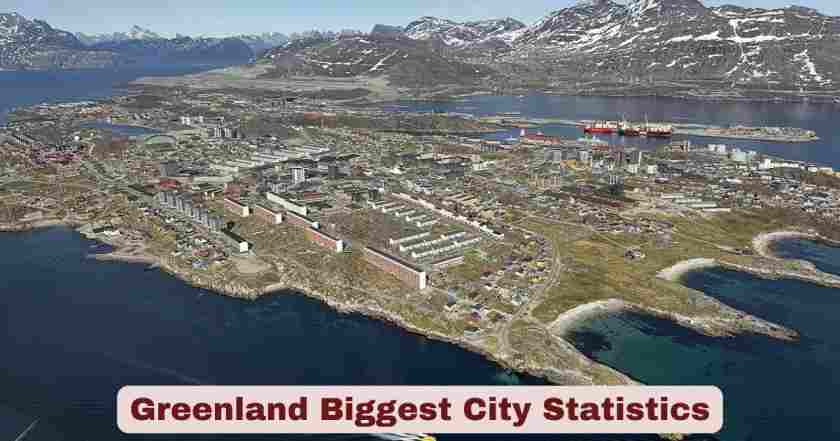
Greenland’s Biggest City in 2026
Nuuk, the capital and largest city of Greenland, stands as the political, economic, and cultural center of the world’s largest island as of 2026. With a population of 20,113 to 20,288 residents as of January 2025-2026 depending on the measurement methodology, Nuuk represents an extraordinary demographic concentration—approximately 35% to 36% of Greenland’s entire population of 56,542 people live within this single city. This proportion makes Nuuk one of the most demographically dominant national capitals globally in relative terms, comparable to Iceland where Reykjavík contains 37% of national population or Uruguay where Montevideo holds 42%. The city’s dominance reflects sustained internal migration over the past 50 years as Greenlanders have progressively abandoned remote settlements and smaller towns in favor of Nuuk’s superior employment opportunities in government administration, services, education, healthcare, and commercial activities.
Founded in 1728 by Danish-Norwegian missionary Hans Egede when he relocated from the earlier Hope Colony, Nuuk sits on Greenland’s southwest coast at the mouth of a fjord system approximately 240 kilometers (150 miles) south of the Arctic Circle. Originally named Godthåb (meaning “Good Hope” in Danish), the city was renamed Nuuk—the Greenlandic word for “cape”—on May 1, 1979, when Greenland established Home Rule government. The area has been inhabited for over 4,500 years, with the ancient pre-Inuit Saqqaq culture settling around 2200 BCE, followed by the Dorset culture, Norse colonists from around 1000 AD until their mysterious disappearance in the 15th century, and finally modern Greenlandic Inuit populations. As of 2026, Nuuk has experienced steady population growth even as overall national population stagnates or declines, with the city’s population having doubled since 1977, increased by over a third since 1990, and risen by 21% since 2000, making it by far Greenland’s largest urban center.
Interesting Stats & Facts About Greenland’s Biggest City in 2026
| Key Fact Category | Statistic/Detail | Source/Year |
|---|---|---|
| Population (January 2025) | 20,113 residents (Statistics Greenland) | Statistics Greenland, January 2025 |
| Population (2026 Estimate) | 20,288 residents (World Population Review) | World Population Review, 2026 |
| Percentage of National Population | 35-36% of Greenland’s total | Statistics Greenland / Multiple sources, 2025-2026 |
| Greenland’s Total Population | 56,542 (January 2025) | Statistics Greenland, January 2025 |
| Population July 2025 | 20,085 residents | Statistics Greenland Midyear Report, July 2025 |
| Population Growth 2024-2025 | +31 residents (slowed from usual) | Statistics Greenland, 2025 |
| Population Since 1977 | Doubled (100% increase) | Wikipedia / Statistics Greenland, 2024 |
| Population Since 2000 | +21% increase | Wikipedia, 2024 |
| Year Founded | 1728 by Hans Egede | Historical records, 1728 |
| Former Name | Godthåb (until May 1, 1979) | Historical records, 1979 |
| Distance from Arctic Circle | Approximately 240 km (150 miles) south | Geographic data, 2025 |
| Foreign-Born Residents (2015) | 3,826 people | Wikipedia citing Statistics Greenland, 2015 |
Data compiled from Statistics Greenland Official Publications (January 2025, July 2025), World Population Review (2026), Wikipedia Nuuk Demographics (January 2026), City Population Database (2024-2025), and Geographic Data Sources (2025)
Nuuk’s population of 20,113 to 20,288 as of January 2025-2026 represents not just numerical growth but fundamental demographic transformation. The city’s expansion reflects Greenland’s broader urbanization trend, with 90.73% of the national population now living in urban settlements compared to rural areas. Within Greenland’s urban hierarchy, Nuuk’s dominance is overwhelming—the capital city contains more people than the next three largest towns combined (Sisimiut with 5,200 residents, Ilulissat with 4,400, and Qaqortoq with 3,000). This concentration creates both opportunities and challenges: while Nuuk benefits from economies of scale that support universities, hospitals, cultural institutions, and diverse employment, smaller communities struggle with depopulation, aging demographics, and limited services.
The 3,826 foreign-born residents recorded in 2015 data highlight Nuuk’s role as Greenland’s primary destination for international migration, particularly from Denmark. Approximately half of Greenland’s immigrants live in Nuuk, attracted by good employment opportunities with high wages in government, fishing industry, education, and professional services. Danish citizens continue settling in the town, making Nuuk the Greenlandic city with the highest proportion of Danes in its population. The average income of a Nuuk resident is more than twice the average for other parts of Greenland, reflecting the concentration of high-skilled government and professional jobs in the capital. This income differential drives continued migration from smaller towns and settlements, with only 7% of Greenland’s population now living in communities of 200 or fewer residents, down from much higher percentages in previous decades.
Population Demographics and Growth Patterns in 2026
| Demographic Metric | Nuuk Statistics | Context/Comparison |
|---|---|---|
| Total Population (January 2025) | 20,113 | 35.2% of Greenland’s 56,542 total |
| Total Population (July 2025) | 20,085 | Slight seasonal variation |
| Population 2024 | 19,872 | Annual growth of +241 (+1.2%) |
| Population 2000 | 13,445 | +50.6% increase over 25 years |
| Population 1977 | Approximately 10,000 | Doubled in 48 years |
| Annual Growth 2024-2025 | +31 | Slowed from typical 200-300/year |
| Ethnic Composition | Approximately 90% Inuit | Highest aboriginal percentage globally |
| Danish Population | Highest in Greenland | Exact % varies by data source |
| Foreign-Born (2015) | 3,826 (19% of population) | Half of all Greenland immigrants |
| Native Greenlanders | Approximately 16,000-16,500 | About 25% of all native Greenlanders |
| Gender Ratio | Relatively balanced | Slight female majority typical |
| Median Age | 35-36 years (est.) | Younger than national 35.1 years |
Data compiled from Statistics Greenland Population Estimates (2024-2025), Wikipedia Demographics (January 2026), World Population Review (2026), The Guardian Indigenous Cities Article (2016), and Historical Population Records (1977-2025)
Nuuk’s demographic profile reveals a city in transition, balancing indigenous heritage with modern urbanization pressures. The city’s approximately 90% Inuit population makes it, according to a 2016 article in The Guardian examining indigenous influences on cities worldwide, the urban center with probably the highest percentage of aboriginal people of any city globally. This extraordinary statistic reflects Greenland’s unique status as the only country in the Americas with a majority indigenous population, and Nuuk celebrates this Inuit culture and history to an extent that is unprecedented in cities with higher absolute aboriginal populations. Traditional practices including drum dancing, throat singing, and kayaking coexist with modern institutions, creating a distinctive urban culture that blends millennia-old traditions with contemporary Scandinavian-influenced governance and infrastructure.
The population growth from 13,445 in 2000 to 20,113 in 2025 represents a 50.6% increase over 25 years, averaging roughly 267 additional residents annually. However, 2024-2025 saw growth slow dramatically to just +31 people, raising questions about whether Nuuk’s sustained expansion is moderating. This slowdown coincides with overall Greenlandic population decline of -157 people nationally in 2024, driven by only 684 births (the lowest since World War II) against approximately 500 deaths and net emigration of 300-400 people to Denmark or other countries. The July 2025 midyear population of 20,085 shows slight seasonal fluctuation from the January figure of 20,113, reflecting movement patterns as some residents travel temporarily for education, work, or family reasons.
The 3,826 foreign-born residents recorded in 2015 constituted approximately 19% of Nuuk’s then-population of roughly 17,000-18,000, making the capital significantly more diverse than smaller Greenlandic towns where foreign-born populations rarely exceed 5-10%. Danish citizens form the largest foreign group, attracted by salaries often 50-100% higher than comparable positions in Denmark, tax advantages, and the adventure of Arctic living. Smaller contingents from the Philippines, Thailand, China, Iceland, and the Faroe Islands contribute to Nuuk’s cosmopolitan character. This demographic diversity supports restaurants, shops, and cultural events uncommon in Greenland’s smaller communities, reinforcing Nuuk’s status as the country’s sole true urban center capable of supporting metropolitan amenities.
Economic Activity and Employment in Greenland’s Biggest City 2026
| Economic Metric | Nuuk Statistics | National Context |
|---|---|---|
| Primary Employer | Public sector (government) | 43-66% of Greenland workforce |
| Government Employees (Greenland) | 11,633 (2023) | Most concentrated in Nuuk |
| State Company Employees (Greenland) | 5,117 (2023) | Disproportionate Nuuk presence |
| Average Income | More than double non-Nuuk areas | Reflects skilled employment concentration |
| Fishing Fleet | Nearly half of Greenland’s fleet | Major industry despite urban location |
| Royal Greenland Processing | DKK 50 million ($7 million) annually | 80% shrimp, plus cod/lumpfish/halibut |
| Tourism Employment | 800 full-time equivalents (Greenland) | Significant Nuuk concentration |
| Unemployment Rate | Lower than national average | Exact rate varies by data source |
| Education-Income Correlation | Strong positive | Higher education = higher income |
| GDP Contribution | Disproportionate to population | Capital city concentration effect |
| Construction Sector | Active growth especially in Nuuk | Driving recent GDP expansion |
| Retail and Services | Most developed in Greenland | Only location supporting major retail |
Data compiled from Economy of Greenland Wikipedia (January 2026), The American Prospect Greenland Economy Analysis (October 2025), Statistics Greenland Employment Data (2023-2024), Royal Greenland Annual Reports (2024-2025), and Trap Greenland Industry Analysis (2024)
Nuuk’s economy is fundamentally dominated by public sector employment, reflecting Greenland’s broader economic structure where 43% to 66% of the workforce (depending on whether state-owned companies are included) works for government entities. As the seat of Greenland’s self-government parliament (Inatsisartut) and all major administrative agencies, Nuuk hosts the overwhelming majority of the 11,633 Greenland residents who worked for government directly in 2023, plus substantial portions of the 5,117 people employed by state-owned companies including Royal Greenland (fishing), Air Greenland (aviation), Tusass (telecommunications), Nukissiorfiit (electricity), and Pilersuisoq (retail stores). These state companies collectively generated 2.6 billion kroner in wages and profits (approximately $410 million) in 2023, representing roughly 11% of GDP, with Nuuk capturing disproportionate shares due to headquarters locations and operational concentrations.
The fishing industry remains economically significant despite Nuuk’s urban character. Nearly half of Greenland’s fishing fleet is registered in Nuuk, with vessels ranging from small dinghies for inshore fishing to large trawlers for offshore operations. The Royal Greenland processing plant in Nuuk absorbs landed seafood worth over DKK 50 million ($7 million) annually, with 80% consisting of cold-water shrimp—Greenland’s most valuable export commodity. The remaining 20% includes cod, lumpfish, Greenland halibut, and other species. Seafood, including seal meat (despite international controversy over sealing), is sold in abundance in Nuuk’s fish markets, with Kalaaliaraq Market being the largest. However, Nuuk’s fishing industry has declined relative to its heyday in the 1970s-1980s as the capital shifted toward service and administrative employment.
Construction has emerged as a significant growth sector, particularly in Nuuk, driven by housing demand from population growth and infrastructure modernization. The 2016-2017 period saw GDP growth of 4.6% compared to 1.1% in 2015 and negative growth in 2013-2014, with expansion driven partly by construction activity, especially in Nuuk. Tourism contributes approximately 800 full-time equivalent jobs across Greenland, with Nuuk capturing substantial shares due to its airport access, hotel infrastructure, cultural attractions including the Greenland National Museum, and role as a cruise ship port. Annual tourism growth of 20% in 2015-2016 has moderated but remains positive, with Nuuk positioned as the primary gateway for visitors exploring Greenland’s natural wonders, indigenous culture, and Arctic landscapes.
Climate and Weather Patterns in Nuuk 2026
| Climate Metric | Annual/Seasonal Data | Monthly Extremes |
|---|---|---|
| Climate Classification | ET (Tundra) / EF (Ice Cap) | Köppen-Geiger system |
| Annual Mean Temperature | -2.59°C to -0.7°C (27-31°F) | Sources vary slightly |
| Warmest Month | July: 8-10°C (46-50°F) average | High of 9.9-11°C (50°F) |
| Coldest Month | February: -8°C (17°F) average | Low of -10.7 to -14°C (12-7°F) |
| Annual Precipitation | 751-951 mm (29.6-37.4 inches) | Includes rain and snow |
| Wettest Month | September: 89 mm (3.5 inches) | 14.1 rainy days |
| Driest Month | January: 40 mm (1.57 inches) | 13.8 rainy days |
| Annual Rainy Days | 159.6 days | Nearly half the year |
| Summer Temperatures | June-August: 7-10°C (44-50°F) | Mildest period |
| Winter Temperatures | December-February: -8 to -10°C (17-14°F) | Harshest period |
| Sea Water Temperature | -1.1°C (30°F) Feb to 5.2°C (41°F) Aug | Davis Strait averages |
| Humidity Range | 69-87% | June highest, January lowest (varies by source) |
Data compiled from Climate-Data.org (2025), Weather Atlas Nuuk Climate (2024), Holiday-Weather.com (2024), Weather Spark Annual Averages (2024), World Weather Online Historical Data (2024), and Weather2Travel Climate Guide (2026)
Nuuk experiences a severe tundra climate (Köppen classification ET) or ice cap climate (EF) depending on the specific measurement methodology, characterized by long, bitterly cold winters, brief cool summers, and consistent precipitation throughout the year. The annual mean temperature of -2.59°C to -0.7°C (varying by data source and measurement period) places Nuuk well below the 0°C threshold that would support tree growth, explaining the treeless landscape surrounding the city. Despite being located approximately 240 kilometers (150 miles) south of the Arctic Circle, Nuuk’s coastal position subjects it to maritime influences that moderate temperatures compared to Greenland’s interior but also generate persistent cloud cover, wind, and precipitation.
Summer in Nuuk, spanning June through August, brings the year’s mildest conditions with average high temperatures reaching 7-10°C (44-50°F) and occasional peaks to 11°C (52°F) in July. These modest temperatures—considered “chilly” by global standards but relatively comfortable by Greenland norms—attract tourists during the brief warm season. June experiences the longest daylight hours, reaching 20.9 hours near the summer solstice, though persistent cloud cover limits actual sunshine to approximately 6.9 hours daily. The midnight sun doesn’t reach Nuuk at its latitude, but extended twilight creates near-continuous daylight that Greenlanders celebrate after enduring winter darkness. Sea water temperatures peak at 5.2°C (41°F) in August, technically allowing brief swimming for hardy individuals, though most avoid the frigid Davis Strait waters.
Winter dominates Nuuk’s calendar from December through March, with average high temperatures plunging to -8°C (17°F) in February and nighttime lows reaching -10.7 to -14°C (12-7°F). Wind chill can drive perceived temperatures far lower, creating dangerous conditions during storms. December brings the shortest daylight hours at just 4.4 hours, with the sun barely rising above the horizon at midday. Sunshine hours drop to a mere 0.2 hours in December as cloud cover and low sun angles limit solar radiation. Snowfall occurs on 14.5 days in March, creating the winter wonderland aesthetic associated with Arctic cities. Despite harsh conditions, Nuuk maintains year-round operations, with modern infrastructure including indoor shopping centers, heated buildings, and insulated housing that allow comfortable urban living even during peak winter severity.
Infrastructure and Urban Development in Nuuk 2026
| Infrastructure Category | Nuuk Facilities/Statistics | Context |
|---|---|---|
| Roads | Limited paved roads within city | Greenland has <100 mi total paved |
| Inter-City Transportation | None by road | Air and sea only |
| Airport | Nuuk Airport (GOH) | Domestic flights primarily |
| Major International Gateway | Kangerlussuaq (SFJ) 318.89 km away | Connecting point for Copenhagen |
| Air Connections | Copenhagen, Ilulissat, Narsarsuaq | Air Greenland routes |
| Seaport | Sikuki Nuuk Harbour A/S | Container, trawlers, cruise ships |
| Port Capabilities | World-class container facilities | Transit cargo capacity |
| Electricity Provider | Nukissiorfiit (government monopoly) | Serves all Greenland |
| Primary Power Source | Hydropower | Buksefjord Dam (45 MW) |
| Renewable Energy Share | 70%+ of city supply | Among world’s highest |
| Telecommunications | Tusass (state company) | Satellite and marine cable |
| Hospital | Queen Ingrid’s Health Center | Regional center for Sermersooq |
Data compiled from Nuuk Wikipedia Infrastructure Section (January 2026), Economy of Greenland Wikipedia (January 2026), Moody’s Analytics Greenland Profile (2025), Trap Greenland Infrastructure Data (2024), and Visit Greenland Figures (2025)
Nuuk’s infrastructure reflects the unique challenges of Arctic urban development, balancing modern amenities with geographic isolation and extreme climate. The city has limited paved roads within its boundaries, with Greenland as a whole possessing less than 100 miles of paved roads as of 2025—a stark contrast to countries of comparable geographic size. No roads connect Nuuk to any other Greenlandic town, making inter-urban travel entirely dependent on air and sea transportation. This isolation fundamentally shapes urban planning, as all supplies, materials, and visitors must arrive by aircraft or ship, creating logistics challenges and higher costs that permeate every aspect of city life.
Nuuk Airport (GOH) serves as the city’s primary aviation gateway, handling domestic flights to Ilulissat, Kangerlussuaq, Narsarsuaq, and other Greenlandic destinations via Air Greenland, the government-owned national carrier. However, Nuuk Airport cannot accommodate large international jets, requiring travelers from Copenhagen or other international origins to transfer at Kangerlussuaq Airport (SFJ), located 318.89 kilometers away, for final connection to Nuuk on smaller aircraft. This two-stage journey adds time and expense to travel, though plans for airport expansion have been discussed periodically to enable direct international flights. Within the city, public buses and taxis provide ground transportation, while many residents walk or use small boats during ice-free months to access nearby settlements.
The Sikuki Nuuk Harbour A/S container port represents world-class infrastructure by Greenlandic standards, with facilities for container traffic, trawler support, cruise ship docking, and capacity for managing large volumes of transit cargo. During the ice-free navigation season (approximately May through November), cargo ships deliver everything from construction materials to food supplies, with winter months requiring air freight for perishable items. Cruise tourism has grown substantially, with 20% annual increases in 2015-2016, bringing thousands of visitors who boost the local economy during brief port calls. The combination of container facilities and cruise infrastructure positions Nuuk as Greenland’s primary maritime gateway despite competition from Sisimiut and other west coast ports.
Education and Healthcare Facilities in Nuuk 2026
| Institution Category | Nuuk Facilities | Significance |
|---|---|---|
| University | Ilisimatusarfik (University of Greenland) | Greenland’s only university |
| Year Founded | 1987 | Expanded 2007 with Ilimmarfik building |
| University Departments | Journalism, economics, language, literature, media, history, theology, social work | Comprehensive liberal arts |
| Technical College | Nuuk Technical College | Vocational training |
| Nursing School | Department of Nursing and Health Science | Healthcare workforce development |
| Oldest Educational Institution | Department of Learning (Ilinniarfissuaq) | In old colonial Nuuk (Nuutoqaq) |
| Specialized Training | Iron & Metal School | Industrial skills |
| Hospital | Queen Ingrid’s Health Center | Regional health center for Sermersooq |
| Hospital Services | Emergency room, general practitioners, specialists | Most comprehensive in Greenland |
| National Hospital Designation | Yes | Serves all Greenland for complex cases |
| Dental Care | Public dental clinics | Free for residents |
| Patient Transfers | To Denmark for highly specialized treatment | Medevac for complex cases |
Data compiled from Nuuk Wikipedia Education/Healthcare Sections (January 2026), Visit Greenland Facilities Guide (2025), Statistics Greenland Social Services Data (2024), and Greenland in Figures 2025 Publication
Nuuk’s status as Greenland’s educational hub is anchored by Ilisimatusarfik (University of Greenland), founded in 1987 and significantly expanded in 2007 with the Ilimmarfik building. As Greenland’s only university, it serves approximately 150-200 students at any given time, offering bachelor’s and master’s degree programs in journalism, management and economics, language and literature, media studies, cultural and social history, theology and religion, and social work. The university’s small size reflects Greenland’s limited population, but its importance vastly exceeds enrollment numbers—it produces the teachers, journalists, social workers, administrators, and cultural leaders who shape Greenlandic society. Most students are native Greenlanders, though some Danish and international students attend, creating modest cultural diversity.
Technical and vocational education complements university offerings through institutions like Nuuk Technical College, which trains students in construction trades, mechanical skills, and other practical professions essential to maintaining infrastructure in Arctic conditions. The Department of Nursing and Health Science addresses Greenland’s chronic shortage of healthcare workers by training nurses, medical assistants, and allied health professionals. The Iron & Metal School provides specialized training in welding, metalworking, and equipment maintenance—skills critical for supporting fishing vessels, construction projects, and industrial operations. The Department of Learning (Ilinniarfissuaq), located in old colonial Nuuk (Nuutoqaq), stands as Greenland’s oldest educational facility, tracing its roots to colonial-era missionary schools.
Queen Ingrid’s Health Center serves as Nuuk’s hospital and Greenland’s de facto national hospital, providing emergency care, general practitioner services, specialist consultations, and surgical capabilities. The facility functions as the regional health center for Sermersooq municipality (Greenland’s largest municipality by population, containing Nuuk and surrounding areas) while also accepting complex cases from across Greenland that exceed local healthcare capabilities. Free healthcare services extend to all residents, including prescription medications and dental care through public clinics. However, highly specialized treatments unavailable in Greenland—such as certain cancer therapies, complex cardiac procedures, or advanced neurosurgery—require patient transfer to hospitals in Denmark, typically Copenhagen, with costs covered by Greenland’s healthcare system. This arrangement reflects the economic impracticality of maintaining full tertiary care capabilities for a population of just 56,000 spread across vast distances.
Cultural Institutions and Indigenous Heritage in Nuuk 2026
| Cultural Aspect | Nuuk Institutions/Statistics | Significance |
|---|---|---|
| National Museum | Greenland National Museum | Primary cultural repository |
| Cultural Center | Katuaq Cultural Center | Concerts, theater, film, art exhibitions |
| Katuaq Facilities | Film screenings, concerts, performances, exhibitions | Modern Arctic architecture |
| Indigenous Population | Approximately 90% Inuit | Highest urban aboriginal percentage globally |
| Language | Greenlandic (Kalaallisut) official | Danish widely spoken |
| Traditional Arts | Drum dancing, throat singing, kayaking | Ancient Inuit practices maintained |
| Folk Dancing | Popular community activity | European origin from 17-18th century |
| Music Scene | Large number of musicians relative to population | Active performance culture |
| Choir Tradition | Most towns have choirs | Strong vocal music culture |
| Annual Celebrations | National Day (June 21), New Year, Easter | Mix of Inuit and Danish traditions |
| Religious Affiliation | Approximately 85-93% Lutheran | Church of Denmark influence |
| Fish Market | Kalaaliaraq Market | Largest in Greenland |
Data compiled from Nuuk Wikipedia Cultural Section (January 2026), The Guardian Indigenous Cities Article (2016), Visit Greenland Cultural Guide (2025), Greenland in Figures 2025, and Demographics of Greenland Wikipedia (January 2026)
Nuuk’s cultural landscape uniquely blends ancient Inuit traditions with contemporary Scandinavian influences, creating an urban environment that The Guardian identified in 2016 as having “probably the highest percentage of aboriginal people of any city” at approximately 90% Inuit. This extraordinary indigenous presence shapes every aspect of city life, from the predominance of Greenlandic language in daily conversation to the celebration of traditional practices including drum dancing, throat singing, and kayaking. The Greenland National Museum, housed in Nuuk, preserves and exhibits artifacts spanning 4,500 years of human habitation, including mummified bodies from the Thule culture, Norse artifacts from medieval settlements, and comprehensive displays on Inuit technology, spirituality, and daily life across centuries.
The Katuaq Cultural Center, opened in 1997, serves as Nuuk’s premier venue for performing arts, with facilities for film screenings, concerts, theater performances, and art exhibitions. Its distinctive architectural design, featuring curved walls that evoke the aurora borealis (Northern Lights), has become an iconic Nuuk landmark. The center hosts both traditional Inuit performances—such as drum dancing with its rhythmic chanting and circular dances—and contemporary Western-style concerts, theatrical productions, and international film festivals. Most Greenlandic towns maintain their own choirs, and Nuuk’s choral tradition is particularly strong, with church choirs, community choruses, and school singing groups performing regularly.
Folk dancing represents a fascinating cultural fusion, as the traditional dances are actually of European origin, introduced by whalers in the 17th century and early colonists in the 18th century, but now fully integrated into Greenlandic cultural identity. Drum dancing and singing represent the original Inuit musical tradition, preserved and promoted through cultural organizations and educational programs. The city celebrates a calendar of annual events mixing Inuit and Danish traditions: National Day on June 21 (the longest day of the year) features traditional costume parades, kayak races, and communal gatherings; New Year brings fireworks and community celebrations; and Easter combines Christian observance with traditional spring hunting preparations. The Kalaaliaraq Fish Market, Nuuk’s largest, functions not just as a commercial venue but as a social gathering place where residents meet, exchange news, and maintain community bonds in a manner continuous with centuries of Inuit tradition.
Disclaimer: This research report is compiled from publicly available sources. While reasonable efforts have been made to ensure accuracy, no representation or warranty, express or implied, is given as to the completeness or reliability of the information. We accept no liability for any errors, omissions, losses, or damages of any kind arising from the use of this report.