
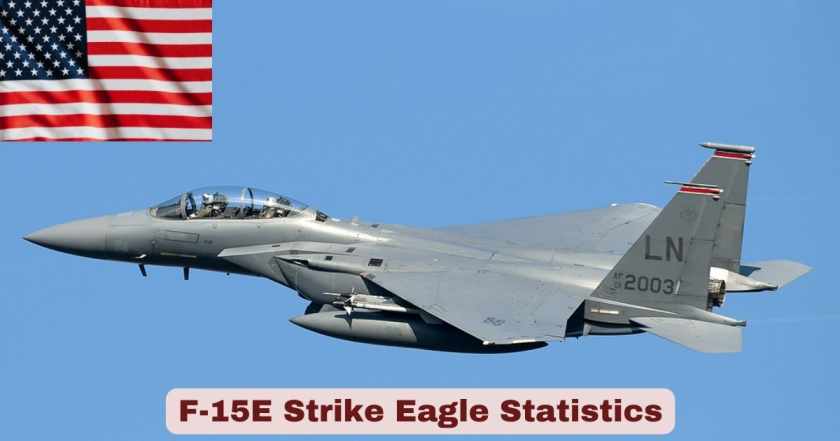
F-15E Strike Eagle in 2026
The F-15E Strike Eagle is arguably the most battle-proven multirole strike fighter in the history of the United States Air Force. Originally designed and built by McDonnell Douglas — a company absorbed by Boeing following their 1997 merger — the F-15E first flew on December 11, 1986, and entered operational service with the USAF in 1989. Unlike earlier Eagle variants that were dedicated air-superiority platforms, the Strike Eagle was purpose-built for the Dual-Role Fighter mission: fly deep into enemy territory, destroy heavily defended ground targets with precision, and fight its way back out without an escort. It carries two crew members — a pilot and a Weapon Systems Officer (WSO) — and can haul almost every conventional and nuclear weapon in the USAF inventory across 15 hardpoints while still retaining the air-to-air combat DNA of its legendary F-15 lineage. In 2026, the USAF operates approximately 218 F-15E Strike Eagles and the jet remains one of the cornerstones of American airpower, having accumulated more than three decades of continuous combat action in every major theater from the Persian Gulf to Afghanistan, Iraq, Syria, and Libya.
What makes the F-15E Strike Eagle’s story in 2026 particularly compelling is the pace of transformation happening right now. The aircraft is undergoing the most significant modernization effort of its operational life — a sweeping upgrade campaign centered on the new AN/APG-82(V)1 Active Electronically Scanned Array (AESA) radar and the AN/ALQ-250 Eagle Passive/Active Warning Survivability System (EPAWSS), which replaced the aircraft’s 1970s-era analog electronic warfare suite beginning in January 2025, when the first two fully upgraded jets arrived at RAF Lakenheath, England. At the same time, the F-15E’s direct successor — the Boeing F-15EX Eagle II — is entering the USAF fleet with a planned buy of 104 aircraft at approximately $94 million per unit (Lot 4 flyaway cost). The F-15 family is not going anywhere. In 2026, between the upgraded Strike Eagle fleet and the incoming Eagle II, the F-15 line represents one of the USAF’s largest and most capable tactical aircraft investments — and the statistics behind that investment are nothing short of extraordinary.
Key Interesting Facts About the F-15E Strike Eagle in 2026
Here are the most remarkable facts and data points about the F-15E Strike Eagle — verified from official US government and defense program sources — before the detailed statistical breakdowns.
| Fact | Data Point |
|---|---|
| F-15E first flight date | December 11, 1986 |
| F-15E entered USAF service | 1989 |
| Total F-15E Strike Eagles ordered by USAF | 236 aircraft |
| Total F-15E variant aircraft built (all versions worldwide) | ~405 aircraft |
| USAF F-15E Strike Eagles in inventory (2026) | ~218 aircraft |
| F-15E aircraft in service worldwide (all operators) | ~335 aircraft (approx.) |
| F-15E maximum takeoff weight | 81,000 lb (36,741 kg) |
| F-15E maximum speed | Mach 2.5 |
| F-15E service ceiling | 50,000 ft |
| F-15E combat range with CFTs + 3 external tanks | ~2,762 miles (further with air refueling) |
| F-15E weapons hardpoints | 15 |
| F-15E maximum weapons payload | ~29,000 lb (13,154 kg) |
| F-15 family air-to-air combat record (all variants) | 104 kills — 0 losses |
| F-15E sorties flown in Gulf War (Desert Storm, 1991) | ~2,200 sorties |
| Coalition precision munitions share delivered by F-15Es — Gulf War | ~60% |
| F-15E combat losses to enemy fire (all conflicts to date) | 2 aircraft (both Gulf War) |
| F-15EX Eagle II flyaway cost — Lot 4 (FY2026) | $94 million per aircraft |
| F-15EX Eagle II fully combat-ready cost (incl. EPAWSS + targeting + IRST pods) | up to $117 million |
| Total USAF F-15EX procurement planned | 104 aircraft |
| F-15EX Lot 4 deliveries — scheduled start | 2026 |
| EPAWSS unit acquisition cost per system | $17.355 million |
| Number of F-15Es receiving EPAWSS upgrade | 99 aircraft |
| First EPAWSS-equipped F-15E delivered to frontline unit | January 15, 2025 — 48th FW, RAF Lakenheath, England |
| F-15E planned USAF service life | Through at least 2035 (airframe rated 8,000–16,000 hrs with depot maintenance) |
| F-15E engines (primary configuration) | 2x Pratt and Whitney F100-PW-229 turbofans, 29,000 lb thrust each |
| F-15E internal cannon | M61A1 20mm six-barrel Vulcan Gatling gun (500 rounds) |
Data Sources: USAF Fact Sheet — F-15E Strike Eagle, af.mil; Air and Space Forces Magazine F-15E Weapon System Page, airandspaceforces.com; Wikipedia — McDonnell Douglas F-15E Strike Eagle (updated February 2026); Airfighters.com F-15E data; Breaking Defense — F-15EX unit cost reporting, October 2023; The War Zone — EPAWSS delivery report, January 2025; Air Force Materiel Command EPAWSS delivery press release, afmc.af.mil.
These headline numbers tell you almost everything you need to know about why the F-15E Strike Eagle has endured for over three decades without a single air-to-air combat loss. The aircraft’s combination of raw performance figures — Mach 2.5 top speed, 50,000 ft ceiling, 29,000 lb payload, and a 2,762-mile range — puts it in a class almost entirely by itself among tactical strike fighters. The F-15 family’s 104-0 air-to-air combat record is, without exaggeration, the most dominant kill-loss ratio of any jet fighter in history. And the fact that F-15E Strike Eagles flew approximately 2,200 sorties in the Gulf War alone while delivering roughly 60% of all coalition precision-guided munitions shows this is not just a platform that looks good on paper — it is a machine that wins wars.
The modernization statistics are equally striking. The EPAWSS program’s $17.355 million per-system unit cost — upgrading 99 F-15Es in total — represents a concentrated investment by the USAF in keeping the Strike Eagle relevant through the mid-2030s. The January 2025 arrival of the first EPAWSS-equipped F-15Es at RAF Lakenheath marked a generational leap in survivability for a platform originally designed to face Cold War threats. Together with the incoming F-15EX Eagle II — 104 new-build jets at approximately $94 million each, with Lot 4 deliveries beginning in 2026 — the F-15 line is in many ways more capable in 2026 than at any point in its history.
F-15E Strike Eagle Losses in Operation Epic Fury — Iran War, March 2026
In a development that broke on March 2, 2026 — the same day this article was published — the F-15E Strike Eagle’s combat loss record changed for the first time since the Gulf War. Three USAF F-15E Strike Eagles were shot down over Kuwait during Operation Epic Fury, the US-led air campaign against Iran. This is, without question, the most significant F-15E loss event in over 30 years and constitutes a major operational and historical data point for this aircraft.
| Incident / Data Point | Confirmed Detail |
|---|---|
| Operation name | Operation Epic Fury — US campaign against Iran |
| Operation start date | February 28, 2026 — US and Israeli coordinated strikes on Iran |
| F-15E losses — date and time | March 1, 2026, 11:03 p.m. ET (March 2, local Kuwait time, 7:03 a.m.) |
| Number of F-15E Strike Eagles lost | 3 aircraft |
| Cause of loss | Apparent friendly fire — mistakenly shot down by Kuwaiti air defenses |
| All six aircrew status | All 6 safely ejected and recovered; all in stable condition |
| Crew composition | 3 pilots + 3 Weapons Systems Officers (WSOs) |
| Squadron identification (open-source) | Helmet markings traced to 335th Fighter Squadron, Seymour Johnson AFB, NC |
| Operational context | Aircraft flying defensive missions during Iranian attack involving ballistic missiles, drones, and aircraft |
| Kuwait acknowledgement | Kuwait confirmed the incident; CENTCOM expressed gratitude for Kuwait’s SAR support |
| Investigation status | Under investigation as of March 2, 2026 |
| Confirmed by | US Central Command (CENTCOM) official press release |
| Prior F-15E combat losses (total before this incident) | 2 aircraft — both during Gulf War (Desert Storm, 1991) |
| Updated F-15E total combat losses | 5 aircraft (2 Desert Storm + 3 Operation Epic Fury) |
| Air-to-air combat losses — F-15 family (all variants) | Still 0 — these losses were not air-to-air defeats |
| Context: Iranian strikes in region (as of March 2, 2026) | Iran launched retaliatory strikes on bases in Kuwait, Bahrain, UAE, and Jordan; 555+ people killed in Iran by US-Israeli strikes per Iranian Red Crescent Society |
| US fatalities in Operation Epic Fury (as of March 2, 2026) | 4 US service members killed in action |
| Primary F-15E deployment base for Operation Epic Fury | Muwaffaq Salti Air Base, Jordan (F-15Es redeployed from RAF Lakenheath in January 2026) |
| THAAD defense at Muwaffaq Salti | One of 8 bases worldwide with THAAD anti-ballistic missile system deployed |
Data Sources: US Central Command (CENTCOM) official press release, March 2, 2026; Air and Space Forces Magazine — “Three USAF F-15E Strike Eagles Shot Down By Friendly Fire,” March 2, 2026, airandspaceforces.com; The War Zone (twz.com) — “Three U.S. F-15E Strike Eagles Shot Down In Apparent Friendly Fire Incident in Kuwait,” March 2, 2026; Aviation Week Network — “U.S. Suffers F-15 Losses As Iran Fighting Widens,” March 2, 2026; The Aviationist — “Three U.S. F-15E Strike Eagles Shot Down,” March 2, 2026; Military Times — “3 F-15s Shot Down by Kuwait in Friendly Fire Incident,” March 2, 2026; Task and Purpose — F-15 Middle East deployment reporting, January 2026.
The loss of three F-15E Strike Eagles on March 1–2, 2026 in a single friendly fire incident is a watershed moment in the aircraft’s operational history. The circumstances are as important as the numbers. CENTCOM’s confirmed account states that the jets were flying defensive combat operations against incoming Iranian ballistic missiles and drones over Kuwait when Kuwaiti air defenses mistakenly engaged them — a tragic and textbook example of the fratricide risks inherent in the most complex air defense battlespace in decades. The F-15E is notably not equipped with a Missile Warning Sensor (MWS) for infrared-guided missiles, which means the crews had no onboard warning system if the surface-to-air missiles were IR-guided — the aircraft would have had no automatic alert before impact. The fact that all six crew members ejected safely and were recovered is a tribute to both the ACES II zero/zero ejection seats and the responsiveness of Kuwaiti and US search-and-rescue forces.
The operational backdrop gives these losses the weight they deserve. Operation Epic Fury began February 28, 2026, when US and Israeli forces launched a massive coordinated strike on Iranian nuclear facilities, IRGC command centers, air defense capabilities, missile launch sites, and military airfields across Tehran, Isfahan, and Qom. Iran responded with retaliatory strikes on US and partner bases across the region — Kuwait, Bahrain, UAE, and Jordan — launching hundreds of ballistic missiles and drones in a sustained campaign that required around-the-clock air defense operations. F-15Es had been forward deployed from RAF Lakenheath to Muwaffaq Salti Air Base in Jordan specifically for this operation as recently as January 2026, reflecting the USAF’s assessment that the Strike Eagle’s combination of range, payload, and the newly fielded EPAWSS electronic warfare suite made it indispensable for the missions ahead. The loss of three jets to friendly fire in this context does not diminish the aircraft’s capabilities — it underscores the terrifying complexity of operating in a multi-partner, multi-threat, contested combat zone where deconfliction of airspace at the required speed is an unsolved operational challenge even for the most advanced militaries on Earth.
F-15E Strike Eagle Core Performance Specifications in 2026
Before examining deployment data, modernization programs, and international operators, it helps to have all the key performance numbers in one place. The table below draws directly from the official US Air Force Fact Sheet and verified defense program data.
| Specification | F-15E Strike Eagle |
|---|---|
| Primary Mission | Dual-role: air-to-air and deep strike / air-to-ground |
| Crew | 2 — Pilot + Weapon Systems Officer (WSO) |
| First Flight | December 11, 1986 |
| Entered USAF Service | 1989 |
| Manufacturer | McDonnell Douglas / Boeing (post-1997 merger) |
| Engines | 2x Pratt and Whitney F100-PW-229 afterburning turbofans |
| Engine Thrust (each, with afterburner) | 29,000 lb |
| Maximum Speed | Mach 2.5 (~1,875 mph / ~3,017 km/h) |
| Service Ceiling | 50,000 ft (15,240 m) |
| Range (with CFTs + 3 external tanks) | ~2,762 miles (4,445 km) |
| Maximum Takeoff Weight | 81,000 lb (36,741 kg) |
| Weapons Payload | ~29,000 lb (13,154 kg) across 15 hardpoints |
| Internal Cannon | M61A1 Vulcan, 20mm, 6-barrel rotary, 500 rounds |
| Air-to-Air Missiles | AIM-9 Sidewinder, AIM-120 AMRAAM |
| Air-to-Ground Weapons | GBU-10/12/24/28/31/38, JASSM, SDB, B61 nuclear gravity bomb |
| Radar (legacy) | AN/APG-70 mechanically scanned |
| Radar (upgraded — Radar Modernization Program) | AN/APG-82(V)1 AESA |
| Electronic Warfare (legacy) | AN/ALQ-135 TEWS (1970s analog technology) |
| Electronic Warfare (upgraded) | AN/ALQ-250 EPAWSS |
| Navigation System | Laser gyro + GPS; digital moving map in both cockpits |
| Low-Level Targeting | LANTIRN pods (terrain-following radar + infrared targeting) |
| Airframe Service Life | 8,000 hours rated; up to 16,000 hrs with depot maintenance |
| Ejection Seats | ACES II zero/zero ejection seats (pilot + WSO) |
Data Sources: US Air Force Official Fact Sheet — F-15E Strike Eagle, af.mil; Air and Space Forces Magazine F-15E weapon system overview, airandspaceforces.com; Seymour Johnson AFB F-15E Fact Sheet, seymourjohnson.af.mil; Wikipedia — McDonnell Douglas F-15E Strike Eagle (updated 2026).
The F-15E’s performance specifications represent a platform designed in the early 1980s that has been so thoroughly modernized it remains competitive with aircraft built in the 21st century. The Mach 2.5 top speed makes it one of the fastest tactical jets currently flying — a figure that actually exceeds the F-22 Raptor in raw dash speed, though the Raptor leads in sustained supercruise and stealth. The 29,000-lb weapons payload spread across 15 hardpoints is simply unmatched among fighter aircraft in the current USAF inventory. No other tactical jet in the US arsenal carries as much ordnance — which is precisely why mission planners consistently assign the Strike Eagle to the most demanding and heavily tasked strike packages.
The airframe life statistics tell a fascinating story about the engineering quality behind the original design. An F-15E’s structure is rated for 8,000 flight hours, but can be extended to 16,000 hours with proper depot maintenance — twice the lifetime of earlier F-15 variants. That exceptional structural durability is exactly why the USAF is willing to invest hundreds of millions in modernization programs like EPAWSS and the APG-82 radar upgrade rather than simply retiring the fleet. As of late 2024, 119 of the 218 F-15Es in USAF inventory were still powered by the older F100-PW-220 engines producing 23,500 lb of thrust each — a fact that underscores both the age range of the surviving fleet and the scope of standardization work still ahead.
F-15E Strike Eagle Fleet Numbers and USAF Inventory in 2026
How many F-15E Strike Eagles does the United States Air Force actually operate in 2026 — and how does that compare to the broader global picture?
| Operator | Variant | Aircraft in Service (2026 approx.) | Primary Base(s) / Notes |
|---|---|---|---|
| US Air Force | F-15E Strike Eagle | ~218 | Seymour Johnson AFB, NC; Mountain Home AFB, ID; RAF Lakenheath, UK; Kadena AB, Japan (rotational) |
| Israel (IAF) | F-15I Ra’am | 25 | Tel Nof Air Base; F-15IA (EX-based) contract signed Dec. 2025 for 25 more |
| Saudi Arabia (RSAF) | F-15S / F-15SR | ~72 built; 66 undergoing F-15SR upgrade by 2026 | Multiple RSAF bases |
| South Korea (RoKAF) | F-15K Slam Eagle | ~59–61 | Daegu Air Base; APG-82 + EPAWSS upgrade approved Dec. 2022 |
| Singapore (RSAF) | F-15SG | ~24 | Paya Lebar Air Base; 6 stationed at Mountain Home AFB, ID for training |
| Qatar (QEF) | F-15QA | 36 | All delivered; direct predecessor/basis for F-15EX design |
| Total — All F-15E variants worldwide | — | ~335 approx. | — |
| USAF F-15EX Eagle II — in inventory (March 2026) | F-15EX | ~20–30+ aircraft (ongoing deliveries since Mar. 2021) | Eglin AFB FL (test); Portland ANGB OR; deliveries to additional ANG units |
| USAF F-15EX Eagle II — total planned buy | F-15EX | 104 | Lot 4 deliveries commencing 2026 |
Data Sources: Airfighters.com F-15E Strike Eagle global operator data (updated 2026); Air and Space Forces Magazine — F-15EX inventory and basing; Wikipedia — McDonnell Douglas F-15E Strike Eagle operator list (updated February 2026); Wikipedia — Boeing F-15EX Eagle II (updated January 2026); The War Zone reporting on USAF F-15E inventory, 2024–2025.
The ~218 USAF F-15Es in active inventory place the Strike Eagle among the most numerous advanced strike aircraft in the American fleet, though that number has been declining from the original 236 delivered as older airframes reach end-of-life. The Air Force has been engaged in a significant internal debate about how aggressively to retire older F-15Es — one that Congress has repeatedly pushed back on, concerned about shrinking tactical aircraft numbers at a time when global threats are multiplying. The ~335 F-15E variants in service worldwide make this one of the most widely deployed advanced multirole strike aircraft families on the planet, with operators on four continents and in three of the most strategically sensitive regions in the world — the Middle East, East Asia, and Europe.
The F-15EX Eagle II is the crucial part of this picture going forward. With Lot 4 deliveries commencing in 2026 and a total program buy of 104 aircraft, the USAF is actively shaping a force structure that blends the proven operational heritage of the F-15E with the dramatically enhanced capabilities of the EX. Critically, basic F-15 training for both the F-15E and F-15EX will transition to Seymour Johnson AFB, North Carolina beginning in 2026 — cementing the traditional home of the Strike Eagle as the nucleus of the entire F-15 family’s future. The planned permanent basing of 36 F-15EXs at Kadena AB, Japan — expected as early as 2026 — will restore a permanent advanced Eagle presence at one of the most strategically critical bases in the Pacific, following the December 2024 completion of the F-15C/D drawdown there.
F-15E Strike Eagle Combat History and Operational Statistics in 2026
The F-15E Strike Eagle’s combat record is one of the defining statistics in modern military aviation. The table below captures key operational data across every major conflict in which the aircraft has been employed.
| Conflict / Operation | Period | Key F-15E Role and Statistics |
|---|---|---|
| Operation Desert Shield / Desert Storm (Gulf War) | 1990–1991 | ~2,200 sorties; delivered ~60% of coalition precision-guided munitions; hunted SCUD missile launchers nightly; scored F-15E’s only air-to-air kill (Iraqi Mi-24 Hind, Feb. 14, 1991, via GBU-10); 2 aircraft lost to ground fire |
| Operations Northern and Southern Watch (Iraq NFZs) | 1991–2003 | Enforced no-fly zones; struck Iraqi radar, comms, and C2 sites; multiple deployed rotations over 12 years |
| Operation Allied Force (Yugoslavia / Kosovo) | 1999 | Precision strikes against Serbian military infrastructure, air defense sites, command nodes |
| Operation Enduring Freedom (Afghanistan) | 2001–2014 | Multi-year continuous deployment; close air support, deep strike, ISR; routinely loitered 10+ hours per sortie via air refueling |
| Operation Iraqi Freedom / Operation New Dawn | 2003–2011 | Strike packages against hardened targets; time-sensitive targeting missions; significant role in the initial air campaign |
| Operation Inherent Resolve (Iraq / Syria — ISIS) | 2014–present | Precision strikes on ISIS infrastructure, command nodes, oil facilities; deployed from Incirlik and regional bases |
| Saudi-led coalition operations, Yemen theater | 2015–present | Saudi F-15S/SR aircraft; at least 2 RSAF F-15S aircraft lost during Houthi-contested operations |
| Iranian drone and missile intercept, Israel (April 2024) | April 13–14, 2024 | US F-15Es covered North and Central corridors during Iran’s 300+ projectile attack on Israel; APG-82 AESA radar key to intercept chain; F-16Cs covered South corridor |
| F-15 family overall air-to-air record (all variants, all operators) | 1979–2026 | 104 aerial victories — 0 air-to-air losses |
| USAF F-15 air-to-air kills in Desert Storm | 1991 | 34 confirmed kills (F-15C/D); F-15 accounted for 36 of USAF’s 39 total air-to-air victories in the war |
Data Sources: US Air Force Official Fact Sheet — F-15E Strike Eagle, af.mil; Wikipedia — McDonnell Douglas F-15E Strike Eagle operational history (updated 2026); warhistory.org — F-15E Operational History; defensefeeds.com — F-15E Strike Eagle combat analysis (February 2026); zona-militar.com — AESA radar role in April 2024 Iranian drone/missile intercept (November 2025); Sandboxx News — F-15E Gulf War air-to-air kill account.
The approximately 2,200 Gulf War sorties and the ~60% share of coalition precision-guided munitions delivered by the Strike Eagle are not numbers that can be overstated. In a 42-day air campaign that dismantled one of the largest Arab armies in history, the F-15E functioned as the precision backbone of the coalition effort. Night after night, Strike Eagles hunted SCUD launchers across western Iraq using LANTIRN’s terrain-following radar to fly fast and low in the dark, then climbed to deliver laser-guided bombs with pinpoint accuracy. The aircraft’s first-ever air-to-air kill — destroying an Iraqi Mi-24 Hind helicopter on February 14, 1991, with a 2,000-lb GBU-10 laser-guided bomb rather than a missile — remains one of the most remarkable individual engagements in aviation history. The bomb was dropped on a helicopter that was approximately 800 feet above the ground, while the pilot and WSO were engaged with four other Iraqi helicopters threatening US Special Forces on the ground.
The April 2024 Iranian mass attack on Israel added an entirely new chapter to the F-15E’s operational record. Assigned to cover the North and Central airspace corridors as Iran launched over 300 ballistic missiles and drones, US F-15Es helped neutralize one of the largest air defense challenges in the Middle East in decades. The APG-82(V)1 AESA radar’s ability to simultaneously track multiple aerial targets at extended ranges was cited as central to the kill chain that night. This is precisely the operational scenario that the EPAWSS upgrade and the next-generation APG-82(V)X radar are engineered to optimize the aircraft for going forward — contested, multi-threat airspace against near-peer adversary systems.
F-15E Strike Eagle Modernization Programs and Key Statistics in 2026
The F-15E’s 2026 modernization portfolio is one of the most intensive upgrade campaigns currently active in the USAF. Two programs in particular define the aircraft’s trajectory through the 2030s.
| Program | Details | Status and Key Data |
|---|---|---|
| AN/APG-82(V)1 AESA Radar — Radar Modernization Program (RMP) | Replaces legacy AN/APG-70 with Active AESA; combines APG-63(V)3 antenna + APG-79 processor | IOC achieved 2014; fleet-wide upgrade targeting completion 2025 per Air and Space Forces Magazine |
| AN/ALQ-250 EPAWSS — Eagle Passive/Active Warning Survivability System | Replaces Cold War-era AN/ALQ-135 TEWS; integrates radar warning, geolocation, active/passive jamming, decoy dispensing | First delivered Jan. 15, 2025 to 48th FW, RAF Lakenheath; 99 F-15Es to receive upgrade |
| EPAWSS unit acquisition cost (FY2024 Air Force SAR) | Per system, then-year dollars | $17.355 million (up from $10.1M baseline due to smaller fleet buy: 99 vs. 217 aircraft) |
| EPAWSS — Nunn-McCurdy breach | Cost growth triggered mandatory SecDef program review | Program certified as essential and continued; smaller fleet receiving upgrade |
| Large Area Digital (LAD) Displays + MIDS/JTRS | Full-color cockpit display upgrade to exploit AESA and EPAWSS; enables jam-resistant Link 16 data networking | Concurrent upgrade supporting RMP and EPAWSS programs |
| MUOS SATCOM + SATURN UHF | Secure, jam-resistant satellite communications; NATO-interoperable | F-15Es transitioning to new systems 2024–2026 |
| AN/APG-82(V)X — next-generation radar (for F-15EX) | Gallium nitride (GaN) based; longer range, lower probability of intercept (LPI), enhanced EW vs. APG-82(V)1 | Announced by Raytheon, Air Space and Cyber Conference, September 2025; intended for F-15EX production |
| South Korea F-15K upgrade (approved Dec. 2022) | All ~59 F-15Ks to APG-82(V)1 AESA + EPAWSS + ADCP II mission computer | In progress as of 2026 |
| Open Mission System (OMS) architecture — F-15EX | Software-defined open architecture enabling rapid capability upgrades without full hardware overhaul | Standard on F-15EX; enables rapid integration of new weapons and sensors |
Data Sources: Air and Space Forces Magazine — F-15E weapon system modernization page, airandspaceforces.com (January 2026 update); Air Force Materiel Command news release — first EPAWSS F-15E delivery, afmc.af.mil; The War Zone — EPAWSS F-15E analysis and delivery coverage, January 2025; Interesting Engineering — EPAWSS overview, January 2025; The War Zone — APG-82(V)X announcement, September 2025; Wikipedia — F-15E EPAWSS and RMP program sections (updated 2026).
The two most consequential numbers in this modernization table are 99 F-15Es receiving EPAWSS at $17.355 million per system — and the January 15, 2025 delivery date to RAF Lakenheath’s 48th Fighter Wing. That delivery location was deliberate. Lakenheath’s Strike Eagles are the aircraft most likely to find themselves in high-threat European airspace if deterrence fails with Russia, making them the right place to field the most advanced EW capability first. EPAWSS replaces three separate legacy components — the AN/ALR-56C radar warning receiver, the AN/ALQ-135 internal jamming system, and the AN/ALE-45 dispenser set — consolidating all three into a single integrated digital suite that is simultaneously lighter, smaller, more capable, and more maintainable than what it replaced. The unit cost jump from $10.1 million to $17.355 million reflects a painful but unavoidable consequence of reducing the upgrade fleet from 217 aircraft to 99 — the same fixed development costs spread over far fewer units.
The APG-82(V)X unveiled in September 2025 signals that Raytheon and the USAF are already looking beyond the current upgrade generation. The gallium nitride technology underlying the new radar is the same semiconductor advance that has transformed the latest generation of AESA radars across multiple platforms — it delivers dramatically higher power density, broader bandwidth, and better thermal performance than silicon-based predecessors. In plain English: the radar sees further, is harder for the enemy to detect, and can jam a wider range of threats simultaneously. Combined with EPAWSS’s autonomous threat detection and response capabilities, the F-15EX with APG-82(V)X will enter service with a sensor and electronic warfare suite that would have been considered futuristic when the original F-15E first flew in 1986.
F-15E Strike Eagle Cost and Procurement Statistics in 2026
Understanding the F-15E’s cost profile — both its original acquisition figures and current F-15EX procurement data — is essential context for evaluating the platform’s role in the 2026 USAF fighter inventory.
| Cost / Procurement Metric | Amount | Source / Notes |
|---|---|---|
| F-15E original USAF flyaway cost (FY1998 dollars) | $31.1 million per aircraft | Official program flyaway cost at time of production |
| F-15E flyaway cost adjusted to 2026 dollars (CPI) | ~$62 million | CPI inflation-adjusted calculation from FY1998 base |
| Total USAF F-15E aircraft ordered | 236 | Full production run; Boeing / McDonnell Douglas |
| F-15EX flyaway cost — Lot 1 (6 aircraft, FY2020) | $80.5 million per aircraft | Breaking Defense; first production lot contract, Nov. 2022 |
| F-15EX flyaway cost — Lot 2 | ~$90 million per aircraft | Breaking Defense exclusive, October 2023 |
| F-15EX flyaway cost — Lot 3 | ~$97 million per aircraft | Breaking Defense exclusive, October 2023 |
| F-15EX flyaway cost — Lot 4 (24 aircraft) | ~$94 million per aircraft | Pentagon APUC; Air and Space Forces Magazine |
| F-15EX fully combat-ready all-in cost (incl. EPAWSS + targeting pod + IRST) | ~$117 million per aircraft | Breaking Defense / Heritage Foundation analysis, 2022 |
| Cumulative value — Lots 2, 3 and 4 Boeing contract | $3.9 billion for 48 aircraft | Breaking Defense, October 2023 |
| Total USAF F-15EX planned buy | 104 aircraft (reduced from 144) | Air and Space Forces Magazine |
| USAF F-15EX EPAWSS unit acquisition cost | $17.355 million per system | USAF Selected Acquisition Report (SAR) |
| Boeing F-15EX first delivery | March 11, 2021 — Eglin AFB, FL | Air Force Materiel Command |
| F-15EX Lot 4 delivery commencement | 2026 | Boeing spokesperson per Breaking Defense |
| F-15EX Initial Operational Capability (IOC) | July 10, 2024 — 142nd Wing, Portland ANGB, OR | Air and Space Forces Magazine |
| Israel F-15IA contract | Signed December 2025 — 25 aircraft with option for 25 more | Wikipedia — Boeing F-15EX Eagle II (Jan. 2026 update) |
| Egypt F-15EX talks (as of Nov. 2025) | Up to 46 F-15EX fighters; initial deliveries potentially from 2028 | Wikipedia — Boeing F-15EX Eagle II (Jan. 2026 update) |
Data Sources: Breaking Defense — F-15EX unit cost exclusive reporting, October 2023, breakingdefense.com; Air and Space Forces Magazine — F-15EX program overview, airandspaceforces.com; Air Force Materiel Command — F-15EX delivery records; USAF Selected Acquisition Report (SAR) data as reported by Air and Space Forces Magazine; Wikipedia — Boeing F-15EX Eagle II (updated January 2026).
The cost trajectory of the F-15EX program is one of the more debated topics in current USAF procurement circles. When Boeing first pitched the aircraft in the late 2010s, the estimated unit cost was $80 million — positioned as a less expensive alternative to the F-35A. The reality has been more complicated. The Lot 2 price of $90 million, Lot 3 at $97 million, and Lot 4 settling at $94 million means the aircraft now costs more per unit than an F-35A on flyaway cost alone. When the targeting pod ($2.5 million), IRST pod ($10.9 million), and EPAWSS ($13.6 million) required for full combat capability are added — as detailed in a 2022 Breaking Defense analysis — the all-in figure reaches approximately $117 million. Boeing and the USAF dispute this framing because the F-15EX’s official flyaway cost definition does include EPAWSS, but the debate over what constitutes a fully capable aircraft continues.
The December 2025 Israel contract for 25 F-15IA aircraft with options for 25 more is significant beyond the sale itself. Foreign military sales help reduce per-unit production costs for the USAF by spreading Boeing’s manufacturing overhead across a larger order book — which is why Boeing has consistently prioritized international deals as a cost-control mechanism for American procurement. Egypt’s negotiations for up to 46 F-15EXs with deliveries potentially starting in 2028 add to that pipeline. The consolidation of F-15E and F-15EX training at Seymour Johnson AFB from 2026 represents the USAF formally cementing the Strike Eagle’s home base as the operational and institutional center of the entire F-15 family — a recognition that this aircraft is not a legacy platform in its final years, but a modernizing workhorse with at least another decade of frontline service ahead.
Disclaimer: This research report is compiled from publicly available sources. While reasonable efforts have been made to ensure accuracy, no representation or warranty, express or implied, is given as to the completeness or reliability of the information. We accept no liability for any errors, omissions, losses, or damages of any kind arising from the use of this report.