
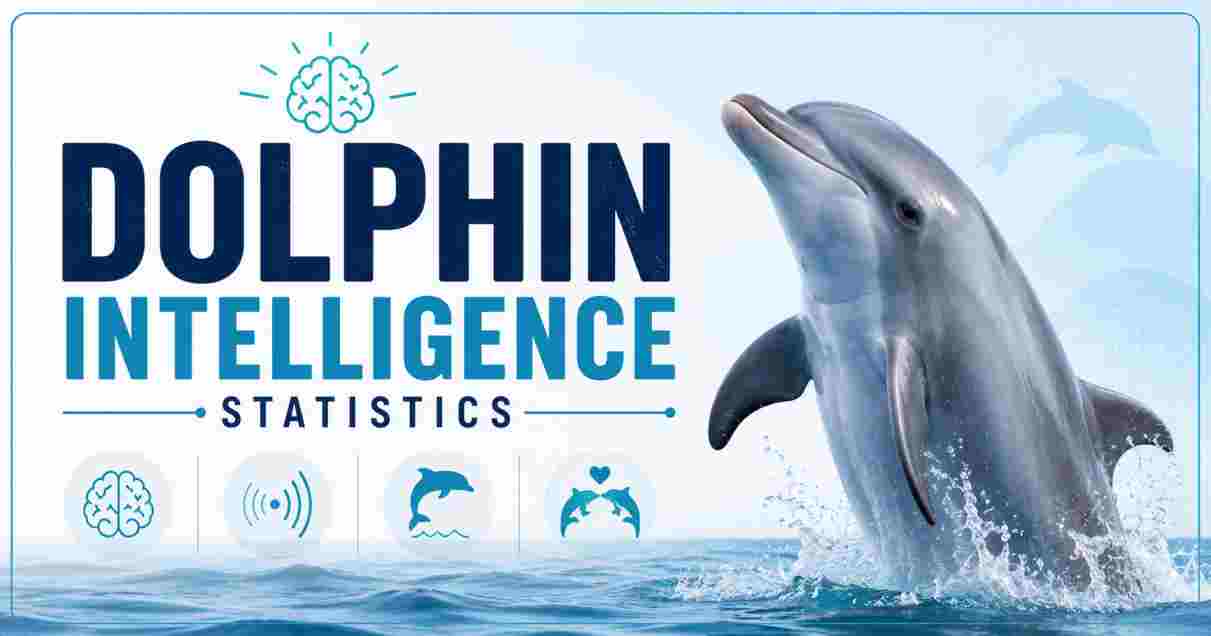
How Smart Are Dolphins? What Science Shows in 2026
Dolphins sit near the top of every credible animal intelligence ranking, and the research behind that placement is more rigorous than most people realize. They are not intelligent in a vague, feel-good sense that popular documentaries project onto them. They are intelligent in the specific, measurable ways that scientists use to assess cognition: they pass the mirror self-recognition test, a threshold cleared by fewer than ten species on Earth. They maintain social memories lasting over 20 years — the longest recorded in any non-human species. They have been observed using tools in the wild and passing that knowledge across generations. A 2025 study from Woods Hole Oceanographic Institution produced what researchers described as the first evidence of possible language-like communication in dolphins, with non-signature whistles functioning like shared vocabulary across individuals. These are not behavioral curiosities. They are data points in a growing body of research that places the bottlenose dolphin’s cognitive profile closer to great apes than to most other mammals.
What makes dolphin intelligence particularly interesting from a scientific standpoint is the evolutionary distance it represents. Dolphins and primates last shared a common ancestor roughly 95 million years ago, in a lineage that had almost certainly not yet developed the neural complexity we now associate with high cognition. Yet both groups independently evolved large brains, spindle neurons previously thought exclusive to humans, self-recognition, complex social structures, symbolic communication, and long-term memory. The technical term for this is convergent cognitive evolution — and it forces a fundamental question about intelligence itself. If two groups so distant from each other, with completely different brain architectures and ecological pressures, both arrived at similar cognitive outcomes, then the underlying drivers are probably broader and more fundamental than researchers had assumed. The bottlenose dolphin’s encephalization quotient of 4.14–5.6 — the ratio measuring brain size relative to body size — is second only to humans among all animals. That number, combined with what behavioral studies have revealed over decades, is why the dolphin remains one of the most studied and most cognitively significant non-human animals alive.
Key Interesting Facts: Dolphin Intelligence 2026
DOLPHIN INTELLIGENCE — AT A GLANCE (2026)
==========================================

EQ (Encephalization Quotient — brain/body ratio):
Humans             ████████████████████████████████████████████  7.0–7.8
Bottlenose Dolphin ████████████████████████████░░░░░░░░░░░░░░░░  4.14–5.6 (2nd highest globally)
Chimpanzee         ████████████████░░░░░░░░░░░░░░░░░░░░░░░░░░░░  2.2–2.5
Orca               ████████████████░░░░░░░░░░░░░░░░░░░░░░░░░░░░  2.57–3.3
Gorilla            ████████████░░░░░░░░░░░░░░░░░░░░░░░░░░░░░░░░  ~1.7–2.0
Dog                ████████░░░░░░░░░░░░░░░░░░░░░░░░░░░░░░░░░░░░  ~1.2

DOLPHIN BRAIN DEVELOPMENT SPEED vs. HUMAN:
Birth brain mass (% of adult):
Bottlenose Dolphin  ████████████████████████████░░░░░░░░  42.5% at birth
Human               ██████████████░░░░░░░░░░░░░░░░░░░░░░  28% at birth
80% adult brain mass reached:
Bottlenose Dolphin  ████████████████████████████░  18 months
Human               ██████████████████████████░░░  3–4 years
| Fact | Figure | Source / Date |
|---|---|---|
| Bottlenose dolphin EQ | 4.14–5.6 — 2nd highest of any animal after humans | EBSCO Research Starters; ScienceInsights (November 2025); Oreate AI (December 2025) |
| Human EQ for comparison | 7.0–7.8 | Oxford Reference; Oreate AI |
| Chimpanzee EQ for comparison | 2.2–2.5 | Oreate AI, December 2025 |
| Orca EQ | 2.57–3.3 | Oreate AI, December 2025 |
| Dolphin brain size vs. same-sized animals | Dolphin brain is 4–5 times larger than expected for an animal of its body size | Dolphins World; SuchScience |
| Dolphin brain mass at birth (% of adult) | 42.5% — vs. 28% for human newborns | Dolphins World |
| Age dolphin brain reaches 80% of adult mass | 18 months — vs. 3–4 years for humans | Dolphins World |
| Species of dolphin confirmed to pass mirror self-recognition (MSR) test | Bottlenose dolphin — confirmed by Reiss & Marino (2001), PNAS | PNAS; Scientific American (February 2024) |
| Other species that pass the MSR test (full list confirmed up to 2025) | Great apes, bottlenose dolphins, Asian elephants, magpies — and cleaner wrasse fish (debated) | Philosophical Transactions of the Royal Society B, November 13, 2025 |
| Dolphin MSR study result | All 3 predicted behaviors confirmed — selected best reflective surface to inspect markings | Scientific American; PNAS 2001 |
| Social memory duration — signature whistle recognition | Over 20 years — longest social memory documented in any non-human species | ScienceDaily; Proceedings of the Royal Society B |
| Dolphin studied — specific case | Two dolphins, Allie and Bailey, recognized each other after separation | Gizmodo; Jason Bruck PhD, SFA Sawdust Magazine |
| Signature whistles — how many recorded in Sarasota Bay alone | 926 recording sessions of 293 individual dolphins | Sarasota Dolphin Research Program |
| Non-signature whistles — new 2025 finding | First evidence that non-signature whistles may function like shared vocabulary (words) — not just individual identifiers | WHOI / phys.org, May 19, 2025; Laela Sayigh et al., bioRxiv April 2025 |
| Study recognition | Won inaugural Coller Dolittle Challenge for most significant animal communication research | phys.org, May 2025 |
| Dolphin spindle neurons (von Economo neurons) | Confirmed in bottlenose dolphins, humpback whales, fin whales, killer whales, sperm whales | Wild Dolphin Project; Mount Sinai School of Medicine |
| Dolphin limbic system compared to human | Dolphin limbic system is more developed than the human equivalent for social-emotional processing | zmescience.com citing Lori Marino, Emory University |
| Unihemispheric slow-wave sleep | Dolphins sleep with one brain hemisphere at a time — keeping the other fully awake; each hemisphere gets ~4 hours per 24-hour cycle | Live Science; Neuroscience & Biobehavioral Reviews, 2008 |
| Sponge tool use — new 2025 research finding | Sponging cognitively demands compensation for altered echolocation signals while using tool — harder than previously understood | Georgetown University / Aarhus University; Jacobs et al. 2025 |
| Cultural transmission of sponge tool use | Passed almost exclusively mother to calf after thousands of hours of exposure — not peer-to-peer | Georgetown University; Jacobs et al. 2025 |
| Echolocation frequency range | 0.2 to 150 kHz — objects detectable up to ~100 yards | Dolphin Research Center (Reynolds & Rommel, 1999) |
| Bottlenose dolphin’s melon | Waxy lens-shaped forehead structure that focuses echolocation clicks into a tight beam | Dolphin Research Center |
| Estimated global dolphin population | ~4–6 million individuals (best-available central estimate across all species) | Quora synthesis citing IUCN accounts and regional surveys, May 2024 |
| Number of cetacean species evaluated on IUCN Red List (2025) | 93 of 94 species, plus 10 subspecies and 31 subpopulations | IUCN SSC Cetacean Specialist Group, 2025-2 Red List edition |
| Māui dolphin population | ~54 individuals (2021 estimate; could be fewer than 40 accounting for recent mortalities) | New Zealand Government 2021 report; Wikipedia |
| Common dolphin female lifespan — recent decline | Female lifespan has shortened by 7 years on average — from 24 to 17 years; population growth slowed by 2.4% | Conservation Letters study; Discover Wildlife, October 2025 |
Source: EBSCO Research Starters (Dolphin Psychology); ScienceInsights (November 14, 2025); Oreate AI (December 16, 2025); phys.org / WHOI (May 19, 2025); Georgetown University press release (July 2025); Sarasota Dolphin Research Program; ScienceDaily (social memory); Dolphin Research Center; IUCN Cetacean Specialist Group (2025); Discover Wildlife (October 2025); Live Science (unihemispheric sleep)
Several numbers in this table deserve more attention than a single read through a table provides. An EQ of 4.14–5.6 in the bottlenose dolphin is not a marginal advantage over other mammals — it represents a brain that is proportionally more than three times larger than a chimpanzee’s relative to body size, in a species that shared no recent evolutionary history with primates. The fact that dolphin brains develop faster than human brains in early life — reaching 42.5% of adult mass at birth compared to 28% for humans — and hit the 80% threshold a full two to three years before human children do suggests that the neural investment dolphins make very early is substantially front-loaded. That pattern parallels what happens in primate species with high cognitive demands: they grow large brains quickly.
The 2025 WHOI paper on non-signature whistles is probably the most significant dolphin cognition finding of the past two years. Signature whistles — the individually unique sounds that function like names — have been studied for decades. Non-signature whistles, which make up roughly half of all dolphin vocalizations, received far less research attention until Laela Sayigh and colleagues identified stereotyped whistle types shared across multiple individuals — not unique identifiers, but apparently shared signals with consistent functions such as alarm and query. That is a different class of communication from naming. It looks like vocabulary. The research won the inaugural Coller Dolittle Challenge, a prize specifically for breakthrough animal communication research, and is currently in preprint as of April 2025. It has not yet cleared full peer review, but the researchers and the methods are credible and well-regarded.
Dolphin Brain: Size, Structure and Neuroscience Data 2026
DOLPHIN BRAIN — STRUCTURAL COMPARISON (2026)
=============================================

NEOCORTEX COMPLEXITY (folding / gyrification):
Human              ████████████████████████████████████████████  Very high
Bottlenose Dolphin ████████████████████████████████████████░░░░  Very high (comparable)
Chimpanzee         ████████████████████████████░░░░░░░░░░░░░░░░  High
Dog                ████████████░░░░░░░░░░░░░░░░░░░░░░░░░░░░░░░░  Moderate
Rat                ██████░░░░░░░░░░░░░░░░░░░░░░░░░░░░░░░░░░░░░░  Low (smooth)

BRAIN HEMISPHERE SIZES (DELPHINIDAE):
Dolphin            ████████████████████████████░░░░░░░░░░░░░░░░  ~1.5–1.7 kg (some species > human weight)
Human              ████████████████████████░░░░░░░░░░░░░░░░░░░░  ~1.3–1.4 kg

KEY STRUCTURES — CONFIRMED IN DOLPHIN BRAIN:
Neocortex                    ✓  Highly developed, comparable convolution to humans
Spindle neurons (VEN)        ✓  Found in limbic and frontoinsular cortex areas
Developed hippocampus        ✓  Supports spatial memory and navigation
Large cerebellum             ✓  Acoustic processing + movement coordination
Broca's/Wernicke's analogues ✓  Language-area homologues confirmed
| Brain Structure / Metric | Finding in Dolphins | Comparison / Context | Source |
|---|---|---|---|
| Brain weight (bottlenose dolphin) | ~1.5–1.7 kg in some species — larger than human brain by weight | Human: ~1.3–1.4 kg | Wild Dolphin Project; zmescience.com |
| EQ (encephalization quotient) | 4.14–5.6 depending on species and method | Human: 7.0–7.8; Chimp: 2.2–2.5 | EBSCO Research Starters; ScienceInsights |
| Neocortex convolution | Highly folded / gyrified — comparable to human neocortex | More convoluted than chimpanzees | ScienceNewsToday (April 2026); zmescience.com |
| Spindle neurons (Von Economo neurons) | Confirmed in bottlenose dolphins, humpbacks, orcas, fin whales, sperm whales | Previously thought exclusive to humans and great apes | Wild Dolphin Project; Mount Sinai School of Medicine |
| Limbic system development | More developed than in humans for social-emotional processing | Suggests dolphins may have richer emotional-social awareness than we do | zmescience.com citing Lori Marino |
| Hippocampus | Well-developed; supports memory and spatial navigation | Consistent with observed long-term social memory and navigation abilities | SuchScience; EBSCO |
| Cerebellum | Very large relative to brain — handles acoustic processing and movement | Acoustic processing is central to dolphin cognition (echolocation, communication) | SuchScience |
| Broca’s/Wernicke’s area homologues | Confirmed — dolphin brains have regions corresponding to human language areas | Do not produce language like humans but support communication via gesture, vocalization | National Chimpanzee Brain Resource (comparative data) |
| Brain size relative to similarly sized animals | 4–5 times larger than expected | MRI studies confirm consistent pattern | Dolphins World |
| Cognitive convergence with primates | Described by Reiss & Marino as “a striking case of cognitive convergence” despite 65–70 million years of separate evolution | Brains arrived at similar outcomes from completely different architectures | PNAS, 2001; EBSCO |
| Unihemispheric sleep — EEG confirmation | First documented in bottlenose dolphins in 1977 by Mukhametov et al., confirmed repeatedly | One hemisphere shows slow-wave sleep patterns; other shows wakefulness patterns simultaneously | PMC / Neuroscience & Biobehavioral Reviews |
| Sleep per hemisphere per 24 hours | ~4 hours of slow-wave sleep per hemisphere | Total: approximately 8 hours distributed across both hemispheres over 24 hours | Live Science; Neuroscience & Biobehavioral Reviews 2008 |
| Brain development at birth | Newborn bottlenose dolphin brain = 42.5% of adult mass | Human newborns: 28% of adult brain mass | Dolphins World |
| 80% adult brain mass reached | 18 months in dolphins | 3–4 years in humans | Dolphins World |
Source: zmescience.com citing Lori Marino; Wild Dolphin Project; ScienceNewsToday (April 7, 2026); EBSCO Research Starters; PNAS (Reiss & Marino, 2001); SuchScience; Dolphins World; Live Science (unihemispheric sleep); PMC unihemispheric sleep review
The spindle neuron finding is worth explaining properly, because it tends to get treated as a fun fact rather than the significant discovery it actually is. Von Economo neurons — also called spindle neurons — are a specific type of large, elongated brain cell found in the anterior cingulate cortex and frontoinsular cortex. In humans, they are strongly associated with empathy, social awareness, self-awareness, and the rapid processing of complex social information. Before 2006, they were considered exclusive to humans and great apes. Then they were found in elephants. Then in cetaceans — including bottlenose dolphins, humpback whales, fin whales, orcas, and sperm whales. Patrick Hof at the Mount Sinai School of Medicine, who co-discovered the whale spindle cells, has stated publicly: “It’s absolutely clear to me that these are extremely intelligent animals.” The presence of these cells in the same brain locations as in humans is not a coincidence. It suggests that the neural hardware for empathy and social self-awareness may have been selected for independently in multiple mammalian lineages that all faced similar social complexity challenges.
Unihemispheric slow-wave sleep is another dolphin brain capability that has moved from specialty neuroscience into mainstream awareness recently. The first EEG documentation of this in dolphins was published in 1977 by Mukhametov and colleagues, and it has been confirmed many times since. What it means practically: a dolphin at any given moment may have one hemisphere running normal waking patterns while the other is in deep sleep. The eye on the side of the sleeping hemisphere is closed; the other stays open. The sleeping dolphin continues swimming, continues monitoring the environment with its active hemisphere, and continues surfacing to breathe. Each hemisphere gets approximately 4 hours of slow-wave sleep per 24-hour cycle. A 2025 study published in a sleep science journal even attempted to test whether this ability might be evolutionarily conserved in humans by having people sleep in float tanks — the researchers were trying to determine whether the aquatic sleep adaptation might still be latent in human brains under the right conditions.
Dolphin Communication: Language, Whistles & Echolocation in 2026
DOLPHIN COMMUNICATION SYSTEM — 2026 OVERVIEW
=============================================

COMMUNICATION TYPES:
Signature whistles    ████████████████████████████░░░░░░░░  Individual "names" — unique per dolphin
Non-signature whistles ██████████████████████░░░░░░░░░░░░░  ~50% of all vocalizations — possible vocabulary
Echolocation clicks   ████████████████████████████████████  0.2–150 kHz; detects objects up to ~100 yards
Body language         ██████████████░░░░░░░░░░░░░░░░░░░░░░  Leaps, flips, jaw claps, postures

SIGNATURE WHISTLE DATABASE — SARASOTA BAY, FLORIDA:
Individuals recorded:     293 dolphins
Recording sessions:       926 sessions
Data collected since:     1970s (ongoing)
Program:                  Sarasota Dolphin Research Program (longest-running dolphin study globally)

NON-SIGNATURE WHISTLE FINDING (May 2025 — WHOI / Sarasota):
Proportion of vocalizations that are non-signature:  ~50%
Finding:  Stereotyped whistle types shared across multiple individuals
Function: Possible alarm, query, and other context-specific signals
Status:   Preprint April 2025; winner of inaugural Coller Dolittle Challenge
| Communication Metric | Finding | Source |
|---|---|---|
| Signature whistles | Each dolphin develops a unique signature whistle — a learned identity signal, functions like a name | EBSCO; Sarasota Dolphin Research Program |
| Signature whistles — learned, not inherited | Dolphins do not inherit their signature whistle; it is developed and modified over time | EBSCO Research Starters |
| Social memory via signature whistle — maximum confirmed | Over 20 years — longest social memory of any non-human species | ScienceDaily; Proceedings of the Royal Society B |
| Cross-modal recognition | Bruck’s research showed signature whistles are representational — hearing a whistle elicits a mental image of the owner | SFA Sawdust Magazine, Spring 2023 |
| Non-signature whistles — proportion of vocalizations | ~50% of all dolphin vocalizations | phys.org / WHOI, May 2025 |
| 2025 WHOI finding — non-signature whistles | First evidence of widespread sharing of stereotyped non-signature whistle types across wild individuals — possible vocabulary-like function | Sayigh et al., bioRxiv April 21, 2025; phys.org May 19, 2025 |
| Award won by WHOI research team | Inaugural Coller Dolittle Challenge — for most significant animal communication research | EcoWatch, July 2025; phys.org |
| Possible language-like structure | Specific non-signature whistles linked to alarm and query functions — shared across individuals | phys.org, May 2025 |
| Sarasota Dolphin Whistle Database | 926 recording sessions, 293 individual dolphins — age, sex, and matrilineage known for most | Sarasota Dolphin Research Program |
| Echolocation frequency range | 0.2 to 150 kHz | Dolphin Research Center (Reynolds & Rommel, 1999) |
| Echolocation detection range | Objects detectable up to ~100 yards | Dolphin Research Center |
| Melon (forehead structure) | Waxy, lens-shaped structure that focuses clicks into a tight forward beam | Dolphin Research Center |
| Click production method | Clicks produced in rapid sequences called “click trains” — sound like a creaking door or buzz at human-perceivable speed | Dolphin Research Center |
| Adaptive frequency use | Dolphins use lower frequencies for distant targets (longer range) and higher frequencies closer (more detail) | Dolphin Research Center |
| Sponge tool use echolocation finding (2025) | Sponge on rostrum significantly distorts acoustic signals — requiring active cognitive compensation | Georgetown University / Jacobs et al. 2025 |
| Maternal transmission of sponge technique | Calves exposed to thousands of hours of maternal sponging before mastering it independently | Georgetown / Jacobs et al. 2025 |
| Orca vocal dialects | Different orca pods maintain distinct dialects passed across generations | Scientific literature |
| Dolphin “baby talk” | Dolphin mothers use simplified, higher-pitched signature whistles when calling to their young — a direct parallel to human motherese | ScienceDaily, October 2, 2024 citing dolphin communication research |
Source: phys.org (May 19, 2025); Laela Sayigh et al. bioRxiv (April 21, 2025); Georgetown University press release (July 2025); Sarasota Dolphin Research Program; Dolphin Research Center; ScienceDaily (social memory, October 2024)
The 2025 WHOI paper on non-signature whistles needs clear context about what it does and does not claim. For decades, dolphin communication research focused heavily on signature whistles — the individually unique sounds that function like names. That work was important and well-supported. But it left a large gap: what do the other 50% of dolphin vocalizations — the non-signature whistles — actually do? Sayigh and colleagues found that stereotyped whistle types are shared across multiple wild dolphins and appear to be linked to specific contextual functions like alarm and query. A dolphin producing an alarm whistle is producing a signal that other dolphins in the group recognize as an alarm signal, not as an individual’s name. That is qualitatively different from signature whistle communication. It is context-specific shared signaling — which is closer to what we would consider vocabulary in human language systems. The research is still in preprint as of this writing, but the team and their methodology are well-established, and the Coller Dolittle Challenge — which specifically targets breakthrough animal communication science — doesn’t award its inaugural prize to weak work.
The sponge tool use research from Georgetown and Aarhus published in 2025 added a layer to a behavior first described by Krutzen and colleagues in 2005. It was always known that Shark Bay bottlenose dolphins in Australia carry marine sponges on their rostrums while foraging the seafloor. What the 2025 study found is that using a sponge is significantly more cognitively demanding than it appears, because the sponge distorts the dolphin’s echolocation signals — the primary sensory system it depends on to locate buried prey. Dolphins that sponge must actively compensate for corrupted acoustic input every single time they use the tool. That is not a simple learned trick. It requires real-time cognitive adjustment of a sensory system while simultaneously manipulating a tool and hunting. The fact that it is passed almost exclusively from mother to calf after thousands of hours of observation — rather than spreading peer-to-peer as many cultural behaviors do — makes it one of the clearest examples of deliberate maternal cultural transmission in non-human animals.
Dolphin Mirror Self-Recognition and Self-Awareness in 2026
MIRROR SELF-RECOGNITION TEST — SPECIES THAT PASS (2025 CONFIRMED LIST)
========================================================================

Confirmed (traditional MSR mark test):
Humans                  ✓  Emerges at 18–24 months (human children)
Great Apes              ✓  Chimpanzees, bonobos, gorillas, orangutans
Bottlenose Dolphins     ✓  Confirmed 2001 (Reiss & Marino, PNAS); earliest onset of any species
Asian Elephants         ✓  Confirmed 2006 (Plotnik et al.)
European Magpies        ✓  Only bird species; confirmed 2008

Debated / newer claims:
Cleaner Wrasse Fish     ⚠  Passed mark test 2019; interpretation contested
Various corvids         ⚠  Some evidence; not fully confirmed

DOLPHIN MSR — SPECIFIC FINDINGS (Reiss & Marino, PNAS 2001):
All 3 predicted self-aware behaviors confirmed:
✓ Did not show social responses to own reflection
✓ Spent more time at mirror when marked
✓ Navigated to best available reflective surface to inspect markings

PRECOCIOUS DEVELOPMENT:
Dolphins demonstrate MSR at a younger age than has been
reported for children OR any other species tested.
| Self-Awareness Metric | Dolphin Finding | Source / Date |
|---|---|---|
| Mirror self-recognition confirmed | Yes — bottlenose dolphin; confirmed in multiple studies since 2001 | Reiss & Marino, PNAS, 2001; Scientific American, February 2024 |
| Study design | Dolphins marked with black ink, sham-marked, or not marked — then given access to reflective surfaces | Reiss & Marino, PNAS, 2001 |
| Result — social response to reflection | Did not show social responses — consistent with recognizing self, not another dolphin | Reiss & Marino; Scientific American |
| Result — time at mirror when marked | Spent more time at the mirror when marked — inspection behavior | Reiss & Marino |
| Result — surface selection | Selected the best available reflective surface to inspect the marked area | Scientific American |
| Precocious MSR development | Dolphins show MSR at a younger age than human children or any other tested species | Precocious development study, PMC; PLoS ONE |
| Full species list confirmed for MSR (as of Nov 2025) | Great apes, bottlenose dolphins, Asian elephants, European magpies; cleaner wrasse debated | Philosophical Transactions of the Royal Society B, November 13, 2025 |
| Broader significance | “A striking case of cognitive convergence” — two lineages separated by 65–70 million years independently developed self-recognition | Reiss & Marino, PNAS; ScienceDirect (March 2026) |
| Implications for self-awareness theory | “Self-recognition may result from large brains and advanced cognitive ability, as opposed to being a byproduct of primate-specific factors” | Scientific American citing original PNAS study |
| Dolphin self-awareness research status (2026) | Still considered one of fewer than 10 species globally with confirmed self-awareness | Philosophical Transactions B, November 2025; ScienceInsights |
| Cross-modal taste + whistle identification (Bruck study) | Dolphins identify companions both by taste and signature whistle — multi-modal social recognition | SFA Sawdust Magazine, Spring 2023 |
| Dolphin “smile” communication (2024) | Research shows bottlenose dolphins use facial expressions during play — “smiling” at each other as social signal | ScienceDaily, October 2, 2024 |
Source: Reiss & Marino, PNAS (2001); Scientific American (February 2024); Philosophical Transactions of the Royal Society B (November 13, 2025); ScienceDirect (March 4, 2026); SFA Sawdust Magazine (Spring 2023); ScienceDaily (October 2, 2024)
The mirror self-recognition result holds up well against scrutiny, which is worth saying because some animal cognition claims do not. The original Reiss and Marino 2001 PNAS study used careful controls: a sham-marking condition (a water-filled marker that produced a visible mark but no ink), a no-marking condition, and the actual ink-marking condition. The predicted self-aware behaviors were specified before the experiment was run, not post-hoc. Both dolphin subjects showed all three. The study was not a case of observing animals doing something and then interpreting it as self-recognition after the fact — it used the same mark-test protocol developed by Gordon Gallup in 1970 for great apes, applied in a manner appropriate for an aquatic mammal. Subsequent studies have confirmed the finding and additionally shown that dolphins demonstrate MSR at an earlier developmental age than any other species tested, including human children. A human infant reliably passes the mirror test at 18–24 months. Dolphins appear to pass it younger.
The October 2024 research on dolphin smiling during play represents a direction the field is moving toward: documenting not just high-level cognition like self-recognition, but the social emotional signaling that underlies relationship maintenance in dolphin groups. The study showing that bottlenose dolphins produce open-mouth expressions directed at companions during play — and that those companions frequently mirror the expression back — is another data point suggesting that facial and gestural communication in dolphins carries social meaning in a way that is functionally similar to how these signals work in primates. Combine that with spindle neurons in the limbic system, a more elaborate limbic system than humans have, and the long-term social memory research, and the picture of dolphin social-emotional intelligence becomes difficult to dismiss.
Dolphin Social Intelligence: Memory, Culture and Relationships 2026
DOLPHIN SOCIAL STRUCTURE AND COGNITION
========================================

FISSION-FUSION SOCIETY (same structure as humans):
Core social units  →  Larger alliances  →  Fluid memberships based on context
"You get smart over evolutionary time when you have that kind of social system"
— Jason Bruck, PhD (who conducted the 20-year social memory study)

SOCIAL MEMORY DURATION COMPARISON:
Dolphins    ████████████████████████████████████████████████  20+ years confirmed
Elephants   █████████████████████████████████████████░░░░░░░  Very long (decades; less precisely quantified)
Humans      ████████████████████████████████████████░░░░░░░░  Long (decades; faces change, whistles don't)
Chimpanzees ████████████████████████████░░░░░░░░░░░░░░░░░░░░  Long (decades confirmed in some studies)

DOLPHIN CULTURAL BEHAVIORS DOCUMENTED IN WILD:
Sponge foraging tool use (Shark Bay, Australia)    ✓  Maternally transmitted
Crater feeding (Bahamas)                           ✓  Localized technique
Strand feeding (South Carolina coast)              ✓  Culturally transmitted
Mud ring feeding (Florida)                         ✓  Culturally transmitted
Beach rubbing (various sites)                      ✓  Social behavior
Signature whistle copying                          ✓  Individual mimicry
| Social Intelligence Metric | Finding | Source |
|---|---|---|
| Social structure type | Fission-fusion society — same structure as humans: fluid group membership, distinct social subgroups, complex alliances | SFA Sawdust Magazine citing Jason Bruck; EBSCO |
| Link between social complexity and intelligence | “When you have that kind of social system, you get smart over evolutionary time — or at least smart in a way that we understand” — Jason Bruck (researcher who conducted 20-year social memory study) | SFA Sawdust Magazine, Spring 2023 |
| Social memory duration | Dolphins recognized old tank-mates’ signature whistles after more than 20 years of separation | ScienceDaily; Proceedings of the Royal Society B (Bruck, 2013) |
| Exceeds human facial recognition advantage | Dolphin social memory may be “more long-lasting than facial recognition among humans” because human faces change over decades but dolphin signature whistles remain stable | ScienceDaily citing Bruck |
| Response strength — old vs. new companions | Dolphins responded significantly more to whistles of old companions than to unfamiliar dolphins, regardless of how long separated | Gizmodo citing Bruck; ScienceDaily |
| Social memory classified as | “An animal operating cognitively at a level that’s very consistent with human social memory“ | ScienceDaily citing Bruck |
| Representational memory confirmed | Hearing a signature whistle elicits a mental representation of the owner — not just a familiar sound | SFA Sawdust Magazine |
| Cross-modal identification | Dolphins identify companions by both taste and signature whistle — two separate sensory channels | SFA Sawdust Magazine, Spring 2023 |
| Cultural behaviors in wild — documented | Sponge foraging, crater feeding, strand feeding, mud ring feeding, beach rubbing — at least 5 distinct culturally transmitted foraging techniques | Georgetown 2025; established cetacean culture literature |
| Strand feeding | Group of dolphins chases fish onto a mudbank and temporarily beaches itself to catch them — learned group coordination technique | Cetacean culture literature |
| Sponge tool cultural transmission | Passed mother to calf after thousands of hours of observation — not spontaneous, not peer-to-peer | Georgetown / Jacobs et al. 2025 |
| Alliance formation | Dolphins form multi-level alliances — alliances of alliances — to compete for mating access, similar in complexity to human political coalitions | Cetacean social cognition literature |
| Play behavior — 2024 research | Bottlenose dolphins use facial expressions (“smiling”) during play to communicate play intent | ScienceDaily, October 2, 2024 |
| Dolphin “self-talk” observed (2024) | A solitary bottlenose dolphin was recorded exhibiting unusual acoustic behavior consistent with self-directed vocalizations | Bioacoustics, November 2024 (Filatova et al.) |
Source: SFA Sawdust Magazine, Spring 2023 (Jason Bruck); ScienceDaily (social memory); Georgetown University (July 2025); Bioacoustics journal (November 2024); ScienceDaily (October 2, 2024); cetacean culture and social cognition literature
Jason Bruck’s research on dolphin social memory goes beyond the headline number. The 20-year recognition figure was striking when it first published. But the deeper finding — confirmed by subsequent cross-modal experiments — is that dolphin social memory is representational. When a dolphin hears a familiar signature whistle, it is not just pattern-matching to a familiar sound. It is retrieving a mental representation of the individual the whistle belongs to — a mental model of a specific social partner. That is what Bruck calls a “mental picture of the whistle’s owner” being activated in the listener’s mind. This is functionally close to what happens in human social memory when we hear a friend’s voice.
The five culturally transmitted foraging techniques documented in wild dolphins are the behavioral equivalent of what primatologists call culture in chimpanzee populations. Sponge foraging in Shark Bay, crater feeding in the Bahamas, strand feeding along the South Carolina and Georgia coasts, mud ring feeding in Florida — these are location-specific, learned behaviors that not every dolphin in an area performs, that require learning from others, and that are passed down through social exposure rather than genetic encoding. The 2024 observation of a solitary bottlenose dolphin engaging in what appeared to be self-directed vocalization — essentially talking to itself — was published in the journal Bioacoustics and noted as unusual even for a species known for complex communication. It is a data point, not a conclusion. But it adds to a portrait of a species whose cognitive and communicative inner life researchers are still only beginning to map.
Dolphin Species, Population and Conservation Status 2026
DOLPHIN POPULATION AND CONSERVATION — GLOBAL STATUS (2026)
===========================================================

GLOBAL DOLPHIN POPULATION (all species):
Best-available central estimate   ████████████████████████  ~4–6 million individuals
Conservative bound                ████████████░░░░░░░░░░░░  ~2 million
Optimistic bound                  ████████████████████████████████  ~10 million

MOST ABUNDANT SPECIES (Pacific, selected estimates):
Common dolphin           ████████████████████████████████  ~3.18 million
Spotted dolphin          ████████████████████░░░░░░░░░░░░  ~1.78 million
Spinner dolphin          ████████████████████░░░░░░░░░░░░  ~1.58 million
Striped dolphin          ████████████████░░░░░░░░░░░░░░░░  ~1.49 million

MOST CRITICALLY ENDANGERED:
Māui dolphin (NZ)         ░░░░░░░░  ~54 individuals (2021)
Vaquita (not dolphin, porpoise) ░  <10 individuals remaining

IUCN RED LIST STATUS (2025-2 Edition):
Species evaluated:  93 of 94 cetacean species
Species worsened since 2008:  20% of all species
Species improved since 2008:  only 3
| Species / Population Metric | Figure | Source / Date |
|---|---|---|
| Global dolphin population (all species, central estimate) | ~4–6 million individuals | Quora synthesis of IUCN accounts, regional surveys, May 2024 |
| Global dolphin population range | 2 million (conservative) to 10 million (optimistic) | Regional marine mammal surveys and IUCN accounts |
| Total cetacean species on IUCN Red List (2025) | 93 of 94 species evaluated, plus 10 subspecies and 31 subpopulations | IUCN SSC Cetacean Specialist Group, 2025-2 Red List |
| Share of cetacean species whose status worsened (2008–2021) | 20% of all assessed species worsened | IUCN; published in Conservation Biology (2023) |
| Share that improved | Only 3 species moved to lesser threat categories | IUCN |
| Highest-risk habitats | Freshwater species: 100% of freshwater cetaceans threatened; coastal species: 60% threatened | IUCN SSC Cetacean Specialist Group |
| Māui dolphin population (New Zealand) | ~54 individuals (2021 government estimate); possibly fewer than 40 accounting for recent mortalities | NZ Government 2021; Wikipedia |
| Māui dolphin IUCN status | Critically Endangered | IUCN Red List |
| Māui dolphin classification | One of the rarest and smallest dolphin subspecies globally | IUCN |
| South Asian River dolphin (Ganges + Indus subspecies) | Total population estimated at fewer than 5,000 | World Animal Protection |
| Common dolphin — female lifespan decline | Average lifespan shortened from 24 to 17 years — a 7-year reduction | Conservation Letters; Discover Wildlife (October 2025) |
| Common dolphin — population growth slowdown | Population growth slowed by 2.4% | Conservation Letters; Discover Wildlife (October 2025) |
| Common dolphin population — North Pacific (selected) | Common dolphin: ~3.18 million; Striped: ~1.49 million; Spotted: ~1.78 million; Spinner: ~1.58 million | Quora synthesis of NOAA and IUCN data |
| Baiji (Yangtze River Dolphin) | Functionally extinct — last confirmed sighting 2006; declared extinct | Conservation sources |
| Primary threat — river dolphins | Water development projects (dams, irrigation barrages) fragmenting habitat | World Animal Protection |
| Primary threat — oceanic dolphins | Bycatch (incidental capture in fishing gear), pollution, climate change | World Animal Protection; IUCN |
| Bottlenose dolphin IUCN status | Least Concern globally — though localized subpopulations face serious pressure | IUCN; eco-savvy.blog |
Source: IUCN SSC Cetacean Specialist Group (2025-2 Red List Edition); Conservation Biology (2023) summarizing Red List findings; Discover Wildlife (October 2025) citing Conservation Letters; World Animal Protection; NZ Government 2021 Māui dolphin report; Quora synthesis of IUCN accounts (May 2024)
The 20% of cetacean species whose conservation status worsened between 2008 and 2021 is the headline from the most comprehensive cetacean Red List assessment in history, published in Conservation Biology in 2023 based on IUCN data. Only 3 species improved. The pattern is especially stark in freshwater environments: 100% of freshwater cetacean species are considered threatened, reflecting the unique vulnerability of river dolphins to human infrastructure — dams, barrages, irrigation systems that break up river connectivity and reduce the habitat available to animals that cannot cross land to reach new water. The Baiji — the Yangtze River dolphin — was declared functionally extinct after the last confirmed sighting in 2006, becoming the first cetacean species to be driven to extinction in modern times, almost entirely through habitat degradation and bycatch. It is a benchmark that conservation programs working with the Māui dolphin, the Vaquita, and the South Asian River dolphin are specifically trying not to repeat.
The 2025 Conservation Letters study on common dolphins — not a rare or endangered species — produced results that received less attention than they deserved. Finding that average female lifespan has dropped 7 years (from 24 to 17) and that population growth has slowed by 2.4% in a species classified as Least Concern is a signal that the pressures shaping dolphin demographics are operating across the abundance spectrum, not just at the margins. The causes are complex and not fully resolved, but bycatch, pollution, prey depletion, and climate-driven shifts in prey distribution are all candidates. For a species as cognitively sophisticated as the bottlenose dolphin — one that maintains social relationships across two decades, teaches its young complex foraging skills, and communicates using a system that may involve something like shared vocabulary — the question of what conservation actually requires goes beyond population counts. It includes preserving the social structures and cultural knowledge that make these animals what they are.
Disclaimer: This research report is compiled from publicly available sources. While reasonable efforts have been made to ensure accuracy, no representation or warranty, express or implied, is given as to the completeness or reliability of the information. We accept no liability for any errors, omissions, losses, or damages of any kind arising from the use of this report.