
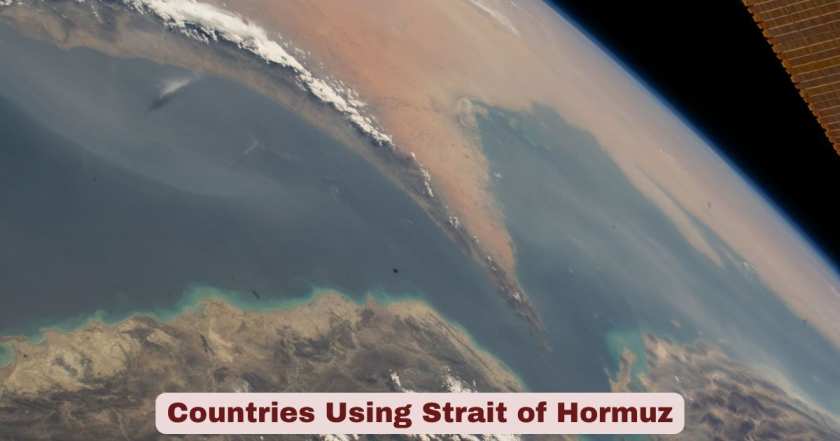
Countries Using Strait of Hormuz in 2026
The Strait of Hormuz is the single most consequential maritime chokepoint on Earth — a narrow waterway connecting the Persian Gulf to the Gulf of Oman and the Arabian Sea, and the only sea passage that links the oil-rich Gulf region to the open ocean. Flanked by Iran to the north and Oman’s Musandam Peninsula to the south, the strait stretches approximately 104 miles (167 km) in length, with a width that varies from around 60 miles (97 km) at its widest to just 21 miles (34 km) at its narrowest navigable point. Within that narrow passage, commercial vessels follow a Traffic Separation Scheme established by the International Maritime Organization: two shipping lanes, each 2 miles wide, running in opposite directions and separated by a 2-mile buffer zone. That means the entire commercial shipping corridor — through which a significant share of the planet’s oil and gas flows every single day — is effectively just 6 miles of structured, managed waterway. The strait is deep enough throughout most of its width, ranging from 200 to 330 feet (60 to 100 meters), to handle even the world’s largest crude oil tankers, including Very Large Crude Carriers (VLCCs) capable of carrying over 2 million barrels per cargo.
In 2025 and heading into 2026, the Strait of Hormuz was carrying an average of 20 million barrels of oil per day — equivalent to approximately 20% of global petroleum liquids consumption and more than 25% of all global seaborne oil trade, according to data from both the US Energy Information Administration (EIA) and the International Energy Agency (IEA). Beyond crude oil, the strait also handled approximately 20% of all global LNG (liquefied natural gas) trade in both 2024 and 2025, primarily from Qatar — the world’s second-largest LNG exporter, which has no alternative maritime route to global markets. On an average day in 2025, approximately 138 commercial vessels transited the strait’s shipping lanes, amounting to more than 30,000 tankers per year — cargo ships carrying not just oil and gas but also refined petroleum products, fertilizers, aluminum, chemicals, petrochemicals, and a wide range of manufactured goods that keep supply chains across Asia, Europe, and North America functioning. The seven major Gulf Cooperation Council (GCC) countries — Saudi Arabia, the UAE, Kuwait, Qatar, Iraq, Bahrain, and Oman — all depend on the strait for a majority of their export revenue, making the Strait of Hormuz not just an energy corridor but the economic lifeline of one of the world’s most oil-abundant regions.
Interesting Strait of Hormuz Facts 2026
| Fact | Detail |
|---|---|
| Location | Between Iran (north) and Oman’s Musandam Peninsula (south) |
| Total Length | Approximately 104 miles (167 km) |
| Width at Narrowest Point | 21 miles (34 km) |
| Width at Widest Point | ~60 miles (97 km) |
| Depth Range | 200 to 330 feet (60–100 meters) — deep enough for VLCCs |
| Commercial Shipping Lanes | Two 2-mile-wide lanes (inbound + outbound) separated by a 2-mile buffer zone |
| Average Daily Vessel Transits (2025) | ~138 commercial vessels per day |
| Annual Tanker Transits | More than 30,000 tankers per year |
| Daily Oil Transit (2024 & 2025 average) | ~20 million barrels per day (b/d) of crude + petroleum products |
| Share of Global Petroleum Consumption | ~20% of global petroleum liquids consumption |
| Share of Global Seaborne Oil Trade | More than 25% of all global seaborne oil trade |
| Daily Crude Oil + Condensate Transit | ~15 million b/d — nearly 34% of global crude oil trade |
| Daily Petroleum Products Transit | ~5 million b/d of refined products (diesel, jet fuel, fuel oil) |
| LNG Transit Share of Global Trade | ~20% of global LNG trade in 2024 and 2025 |
| LNG Volume Transiting (2025) | Over 112 billion cubic meters (bcm) |
| Qatar LNG Dependency | ~93% of Qatar’s LNG exports transit the strait |
| UAE LNG Dependency | ~96% of UAE LNG exports transit the strait |
| Countries with ZERO Pipeline Bypass | Iraq, Kuwait, Qatar, Bahrain — entirely dependent on the strait |
| Total Pipeline Bypass Capacity (Saudi + UAE) | Estimated 3.5–5.5 million b/d — covers ~25% of normal Hormuz flows |
| Fertilizer Trade via Hormuz | Over 30% of internationally traded fertilizers transit the strait |
| Gulf Aluminum Production Shipped via Hormuz | ~5 million tonnes/year — ~8–9% of global aluminum supply |
| Share of Global Sulphur Trade via Hormuz | ~50% of global seaborne sulphur trade |
| Oil Flows: Peak Year | 21 million b/d in 2018 and 2022 |
| Governing Body for Shipping Lanes | UN’s International Maritime Organization (IMO) Traffic Separation Scheme |
| US Navy Presence | US Fifth Fleet based in Bahrain since 1995 ensures freedom of navigation |
Source: US Energy Information Administration (EIA) June 2025, International Energy Agency (IEA) Strait of Hormuz Factsheet February 2026, Wikipedia — Strait of Hormuz, Britannica, Strauss Center, IEA Middle East and Global Energy Markets April 2026
The facts above establish why the Strait of Hormuz is routinely called the most strategically critical piece of ocean on Earth. The combination of extraordinary volume — 20 million barrels of oil every single day, equivalent to roughly 231 barrels every second — with an almost complete lack of viable alternatives is what makes this passage uniquely irreplaceable in global energy logistics. No other maritime chokepoint on Earth carries a comparable share of both oil and gas relative to global consumption simultaneously. The Suez Canal is a major trade route, but its closure can be partially circumvented via the Cape of Good Hope at added cost. The Panama Canal affects container and grain trade but not fundamental energy supply. The Strait of Hormuz is categorically different: for Iraq, Kuwait, Qatar, and Bahrain, there is simply no maritime alternative. Their oil and gas either exits via this strait or it does not exit at all.
The diversity of what transits alongside crude oil adds further depth to the strait’s importance. The 30%+ of globally traded fertilizers that flow through Hormuz connect the waterway directly to global food security, because disruptions don’t just raise gasoline prices — they threaten the supply of urea and ammonia that farmers across Asia, Africa, and South America depend on for crop yields. The 5 million tonnes of aluminum per year shipped out of Gulf smelters through Hormuz feeds construction, transportation, and clean energy manufacturing globally. With 50% of global seaborne sulphur trade also moving through the passage — sulphur being a key feedstock for agricultural chemicals and industrial processes — the economic tentacles of the Strait of Hormuz reach into virtually every sector of the modern economy. The governing reality is stark: when this strait functions normally, the world barely notices it. When it doesn’t, the effects are immediate, cascading, and global.
Countries Exporting Through the Strait of Hormuz 2026
| Country | Est. Daily Export Volume | Share of Total Hormuz Crude Flows (Q1 2025) | Pipeline Bypass Available? |
|---|---|---|---|
| Saudi Arabia | ~5.5 million b/d | 37.2% — largest single exporter | Yes — East-West Pipeline (Petroline), up to 7M b/d capacity to Red Sea (Yanbu) |
| Iraq | ~3.0–3.3 million b/d | 22.8% — second largest | Partial — Kirkuk–Ceyhan pipeline to Turkey (northern fields only); Basra southern fields have no bypass |
| United Arab Emirates (UAE) | ~1.6–1.8 million b/d | 12.9% | Yes — Abu Dhabi Crude Oil Pipeline (ADCOP) to Fujairah, ~1.8M b/d capacity; offshore fields still Hormuz-dependent |
| Kuwait | ~1.5 million b/d | 10.1% | No — entirely dependent on Strait of Hormuz |
| Qatar | LNG-focused; oil minor | Minor crude share | No — entirely dependent for all LNG exports; no alternative LNG route |
| Bahrain | Minor oil exporter | Minor crude share | No — entirely dependent |
| Top 5 Countries Combined | ~93.6% of all Hormuz crude | — | — |
| Saudi Arabia — East-West Pipeline | Up to 7 million b/d design capacity | In use: ~2M b/d pre-crisis; ~3–5M b/d available as bypass | Runs from Abqaiq to Yanbu (1,200 km) — built 1981 during Iran-Iraq War |
| UAE — ADCOP Pipeline | 1.5–1.8 million b/d capacity | Current utilization ~73%; ~700,000 b/d additional bypass available | Runs from Habshan to Fujairah (400 km) — built 2012 |
| Qatar — LNG Exports (2025) | Over 112 bcm total LNG | 93% transits Hormuz — NO alternative route | No LNG pipeline bypass exists anywhere |
| UAE — LNG Exports (2025) | ~7 bcm | 96% transits Hormuz | No LNG pipeline bypass exists |
| Gulf Refined Products Exports (2025) | ~3.3 million b/d | Diesel, jet fuel, fuel oil to global markets | Very limited bypass options for products |
| Gulf LPG Exports (2025) | ~1.5 million b/d | Critical for Asia’s petrochemical sector | No bypass |
| Middle East Share of Global Crude Production (2025) | ~32% of global total | Countries: Saudi Arabia, Iraq, UAE, Kuwait in top 10 | — |
Source: EIA Analysis based on Vortexa tanker tracking (Q1 2025), Visual Capitalist / EnergyNow — “Charted: Oil Trade Through the Strait of Hormuz by Country” (March 2026), IEA Strait of Hormuz Factsheet (February 2026), Control Risks — “The Strait of Hormuz: How Would a Closure Impact Trade?” (August 2025)
Saudi Arabia’s dominance of Hormuz export flows is the single most important data point in this table. At 37.2% of all crude and condensate flows — roughly 5.5 million barrels every day — the kingdom is not just a large contributor but a structurally defining one. Saudi Arabia’s export capacity also gives it the most meaningful alternative infrastructure: the Petroline (East-West Pipeline) built in 1981 during the Iran-Iraq War, running 1,200 kilometers across the Arabian Peninsula from the Abqaiq processing complex to the Red Sea port of Yanbu. With a design capacity expanded to 7 million barrels per day, this pipeline represents the most significant bypass infrastructure in the entire Gulf region — though in early 2026 only around 2 million b/d was in regular use, leaving a substantial but not unlimited buffer capacity. The UAE’s Abu Dhabi Crude Oil Pipeline (ADCOP) adds another layer of partial resilience, running 400 km from inland Habshan fields to the Gulf of Oman port at Fujairah — but this route is also already partially utilized in normal operations, leaving approximately 700,000 b/d of additional emergency capacity.
The situation for Iraq, Kuwait, Qatar, and Bahrain is categorically different and far more structurally vulnerable. Iraq’s southern Basra fields, which produce the overwhelming majority of its exportable crude — approximately 3.3 million barrels per day — have no pipeline connection to any port outside the Gulf. Iraq’s existing Kirkuk-Ceyhan pipeline serves northern fields only and is not capable of handling southern volumes at any meaningful scale. Kuwait has zero bypass infrastructure, making every barrel it exports entirely dependent on this single maritime corridor. Qatar’s LNG situation is the starkest of all: the country is the world’s second-largest LNG exporter, with over 112 billion cubic meters shipped in 2025, and there is no physical way to route any of that gas to global markets except through the Strait of Hormuz. There are no pipelines, no overland routes, no alternative LNG liquefaction terminals elsewhere that could absorb Qatar’s volumes. The IEA has been explicit: disrupting LNG flows through Hormuz would cause a drop in global LNG supply more than double the flow of the Nord Stream pipeline in its peak year.
Top Countries Importing Through the Strait of Hormuz 2026
| Country / Region | Estimated Daily Oil Import Volume via Hormuz | Share of Hormuz Crude Flows | Key Vulnerability |
|---|---|---|---|
| China | ~4–5 million b/d | ~33% of all Hormuz crude — receives roughly 1/3 of its oil via the strait | World’s largest oil importer; ~60% of crude from Middle East |
| India | ~2.5–3 million b/d | Part of combined 44% (China + India) | ~60–65% of crude imports from Gulf |
| Japan | ~1.6 million b/d | Among top 4 importers | 95% of Japan’s crude imports from Middle East; fossil fuels = 87% of total energy |
| South Korea | ~1.7 million b/d | Among top 4 importers | ~68% of crude imports via Hormuz |
| China + India Combined | — | 44% of all Hormuz crude exports | Both rapidly growing economies with limited short-term substitution |
| China + India + Japan + South Korea | — | 69% of all Hormuz crude exports | Top 4 Asia importers collectively dominant |
| All Asian Markets Combined | — | 84% of crude and condensate flows (2024) | Overwhelmingly Asia-facing corridor |
| Asian LNG Markets | — | 83% of all Hormuz LNG (2024); 27% of Asia’s total LNG imports (2025) | Bangladesh, India, Pakistan: ~two-thirds of LNG via Hormuz |
| IEA Member Countries (all) | — | ~29% of Hormuz crude | Japan and South Korea most exposed among IEA nations |
| Europe | — | ~10–12% of oil flows | 12–14% of LNG from Qatar via Hormuz; ~7% of total LNG inflows (2025) |
| United States | ~0.5 million b/d | ~7% of US crude imports; 2% of US petroleum consumption | Low and declining; near 40-year low in 2024 due to domestic shale boom |
| Bangladesh | — | ~2/3 of total LNG supply from Hormuz | Natural gas = 50% of electricity generation |
| Pakistan | — | ~2/3 of total LNG supply from Hormuz | Natural gas = 25% of electricity generation |
| Taiwan | Significant volumes | High dependence on Gulf crude | Nearly all oil from Middle East |
| Singapore / Southeast Asia | Significant volumes | Gulf crude for regional refining | Key regional hub for refined products |
Source: EIA June 2025 Today in Energy — “Amid regional conflict, the Strait of Hormuz remains critical oil chokepoint,” IEA Strait of Hormuz Factsheet (February 2026), Zero Carbon Analytics — “Asian countries most at risk from oil and gas supply disruptions in Strait of Hormuz” (February 2026), Atlas Institute for International Affairs (March 2026)
The import side of the Strait of Hormuz equation tells a story that is almost entirely written in Asia. With 84% of all crude oil and condensate flows in 2024 heading to Asian markets, and 83% of LNG flows doing the same, the strait functions as an overwhelmingly Asia-serving energy corridor. China’s position is particularly significant — receiving roughly one-third of all crude oil that transits Hormuz and sourcing approximately 60% of its total crude imports from the Middle East, China is the single most exposed large economy to any disruption in transit flows. India is close behind, with 60–65% of its crude imports originating in the Gulf. Together, China and India account for 44% of all Hormuz crude exports — a concentration that means these two economies would experience the most immediate and severe supply shock in any disruption scenario.
Japan and South Korea represent the most structurally fragile importers in proportional terms. Japan sources 95% of all its crude oil from the Middle East, and fossil fuels account for 87% of Japan’s total energy needs — meaning that Hormuz is not just an import route for Japan but the near-singular pipeline of its modern economy’s energy input. South Korea routes approximately 68% of its crude imports through the strait. For both countries, there is effectively no short-term substitution: Atlantic Basin or West African crude can partially replace Gulf grades, but only at higher freight costs, longer transit times, and with significant refinery configuration constraints since Asian refineries are typically calibrated for heavier, sourer Middle Eastern crude. The United States sits at the opposite end of the vulnerability spectrum — importing just 0.5 million b/d via Hormuz in 2024, a figure that represents only 7% of total US crude imports and a mere 2% of US petroleum liquids consumption, down to the lowest level in nearly 40 years as domestic shale production and Canadian imports have surged.
Strait of Hormuz Oil Transit Volume Statistics 2026
| Metric | Volume / Data | Period |
|---|---|---|
| Total Oil Transit (Crude + Products) | ~20 million b/d | 2024 full-year average (EIA) |
| Total Oil Transit (Crude + Products) | ~20 million b/d | 2025 full-year average (IEA) |
| Total Oil Transit (H1 2025 estimate) | ~20.9 million b/d | H1 2025 (EIA World Oil Transit Chokepoints) |
| Crude Oil + Condensate Transit | ~15 million b/d | 2025 — IEA / EIA |
| Crude Oil Share of Global Crude Trade | ~34% | 2025 (IEA) |
| Petroleum Products Transit | ~4.8–5.5 million b/d | 2025 (diesel, jet fuel, fuel oil) |
| Share of Global Petroleum Consumption | ~20% | 2024–2025 |
| Share of Global Seaborne Oil Trade | More than 25% | 2024–Q1 2025 |
| Peak Historic Transit Volume | 21 million b/d | 2018 and 2022 |
| 2020 Volume (COVID dip) | Lower than 20M b/d | 2020 — COVID demand collapse |
| Volume Change 2022–2024 | Declined 1.6 million b/d (crude) offset by +0.5M (products) | Due to OPEC+ cuts and Saudi routing shift |
| Q1 2025 vs 2024 | Flat — remained near 20 million b/d | Q1 2025 (EIA) |
| Gulf Refined Products Exports (2025) | 3.3 million b/d | Diesel, jet fuel, fuel oil |
| Gulf LPG Exports (2025) | 1.5 million b/d | Key petrochemical feedstock for Asia |
| Spare Production Capacity (Q4 2025) | Over 4 million b/d | Primarily Saudi Arabia (excluding sanctioned countries) |
| Structural Dependency (No Bypass) | ~14 million b/d | Locked to Hormuz — no alternative route possible |
| Combined Bypass Capacity (Saudi + UAE) | 3.5–5.5 million b/d | EIA / IEA estimates (early 2026 condition) |
| Flows in 2011 (Historical Comparison) | 17 million b/d | Per EIA — shows growth over decade |
| Value of Oil at 2019 Prices (2018 Peak) | ~$1.2 billion per day | Based on 21 million b/d at 2019 benchmark |
Source: EIA June 2025 Today in Energy, IEA Strait of Hormuz Factsheet (February 2026), Statista (EIA Q1 2025 data), Speed Commerce analysis of IEA/EIA data (March 2026), Al Jazeera (UN data for 2024 breakdown)
The Strait of Hormuz oil transit volume statistics reveal both the extraordinary scale of normal flows and the structural rigidity that makes this corridor so difficult to replace. The headline figure of 20 million barrels per day has been remarkably stable — remaining near that level from 2020 through 2025, with a brief peak at 21 million b/d in 2018 and 2022. The modest decline between 2022 and 2024 was not a sign of diminishing importance but rather a reflection of deliberate OPEC+ production cuts, with Saudi Arabia, Kuwait, and the UAE voluntarily curtailing output, and of Saudi Arabia strategically using its East-West Pipeline to reroute some volumes to the Red Sea during the Bab al-Mandeb shipping disruptions in 2024 caused by Houthi activity. Those volumes didn’t disappear — they moved through a different route, demonstrating the partial flexibility the Saudi pipeline provides.
The structural dependency figure of approximately 14 million b/d is arguably the most important single number in this dataset. That’s the volume of oil that is physically locked to the Strait of Hormuz regardless of what pipelines Saudi Arabia and the UAE deploy — because Iraq, Kuwait, Qatar, Bahrain, and the substantial portion of UAE offshore production have no alternative route. Even fully utilizing both the Saudi Petroline and the UAE’s ADCOP only bridges a 3.5–5.5 million b/d gap, leaving an unbridgeable 14 million b/d with no practical alternative. When analysts describe Hormuz as uniquely irreplaceable among global chokepoints, this is the number behind that assertion. For comparison, the entire daily oil consumption of China, the world’s largest oil importer, is approximately 16 million b/d — meaning the structurally trapped Hormuz volume alone equals nearly the entire Chinese demand.
Strait of Hormuz LNG Trade Statistics 2026
| LNG Metric | Volume / Data | Period |
|---|---|---|
| Total LNG Transiting Hormuz | Over 112 billion cubic meters (bcm) | 2025 (IEA) |
| LNG Share of Global Trade | ~20% of global LNG trade | 2024 and 2025 |
| Qatar LNG Total Exports (2025) | Over 112 bcm | Qatar = world’s 2nd-largest LNG exporter |
| Qatar LNG Dependency on Hormuz | ~93% of Qatar’s LNG exports transit the strait | 2025 (IEA) |
| UAE LNG Exports (2025) | ~7 bcm | — |
| UAE LNG Dependency on Hormuz | ~96% of UAE LNG exports transit the strait | 2025 (IEA) |
| LNG to Asian Markets Share | 83% of Hormuz LNG went to Asia | 2024 (EIA) |
| LNG to Asian Markets Share (2025) | ~90% of Hormuz LNG to Asian markets | 2025 (IEA) |
| Top 3 LNG Destination Countries | China, India, South Korea | 2024 (EIA) |
| China + India + South Korea LNG Share | 52% of all Hormuz LNG flows | 2024 (EIA) |
| Asia’s LNG from Hormuz (2025) | ~27% of Asia’s total LNG imports | 2025 (IEA) |
| Europe’s LNG from Hormuz (2025) | ~7% of Europe’s total LNG inflows | 2025 (IEA) |
| Bangladesh LNG via Hormuz | ~Two-thirds of total LNG supply | 2025 (IEA) |
| India LNG via Hormuz | ~Two-thirds of total LNG supply | 2025 (IEA) |
| Pakistan LNG via Hormuz | ~Two-thirds of total LNG supply | 2025 (IEA) |
| Bangladesh Electricity from Gas | 50% of electricity generation | 2024 |
| Pakistan Electricity from Gas | 25% of electricity generation | 2024 |
| Qatar Dolphin Pipeline (Gas) | ~20.5 bcm to UAE and Oman | 2025 — limited spare capacity |
| LNG Alternative Routes | None — no alternative route exists for Qatar or UAE | — |
| Global LNG Supply Drop if Closed | Over 300 mcm/day — double the average Nord Stream flow | IEA estimate |
Source: EIA June 2025 — “About one-fifth of global liquefied natural gas trade flows through the Strait of Hormuz,” IEA Strait of Hormuz Factsheet (February 2026), Safety4Sea, LNG Industry, Zero Carbon Analytics (February 2026), Arab Reform Initiative (March 2026)
The LNG transit statistics for the Strait of Hormuz may tell an even more stark story than the oil figures, because natural gas has virtually no short-term substitution mechanism. When Qatar ships over 112 billion cubic meters of LNG through this corridor — representing the overwhelming majority of its entire export capacity — every cubic meter of it is physically irreplaceable by any overland or alternative sea route. The Dolphin Pipeline carries approximately 20.5 bcm of piped gas from Qatar to the UAE and Oman, but this route has limited spare capacity and only serves its own regional market. There is no pipeline connecting Qatar to Europe, India, China, Japan, or South Korea. Every cargo bound for those customers — which collectively represent the backbone of global LNG demand — must board an LNG tanker and transit through that 2-mile-wide shipping lane in the Strait of Hormuz. The IEA has quantified the consequence explicitly: a full LNG flow disruption would cut global LNG supply by more than 300 million cubic meters per day, a volume more than double what the Nord Stream pipeline — Europe’s most consequential gas infrastructure — ever carried at its peak.
The vulnerability of Bangladesh, India, and Pakistan deserves particular emphasis in the LNG context. These three countries collectively source approximately two-thirds of their total LNG supply through the Strait of Hormuz, according to IEA data. In Bangladesh, where natural gas powers 50% of the electricity grid, and Pakistan, where it accounts for 25% of electricity generation, supply disruptions at Hormuz translate almost immediately into power grid instability and potential industrial shutdowns. Both economies are highly price-sensitive, meaning they are among the first to drop out of LNG spot markets when prices surge — forcing gas-fired power plants offline and triggering demand-side energy crises that can cascade into broader economic disruption. The concentration of LNG dependency in some of the world’s most populous and economically vulnerable nations means that Hormuz LNG flows carry a human development dimension that goes well beyond oil price benchmarks or freight rate movements.
Non-Energy Commodities Using the Strait of Hormuz 2026
| Commodity | Volume / Share via Hormuz | Key Details |
|---|---|---|
| Fertilizers — Urea | 30–35% of global urea exports | Middle East is world’s largest urea export region |
| Fertilizers — Ammonia | ~20–30% of global ammonia exports | Key input for agricultural fertilizer globally |
| Fertilizers — Phosphate | ~20% of global phosphate trade | Important for crop nutrient supply chains |
| Total Internationally Traded Fertilizers | Over 30% of global fertilizer trade | Critical for global food security |
| Aluminium | ~5 million tonnes per year | ~8–9% of global aluminum supply outside China |
| Aluminium — Gulf Production Share | ~8% of global supply | From smelters in Bahrain, Qatar, Saudi Arabia, UAE |
| Sulphur | ~50% of global seaborne sulphur trade | Used in fertilizer production and industrial processes |
| Petrochemicals | Significant volumes | Gulf is a major global petrochemical export hub |
| Polymers / Plastics Feedstock | Significant volumes | LPG and naphtha from Gulf used globally |
| Helium | Significant proportion of global trade | Qatar is world’s second-largest helium exporter |
| Container Trade (Gulf Ports) | ~33 million TEUs/year to Gulf terminals | 3.5% of global container trade |
| Jebel Ali (Dubai) Container Throughput | ~15.5 million TEUs/year | 65% transshipment ratio — Middle East’s primary hub |
| Container Ships Transiting Hormuz | Part of 138 vessels/day average | Cargo ships, bulk carriers, tankers all use the strait |
| Grain / Food Imports into Gulf | Qatar, Kuwait, Iraq have ~6 months reserves | Gulf states dependent on food imports through the strait |
| Steel / Construction Materials | Significant volumes into Gulf | Regional construction boom requires material imports |
Source: IEA — “The Middle East and Global Energy Markets” (April 2026), Wikipedia — Strait of Hormuz, Al Jazeera Centre for Studies — “The Strait of Hormuz: Global Economic Shock” (April 2026), Speed Commerce analysis (March 2026)
The non-energy commodity statistics for the Strait of Hormuz reveal a dependency structure that extends far beyond the energy sector that dominates headlines. The fertilizer trade numbers are among the most globally consequential: with over 30% of all internationally traded fertilizers — including urea, ammonia, and phosphate — transiting through this waterway, the Strait of Hormuz is embedded in the global food production system in ways that become immediately apparent during disruptions. The Middle East, particularly the GCC countries, has developed into one of the world’s most important fertilizer export hubs because of the region’s abundant natural gas feedstock, which is the primary raw material for ammonia-based fertilizer production. When Hormuz flows are disrupted, the consequences for spring planting seasons in major agricultural importers across South Asia, Sub-Saharan Africa, and Southeast Asia can ripple through to food prices months later.
The aluminum and sulphur statistics are equally revealing. Gulf smelters in Bahrain, Qatar, Saudi Arabia, and the UAE collectively produce approximately 5 million tonnes of aluminum per year, roughly 8–9% of global supply outside China, all of which travels to international markets through the Strait of Hormuz. This aluminum goes into automotive manufacturing, aircraft production, construction projects, and increasingly the frames and components of solar panels and electric vehicle batteries — meaning that Hormuz disruptions now carry consequences for the energy transition supply chain as well as for conventional industrial output. The 50% of global seaborne sulphur trade transiting the strait ties back to the fertilizer story: sulphur is a key input in phosphate fertilizer manufacturing, and its price volatility in disruption scenarios directly feeds into agricultural input cost inflation globally. Together, these non-energy flows confirm that the Strait of Hormuz is not an oil chokepoint that happens to carry some other goods — it is a fundamental artery of the world economy that carries the inputs of modern civilization across multiple sectors simultaneously.
Alternative Routes & Bypass Infrastructure Statistics 2026
| Bypass Infrastructure | Operator / Country | Design Capacity | Usable Bypass Capacity (Early 2026) | Destination Port |
|---|---|---|---|---|
| East-West Crude Oil Pipeline (Petroline) | Saudi Aramco / Saudi Arabia | 7 million b/d (expanded) — original 5M b/d | ~3–5 million b/d additional available | Yanbu, Red Sea |
| Abu Dhabi Crude Oil Pipeline (ADCOP / Habshan-Fujairah) | ADNOC / UAE | 1.5–1.8 million b/d | ~700,000 b/d additional available (rest already in use) | Fujairah, Gulf of Oman |
| ADNOC Underground Storage at Fujairah | ADNOC / UAE | 42 million barrels of storage capacity | — | Fujairah |
| Kirkuk–Ceyhan Oil Pipeline | Iraq / Turkey | ~600,000–900,000 b/d operational | Northern Iraq only — Basra southern fields not connected | Ceyhan, Turkey (Mediterranean) |
| Iraq Pipeline through Saudi Arabia (IPSA-2) | Historic — seized by Saudi Arabia in 1990 | 1.65 million b/d | Non-operational — could theoretically be revived | Saudi Red Sea coast |
| Qatar — LNG Bypass | None | Zero — no alternative LNG route exists | N/A | No bypass possible |
| Kuwait — Crude Bypass | None | Zero | N/A | No bypass possible |
| Bahrain — Export Bypass | None | Zero | N/A | No bypass possible |
| Total Combined Bypass (Saudi + UAE) | — | ~8.8 million b/d combined max | 3.5–5.5 million b/d effective additional | — |
| Hormuz Normal Flow vs. Bypass Coverage | — | 20 million b/d normal | Bypass covers ~25% of normal flow | — |
| Oil Structurally Trapped (No Bypass) | Iraq, Kuwait, Qatar, Bahrain + UAE offshore | ~14 million b/d | Cannot be bypassed | — |
| Saudi East-West Pipeline Length | Abqaiq to Yanbu | 1,200 km | — | Built 1981 during Iran-Iraq War |
| UAE ADCOP Pipeline Length | Habshan to Fujairah | 400 km | — | Built 2012 |
| Oman Deep-Water Ports | Duqm, Salalah, Sohar | Outside the strait | Available for Arabian Sea-connected flows | Could theoretically support partial bypass via Omani waters |
Source: EIA June 2025 Today in Energy, IEA Strait of Hormuz Factsheet (February 2026), CNBC — “The two oil pipelines helping Saudi Arabia and UAE bypass the Strait of Hormuz” (March 2026), Engineering News-Record — “Hormuz Bypass Infrastructure Was Sized for a Short Disruption” (March 2026), Al Jazeera — “Saudi, UAE, Iraq: Can Three Pipelines Help Oil Escape Strait of Hormuz?” (March 2026)
The bypass infrastructure statistics make a single fundamental point with unusual clarity: the alternative routing capacity for Hormuz-dependent energy flows is a fraction of normal transit volumes. Even combining the Saudi Petroline’s available spare capacity of 3–5 million b/d with the UAE ADCOP’s additional 700,000 b/d, the total achievable bypass for crude oil is somewhere between 3.5 and 5.5 million b/d under optimistic operational assumptions. Against a baseline of 20 million b/d in normal transit flows, that bypass capacity covers approximately 25% of the normal throughput. The remaining 14 million b/d has no physical path to global markets other than through the strait — and this is not a gap that can be closed by investment within weeks or months. The Iraq Pipeline through Saudi Arabia (IPSA-2) was built in 1987, seized in 1990, and remains non-operational; even if revived, its 1.65 million b/d capacity is a meaningful but limited addition to the bypass equation.
The decision to build partial rather than full bypass capacity was not an oversight by Gulf producers — it was a deliberate infrastructure bet made over four decades, reflecting a consistent judgment that any Hormuz disruption would be short-lived and that maintaining partial bypass for weeks-long emergencies was economically rational given the cost of building full-scale alternatives. Saudi Arabia’s Petroline was constructed in 1981 specifically to hedge against the threat posed by the Iran-Iraq War, and it has served its purpose as a pressure-relief valve during various regional tensions. The UAE’s ADCOP, completed in 2012, added a second partial alternative following the Arab Spring instability. Both pipelines have proven their value as operational tools for day-to-day optimization — Saudi Arabia actively used the Petroline to route crude to the Red Sea in 2024 to avoid the Bab al-Mandeb disruptions caused by Houthi activity. But the gap between 25% bypass coverage and the 100% dependency that Iraq, Kuwait, Qatar, and Bahrain face remains one of the defining structural vulnerabilities in global energy infrastructure.
Disclaimer: This research report is compiled from publicly available sources. While reasonable efforts have been made to ensure accuracy, no representation or warranty, express or implied, is given as to the completeness or reliability of the information. We accept no liability for any errors, omissions, losses, or damages of any kind arising from the use of this report.