
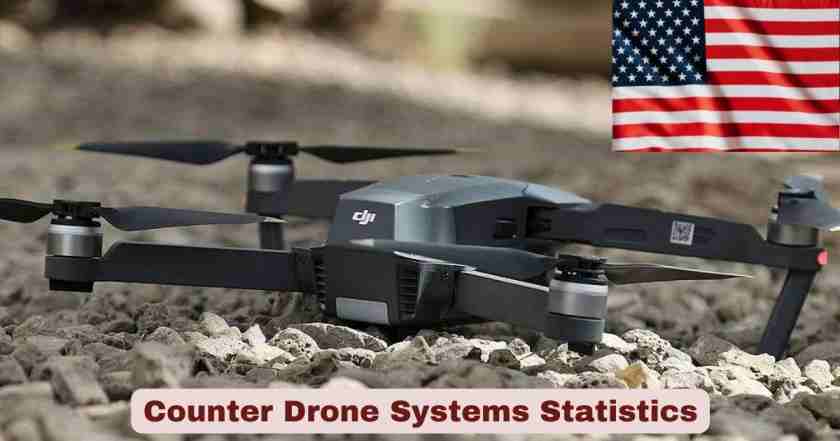
What Is Counter Drone Systems?
Counter-drone systems — also widely referred to as Counter-UAS (C-UAS), Counter-UAV, or Anti-Drone technology — are integrated hardware and software platforms specifically engineered to detect, track, identify, and neutralize unauthorized or hostile unmanned aerial vehicles (UAVs) across military, homeland security, critical infrastructure, and commercial environments. The technology stack of a modern counter-drone system in 2026 is layered and multi-modal: radar (S-band, Ku-band, and AESA variants) provides wide-area airspace surveillance; radio frequency (RF) sensors scan the electromagnetic spectrum for drone-to-operator control links; electro-optical and infrared (EO/IR) cameras provide visual confirmation and identification; acoustic sensors detect the distinctive rotor signatures of small unmanned aircraft; AI-powered command-and-control software (platforms like Anduril’s Lattice, Dedrone’s DedroneTracker, and DroneShield’s DroneSentry) fuses all sensor inputs in real time and recommends or autonomously executes engagement decisions; and defeat mechanisms range from RF jamming and GPS spoofing (soft-kill, non-kinetic) to high-energy lasers, high-power microwave (HPM) emitters, interceptor drones, and kinetic missiles (hard-kill). As of March 2026, the global counter-drone market is valued at approximately $3.88–$4.93 billion (varying by methodology across Fortune Business Insights, Grand View Research, BIS Research, and Kearney), growing at a compound annual growth rate (CAGR) of between 19.79% and 26.5%, and projected to reach between $14.5 billion (MarketsandMarkets, 2030) and $36.42 billion (BIS Research, 2035) — making it one of the fastest-growing segments in the entire global defense and security technology industry.
The acceleration of the counter-drone market in 2026 is being driven by a confluence of forces that were not simultaneously present in any prior year. The Ukraine conflict — which has now produced nearly 2,000 confirmed combat drone kills by a single autonomous interceptor system alone and has demonstrated that 70% of frontline casualties are now attributable to UAVs — has compressed procurement timelines to near-wartime velocity across NATO and allied nations. The U.S. DoD’s FY2026 budget allocates $3.1 billion specifically for C-UAS capabilities — a $940 million increase (43% jump) over FY2025 — and designates a dedicated $13.4 billion autonomy section for the first time in Pentagon budget history. The NDAA FY2026 mandated the creation of JIATF-401 — the first unified joint counter-UAS task force under the Deputy Secretary of Defense — acknowledging institutionally that no single service can manage the drone threat alone. The U.S. Army alone is requesting $693 million for counter-drone systems and $729 million to accelerate Maneuver Short Range Air Defense (M-SHORAD) vehicles in FY2026. Meanwhile, the 2026 FIFA World Cup and 2028 Los Angeles Olympics are driving massive civilian C-UAS procurement for airspace protection at major public events — with the Qatar 2022 World Cup’s deployment of D-Fend Solutions’ EnforceAir serving as the established template. The global counter-drone technology market in 2026 is no longer a niche defense research area — it is a mainstream, multi-billion-dollar, battlefield-proven industrial ecosystem reshaping how every military, government, and major public institution thinks about the airspace above them.
Counter Drone Systems 2026 — Key Facts
| # | Counter Drone Key Fact | Details |
|---|---|---|
| 1 | Global C-UAS Market: $3.88 Billion in 2026 | The global counter-drone (anti-drone) market is valued at approximately $3.88 billion in 2026 (Fortune Business Insights), growing to $16.45 billion by 2034 at a 19.79% CAGR |
| 2 | US DoD FY2026 C-UAS Budget: $3.1 Billion | The U.S. Department of Defense has allocated $3.1 billion specifically for counter-UAS capabilities in FY2026 — a $940 million (43%) increase over FY2025 — per the Pentagon FY2026 budget submission |
| 3 | Nearly 2,000 Combat Drone Kills by Single Autonomous System in Ukraine | By early 2026, a single autonomous interceptor system deployed in Ukraine had achieved nearly 2,000 confirmed combat drone kills — the most extensive real-world validation of autonomous C-UAS in history |
| 4 | 13:1 Cost Exchange Ratio — Autonomous Interceptors vs. FPV Drones | Research and Markets (February 27, 2026) documents a 13:1 favorable cost exchange ratio for autonomous AI-guided interceptors versus the enemy FPV drones they destroy — a critical benchmark for sustainable drone defense economics |
| 5 | 70% of Frontline Casualties in Ukraine Caused by Drones | Verified battlefield data from Ukraine confirms that 70% of frontline casualties are now attributable to UAVs — the statistic that transformed C-UAS from a specialty capability to a universal military requirement |
| 6 | US Army FY2026: $693 Million for Counter-Drone + $729 Million for M-SHORAD | In FY2026, the U.S. Army is requesting $693 million for counter-drone systems and $729 million to accelerate M-SHORAD (Maneuver Short Range Air Defense) vehicle procurement — per Pentagon FY2026 budget briefing |
| 7 | C-UAS Market Projected at $36.42 Billion by 2035 | The global counter-UAV market is projected to reach $36.42 billion by 2035 from $4.93 billion in 2025 — a CAGR of 22.14% (BIS Research / Research and Markets, February 2026) |
| 8 | UK Commits £600 Million for Project Octopus Interceptor Drones | In December 2025, the UK Ministry of Defence committed £600 million for Project Octopus — interceptor drones manufactured in thousands per month — directly responding to the scale of Russian drone attacks on Ukraine exceeding 20,000 aerial attacks in two months |
| 9 | North America Holds 44–46% of Global Anti-Drone Market | North America holds the largest regional share of the global anti-drone market at 44–46% of total revenue (Grand View Research; Precedence Research, 2025) driven by advanced defense infrastructure and DoD investment |
| 10 | Interdiction Segment Dominates Market at 53.49% Share (2026) | The interdiction (defeat) segment dominates the global C-UAS market with 53.49% market share in 2026 — driven by RF jamming, laser systems, and kinetic interceptors (Fortune Business Insights) |
| 11 | Iron Beam Laser: ~$3 per Interception vs. $50,000 Missile | Israel’s Iron Beam (Or Eitan), now in operational IDF service since December 2025, costs approximately $3 per laser interception — versus $50,000 per Iron Dome Tamir missile — establishing directed energy as the economically dominant counter-drone defeat mechanism |
| 12 | FY2026 NDAA Creates JIATF-401 — First Unified Joint C-UAS Command | The NDAA FY2026 mandated the creation of JIATF-401 — a dedicated joint counter-UAS task force under the Deputy Secretary of Defense — the first unified command structure for joint C-UAS operations across all U.S. military services |
| 13 | DroneShield Deployed in 40+ Countries — A$2.9 Billion Market Cap | Australian firm DroneShield (ASX: DRO) has deployed counter-drone products in over 40 countries, reached a market cap of A$2.9 billion (~$1.9 billion USD) by 2024, and became the best-performing stock on the S&P/ASX 200 that year |
| 14 | Russia Conducted 20,000+ Aerial Drone Attacks on Ukraine in Two Months | Drone warfare data from late 2025 / early 2026 documented Russia conducting more than 20,000 aerial drone attacks on Ukraine within a two-month period — driving NATO counter-drone procurement to wartime urgency |
| 15 | $49.9 Billion in Defense Tech Investment in 2025 | The defense technology sector attracted $49.9 billion in total investment in 2025 — the largest single-year figure on record — with C-UAS and autonomous systems identified as the primary growth driver (Research and Markets, February 2026) |
Source: Fortune Business Insights (fortunebusinessinsights.com); Grand View Research (grandviewresearch.com); BIS Research / Research and Markets (globenewswire.com, February 27, 2026); Pentagon FY2026 budget briefing (cuashub.com, October 2025); Defense One (defenseone.com, June 2025); Inside Unmanned Systems (insideunmannedsystems.com, January 2026); Drone-Warfare.com (January 2026); RTX / Raytheon (rtx.com, February 11, 2026); Precedence Research (precedenceresearch.com, January 2026); onoff.gr; Congress.gov – CRS Report R48477
These 15 counter-drone key facts for 2026 define an industry that is experiencing the most compressed and consequential growth surge in any defense technology sector since the proliferation of precision-guided munitions in the 1990s. The convergence of three simultaneous drivers — Ukraine’s battlefield-level drone threat, nation-state drone swarm investments (China targeting one million tactical UAS by 2026), and mass civilian public event security requirements — has collapsed the typical peacetime procurement cycle from years to months across every major Western military and dozens of allied nations. The $3.1 billion U.S. DoD C-UAS allocation in FY2026 — a 43% single-year increase — is the clearest institutional signal available that the Pentagon no longer regards this as an emerging threat to be studied, but as an active and present operational requirement demanding immediate and large-scale capability procurement.
The economics facts embedded in these statistics are where the real strategic drama lies. The 13:1 cost exchange ratio of autonomous interceptors versus enemy FPV drones, Iron Beam’s $3-per-shot laser interception cost, and Ukraine’s $3,000 Wild Hornet interceptor drones achieving tactical success against sophisticated threats — these numbers collectively describe a world in which drone defense is finally becoming economically sustainable at scale. For years, the asymmetry ran the other way: a $50,000 Tamir missile to kill a $500 commercial drone meant that any adversary with access to consumer electronics could drain defense budgets faster than they could be replenished. 2026 is the year that equation is being reversed, as directed energy, AI-guided autonomous interceptors, and purpose-built low-cost defeat munitions begin to match the mass-production economics of the threat they are designed to counter.
Counter Drone Systems 2026 — Market Size & Growth Statistics
| Metric | Data | Source |
|---|---|---|
| Global Anti-Drone Market Size (2025) | $3.11–$4.93 billion (range across analysts) | Fortune Business Insights; BIS Research; Grand View Research |
| Global Anti-Drone Market Size (2026) | $3.88 billion (Fortune Business Insights baseline) | Fortune Business Insights (2026) |
| CAGR 2026–2034 (Fortune Business Insights) | 19.79% | Fortune Business Insights |
| CAGR 2025–2030 (MarketsandMarkets) | 26.5% | MarketsandMarkets (November 2025) |
| CAGR 2026–2033 (Grand View Research) | 25.2% | Grand View Research |
| CAGR 2026–2035 (BIS Research) | 22.14% | BIS Research (February 2026) |
| Projected Market Size — 2030 | $14.51 billion (MarketsandMarkets); $6.75 billion (Business Research Co.) | MarketsandMarkets; EINPresswire (January 2026) |
| Projected Market Size — 2033 | $19.84 billion | Grand View Research |
| Projected Market Size — 2034 | $16.45 billion | Fortune Business Insights |
| Projected Market Size — 2035 | $30.91 billion (Precedence Research); $36.42 billion (BIS Research) | Precedence Research (January 2026); BIS Research (February 2026) |
| Autonomous / AI-Enhanced Kinetic C-UAS Subsegment (2025) | $600 million — first-ever sizing of this subsegment | Research and Markets (February 27, 2026) |
| Autonomous / AI Kinetic C-UAS Forecast (2030) | $1.4B–$4.1B (3 scenarios: conservative / base / optimistic) | Research and Markets (February 27, 2026) |
| North America Market Share (2025) | 44–46% of global revenue | Grand View Research; Precedence Research |
| Asia-Pacific CAGR (2026–2035) | 32.1% — fastest regional growth | Precedence Research (January 2026) |
| Europe CAGR (2026–2033) | 26% | Grand View Research |
| Interdiction Segment Share (2026) | 53.49% of total market | Fortune Business Insights |
| Detection & Disruption Segment Share (2025) | 69%+ of market (detection + disruption combined) | Precedence Research |
| Defense End-User Segment (2024) | $2,509.2 million — projected to $25,658 million by 2035 | BIS Research (CAGR 22.84%) |
| Total Defense Tech Investment (2025) | $49.9 billion — record annual figure | Research and Markets, February 27, 2026 |
Source: Fortune Business Insights (fortunebusinessinsights.com, 2026); Grand View Research (grandviewresearch.com); MarketsandMarkets (marketsandmarkets.com, November 2025); BIS Research via Research and Markets (globenewswire.com, February 27, 2026); Precedence Research (precedenceresearch.com, January 2026); The Business Research Company (EINPresswire, January 16, 2026); Research and Markets (globenewswire.com, February 27, 2026)
The counter-drone market size and growth statistics for 2026 span a notably wide range depending on methodology — from $3.11 billion (Fortune Business Insights) to $4.93 billion (BIS Research) for the 2025 baseline alone — reflecting the genuine complexity of defining what counts as a “counter-drone system” versus overlapping air defense, electronic warfare, and C4ISR categories. The most analytically rigorous of the recent reports, published by Research and Markets on February 27, 2026, resolves this by isolating the most important new subsegment for the first time: the autonomous and AI-enhanced kinetic defeat layer, sized at $600 million in 2025 and projected to reach between $1.4 billion and $4.1 billion by 2030. This is the segment that matters most strategically — not the broad detection market, not the legacy RF jamming hardware, but the AI-guided guns and autonomous interceptor drones that are actually destroying enemy drones in combat, validated by nearly 2,000 confirmed kills in Ukraine. The rest of the market is important context; this subsegment is where the doctrine-defining battles are being won and lost right now.
The regional market distribution tells a clear strategic story. North America’s 44–46% share reflects the overwhelming scale of U.S. DoD C-UAS investment, but the Asia-Pacific’s 32.1% CAGR — the fastest of any region — is the number that commands attention for what it reveals about where threat perception is rising fastest. China’s stated goal of fielding one million tactical UAS by 2026, combined with ongoing tensions across the Taiwan Strait, South China Sea, and Korean Peninsula, has triggered C-UAS procurement urgency in Japan, South Korea, Taiwan, Australia, and India that is compressing programs which would normally take a decade into a few budget cycles. India alone has placed $1.5 billion in fresh counter-drone orders with domestic firms — confirmed by Fortune Business Insights. Europe’s 26% CAGR is being driven directly by Russian drone incursions into NATO airspace and the battlefield lessons of Ukraine forcing Germany, France, the UK, Poland, and the Baltic states into emergency procurement outside their normal multi-year planning cycles.
Counter Drone Systems 2026 — US Government Funding & Budget Statistics
| Budget Item | Value | Source / Year |
|---|---|---|
| Total DoD C-UAS Allocation (FY2026) | $3.1 billion | Pentagon FY2026 budget request (cuashub.com, October 2025) |
| FY2026 vs FY2025 C-UAS Increase | +$940 million (+43%) | Pentagon FY2026 budget briefing |
| Total DoD Autonomy & Autonomous Systems Budget (FY2026) | $13.4 billion — first dedicated autonomy section in Pentagon history | Pentagon FY2026 budget request |
| U.S. Army — Total UAS / C-UAS / EW Flexible Funding (FY2026) | $1.7 billion (UAS + C-UAS + EW combined) | Pentagon FY2026 budget; cuashub.com |
| U.S. Army — Counter-Drone Systems (FY2026) | $693 million | Pentagon FY2026 budget |
| U.S. Army — M-SHORAD Vehicle Procurement (FY2026) | $729 million | Pentagon FY2026 budget |
| U.S. Army — EW C-UAS Rapid Acquisition (FY2026) | $79 million (rapid acquisition of ready-to-deploy EW C-UAS) | Pentagon FY2026 |
| U.S. Army — Counter sUAS Development & Testing (FY2026) | $55.2 million | Defense One (June 2025) |
| U.S. Army — Agile C-UAS Development (FY2026) | $143.6 million | Defense One (June 2025) |
| U.S. DoD C-UAS Research Investment Target (by 2026) | $668 million in new drone defense R&D | Fortune Business Insights |
| U.S. DoD C-UAS Technology Acquisition Target | ~$78 million for rapid C-UAS tech acquisition by 2026 | Fortune Business Insights |
| NDAA FY2026 JIATF-401 Establishment | Dedicated Joint Counter-UAS Task Force — under Deputy SecDef | NDAA FY2026; drone-warfare.com (January 2026) |
| NDAA FY2026 C-UAS Total Investment | $3.187 billion C-UAS — $940 million above FY2025 | drone-warfare.com (January 2026) |
| U.S. DoD Counter-UAS Authority Extension | Congress considering whether to extend DoD domestic C-UAS authorities beyond December 31, 2026 expiry | Congress.gov CRS Report R48477 |
| India Counter-Drone Procurement (2026) | $1.5 billion in fresh domestic counter-drone orders + Indian Navy BEL Naval Anti-Drone contract | Fortune Business Insights |
| France PARADE Program Commitment | $32.85 million — Thales & CS Group, drone countermeasures for national events | Fortune Business Insights |
| UK Government C-UAS Technology Investment (since 2019) | ~$2.5 million across 18 projects (early-stage) | Fortune Business Insights |
| UK Project Octopus Commitment (December 2025) | £600 million (~$756 million) — thousands of interceptor drones per month | drone-warfare.com (January 2026) |
| Anduril Marine Corps C-UAS Contract (March 2025) | $642 million for AI-powered counter-UAS systems | Mordor Intelligence (July 2025) |
Source: Pentagon FY2026 budget briefing (cuashub.com, October 2025); Defense One (defenseone.com, June 2025); Congress.gov – CRS Report R48477 (Counter-UAV Background and Issues for Congress); Fortune Business Insights (2026 market report); drone-warfare.com (January 2026); NDAA FY2026; Mordor Intelligence (July 2025); Inside Unmanned Systems (January 2026)
The U.S. government counter-drone funding statistics for 2026 represent a level of institutional commitment to C-UAS capability that has no recent peacetime parallel in American defense procurement history. The $3.187 billion NDAA FY2026 C-UAS investment — $940 million above FY2025 — is not a marginal adjustment. It is a structural recognition that the threat calculus has permanently changed, and that the U.S. military’s historical advantage in airspace superiority can no longer be assumed against adversaries who field thousands of cheap, expendable drones that saturate and overwhelm expensive legacy interceptor systems. The first-ever dedicated autonomy section in Pentagon budget history, totaling $13.4 billion, signals that autonomous systems — both offensive UAS and defensive C-UAS — are now a top-three priority for the Department of Defense, ranking alongside nuclear modernization and hypersonic weapons as the most consequential capability investments of the decade.
The congressional dimension of the C-UAS funding picture is equally significant. Congress.gov’s CRS Report R48477 confirms that Congress is actively considering whether to extend the DoD’s domestic C-UAS operational authorities beyond their current December 31, 2026 expiry date — a debate that directly affects the legal ability of the U.S. military to operate counter-drone systems over American territory in scenarios from drug smuggling interdiction at the southern border to VIP protection and critical infrastructure defense. The JIATF-401 creation under the NDAA FY2026 — consolidating what were previously fragmented service-level C-UAS programs into a single unified joint command — is the organizational complement to the funding surge: money without coordination produces waste; $3.1 billion with a unified command structure produces operational capability at the speed the threat demands.
Counter Drone Systems 2026 — Major Systems & Technology Comparison
| System / Platform | Developer | Type | Key Capability | Status (2026) |
|---|---|---|---|---|
| Iron Beam (Or Eitan) | Rafael Advanced Defense Systems (Israel) | Directed Energy Laser — 100 kW | Intercepts rockets, UAVs, mortars at up to 10 km for ~$3 per shot | Operational — IDF combat-active since December 2025 |
| Coyote Block 2/3NK | Raytheon (RTX) | Interceptor drone / Non-Kinetic munition | Intercepts UAS; Block 3NK uses non-kinetic effects for swarm defeat; $100,000–$150,000 per unit | Active service — US Army; proven in Middle East |
| KuRFS Radar | Raytheon (RTX) | Ku-band AESA Fire Control Radar | Highly precise sensing for C-UAS detection and fire control; integrates with Coyote | Active service — US Army |
| Drone Dome | Rafael Advanced Defense Systems (Israel) | 360° Radar + RF Jamming + Laser option | All-weather, 360° detection and jamming; deployed at Gatwick Airport, UK events | Operational — multiple countries |
| AUDS (Anti-UAV Defence System) | Blighter + Chess Dynamics + Liteye (UK) | Radar + EO/IR + RF disruptor | First deployed against ISIS drones in Battle of Mosul (2016–2017); exported worldwide | Operational — military and critical infrastructure |
| DroneGun Tactical | DroneShield (Australia) | Handheld RF Jammer | 1–2 km range RF disruption; 6 kg; forces RTH or landing; used in Ukraine | Active service — 40+ countries |
| DroneSentry-X | DroneShield (Australia) | Autonomous Mobile C-UAS Station | AI-driven detection and jamming; vehicle-mounted; auto-defeat without operator | Active — military and event security |
| RfPatrol | DroneShield (Australia) | Wearable RF Sensor | Wearable silent drone detection; 8-hour battery; NATO-standard; real-time alerts | Active service — military and VIP protection |
| EnforceAir / EnforceAir2 | D-Fend Solutions (Israel) | RF-Cyber Takeover System | Passively detects, identifies, takes over drone control; forces safe landing; no jamming | Deployed — Qatar World Cup, airports, US Army (Combined Resolve 25-02) |
| Lattice C2 Platform | Anduril Industries (USA) | AI C2 / Sensor Fusion Software | Integrates all C-UAS sensors; autonomous engagement decisions; $642M Marine Corps contract (March 2025) | Active — USNORTHCOM, US Army, US Marines |
| Dedrone DedroneTracker | Dedrone by Axon (Germany/USA) | AI Multi-Sensor Detection Platform | Radar + RF + EO/IR + acoustic fusion; AI threat classification; urban and battlefield deployments | Active — 40+ countries, military and enterprise |
| Leonidas HPM System | Epirus (USA) | High-Power Microwave (HPM) — Swarm defeat | Emits microwave pulses disabling entire drone swarms by frying onboard electronics simultaneously | Development / limited deployment (2025–2026) |
| Scalable C-UAS | Lockheed Martin (USA) | AI-Enabled Autonomous C-UAS | Identifies, prioritizes, and neutralizes drones autonomously; introduced 2025 | Active (2025 introduction) |
| Skyjacker | Safran Electronics & Defense (France) | GPS Spoofing / GNSS Hijack + Radar | Alters drone trajectory via fake GNSS signals; safe landing; launched June 2024 | Active — military and critical infrastructure |
| Wild Hornet Interceptor Drone | Ukrainian domestic (TAF Industries + others) | Interceptor drone / c-sUAS | ~$3,000 per unit; autonomous interception of FPV drones; produced in volume | Active — Ukraine frontline |
Source: RTX / Raytheon (rtx.com, February 11, 2026 — Counter-Drone Technologies article); DroneShield (droneshield.com); D-Fend Solutions via Defense Advancement (defenseadvancement.com, November 2025); Anduril via Mordor Intelligence (July 2025); Epirus Leonidas (skyctrl.com, July 2025); Lockheed Martin; Safran (precedenceresearch.com, January 2026); Research and Markets (February 27, 2026); onoff.gr
The counter-drone systems technology comparison table for 2026 captures the extraordinary breadth of the C-UAS technology landscape — from a handheld 6 kg RF jammer carried by a single soldier to a 100 kW laser system mounted on an ISO container defending an entire city sector, with every imaginable point on the cost-capability spectrum in between. What the table also reveals is the growing bifurcation between soft-kill (non-kinetic) and hard-kill (kinetic and directed energy) approaches, and why both are needed simultaneously in operational environments. D-Fend Solutions’ EnforceAir — which takes over a drone’s communication protocol and lands it safely without jamming a single spectrum band — is invaluable at civilian events like the Qatar World Cup where RF disruption would interfere with broadcasting and mobile networks. Raytheon’s Coyote Block 3NK is essential in military environments where jamming-resistant fiber-optic FPV drones (increasingly common on the Ukraine battlefield) require physical defeat. Epirus Leonidas HPM addresses the swarm problem — where dozens or hundreds of cheap drones attack simultaneously — by disabling the entire group’s electronics with a single directed microwave pulse rather than requiring an individual engagement for each target.
The cost data across these systems is the most operationally consequential set of numbers in the entire counter-drone technology landscape. From $3 per Iron Beam laser shot at one extreme, through $3,000 Wild Hornet interceptor drones, $100,000–$150,000 Coyote missiles, all the way to $50,000 Tamir interceptor missiles defending against a $500 commercial drone at the old, economically unsustainable end of the spectrum — the table maps an industry in active transition. The most important technology competition happening in 2026 is not between defense giants and each other, but between the economics of drone attack and the economics of drone defense. Ukraine has proven that when the intercept cost falls below the attack cost — as it does with Coyote, Wild Hornet, and Iron Beam against cheap FPV and Shahed-class drones — the strategic math flips in the defender’s favor. Every government procurement decision being made in 2026’s $3.88 billion global market is, in one way or another, a bet on which systems will win that economic contest at scale.
Counter Drone Systems 2026 — Ukraine Battlefield Statistics
| Metric | Data | Source / Date |
|---|---|---|
| UAV Casualty Contribution — Ukraine Frontline | 70% of frontline casualties caused by UAVs | Verified battlefield data, cited in multiple peer-reviewed and defense sources (2025–2026) |
| Russian Drone Attacks on Ukraine — 2-Month Peak (late 2025) | 20,000+ aerial drone attacks in two months | drone-warfare.com (January 2026); Inside Unmanned Systems (January 2026) |
| Confirmed Combat Kills — Single Autonomous C-UAS System | Nearly 2,000 confirmed kills by one autonomous interceptor system | Research and Markets, February 27, 2026 |
| Cost Exchange Ratio — Autonomous Interceptors vs. FPV Drones | 13:1 favorable for autonomous AI interceptors | Research and Markets, February 27, 2026 |
| Ukraine Wild Hornet Interceptor Cost | ~$3,000 per unit — cost-effective tactical UAV defeat | drone-warfare.com; Inside Unmanned Systems |
| $117,000 in Drones vs. $3 Billion in Russian Assets | Operation Spider’s Web — 100 smuggled UAS costing $117,000 destroyed $3 billion in Russian assets — a 25,000-fold asymmetry | Foreign Affairs (July 4, 2025), cited in debuglies.com |
| Russian Long-Range Bomber Fleet Damage (June 2025) | Ukraine drone attack in June 2025 damaged or destroyed approximately one-third of Russia’s nuclear-capable long-range bombers | Inside Unmanned Systems (January 2026) |
| Russia Drone Production Goal | Russia targeting sustained high-volume drone production for continued saturation attacks | Multiple defense analysts |
| Ukraine Drone Defense Fragmentation Challenge | Multiple services — Unmanned Systems Forces, individual brigades, National Guard, Territorial Defense Forces — all independently developing C-UAS with no central architecture | Modern War Institute / West Point (October 2025) |
| 90% C-UAS Efficacy — Project Flytrap, Hungary (June 2025) | U.S. Army Lt. Gen. Costanza’s Project Flytrap exercise in Hungary achieved 90% counter-UAS efficacy | debuglies.com (October 2025); Inside Unmanned Systems |
| DroneShield Equipment Active in Ukraine | DroneShield equipment, RF jammers, and electronic countermeasures form standard kit for every Ukrainian brigade | onoff.gr (citing Ukraine frontline deployments) |
Source: Research and Markets (globenewswire.com, February 27, 2026); drone-warfare.com (January 2026); Inside Unmanned Systems (insideunmannedsystems.com, January 2026); Foreign Affairs (July 4, 2025); debuglies.com (October 2025); Modern War Institute / West Point (mwi.westpoint.edu, October 2025); onoff.gr
The Ukraine battlefield statistics for counter-drone systems constitute the single most consequential real-world data set in the history of C-UAS development. No exercise, simulation, red team evaluation, or controlled test has ever generated the volume and quality of ground-truth performance data that the Ukraine conflict has produced since 2022 — and the data is unambiguous in its implications. 70% of frontline casualties caused by UAVs means that drone defense is not a specialty air defense problem but an every-soldier, every-unit survival skill. 20,000+ Russian drone attacks in two months means that any C-UAS architecture based on expensive individual interceptor missiles will bankrupt its operator before it defeats the threat. The 25,000-fold asymmetry documented in Operation Spider’s Web — where $117,000 in consumer drones destroyed $3 billion in Russian assets — is the number that has genuinely shocked defense establishments worldwide, because it demonstrates that even the world’s second most powerful military, spending hundreds of billions on air defense, can be strategically damaged by a relatively small investment in commercially available drones guided by basic navigation systems.
The 91% efficacy figure from Project Flytrap in Hungary (June 2025) — a U.S. Army live exercise testing counter-UAS integration at the unit level — provides the countervailing data point: when counter-drone systems are properly integrated, trained for, and layered across multiple defeat mechanisms, very high intercept rates are achievable even against sophisticated threats. The lesson Ukraine is demonstrating and the U.S. Army is absorbing through Project Flytrap, JIATF-401, and the $693 million FY2026 C-UAS budget is that effectiveness is not primarily a technology problem — it is a doctrine, training, and systems integration problem. The technology exists. The funding is flowing. What 2026 represents for global counter-drone capability is the year when those two elements — battlefield-proven technology and institutional procurement commitment — are finally being combined at the scale the threat has long demanded.
Disclaimer: This research report is compiled from publicly available sources. While reasonable efforts have been made to ensure accuracy, no representation or warranty, express or implied, is given as to the completeness or reliability of the information. We accept no liability for any errors, omissions, losses, or damages of any kind arising from the use of this report.