
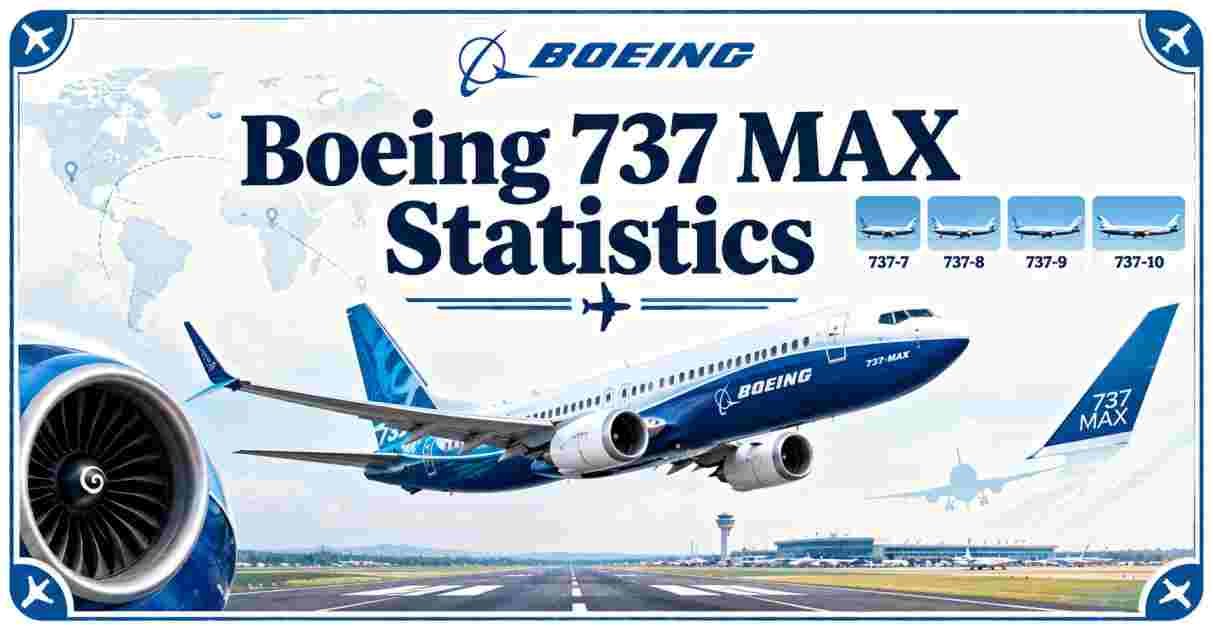
The Boeing 737 MAX is now Boeing’s best-selling aircraft family ever, with 7,206 total orders surpassing the previous-generation 737NG’s 7,159. Production reached 42 aircraft a month in early 2026, with the FAA lifting its two-year production cap that March and clearing Boeing to ramp toward 47 a month by mid-year and 53 by year-end.
Boeing 737 MAX in 2026
The Boeing 737 MAX has spent 2026 completing one of the more unusual turnarounds in commercial aviation history. After a 20-month worldwide grounding following two fatal crashes, two years of FAA-imposed production caps after a 2024 door-plug blowout, and years of quality-control scrutiny, the program crossed into 2026 with its order book larger than any 737 variant before it and its factories finally cleared to build faster than the 42-a-month ceiling that had constrained it since the Alaska Airlines incident.
This report pulls together the verified numbers behind the 737 MAX program as it stands today: the structural and engineering specifications across all four variants, the production and delivery data from Boeing’s own SEC filings, the order backlog, and the certified g-force limits and flight-control history, including MCAS, that define how the aircraft is built and flown. Every figure below comes from Boeing’s own quarterly SEC filings, FAA regulatory documents, or named aviation-industry data providers, not from independent estimates.
Few commercial aircraft programs have had their engineering and regulatory history scrutinized as closely as the 737 MAX’s over the past seven years. That scrutiny means the publicly available data on this program, production rates, delivery counts, backlog figures, certification milestones, is unusually granular and well-documented compared with most commercial aircraft types, largely because Boeing now reports MAX-specific figures in every quarterly filing and because the FAA has published detailed technical justifications for each regulatory decision affecting the program since 2019.
Interesting Facts About the Boeing 737 MAX in 2026
737 MAX vs 737NG: TOTAL ORDERS
737NG (previous generation)    █████████████ 7,159
737 MAX (current generation)   ██████████████ 7,206
| Fact | Detail |
|---|---|
| Total 737 MAX orders (as of July 2026) | 7,206, Boeing’s best-selling aircraft family ever |
| Previous record (737NG) | 7,159 orders |
| Production rate, early 2026 | 42 aircraft/month (FAA-capped) |
| FAA production cap lifted | March 2026 |
| Production rate target, mid-2026 | 47 aircraft/month |
| Production rate target, year-end 2026 | 53 aircraft/month |
| Long-term aspirational rate | 63 aircraft/month |
| Boeing commercial deliveries, H1 2026 | 314 total, 243 were 737 MAX (77%) |
Source: The Boeing Company, Form 10-Q and 8-K filings, Q1-Q2 2026; FAA production rate approvals.
The 737 MAX’s order total of 7,206 aircraft, reported in Boeing’s July 2026 mid-year results, makes it the best-selling commercial aircraft program in Boeing’s history, edging past the 7,159 orders logged by the previous-generation 737NG over that aircraft’s full production run. Reaching that milestone took the MAX roughly a decade; the NG needed closer to two decades to accumulate its total, a reflection of how much larger the global narrowbody replacement cycle has grown.
Production tells a more constrained story. The FAA capped MAX output at 42 aircraft a month following the January 2024 Alaska Airlines door-plug incident, a restriction that held for roughly two years before being lifted in March 2026. Boeing’s own mid-2026 results show 243 of 314 total commercial deliveries, 77%, were 737 MAX aircraft, Boeing’s clearest sign yet that the program’s post-grounding, post-door-plug recovery has become its primary profit engine again.
Boeing 737 MAX Model Specifications: MAX 7, 8, 9, 10 in 2026
737 MAX FAMILY RANGE BY VARIANT (nautical miles)
MAX 7    ███████████████████ 3,800 nm
MAX 8    ██████████████████ 3,550 nm
MAX 9    █████████████████ 3,300 nm
MAX 10   ████████████████ 3,100 nm
| Variant | Typical Seats | Max Seats | Range | Length |
|---|---|---|---|---|
| 737 MAX 7 | ~153 | 172 | 3,800 nm (7,040 km) | 35.6 m |
| 737 MAX 8 | ~162-178 | 210 | 3,550 nm (6,570 km) | 39.52 m |
| 737 MAX 9 | ~178 | 220 | 3,300 nm (6,110 km) | 42.1 m |
| 737 MAX 10 | 188-204 | 230 | 3,100 nm (5,740 km) | 43.8 m |
Source: Boeing 737 MAX type specifications; aerocorner.com; planefyi.com aircraft database.
All four 737 MAX variants share the same fuselage width, the same CFM LEAP-1B turbofan engines, and the same Mach 0.79 long-range cruise speed, roughly 453 knots (839 km/h). What changes down the family is length and seat count: each step from the MAX 7 up to the MAX 10 adds fuselage sections and passenger capacity while trading away range, the MAX 10 gives up roughly 700 nautical miles of reach compared to the MAX 7 in exchange for carrying around 58 more seats in a single-class layout.
The MAX 10, at 43.8 meters, is the longest 737 ever built and required a unique engineering solution to fly safely: a levered main landing gear system that extends slightly during takeoff rotation to prevent the extended-length tail from striking the runway, a problem the shorter MAX variants don’t face. Both the 737-7 and 737-10 had completed certification flight testing by July 2026, with Boeing targeting full FAA certification later in 2026 and first customer deliveries beginning in 2027.
The 737 MAX 8 remains the workhorse of the family and the variant most frequently seen in airline fleets today, since it entered commercial service years before the 7 and 10 variants cleared certification. Its blend of roughly 162 to 178 typical seats and 3,550 nautical miles of range covers the broadest set of airline missions, from dense domestic trunk routes to transcontinental and short international flying, without being specialized narrowly for either maximum capacity or maximum range the way the MAX 7 and MAX 10 are at opposite ends of the family.
Boeing 737 MAX G-Force and Structural Load Limits in 2026
CERTIFIED LIMIT LOAD FACTORS, TRANSPORT CATEGORY AIRCRAFT
Positive limit load factor    █████████████████████████ +2.5g
Negative limit load factor    ██████████ -1.0g
| Structural Limit | Certified Value |
|---|---|
| Positive limit load factor (normal state) | +2.5g |
| Negative limit load factor | -1.0g |
| Governing regulation | 14 CFR Part 25.333(b) and 25.301 |
| Certification category | Transport Category, FAA Part 25 and Part 36 |
| Service ceiling | 41,000 ft |
| Max takeoff weight (MAX 10) | ~92,000 kg (202,800 lb) |
Source: FAA 14 CFR Part 25.301, 25.305, 25.333(b); Boeing 737 Aircraft Flight Manual limitations.
Like every other Boeing and Airbus transport-category jet certified under FAA Part 25, the 737 MAX is designed to a positive limit load factor of +2.5g and a negative limit load factor of -1.0g, the standard structural envelope set out in 14 CFR 25.333(b). These figures represent the maximum loads the airframe is certified to withstand in service without permanent deformation, with an additional factor of safety applied on top to establish the aircraft’s true ultimate structural limit, which sits well beyond the certified limit load itself.
The 737 MAX’s flight control software, including the once-controversial Maneuvering Characteristics Augmentation System (MCAS), operates independently of these structural g-force limits; MCAS adjusts the aircraft’s horizontal stabilizer trim to maintain predictable handling characteristics as the aircraft approaches a high angle of attack, rather than directly limiting structural load. FAA documentation confirms the redesigned MCAS, certified for return to service in November 2020, uses inputs from both angle-of-attack sensors rather than the single-sensor design implicated in the two 2018-2019 accidents, and is limited to a single activation per erroneous angle-of-attack event. The US plane crash statistics report provides broader context on how the MAX’s accident history compares against overall US commercial aviation safety trends.
It’s worth being precise about what these figures actually govern. The +2.5g/-1.0g limit load factors describe the structural design envelope of the airframe itself, the forces the wings, fuselage, and control surfaces are built to withstand without damage, and that standard applies identically across every Part 25 transport-category jet, not just the 737 MAX. Regulations including 14 CFR 25.143(g), 25.251(e), and 25.255 separately require that the control column’s pull force increase as angle of attack increases, a handling-qualities requirement distinct from the structural load limit, and it was compliance with this handling-qualities requirement, not the structural g-force limit, that originally drove Boeing’s use of MCAS.
Boeing 737 MAX Production Rate Timeline in 2026
737 MAX MONTHLY PRODUCTION RATE, 2024-2026 (aircraft/month)
Post-2024 incident cap     ██████████████ 38
Early 2026                 ████████████████ 42
Mid-2026 target            ██████████████████ 47
Year-end 2026 target       ████████████████████ 53
Long-term aspiration       ████████████████████████ 63
| Period | Production Rate | Milestone |
|---|---|---|
| After January 2024 incident | 38/month | Initial FAA-imposed cap |
| Early 2026 | 42/month | Rate held through Q1 2026 |
| March 2026 | 42/month | FAA lifts the production cap entirely |
| Summer 2026 | 47/month | New 4th production line activated |
| Year-end 2026 (target) | 53/month | “Magic number” to cut into backlog |
| Long-term aspiration | 63/month | Stated goal, no firm date |
Source: Boeing Form 10-Q, Q1-Q2 2026; FAA production rate approvals; Boeing CEO Kelly Ortberg investor remarks, May 2026.
The FAA capped 737 MAX production at 38 aircraft a month after the January 2024 Alaska Airlines Flight 1282 door-plug blowout, later easing the cap to 42 as Boeing demonstrated improved quality controls. That 42-a-month ceiling held through the first quarter of 2026 before the FAA lifted the production cap entirely in March 2026, roughly two years after it was first imposed, clearing Boeing to pursue the production increases it had been publicly requesting.
Boeing CEO Kelly Ortberg told investors in May 2026 the company had “successfully completed the capstone review for the 47-unit production rate,” and the company activated low-rate initial production on a new fourth 737 line in Everett, Washington, in July 2026, the first time MAX aircraft have been built outside the traditional Renton final assembly line. Boeing’s stated year-end target of 53 aircraft a month is explicitly tied to making a dent in its massive backlog, while Ortberg has said the company “aspires to eventually reach a production rate of 63 units per month.”
The new Everett line is designed to build all three certified MAX variants, the 8, 9, and 10, giving Boeing flexibility to shift production mix toward whichever model has the strongest near-term demand without disrupting the existing Renton lines. Boeing has said it does not expect the Everett line to contribute meaningfully to the company’s overall rate increases before early 2027, meaning the climb from 42 to 47 and then to 53 aircraft a month through the rest of 2026 will rely primarily on the established Renton production system rather than the new capacity.
Boeing 737 MAX Orders and Backlog Statistics in 2026
BOEING COMMERCIAL AIRCRAFT BACKLOG GROWTH, 2025-2026
Dec 31, 2025        ████████████████████████████ $567.3 billion
Jun 30, 2026        ██████████████████████████████ $596.7 billion
| Backlog Metric | Figure |
|---|---|
| Total commercial backlog value, Dec 31, 2025 | $567.3 billion |
| Total commercial backlog value, Jun 30, 2026 | $596.7 billion (record) |
| Total commercial backlog, aircraft count, end of June 2026 | 6,814 aircraft |
| 737 MAX-specific backlog (early 2026) | ~4,800-4,887 aircraft |
| Net new orders, Q2 2026 | 246 aircraft |
| 2026 order cancellations (6 months) | $2,777 million, primarily 737 aircraft |
Source: The Boeing Company, Form 10-Q, June 30, 2026; Boeing Q2 2026 earnings release.
Boeing’s total commercial aircraft backlog climbed from $567.3 billion at the end of 2025 to a record $596.7 billion by June 30, 2026, reflecting new orders consistently outpacing deliveries across the first half of the year. The company’s own 10-Q filing notes $2,777 million in order cancellations during the first six months of 2026, “primarily related to 737 aircraft,” a reminder that even a record backlog carries some attrition as individual customer circumstances change.
At current industry-wide delivery rates, aviation analysts have noted Boeing and Airbus combined hold roughly 12 years of aircraft production sitting in their order books, a gap that puts real pressure on Boeing’s production-ramp timeline: unless the company can sustain 53 or more deliveries a month, its own backlog of roughly 4,800-plus MAX aircraft alone would take the better part of a decade to work through at 2026’s early-year pace. For broader context on how commercial aircraft deliveries translate into actual US passenger capacity, the air travel statistics report tracks total domestic and international passenger volumes against the US commercial fleet size.
Boeing 737 MAX Safety History and MCAS in 2026
737 MAX ACCIDENT AND GROUNDING TIMELINE
Oct 29, 2018   Lion Air Flight 610: 189 deaths
Mar 10, 2019   Ethiopian Airlines Flight 302: 157 deaths
Mar 2019       Worldwide grounding begins
Nov 2020       US grounding lifted (20 months)
Jan 5, 2024    Alaska Airlines door-plug incident
Mar 2026       FAA production cap lifted
| Date | Event |
|---|---|
| October 29, 2018 | Lion Air Flight 610 crashes; 189 deaths |
| March 10, 2019 | Ethiopian Airlines Flight 302 crashes; 157 deaths |
| March 2019 | Worldwide 737 MAX grounding begins |
| November 2020 | FAA lifts the US grounding after 20 months |
| January 5, 2024 | Alaska Airlines Flight 1282 door-plug blowout |
| 2024-2026 | FAA imposes and maintains production rate caps |
| March 2026 | FAA lifts the production cap entirely |
Source: FAA Preliminary Summary of the 737 MAX Review; NTSB accident investigations; DOT OIG Final Report, February 2021.
The 737 MAX’s two fatal 2018-2019 accidents, which together killed 346 people, were traced primarily to the original MCAS design, which relied on a single angle-of-attack sensor and could repeatedly push the aircraft’s nose down based on a single faulty sensor reading, overwhelming pilots who had not been trained on the system’s existence. A Department of Transportation Inspector General investigation found that Boeing had not identified MCAS as “novel or unusual” during certification, so the FAA never applied a special certification condition specific to the system.
The redesigned MCAS that returned the MAX to service in November 2020 now requires agreement between both angle-of-attack sensors before activating, and the FAA confirmed in its official return-to-service documentation that the aircraft “is capable of continued safe flight and landing” even with MCAS fully inoperative, a compliance standard required under 14 CFR 25.671 and 25.1309. The January 2024 door-plug incident, while unrelated to MCAS, triggered a fresh round of manufacturing-quality scrutiny that drove the two-year production cap only lifted in March 2026, underscoring how the program’s safety and production history have remained intertwined even years after the original grounding ended.
Boeing 737 MAX Deliveries by Quarter in 2026
BOEING COMMERCIAL DELIVERIES, Q1-Q2 2026
Q1 2026 total        ██████████████ 143
Q2 2026 total        █████████████████ 171
H1 2026 total        ███████████████████████████████ 314
| Period | Total Commercial Deliveries | Revenue |
|---|---|---|
| Q1 2026 | 143 aircraft | $9.2 billion |
| Q2 2026 | 171 aircraft | $11.75 billion |
| H1 2026 total | 314 aircraft | $20.95 billion |
| H1 2025 total (comparison) | 280 aircraft | $19.0 billion |
| Year-over-year delivery growth | +12% | — |
| June 2026 single-month deliveries | 64 total, 43 were 737s | — |
Source: The Boeing Company, Form 8-K, Q1 and Q2 2026 earnings releases.
Boeing’s 314 total commercial deliveries across the first half of 2026 mark the company’s strongest first-half total since 2018, with the 737 program driving nearly all of that growth: Q2 2026 alone saw 171 deliveries generating $11.75 billion in Commercial Airplanes revenue, a 14% increase over Q2 2025’s 150 deliveries. June 2026 specifically saw 43 narrowbody 737s delivered out of 64 total commercial aircraft that month, including 35 737 MAX 8s and 7 MAX 9s.
Boeing’s full-year 2026 guidance calls for roughly 500 total 737 deliveries, a figure the company reaffirmed even after a wiring-check issue briefly slowed some second-quarter deliveries. Even with that disruption, Boeing’s own reporting characterizes the MAX program’s delivery trajectory as its clearest production recovery since the original 2019 grounding, a turnaround that has directly supported the broader Boeing Commercial Airplanes segment’s narrowing operating losses across 2026. The program’s recovery carries implications well beyond Boeing’s own balance sheet, including for government aircraft programs that rely on Boeing’s commercial airframes, such as the new Air Force One program, which is built on a related Boeing 747 and 737 derivative supply chain facing its own cost and schedule pressures.
Despite the delivery growth, Boeing’s Commercial Airplanes segment posted an operating margin of negative 2.7% in Q2 2026 and negative 6.1% in Q1 2026, underscoring that rising delivery volume alone has not yet returned the segment to profitability. Boeing attributes the improving but still-negative margin to the mix of costs still embedded in ramping production, the ongoing 737-7 and 737-10 certification programs, and broader supply-chain normalization following its acquisition of fuselage supplier Spirit AeroSystems, a deal aimed at tightening quality control over the same door-plug-style components implicated in the January 2024 incident.
Boeing 737 MAX – FAQs
How many Boeing 737 MAX orders are there in 2026?
7,206 total orders as of July 2026, making the MAX Boeing’s best-selling aircraft family ever, surpassing the 737NG’s 7,159.
What is the current 737 MAX production rate?
42 aircraft a month in early 2026, with the FAA-imposed cap lifted in March 2026, and Boeing targeting 47 by mid-2026 and 53 by year-end.
What is the g-force limit on the Boeing 737 MAX?
A certified positive limit load factor of +2.5g and a negative limit load factor of -1.0g, the standard FAA Part 25 transport-category structural limit.
How many 737 MAX aircraft has Boeing delivered?
243 of Boeing’s 314 total commercial deliveries in the first half of 2026 were 737 MAX aircraft, about 77% of all deliveries.
What is MCAS on the Boeing 737 MAX?
The Maneuvering Characteristics Augmentation System, flight control software that adjusts horizontal stabilizer trim near high angles of attack; it was redesigned in 2020 to require agreement from both angle-of-attack sensors.
How long was the 737 MAX grounded?
20 months, from March 2019 to November 2020 in the United States, following two fatal crashes that killed 346 people combined.
What are the four 737 MAX models?
The MAX 7, MAX 8, MAX 9, and MAX 10, ranging from roughly 153 to 204 typical seats and 3,100 to 3,800 nautical miles of range.
When will the 737-7 and 737-10 be certified?
Both completed certification flight testing by July 2026, with FAA certification expected later in 2026 and first deliveries in 2027.
How large is Boeing’s current commercial aircraft backlog?
A record $596.7 billion across 6,814 aircraft as of June 30, 2026, with roughly 4,800-plus of those being 737 MAX orders.
What caused the FAA to cap 737 MAX production?
The January 5, 2024 Alaska Airlines Flight 1282 incident, in which a door plug blew out mid-flight, prompting an initial 38-a-month cap later eased to 42.
What engines power the Boeing 737 MAX?
Two CFM International LEAP-1B turbofan engines on every variant, producing roughly 28,000 to 29,000 pounds of thrust each.
Disclaimer: This research report is compiled from publicly available sources. While reasonable efforts have been made to ensure accuracy, no representation or warranty, express or implied, is given as to the completeness or reliability of the information. We accept no liability for any errors, omissions, losses, or damages of any kind arising from the use of this report.