
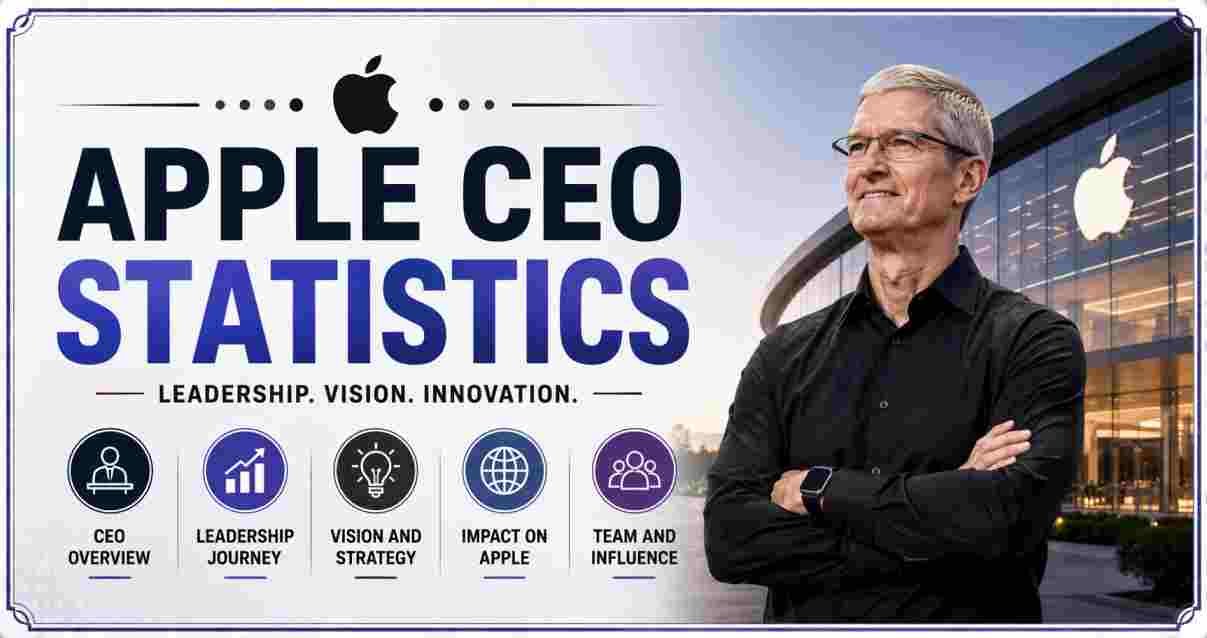
Who Is Apple’s CEO?
Apple’s Chief Executive Officer is the company’s top corporate leader, responsible for overseeing product strategy, financial performance, and day-to-day operations across one of the largest technology companies on Earth. As of September 1, 2026, that role belongs to John Ternus, a 25-year Apple veteran who spent his career in hardware engineering before being named the company’s fourth CEO in its history, following Steve Jobs, Gil Amelio and John Sculley in earlier decades, and most recently Tim Cook. The CEO reports to Apple’s Board of Directors, chaired since the transition by Art Levinson as Lead Independent Director, and works alongside a senior leadership team spanning hardware, software, services, and operations.
The CEO transition capped Tim Cook’s 15-year tenure, during which Apple grew from a company worth roughly $350 billion into a $4.6 trillion technology giant, becoming the first US publicly traded company to cross the $1 trillion market cap threshold in 2018 along the way. Cook did not leave Apple; instead, he moved into a newly created Executive Chairman role, continuing to serve the company in an advisory and governance capacity while Ternus assumes full operational control. This report breaks down the financial and structural details behind that transition, along with the compensation, revenue, and market performance figures defining Apple’s leadership today.
Key Apple CEO Facts in 2026
| Fact | Figure |
|---|---|
| Current CEO (as of Sept. 1, 2026) | John Ternus |
| Former CEO / new Executive Chairman | Tim Cook |
| Transition effective date | September 1, 2026 |
| Cook’s total CEO tenure | 15 years (Aug. 24, 2011 – Sept. 1, 2026) |
| Ternus’s tenure at Apple before becoming CEO | 25 years (joined 2001) |
| Apple market cap under Cook, start | ~$350 billion |
| Apple market cap under Cook, end | ~$4.6 trillion |
| Stock gain during Cook’s tenure | 2,150% to 2,275%, depending on measurement date |
| Ternus’s new total pay package | $58 million/year |
| Cook’s new Executive Chairman salary | $2 million/year, effective Sept. 26, 2026 |
Source: Apple 8-K and 8-K/A SEC filings, April-September 2026; Bloomberg via Yahoo Finance, September 2026; The Motley Fool, September 2026.
Taken together, these figures capture one of the most significant corporate leadership transitions in recent technology history. Cook’s 15-year run delivered a stock gain in the range of 2,150% to 2,275%, a return so large that Bank of America analyst Wamsi Mohan calculated Apple created market value at a rate of roughly $32 million an hour, every hour, for nearly the entire tenure. That kind of sustained value creation places Cook among the most successful corporate leaders of his generation, having taken over from Apple co-founder Steve Jobs at an especially delicate moment for the company.
What makes this transition structurally unusual is that Cook isn’t actually leaving Apple. Rather than a clean handoff followed by departure, the company created an Executive Chairman role specifically to retain Cook’s institutional knowledge, industry relationships, and government connections while giving Ternus full operational authority as CEO. This arrangement, formally announced on April 20, 2026 and effective September 1, 2026, reflects a deliberate, months-long succession plan rather than an abrupt leadership change.
Breaking: The Tim Cook to John Ternus CEO Transition 2026
| Transition Metric | Detail |
|---|---|
| Announcement date | April 20, 2026 |
| Board appointment date (Ternus) | April 17, 2026 |
| Transition effective date | September 1, 2026 |
| Cook’s new title | Executive Chairman of the Board |
| Ternus’s prior title | Senior Vice President of Hardware Engineering |
| Art Levinson’s new role | Lead Independent Director (was Chair of the Board for 15 years) |
| Cook’s quote on Ternus | Called him “a visionary whose contributions to Apple over 25 years are already too numerous to count” |
| Ternus’s quote on the role | “I am humbled to step into this role, and I promise to lead with the values and vision that have come to define this special place for half a century” |
Source: Apple Newsroom official announcement, April 2026; Apple 8-K SEC filing, April 20, 2026; Fox Business, September 2026.
Apple CEO Transition Timeline, 2026
Apr 17    Board appoints John Ternus as CEO-designate and board member
Apr 20    Apple publicly announces Cook-to-Ternus transition plan
Sep 1     Transition effective; Ternus becomes CEO, Cook becomes Executive Chairman
Sep 1-2   Ternus's first days as CEO; initial pay package disclosed via SEC filing
The four-month gap between the April announcement and the September effective date gave Apple, its board, investors, and Ternus himself a structured runway to prepare for the handoff, rather than executing an immediate transition. This approach mirrors best practices in large-company succession planning, where a publicly telegraphed timeline helps stabilize investor confidence and gives the incoming CEO time to begin shadowing key relationships and decisions before formally assuming full authority.
Cook’s own framing of the choice — praising Ternus’s 25 years of contributions as “too numerous to count” — signals confidence in an internal successor deeply steeped in Apple’s product culture, rather than an outside hire brought in to shake up the company’s direction. Art Levinson’s shift from Board Chair to Lead Independent Director after 15 years in the top governance role adds a second layer of leadership renewal happening simultaneously with the CEO transition, suggesting Apple used this moment to refresh multiple senior positions at once rather than isolating the change to the CEO seat alone.
New Apple CEO John Ternus Statistics 2026
| Ternus Background Metric | Figure |
|---|---|
| Age (as of transition) | 50 years old |
| Year joined Apple | 2001 |
| Years at Apple before becoming CEO | 25 years |
| Year joined Apple’s executive team | 2021 |
| Prior title | SVP of Hardware Engineering |
| Products overseen | Mac, iPad, iPhone, Apple Watch, AirPods |
| Notable technical achievement | Oversaw transition to in-house Apple Silicon chips |
| AirPods advancement led | Development of over-the-counter hearing aid capability |
| Background type | Product design and hardware engineering, distinct from Cook’s operations background |
Source: Fox Business, September 2026; Apple Newsroom official announcement, April 2026.
Apple CEO Leadership Background Comparison
Tim Cook (2011-2026)   ████████████████████████ Operations & supply chain management
John Ternus (2026-)    ████████████████████████ Product design & hardware engineering
Ternus’s ascent represents a genuine shift in Apple’s leadership philosophy: where Cook built his reputation on operational excellence and supply chain mastery, Ternus’s 25-year career has been spent almost entirely in product design and hardware engineering, working directly on the physical devices that define Apple’s brand. Cult of Mac editor Leander Kahney described this as “a great thing,” noting that Apple’s manufacturing focus requires “deep, deep expertise in how to make things, and Ternus definitely has that.”
Ternus’s specific technical accomplishments — leading the Apple Silicon transition across the Mac lineup and driving AirPods innovations that turned the earbuds into an over-the-counter hearing health system — position him as a leader whose credibility comes from shipped products rather than financial or operational metrics alone. Analysts have specifically flagged that this product-first background could prove valuable as Apple works to deepen artificial intelligence integration across its hardware and software, starting with the company’s widely anticipated overhaul of Siri.
Tim Cook’s 15-Year Tenure Statistics 2026
| Cook Legacy Metric | Figure |
|---|---|
| CEO start date | August 24, 2011 |
| CEO end date | September 1, 2026 |
| Predecessor | Steve Jobs |
| Apple market cap, 2011 (start of tenure) | ~$338-350 billion |
| Apple market cap, 2026 (end of tenure) | ~$4.5-4.75 trillion |
| Total stock gain during tenure | 2,150% to 2,275% |
| Apple’s rank when Cook took over | Building toward first $1T milestone |
| Apple’s rank at end of Cook’s tenure | 2nd-most valuable company globally, behind Nvidia |
| Total spent on stock buybacks since fiscal 2012 | Over $840 billion |
| Share count reduction since 2012 peak | Nearly 45%, lowest level since 1998 |
Source: Bloomberg via Yahoo Finance, September 2026; company data through Q1 2026.
Apple Market Capitalization: Start vs End of Cook's Tenure
2011 (Cook takes over)     ██ ~$350 billion
2026 (Cook steps down)     ████████████████████████████████████████ ~$4.6 trillion
Cook’s tenure produced one of the largest sustained corporate value creation runs in modern business history, taking Apple from a company already successful under Steve Jobs to one worth more than 13 times its 2011 valuation. A cornerstone of that growth strategy was an aggressive stock buyback program, with Apple spending more than $840 billion repurchasing its own shares since fiscal 2012, reducing outstanding share count by nearly 45% and pushing it to its lowest level since 1998 — a program activist investor Carl Icahn had specifically urged the company to pursue back in 2014, arguing the stock was undervalued at the time.
Chris Brigati, chief investment officer at SWBC, summarized the scope of Cook’s legacy succinctly: “Steve Jobs left huge shoes to fill, but Cook is also leaving big shoes, albeit of a different type, given his very different approach to expanding the company’s growth engines.” Bank of America’s Wamsi Mohan flagged one notable shift likely under Ternus: Apple has moved away from its historical net cash neutral objective, a change that “could signal a period of higher investment in R&D, Capex, and larger M&A” — investment categories Cook’s era notably de-emphasized relative to buybacks and shareholder returns.
Apple CEO Salary and Compensation Statistics 2026
| Compensation Metric | Figure |
|---|---|
| Cook’s 2025 total target compensation (as CEO) | $59 million |
| Cook’s base salary (unchanged since 2016) | $3 million |
| Cook’s target cash incentive (200% of base) | $6 million |
| Cook’s target equity award value | $50 million (25% time-based, 75% performance-based) |
| Ternus’s new total pay package | $58 million/year |
| Ternus’s annual base salary (post-transition) | $3 million |
| Ternus’s prorated FY2026 RSU award | $2.5 million |
| Ternus’s FY2027 annual equity target | $55 million (75% performance-based, 25% time-based) |
| Cook’s new salary as Executive Chairman | $2 million/year, effective Sept. 26, 2026 |
| Cook’s FY2027 equity award as Executive Chairman | $45 million (50% performance-based, 50% time-based) |
Source: Apple 8-K/A SEC filing, September 2026; Apple DEF 14A Proxy Statement, FY2026; Deadline and TheWrap, September 2026.
CEO Total Pay Package Comparison: Cook (2025) vs Ternus (2026)
Cook, Final Year as CEO (2025)   ████████████████████████████████████████████████ $59M total target
Ternus, First Package (2026)     ███████████████████████████████████████████████ $58M total
The near-identical scale of Ternus’s $58 million package compared to Cook’s final $59 million total target compensation signals Apple’s board intentionally maintained pay continuity through the transition rather than adjusting compensation significantly upward or downward for the new CEO. Both packages follow the same fundamental structure — a modest base salary paired with a much larger performance-linked equity award — though the specific vesting mechanics differ slightly, with Ternus’s FY2027 award weighted more heavily toward performance-based vesting (75%) than Cook’s historical equity structure.
Cook’s own post-transition arrangement as Executive Chairman reflects a significant compensation step-down appropriate to a reduced operational role: his salary dropped from $3 million to $2 million, and his equity award shifted to an even 50/50 split between performance-based and time-based vesting, compared to the CEO-level 75% performance weighting both he and Ternus received while holding the top operational job. Notably, Apple’s proxy filing specifies that if Cook’s employment ends due to retirement on or after the first anniversary of his Executive Chairman equity grant date, his award will continue vesting on its originally scheduled dates rather than accelerating or forfeiting — a provision designed to smooth any further transition away from the company down the road.
Apple Revenue and Financial Performance Statistics 2026
| Financial Metric | Figure |
|---|---|
| FY2026 Q3 quarterly revenue (ended June 27, 2026) | $109.4 billion, up 16% year-over-year |
| FY2026 Q3 gross margin | 50.1%, including ~2-point tariff refund benefit |
| FY2026 Q3 diluted EPS | $2.02, up 29% year-over-year |
| FY2011 annual revenue (start of Cook’s tenure) | $108 billion |
| Trailing-12-month revenue (2026) | Over $466 billion |
| iPhone revenue growth (recent period, YoY) | 22%, driven by iPhone 17 lineup |
| Q3 2026 records set | Total company revenue, EPS, and revenue in every geographic segment |
| Cook’s stated Q3 characterization | “Our strongest June quarter ever” |
Source: Apple 8-K SEC filing, Q3 FY2026 earnings release, June 27, 2026.
Apple Annual Revenue: FY2011 vs Trailing-12-Month 2026 ($ Billions)
FY2011 (Cook's first full year)   ████████ $108B
TTM 2026 (end of Cook's tenure)   ████████████████████████████████████████ $466B+
Apple’s revenue growth from $108 billion in fiscal 2011 to more than $466 billion on a trailing-12-month basis represents more than a fourfold increase over Cook’s tenure, and the company’s final quarterly results before the leadership transition showed no signs of slowing: Q3 FY2026 revenue hit $109.4 billion, up 16% year-over-year, with records set not just in total revenue but across every individual geographic segment the company reports.
The 22% year-over-year iPhone revenue growth, driven by strong iPhone 17 lineup performance, is particularly notable given that the iPhone — a product that debuted under Steve Jobs, not Cook — still accounts for more than half of Apple’s total sales even after 15 years of aggressive services and wearables expansion. That durability underscores an important nuance in Cook’s legacy: while he successfully diversified Apple’s revenue base by scaling iCloud, Apple Pay, Apple TV, and Apple Music into major businesses in their own right, the core hardware franchise he inherited from Jobs remains the company’s foundational growth engine even as Ternus takes over.
Apple Market Capitalization and Valuation Statistics 2026
| Valuation Metric | Figure |
|---|---|
| Apple market cap when Cook took over (2011) | ~$338-350 billion |
| Apple market cap when Cook stepped down (2026) | ~$4.5-4.75 trillion |
| Year Apple first crossed $1 trillion market cap | 2018 |
| Apple’s historic distinction at that milestone | First publicly traded US company to reach $1 trillion |
| Apple’s current global valuation rank | 2nd, behind Nvidia |
| Total value created during Cook’s tenure | Approximately $4.2-4.4 trillion in absolute terms |
| Implied hourly value creation rate (BofA estimate) | ~$32 million per hour, nearly continuously for 15 years |
| AAPL stock price movement on transition day | +2.61% |
Source: Bloomberg via Yahoo Finance, September 2026; Fox Business, September 2026; Bank of America research note, August 2026.
Apple's Market Cap Milestones Under Tim Cook
2011   ● Cook becomes CEO (~$350B market cap)
2018   ● First US company to reach $1 trillion market cap
2026   ● Cook steps down; market cap ~$4.6-4.75 trillion
Apple’s journey from roughly $350 billion to nearly $4.75 trillion during Cook’s tenure includes one of the most closely watched milestones in modern corporate history: becoming the first publicly traded US company to cross the $1 trillion market capitalization threshold in 2018, a benchmark that took the company just seven years into Cook’s leadership to reach. From there, Apple nearly quintupled again over the following eight years, even as competition intensified across every major product category the company operates in.
Apple now sits as the world’s second-most valuable public company, trailing only Nvidia amid the ongoing AI infrastructure boom — a notable positioning shift, since Apple spent much of the 2020s as either the first or second-largest company globally, alternating with Microsoft and, more recently, Nvidia, depending on market conditions. The stock’s modest 2.61% gain on the actual day of the CEO transition suggests investors had already priced in the leadership change well ahead of time, consistent with the extended, publicly telegraphed timeline Apple used between the April announcement and the September effective date. Readers interested in how Apple’s overall corporate scale compares to other major US companies can find further context in our Richest Company Statistics in the US report.
Apple CEO Role and Corporate Governance Statistics 2026
| Governance Metric | Figure |
|---|---|
| Apple CEOs in company history (through 2026) | 4 (excluding interim/co-founder periods): Sculley, Amelio, Jobs, Cook, Ternus |
| Board chair role change | Levinson moves from Chair to Lead Independent Director |
| Years Levinson served as Board Chair | 15 years |
| Committee overseeing CEO compensation | People and Compensation Committee |
| Vesting structure standard for time-based RSUs (FY2027) | Semiannual, 12.5% installments over 4 years |
| Performance metric for performance-based RSUs | Total shareholder return relative to S&P 500 |
| Apple’s next product focus under new CEO | Siri overhaul, deeper AI integration |
| Sector Apple products span (per Ternus’s oversight history) | Mac, iPad, iPhone, Apple Watch, AirPods |
Source: Apple DEF 14A Proxy Statement, FY2026; Apple 8-K/A SEC filing, September 2026.
Apple Board Leadership Structure, Pre- and Post-Transition
Before Sept 1, 2026:   Art Levinson (Board Chair) + Tim Cook (CEO)
After Sept 1, 2026:    Art Levinson (Lead Independent Director) + Tim Cook (Executive Chairman) + John Ternus (CEO)
The governance restructuring accompanying this CEO transition goes beyond the operational leadership change itself, reshaping how Apple’s board oversight functions going forward. With Cook joining the board as Executive Chairman and Levinson stepping back from the Chair role after 15 years to become Lead Independent Director, Apple now has both a sitting former CEO and a long-tenured independent director occupying senior governance positions simultaneously — a structure designed to preserve institutional continuity while formally separating day-to-day operational authority, held by Ternus, from board-level oversight functions.
The standardized equity vesting structure applied to both Ternus’s and Cook’s FY2027 awards — semiannual installments over four years for the time-based portion, tied to relative shareholder return versus the S&P 500 for the performance-based portion — reflects Apple’s broader approach to aligning executive incentives with long-term investor outcomes rather than short-term stock movements. As Ternus begins shaping Apple’s product direction, particularly around the company’s anticipated AI-driven Siri overhaul, readers tracking how executive compensation compares across the broader technology sector may find our Tech Salary Statistics in the US report useful context, alongside our dedicated coverage of iPhone 18 statistics, which tracks the flagship product line Ternus himself helped engineer before becoming CEO.
Disclaimer: This research report is compiled from publicly available sources. While reasonable efforts have been made to ensure accuracy, no representation or warranty, express or implied, is given as to the completeness or reliability of the information. We accept no liability for any errors, omissions, losses, or damages of any kind arising from the use of this report.