
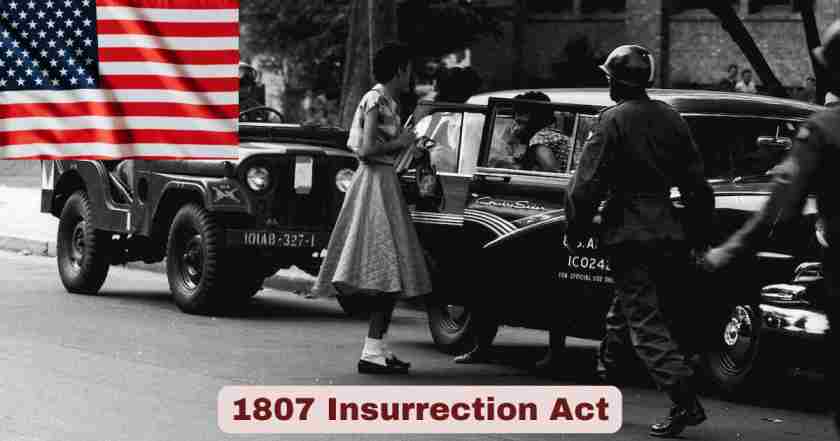
1807 Insurrection Act in the US
The 1807 Insurrection Act represents one of the foundational pieces of legislation governing presidential emergency powers in the United States, enacted on March 3, 1807, during the administration of President Thomas Jefferson. This historic law emerged from the tumultuous circumstances surrounding the Aaron Burr Conspiracy, a bizarre plot in which the former Vice President allegedly sought to establish his own empire in the Louisiana Territory or invade Spanish-held Mexico. The Act fundamentally transformed presidential authority by permitting the deployment of both land and naval forces—not merely state militias—to suppress insurrections, domestic violence, or obstructions to federal law enforcement. As one of the oldest emergency statutes in American history, this 219-year-old law has shaped the relationship between federal military power and civilian governance across more than two centuries of American democracy.
The significance of the 1807 Insurrection Act extends far beyond its original purpose, having been substantially amended twice—first in 1861 during the Civil War and again in 1871 during Reconstruction—to expand presidential powers even further. The law currently exists as Title 10, Sections 251-255 of the United States Code and serves as the primary statutory exception to the Posse Comitatus Act of 1878, which generally prohibits military involvement in civilian law enforcement. Throughout its history spanning more than two centuries, the Act has been invoked approximately 30 times by 15 different presidents, shaping pivotal moments in American history from the suppression of the Ku Klux Klan to the enforcement of school desegregation. The Act’s foundational language, barely modified from Jefferson’s era, continues to grant presidents extraordinarily broad discretion to deploy military forces domestically, making it one of the most powerful and controversial executive authorities in the constitutional framework.
Interesting Facts and Latest Statistics Regarding 1807 Insurrection Act in the US
| Key Fact Category | Statistic/Detail | Year/Period |
|---|---|---|
| Date of Enactment | March 3, 1807 | Signed by President Thomas Jefferson |
| Predecessor Legislation | Calling Forth Act of 1792 (Militia Act) | Signed by President George Washington |
| First Use After Enactment | 1808 – Embargo Act enforcement | President Jefferson, 1 year after signing |
| Current Legal Codification | Title 10 U.S. Code, Sections 251-255 | Current statutory location |
| Total Major Amendments | 2 major amendments (1861, 1871) | Civil War and Reconstruction eras |
| Total Historical Invocations | 30 documented invocations | 1792-1992 (230+ years) |
| Number of Presidents Who Used It | 15 different presidents | Washington through George H.W. Bush |
| Original Text Length | 1 paragraph (approximately 100 words) | Remarkably concise legislation |
| Sections in Current Law | 5 statutory sections (251-255) | Expanded from original single section |
| Related Legislation | Posse Comitatus Act of 1878 (creates exception) | Restricts military in law enforcement |
| Last Use Before Modern Era | 1992 Los Angeles riots | 185 years after original enactment |
| Years Active | 219 years (1807-present) | Oldest emergency power statute still in use |
Data Source: U.S. Congress Library, National Archives, Brennan Center for Justice, Historical Congressional Records
The 1807 Insurrection Act stands as a remarkably enduring piece of American legislation, with its 219-year history making it one of the oldest continuously operative federal statutes governing executive emergency powers. President Thomas Jefferson signed the Act into law on March 3, 1807, as one of several bills passed on the final day of the Ninth Congress, establishing legal authority for presidents to deploy not just state militias but also land and naval forces of the United States military to suppress domestic insurrections or enforce federal law. The legislation emerged directly from Jefferson’s response to the Aaron Burr Conspiracy of 1806-1807, where the former Vice President allegedly plotted to create a breakaway territory in the Louisiana Purchase lands or invade Spanish-controlled Mexico with a private army. This crisis convinced Jefferson and Congress that the existing 1792 Militia Act, which had been successfully used by President George Washington to suppress the 1794 Whiskey Rebellion, provided insufficient authority because it limited federal response to calling forth state militias rather than deploying regular federal military forces.
The Act’s first documented use came swiftly in 1808, merely one year after enactment, when President Jefferson himself invoked it to enforce the highly unpopular Embargo Act of 1807, which prohibited American ships from trading with foreign nations in an attempt to pressure Britain and France during the Napoleonic Wars. The original legislative text contained just one paragraph of approximately 100 words, yet its extraordinarily broad language has proven sufficiently flexible to address crises ranging from slave rebellions to civil rights enforcement to natural disaster response across 230+ years of American history. The Act has been substantially amended twice: first in 1861 when President Abraham Lincoln and Congress expanded it to permit deployment of federal forces against Confederate rebellion even over state objections, and again in 1871 with the Third Enforcement Act (also called the Ku Klux Klan Act) during Reconstruction to explicitly authorize federal military protection of African Americans’ constitutional rights. Today’s statute comprises 5 sections codified in Title 10, Sections 251-255 of the United States Code, representing a significant expansion from its original single-paragraph format, with 15 different presidents having invoked this authority across 30 documented occasions between 1792 and 1992.
Historical Context Leading to the 1807 Insurrection Act in the US
| Event | Date | Key Figures | Outcome | Connection to 1807 Act |
|---|---|---|---|---|
| Whiskey Rebellion | 1794 | President George Washington, Alexander Hamilton | Federal militia suppressed rebellion | Demonstrated need for federal power but only used state militias |
| Calling Forth Act of 1792 | May 2, 1792 | President Washington, Congress | Authorized President to call forth state militias | Predecessor legislation, limited to militia forces |
| Aaron Burr Conspiracy | 1806-1807 | Aaron Burr, Thomas Jefferson, James Wilkinson | Burr arrested and tried for treason | Direct catalyst for 1807 Act passage |
| Burr’s Western Expedition | August 1806 | Aaron Burr, approximately 60-80 followers | Expedition stopped at Mississippi Territory | Revealed need for federal military deployment authority |
| Jefferson’s Proclamation | November 27, 1806 | President Thomas Jefferson | Warned citizens against Burr conspiracy | Presidential action before legislation existed |
| Burr’s Arrest | February 19, 1807 | Aaron Burr, federal authorities | Arrested in Alabama Territory | Two weeks before Act passage |
| 1807 Act Passage | March 3, 1807 | Ninth Congress, President Jefferson | Law enacted granting expanded presidential power | Formalized authority to deploy regular military forces |
Data Source: National Archives, Library of Congress, Presidential Papers of Thomas Jefferson, Historical Records
The pathway to the 1807 Insurrection Act began with the earlier Calling Forth Act of 1792, which President George Washington successfully employed during the Whiskey Rebellion of 1794 when approximately 13,000 state militia troops were mobilized to suppress tax resistance in western Pennsylvania. However, that earlier law limited presidents to calling forth state militias and required elaborate procedures including a presidential proclamation commanding insurgents to disperse and a certification that federal marshals could not execute the law. The 1792 Act proved adequate for Washington’s purposes, but President Jefferson encountered a qualitatively different threat in the Aaron Burr Conspiracy that exposed the limitations of relying solely on state militias rather than regular federal military forces.
Aaron Burr, who had served as Vice President from 1801-1805 and famously killed Alexander Hamilton in a duel in 1804, began organizing a mysterious western expedition in August 1806 that alarmed Jefferson administration officials. General James Wilkinson, the commanding general of the U.S. Army and Burr’s alleged co-conspirator, eventually betrayed Burr by sending dispatches to President Jefferson warning of a plot to separate western territories from the United States or invade Spanish Mexico. Jefferson issued a presidential proclamation on November 27, 1806, warning citizens against participating in Burr’s conspiracy, but the legal authority to deploy federal troops to prevent the conspiracy remained unclear under existing law. Burr was arrested on February 19, 1807, in the Alabama Territory, just two weeks before Congress passed the 1807 Insurrection Act on March 3, 1807, the final day of the legislative session. The Act explicitly authorized the President to employ both land and naval forces—not just state militias—to suppress insurrections and enforce federal law, fundamentally expanding executive power in ways that would shape American governance for the next 219 years and through 30 subsequent invocations by 15 different presidents.
Original Text and Provisions of the 1807 Insurrection Act in the US
| Provision Element | Original 1807 Language | Scope of Authority | Key Terms |
|---|---|---|---|
| Triggering Conditions | “Insurrection or obstruction to the laws” | Domestic violence, rebellion, or law enforcement impediments | Broad, undefined terms |
| Forces Authorized | “Land or naval force” of the United States | Regular federal military, not just state militias | Army and Navy personnel |
| Presidential Discretion | “Whenever…in the judgment of the President” | Sole executive determination of necessity | No external oversight required |
| Geographic Scope | Any state or territory of the United States | Nationwide application | All U.S. territory |
| Duration Limits | None specified in original Act | Unlimited deployment period | No sunset provision |
| Congressional Role | None required after initial authorization | No consultation or approval needed for use | Pure executive authority |
| Proclamation Requirement | Must issue proclamation ordering insurgents to disperse | Presidential warning before deployment | Inherited from 1792 Act |
| Primary Purpose | Suppress insurrection and enforce federal law | Dual function: rebellion suppression and law enforcement | Exceptionally broad mandate |
Data Source: Statutes at Large of the United States, 9th Congress Session II, National Archives
The original 1807 Insurrection Act consisted of a remarkably brief single paragraph containing approximately 100 words, yet those few words granted the President extraordinary authority that would echo through American history for more than two centuries. The key operative language authorized the President to employ “such of the land or naval force of the United States as he may deem necessary” whenever there shall be an “insurrection in any state against its government” or when “combinations too powerful to be suppressed by the ordinary course of judicial proceedings” obstruct execution of federal or state laws. This language represented a fundamental expansion beyond the 1792 Calling Forth Act, which had limited presidents to mobilizing state militias rather than deploying the regular United States Army or Navy.
The Act’s brevity belies its extraordinary scope, particularly the phrase granting authority “whenever…in the judgment of the President” such action becomes necessary. This vests sole discretion in the executive to determine when conditions warrant military deployment, with no requirement for Congressional consultation, judicial approval, or state consent in cases of federal law enforcement. The only procedural safeguard carried over from the 1792 Act was the requirement that the President issue a proclamation commanding insurgents to disperse before deploying forces, though even this requirement has been interpreted loosely in practice. The original Act contained no time limits on deployments, no definitions of key terms like “insurrection” or “combinations,” and no specification of what actions military forces could take once deployed. The lack of sunset provisions or renewal requirements meant that once enacted on March 3, 1807, the authority would continue indefinitely until Congress chose to repeal or modify it—a power Congress has exercised only twice in 219 years, both times to expand rather than restrict presidential authority through the 1861 and 1871 amendments. This original concise language has proven sufficiently elastic to justify 30 invocations across vastly different circumstances, from enforcing trade embargoes to suppressing labor strikes to protecting civil rights marchers.
First Use of the 1807 Insurrection Act in the US – 1808 Embargo Enforcement
| Aspect | Details | Statistics | Historical Significance |
|---|---|---|---|
| Date of Invocation | 1808 | 1 year after Act’s passage | First documented use of new authority |
| President | Thomas Jefferson | Democratic-Republican | Same president who signed Act into law |
| Precipitating Event | Widespread violation of Embargo Act of 1807 | Massive smuggling operations | Trade restrictions extremely unpopular |
| Geographic Focus | Northern border states, particularly New York and Vermont | Canadian border region | Smuggling routes to British Canada |
| Legal Basis | Enforcement Act of January 9, 1809 | Expanded embargo enforcement powers | Combined with Insurrection Act authority |
| Federal Forces Deployed | Army and Navy personnel | Numbers not precisely documented | Mixed military and customs enforcement |
| Duration | January-March 1809 | Approximately 2-3 months | Ended when Jefferson left office |
| Effectiveness | Limited success, embargo widely evaded | Economic losses estimated in millions | Demonstrated limits of military enforcement |
| Political Consequences | Deeply unpopular, damaged Jefferson’s legacy | Contributed to Federalist gains in 1808 elections | Embargo repealed March 1, 1809 |
Data Source: Presidential Papers of Thomas Jefferson, National Archives, Congressional Records of 1808-1809
The first invocation of the newly enacted 1807 Insurrection Act came ironically from the very president who had championed its passage, when Thomas Jefferson deployed federal military forces in 1808 to enforce the spectacularly unpopular Embargo Act of December 22, 1807. This legislation prohibited virtually all American ships from sailing to foreign ports in an attempt to pressure Britain and France to respect American neutrality during the Napoleonic Wars, but it had the unintended consequence of devastating the American economy, particularly in New England port cities whose livelihoods depended on international trade. Widespread smuggling operations emerged almost immediately, with merchants smuggling goods across the Canadian border and ships illegally departing for European ports despite the prohibition.
Jefferson viewed this massive evasion as a form of insurrection against federal law, justifying use of his newly acquired authority under the 1807 Act to deploy Army and Navy personnel to assist customs officials in enforcement operations. The most intensive military deployments occurred along the northern border in states like New York and Vermont, where smuggling to British-controlled Canada proved particularly lucrative and organized. Congress passed additional enforcement legislation on January 9, 1809, further expanding presidential authority to use military force to suppress violations, creating what historians have described as one of the most coercive peacetime uses of federal power in early American history. However, the military enforcement proved largely ineffective, as smugglers adapted their routes and methods, and public resentment of the embargo grew to the point that Jefferson’s own Democratic-Republican party faced significant electoral losses in the 1808 elections. The embargo was finally repealed on March 1, 1809, just three days before Jefferson left office, marking an ignominious end to this first use of the Insurrection Act. The experience demonstrated both the broad authority the 1807 Act granted presidents and the political risks of deploying military forces against ordinary citizens engaged in economically motivated violations of unpopular laws, lessons that would inform how future presidents approached the use of this extraordinary power across the next 219 years and 29 subsequent invocations.
Major Amendments to the 1807 Insurrection Act in the US
| Amendment | Date Enacted | President/Congress | Key Changes | Historical Context | Legal Impact |
|---|---|---|---|---|---|
| 1861 Amendment | July 29, 1861 | President Abraham Lincoln, 37th Congress | Authorized use against “rebellion” even over state objection | Civil War, Confederate secession | Eliminated state consent requirement for federal law enforcement |
| 1871 Enforcement Act (Third) | April 20, 1871 | President Ulysses S. Grant, 42nd Congress | Explicit authority to protect constitutional rights and combat conspiracies | Reconstruction, KKK violence against freedpeople | Authorized deployment to protect civil rights |
| Civil Rights Act of 1871 | April 20, 1871 (same legislation) | President Grant, 42nd Congress | Federal government could act when states failed to protect rights | Systematic state failure to protect African Americans | Created federal duty to protect constitutional rights |
| Modern Codification | 1956 | 84th Congress | Reorganized as Title 10 U.S. Code Sections 251-255 | Post-WWII statutory reorganization | No substantive changes, organizational only |
Data Source: Statutes at Large, Congressional Records, National Archives, Reconstruction Era Legal History
The 1807 Insurrection Act has been substantively amended only twice in its 219-year history, both times to expand rather than restrict presidential authority, reflecting Congressional recognition during national crises that the original statute needed strengthening rather than limitation. The first major amendment came on July 29, 1861, barely four months into the Civil War, when President Abraham Lincoln and the 37th Congress passed legislation explicitly authorizing use of federal military forces to suppress “rebellion” against the United States government even without state consent or request. This modification proved critical because Confederate state governments obviously would not request federal assistance in suppressing their own secession, and the amendment clarified that federal authority superseded state opposition when enforcing federal law or suppressing rebellion against the national government.
The second and most significant amendment arrived during Reconstruction with the Third Enforcement Act (also called the Ku Klux Klan Act) of April 20, 1871, which President Ulysses S. Grant signed into law to combat organized white supremacist violence against freedpeople in the former Confederacy. This legislation added explicit language authorizing the President to deploy military forces to protect constitutional rights and suppress conspiracies that deprived citizens of equal protection under law, even when state governments proved unwilling or unable to provide such protection themselves. The 1871 amendment transformed the Insurrection Act from primarily a tool for suppressing rebellions into an instrument for actively protecting civil rights, establishing federal authority to override state inaction when constitutional rights were systematically violated. President Grant invoked this newly expanded authority eight times during his presidency, more than any other president in history, deploying federal troops across South Carolina, North Carolina, Mississippi, and other Southern states to break up KKK organizations and protect African American voting rights and physical safety. These two amendments in 1861 and 1871 fundamentally expanded the scope of presidential power under the Insurrection Act, creating the framework that would govern all subsequent 30 invocations through 1992 and that continues to define executive authority as codified in Title 10, Sections 251-255 today.
Current Statutory Structure of the 1807 Insurrection Act in the US
| Section | Title 10 U.S. Code | Subject Matter | Original Source | Key Authority Granted |
|---|---|---|---|---|
| Section 251 | Federal aid for State governments | State request for assistance | 1807 original Act | Deployment when state requests help suppressing insurrection |
| Section 252 | Use of militia and armed forces to enforce Federal authority | Obstruction of federal law | 1807 original Act, 1861 amendment | Deployment when unlawful obstructions prevent law execution |
| Section 253 | Interference with State and Federal law | Constitutional rights protection | 1871 Enforcement Act | Deployment to protect constitutional rights or when state unable/unwilling to protect rights |
| Section 254 | Proclamation to disperse | Warning requirement | 1792 Calling Forth Act | President must order insurgents to disperse before deploying forces |
| Section 255 | [Repealed] | Former additional provisions | Various | Section removed during statutory reorganization |
Data Source: United States Code Title 10, Armed Forces, Cornell Law School Legal Information Institute
The current 1807 Insurrection Act exists as a five-section framework within Title 10 of the United States Code, Sections 251-255, representing the culmination of 219 years of legislative development from Jefferson’s original single-paragraph statute. Section 251 preserves the original concept from the 1792 Calling Forth Act that permits states to request federal military assistance when facing insurrection or domestic violence beyond their capacity to suppress using their own resources. This section requires an application from the state legislature or governor (when the legislature cannot be convened) before the President may deploy forces, representing the least controversial use of federal military power since it responds to state consent.
Section 252 embodies the core innovation of the 1807 Act itself, authorizing the President to deploy forces whenever unlawful obstructions, combinations, or assemblages make it impracticable to enforce federal law through ordinary judicial proceedings. This section requires no state consent and vests sole discretion in the President to determine when such conditions exist, making it the most powerful and controversial provision. Section 253, derived from the 1871 Enforcement Act amendments, represents the most expansive presidential authority by permitting deployment to protect constitutional rights or enforce federal court orders when states prove unable or unwilling to do so, the provision used during the Civil Rights Era by Presidents Eisenhower, Kennedy, and Johnson to enforce school desegregation against state resistance. Section 254 maintains the procedural requirement inherited from the 1792 Act that the President must issue a proclamation ordering insurgents to disperse before deploying military forces, though this represents a relatively minor check on executive authority since the President controls both the proclamation and deployment decisions. The statutory framework’s five sections (with Section 255 having been repealed) thus reflect the layered history of presidential emergency powers, incorporating elements from 1792, 1807, 1861, and 1871 into a unified structure that has governed all 30 historical invocations and continues to define the extraordinary authority available to presidents in the 21st century.
Usage Statistics of the 1807 Insurrection Act in the US by Time Period
| Era | Years Covered | Number of Invocations | Primary Purposes | Presidents Who Invoked | Most Notable Uses |
|---|---|---|---|---|---|
| Early Republic | 1808-1860 | 6 invocations | Trade enforcement, slave rebellions, border disputes | Jefferson, Jackson, others | Embargo Act (1808), Nat Turner aftermath (1831) |
| Civil War | 1861-1865 | Multiple invocations | Suppressing Confederate rebellion | Abraham Lincoln | Preserving the Union against secession |
| Reconstruction | 1865-1877 | 8 invocations | Combating KKK, protecting freedpeople | Ulysses S. Grant primarily | South Carolina (1871), Mississippi, North Carolina |
| Gilded Age | 1877-1900 | 5 invocations | Labor strikes, anti-Chinese violence | Hayes, Cleveland | Pullman Strike (1894), railroad worker strikes |
| Progressive Era | 1900-1920 | 2 invocations | Labor unrest, resource conflicts | Wilson, Harding | Colorado coal fields (1914), West Virginia (1921) |
| Interwar Period | 1920-1945 | 1 invocation | Race riots | Franklin D. Roosevelt | Detroit race riots (1943) |
| Civil Rights Era | 1954-1968 | 6 invocations | School desegregation, civil rights protection | Eisenhower, Kennedy, Johnson | Little Rock (1957), Ole Miss (1962), Selma (1965) |
| Modern Period | 1989-1992 | 2 invocations | Natural disaster looting, urban riots | George H.W. Bush | Hurricane Hugo (1989), LA riots (1992) |
| Contemporary | 1992-present | 0 invocations | None – longest gap in history | None | 33+ years without use |
Data Source: Brennan Center for Justice, Congressional Research Service, National Archives
The usage pattern of the 1807 Insurrection Act across 219 years reveals distinct clusters of invocations corresponding to major historical crises, with the Reconstruction Era representing the most intensive period of use when President Ulysses S. Grant deployed federal troops 8 times between 1869-1877 to combat Ku Klux Klan violence and protect the constitutional rights of formerly enslaved African Americans. This concentration of invocations established crucial precedent for federal authority to override state resistance when protecting civil rights, though Grant’s aggressive use of military force in domestic affairs generated significant political backlash that contributed to the passage of the Posse Comitatus Act of 1878, which attempted to limit military involvement in civilian law enforcement.
The Civil Rights Era of the 1950s and 1960s witnessed 6 invocations by three presidents who deployed federal forces to enforce court-ordered school desegregation and protect civil rights activists against violent state resistance, representing the most recent period when presidents invoked the Act specifically to protect constitutional rights under Section 253 authority derived from the 1871 amendments. The modern period since 1992 marks an unprecedented 33-year gap without any invocations, the longest stretch in the Act’s entire 219-year history, reflecting either improved state and local crisis response capabilities, changed political calculations about domestic military deployment, or simply the absence of crises severe enough to warrant federal military intervention. Throughout this long history, the 30 total invocations by 15 different presidents demonstrate that while the Act grants extraordinary authority, its actual use has been relatively rare, averaging one invocation every 7.7 years across more than two centuries, though clustering during specific crisis periods like Reconstruction and the Civil Rights Movement rather than being evenly distributed across time.
Legal Controversies and Constitutional Debates Regarding the 1807 Insurrection Act in the US
| Constitutional Issue | Debate | Legal Arguments For | Legal Arguments Against | Current Status |
|---|---|---|---|---|
| Posse Comitatus Exception | Does Act violate spirit of civilian law enforcement? | Statutory exception explicitly carved out in 1878 | Undermines fundamental principle of military-civilian separation | Act remains valid exception |
| Vague Triggering Language | Terms like “insurrection” undefined | Presidential flexibility needed for crises | Invites executive overreach and abuse | No judicial definitions established |
| Lack of Congressional Oversight | No requirement for Congressional approval | Emergency situations require swift executive action | Violates separation of powers principles | No Congressional check in statute |
| Duration of Deployments | No time limits specified | Crises vary in length and complexity | Open-ended authority risks indefinite military rule | No statutory time limits exist |
| Federalism Concerns | Federal override of state authority | Supremacy Clause grants federal priority | Tenth Amendment reserves police powers to states | Federal authority generally upheld |
| Habeas Corpus Suspension | Can Act suspend habeas corpus? | May be necessary during rebellion | Only Congress can suspend habeas (Article I) | Generally understood Act cannot suspend habeas |
| Martial Law Declaration | Does Act authorize martial law? | Necessary for severe insurrections | Constitution doesn’t explicitly authorize martial law | Unclear, never definitively resolved |
| Judicial Review Availability | Can courts review presidential invocations? | Political question doctrine may bar review | Executive power subject to judicial oversight | Very limited judicial precedent |
Data Source: Constitutional Law Scholars, Brennan Center for Justice, American Law Institute, Legal Commentary
The 1807 Insurrection Act has generated persistent constitutional controversy throughout its 219-year history, with legal scholars and civil liberties advocates questioning whether such broad, unchecked presidential authority to deploy military forces domestically comports with constitutional principles of separation of powers, federalism, and civilian control of the military. The Act’s relationship to the Posse Comitatus Act of 1878 creates an acknowledged tension: Congress passed Posse Comitatus specifically to prevent military involvement in civilian law enforcement after Reconstruction-era abuses, yet explicitly preserved the Insurrection Act as a statutory exception, essentially saying military domestic deployment is generally prohibited except when the President determines it necessary under this 1807 statute.
The vague triggering language inherited from Jefferson’s original text represents perhaps the most significant constitutional concern, with terms like “insurrection,” “domestic violence,” “unlawful combinations,” and “conspiracies” remaining undefined in statute and subject to presidential interpretation. Critics argue this grants presidents near-dictatorial power to deploy troops against American citizens based on subjective determinations that face no meaningful oversight from Congress or courts. The lack of time limits compounds this concern, as nothing in the statute requires presidents to seek Congressional approval after any specified period, unlike the War Powers Resolution that governs foreign military deployments. Defenders of the Act argue that genuine domestic emergencies require swift executive action without delay for Congressional debate, and that political accountability through elections provides sufficient check on presidential abuse. The federalism debate centers on whether the Act’s authorization for federal military intervention, even over state objection, violates the Tenth Amendment’s reservation of police powers to states, though courts have generally upheld federal supremacy under the Supremacy Clause when enforcing federal law or protecting constitutional rights. The question of whether the Act permits suspension of habeas corpus or declaration of martial law remains constitutionally murky, with most scholars arguing these authorities require explicit Congressional authorization beyond what the 1807 Act provides, though the lack of judicial precedent means these critical questions could arise during any future invocation without clear legal resolution after more than two centuries of the statute’s existence.
Reform Proposals for the 1807 Insurrection Act in the US Throughout History
| Reform Proposal | Year/Period | Sponsor | Key Provisions | Fate | Rationale |
|---|---|---|---|---|---|
| Posse Comitatus Act | 1878 | 45th Congress | Prohibited military in law enforcement but exempted Insurrection Act | Enacted | Limited military domestic role after Reconstruction |
| Post-WWII Review | 1940s-1950s | Various Congressional committees | Examined emergency powers generally | No Insurrection Act changes | Focus on wartime powers, not domestic deployment |
| Civil Rights Era Debates | 1960s | Southern Congressional delegations | Attempted to restrict federal intervention in states | Failed | Opposed desegregation enforcement |
| Post-Kent State Proposals | 1970s | Various members of Congress | Restrict National Guard use against civilians | Limited reforms passed | Response to 1970 campus shootings |
| Post-Hurricane Katrina | 2006-2007 | 109th Congress, Bush Administration | Expand authority for natural disaster response | Defense Authorization Act amendments | Clarified natural disaster authority |
| 2020 Protests Response | 2020-2021 | Multiple Democratic members | Narrow triggers, require Congressional approval, time limits | Not enacted | Response to Trump threats during protests |
| Brennan Center Proposal | 2022 | Brennan Center for Justice | Define terms, Congressional role, judicial review, prohibited actions | Policy recommendation | Comprehensive reform framework |
| American Law Institute Principles | 2024 | Bipartisan legal scholars | Modernize language, fast-track renewal, oversight mechanisms | Policy recommendation | 21st-century update to 1807 framework |
| 2025 Congressional Bills | 2025 | H.R. 4076, S. 2070 | 7-day limit, Congressional consultation, clearer definitions | Pending | Response to continued Trump threats |
Data Source: Congressional Records, Brennan Center for Justice, American Law Institute, Legislative History
Throughout the 219-year history of the 1807 Insurrection Act, surprisingly few serious reform efforts have gained traction in Congress despite periodic concerns about executive overreach and abuse of emergency powers. The Posse Comitatus Act of 1878 represented the most significant legislative attempt to constrain military domestic deployment, but rather than reforming or repealing the Insurrection Act, Congress explicitly preserved it as a statutory exception, essentially acknowledging that some circumstances genuinely require federal military intervention domestically. This established a pattern that would repeat across subsequent reform debates: recognition of the Act’s potential for abuse combined with reluctance to eliminate what is perceived as a necessary emergency authority.
The Civil Rights Era generated intense Congressional debate, though from an unexpected direction, with Southern segregationist members attempting to restrict rather than preserve the Act’s use after Presidents Eisenhower, Kennedy, and Johnson deployed federal troops to enforce desegregation. These efforts failed, but they highlighted how the Act’s constitutionality and appropriateness depends heavily on political perspective regarding federal versus state authority. The 2006 Defense Authorization Act amendments expanded the Act’s authority for natural disaster response following Hurricane Katrina, demonstrating Congressional willingness to broaden rather than narrow presidential power when addressing perceived gaps in emergency response capabilities. The most comprehensive modern reform proposals emerged after President Trump’s 2020 threats to invoke the Act against protesters, spurring the Brennan Center’s 2022 blueprint and the American Law Institute’s 2024 principles, both recommending fundamental changes including clear definitions of triggering terms, mandatory Congressional consultation, time limits requiring legislative renewal, and judicial review provisions.
Disclaimer: This research report is compiled from publicly available sources. While reasonable efforts have been made to ensure accuracy, no representation or warranty, express or implied, is given as to the completeness or reliability of the information. We accept no liability for any errors, omissions, losses, or damages of any kind arising from the use of this report.