
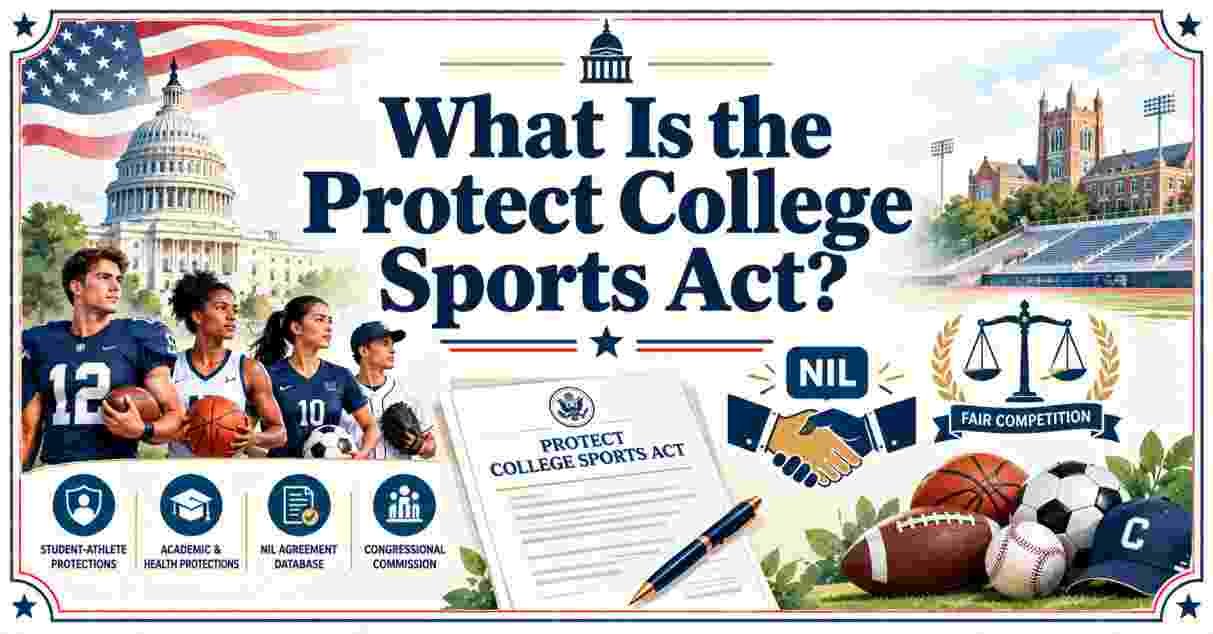
The Protect College Sports Act is a federal bill that creates a national right to Name, Image and Likeness compensation for college athletes, caps agent fees at 5%, and guarantees scholarships for 10 years after eligibility ends. The Senate passed it 77-22 on September 28, 2026, sending it to the House of Representatives.
Protect College Sports Act in 2026
The Protect College Sports Act is the first comprehensive college sports bill to get a full floor vote in either chamber of Congress. It sets one national rulebook for NIL deals, athlete health coverage, scholarships and agent conduct, replacing the patchwork of state laws that has governed college athletics since NIL rights first arrived in 2021. Senators Maria Cantwell (D-Wash.) and Ted Cruz (R-Texas), the top Democrat and Republican on the Senate Commerce Committee, led the bill through more than a year of negotiation before the Senate passed it 77-22 on September 28, 2026.
The bill answers a question Congress has dodged for years: what happens now that college athletes get paid directly by their schools. That question became urgent after a 2025 court settlement forced the NCAA to let schools share revenue with players for the first time. The Protect College Sports Act now moves to the House, where its sponsor says it has “a better than 50% chance” of passing. This report covers what the bill actually does, how the Senate vote broke down, and how it fits into the broader shift in college athlete compensation already underway.
The bill also carries an unusually long legislative runway behind it for something that only just reached a floor vote. Cantwell’s office released a snapshot report on September 15, 2026 documenting how fast athletics spending has grown relative to college and university budgets overall, and Cantwell joined current athletes, coaches, and senators from both parties at a Capitol Hill press conference on September 14 to build support before the procedural vote the next day. Gonzaga head men’s basketball coach Mark Few was among those who spoke in favor of the legislation at that event.
Interesting Facts About the Protect College Sports Act in 2026
SENATE VOTE MARGINS ON THE BILL, 2026
Sep 15 cloture vote (74-24)   ███████████████ needed 60
Sep 28 final passage (77-22)  ███████████████ passed
| Fact | Detail |
|---|---|
| Official bill name | Protect College Sports Act of 2026 (S.4668, 119th Congress) |
| Lead sponsors | Sen. Maria Cantwell (D-Wash.), Sen. Ted Cruz (R-Texas) |
| Cloture vote | 74-24, September 15, 2026 (needed 60) |
| Final passage vote | 77-22, September 28, 2026 |
| Co-sponsors | 8 senators, evenly split by party |
| Next step | Heads to the House of Representatives |
| House sponsor | Rep. Baumgartner |
| Agent fee cap | 5% of NIL compensation |
| Post-eligibility scholarship guarantee | 10 years |
Source: U.S. Senate Committee on Commerce, Science, and Transportation; Congress.gov.
The bill needed just 60 votes to clear a procedural cloture hurdle on September 15, and it cleared that bar comfortably at 74-24. Two weeks later, final passage came in even stronger at 77-22, a bipartisan margin unusual for a bill touching both labor and antitrust law. Senator Dan Sullivan (R-Alaska) did not vote, and the bill’s opponents spanned both parties, including Senator Rand Paul (R-Ky.), who argued Congress should stay out of college sports, and Senator Cory Booker (D-N.J.), who raised concerns about the bill’s impact on Black athletes.
The 5% agent fee cap and the 10-year post-eligibility scholarship guarantee are two of the bill’s most concrete athlete protections, but they sit alongside a much larger structural change: a federal antitrust exemption that shields the NCAA, conferences and schools from athlete lawsuits over their enforcement of eligibility, transfer and compensation rules. That trade-off, new protections in exchange for reduced legal recourse, is the central tension critics and supporters have argued over since the bill was first introduced.
Senate Vote Breakdown on the Protect College Sports Act in 2026
FINAL PASSAGE VOTE, SEPTEMBER 28, 2026
Yes    ███████████████████████████████████████ 77
No     ███████████ 22
Absent █  1
| Vote Detail | Figure |
|---|---|
| Total senators | 100 |
| Voted yes | 77 |
| Voted no | 22 |
| Did not vote | 1 (Sen. Dan Sullivan, R-Alaska) |
| Notable no votes | Sen. Rand Paul (R-Ky.), Sen. Cory Booker (D-N.J.) |
| Vote type | Final passage, bipartisan majority in both parties |
| Date and time | Monday night, September 28, 2026 |
Source: U.S. Senate Committee on Commerce, Science, and Transportation; Fox News; NewsNation.
The 77-22 final tally crossed party lines in both directions. Senate Majority Leader John Thune (R-S.D.) backed the bill ahead of the vote, saying “most people acknowledge that the current landscape of college sports is a mess.” On the floor, Cantwell framed the bill’s core purpose plainly: “the federal right to NIL” and, just as importantly in her telling, the first time federal law would guarantee “an athlete gets a percentage of the media rights, the ticket sales and the sponsorship.”
The bill’s co-sponsor list itself signals how carefully it was built for bipartisan appeal: Chris Coons (D-Del.), Eric Schmitt (R-Mo.), Peter Welch (D-Vt.), Shelley Moore Capito (R-W.Va.), John Hickenlooper (D-Colo.), Pete Ricketts (R-Neb.), Ben Ray Luján (D-N.M.) and John Hoeven (R-N.D.) rounded out the sponsor list, four senators from each party, a structure that mirrors the Cantwell-Cruz partnership leading the bill and likely helped it clear both the cloture threshold and final passage with such wide margins.
Opposition came from different directions within each party. Rand Paul’s objection was libertarian in nature, that lawmakers should let athletes and markets sort this out without federal rules. Cory Booker’s objection ran the opposite way: he argued the Senate should have spent more time weighing the bill’s impact on athletes, especially Black athletes, who make up a disproportionate share of the revenue-generating sports the bill’s antitrust exemption most directly affects. The bill’s supporters countered that Cantwell specifically built provisions supporting HBCUs into the legislation, arguing it puts historically Black colleges and universities “at the table where the future gets decided.”
What the Protect College Sports Act Actually Changes in 2026
CORE PROTECTIONS IN THE BILL
Federal NIL right                 █ new
Agent fee cap                     █ 5%
Scholarship guarantee             ██████████ 10 years
Post-eligibility medical coverage █████  5 years
| Provision | What It Does |
|---|---|
| Federal NIL right | Codifies athletes’ right to earn NIL compensation, replacing state-by-state laws |
| Agent fee cap | Limits agent fees to 5% of an athlete’s NIL compensation |
| Scholarship guarantee | Guarantees scholarships for 10 years after eligibility ends; can’t be pulled for injury or poor performance |
| Medical coverage | Division I schools must cover out-of-pocket athletic injury/illness costs, current athletes plus 5 years post-eligibility |
| Minimum sports requirement | Schools must maintain a minimum number of sports, protecting women’s and Olympic programs |
| Private right of action | Lets athletes sue directly to enforce NIL, agent, health and scholarship provisions |
Source: U.S. Senate Committee on Commerce, Science, and Transportation, September 28, 2026 press release.
Cantwell described the bill’s revenue-sharing language as its most consequential piece: “this is [Congress] saying, for the first time, that an athlete gets a percentage of the media rights, the ticket sales and the sponsorship.” That right sits on top of, not in place of, the direct revenue-sharing payments schools already make under the 2025 House settlement, discussed below. The 5% agent fee cap directly targets what Cantwell called “predatory agents” who have taken outsized cuts of athlete NIL earnings since the 2021 NIL era began.
The 10-year scholarship guarantee and the 5-year post-eligibility medical coverage requirement extend athlete protections well past the four years most athletes actually compete, addressing complaints that schools could previously drop injured or underperforming athletes from scholarship rolls with little recourse. The bill also requires NIL agreements to serve a “valid business purpose” with pay commensurate to non-athlete comparables, athletes must disclose NIL deals to their schools, and athletic associations must maintain a public database of NIL valuations, provisions aimed at curbing pay-for-play arrangements disguised as endorsement deals. Injury and health protections in the bill sit alongside a broader, long-running concern about how physically demanding college athletics already is; the sports injury statistics tracked separately show roughly 210,674 NCAA injuries recorded annually across 25 sports even before this bill’s new medical-coverage requirements take effect.
The Antitrust Exemption and What Athletes Give Up
WHAT THE ANTITRUST EXEMPTION COVERS
Revenue sharing rules   █ shielded
NIL enforcement          █ shielded
Eligibility rules         █ shielded
Transfer rules             █ shielded
| Exemption Detail | Effect |
|---|---|
| What’s shielded | NCAA, conferences and schools enforcing revenue-sharing, NIL, eligibility and transfer rules |
| What athletes lose | Ability to sue over enforcement of those specific rules |
| What athletes keep | Private right of action for NIL rights, agent protections, health/safety and scholarship terms |
| Comparable model | Similar to antitrust exemptions held by the NFL and NBA |
| Key difference from pro leagues | NFL/NBA players collectively bargain over rules; college athletes do not |
Source: NBC News; The Athletic (Detroit News); Congress.gov S.4668 text summary.
The antitrust exemption is the bill’s most legally significant, and most contested, provision. It blocks athletes from suing the NCAA, conferences and schools over their enforcement of rules on revenue sharing, NIL, eligibility and transfers, the exact category of rules that has been challenged repeatedly in court over the past decade, producing the cases that forced the NCAA to change its amateurism model in the first place. Professional leagues like the NFL and NBA already hold similar antitrust protections, but their players’ unions collectively bargain over the rules those exemptions protect. College athletes have no equivalent bargaining structure, which is the crux of critics’ objection: the bill grants schools legal cover without giving athletes a seat at the table to negotiate the rules themselves.
Supporters frame the trade differently. Cantwell has argued the exemption is necessary to stop the current pattern in which nearly every NCAA rule change gets tied up in litigation within months, creating the “chaos” both parties’ leadership referenced ahead of the vote. Ted Cruz called the bill’s passage “a monumental day,” saying it would “protect the hundreds of thousands of student athletes currently competing in college sports, the millions who will follow in their footsteps, and every college sports fan who wants to preserve this great American tradition.” Whether the exemption’s legal certainty is worth athletes losing a direct route to court is likely to remain the bill’s central fault line as it moves to the House.
How the 2025 House Settlement Set the Stage in 2026
HOUSE V. NCAA REVENUE-SHARING CAP GROWTH ($ millions per school)
2025-26 (year one)   █████████████████████ $20.5M
2026-27 (current)    █████████████████████ $21.3M
2034-35 (projected)  █████████████████████████████████ $32.9M
| Settlement Detail | Figure |
|---|---|
| Settlement approval date | June 6, 2025 |
| Total back-pay damages | $2.8 billion, paid over 10 years |
| Athletes covered by back pay | Roughly 390,000, competing 2016-2024 |
| Revenue-sharing cap, 2025-26 | $20.5 million per school |
| Revenue-sharing cap, 2026-27 | $21.3 million per school |
| Projected cap, 2034-35 | $32.9 million per school |
| Annual cap escalator | About 4% a year |
Source: Congressional Research Service; Duane Morris LLP; Knight Commission.
The Protect College Sports Act exists because of what came before it: the House v. NCAA settlement, approved by a federal court on June 6, 2025, which ended the NCAA’s amateurism model by letting schools pay athletes directly for the first time. That settlement set a revenue-sharing cap of $20.5 million per school for the 2025-26 academic year, an amount schools may, but aren’t required to, distribute among their athletes. The cap has already climbed to roughly $21.3 million for the current 2026-27 year and is projected to reach $32.9 million by 2034-35 under its built-in 4% annual escalator.
That settlement also created the College Sports Commission, a new enforcement body overseeing revenue sharing and NIL deals, largely displacing the NCAA’s own compliance apparatus for these functions. The Protect College Sports Act builds directly on top of that framework rather than replacing it, adding federal statutory backing, national uniformity across states, and the athlete protections described above to a system the House settlement created but left legally uncertain. Without congressional action, schools and athletes were operating under a patchwork of state NIL laws and a settlement subject to ongoing appeals, exactly the instability Cantwell cited as her rationale for pursuing federal legislation in the first place.
Women’s and Olympic Sports Protections in the Bill
WHY THIS PROVISION MATTERS
Schools required to maintain minimum sport count     █ yes
Revenue concentrated in football/basketball          █ yes
| Protection Detail | Figure |
|---|---|
| Requirement | Schools must maintain a minimum number of sports to remain eligible |
| Stated goal | Prevent cutting women’s and Olympic programs as football/basketball payouts grow |
| Context | Almost all NCAA commercial revenue comes from football and men’s basketball |
| Cantwell’s framing | Bill “stabilizes” the loss of women’s and Olympic sports funding |
Source: U.S. Senate Committee on Commerce, Science, and Transportation.
As revenue-sharing dollars concentrate around football and men’s basketball, athletic departments have faced growing pressure to fund those payouts by trimming lower-revenue programs, a pattern administrators have already flagged since the House settlement took effect. The Protect College Sports Act responds by requiring schools to maintain a minimum number of sports programs as a condition of participating in the new compensation framework, a direct attempt to stop swimming, wrestling, gymnastics and other Olympic-pipeline sports from being cut to free up budget for football and basketball payrolls.
Cantwell tied this provision explicitly to broader concerns about how college athletics money is spent: “We need to stop stealing money out of college [and] university institutions for education, for tuition, for professors, and putting it into an arms race on sports.” The bill doesn’t cap what schools can spend on revenue sharing, but by requiring a sport-count floor, it aims to prevent that arms race from eliminating the non-revenue programs most closely tied to the U.S. Olympic pipeline, a swath of college athletics that has no equivalent NIL earning potential and depends almost entirely on institutional funding to survive. The stakes are visible even in the sport that generates the bill’s biggest headlines: March Madness alone drew massive national attention in 2026, and the NCAA basketball statistics tracked separately show just how concentrated broadcast revenue and viewership already are around a handful of marquee programs.
What Happens Next: The House and the Road Ahead
BILL'S PATH THROUGH CONGRESS
Senate cloture (Sep 15)     █ passed 74-24
Senate final vote (Sep 28)  █ passed 77-22
House vote                    not yet scheduled
| Next Step | Status |
|---|---|
| Senate passage | Complete, September 28, 2026 |
| House committee action | Pending |
| House floor vote | Not yet scheduled |
| House sponsor’s own odds estimate | “Better than 50% chance” |
| Legislative deadline pressure | End of legislative year, ahead of November 2026 midterms |
Source: The Spokesman-Review; Detroit News; NBC News.
The bill’s House sponsor, Rep. Baumgartner, wrote on social media the day of Senate passage that the bill “will have a better than 50% chance in the House,” a notably cautious estimate for a bill that just cleared the Senate with 77 votes. That caution reflects real uncertainty: the House has never held a full floor vote on comprehensive college sports legislation, and opposition there has come from a different mix of critics, including some lawmakers who back giving athletes formal employee status and collective bargaining rights instead of the framework this bill creates.
Timing adds further pressure. The Senate passed the bill in one of its final sessions before senators left Washington ahead of the November 2026 midterm elections, and the House faces the same compressed legislative calendar. Whether the bill reaches the President’s desk before the current Congress ends remains genuinely uncertain, and the House is expected to debate, and likely amend, several of the Senate’s core provisions, including the antitrust exemption and the specific scope of the private right of action, before any final vote. The Senate also adopted a package of amendments in the days before final passage, published by the Commerce Committee alongside its vote announcement, underscoring that even the version that passed the Senate went through late changes right up to the night of the vote.
Protect College Sports Act FAQs
What is the Protect College Sports Act?
A federal bill that creates one national framework for college athlete NIL rights, revenue sharing, agent regulation, scholarships and health coverage, replacing the current patchwork of state laws.
Did the Senate pass the Protect College Sports Act?
Yes. The Senate passed it 77-22 on September 28, 2026, sending it to the House.
Who sponsored the Protect College Sports Act?
Sen. Maria Cantwell (D-Wash.) and Sen. Ted Cruz (R-Texas) led the bill, with eight additional co-sponsors split evenly between both parties.
What does the bill do for NIL rights?
It creates a federal right for athletes to earn NIL compensation, replacing the current mix of differing state laws with one national standard.
How much can agents charge under the bill?
Agent fees are capped at 5% of an athlete’s NIL compensation.
How long are scholarships guaranteed under the bill?
10 years after an athlete’s eligibility ends, and scholarships cannot be revoked for injury or poor performance.
Does the bill give the NCAA legal protection?
Yes. It grants the NCAA, conferences and schools an antitrust exemption shielding their enforcement of revenue-sharing, NIL, eligibility and transfer rules from athlete lawsuits.
Who voted against the Protect College Sports Act?
22 senators, including Rand Paul (R-Ky.), who argued against federal involvement in college sports, and Cory Booker (D-N.J.), who cited concerns about the bill’s impact on Black athletes.
How does this relate to the House v. NCAA settlement?
The bill builds on that 2025 settlement, which let schools share revenue directly with athletes starting at a $20.5 million per-school cap, by adding federal statutory backing and national uniformity.
Will the Protect College Sports Act become law?
It’s uncertain. The bill still needs House passage and the President’s signature, and its House sponsor put its chances at “better than 50%.”
Does the bill protect women’s and Olympic sports?
Yes. It requires schools to maintain a minimum number of sports programs, aimed at preventing cuts as football and basketball revenue-sharing payouts grow.
What happens to athletes’ medical costs under the bill?
Division I schools must cover out-of-pocket costs for athletic injuries and illness for current athletes and for 5 years after their eligibility ends.
Disclaimer: This research report is compiled from publicly available sources. While reasonable efforts have been made to ensure accuracy, no representation or warranty, express or implied, is given as to the completeness or reliability of the information. We accept no liability for any errors, omissions, losses, or damages of any kind arising from the use of this report.