
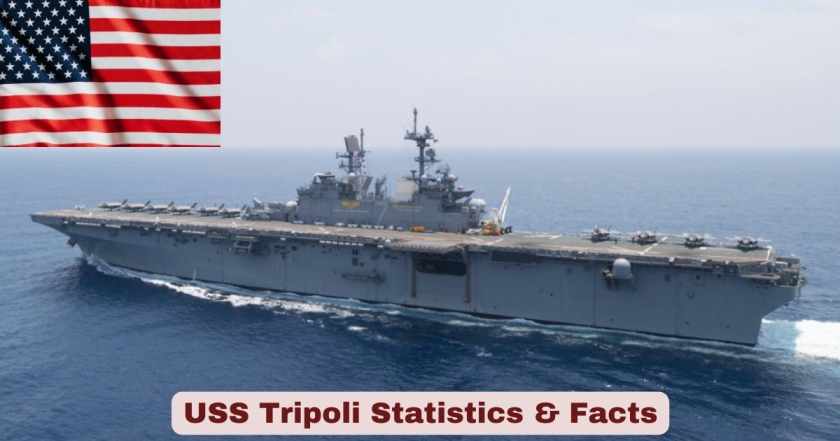
What is USS Tripoli?
USS Tripoli (LHA-7) is one of the most powerful and technologically advanced amphibious assault ships ever built, currently serving as a frontline asset of the United States Navy in one of the most high-stakes military deployments of the modern era. Commissioned on July 15, 2020, in Pascagoula, Mississippi, Tripoli is the second ship of the America-class amphibious assault ship programme — a class designed from the ground up around the needs of the 21st-century United States Marine Corps, with an aviation-centric configuration that allows it to function simultaneously as a helicopter carrier, V/STOL jet platform, command ship, hospital ship, and amphibious force projection vessel. At 844 feet (257 metres) long, displacing over 45,000 long tons when fully loaded, and capable of operating the F-35B Lightning II stealth fighter jet, USS Tripoli is roughly comparable in size to the French aircraft carrier Charles de Gaulle — yet unlike a traditional aircraft carrier, it is purpose-built to land Marines directly onto hostile shores. Its motto — In Aere Terram Marique (In the Air, on Land, and Sea) — captures precisely what this ship was designed to do: project overwhelming force across all three domains simultaneously.
As of March 14, 2026, USS Tripoli sits at the epicentre of global military attention. Deployed from its forward homeport of Sasebo, Japan, the ship was ordered by US Secretary of Defense Pete Hegseth on the direction of US Central Command (CENTCOM) to sail immediately toward the Middle East as the US-Iran war — Operation Epic Fury — entered its third week. Spotted by commercial satellite imagery sailing alone near Taiwan, the ship faces a transit of approximately 6,000 nautical miles to reach the waters off Iran — a journey of roughly 12 to 16 days at normal transit speed. With 2,500 Marines from the 31st Marine Expeditionary Unit (MEU) embarked, and positioned to become the second-largest US naval vessel in the region behind the aircraft carrier USS Abraham Lincoln, Tripoli’s deployment signals that the United States is actively preparing for escalation scenarios in the Strait of Hormuz — whether that means escorting oil tankers, conducting amphibious operations, or seizing key infrastructure. The world is watching this ship’s track very carefully.
Interesting Facts About USS Tripoli 2026
| Fact | Detail |
|---|---|
| Full Designation | USS Tripoli (LHA-7) |
| Ship Class | America-class amphibious assault ship (Landing Helicopter Assault / LHA) |
| Hull Classification | LHA-7 |
| Callsign | NEEE |
| Position in Class | Second ship of the America-class (Flight 0 variant) |
| Named After | The Battle of Derna (1805) — US Marine Corps’ first overseas land battle, during the First Barbary War against Tripoli |
| Motto | In Aere Terram Marique — “In the Air, on Land, and Sea” |
| Name Announced | May 7, 2012 (by Secretary of the Navy Ray Mabus) |
| Third Ship to Bear the Name | Preceded by USS Tripoli (CVE-64, WWII escort carrier) and USS Tripoli (LPH-10, Cold War/Desert Storm) |
| Builder | Huntington Ingalls Industries (HII), Ingalls Shipbuilding, Pascagoula, Mississippi |
| Design Basis | Based on USS Makin Island (LHD-8) — itself an improved Wasp-class ship; ~45% of design inherited from LHD-8 |
| Key Design Change from Predecessors | No well deck — removed to maximise aviation hangar space, fuel stowage, and maintenance facilities |
| Ship Sponsor | Lynne Mabus (wife of former Navy Secretary Ray Mabus) |
| Ship’s Coat of Arms Colours | Dark blue, red, and gold — representing the US Navy and US Marine Corps |
| Awards Won | Admiral James Flatley Memorial Award for Naval Aviation Safety (2022) |
| US Marine Corps Hymn Connection | “From the Halls of Montezuma to the shores of Tripoli” — the hymn directly references the Battle of Derna that this ship is named for |
| Nickname / Informal Designation | “Lightning Carrier” — when loaded with up to 20 F-35B jets |
| Comparable Foreign Vessel Size | Similar displacement to French aircraft carrier Charles de Gaulle and Indian INS Vikramaditya |
| Size Comparison (domestic) | Nearly 3 football fields in length; 20 storeys tall from keel to top of deckhouse |
Source: Wikipedia (USS Tripoli LHA-7, updated March 13, 2026), US Navy Naval Vessel Register, USNI News, Grokipedia, navysite.de, HII official website, Military Fandom Wiki
The naming history of USS Tripoli is itself a compressed lesson in American military history. The Battle of Derna in 1805, in which a small detachment of US Marines led a mercenary force across the Libyan desert to capture the city of Derne and force the Pasha of Tripoli to terms, was the first time US military forces fought a land battle on foreign soil — and the event that gave the Marine Corps Hymn its famous opening lines: “From the Halls of Montezuma to the shores of Tripoli.” Choosing this name for the Navy’s newest and most capable amphibious assault ship was a deliberate statement about the ship’s mission: projecting American power onto foreign shores, exactly as those first Marines did over two centuries ago. The fact that this is the third US naval vessel to carry the name Tripoli — after a World War II escort carrier and a Cold War-era assault ship that served in Operation Desert Storm — shows the consistent importance the name has held in US naval tradition.
The “no well deck” design choice that defines USS Tripoli as a Flight 0 America-class ship deserves particular attention because it generated significant controversy within the US Navy and Marine Corps. Removing the well deck — the internal flooded chamber from which earlier amphibious ships launched landing craft and amphibious vehicles directly onto beaches — freed up space for a dramatically enlarged aviation hangar, increased JP-5 jet fuel storage, expanded maintenance bays, and enhanced command-and-control facilities. Critics argued this made Tripoli and her sister ship USS America less capable as true amphibious warships. Supporters countered that the aviation upgrade made them far more lethal as “lightning carriers” capable of operating 20 to 25 F-35B stealth fighters — transforming what was nominally an amphibious assault ship into something functionally closer to a small aircraft carrier. In 2026, both arguments are being tested simultaneously in the Persian Gulf.
USS Tripoli Construction & Cost Statistics 2026
| Metric | Data |
|---|---|
| Construction Contract Award | May 31, 2012 |
| Contractor | Huntington Ingalls Industries (HII), Ingalls Shipbuilding |
| Contract Type | Fixed-price incentive contract |
| Contract Value | $2.38 billion USD |
| Advance Procurement Contract | $175 million (awarded June 2010, for long-lead materials) |
| Fabrication Start | July 2013 (component fabrication) |
| Keel Laid | June 20, 2014 — Pascagoula, Mississippi |
| Launched | May 1, 2017 |
| Christened | September 16, 2017 |
| Delivered to US Navy | February 28, 2020 |
| Commissioned | July 15, 2020 — Pascagoula, Mississippi (ceremony reduced due to COVID-19) |
| Total Build Time (keel to commissioning) | ~6 years |
| Man-Hours to Build | Over 9 million man-hours |
| Structural Units Fabricated | Over 200 modular structural units |
| Electrical Cable Installed | ~1,000 miles of electrical cable |
| Pipe Installed | ~431,000 feet of pipe |
| Hull Insulation | Enough to cover 40 acres |
| Construction Location | Ingalls Shipbuilding, Pascagoula, Mississippi |
| Delivery Schedule | Original target: 2017; delivered 2020 — approximately 1 year behind schedule |
| COVID-19 Impact | At least 9 sailors tested positive before commissioning; ~630 sailors temporarily removed as precaution |
Source: Wikipedia (USS Tripoli LHA-7), HII official website, USNI News, Grokipedia, navysite.de, US Navy Naval Vessel Register
The $2.38 billion construction cost of USS Tripoli reflects the extraordinary complexity of building what is effectively a floating city — one capable of sustaining combat aviation operations, hosting a fully equipped hospital, commanding joint military forces across air, land, and sea domains, and delivering an entire Marine Expeditionary Unit to any coastline on earth. The 9 million man-hours required to build the ship — equivalent to roughly 4,500 full-time workers for an entire year — give a sense of the labour intensity of the programme. The scale of internal systems alone is staggering: 1,000 miles of electrical cable sufficient to stretch from New York to Kansas City, 431,000 feet of pipe running through bulkheads and decks, and enough insulation material to cover 40 acres. The one-year delay from the 2017 delivery target to the actual February 2020 delivery was attributed to construction complexity, systems integration challenges, and the difficulty of meeting the full F-35B integration requirements — with final F-35 capability installs ultimately pushed to post-delivery.
The COVID-19 pandemic added an unwanted footnote to Tripoli’s commissioning story. With at least 9 sailors testing positive for SARS-CoV-2 while the ship was docked in Pascagoula in April 2020, approximately 630 sailors were moved off the ship as a precautionary measure — a logistically and operationally disruptive step that nonetheless successfully contained the outbreak to only “around a couple dozen sailors,” according to US Navy officials quoted at the time. The planned public commissioning ceremony at NAS Pensacola in June 2020 was cancelled as a result, and the ship was quietly commissioned on July 15, 2020, in Pascagoula, with a reduced ceremony. It was an inauspicious beginning for the Navy’s newest capital ship — but one that has since been entirely overtaken by the operational record the ship has built in the five and a half years since.
USS Tripoli Technical Specifications Statistics 2026
| Specification | Data |
|---|---|
| Hull Length | 844 feet (257.2 metres) |
| Beam (Width) | 106 feet (32.3 metres) |
| Draft (Depth below waterline) | 26 feet (7.9 metres) |
| Displacement (Full Load) | ~45,690 long tons (46,400 tonnes) |
| Flight Deck Area | Over 2 acres |
| Hangar Deck | Enlarged hangar with 2 wide, high-bay areas; each fitted with overhead crane for aircraft maintenance |
| Propulsion System | CODLOG hybrid-electric (Combined Diesel-Electric or Gas Turbine) |
| Main Engines | 2 × General Electric LM2500+ gas turbines |
| Gas Turbine Power | Each rated at 35,290 shp — combined 70,000 shaft horsepower |
| Auxiliary Propulsion | 2 × electric auxiliary propulsion motors (APS) — 5,000 hp each |
| Shafts / Propellers | 2 shafts, 2 propellers |
| Maximum Speed | Over 22 knots (25 mph / 41 km/h) |
| Range | Approx. 9,500 nautical miles at 20 knots |
| Crew (Ship’s Company) | 102 officers + 1,102 enlisted = 1,204 total |
| Marine Complement | 1,687 Marines (plus 184 surge capacity = up to 1,871) |
| Total Personnel Capacity | Over 3,000 (crew + Marines combined) |
| Hospital | Full on-board hospital (reconfigurable; smaller than Wasp-class predecessors) |
| Command & Control | Reconfigurable command and control complex for joint/multinational operations |
| Well Deck | None (Flight 0 design — removed to expand aviation capacity) |
| Panama Canal Compatible | Yes — beam of 106 ft dictated specifically by Panama Canal width requirements |
Source: Naval Technology, National Security Journal, HII official website, Wikipedia, seaforces.org, militaryfactory.com
The technical specifications of USS Tripoli reveal a vessel that sits in a genuinely unusual category in global naval terms — not quite an aircraft carrier, not quite a traditional amphibious assault ship, but something more powerful and flexible than either. Its 844-foot length and ~45,690 long ton full-load displacement place it in the same size bracket as some of the world’s conventional aircraft carriers, yet its primary identity remains as an amphibious warfare ship. The CODLOG hybrid propulsion system — using gas turbines for high-speed transit and electric auxiliary motors for quieter, more fuel-efficient low-speed operations near coastlines — was directly inherited from USS Makin Island (LHD-8), where the system demonstrated substantial fuel savings compared to older steam-turbine ships. At over 22 knots maximum speed, Tripoli can outpace most merchant vessels and keep pace with carrier strike group formations during transit, while the electric-mode operation significantly reduces fuel consumption during the slower coastal approach and amphibious operation phases.
The “no well deck” trade-off — while controversial — delivered tangible performance gains. The expanded hangar accommodates two wide, high-bay maintenance areas, each with an overhead crane, meaning that complex aircraft repairs including engine changes can be performed at sea rather than in port. The over 2-acre flight deck supports simultaneous multi-aircraft operations including F-35B launches and landings, MV-22 Osprey rotations, CH-53K heavy-lift helicopter operations, and attack helicopter sorties. The beam width of exactly 106 feet was not chosen arbitrarily — it is the maximum beam that allows transit through the Panama Canal, a hard constraint that shapes the entire geometry of the ship’s design. For a vessel whose entire purpose is global power projection, the ability to transit between the Pacific and Atlantic without rounding Cape Horn is strategically essential.
USS Tripoli Aircraft & Weapons Systems Statistics 2026
| Metric | Data |
|---|---|
| Primary Fixed-Wing Aircraft | F-35B Lightning II (STOVL — Short Takeoff / Vertical Landing) |
| Lightning Carrier Capacity (Max) | 20–25 F-35B jets |
| Lightning Carrier Demo (April 2022) | Operated 20 F-35Bs simultaneously — proof of concept confirmed |
| Other Fixed-Wing | AV-8B Harrier II (legacy; being phased out) |
| Tiltrotor Aircraft | MV-22B Osprey (primary troop transport; VTOL/STOL) |
| Attack Helicopters | AH-1Z Viper (formerly AH-1W SuperCobra) |
| Heavy Lift Helicopters | CH-53K King Stallion (replacing CH-53E Super Stallion) |
| Medium Helicopters | UH-1Y Venom |
| Maritime Helicopters | MH-60S Knighthawk |
| Normal Air Combat Element (ACE) | Mix of F-35Bs, Ospreys, and attack/lift helicopters — typically ~20–31 aircraft total |
| Defensive Weapons: Missiles | 2 × RIM-116 Rolling Airframe Missile (RAM) launchers |
| Defensive Weapons: Missiles (2) | 2 × RIM-162 Evolved Sea Sparrow Missile (ESSM) launchers |
| Close-In Weapon System (CIWS) | 2 × 20 mm Phalanx CIWS (last-ditch anti-missile gatling system) |
| Machine Guns | 7 × twin .50 BMG (12.7mm) M2 Browning machine gun mounts |
| Electronic Warfare | AN/SLQ-32B(V)2 electronic warfare suite |
| Decoys | 2 × Mk 53 Nulka decoy launchers |
| No Offensive Strike Missiles | Tripoli carries no Tomahawk cruise missiles or offensive naval guns — relies on embarked aircraft for strike |
| F-35B Max Range | ~1,350 km (840 miles) on internal fuel |
| MV-22 Osprey Speed | ~509 km/h (316 mph) — significantly faster than helicopters |
| MV-22 Combat Radius | ~722 km (450 miles) in assault configuration |
Source: Wikipedia (USS Tripoli LHA-7 and America-class), Naval Technology, militaryfactory.com, National Security Journal, HII official website
The aircraft and weapons statistics for USS Tripoli define exactly why the ship is regarded as such a decisive military instrument. The F-35B Lightning II is the centrepiece of its offensive capability — a 5th-generation stealth multirole fighter capable of supersonic flight, equipped with advanced radar, electronic warfare suites, and the ability to carry both air-to-air and air-to-ground weapons internally (maintaining its stealth profile) or on external hardpoints. When Tripoli loaded 20 F-35Bs simultaneously in April 2022 for the landmark “lightning carrier concept demonstration,” it proved that a ship originally classified as an amphibious assault vessel could project jet-fighter-based air power comparable to a small dedicated aircraft carrier. In the context of the 2026 Iran war, this matters enormously — 20 F-35Bs operating from Tripoli in the Arabian Sea can strike targets throughout southern Iran, threaten IRGC naval assets in the Persian Gulf, and conduct combat air patrol over the Strait of Hormuz without requiring land bases in the region.
The defensive weapons suite reflects the ship’s status as a high-value asset requiring layered protection against the exact threat environment Iran has been deploying — namely, ballistic missiles, anti-ship cruise missiles, and swarm drone attacks. The Phalanx CIWS provides a last-resort defence, firing up to 4,500 rounds per minute of 20mm tungsten rounds to destroy incoming missiles at close range. The Rolling Airframe Missile (RAM) system and Evolved Sea Sparrow (ESSM) provide medium-range intercept capability. The 7 twin .50-calibre machine gun mounts provide close-range defence against the small fast-boat attacks that IRGC naval doctrine specifically prioritises in the Persian Gulf. Notably, Tripoli carries no offensive strike missiles of its own — unlike destroyers, it has no Tomahawk capability. Its offensive power comes entirely through its embarked aircraft, making the protection of those aircraft and the ship itself the absolute top tactical priority.
USS Tripoli Deployment History & Homeport Statistics 2026
| Metric | Data |
|---|---|
| Initial Homeport (Post-Commission) | Pascagoula, Mississippi (July 2020) |
| Homeport Shift 1 | San Diego, California — September 2020 |
| Maiden Deployment Departure | May 2, 2022 — from Naval Station San Diego |
| Maiden Deployment Area | Western Pacific Ocean (US 5th and 7th Fleet areas) |
| Lightning Carrier Demo Date | April 7, 2022 — operated 20 F-35Bs from flight deck |
| 31st MEU Embarkation (2022) | July 25, 2022 — at Naval Base Okinawa, Japan |
| Singapore Port Call (2022) | August 31, 2022 — Changi Naval Base |
| Return from Maiden Deployment | November 29, 2022 |
| Forward Deployment Decision | February 2025 — confirmed by USNI News; to replace USS America in Sasebo |
| Departed San Diego for Japan | May 19, 2025 |
| Arrived Sasebo, Japan (New Homeport) | June 23, 2025 |
| Current Homeport (as of March 2026) | US Fleet Activities Sasebo, Japan |
| Assigned Fleet | US 7th Fleet (Indo-Pacific) |
| Expeditionary Strike Group | Expeditionary Strike Group 7 (ESG-7) |
| Embarked Marine Unit | 31st Marine Expeditionary Unit (31st MEU) — headquartered in Okinawa |
| 31st MEU Size | At least 2,200–2,500 Marines (standard MEU strength) |
| Ordered to Middle East | March 13, 2026 — Secretary Hegseth approves CENTCOM request |
| Distance to Middle East from Last Known Position | ~6,000 nautical miles (spotted near Taiwan) |
| Estimated Transit Time | 12–16 days at normal cruising speed |
| Significance of Deployment | Would be second-largest US naval vessel in region behind USS Abraham Lincoln (CVN-72) |
Source: Wikipedia (updated March 13, 2026), USNI News (February 14, 2025), Fortune/AP (March 13, 2026), The War Zone (March 13, 2026), navysite.de, investinglive.com, navalnews.com
The deployment timeline of USS Tripoli from 2020 to 2026 tells the story of a ship that spent its entire operational life in exactly the region — the Indo-Pacific — where the US military most needed a forward-deployed big-deck amphibious asset, before being abruptly redirected to a completely different theatre of war. The June 23, 2025 arrival at Sasebo, Japan as the Navy’s primary forward-deployed amphibious warship — replacing USS America — represented the fulfilment of a strategic plan years in the making, positioning Tripoli closer to the South China Sea, the Taiwan Strait, and the East China Sea for exactly the kind of rapid-response missions that characterise 7th Fleet operations. The 31st Marine Expeditionary Unit, permanently based in Okinawa and specifically designed for rapid deployment across the Indo-Pacific, had been working with Tripoli as its primary platform since the 2022 maiden deployment and was already deeply integrated with the ship’s crew and systems.
The March 13, 2026 order to redeploy to the Middle East — pulling Tripoli and its Marines directly from waters near Taiwan and routing them toward Iran — is both a statement of operational priorities and a source of strategic anxiety for Indo-Pacific planners. Fortune (AP, March 13, 2026) specifically noted the tension: the US was sending Tripoli to the Middle East “pulling them from waters near Taiwan” — a detail that underscores the genuine capacity constraints facing the US military in managing simultaneous crisis theatres. With the ~6,000 nautical mile transit likely to take 12 to 16 days, Tripoli will not arrive in the Middle East until late March 2026 at the earliest — making its deployment a signal of commitment and intent as much as an immediate combat capability. The fact that Secretary Hegseth approved the deployment on CENTCOM’s direct request, citing the need to respond to Iran’s Strait of Hormuz closure campaign, makes clear that Tripoli’s primary mission upon arrival is expected to involve naval escort operations for oil tankers, amphibious contingency planning, and force projection near Kharg Island or the Strait itself.
USS Tripoli 2026 Iran War Mission & Strategic Statistics
| Metric | Data |
|---|---|
| Operation Name | Operation Epic Fury (US-Israel war against Iran, begun February 28, 2026) |
| Deployment Order Authority | Secretary of Defense Pete Hegseth — approved CENTCOM request |
| Requesting Command | US Central Command (CENTCOM) |
| Reported By | The Wall Street Journal (first report); confirmed by AP, USNI News, The War Zone |
| Date Ordered | March 13, 2026 |
| Embarked Marines | ~2,500 Marines — elements of the 31st Marine Expeditionary Unit |
| Amphibious Ready Group (ARG) Composition | Typically: 1 assault ship + 2 transport docks + 1 support vessel |
| Marines in a Full ARG/MEU | At least 2,200 Marines (standard); up to 2,500 with surge |
| US Ships Already in Region (March 13, 2026) | 12 ships including USS Abraham Lincoln (CVN-72) and 8 destroyers in the Arabian Sea |
| Tripoli’s Rank in Regional Naval Force | Would become second-largest ship behind USS Abraham Lincoln |
| US Ground Troops in Region (Al-Udeid alone) | ~8,000 US troops at Al-Udeid Air Base, Qatar |
| Total Enemy Targets Struck (as of March 13) | Over 15,000 targets struck — confirmed by Sec. Def. Hegseth (“more than 1,000/day”) |
| Tripoli Last Known Position | Near Taiwan (spotted by commercial satellite) |
| Distance from Taiwan to Strait of Hormuz | ~6,000 nautical miles |
| Transit Time Estimate | 12–16 days |
| Primary Mission Scope | Naval tanker escort; amphibious contingency planning; Strait of Hormuz force presence |
| Kharg Island Seizure Option | Confirmed “on the table” per Axios (March 7, 2026) — Tripoli is the primary vessel capable of executing such an operation |
| MEU Capabilities | Amphibious landings; embassy security; non-combatant evacuation; disaster relief; special operations support |
| US KC-135 Crash (March 13, 2026) | All 6 crew killed; total US service member deaths: at least 13 |
| US Fighter Jets Lost (Friendly Fire) | 3 F-15s mistakenly downed by Kuwaiti friendly fire |
| Iran Strait of Hormuz Status (March 13) | Effectively closed — Iran attacking tanker traffic; 16 ships attacked, 5 crew killed |
Source: Fortune/AP (March 13, 2026), The War Zone (March 13, 2026), USNI News (March 13, 2026), Naval News (March 13, 2026), investinglive.com, maritime-executive.com, Wikipedia (updated March 13, 2026)
The strategic statistics surrounding USS Tripoli’s 2026 deployment place this ship squarely at the intersection of the two most consequential geopolitical flashpoints of the decade simultaneously: the US-Iran war in the Persian Gulf and the ongoing Taiwan Strait tension in the Indo-Pacific. That the US military pulled Tripoli from near Taiwan and routed it toward Iran is not a casual decision — it represents a prioritisation judgment that will be scrutinised by military planners in Beijing, Taipei, Tokyo, and Seoul just as closely as it is in Tehran and Washington. For Iran, the deployment signal is obvious: the US is escalating toward amphibious options that it has not yet exercised. The 31st MEU’s 2,500 Marines can conduct everything from non-combatant evacuation operations at US embassies in Gulf states to a full amphibious assault on a defended coastline. Every Gulf state ally and every Iranian military planner knows this.
The Kharg Island seizure scenario — reported by Axios on March 7, 2026 as actively “on the table” in Trump administration deliberations — gives Tripoli’s deployment its sharpest strategic edge. There is no other US asset currently in the region capable of executing a Marine Corps amphibious assault on a defended island facility. USS Abraham Lincoln is a nuclear-powered strike carrier — it can devastate targets from the air but cannot land troops. Only an America-class big-deck amphibious ship with an embarked MEU has that combination of F-35B air cover, MV-22 troop delivery, CH-53K heavy-lift, and attack helicopter gunship support needed to seize and hold 20 square kilometres of defended Iranian territory. The 12–16 day transit means Tripoli cannot arrive before approximately March 25–29, 2026 at the earliest — a window that both sides are acutely aware of, and which may itself shape the pace of diplomatic and military activity in the coming weeks.
Disclaimer: This research report is compiled from publicly available sources. While reasonable efforts have been made to ensure accuracy, no representation or warranty, express or implied, is given as to the completeness or reliability of the information. We accept no liability for any errors, omissions, losses, or damages of any kind arising from the use of this report.