
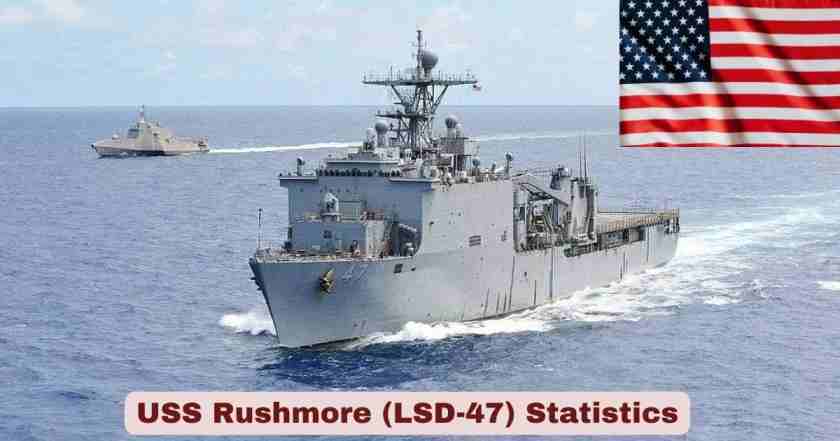
USS Rushmore in America 2026
USS Rushmore (LSD-47) is one of the most strategically significant amphibious warships currently active in the United States Navy, operating as a Whidbey Island-class dock landing ship purpose-built to transport, launch, and recover Landing Craft Air Cushion (LCAC) hovercraft and a broad range of amphibious assault vehicles in support of Marine Expeditionary Unit (MEU) operations across the globe. Named after the iconic Mount Rushmore National Memorial in the Black Hills of South Dakota — a monument honoring Presidents George Washington, Thomas Jefferson, Abraham Lincoln, and Theodore Roosevelt — the ship carries the motto “Nobility Power,” a phrase that reflects both the grandeur of her namesake and the weight of her combat mission. Commissioned on 1 June 1991 at New Orleans, Louisiana, she was constructed by Avondale Shipyards at a cost of $149 million, making her the seventh ship in the Whidbey Island class and the fourth of her class assigned to the United States Pacific Fleet. As of April 2026, she remains in active service and has been continuously forward-deployed to the Indo-Pacific region as a cornerstone of American amphibious power projection.
In 2026, USS Rushmore (LSD-47) continues to serve a front-line operational role at a time of heightened geopolitical tension across the Indo-Pacific and Middle East. Forward-deployed from Fleet Activities Sasebo, Japan, she is part of Amphibious Squadron 11 under the broader U.S. 7th Fleet command structure — the largest forward-deployed numbered fleet in the entire U.S. Navy. Following joint amphibious exercises with Japan’s Ground Self-Defense Force in early 2025 and a milestone achievement as the first ship in 7th Fleet to launch and recover Amphibious Combat Vehicles (ACVs), the ship has been reported as transiting the Strait of Malacca in late March 2026 en route to join the Tripoli Amphibious Ready Group in support of operations in the CENTCOM (Central Command) area of responsibility. Her decades-long service record, operational relevance, and current high-tempo deployment posture make her one of the most closely watched amphibious assets in the United States fleet today.
Interesting Facts About USS Rushmore (LSD-47) 2026
| Fact Category | Detail |
|---|---|
| Ship Name | USS Rushmore (LSD-47) |
| Class | Whidbey Island-class Dock Landing Ship |
| Hull Number | LSD-47 |
| Named After | Mount Rushmore National Memorial, Black Hills, South Dakota |
| Ship Motto | “Nobility Power” |
| Builder | Avondale Shipyards, New Orleans, Louisiana |
| Construction Cost | $149 million |
| Keel Laid | 9 November 1987 |
| Launch Date | 6 May 1989 |
| Commissioning Date | 1 June 1991 |
| Sponsor at Christening | Mrs. Meredith Brokaw (wife of NBC anchor Tom Brokaw) |
| Ship’s Number in Class | 7th ship in the Whidbey Island class |
| Pacific Fleet Position | 4th Whidbey Island-class ship in U.S. Pacific Fleet |
| Current Homeport (2026) | Fleet Activities Sasebo, Japan |
| Previous Homeport | Naval Station San Diego, California (until November 2021) |
| Homeport Shift Year | 2021 (arrived Sasebo: 17 November 2021) |
| Squadron Assignment | Amphibious Squadron 11 (PHIBRON 11) |
| Fleet Command | U.S. 7th Fleet |
| First Commander | CDR. Bruce E. Dunscombe |
| Historic Commanding Officer | Commander Michelle J. Howard (12 March 1999) — first African American woman to command a U.S. Navy ship |
| Status as of April 2026 | Active — transiting Strait of Malacca toward CENTCOM AOR |
| First Deployment Mission | Operation Restore Hope, Somalia (1992) — largest military humanitarian operation in history at that time |
| ACV Milestone (2025) | First ship in 7th Fleet to launch and recover Amphibious Combat Vehicles (ACVs) |
Source: U.S. Naval Vessel Register (NVR), navy.mil; Wikipedia (USS Rushmore LSD-47, verified March 2026); USNI News, April 2026; INDOPACOM Public Affairs
USS Rushmore carries a unique place in U.S. naval history that goes well beyond her technical specifications. She was the vessel on which Commander Michelle J. Howard — who later became the first woman ever to achieve four-star admiral rank in U.S. military history — assumed command on 12 March 1999, making that date a landmark moment not just for the ship but for the entire U.S. armed forces. Additionally, she was selected as the test platform for the “Smart Ship” program known as Gator 17 in the late 1990s, a technology initiative that directly influenced the design of the follow-on LPD-17 class amphibious ships. Few U.S. warships can claim that kind of dual legacy — both historical firsts in leadership representation and direct technological contribution to future ship design. These facts alone distinguish her from most vessels of her era still in active service.
The ship also holds a notable operational milestone: she became the first United States Naval warship to visit Doha, Qatar in a decade during her 1999 deployment, and on 1 December 2007, she became the first ship since the September 11 attacks to host a U.S. Navy open house while in port at Seal Beach, California, drawing thousands of visitors. As of early April 2026, she is reported to be transiting toward the Middle East as part of the Tripoli Amphibious Ready Group, reflecting ongoing demand for her amphibious lift capabilities even after more than 34 years of continuous commissioned service.
USS Rushmore (LSD-47) 2026 Key Physical & Technical Statistics
| Specification | Data |
|---|---|
| Ship Type | Dock Landing Ship (LSD) |
| Overall Length | 609 feet (185.6 meters) |
| Beam (Width) | 84 feet (25.6 meters) |
| Draft | 20 feet (6.1 meters) |
| Light Displacement | 10,560 tons |
| Full Load Displacement | 15,939 tons (approx. 16,194 metric tons) |
| Propulsion System | 4 × Colt Industries 16-cylinder diesel engines |
| Number of Shafts | 2 shafts |
| Total Shaft Horsepower | 33,000 shp (25 MW) |
| Maximum Speed | 20+ knots (23.5+ mph / 37+ km/h) |
| Well Deck Length | 440 feet (approx. 134 meters) |
| Well Deck Width | 50 feet (15.2 meters) |
| LCAC Capacity (Well Deck) | Up to 4 LCACs (5 if vehicle ramp raised) |
| Alternative Craft Capacity | 3 Landing Craft Utility (LCU) or 21 LCM or 64 AAVs |
| Aviation Facilities | 2 helicopter landing spots (no permanent hangar) |
| Helicopter Types Supported | CH-53E Sea Stallion, MH-60 Seahawk |
| Hull Material | High-tensile steel with bulbous bow |
Source: U.S. Navy Fact File — Dock Landing Ship (LSD), navy.mil (last updated July 2019); GlobalSecurity.org LSD-47 specifications; SOFREP Whidbey Island-class technical overview
The physical footprint of USS Rushmore tells the story of a ship designed from the ground up for one singular purpose: enabling the United States Marine Corps to get ashore under any conditions, against any shore. Her 609-foot hull combined with a 440-foot floodable well deck — the largest LCAC capacity of any U.S. amphibious platform when the class was introduced — gives her a qualitative edge that remains relevant even by 2026 standards. The 33,000 shaft horsepower generated by four Colt diesel engines allows her to maintain a sustained speed above 20 knots, critical for keeping pace with carrier strike groups and rapidly repositioning in dynamic threat environments. The combination of a shallow 20-foot draft and a large well deck gives her access to coastlines and anchorages that deeper-hulled ships simply cannot reach, making her particularly valuable in the littoral and expeditionary contexts that define today’s Indo-Pacific and CENTCOM operational theaters.
The well deck itself deserves particular attention. Designed to flood on demand and accept Landing Craft Air Cushion (LCAC) hovercraft — each capable of carrying a 60-70 ton payload at over 40 knots — the deck can also accommodate conventional LCU (Landing Craft Utility) boats and up to 64 Assault Amphibious Vehicles (AAVs) simultaneously. This flexibility means USS Rushmore is not locked into a single method of force projection; her commanders can mix and match landing craft types based on beach conditions, threat environment, and the tactical requirements of the MEU embarked. Two helicopter landing spots on the flight deck — compatible with both the heavy CH-53E Sea Stallion and the versatile MH-60 Seahawk — further extend her operational reach into the third dimension, enabling vertical envelopment of objectives.
USS Rushmore (LSD-47) 2026 Crew & Troop Capacity Statistics
| Category | Number |
|---|---|
| Ship’s Officers | 22 |
| Ship’s Enlisted Crew | 391 |
| Total Ship’s Company | 413 |
| USMC Landing Force Officers | 27 |
| USMC Landing Force Enlisted | 375 |
| Standard Marine Embarked Total | 402 |
| Marine Surge Capacity | Additional +102 (total up to 504) |
| Maximum Personnel Capacity | 627 embarked Marines (with berthing accommodations) |
| Combined Ship + Marines (Standard) | Approximately 815 personnel |
| Combined Ship + Marines (Surge) | Approximately 917+ personnel |
Source: U.S. Navy Fact File — Dock Landing Ship (LSD), navy.mil; GlobalSecurity.org LSD-47 data sheet
What these numbers reveal is that USS Rushmore is far more than a ship — she is a self-contained expeditionary base capable of housing, feeding, training, and deploying an entire reinforced Marine rifle battalion’s worth of combat power at sea for extended periods. The standard 402 Marines embarkation number reflects a typical Marine Expeditionary Unit (MEU) detachment configuration — the force structure that forms the backbone of U.S. forward presence operations across the 7th Fleet area. The surge capacity pushing total Marine personnel to over 500 reflects the ship’s ability to rapidly scale up for crisis response, non-combatant evacuation operations (NEO), or large-scale amphibious assault. The ship’s complete medical and dental facilities — explicitly noted in Navy specifications — ensure that this floating force remains medically self-sufficient without reliance on shore-based infrastructure.
The 22 officers and 391 enlisted who comprise the ship’s company operate every system from propulsion to aviation coordination to weapons control, 24 hours a day across multiple watch rotations. This crew-to-ship ratio reflects decades of naval engineering refinement, particularly the Smart Ship Gator 17 program that USS Rushmore herself hosted in the late 1990s, which demonstrated how automation and modern systems could reduce required manning without sacrificing operational capability. That research directly informed the design of the next-generation LPD-17 San Antonio class, meaning the lessons learned aboard Rushmore’s decks are still influencing U.S. Navy ship design more than 25 years later.
USS Rushmore (LSD-47) 2026 Armament & Defensive Weapons Statistics
| Weapon System | Quantity / Detail |
|---|---|
| 25mm Mk 38 Mod 2 Autocannons | 2 mounts |
| 20mm Phalanx CIWS (Close-In Weapon System) | 2 mounts |
| Rolling Airframe Missile (RAM) Launchers | 2 mounts |
| M2HB .50 caliber (12.7mm) Machine Guns | 6 mounts |
| Primary Anti-Air Defense | Rolling Airframe Missile (RAM) + Phalanx CIWS |
| Primary Surface Defense | 25mm Mk 38 cannons + .50 cal. machine guns |
| Radar Suite | Multifunction surface search and navigation radar |
| Navigation Systems | Integrated bridge system with GPS/INS |
| Communications | Secure satellite and UHF/HF tactical data exchange |
| CBR Protection | Chemical, Biological, Radiological (CBR) filtration system |
Source: U.S. Navy Fact File — Dock Landing Ship (LSD), navy.mil; Wikipedia USS Rushmore (LSD-47) — verified armament data cross-referenced with NAVSEA specifications
USS Rushmore’s defensive weapons suite reflects the layered protection philosophy that the U.S. Navy has applied to amphibious ships since the post-Cold War redesigns of the 1980s and 1990s. As a dock landing ship — not a destroyer or cruiser — her weapons are calibrated for self-defense and close-in threat suppression, not blue-water combat. The two Phalanx CIWS mounts provide a last-ditch automated defense against incoming anti-ship missiles, using a high-rate-of-fire 20mm Gatling cannon that can engage multiple simultaneous targets. The two Rolling Airframe Missile (RAM) launchers extend the defensive envelope further out, providing a guided missile intercept capability against both anti-ship missiles and low-flying aircraft. Together, these two systems give Rushmore a credible point-defense capability that can operate automatically even under electronic warfare conditions.
The two 25mm Mk 38 Mod 2 autocannons and six .50-caliber M2HB machine guns round out the close-range picture, particularly valuable in anti-swarm boat defense — the threat scenario most relevant to operations in the Persian Gulf and Strait of Hormuz environments where she has historically operated. The Chemical, Biological, Radiological (CBR) filtration system and redundant power-distribution sections with shock-hardened machinery mounts reflect the reality that USS Rushmore is designed to survive, not just operate — even in contaminated or combat-degraded environments. As the ship deploys toward the CENTCOM area of responsibility in 2026, this weapons and survivability package takes on renewed importance.
USS Rushmore (LSD-47) 2026 Operational History — Key Deployment Statistics
| Year | Operation / Event | Theater / Location |
|---|---|---|
| 1991 | Ship commissioned | New Orleans, Louisiana |
| 1992 | Operation Restore Hope | Somalia — humanitarian mission |
| 1994 | Operation Support Hope | Mombasa, Kenya |
| 1996 | Exercise Cobra Gold, Infinite Moonlight, Red Reef, MEUEX ’96 | Thailand, Jordan, Saudi Arabia, Kuwait |
| 1999 | Deployment with Peleliu ARG + 11th MEU | Indo-Pacific, Persian Gulf |
| 1999 | First USN ship to visit Doha, Qatar in 10 years | Doha, Qatar |
| 1999 | CDR Michelle J. Howard assumes command (historic milestone) | San Diego, CA |
| 2001 | CARAT 2001 | Western Pacific, South China Sea |
| 2003 | Operation Iraqi Freedom (Tarawa ARG) | Persian Gulf / Iraq |
| 2004–2005 | Operation Iraqi Freedom + Operation Unified Assistance (tsunami relief) | Persian Gulf; Southeast Asia |
| 2006 | RIMPAC 2006 | Hawaii |
| 2012 | Deployment with Peleliu ARG + 15th MEU | Western Pacific, Indian Ocean, Persian Gulf |
| 2015 | Rescued 65 people from capsized ferry | Makassar Strait, Indonesia |
| November 2021 | Homeport shift to Sasebo, Japan | Sasebo, Japan |
| 2025 | Exercise Iron Fist 2025 + AIT/CERTEX with 31st MEU | Philippine Sea / Japan |
| 2025 | First 7th Fleet ship to launch/recover ACVs | 7th Fleet AOR |
| March–April 2026 | Transiting Strait of Malacca to join Tripoli ARG in CENTCOM | Middle East bound |
Source: Wikipedia — USS Rushmore (LSD-47), verified March 2026; USNI News April 2026; U.S. INDOPACOM public affairs (Nov. 2021 homeport transfer); DVIDSHUB operational imagery records 2025
The operational record of USS Rushmore (LSD-47) reads like a compressed history of American power projection over 34 years — from feeding starving civilians in Somalia in 1992 during the largest military humanitarian operation the world had seen at that time, to racing into the Indian Ocean in 2004 when the Indian Ocean earthquake and tsunami killed more than 100,000 people across Southeast Asia in a matter of hours. During the tsunami response, the ship served as an afloat helicopter refueling base and launched her LCACs loaded with food and water directly onto disaster-stricken shores — a mission she was never originally designed for, but executed with precision. In 2015, her crew didn’t hesitate to divert course in the Makassar Strait to rescue 65 people stranded on a makeshift raft after a ferry sank — a reminder that warships also serve as instruments of mercy at sea.
The 2021 homeport shift to Sasebo, Japan was a defining moment in the ship’s current operational era, permanently repositioning her at the cutting edge of U.S. forward-deployed deterrence in the Indo-Pacific. The November 17, 2021 arrival at Fleet Activities Sasebo placed her within rapid response range of the Taiwan Strait, Korean Peninsula, South China Sea, and the broader First Island Chain. Her 2025 milestone — becoming the first ship in 7th Fleet to launch and recover Amphibious Combat Vehicles (ACVs) — signals that even at 34 years of age, USS Rushmore remains on the leading edge of capability integration. The ACV is the Marine Corps’ newest amphibious vehicle, replacing the decades-old AAV-7, and the fact that Rushmore achieved this integration milestone first in the entire 7th Fleet speaks to both the professionalism of her crew and her continuing operational relevance in 2026.
USS Rushmore (LSD-47) 2026 — Class & Fleet Context Statistics
| Data Point | Statistic |
|---|---|
| Class Name | Whidbey Island-class |
| Lead Ship | USS Whidbey Island (LSD-41) — commissioned 9 February 1985 |
| Number of Ships in Whidbey Island Class | 8 total ships (LSD-41 through LSD-48) |
| Rushmore’s Position in Class | 7th of 8 |
| Class Designer & Original Builder (Lead Ship) | Lockheed Shipbuilding, Seattle, WA |
| Builder of LSD-44 through LSD-48 | Avondale Shipyards, New Orleans, LA |
| Original Design Service Life | Approximately 25 years |
| Extended Service Life | Through approximately 2038 (after midlife upgrades) |
| Midlife Upgrade Authorization | Authorized 2009 for multi-year upgrades |
| Rushmore Age as of June 2026 | 35 years in commissioned service |
| Total LCAC Capacity (Largest of any USN platform) | 4 LCACs (class-defining characteristic) |
| Fleet Assignment | U.S. Pacific Fleet / 7th Fleet |
| Current ARG Association (2026) | Tripoli Amphibious Ready Group (joining) |
| Sister Ships (Sasebo-deployed) | USS Ashland (LSD-48) — also Sasebo-based |
| Replaced Ship at Sasebo | USS Germantown (LSD-42) |
Source: U.S. Navy Fact File — Dock Landing Ship (LSD), navy.mil; Whidbey Island-class Wikipedia; USNI News ARG composition reports, April 2026
Looking at USS Rushmore in the context of her entire Whidbey Island class reveals just how long-lived and how strategically embedded this ship design has become in the fabric of American amphibious warfare. When the class was introduced in 1985 with USS Whidbey Island (LSD-41), it represented a generational leap over the aging Thomaston-class LSDs it replaced. The key innovation was the class’s singular focus on LCAC operations — these ships were built specifically to carry four LCACs, giving them the largest LCAC capacity of any U.S. Navy amphibious platform to this day. That design choice has proven remarkably durable; 34+ years later, USS Rushmore is still deploying LCACs in real-world operations. A 2009 congressional authorization approved midlife upgrades to extend service lives of select ships through 2038, and Rushmore has been the beneficiary of those investments, keeping systems like her propulsion, communications, and defensive weapons current enough to remain operationally credible.
By April 2026, USS Rushmore is one of the most actively deployed ships in the entire Whidbey Island class, embedded in the Tripoli Amphibious Ready Group alongside the amphibious assault ship USS Tripoli and USS New Orleans (LPD-18), with the 31st Marine Expeditionary Unit — the Marine Corps’ only continuously forward-deployed MEU — embarked. This three-ship ARG composition is the standard Navy-Marine Corps team optimized for rapid crisis response, and Rushmore’s role as the well-deck-intensive asset in that team is precisely what she was built for. At 35 years of commissioned service as of June 2026, she stands as a testament to both the durability of American naval engineering and the strategic decision to maintain forward-deployed amphibious forces in the Western Pacific as a cornerstone of Indo-Pacific deterrence strategy.
USS Rushmore (LSD-47) 2026 — Structural & Engineering Key Data
| Engineering Category | Specification |
|---|---|
| Hull Construction | High-tensile steel plating |
| Hull Feature | Bulbous bow (reduces hydrodynamic drag) |
| Deckhouse Materials | Composite panels (reduced radar cross-section) |
| Engine Type | Colt Industries 16-cylinder diesel (× 4) |
| Power Output | 33,000 shaft horsepower (25 MW) |
| Drive Configuration | 2-shaft configuration with reduction gearing |
| Ballast Water Capacity | 12,860 tons total ballast capacity |
| Ballast Down Time | Approximately 15 minutes |
| De-ballast Time | Approximately 30 minutes |
| Fuel Storage | Two independent fuel tanks with automated management |
| Crane Capacity | 20-ton and 60-ton cranes fitted |
| Material Handling Equipment | Elevators, roller conveyors, forklifts, pallet transporters, turntable |
| Turntable Location | Between well deck and helicopter deck (forward of boat deck) |
| Repair Capability | Expanded repair shop facilities for LCAC and conventional craft |
| Medical Facilities | Complete medical and dental suites |
| Survivability | Shock-hardened machinery mounts; redundant power distribution |
Source: U.S. Navy Fact File — Dock Landing Ship (LSD), navy.mil; FAS Military Analysis Network (LSD-41 class specifications); GlobalSecurity.org LSD-47 engineering data; Technical Parameters EU — USS Rushmore (LSD-47), July 2025
The engineering philosophy behind USS Rushmore is one of deliberate, task-specific optimization. Every major engineering decision — from the bulbous bow that cuts through sea resistance to the twin-shaft Colt diesel arrangement delivering 33,000 horsepower — was made in service of one goal: getting Marines and their equipment from the ship to the beach, fast and reliably, in any sea state. The ballast system is one of the ship’s most impressive but least-discussed capabilities: the ability to flood the well deck to launch LCACs in approximately 15 minutes and deballast in 30 minutes means that in a real-world assault scenario, Rushmore can shift from transit mode to full launch operations with remarkable speed. This rapid ballast cycling is what makes Amphibious Ready Group operations so tactically agile — the force can generate sortie after sortie of landing craft without lengthy repositioning delays.
The 20-ton and 60-ton cranes fitted on deck give the ship heavy-lift capability that most surface combatants simply do not have, enabling her to load and offload large vehicle payloads — tanks, artillery pieces, engineering equipment — directly onto landing craft in open water. The turntable between the well deck and helicopter deck was a design innovation specific to the Whidbey Island class, allowing vehicle turnarounds during loading and unloading operations that would otherwise require time-consuming back-and-forth maneuvering in a confined well deck. Combined with roller conveyors, forklifts, and pallet transporters, these systems make USS Rushmore a genuine logistics node afloat — one capable of sustaining Marine combat operations across multiple days without reliance on fixed port infrastructure, exactly the kind of capability that makes her relevant in the contested maritime environments of 2026.
Disclaimer: This research report is compiled from publicly available sources. While reasonable efforts have been made to ensure accuracy, no representation or warranty, express or implied, is given as to the completeness or reliability of the information. We accept no liability for any errors, omissions, losses, or damages of any kind arising from the use of this report.