
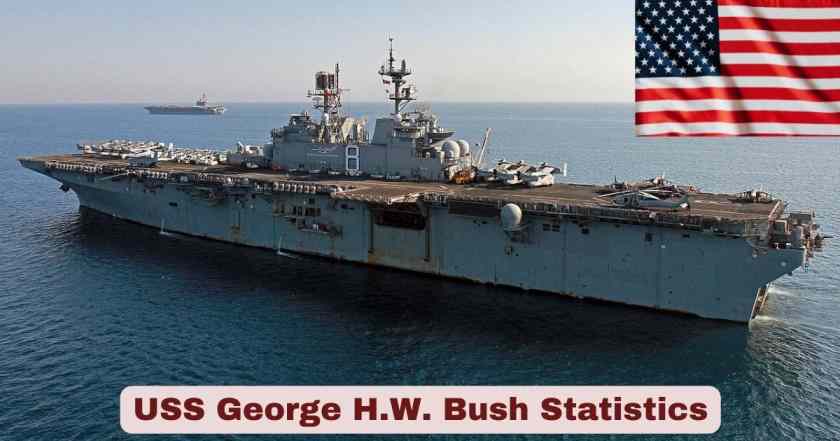
USS George H.W. Bush (CVN-77) in America
The USS George H.W. Bush (CVN-77) is the tenth and final Nimitz-class nuclear-powered supercarrier of the United States Navy — the last ship in the most powerful class of warships ever constructed, commissioned on January 10, 2009, built at a cost of $6.2 billion by Northrop Grumman Newport News Shipbuilding in Newport News, Virginia, and named for George Herbert Walker Bush — the 41st President of the United States, 11th Director of Central Intelligence, and one of the Navy’s own: a World War II carrier aviator who flew 58 combat missions aboard USS San Jacinto, was shot down over the Pacific on September 2, 1944, and received the Distinguished Flying Cross for his service. The ship carries the callsign Avenger — honoring the TBF Avenger torpedo bomber that the future president flew into combat — and fights under the motto Freedom at Work, a phrase that connects the carrier’s daily operational purpose to the biography of the man whose name is welded permanently into its keel. CVN-77 is simultaneously the culmination of the Nimitz program and its evolutionary endpoint: engineers at Northrop Grumman incorporated Ford-class design improvements into the Bush’s construction from the outset — including a bulbous bow for improved hull efficiency, curved flight deck edges to reduce radar signature, a repositioned and streamlined island superstructure moved further aft to reduce electronic self-interference, updated radar cross-section shaping, a new propeller design, modernized aviation fuel storage and distribution, and a new underwater hull coating system — producing a warship that is physically a Nimitz-class carrier but operationally the bridge to the Ford class that followed it. The Bush displaces approximately 100,000 to 104,000 tons fully loaded, stretches 1,092 feet (332.85 meters) in length with a 252-foot (76.8 m) wide flight deck, is powered by two Westinghouse A4W nuclear reactors driving four shafts at 260,000 shaft horsepower, sustains speeds of 30+ knots, and carries a combined crew of approximately 5,000 to 6,000 personnel — comprising roughly 3,200 ship’s company and 2,480 embarked air wing aircrew and personnel — along with a Carrier Strike Group flag staff of approximately 70. The ship is homeported at Naval Station Norfolk, Virginia — the world’s largest naval station — and embarks Carrier Air Wing 7 (CVW-7), based at Naval Air Station Oceana, Virginia, whose aircraft carry the tail code AG.
In November 2024, CVN-77 returned to the fleet after completing a 10-month Planned Incremental Availability (PIA) at Norfolk Naval Shipyard on time — the Navy’s official announcement confirming the carrier returned to Naval Station Norfolk on November 16, 2024 following successful sea trials. The PIA, which began in January 2024, encompassed comprehensive upgrades to the ship’s sensors, combat systems, communication networks, crew living spaces, galley equipment, and connectivity infrastructure — including installation of the Consolidated Afloat Networks and Enterprise Services (CANES) upgrade, a Navy-wide computing and network modernization program. Most significantly, the 2024 PIA period also saw the installation of an Unmanned Air Warfare Center (UAWC) — the first of its kind fitted on any U.S. aircraft carrier — a dedicated facility enabling CVN-77’s pilots and mission operators to conduct drone operations and eventually control MQ-25 Stingray unmanned aerial refueling tankers directly from the ship. This UAWC installation marks the Bush as the first Nimitz-class carrier to begin the institutional integration of unmanned systems into carrier air wing operations that the entire fleet will eventually adopt. Following the completion of the PIA and sea trials, throughout 2025 and into early 2026, CVN-77 focused intensively on readiness training — conducting Composite Training Unit Exercises (COMPTUEX) and integrated group sail exercises with its strike group escorts in the Western Atlantic, maintaining high sortie rates in documented August 2025 Atlantic operations in support of NATO readiness, and completing the certification cycle that would qualify the ship and air wing for deployment. As of March 7, 2026, CVN-77 is assessed as fully operational and deployment-ready — positioned at Norfolk and available for tasking as the global situation demands, with defense planners having actively considered CVN-77 deployments in response to the Operation Epic Fury campaign against Iran that commenced February 28, 2026.
USS George H.W. Bush (CVN-77) 2026 — Key Facts
| # | CVN-77 Key Fact | Details |
|---|---|---|
| 1 | 10th and Final Nimitz-Class Carrier — Last of Its Kind | USS George H.W. Bush is the 10th and final Nimitz-class nuclear-powered supercarrier ever built — the end of a class that spanned construction from USS Nimitz (commissioned 1975) to CVN-77 (2009) — no additional Nimitz-class carriers will ever be built; the Ford-class (CVN-78+) is the successor |
| 2 | $6.2 Billion Construction Cost — Built at the Only US Yard Capable of Building Nuclear Carriers | CVN-77 was built at a cost of $6.2 billion by Northrop Grumman Newport News Shipbuilding — the only shipyard in the United States capable of constructing nuclear-powered aircraft carriers — with contract awarded January 26, 2001 and keel laid September 6, 2003 |
| 3 | Named for a Combat Naval Aviator — George H.W. Bush Flew 58 Combat Missions, Shot Down 1944 | The ship is named for the 41st U.S. President, who flew 58 combat missions as a Navy carrier aviator in WWII aboard USS San Jacinto, was shot down by Japanese anti-aircraft fire September 2, 1944, received the Distinguished Flying Cross, and was one of the Navy’s youngest pilots — receiving wings at age 18 in June 1943 |
| 4 | 100,000–104,000 Tons Fully Loaded — 1,092 Feet Long — Flight Deck 252 Feet Wide | CVN-77 displaces approximately 100,000–104,000 tons fully loaded, measures 1,092 feet (332.85 m) in length, with a flight deck 252 feet (76.8 m) wide — among the largest warships ever constructed by any navy, at any point in history |
| 5 | Two Westinghouse A4W Nuclear Reactors — 260,000 Shaft Horsepower — 30+ Knots | CVN-77 is propelled by two Westinghouse A4W nuclear reactors driving four shafts at a combined 260,000 shaft horsepower — achieving 30+ knots (34.5+ mph) sustained speed — with the reactors providing effectively unlimited range, constrained only by provisions and crew endurance rather than fuel |
| 6 | PIA Completed On-Time November 16, 2024 — First U.S. Carrier with Unmanned Air Warfare Center (UAWC) | CVN-77 completed its 10-month Planned Incremental Availability (PIA) on time on November 16, 2024 at Norfolk Naval Shipyard — and became the first U.S. aircraft carrier fitted with an Unmanned Air Warfare Center (UAWC), enabling control of MQ-25 Stingray unmanned tankers from the ship |
| 7 | 5,000–6,000 Total Personnel — 3,200 Ship’s Company + 2,480 Air Wing + 70 Flag Staff | CVN-77 operates with a combined complement of approximately 5,000–6,000 personnel — comprising ~3,200 ship’s company (including ~160 officers), ~2,480 embarked air wing aircrew and support, and approximately 70 carrier strike group flag staff and support personnel |
| 8 | Four Steam Catapults — Launches Aircraft Every 20 Seconds — Four Deck Elevators | The flight deck is equipped with four steam catapults capable of launching aircraft at a rate of one every 20 seconds, supported by four aircraft elevators moving aircraft between the flight deck and hangar bay — sustaining a combat sortie rate that no other nation’s carrier can match |
| 9 | Up to 90 Aircraft — F/A-18 Super Hornets, EA-18G Growlers, E-2D Hawkeyes, MH-60 Seahawks | CVN-77 typically operates up to 90 fixed-wing and rotary-wing aircraft — including F/A-18E/F Super Hornets (strike fighter), EA-18G Growlers (electronic attack), E-2D Advanced Hawkeye (airborne command and control), and MH-60R/S Seahawk helicopters (ASW, logistics) |
| 10 | Callsign Avenger — Motto Freedom at Work — Named for TBF Avenger Torpedo Bomber | CVN-77 carries the callsign Avenger — directly referencing the Grumman TBF Avenger torpedo bomber flown in combat by George H.W. Bush — and the motto Freedom at Work, both formally adopted upon commissioning January 10, 2009 at Naval Station Norfolk |
| 11 | Operation Inherent Resolve 2014 and 2017 — ISIS Airstrikes Iraq and Syria from CVN-77 | CVN-77 deployed to the Persian Gulf in February 2014 and again from January–August 2017, both times launching sustained F/A-18 Super Hornet combat airstrikes against ISIS targets in Iraq and Syria under Operation Inherent Resolve — the carrier’s only confirmed combat strike deployments to date |
| 12 | 2022–2023 NATO Mediterranean Deployment — Neptune Strike — Tri-Carrier Operations | CVN-77 deployed August 10, 2022, operating under U.S. Naval Forces Europe / Sixth Fleet in the Mediterranean through April 2023 — conducting Neptune Strike NATO exercises, tri-carrier events with European partners, Dynamic Manta anti-submarine exercises, and reassurance operations following Russia’s February 2022 invasion of Ukraine |
| 13 | First Unmanned Aircraft X-47B Catapult Launch from a Carrier — May 14, 2013 | On May 14, 2013, USS George H.W. Bush made naval aviation history by conducting the first-ever catapult launch of an unmanned aircraft from a U.S. aircraft carrier — the Northrop Grumman X-47B UCAS demonstrator — during Atlantic sea trials, a milestone that directly preceded the MQ-25 program that CVN-77’s 2024 UAWC now supports |
| 14 | Homeport: Naval Station Norfolk, Virginia — Embarked Air Wing: CVW-7 (NAS Oceana, Tail Code AG) | CVN-77 is homeported at Naval Station Norfolk, Virginia — the world’s largest naval station — and permanently embarks Carrier Air Wing 7 (CVW-7), based at Naval Air Station Oceana, Virginia, with seven assigned squadrons and the tail code AG on all aircraft |
| 15 | Fully Operational and Deployment-Ready as of March 2026 — Atlantic Operations Documented August 2025 | Following PIA completion November 2024 and subsequent COMPTUEX training cycle, CVN-77 is fully operational and deployment-ready as of March 2026 — documented in routine Atlantic operations in August 2025 supporting NATO readiness — with defense planners actively considering deployment options in the context of the Iran campaign that opened February 28, 2026 |
Source: U.S. Navy – USS George H.W. Bush official website ; Commander, Naval Air Force Atlantic – USS George H.W. Bush Completes 10-Month Maintenance Period and Sea Trials On-Time ; USNI News – Carrier George H.W. Bush Wraps Up Maintenance Period, Sea Trials, November 18, 2024
These 15 CVN-77 key facts for 2026 frame a carrier that is simultaneously the conclusion of a 50-year warship lineage and the launching platform for the future of unmanned carrier aviation. The $6.2 billion construction cost and the single-yard dependency on Newport News are the industrial facts that explain why the U.S. builds carriers on a generational timeline rather than a production schedule: there is only one shipyard, only one construction dry dock large enough, and the workforce required to weld together a 100,000-ton nuclear warship takes decades to develop and maintain. The on-time completion of the November 2024 PIA — described by Naval Sea Systems Command as the result of innovative strategies and engineering solutions applied by an experienced workforce that had also worked on the Eisenhower’s 2022 PIA — is the operational milestone that moved CVN-77 from a ship in maintenance to a ship back in the fight, fully modernized, CANES-upgraded, and for the first time in U.S. naval history, equipped with a dedicated facility for unmanned system operations.
The UAWC installation is not a cosmetic distinction. The MQ-25 Stingray — the Navy’s carrier-based unmanned aerial refueling tanker — will extend the combat radius of every F/A-18 Super Hornet and EA-18G Growler in CVN-77’s air wing by refueling them in flight, reducing the number of manned strike fighters currently consumed in the tanker role and returning those aircraft to combat strike tasking. The carrier that first flew the unmanned X-47B from its deck in 2013 is now, in 2026, the first carrier with a permanent facility to operate its unmanned successor. The 13-year arc from the X-47B catapult launch to the UAWC installation tells the story of how the Navy integrates transformational technology — slowly, methodically, tested at sea on the same hull that will eventually operationalize the capability.
USS George H.W. Bush (CVN-77) 2026 — Full Technical Specifications
| Specification | CVN-77 Data | Notes |
|---|---|---|
| Hull Classification | CVN-77 | CVN = carrier, fixed-wing, nuclear |
| Ship Class | Nimitz-class supercarrier — 10th and final | Class spans CVN-68 (1975) to CVN-77 (2009) |
| Builder | Northrop Grumman Newport News Shipbuilding, Newport News, Virginia | Only US yard capable of nuclear carrier construction |
| Construction Contract | January 26, 2001 | Awarded to Northrop Grumman Shipbuilding Newport News |
| Keel Laid | September 6, 2003 | Dry Dock 12 — largest dry dock in western hemisphere |
| Launched / Christened | October 7, 2006 | Christened by ship sponsor Dorothy Bush Koch (daughter of namesake) |
| Delivered to Navy | May 2009 | |
| Commissioned | January 10, 2009 | Naval Station Norfolk, Virginia |
| Construction Cost | $6.2 billion | Wikipedia; confirmed by multiple Navy official sources |
| Homeport | Naval Station Norfolk, Virginia | World’s largest naval station |
| Namesake | George Herbert Walker Bush — 41st U.S. President, 11th CIA Director, WWII naval aviator | Only U.S. carrier named for a living president at time of naming ceremony (2002) |
| Callsign | Avenger | Named for the TBF Avenger torpedo bomber Bush flew in WWII |
| Motto | Freedom at Work | Adopted at commissioning |
| Length (Overall) | 1,092 feet (332.85 meters) | History Central; Naval Technology |
| Beam (Waterline) | 134 feet (40.84 meters) | History Central |
| Flight Deck Width | 252 feet (76.8 meters) | Naval Technology; History Central |
| Displacement (Full Load) | ~100,000–104,000 tons | Naval Technology: 102,000t; History Central: ~97,000 tons; Wikipedia: ~100,000t |
| Propulsion | 2 × Westinghouse A4W nuclear reactors + 4 × steam turbines + 4 × shafts | |
| Shaft Horsepower | 260,000 shp | MilitaryFactory; Naval Technology |
| Speed | 30+ knots (34.5+ mph / 55.5+ km/h) | |
| Range | Unlimited (nuclear) — limited by provisions | Reactors rated 20–25 years service life before refueling |
| Flight Deck Area | ~4.5 acres | Multiple sources |
| Steam Catapults | 4 × C-13-1 steam catapults | Launch rate: one aircraft every 20 seconds |
| Arresting Gear | 4 × Mk 7 arresting wires | Angled landing deck |
| Aircraft Elevators | 4 × deck elevators | Transfer aircraft between flight deck and hangar |
| Aircraft Capacity | Up to 90 fixed-wing and rotary-wing aircraft | Typically 60–75 in normal air wing configuration |
| Embarked Air Wing | Carrier Air Wing 7 (CVW-7) — NAS Oceana, VA; tail code AG | 7 squadrons |
| Typical Air Wing Aircraft | F/A-18E/F Super Hornet; EA-18G Growler; E-2D Advanced Hawkeye; MH-60R/S Seahawk; C-2A Greyhound (COD) | F-35C integration ongoing for Nimitz-class air wings |
| Total Personnel | ~5,000–6,000 | Combined ship’s company + air wing + flag staff |
| Ship’s Company | ~3,200 (including ~160 officers) | Naval Technology |
| Air Wing Personnel | ~2,480 | Naval Technology; History Central |
| Flag Staff | ~70 (Carrier Strike Group flag officer and staff) | Naval Technology |
| Armament — Missiles | 2–3 × Mk 29 GMLS launchers for NATO Evolved Sea Sparrow Missile (ESSM) | Sea Sparrow / ESSM surface-to-air missiles |
| Armament — RAM | 2 × Mk 49 launchers for RIM-116 Rolling Airframe Missile (RAM) | Short-range point defense against anti-ship missiles |
| Armament — CIWS | 4 × 20mm Phalanx Close-In Weapon Systems (CIWS) | Last-ditch defense against missiles and aircraft |
| Air Search Radar | ITT SPS-48E 3D (E/F band) + Raytheon SPS-49(V)5 (C/D band) | |
| Fire Control | 3 × Mk 91 MFCS directors (Sea Sparrow) + Mk 23 TAS | |
| Air Traffic Control Radar | SPN-46 + SPN-43C + SPN-41 (landing aid) | |
| Electronic Warfare | SLQ-32A(V)4 countermeasures suite | |
| Torpedo Decoy | SLQ-25A Nixie torpedo decoy system | |
| Combat Data System | Advanced Combat Direction System (ACDS) — Links 4A, 11, and 16 | Upgraded by Lockheed Martin as warfare systems integrator |
| Network Upgrade (2024) | CANES (Consolidated Afloat Networks and Enterprise Services) | Installed during 2024 PIA — Navy-wide computing/network modernization |
| Unmanned System Facility | Unmanned Air Warfare Center (UAWC) — first on any US carrier, installed 2024 | Enables control of MQ-25 Stingray UAS from ship |
| Reactor Fuel Life | 20–25 years per core | A4W reactors — same type as other Nimitz-class carriers |
| Service Life | 50 years (with two mid-life refueling and overhaul cycles, RCOH) | CVN-77 eligible for first RCOH approximately mid-2030s |
| Key Design Differences vs Other Nimitz | Bulbous bow; curved flight deck edges; repositioned island (further aft); new propeller; anti-stain paint; modernized island radar tower; new underwater hull coating | Forward-compatible features developed for Ford-class incorporated in CVN-77 |
Source: U.S. Navy – USS George H.W. Bush official website; Wikipedia – USS George H.W. Bush, updated March 2026; Naval Technology – USS George HW Bush (CVN 77); History Central – George H.W. Bush CVN 77 specifications; MilitaryFactory – USS George H.W. Bush (CVN-77);
The CVN-77 full technical specifications confirm a warship of a scale that has no equivalent in any other navy on earth. The four C-13-1 steam catapults — each capable of accelerating a 70,000-pound aircraft from zero to 165 mph in two seconds — are the mechanical heart of the ship’s offensive purpose: every combat capability of the 90-aircraft air wing flows through those four catapults at the rate of one aircraft every 20 seconds during surge operations. The Phalanx CIWS, ESSM, and RAM layered defensive armament form concentric rings of protection that extend from 10+ miles (ESSM range) down to gun range (Phalanx), ensuring that threats that penetrate the strike group’s outer defensive perimeter still face multiple intercept opportunities before reaching the hull. The new propeller design and bulbous bow incorporated as CVN-77-specific improvements deliver measurable fuel efficiency advantages over earlier Nimitz-class ships — not because nuclear carriers consume aviation fuel in their reactors, but because hull efficiency affects the thermal signature, acoustic signature, and hydrodynamic performance that determine how much power is required to maintain a given speed for a given duration.
The two Westinghouse A4W nuclear reactors powering CVN-77 represent the same technology that has powered every Nimitz-class carrier for five decades — proven, reliable, and capable of sustaining 30+ knot sprint speeds for extended periods without degradation. Each reactor core is rated for 20–25 years of service before requiring replacement — meaning CVN-77, commissioned in 2009, will not require its first refueling and complex overhaul (RCOH) until the mid-2030s. That RCOH — which takes approximately four years at a cost expected to exceed $3 billion — is the single largest maintenance investment the ship will require in its 50-year service life, and it will simultaneously recapitalize every major ship system and extend CVN-77’s service to approximately 2059. The 2024 PIA was not the RCOH — it was a Planned Incremental Availability, a shorter maintenance period that modernizes specific systems without requiring the ship to leave the water for an extended period. The on-time completion was operationally significant because it returned a fully upgraded carrier to the fleet on schedule — a performance metric the Navy has not always achieved with large carrier maintenance periods.
USS George H.W. Bush (CVN-77) 2026 — Deployment & Operational History
| Period | Deployment / Event | Details |
|---|---|---|
| January 10, 2009 | Commissioning | Commissioned at Naval Station Norfolk, Virginia — final Nimitz-class carrier enters service |
| May 2011 | First Deployment | Maiden deployment to Atlantic — joint exercises with Royal Navy in Saxon Warrior exercise; transited to Mediterranean and arrived Naples, Italy, June 2011 |
| August 2011 | Operation Enduring Freedom — Arabian Sea | Air wing supports coalition operations in Afghanistan from the Arabian Sea |
| December 2011 | Returns to Norfolk | Completion of maiden deployment |
| July–December 2012 | First Planned Incremental Availability (PIA) | Four-month overhaul at Norfolk Naval Shipyard — anti-clog measures installed in toilet system; electronics and communications upgrades; new sensor and maintenance systems |
| December 3–4, 2012 | Sea Trials After First PIA | CVN-77 completes sea trials; begins training and qualification cycle |
| May 14, 2013 | X-47B Historic First | First-ever catapult launch of an unmanned aircraft from a U.S. carrier — Northrop Grumman X-47B UCAS launched from CVN-77’s deck in Atlantic Ocean |
| January 2014 | MV-22 and MH-53E Tests | CVN-77 conducts carrier suitability testing of MV-22 Osprey tilt-rotor for COD role and MH-53E mine-sweeping helicopters |
| February 2014 | Persian Gulf Deployment | CVN-77 deploys to U.S. Fifth Fleet area of responsibility — operations in Arabian Gulf — supports Operation Enduring Freedom (Afghanistan) |
| August 2014 | Operation Inherent Resolve — First Iraq/Syria Airstrikes | CVN-77 launches F/A-18 Super Hornet combat airstrikes against ISIS targets in Iraq and Syria — first combat strike operations against ISIS |
| May 2015 | Returns to Norfolk | End of 2014–2015 deployment |
| May 2018 | Chesapeake 2018 — French Navy Integration | CVN-77 hosts French Navy in combined exercise — French Rafale M fighters and E-2C Hawkeye embarked for integrated cyclic flight operations |
| January 2017 | Mediterranean and Arabian Gulf Deployment | CVN-77 deploys with CVW-7 — combat operations against ISIS under Operation Inherent Resolve; precision airstrikes against ISIS; multinational NATO exercises |
| August 2017 | Returns to Norfolk | End of 2017 deployment |
| February 2019 | Drydocking Planned Incremental Availability (DPIA) Begins | First out-of-water maintenance period since construction — 30-month major maintenance and upgrade at Norfolk Naval Shipyard |
| August 2021 | DPIA Completes — Returns to Fleet | CVN-77 undocked after extended 30-month DPIA — completes first major drydocking — re-enters training pipeline |
| December 2021 | MQ-25A Deck Handling Tests | MQ-25A Stingray unmanned aerial tanker begins deck handling tests aboard CVN-77 — first unmanned refueling tanker deck integration evaluation |
| August 10, 2022 | Mediterranean Deployment with CVW-7 / CSG-10 | CVN-77 deploys as Carrier Strike Group 10 (CSG-10) flagship — first deployment since 2017, after 30-month DPIA and training cycle |
| August 25, 2022 | Transits Strait of Gibraltar | CVN-77 and CSG-10 enter Mediterranean Sea — relieve CSG-8 and USS Harry S. Truman |
| Late 2022 – Early 2023 | NATO Mediterranean Operations | CVN-77 operates under U.S. Sixth Fleet — Neptune Strike NATO exercises; dual- and tri-carrier events with European partners; Dynamic Manta ASW exercises; reassurance operations after Russia’s Ukraine invasion |
| April 23, 2023 | Returns to Norfolk | CVN-77 and CSG-10 return from Mediterranean deployment |
| January 2024 | Planned Incremental Availability (PIA) Begins | CVN-77 enters 10-month PIA at Norfolk Naval Shipyard — CANES upgrade, sensors, combat systems, communications, crew spaces; UAWC installed — first on any U.S. carrier |
| November 16, 2024 | PIA Completes On-Time — Sea Trials Passed | CVN-77 returns to Naval Station Norfolk after on-time completion of PIA and successful sea trials — declared ready to rejoin the fleet by NAVSEA |
| 2025 | Training and Readiness Cycle | CVN-77 conducts COMPTUEX, group sails, certification exercises — documented Atlantic operations August 2025 supporting NATO readiness with high sortie rates |
| Early 2026 | Deployment-Ready — Middle East Contingency Consideration | CVN-77 engaged in Western Atlantic certification operations — defense planners consider CVN-77 deployment options in context of Operation Epic Fury Iran campaign commencing February 28, 2026 |
Source: Wikipedia – USS George H.W. Bush, updated March 2026; U.S. Navy – DVIDSHUB CVN-77 unit page, February–March 2026; Commander Naval Air Force Atlantic (AIRLANT) – PIA on-time completion press release, November 2024; USNI News – CVN-77 PIA completion, November 18, 2024; navysite – CVN-77 deployment history; History Central – George H.W. Bush CVN 77; MilitaryFactory – CVN-77 history; DefenseFeeds – CVN-77 capabilities; The Knowledge Base – USS George H.W. Bush, March 6, 2026
The CVN-77 deployment and operational history tells the story of a carrier that commissioned into an era of persistent counterterrorism operations and matured into a platform for great-power competition deterrence — a transition reflected in the shift from its 2014 and 2017 Operation Inherent Resolve ISIS strike deployments to its 2022–2023 NATO Mediterranean reassurance deployment in the shadow of Russia’s invasion of Ukraine. The ISIS operations were the first test of CVN-77 in sustained combat strike operations, and the performance of CVW-7’s F/A-18 Super Hornets flying day and night sorties in Arabian Gulf temperatures against defended ISIS targets established the ship’s crews and air wing as a tested, combat-proven team. The 2022–2023 Mediterranean deployment served an entirely different strategic purpose: the mere presence of a 100,000-ton nuclear-powered carrier operating in waters adjoining the Ukrainian conflict communicated American commitment to NATO Article 5 more clearly than any diplomatic statement — a presence-as-deterrence mission that carriers have performed throughout their history.
The 30-month DPIA from February 2019 to August 2021 was the longest maintenance period in CVN-77’s history — the ship’s first drydocking since its 2009 delivery, a scope of work that encompassed essentially every major mechanical, electrical, and structural system on the ship in a maintenance period that took longer than originally planned. The return to the fleet in August 2021, followed by the August 10, 2022 deployment just 12 months later, reflects both the urgency of the U.S. Navy’s carrier presence requirements and the capability of the Norfolk Naval Shipyard workforce to return the ship to deployment-ready status on a compressed schedule. The on-time 2024 PIA completion — explicitly praised by Naval Sea Systems Command for the application of lessons learned from the Eisenhower’s 2022 PIA by the same experienced workforce — was the correction of the trajectory that the 2019–2021 DPIA had established: proof that the shipyard had institutionalized the efficiency improvements needed to maintain the carrier fleet’s availability on the Navy’s schedule rather than the shipyard’s.
USS George H.W. Bush (CVN-77) 2026 — Carrier Air Wing 7 (CVW-7) Statistics
| Squadron | Designation | Aircraft | Mission | Home Base |
|---|---|---|---|---|
| VFA-143 | Pukin’ Dogs | F/A-18E Super Hornet | Strike fighter — air-to-air + air-to-ground | NAS Oceana, VA |
| VFA-103 | Jolly Rogers | F/A-18F Super Hornet | Strike fighter — air-to-air + air-to-ground | NAS Oceana, VA |
| VFA-86 | Sidewinders | F/A-18E Super Hornet | Strike fighter — air-to-air + air-to-ground | NAS Oceana, VA |
| VFA-136 | Knighthawks | F/A-18E Super Hornet | Strike fighter — air-to-air + air-to-ground | NAS Oceana, VA |
| VAQ-140 | Patriots | EA-18G Growler | Electronic attack — jamming; SEAD; cyber | NAS Whidbey Island, WA |
| VAW-121 | Bluetails | E-2D Advanced Hawkeye | Airborne command, control, and early warning | NAS Norfolk, VA |
| HSC-5 | Nightdippers | MH-60S Seahawk | Helicopter sea combat — logistics, SAR, VERTREP | NAS Norfolk, VA |
| HSM-46 | Grandmasters | MH-60R Seahawk | Helicopter maritime strike — ASW, surface warfare | NAS Mayport, FL |
| VRC-40 Det | Rawhides | C-2A Greyhound | Carrier onboard delivery (COD) — logistics, personnel | NAS Norfolk, VA |
Source: Wikipedia – Carrier Air Wing Seven, updated March 2026; U.S. Navy – Commander Naval Air Force Atlantic (AIRLANT) – CVW-7 welcome aboard; DVIDSHUB – CVN-77 unit page, recent imagery confirming HSC-5, VAW-116/121, and CVW-7 operations, February–March 2026
The Carrier Air Wing 7 statistics confirm an air wing structured around four F/A-18E/F Super Hornet strike fighter squadrons as its primary offensive punch — an architecture that has remained consistent through the Wing’s CVN-77 deployments since 2011. The four Super Hornet squadrons together provide CVN-77 with an inherent multi-role strike fighter force of approximately 40–44 aircraft capable of air superiority, precision strike, anti-ship warfare, and close air support simultaneously, without the mission-specific aircraft limitations that characterized Cold War carrier air wings built around separate fighter (F-14) and attack (A-6/A-7) communities. The EA-18G Growler squadron — VAQ-140 Patriots — is the electronic warfare capability that transforms the air wing from a powerful strike force into a force that can also suppress or destroy adversary air defense radar and command networks, making every Super Hornet sortie safer and more penetrating. The E-2D Advanced Hawkeye of VAW-121 provides the airborne battle management and early warning capability that extends the carrier strike group’s radar coverage beyond line-of-sight — acting as an airborne command post that integrates air, surface, and subsurface pictures for the strike group commander, directing intercepts and managing strike packages simultaneously.
The MH-60R Seahawks of HSM-46 are the carrier’s primary anti-submarine warfare asset in the rotary-wing role — equipped with dipping sonar, sonobuoys, and torpedoes to detect and engage submarine threats at ranges beyond the carrier’s own sonar capability. The MH-60S Seahawks of HSC-5 perform the less glamorous but operationally critical vertical replenishment, search-and-rescue, and logistics missions that sustain the carrier’s at-sea endurance — a carrier that cannot be replenished cannot sustain the sortie rates that justify its existence. The C-2A Greyhound detachment from VRC-40 provides the critical carrier onboard delivery (COD) function — the pipeline through which personnel, high-priority spare parts, mail, and time-sensitive cargo flow between the carrier and the shore, maintaining the human and logistical connections that keep 6,000 people functioning effectively for months at sea. The DVIDSHUB unit page confirmed an E-2D Hawkeye landing aboard CVN-77 on February 28, 2026 — the day Operation Epic Fury opened — confirming the air wing was actively embarked and the ship was conducting flight operations on that date.
Disclaimer: This research report is compiled from publicly available sources. While reasonable efforts have been made to ensure accuracy, no representation or warranty, express or implied, is given as to the completeness or reliability of the information. We accept no liability for any errors, omissions, losses, or damages of any kind arising from the use of this report.