
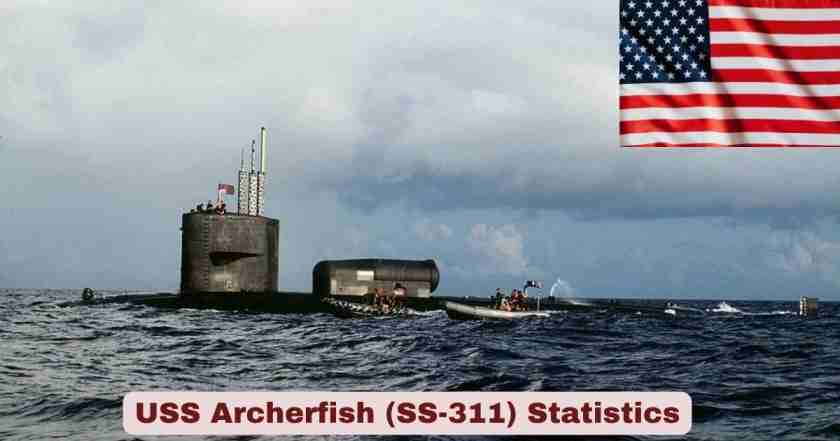
USS Archerfish in America 2026
USS Archerfish (SS/AGSS-311) holds a place in American naval history that is almost without parallel among the thousands of warships the United States has ever sent to sea — she is the submarine that accomplished what no other submarine, in any navy, in any war, has ever done before or since: she sank the largest warship ever sent to the bottom by a single submarine. A Balao-class diesel-electric submarine built at the Portsmouth Naval Shipyard in Kittery, Maine, Archerfish was commissioned on 4 September 1943 and served across three distinct commissioned eras spanning a total of 25 years, from the depths of World War II through the Cold War and into an entirely different chapter as a scientific research vessel. She was the first U.S. Navy ship ever named for the archerfish — a small, remarkable tropical fish found between India and Australia, capable of spitting a pressurized jet of water to knock prey from overhanging branches — a name whose hunting precision proved hauntingly appropriate for what this submarine would accomplish in the dark waters off Tokyo Bay on 28–29 November 1944. Her final status as of 2026 is one of solemn historical record: struck from the Naval Vessel Register on 1 May 1968 and sunk as a torpedo target off San Diego on 17 October 1968 by the submarine USS Snook (SSN-592) — ending the career of one of the most consequential warships America has ever built by sending her to the same element in which she had made history.
In 2026, the legacy of USS Archerfish (SS-311) resonates more forcefully than ever in the context of modern undersea warfare. The single tactical engagement that defines her — a six-and-a-half-hour surface pursuit in the dead of night, followed by a six-torpedo salvo that sent the 72,000-ton Japanese aircraft carrier Shinano to the bottom just 10 days after the carrier’s commissioning — remains the gold standard demonstration of what a well-commanded submarine can accomplish against a target that appears impossibly outmatched. Shinano was not just any warship: she was originally the third hull of the Yamato-class battleships, converted into the largest aircraft carrier ever built up to that time, displacing more than 72,000 long tons at full load. She was escorted by three destroyers and a submarine chaser. Against all of this, a single 1,526-ton submarine with one commander, one crew, and six well-aimed torpedoes ended the most powerful aircraft carrier Japan had ever put to sea — in a single night. For this extraordinary act of seamanship and courage, Archerfish was awarded the Presidential Unit Citation, and her commanding officer, Commander Joseph F. Enright, received the Navy Cross. The record she set — largest warship ever sunk by a submarine — has stood for 81 years as of 2026, and shows no signs of ever being broken.
Interesting Facts About USS Archerfish (SS-311)
| Fact Category | Detail |
|---|---|
| Ship Name | USS Archerfish (SS/AGSS-311) |
| Hull Classification | SS-311 (combat submarine); redesignated AGSS-311 (auxiliary submarine) in 1960 |
| Class | Balao-class diesel-electric submarine |
| Named After | The archerfish — a tropical fish that shoots water jets to knock prey from overhanging branches |
| Navy First | First U.S. Navy ship ever named for the archerfish |
| Builder | Portsmouth Naval Shipyard, Kittery, Maine |
| Keel Laid | 22 January 1943 |
| Launched | 28 May 1943 |
| Commissioned | 4 September 1943 |
| First Commanding Officer | Lt. Commander George W. Kehl |
| Famous Commanding Officer | Commander Joseph F. Enright — commanded 5th through 7th war patrols |
| Sponsor at Launch | Miss Malvina C. Thompson — personal secretary to First Lady Eleanor Roosevelt |
| Total Commissioned Eras | 3 separate eras: 1943–1946; 1952–1955; 1957–1968 |
| Total Active Service | 16 years, 11 months, and 22 days |
| Total Span (Keel to Sinking) | 25 years |
| Stricken from Naval Register | 1 May 1968 |
| Final Fate | Sunk as torpedo target off San Diego — 17 October 1968 — by USS Snook (SSN-592) |
| Greatest Feat | Sank Japanese aircraft carrier Shinano — 29 November 1944 — largest warship ever sunk by a submarine in history |
| Shinano’s Displacement | 72,000 long tons full load — converted from a Yamato-class battleship hull |
| Shinano’s Time in Commission | Only 10 days — commissioned 19 November 1944, sunk 29 November 1944 |
| Torpedoes That Hit Shinano | 4 of 6 fired — set at 10-foot shallow depth to maximize damage |
| Duration of Pursuit Before Attack | 6 hours and 30 minutes of surface tracking |
| Awards — World War II | Presidential Unit Citation + 7 Battle Stars (Asiatic-Pacific Campaign Medal) |
| CO’s Award | Commander Enright received the Navy Cross |
| Hollywood Film | Portrayed the USS Sea Tiger in the 1959 film “Operation Petticoat” starring Cary Grant |
| Honor Guard — Japan Surrender | One of 12 submarines that entered Tokyo Bay on 31 August 1945 and moored for the Japanese surrender ceremony on 2 September 1945 |
Source: Naval History and Heritage Command (NHHC) — DANFS entry for Archerfish (SS-311); Wikipedia — USS Archerfish (SS-311), verified 2026; ussarcherfish.com — “History of the USS ARCHERFISH (SS/AGSS-311)” by G.L. Cornelison; NavSource Naval History — Archerfish photo and record index; Arkansas Inland Maritime Museum at North Little Rock — USS Archerfish (SS-311) record
The facts surrounding USS Archerfish are so extraordinary that they almost resist belief — which is precisely why they need to be stated plainly. Consider what actually happened on the night of 28 November 1944: Commander Joseph F. Enright, commanding a submarine that had endured four largely fruitless patrols without a confirmed kill, spotted what his lookouts thought was a tanker leaving Tokyo Bay. He ordered a surface pursuit that lasted six and a half hours. He was hunting, completely alone, a target escorted by three destroyers, each capable of depth-charging his submarine into oblivion. At close range he submerged and fired six torpedoes set deliberately shallow at 10 feet — a calculated bet that shallower running would maximize hull damage. Four struck home. The breaking-up noises of a dying ship were audible aboard Archerfish for 47 minutes. What Enright did not know — what no American knew until after the war — was that the ship he had just sent to the bottom was Shinano: the largest aircraft carrier ever built, originally designed as a Yamato-class battleship carrying nine 18.1-inch guns, now converted into a 72,000-ton supercarrier that had been in commission for exactly ten days. The Office of Naval Intelligence initially credited Archerfish with sinking a cruiser. They simply couldn’t believe it was a carrier. The full truth only emerged when American forces accessed Japanese naval records after the surrender.
What adds another layer of historical significance to Archerfish’s story is that she was also present at the formal Japanese surrender ceremony on 2 September 1945 — one of only 12 submarines that entered Tokyo Bay on 31 August 1945 and moored alongside tender USS Proteus (AS-19) near the Yokosuka Navy Yard. The same vessel that had dealt one of the most devastating single blows to Japanese naval power was there to witness Japan’s formal capitulation to the Allies on the deck of USS Missouri. Few American warships can claim to have played a role at both the dramatic height of a war and at its ceremonial end. And almost uniquely, Archerfish also later appeared on the silver screen: in the 1959 Cary Grant film “Operation Petticoat”, the submarine played the fictional USS Sea Tiger for underwater and distance shooting — her final Hollywood turn before her scientific career began.
USS Archerfish (SS-311) Physical & Technical Specifications
| Specification | Data |
|---|---|
| Ship Type | Balao-class diesel-electric submarine |
| Overall Length | 311 feet 9 inches (95.02 meters) |
| Beam | 27 feet 3 inches (8.31 meters) |
| Draft | 16 feet 10 inches (5.13 meters) maximum |
| Surfaced Displacement | 1,526 tons (1,550 metric tons) |
| Submerged Displacement | 2,391 tons (2,429 metric tons) |
| Propulsion (Surfaced) | 4 × Fairbanks-Morse Model 38D8-1⁄8 9-cylinder opposed-piston diesel engines driving electrical generators |
| Propulsion (Submerged) | 4 × high-speed Elliott electric motors with reduction gears; 2 × 126-cell Sargo batteries |
| Number of Propellers | 2 propellers |
| Shaft Horsepower (Surfaced) | 5,400 shp (4.0 MW) |
| Shaft Horsepower (Submerged) | 2,740 shp (2.04 MW) |
| Maximum Speed (Surfaced) | 20.25 knots (37.50 km/h) |
| Maximum Speed (Submerged) | 8.75 knots (16.21 km/h) |
| Surface Range | 11,000 nautical miles (20,000 km) at 10 knots |
| Submerged Endurance | 48 hours at 2 knots |
| Patrol Endurance | 75 days on patrol |
| Test Depth | 400 feet (120 meters) |
| Hull Construction | Thicker, higher yield-strength steel pressure hull — defining improvement over Gato class |
| Hull Compartments | 6 compartments: forward torpedo room, officer quarters/forward battery, control room/radio room, crew quarters/aft battery, engine room, aft torpedo room |
Source: Wikipedia — USS Archerfish (SS-311), general characteristics; Naval History and Heritage Command (NHHC) — DANFS Balao (SS-285) specifications; ussarcherfish.com — official ship history record; Wikipedia — Balao-class submarine specifications
The technical specifications of USS Archerfish tell the story of one of the most capable weapons systems the United States produced in the entire Second World War. The defining engineering achievement of the Balao class over its predecessor, the Gato class, was a deceptively simple but enormously consequential upgrade: thicker, higher yield-strength steel in the pressure hull skins and frames, which pushed the test depth from 300 feet to 400 feet — a full 100 feet deeper than the Gatos could safely go. That extra depth margin was not merely a comfort factor; in combat, it was a lifesaving calculation. Every depth charge has a lethal radius and a lethal depth setting. The ability to dive 100 feet deeper than an enemy’s charges were set — or to evade into depth bands the pursuing destroyer’s crew had not anticipated — could mean the difference between survival and destruction. When Archerfish dove to 400 feet to avoid the destroyer counterattack after torpedoing Shinano, that extra depth margin was precisely what kept her alive while the enemy burned fuel searching for her above. The Fairbanks-Morse opposed-piston diesel engines that powered her on the surface were themselves an engineering achievement: more reliable and more powerful than many contemporary alternatives, they drove the boat at over 20 knots surfaced — fast enough to conduct extended surface pursuits of targets and outrun many escort vessels in the right sea conditions.
The patrol endurance of 75 days — combined with a surface range of 11,000 nautical miles at 10 knots — gave USS Archerfish a reach that astonished Japanese planners who had underestimated American submarines’ ability to operate deep inside Japanese home waters. The ability to make a combat patrol from Pearl Harbor all the way to the waters off Tokyo Bay and back, remaining on station for weeks, was something German U-boats of the same era operating in the Atlantic simply could not replicate at those distances. Two independent propulsion modes — diesel-electric on the surface for power and range, battery-electric submerged for stealth — gave submarine commanders tactical flexibility that surface warships entirely lacked. In Archerfish’s case, this meant she could chase Shinano on the surface at full diesel power for six and a half hours, then switch seamlessly to electric motors for the quiet, precise submerged attack that proved decisive.
USS Archerfish (SS-311) Crew & Complement Statistics
| Category | Number / Detail |
|---|---|
| Officers | 10 officers |
| Enlisted Men (Standard) | 70–71 enlisted |
| Total Complement (Standard) | 80–81 personnel |
| Wartime Complement (Late-War) | Often grew to 80 men with additional AA gun crews and systems operators |
| First Commanding Officer | Lt. Commander George W. Kehl — commissioned 4 September 1943 |
| CO — 5th, 6th, 7th War Patrols | Commander Joseph F. Enright — commanded Archerfish from 30 October 1944 |
| Wolfpack Command (6th Patrol) | Enright commanded “Joe’s Jugheads” — 3-submarine wolfpack: Archerfish, Batfish, Blackfish |
| Final Era CO (1959) | LCDR William N. Evans |
| Operation Sea Scan CO | LCDR Kenneth N. Woods — assumed command 4 March 1960 |
| Notable Personnel | CDR George F. Bond — conducted world-record 302-foot buoyant free ascent, 2 October 1959 |
| Crew Berthing | Modular berthing racks across 6 hull compartments; “hot bunking” practiced during high-crew-count wartime patrols |
| Crew Comfort Innovation | Balao class introduced improved berthing and ventilation over earlier classes — reduced fatigue on extended patrols |
Source: Wikipedia — USS Archerfish (SS-311); ussarcherfish.com — commanding officers and full history; NHHC DANFS — Archerfish (SS-311); NavSource — USS Archerfish photo index and record; Wikipedia — Balao-class submarine crew arrangements
The 80-man crew of USS Archerfish operated one of the most psychologically demanding combat environments imaginable — a 312-foot steel tube, submerged in hostile waters for weeks at a time, entirely dependent on each other’s competence for survival. The Balao class was deliberately designed with crew habitability improvements over earlier submarine designs: better berthing arrangements, improved ventilation, and refrigeration for food storage that made 75-day patrols physically sustainable in ways earlier boats could not manage. But no amount of design improvement could fully remove the fundamental reality of wartime submarine service: the crew of USS Archerfish knew, on every patrol, that a single depth charge or a single torpedo could end every one of their lives within seconds. The psychological weight of that reality, multiplied across the six-and-a-half-hour surface chase of Shinano — knowing that any one of those three destroyers could have turned and charged at them, knowing that a single radar contact could have brought down a full escort attack — makes the conduct of Enright and his crew during the 5th war patrol one of the most remarkable demonstrations of professional nerve in American military history.
The post-war career of Archerfish’s crew across her three commissioned eras introduced an entirely different kind of challenge. By the Operation Sea Scan era beginning in 1960, the boat that had hunted the largest carrier in Japan’s fleet was now carrying civilian scientists on oceanographic surveys across the Atlantic and Pacific, cataloging marine weather conditions, water temperatures, ocean depths, and water composition in service of peaceful scientific knowledge. The contrast between the wartime and postwar crew experiences aboard the same hull is stark enough to have inspired the book “Gallant Lady: A Biography of the USS Archerfish” (2006) by Don Keith and Ken Henry — which traces exactly that arc, from combat hunter to scientific platform. The 1959 buoyant ascent experiment conducted aboard Archerfish by CDR George F. Bond and Chief Engineman Cyril Tuckfield — in which both men ascended 302 feet from a submerged Archerfish in just 52 seconds — was itself a landmark contribution to submarine escape science that saved lives in subsequent decades, earning both men the Legion of Merit.
USS Archerfish (SS-311) Armament & Weapons Statistics
| Weapon System | Specification / Detail |
|---|---|
| Torpedo Tubes (Forward) | 6 × 21-inch (533mm) torpedo tubes — bow-mounted |
| Torpedo Tubes (Aft) | 4 × 21-inch (533mm) torpedo tubes — stern-mounted |
| Total Torpedo Tubes | 10 × 21-inch torpedo tubes |
| Total Torpedoes Carried | 24 torpedoes |
| Primary Torpedo Type | Mark 14 torpedo (and later Mark 18) |
| Fire Control System | Mark 10 Torpedo Data Computer (TDC) |
| Deck Gun | 1 × 4-inch (102mm)/50 caliber deck gun |
| Anti-Aircraft Gun | 1 × Bofors 40mm anti-aircraft cannon |
| Secondary AA Gun | 1 × Oerlikon 20mm anti-aircraft cannon |
| Shinano Attack — Torpedoes Fired | 6 torpedoes fired on 28–29 November 1944 |
| Shinano Attack — Torpedoes Hit | 4 confirmed hits |
| Shinano Attack — Depth Setting | Torpedoes deliberately set to run at 10 feet (shallow) to maximize hull damage and increase hit probability |
| Result of Shinano Attack | Shinano capsized and sank — approximately 7 hours after torpedo impact |
| Record Set | Largest warship ever sunk by a submarine — a record that has stood since 29 November 1944 and remains unbroken in 2026 |
Source: Wikipedia — USS Archerfish (SS-311) general characteristics and Shinano engagement narrative; NHHC DANFS — Archerfish (SS-311); Submarine Force Library & Museum Association — “The Sinking of the Imperial Japanese Supercarrier Shinano by USS Archerfish”; Wikipedia — Balao-class submarine armament specifications
The armament of USS Archerfish reflects the fundamental design philosophy of the American fleet submarine of World War II: overwhelming torpedo capacity at range, supported by modest deck guns for surface engagements against lightly armed merchant vessels or small combatants. The 10-tube, 24-torpedo configuration — six tubes firing forward, four firing aft — gave Archerfish a striking capacity that could engage targets from either end of the boat, allowing for attack approaches from multiple angles without the need to fully reverse course. The Mark 10 Torpedo Data Computer was the computational heart of the attack setup: a mechanical analog computer that continuously calculated the solution needed to put a torpedo on a moving target, accounting for the submarine’s own course and speed, the target’s bearing, range, and estimated speed, and the torpedo’s running speed and gyro angle. It was, by the standards of 1943–1945, a remarkably sophisticated targeting system — and Commander Enright used it to lethal effect against Shinano.
The deliberate decision to set the torpedoes for 10-foot shallow running during the Shinano attack reflects a level of tactical sophistication that deserves its own recognition. Enright knew that deep-running torpedoes were a documented problem with American Mark 14 torpedoes earlier in the war — a defect that had cost American submariners countless kills. By setting his weapons shallow, he both countered any possible deep-running tendency and aimed to punch holes high on the hull, above the armored belt and into the less-protected areas of the carrier’s side. The gamble paid off catastrophically for the Japanese. Four torpedo hits struck Shinano between the anti-torpedo bulge and the waterline, flooding rushed through compartments whose watertight doors had been left carelessly open by an inexperienced crew on only their 10th day as a commissioned ship. The Balao-class submarine’s Bofors 40mm and Oerlikon 20mm anti-aircraft guns were also a significant upgrade over earlier boats, reflecting the growing threat from Japanese land-based aircraft as American submarines penetrated closer to the Japanese home islands during 1944 and 1945.
USS Archerfish (SS-311) World War II War Patrol Record Statistics
| Patrol Number | Dates | Area | Notable Event |
|---|---|---|---|
| 1st War Patrol | 23 Dec 1943 – 16 Feb 1944 | North of Formosa (Taiwan) | Attacked 3 ships — no confirmed kills; 42 days at sea |
| 2nd War Patrol | 16 Mar – 27 Apr 1944 | Palau Islands area | No Japanese targets engaged — 42 days at sea |
| 3rd War Patrol | 28 May – 15 Jul 1944 | Bonin Islands / Iwo Jima | Lifeguard duty — rescued downed aviator Ensign John B. Anderson after Iwo Jima strike |
| 4th War Patrol | 7 Aug – 29 Sep 1944 | Off Honshū, Japan | 53 days at sea; no confirmed sinkings; damaged small patrol boat on 13 August |
| 5th War Patrol | 30 Oct – 15 Dec 1944 | Tokyo Bay / Honshū waters | Sank HIJMS Shinano — 29 November 1944 — largest warship ever sunk by a submarine; 48 days on station |
| 6th War Patrol | 10 Jan – 3 Mar 1945 | South China Sea, off Hong Kong / Formosa | “Joe’s Jugheads” wolfpack — Archerfish, Batfish, Blackfish; damaged 1 target; claimed 1 submarine 14 February 1945 (confirmed post-war); ended early due to bow-plane problems |
| 7th War Patrol (Final) | 10 Jul – 15 Aug 1945 | East Honshū / south Hokkaidō coast | Lifeguard duty for B-29 Superfortress strikes on Japanese home islands; in position off Hokkaidō when Japan surrendered 15 August 1945 |
| Post-Surrender | 31 August 1945 | Tokyo Bay | Among 12 submarines entering Tokyo Bay; moored for Japan’s formal surrender ceremony, 2 September 1945 |
Source: Naval History and Heritage Command (NHHC) — DANFS entry, Archerfish (SS-311); Wikipedia — USS Archerfish (SS-311) — full war patrol narrative; World War II Database (ww2db.com) — Archerfish patrol logs; ussarcherfish.com — “History of USS ARCHERFISH 1943 to 1968”
The seven war patrols of USS Archerfish form a narrative arc that is both humbling in its early difficulties and then electrifying in its fifth-patrol climax. The first four patrols — collectively representing more than 150 days at sea in enemy-controlled waters — yielded no confirmed sinkings. This was not unusual in the war of American Pacific submarines; many fine boats and crews went multiple patrols without kills. But it shaped the context in which the 5th patrol’s achievement must be understood. Commander Joseph F. Enright himself had previously asked to be relieved of command of another submarine because he felt he lacked confidence after a fruitless first patrol — and had spent nearly a year on shore duty before accepting command of Archerfish. The man who would execute the most consequential single submarine attack of the entire war came to it after what he himself had experienced as failure. This human dimension of the Archerfish story — a commander who doubted himself, taking command of a submarine that hadn’t sunk anything in four tries, then sinking the largest warship ever sent to the bottom by a submarine — is one of the most compelling in all of American naval history.
The 7th and final war patrol provides a quietly poignant bookend to the combat record. Archerfish was off the coast of Hokkaidō, Japan, providing lifeguard services for B-29 Superfortress bombers striking the Japanese home islands, when word came on 15 August 1945 that Japan had capitulated. The same boat that had struck one of the most devastating single blows against Japanese naval power was in position off the Japanese home islands when the war ended. She then made the 14-day transit to Tokyo Bay, where she moored alongside tender USS Proteus (AS-19) near Yokosuka — and was present as one of 12 submarines when Japan formally surrendered on 2 September 1945 aboard USS Missouri. It would be impossible to script a more complete arc for a warship: from the killing fields off Tokyo Bay in November 1944 to the surrender ceremony in the same bay in September 1945, USS Archerfish witnessed both the violence of the Pacific War and its formal end.
USS Archerfish (SS-311) Post-War & Scientific Career Statistics
| Period / Event | Date / Detail |
|---|---|
| First Decommissioning | 12 June 1946 — placed in Pacific Reserve Group, Mare Island Naval Shipyard |
| Korean War Recommissioning | 6 March 1952 (ordered recommissioned 7 January 1952) — joined Pacific Fleet |
| Maneuvering Room Fire | 28 March 1952 — fire aboard during shakedown; returned to Mare Island under own power; repaired |
| Atlantic Fleet Transfer | Transited Panama Canal; joined Atlantic Fleet 3 July 1952 — attached SubRon 12, Key West, Florida |
| Second Decommissioning | 21 October 1955 — towed to Atlantic Reserve Fleet, New London, Connecticut |
| Third Recommissioning | 1 August 1957 — reactivated at New London; rejoined SubRon 12, Key West |
| Hollywood Appearance | 1959 — portrayed USS Sea Tiger in “Operation Petticoat” (Universal Pictures) — starring Cary Grant |
| World-Record Escape Test | 2 October 1959 — CDR George F. Bond and ENC Cyril Tuckfield completed 302-foot buoyant ascent in 52 seconds — off Key West, over Vestal Shoal; Archerfish bottomed at 322 feet |
| Legion of Merit Awards | Both Bond and Tuckfield received the Legion of Merit in 1960 for establishing feasibility of deep submarine escape by locking out |
| Redesignated AGSS-311 | 22 January 1960 — reclassified from SS to AGSS (auxiliary submarine) upon entering Philadelphia Naval Shipyard for Operation Sea Scan preparation |
| Operation Sea Scan — Phase 1 | 18 May – 3 December 1960 — Atlantic survey; ports include Portsmouth (England), Hammerfest and Bergen (Norway), Faslane (Scotland), Thule and Godthaab (Greenland), Belfast (Northern Ireland), Halifax (Nova Scotia) |
| Operation Sea Scan — Phase 2 | January 1961 – March 1962 — Pacific survey; ports include Yokosuka and Hakodate (Japan), Hong Kong, Subic Bay (Philippines), Bangkok (Thailand), Penang (Malaya), Colombo (Ceylon), Fremantle (Australia) |
| Operation Sea Scan — Phase 3 | 1962–1964 — Eastern Pacific surveys with ports in Pacific Northwest (Seattle, Portland, Vancouver) and South Pacific |
| Operation Sea Scan — Phase 4 (Final) | 17 June 1964 – 1965 — Extended Eastern Pacific; South Pacific; Fiji Islands; Auckland and Wellington (New Zealand); Caroline Islands |
| Final Decommissioning / Striking | 1 May 1968 — declared unfit for further service; struck from Naval Vessel Register |
| Final Fate | 17 October 1968 — sunk as torpedo target off San Diego by USS Snook (SSN-592) |
Source: Wikipedia — USS Archerfish (SS-311) — full post-war career; NHHC DANFS — Archerfish (SS-311); ussarcherfish.com — “History of USS ARCHERFISH 1943 to 1968”; Arkansas Inland Maritime Museum — USS Archerfish (SS-311) historical record
The post-war life of USS Archerfish is in some ways as remarkable as her wartime service, though in a completely different register. The fact that the Navy chose to recommission her twice after her first decommissioning — once in 1952 during the Korean War, and again in 1957 — reflects both the continuing utility of Balao-class boats in Cold War service roles and the institutional reluctance to retire a submarine with her history. The 1959 Operation Petticoat appearance gave Archerfish a different kind of immortality, appearing on cinema screens across America as the fictional USS Sea Tiger in a Cary Grant comedy — a surreal chapter for a vessel that had been, 15 years earlier, one of the most lethal warships in the Pacific. But the most genuinely important post-war chapter was Operation Sea Scan, the multi-year oceanographic survey mission that redesignated her AGSS-311 and sent her — carrying teams of civilian scientists — on some of the most extensive ocean survey voyages ever conducted by a U.S. Navy vessel up to that point.
The Operation Sea Scan cruises between 1960 and 1965 covered an extraordinary geographic sweep: from the High Arctic at Thule, Greenland to Fremantle, Australia; from Bergen, Norway to Auckland, New Zealand; from the South China Sea to the eastern Pacific. The civilian scientific teams aboard mapped marine weather conditions, water temperatures, ocean depths, and water composition across both hemispheres — contributions to oceanographic knowledge that outlasted the vessel herself. Then, in early 1968, the decision came: unfit for further naval service. Struck on 1 May 1968. Towed to a target position off California. And on 17 October 1968, the submarine USS Snook (SSN-592) — a nuclear-powered boat representing the next generation of undersea warfare — sent Archerfish to the bottom with a single torpedo. There is something almost theatrical about a submarine’s end coming by torpedo — the same weapon that had defined her life and her legend.
USS Archerfish (SS-311) — Class & Historical Context Statistics
| Data Point | Statistic |
|---|---|
| Class Name | Balao-class diesel-electric submarine |
| Total Ships in Class | 120 submarines completed — largest submarine class in U.S. Navy history |
| Lead Boat | USS Balao (SS-285) — commissioned 4 February 1943 |
| Class Designer | Captain Andrew McKee and Commander Armand Morgan — key design meeting late 1941 |
| Key Improvement Over Gato Class | Test depth increased from 300 feet to 400 feet via stronger steel pressure hull |
| Hull Steel Thickness | Approximately 7/8 inch (22mm) high-tensile steel — pressure hull skin |
| Archerfish’s Position in Class | Hull number SS-311 — 27th hull of the class |
| Class Operational Period | World War II through Korean War and Cold War era |
| Archerfish’s Record | Holds the permanent world record — largest warship ever sunk by any submarine |
| Shinano’s Record | 72,000-ton aircraft carrier — largest carrier ever built at time of sinking; full-load displacement record not surpassed until USS Forrestal (1955) |
| Shinano Commissioned | 19 November 1944 — sunk 10 days later |
| Depth Charges During Shinano Escape | 14 depth charges dropped — closest detonated 30 yards from Archerfish; no damage sustained |
| ONI Initial Assessment | Office of Naval Intelligence initially credited Archerfish with sinking a cruiser — refused to believe a carrier was in those waters |
| Record Duration | The record of largest warship sunk by a submarine has stood for 81 years as of 2026 |
| Legacy Recognition | Presidential Unit Citation text: “…culminated a dogged six and one-half-hour pursuit…daringly penetrated the strong destroyer escort screen…struck fiercely at a large Japanese aircraft carrier Shinano with all six of her torpedoes finding their mark…” |
Source: Wikipedia — Balao-class submarine; Wikipedia — USS Archerfish (SS-311); Wikipedia — Japanese aircraft carrier Shinano; NHHC DANFS — Archerfish (SS-311); NavSource — Archerfish record index; ussarcherfish.com — Presidential Unit Citation text; Submarine Force Library & Museum Association — Shinano sinking account
The Balao-class submarine program — of which USS Archerfish was the 27th hull — represents the apex of American conventional submarine design in the World War II era, and its legacy is inseparable from the Pacific campaign’s outcome. 120 submarines completed made it the largest submarine class in U.S. Navy history, and those 120 boats, operating across the vast Pacific, strangled Japan’s seaborne supply lines with a ruthlessness that Japanese naval strategists had catastrophically underestimated. The Balao’s critical depth improvement — test depth extended to 400 feet through stronger steel — was the engineering foundation that made that operational tempo survivable. Without it, the depth-charge attacks that routinely pursued American submarines into the Pacific deep would have destroyed far more of them. In the specific case of Archerfish’s Shinano attack, that 400-foot test depth was the margin of survival: the 14 depth charges the Japanese destroyers dropped found nothing, because Enright had already taken his boat to depths where the settings were ineffective. The 30-yard closest detonation was terrifying but not fatal — thanks to the Balao’s stronger hull.
Looking at USS Archerfish from the perspective of 2026 — 81 years after the Shinano sinking — what stands out is not just the tactical brilliance of the attack, but the permanent, irreversible nature of the historical record it created. The largest warship ever sunk by a submarine remains, in 2026, exactly what it was in 1944: a 72,000-ton aircraft carrier sent to the bottom in a single night by a 1,526-ton submarine and a crew of 80 men. No surface navy has subsequently built anything of comparable tonnage that a submarine has sent to the bottom. No submarine has matched or exceeded this mark across the Korean War, the Cold War, the Falklands War, or any subsequent conflict involving undersea warfare. The record belongs, permanently and completely, to USS Archerfish (SS-311), her crew, and her commander — Joseph F. Enright — the officer who doubted himself, took command of a boat that hadn’t scored a kill in four patrols, and then made naval history on a single November night off the coast of Japan.
Disclaimer: This research report is compiled from publicly available sources. While reasonable efforts have been made to ensure accuracy, no representation or warranty, express or implied, is given as to the completeness or reliability of the information. We accept no liability for any errors, omissions, losses, or damages of any kind arising from the use of this report.