
What Are US Tech Companies in the Middle East?
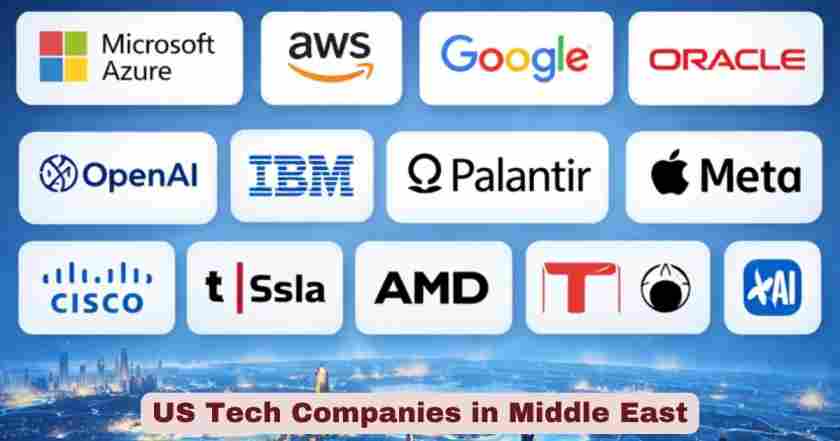
The Middle East has transformed from a region historically defined by oil wealth into one of the fastest-moving digital investment destinations on the planet — and US tech companies are at the absolute center of that shift. In 2026, the Gulf Cooperation Council (GCC) nations — led by the UAE and Saudi Arabia — have collectively positioned themselves as the world’s most aggressive buyers of American AI infrastructure, cloud computing capacity, and enterprise software. Gartner projects IT spending across the MENA region will hit $169 billion in 2026, an 8.9% increase from 2025, making this the most significant year yet in the region’s digital transformation story. Every major Silicon Valley name — from Microsoft and Google to Amazon, Nvidia, Oracle, OpenAI, Meta, Apple, IBM, Palantir, Cisco, and AMD — now has either active offices, operational cloud regions, multi-billion dollar investment commitments, or all three, spread across UAE, Saudi Arabia, Qatar, Bahrain, Israel, Kuwait, and Oman.
What makes 2026 a genuinely watershed moment is the sheer scale and speed of commitment. President Trump’s first major international trip of his second term was a Gulf states tour of Saudi Arabia, Qatar, and the UAE, where he unveiled a sweeping wave of tech investments alongside the CEOs of Tesla, Amazon, OpenAI, Nvidia, AMD, and Palantir — a lineup that signals how deeply US national policy and Silicon Valley commercial strategy have become intertwined across the region. From Microsoft’s $15.2 billion UAE commitment to the 10-square-mile OpenAI Stargate campus rising in Abu Dhabi and AWS’s $5.3 billion Saudi Arabia data center investment, the list of US tech companies in the Middle East in 2026 represents the most concentrated overseas technology bet in Silicon Valley’s history, driven by sovereign wealth capital, ambitious Vision 2030 mandates, and the Gulf’s determination to become a global AI hub.
Interesting Facts: US Tech Companies in the Middle East 2026 | At a Glance
| Fact | Detail |
|---|---|
| MENA IT spending forecast (2026) | $169 billion (Gartner) |
| Year-on-year MENA IT spending growth | 8.9% increase from 2025 |
| Trump’s Gulf tech delegation (May 2025) | CEOs of Tesla, Amazon, OpenAI, Nvidia, AMD, Palantir accompanied President on Gulf tour |
| Microsoft total UAE investment commitment (2023–2029) | $15.2 billion |
| Microsoft UAE spend in first 3 years | $7.3 billion total; $4.6 billion on AI & cloud data centers |
| Microsoft investment in G42 (UAE AI firm) | $1.5 billion |
| Microsoft Saudi Arabia East cloud region launch | Q4 2026 — Eastern Province, 3 availability zones |
| AWS Saudi Arabia investment | $5.3 billion — new region launching 2026 |
| AWS UAE Economic Impact (IDC study) | $5 billion (AED 20.1B); supports avg 5,984 full-time jobs/year over 15 years |
| Google Cloud + PIF (Saudi Arabia) AI hub | $10 billion joint partnership with HUMAIN |
| AMD + Humain (Saudi Arabia) partnership | $10 billion |
| Nvidia Blackwell GPUs sent to Saudi Arabia | 18,000 of its most advanced Blackwell chips (Humain deal) |
| OpenAI Stargate UAE campus size | 10 square miles in Abu Dhabi, 5 GW planned total capacity |
| Stargate UAE initial cluster (2026) | 200 MW cluster expected online in 2026 |
| Saudi Arabia total AI investment pipeline (Q1 2026) | Over $20 billion across public and private channels |
| Saudi Arabia Hexagon data center deal | $2.7 billion, 480 MW — largest single AI infrastructure deal in MENA history |
| Saudi Arabia data center capacity (Q1 2025) | 222 MW IT power; plans to add 760 MW by 2030 |
| Saudi Arabia National Data Center Strategy total | 1.9 GW by 2030, 3.4 GW by 2034; $77 billion total investment |
| Saudi Arabia data center market CAGR (2024–2030) | 29% compound annual growth rate |
| Nvidia R&D employees in Israel | ~6,000 — largest Nvidia R&D hub outside the US |
| UAE ranking in MENA data center IT power (Sep 2025) | #1 in the Middle East |
| Nationwide ChatGPT Plus access for all residents | UAE — first country in the world to offer this nationally |
Source: Gartner, Microsoft, AWS/IDC, Google Cloud, Data Center Dynamics, S&P Global, Middle East Insider, Stargate LLC Wikipedia, Digitimes, Crowell & Moring
The facts above reveal just how deeply intertwined US tech company presence has become with the Gulf’s sovereign economic ambitions. The combination of $169 billion in regional IT spending, $15.2 billion from Microsoft alone, a $10 billion Google–PIF partnership, and a $5.3 billion AWS commitment makes the Middle East the single largest overseas AI infrastructure build-out any Western government has enabled in a single investment cycle. The 10-square-mile Stargate UAE campus being developed in Abu Dhabi — co-built by OpenAI, Oracle, Nvidia, Cisco, and SoftBank — will, when complete, be the largest AI data center facility outside the United States. These are not speculative projections; most began construction before the end of 2025, with the 200 MW initial cluster confirmed to come online this year.
What sets 2026 apart from any prior year is the convergence of American corporate ambition with Gulf sovereign capital at a scale that has no modern precedent. The UAE’s Stargate campus, the Saudi Arabia Hexagon data center at 480 MW, and the simultaneous AWS and Microsoft Saudi Arabia cloud region launches all happening in the same calendar year represent a coordinated digital infrastructure sprint that transforms the Gulf from a market into a platform. The $20 billion+ Saudi AI investment pipeline and the 29% CAGR in Saudi data center capacity confirm this is a structural shift, not a cyclical boom. And the fact that the UAE now gives all its residents free nationwide ChatGPT Plus access — the first country in the world to do so — shows just how completely American AI technology has been woven into Gulf national identity and policy.
Full List of US Tech Companies in the Middle East 2026 | Company-by-Company Overview
| US Tech Company | Middle East Presence | Key Countries | Notable 2025–2026 Commitment |
|---|---|---|---|
| Microsoft | Azure cloud regions, offices, G42 partnership | UAE, Saudi Arabia, Qatar, Israel, Kuwait (planned) | $15.2B UAE investment (2023–2029); Saudi Arabia East region Q4 2026 |
| Amazon (AWS) | Cloud regions in Bahrain, UAE, Israel; Saudi region 2026 | Bahrain, UAE, Israel, Saudi Arabia | $5.3B Saudi Arabia; $1B e& cloud deal (UAE) |
| Google (Alphabet) | Cloud regions in Saudi Arabia (Dammam), Qatar (Doha), Israel; offices in UAE | Saudi Arabia, Qatar, UAE, Israel | $10B AI hub with PIF/HUMAIN |
| Nvidia | Engineering & R&D center (Tel Aviv); offices in Dubai | Israel, UAE, Saudi Arabia | 18,000 Blackwell GPUs to Saudi Arabia; ~6,000 R&D staff in Israel |
| Oracle | Cloud regions in Jeddah (2020) and Riyadh (2024); offices across GCC | Saudi Arabia, UAE, Israel, Qatar | $1.5B+ Saudi investment; co-partner in Stargate UAE |
| OpenAI | Stargate UAE campus (Abu Dhabi); nationwide ChatGPT Plus in UAE | UAE, Saudi Arabia | 10 sq mile, 5 GW Stargate UAE; ChatGPT Plus for all UAE residents |
| AMD | Strategic AI partnerships in Saudi Arabia | Saudi Arabia | $10B Humain partnership; up to 6 GW of Instinct GPUs |
| Cisco | Network infrastructure across GCC; Stargate UAE co-partner | UAE, Saudi Arabia, Qatar, Bahrain | Co-building Stargate UAE with OpenAI, Oracle, Nvidia |
| IBM | Offices and cloud/AI services across Israel, UAE, Saudi Arabia | Israel, UAE, Saudi Arabia | Enterprise AI and government cloud deployments across Gulf |
| Palantir | Main MENA office in Tel Aviv; enterprise and government AI | Israel, UAE | Defense and enterprise AI contracts across the region |
| Meta | Regional offices in Dubai; advertising and AI infrastructure | UAE, Saudi Arabia | Regional ad platform and AI product expansion |
| Apple | Retail stores (Dubai Mall, Abu Dhabi Mall); regional commercial operations | UAE, Saudi Arabia | Flagship retail expansion; fast-growing Gulf consumer market |
| Tesla | Showrooms, service centers, 30+ Supercharger stations across Gulf | UAE, Saudi Arabia, Qatar | January 2026: mass Cybertruck delivery event — 63 units in Dubai Al Marmoom desert |
| xAI (Elon Musk) | Planned 500 MW data center in Saudi Arabia | Saudi Arabia | Collaboration with HUMAIN near Riyadh; Nvidia hardware and systems |
| Qualcomm | MoU with HUMAIN; semiconductor design center planned in Saudi Arabia | Saudi Arabia | AI data centers + Saudi semiconductor ecosystem development |
| Dell | Enterprise hardware, IT solutions and managed services | UAE, Saudi Arabia, Qatar | Enterprise IT deployments supporting Vision 2030 digital transformation |
| HP | Enterprise IT, printing solutions, commercial presence | UAE, Saudi Arabia, Qatar | Major enterprise client base across Gulf governments and corporates |
| Intel | Chip supply and R&D partnerships | Israel, UAE | R&D collaboration in Israel; chip supply underpinning Gulf AI deployments |
| SAP | Cloud computing data centers in Riyadh and Dammam | Saudi Arabia | Launched Riyadh and Dammam data centers supporting Saudi digital transformation |
Source: Microsoft, AWS, Google Cloud, Data Center Dynamics, S&P Global, Stargate LLC Wikipedia, Middle East Insider, Data Center Knowledge, Digitimes, Crowell & Moring
The breadth of the US tech company footprint in the Middle East in 2026 spans virtually every tier of the technology stack — from semiconductor design (Qualcomm, Intel, Nvidia, AMD) to cloud infrastructure (AWS, Microsoft Azure, Google Cloud, Oracle), AI platforms (OpenAI, IBM, Palantir), enterprise software (SAP, Dell, HP), and consumer hardware and services (Apple, Tesla, Meta). What is striking is how recent most of this presence actually is: Amazon launched its Bahrain cloud region in 2019, making the entire Gulf hyperscale footprint less than a decade old. In that window, the region went from having virtually no US hyperscale infrastructure to hosting over 8 active US cloud regions with 4 more confirmed for launch by end-2026.
The diversity of this list also reflects the strategic depth of the Gulf’s AI ambitions. This is not simply a data center story. Tesla holds mass Cybertruck delivery events in the Dubai desert and operates 30+ Supercharger stations across the Emirates, Saudi Arabia, and Qatar. Apple runs flagship retail stores in the Dubai Mall and Abu Dhabi Mall. Palantir operates defense and enterprise AI contracts from Tel Aviv. Qualcomm is building a semiconductor design center to nurture local Saudi engineering talent. And AMD, through its $10 billion Humain deal, is sending up to 6 gigawatts of Instinct GPU capacity into the Kingdom’s AI ecosystem. The UAE and Saudi Arabia in 2026 are not just customers of what Silicon Valley produces — they are active co-investors in what comes next.
US Tech Investment Statistics in the Middle East 2026 | Money & Scale
| Company / Initiative | Investment Amount | Country | Source |
|---|---|---|---|
| Microsoft UAE total commitment (2023–2029) | $15.2 billion | UAE | Microsoft / Reuters |
| Microsoft UAE AI & cloud data centers (deployed) | $4.6 billion | UAE | Microsoft (Nov 2025) |
| Microsoft total UAE spending (first 3 years) | $7.3 billion | UAE | Microsoft |
| Microsoft investment in G42 | $1.5 billion | UAE | Microsoft |
| Microsoft + Du data center in Dubai | $544 million | UAE | Data Center Dynamics |
| Microsoft UAE next-3-year investment target | $15 billion | UAE | Digitimes |
| AWS Saudi Arabia investment | $5.3 billion | Saudi Arabia | AWS / CIO / Bloomberg |
| AWS UAE Economic Impact (IDC, 15-year estimate) | $5 billion (AED 20.1B) | UAE | IDC / AWS |
| AWS + e& cloud agreement (6-year deal) | $1 billion | UAE | Data Center Dynamics (Feb 2026) |
| Google Cloud + PIF / HUMAIN AI Hub | $10 billion | Saudi Arabia | Google / Crowell & Moring |
| AMD + Humain partnership | $10 billion | Saudi Arabia | CSIS / Middle East Insider |
| Oracle Saudi Arabia investment | Over $1.5 billion | Saudi Arabia | Digitimes |
| Stargate UAE (OpenAI, Oracle, Nvidia, Cisco, SoftBank) | 5 GW planned; 200 MW initial cluster 2026 | UAE | Stargate LLC Wikipedia |
| Saudi Arabia AI investment pipeline (Q1 2026) | Over $20 billion | Saudi Arabia | Middle East Insider |
| Saudi Arabia Hexagon data center | $2.7 billion, 480 MW | Saudi Arabia | Middle East Insider |
| Saudi Arabia National Data Center Strategy total | $77 billion by 2034 | Saudi Arabia | Digitimes / S&P Global |
| xAI Saudi Arabia data center (HUMAIN) | 500 MW | Saudi Arabia | Data Center Knowledge (Dec 2025) |
| Five largest US hyperscalers combined 2026 global capex | $660–$690 billion | Global (incl. ME) | Futurum Group |
Source: Microsoft, AWS, Google Cloud, Futurum Group, Digitimes, Data Center Dynamics, Middle East Insider, Stargate LLC Wikipedia, Crowell & Moring, S&P Global, Data Center Knowledge
The dollar figures in this table make it impossible to overstate the financial scale of the US tech bet on the Middle East in 2026. Microsoft alone is committing $15.2 billion to the UAE over six years — more than many sovereign nations receive in total annual foreign direct investment — and had already deployed $7.3 billion of that by end-2025, including $4.6 billion specifically on AI and cloud data centers. AWS is bringing $5.3 billion to Saudi Arabia for a single new cloud region, while Google Cloud and the Saudi PIF are jointly investing $10 billion in a dedicated AI hub with HUMAIN. AMD’s $10 billion Humain deal and Oracle’s $1.5 billion+ Saudi commitment round out a picture in which the top US tech companies collectively represent well over $50 billion in committed Middle East capital in this investment cycle alone.
What makes these numbers even more remarkable is the speed of deployment. Microsoft had already spent $7.3 billion of its $15.2 billion UAE commitment within the first three years — a pace that significantly exceeds original projections. The five largest US hyperscalers — Microsoft, Amazon, Alphabet, Meta, and Oracle — are collectively spending $660–690 billion in global capital expenditure in 2026, roughly 60% higher than 2025 levels, with the Middle East representing one of the most strategically prioritized expansion markets in that entire budget. The Saudi Arabia National Data Center Strategy, targeting $77 billion in total investment and 3.4 GW of capacity by 2034, provides the long-term contractual demand signal that justifies every dollar being committed today — and explains why every major US cloud company is racing to launch its Saudi region before 2026 ends.
Cloud Regions & Data Center Presence of US Tech Companies 2026 | Infrastructure Map
| Company | Active Cloud Regions | Upcoming / Planned | Key Locations |
|---|---|---|---|
| Microsoft Azure | UAE North, UAE Central, Qatar Central, Israel Central | Saudi Arabia East (Q4 2026), Kuwait (planned) | Dubai, Abu Dhabi, Doha, Tel Aviv, Eastern Province |
| Amazon Web Services | Bahrain (2019), UAE (2022), Israel (2023) | Saudi Arabia (2026) | Manama, Dubai/Abu Dhabi, Tel Aviv, Riyadh |
| Google Cloud | Saudi Arabia – Dammam (2023), Qatar – Doha | Kuwait, UAE under active discussion | Dammam, Doha, Tel Aviv |
| Oracle Cloud | Jeddah (2020), Riyadh (2024) | Ongoing expansion | Jeddah, Riyadh, Abu Dhabi |
| OpenAI (Stargate UAE) | Under construction | 200 MW initial cluster online 2026 | Abu Dhabi |
| SAP | Riyadh data center, Dammam data center | Further Gulf expansion | Riyadh, Dammam |
| IBM | Enterprise cloud and AI deployments | Expanding government contracts | Jerusalem, Tel Aviv, Abu Dhabi |
| xAI | Planned | 500 MW Saudi facility | Near Riyadh |
Source: Microsoft Azure global regions, AWS global infrastructure, Google Cloud, Data Center Dynamics, S&P Global, Stargate LLC Wikipedia, Data Center Knowledge
The concentration of US cloud infrastructure in the Middle East by 2026 is remarkable by any historical measure. What began with AWS launching the region’s first hyperscale cloud in Bahrain in 2019 has, in just seven years, expanded into a full multi-vendor cloud ecosystem spanning at least 8 active US cloud regions, with 4 more confirmed or likely to launch by end-2026. The UAE alone hosts or is developing infrastructure from Microsoft Azure (two active regions), AWS, OpenAI’s Stargate campus, Oracle, Cisco, IBM, and SAP — making Abu Dhabi and Dubai the most hyperscaler-dense commercial territory outside the United States. The fact that 85% of Bahrain’s government data has already migrated to the AWS Bahrain Region underscores how completely Gulf governments have trusted American cloud providers with their sovereign digital infrastructure — a level of dependency that no other foreign technology partner has achieved.
The upcoming Microsoft Saudi Arabia East region — a three-availability-zone cluster in the Kingdom’s Eastern Province, with construction completed in late 2024 and a confirmed Q4 2026 go-live — will bring Microsoft’s global footprint to 70 regions across 33 countries. Combined with AWS’s Saudi Arabia region also launching in 2026, the Kingdom is about to receive simultaneous market entries from the world’s two largest cloud providers in a single calendar year. Google Cloud’s Dammam region has been active since November 2023, and Oracle runs active cloud zones in both Jeddah and Riyadh, meaning that by the end of 2026, Saudi Arabia will have become the most US-cloud-serviced new market in the entire Middle East — a transformation built entirely on Vision 2030’s digital sovereignty goals and the sovereign wealth capital to back them up.
Saudi Arabia US Tech Hub Statistics 2026 | Kingdom Data
| Metric | Data | Source |
|---|---|---|
| Saudi Arabia data center IT power capacity (Q1 2025) | 222 MW | S&P Global |
| Planned data center capacity addition by 2030 | +760 MW to existing base | S&P Global |
| Saudi Arabia National Data Center Strategy (2030 target) | 1.9 GW | Digitimes |
| Saudi Arabia National Data Center Strategy (2034 target) | 3.4 GW | Digitimes |
| Total investment in Saudi data center strategy | $77 billion | Digitimes / S&P Global |
| Data center market CAGR (2024–2030) | 29% compound annual growth rate | S&P Global |
| Saudi Arabia total AI investment pipeline (Q1 2026) | Over $20 billion | Middle East Insider |
| Hexagon data center (largest single deal in MENA) | $2.7 billion, 480 MW | Middle East Insider |
| Humain (PIF AI firm) US tech chip deals | AMD ($10B), Nvidia (18,000 Blackwell GPUs), xAI (500 MW facility) | Middle East Insider / DCK |
| Google Cloud Dammam region launch | November 2023 | Google Cloud |
| Google Cloud economic impact projection by 2030 | $109 billion boost to Saudi economy | Google Cloud / Access Partnership |
| Saudi SMEs supported by Google Cloud Dammam | 1.2 million SMEs | Google Cloud |
| Oracle Saudi Arabia cloud regions | 2 — Jeddah (2020), Riyadh (2024) | S&P Global |
| AWS Saudi Arabia cloud region launch | 2026 | AWS |
| Microsoft Saudi Arabia East cloud region launch | Q4 2026 | Data Center Dynamics |
| Mandatory US tech HQ requirement | Yes — Amazon, Google, Microsoft required to establish Saudi-based HQ (2024 deadline) | Bloomberg / S&P Global |
| Saudi data center water requirement (2024) | 15 billion liters annually for cooling | S&P Global |
| Qualcomm semiconductor design center | Planned to develop local Saudi semiconductor engineering talent | Crowell & Moring |
Source: S&P Global, Digitimes, Middle East Insider, Google Cloud, Data Center Dynamics, Crowell & Moring, Data Center Knowledge, AWS, Microsoft
Saudi Arabia in 2026 is executing the most ambitious AI and cloud infrastructure build-out of any single country outside the United States — and the scale of US tech company involvement in that build-out is extraordinary. The Kingdom’s Vision 2030 program has turned technology investment into a sovereign policy priority, including a mandatory regional HQ requirement that forced Amazon, Google, and Microsoft to establish Saudi-based operations or risk losing government contracts. The $20 billion+ AI investment pipeline, the $2.7 billion Hexagon data center covering 480 MW of capacity, the $10 billion Google Cloud–PIF AI hub with HUMAIN, and the $5.3 billion AWS commitment all represent US companies not just entering a new market but co-building the foundational infrastructure of a Vision 2030 economy. Google Cloud alone projected its Dammam region would deliver a $109 billion economic impact to Saudi Arabia by 2030, supporting 1.2 million SMEs across the Kingdom.
The Humain initiative, launched by Saudi Arabia’s Public Investment Fund (PIF) in May 2025, has become the single most powerful deal-making engine for US tech in the entire region. Within months of launch, Humain had signed agreements with AMD ($10 billion), Nvidia (18,000 Blackwell GPUs), xAI (500 MW data center near Riyadh), and Google Cloud ($10 billion AI hub) — a deal concentration that no single entity anywhere in the world matched in 2025. The 29% CAGR in Saudi data center capacity and the target of 3.4 GW by 2034 confirm this is not a short-cycle investment boom but a generational infrastructure commitment. For every major US tech company — from cloud hyperscalers to semiconductor firms and AI platform providers — Saudi Arabia in 2026 represents the most capital-rich, high-conviction, government-backed market opportunity on the planet.
UAE US Tech Hub Statistics 2026 | Emirates Data
| Metric | Data | Source |
|---|---|---|
| UAE ranking in MENA data center IT power (Sep 2025) | #1 in the Middle East | S&P Global |
| Microsoft UAE total investment commitment (2023–2029) | $15.2 billion | Microsoft |
| Microsoft UAE AI infrastructure allocation | $10.1 billion specifically for AI infrastructure | Digitimes |
| Microsoft UAE spending in first 3 years | $7.3 billion (of which $4.6B on AI & cloud) | Microsoft (Nov 2025) |
| Microsoft investment in G42 | $1.5 billion | Microsoft |
| Microsoft + Du data center (Dubai) | $544 million | Data Center Dynamics |
| OpenAI Stargate UAE campus | 10 square miles, 5 GW total planned capacity | Stargate LLC Wikipedia |
| Stargate UAE initial cluster (2026) | 200 MW expected online in 2026 | Digitimes |
| Stargate UAE announcement date | May 16, 2025 (Nvidia, Cisco, OpenAI); May 22, 2025 (G42, Oracle, SoftBank added) | Stargate LLC Wikipedia |
| Stargate UAE co-partners | OpenAI, Oracle, Nvidia, Cisco, SoftBank, G42, MGX | Stargate LLC Wikipedia |
| Nationwide ChatGPT Plus access | All UAE residents — first country globally | Crowell & Moring |
| G42 (UAE state AI firm) US partners | Microsoft, OpenAI, Oracle, Nvidia, Cisco, SoftBank | Stargate LLC Wikipedia / Microsoft |
| AWS UAE Region (active) | 2022 launch — 3 availability zones | AWS |
| AWS UAE economic impact (IDC, 15-year) | $5 billion (AED 20.1B); avg 5,984 jobs/year | IDC / AWS |
| Bahrain government data on AWS | 85% of government data migrated since 2019 | AWS |
| Microsoft Azure active UAE cloud regions | 2 (UAE North, UAE Central) | Microsoft Azure |
| Tesla Supercharger stations in UAE | 30+ across Emirates | Electrek |
| Apple flagship retail presence | Dubai Mall, Abu Dhabi Mall | Market knowledge |
Source: Microsoft, AWS, IDC, Stargate LLC Wikipedia, Digitimes, Crowell & Moring, Data Center Dynamics, Electrek, S&P Global
The UAE’s position as the #1 Middle East data center market in 2026 is the product of a decade of deliberate policy and sovereign investment — and US tech companies have been the primary beneficiaries and architects of that strategy. The G42 partnership model is the UAE’s signature approach: using its state-backed AI firm as the local anchor for mega-deals with Microsoft ($1.5 billion), OpenAI (Stargate UAE campus), Oracle, Nvidia, and Cisco, which collectively produce the largest planned AI campus outside the United States — a 10-square-mile, 5 GW facility in Abu Dhabi. That campus, announced in May 2025 and with its 200 MW initial cluster expected online in 2026, represents a physical landmark of the UAE’s intent to become the global south’s AI infrastructure hub. The unprecedented policy of granting all UAE residents free nationwide ChatGPT Plus access — the first country in the world to do so — is the most visible public expression of how completely the Emirates has embedded American AI technology into national life.
Microsoft’s UAE commitment deserves particular attention for what it reveals about the depth of US tech involvement in the Emirates. The company has not just built data centers — it has invested $1.5 billion directly into G42, the UAE’s primary state AI vehicle, and allocated $10.1 billion of its $15.2 billion total commitment specifically to AI infrastructure. The $544 million data center in Dubai with local telco Du, the two active Azure cloud regions (UAE North and UAE Central), and the ongoing AI buildout all reflect a company treating the UAE not as a foreign market but as a core strategic geography. With the AWS UAE region operational since 2022, Oracle maintaining a strong Gulf presence, and Tesla running 30+ Supercharger stations across the Emirates, the full breadth of the US tech presence in the UAE stretches from hyperscale AI infrastructure right down to every major mall and highway corridor in the country.
Disclaimer: This research report is compiled from publicly available sources. While reasonable efforts have been made to ensure accuracy, no representation or warranty, express or implied, is given as to the completeness or reliability of the information. We accept no liability for any errors, omissions, losses, or damages of any kind arising from the use of this report.