
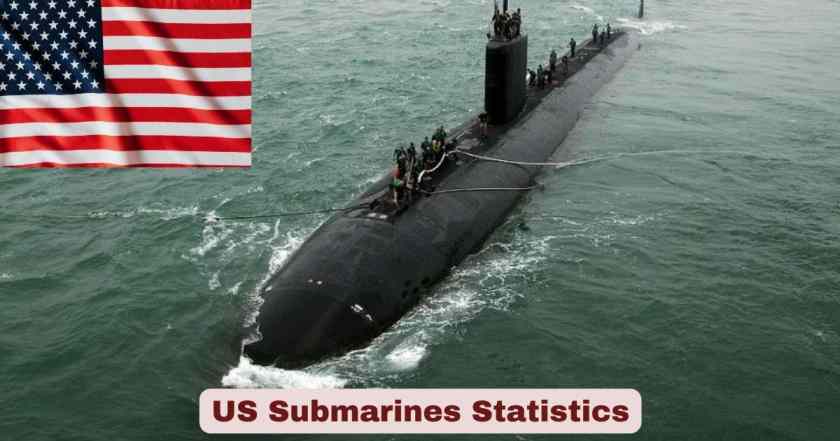
Submarines in America 2026
The United States Navy submarine force is the most capable, most technologically advanced, most geographically distributed, and — as of March 4, 2026 — most recently combat-proven undersea warfare capability on earth, comprising 69 active nuclear-powered submarines operating across every ocean simultaneously without surfacing for weeks or months at a time, conducting missions ranging from the silent nuclear deterrence patrol of an Ohio-class ballistic missile submarine (SSBN) beneath the Arctic ice, to the precision Tomahawk cruise missile strike of a Virginia-class Block V in a contested littoral zone, to the classified intelligence-gathering operations of USS Jimmy Carter (SSN-23) — the dedicated special-mission boat extended by 100 feet specifically for missions no other submarine in any navy can perform. The fleet is organized across four active classes: the Virginia-class (SSN) — the U.S. Navy’s newest and most capable attack submarines, with 24 boats active and representing the world’s most numerous submarine class since July 2025; the Los Angeles-class (SSN) — 34 boats in commission per Congressional Research Service data, progressively retiring as Virginias deliver; the Seawolf-class (SSN) — just 3 boats, each costing approximately $3–3.5 billion and built to defeat the most capable adversary submarines ever envisioned; the Ohio-class — 14 SSBNs constituting the survivable sea leg of the nuclear triad plus 4 SSGNs each configured to carry 154 Tomahawk cruise missiles in their converted missile tubes.
The Columbia-class (SSBN-826), the Navy’s single highest acquisition priority since 2013, is under construction at General Dynamics Electric Boat in Groton, Connecticut and HII Newport News Shipbuilding — with lead boat USS District of Columbia (SSBN-826) now 65% complete, pressure hull projected complete by end of 2026, launch in 2027, and delivery in 2028 per Rear Admiral Todd Weeks, Program Executive Officer Strategic Submarines, speaking at the 2026 WEST conference in February. Every submarine in the United States Navy is nuclear-powered — the last U.S. diesel-electric submarine, USS Blueback (SS-581), was decommissioned in October 1990 — making the United States the only major naval power that operates an exclusively nuclear-powered submarine force, a strategic choice that gives every boat in the fleet unlimited range, endurance measured in months rather than days, and a sustained underwater speed no diesel-electric adversary can match. The Department of Defense deploys up to 70% of the nation’s nuclear warheads on SSBNs — confirming the nuclear submarine as the backbone of American strategic deterrence — while the attack submarine fleet provides the conventional strike, intelligence, anti-submarine, and special operations capabilities that make the submarine force indispensable across the full spectrum of military operations.
On March 3–4, 2026, a United States fast-attack submarine ended an 81-year gap in American combat torpedo history. Defense Secretary Pete Hegseth told the world: “An American submarine sunk an Iranian warship that thought it was safe in international waters. Instead, it was sunk by a torpedo. Quiet death. The first sinking of an enemy ship by a torpedo since World War Two.” Chairman of the Joint Chiefs Gen. Dan Caine provided the operational verdict: “For the first time since 1945, a United States Navy fast attack submarine has sunk an enemy combatant ship using a single Mark 48 torpedo to achieve immediate effect, sending the warship to the bottom of the sea. This is an incredible demonstration of America’s global reach. To hunt, find and kill an out-of-area deployer is something that only the United States can do at this type of scale.” The target was the Iranian Moudge-class frigate IRIS Dena (hull 75) — a 1,500-ton warship armed with anti-ship missiles, SAMs, torpedoes, and a helicopter — sunk with a single MK-48 ADCAP torpedo in the Indian Ocean approximately 40 nautical miles south of Galle, Sri Lanka, in waters the crew believed were thousands of miles from danger. 87 Iranian sailors were confirmed dead, 32 rescued, approximately 61 missing.
The strike was part of Operation Epic Fury — the joint U.S.-Israeli campaign against Iran commencing February 28, 2026 — and also marked the first time the war expanded into the U.S. 7th Fleet area of responsibility, confirming that the American submarine force’s operational reach in 2026 extends from the Eastern Mediterranean to the deepest Indian Ocean simultaneously. The identity of the attacking boat has not been publicly disclosed. The U.S. Department of Defense released periscope footage of the strike — the first such real-time combat footage of an American torpedo engagement ever made public — showing the IRIS Dena’s stern lifted clear of the water by the keel detonation before the ship broke apart and sank. Gen. Caine also confirmed that by March 4, 2026, U.S. forces had destroyed more than 20 Iranian naval vessels — including IRIS Dena, one Iranian submarine, the drone carrier Shahid Bagheri, and the forward base ship IRIS Makran — effectively neutralizing Iran’s major naval presence in theater in less than one week of combat operations.
US Submarines 2026 — Key Facts
| # | US Submarines Key Fact | Details |
|---|---|---|
| 1 | 69 Active Nuclear-Powered Submarines — 100% Nuclear Force | The U.S. Navy operates 69 nuclear-powered submarines (GlobalMilitary.net, 2026 fleet data) — 14 SSBNs, 4 SSGNs, and ~51 SSNs — the only exclusively nuclear-powered submarine force operated by any major naval power, with the last U.S. diesel-electric boat retired October 1990 |
| 2 | US Fast-Attack Sub Sinks IRIS Dena with Single MK-48 — First Torpedo Kill Since 1945 | On March 3, 2026, a U.S. Navy fast-attack submarine fired a single MK-48 ADCAP torpedo sinking the Iranian frigate IRIS Dena in the Indian Ocean — confirmed by Defense Secretary Hegseth and Gen. Dan Caine — the first U.S. torpedo combat kill since USS Torsk on August 14, 1945 |
| 3 | 20+ Iranian Naval Vessels Destroyed in Operation Epic Fury by March 4, 2026 | Gen. Dan Caine confirmed at the March 4 Pentagon briefing that U.S. forces destroyed more than 20 Iranian naval vessels — including IRIS Dena, an Iranian submarine, Shahid Bagheri, and IRIS Makran — “effectively neutralized Iran’s major naval presence in theater” |
| 4 | Virginia-class: 24 Active — World’s Most Numerous Submarine Class | The Virginia-class became the most numerous submarine class in the world following the decommissioning of USS Helena (SSN-725) on July 25, 2025 — with 24 active boats, more than any other single submarine class operated by any navy globally |
| 5 | Ohio-Class SSGNs: 4 Boats × 154 Tomahawks = 616 TLAMs Total Strike Capacity | The four Ohio-class SSGNs (USS Ohio, Florida, Michigan, Georgia) each carry up to 154 Tomahawk cruise missiles in 22 converted missile tubes — a combined capacity of up to 616 TLAMs, more than any other single platform type in the U.S. inventory — retiring by ~2028 |
| 6 | Columbia-Class: 65% Complete — Pressure Hull Complete by End 2026 — Delivery 2028 | Per Rear Adm. Todd Weeks at WEST 2026 (February 2026): USS District of Columbia (SSBN-826) is ~65% complete, with pressure hull complete projected by end of 2026, launch 2027, and delivery 2028 — enabling first deterrent patrol by 2030–2031 |
| 7 | 70% of US Nuclear Warheads Deployed on SSBNs — Sea Leg is Primary Deterrent | The U.S. Department of Defense deploys up to 70% of the nation’s nuclear warheads on SSBNs (CRS Report R41129) — confirming the submarine fleet as the single most critical component of the American nuclear triad, ahead of both land-based ICBMs and bombers |
| 8 | Virginia Block V VPM Triples Tomahawk Capacity: 12 → 40 Missiles Per Boat | Virginia-class Block V submarines include the 84-foot Virginia Payload Module (VPM) adding four large-diameter tubes carrying 7 Tomahawks each (28 additional) — increasing total Tomahawk capacity from 12 to 40 per boat, triple the earlier standard per CRS Report RL32418 |
| 9 | Navy’s SSN Force Goal: 66 Attack Submarines — Currently ~17 Short | The U.S. Navy’s preferred force level requires 66 attack submarines (SSNs) but has only ~49 SSNs in service as of FY2026 start — approximately 17 boats short of requirement — a gap driven by Los Angeles-class retirements outpacing Virginia-class deliveries |
| 10 | Seawolf-Class: 3 Boats — $3–3.5 Billion Each — Most Capable SSNs Ever Built | The 3 Seawolf-class submarines (USS Seawolf SSN-21, Connecticut SSN-22, Jimmy Carter SSN-23) are each estimated at $3–3.5 billion — the most expensive attack submarines ever built — with USS Jimmy Carter extended 100 feet to 453 feet for classified special missions |
| 11 | Columbia-Class: 12 Boats, $126.4 Billion Total — SSBN-826 Alone $15.2 Billion | The 12-ship Columbia-class program carries a total procurement cost of $126.4 billion (FY2025 budget estimate, CRS R41129) — with lead boat USS District of Columbia alone costing $15.2 billion including non-recurring design costs — Navy’s top acquisition priority since 2013 |
| 12 | Ohio-Class Retirements Begin 2027 — First SSBN-730 Leaves Service | Per CRS official data, the first Ohio-class SSBN to retire — hull SSN-730 — leaves service in 2027, with plans to retire one per year following; the Navy needs Columbia-class ready by early 2031 to avoid falling below the 10 operationally available SSBNs required by STRATCOM |
| 13 | Virginia-class Block V: $4.3 Billion Per Boat at 2-Per-Year Production — CRS July 2023 | CRS reported in July 2023 that the cost per Virginia-class Block V boat equipped with VPM is $4.3 billion at the current production rate of approximately 2 boats per year — a cost that reflects both the VPM addition and continued industrial base challenges |
| 14 | AUKUS: Australia Buys 3–5 Virginia-Class SSNs from ~2032 — Trump Confirmed Oct 2025 | President Trump publicly reaffirmed on October 20, 2025 the transfer of Virginia-class nuclear-powered attack submarines to Australia under AUKUS — Australia will receive 3–5 Block IV boats between 2032–2035 while building its own SSN-AUKUS boats alongside the UK |
| 15 | SSN(X) Next-Generation Attack Submarine: CBO Estimates $5.5 Billion Per Hull | The SSN(X) program — planned successor to Virginia-class — is estimated by the Congressional Budget Office at up to $5.5 billion per hull, described in CRS as “faster, stealthier, and able to carry more torpedoes than Virginia-class, similar in size to the Seawolf-class” — no delivery date yet established |
Source: U.S. Navy Fact Files – SSN, SSBN, SSGN (navy.mil); Congressional Research Service Report RL32418 – Navy Virginia-Class Submarine Program and AUKUS (updated January 26, 2026, fas.org/sgp/crs); Congressional Research Service Report R41129 – Navy Columbia (SSBN-826) Class Ballistic Missile Submarine Program (congress.gov/crs); USNI News – “Navy Says Columbia-class Sub Construction Schedule Improving” (news.usni.org, February 11, 2026, citing Rear Adm. Todd Weeks at WEST 2026); 19FortyFive (19fortyfive.com, January–February 2026); General Dynamics Electric Boat – Virginia-class (gdeb.com); Submarine Industrial Base Council – Virginia-class (submarinesuppliers.org); Columbia-class.com – SSBN page (columbia-class.com); Military Times (militarytimes.com, March 4, 2026); Fox News (foxnews.com, March 4, 2026); Wikipedia – Virginia-class submarine (updated March 4, 2026); Wikipedia – Submarines in the United States Navy (updated November 2025); GlobalMilitary.net – United States Navy 2026 (globalmilitary.net); National Security Journal (nationalsecurityjournal.org, August 2025); Army Recognition – Virginia-class (armyrecognition.com, April 2025)
These 15 US submarine key facts for 2026 define an undersea force simultaneously proving its combat supremacy and navigating the most consequential generational transition in submarine history. The IRIS Dena sinking closes 81 years of American torpedo combat history while the Columbia-class construction milestone — pressure hull complete by end of 2026 — opens the next chapter of nuclear deterrence. The Virginia-class becoming the world’s most numerous submarine class and the Block V VPM tripling Tomahawk capacity together confirm that the U.S. attack submarine force is growing in both numbers and individual lethality simultaneously, even as the 17-boat SSN shortfall against the stated 66-boat requirement remains a persistent force structure tension that Congress has funded additional production to address. The 4 Ohio SSGNs carrying 616 combined TLAMs represent strike capacity that will not be replaced on a one-for-one basis when they retire by 2028 — the CRS explicitly notes that the Navy needs twenty VPM-equipped Block V boats to compensate for the SSGN strike capacity loss — giving the Virginia-class Block V program urgency that goes far beyond normal attack submarine procurement cycles.
The 70% of U.S. nuclear warheads deployed on SSBNs is the strategic architecture fact that makes Columbia-class construction delays so operationally consequential. STRATCOM requires 10 operationally available SSBNs at all times — and currently needs 14 Ohio-class boats to maintain that 10-boat availability, because aging maintenance requirements can take up to 4 Ohio boats offline simultaneously. The Columbia-class is designed with improved maintenance cycles that will allow just 12 boats to provide 10 operationally available SSBNs, but that efficiency only matters if the boats exist. Rear Adm. Weeks’ February 2026 statement that the District of Columbia is 65% complete with delivery now projected for 2028 is the most credible recent public assessment, and it represents a modest recovery from the worst delays — but it still means the lead Columbia-class submarine will not begin its first deterrent patrol until approximately 2030–2031, with the critical 2027 Ohio retirement window approaching.
US Submarines 2026 — Fleet Class-by-Class Statistics
| Class | Type | Active (2026) | Home Ports | Key Capability | Retirement Timeline |
|---|---|---|---|---|---|
| Virginia-class (SSN-774) | Fast-attack SSN | 24 active | Groton CT, Pearl Harbor HI, Norfolk VA, Bremerton WA | Multi-mission SSN — ASW, ASUW, land attack, ISR, SOF; Block V adds 40 TLAMs | Service life: 33 years per hull; production continues through 2040s |
| Los Angeles-class (SSN-688) | Fast-attack SSN | ~27 active (CRS: 34 in commission; some in extended maintenance) | Pearl Harbor HI, Groton CT, Norfolk VA, Bremerton WA | Cold War-era backbone; 12-VLS or 2 large payload tubes (688i); 25 Mk-48s | Phased retirement ongoing; final boats retire late 2020s–early 2030s |
| Seawolf-class (SSN-21) | Fast-attack SSN | 3 active | Bremerton WA (SSN-21, SSN-22); Bremerton WA (SSN-23 — special missions) | 8 × 26-inch torpedo tubes; 50 weapons; quietest SSN ever built; Jimmy Carter: 453 ft special mission | No planned retirement — low-density high-demand asset |
| Ohio-class SSBN (SSBN-726) | Ballistic missile submarine | 14 active | Bangor WA (Blue/Gold crews × 8 boats); Kings Bay GA (× 6 boats) | 20 × Trident II D5 SLBMs; sea leg of nuclear triad; 70% of US warheads | First SSBN-730 retires 2027; one per year thereafter through ~2040 |
| Ohio-class SSGN (SSGN-726) | Guided missile submarine | 4 active | Bangor WA; Kings Bay GA; Bremerton WA | 154 × Tomahawk TLAMs each; special forces; 2 SEAL lockout chambers | All 4 retiring by ~2028 — 40-year service life maximum |
| Columbia-class (SSBN-826) | Ballistic missile submarine | 0 active — under construction | Will homeport: Bangor WA and Kings Bay GA | 16 × Trident II D5 SLBMs per boat; electric drive propulsion; X-form stern | Lead boat delivery 2028; first patrol 2030–2031; full 12-boat fleet by 2042 |
| TOTAL | All classes | ~69 submarines | Atlantic + Pacific + forward deployments | Nuclear deterrence + global precision strike + ISR | Net fleet slightly declining short-term; growing post-2030 |
Source: U.S. Navy Fact File – Fleet Ballistic Missile Submarines SSBN (navy.mil, November 13, 2023); U.S. Navy Fact File – Attack Submarines SSN (navy.mil); CRS Report R41129 – Columbia-class (congress.gov/crs); CRS Report RL32418 – Virginia-class (fas.org/sgp/crs, January 26, 2026); Columbia-class.com – SSBN page; Wikipedia – Los Angeles-class submarine; Wikipedia – Seawolf-class submarine; Wikipedia – Ohio-class submarine; GlobalMilitary.net – United States Navy 2026; USNI News (news.usni.org, February 11, 2026)
The US submarine fleet class-by-class statistics map a force in profound transition across every single class simultaneously — a coincidence of timing that has no precedent in American naval history. The Virginia-class is ramping up but producing at only ~1.2 boats per year against a target of 2.2 per year needed to simultaneously meet domestic requirements and AUKUS commitments. The Los Angeles-class is retiring at a pace that has repeatedly threatened to open a “trough” in total SSN numbers below acceptable minimums — a trough that the CRS has flagged in multiple reports as a strategic risk. The Ohio SSGNs are retiring by 2028, taking 616 combined Tomahawks out of the inventory at a moment when the Virginia Block V VPM program is still building its second boat. The Ohio SSBNs are beginning retirement in 2027, creating the countdown clock that makes the Columbia-class delivery timeline so operationally non-negotiable. And the Seawolf-class — just 3 boats, irreplaceable, operating at persistent high-tempo — is being worked harder than any other submarine class in the fleet simply because there are no other submarines that can do what they do.
The two builder arrangement for Virginia-class — General Dynamics Electric Boat in Groton, Connecticut and HII Newport News Shipbuilding in Newport News, Virginia — is not merely an industrial preference but a strategic decision to maintain two independent nuclear submarine construction capabilities in the United States, ensuring that damage to one yard cannot eliminate the nation’s ability to build nuclear submarines. The teaming agreement under which EB and HII split construction of each Virginia-class boat — with EB responsible for the forward hull, torpedo room, and combat systems while HII builds the aft hull, engine room, and propulsion — means each shipyard builds components of every boat, maintaining skills across both yards simultaneously. This approach, confirmed in GD EB’s official Virginia-class program documentation, has been central to achieving the production efficiencies that drove the Virginia-class program’s record of delivering boats under budget and ahead of schedule in its earlier blocks — a record that the Columbia-class has not yet been able to replicate.
US Submarines 2026 — Virginia-Class Technical Specifications
| Specification | Block I–II (SSN-774 to 783) | Block III–IV (SSN-784 to 801) | Block V (SSN-802+) — VPM |
|---|---|---|---|
| Block Numbers | I (4 boats): SSN-774–777; II (6): SSN-778–783 | III (8): SSN-784–791; IV (10): SSN-792–801 | V (FY2019–FY2023): SSN-802+ |
| Length | 377 ft (114.9 m) | 377 ft (114.9 m) | 461 ft (140.5 m) — +84 ft VPM |
| Beam | 34 ft (10.4 m) | 34 ft (10.4 m) | 34 ft (10.4 m) |
| Displacement (submerged) | 7,800 tons | 7,800 tons | 10,200 tons (+30%) |
| Propulsion | S9G PWR nuclear reactor; pump-jet propulsor; 1 shaft | Same | Same |
| Speed | 25+ knots submerged | 25+ knots | 25+ knots |
| Operating Depth | Greater than 800 ft — classified exact | Same | Same |
| Crew | 132–135 (15 officers, 117 enlisted) | 132–135 | ~135 |
| Service Life | 33 years | 33 years | 33 years |
| Torpedo Tubes | 4 × 21-inch (533mm) amidships | Same | Same |
| Torpedoes Carried | ~25 × MK-48 ADCAP | ~25 MK-48 | ~25 MK-48 |
| Vertical Launch — Bow | 12 × VLS tubes (Tomahawk) (Block I–II) | 2 × large-diameter Virginia Payload Tubes (12 TLAMs) (Block III+) | 2 × large-diameter bow tubes + VPM |
| VPM Payload Tubes | None | None | 4 × large-diameter VPM tubes |
| TLAMs Total Capacity | 12 Tomahawks | 12 Tomahawks | 40 Tomahawks (12 bow + 28 VPM) |
| Tomahawk Increase (vs Block I) | Baseline | Same | +233% (+28 missiles) |
| Other Weapons | Harpoon (early), Mk 60 CAPTOR mines, advanced mobile mines, UUVs | Same | Same + LDUUV capability |
| Sonar — Bow | AN/BQQ-10 spherical + conformal arrays | AN/BQQ-10 enhanced | AN/BQQ-10 with improvements |
| Sonar — Hull | Wide-aperture array (WAA) | WAA | WAA |
| Sonar — Towed | TB-16 + TB-29 | TB-16 + TB-29 | TB-16 + TB-29 |
| Photonics Masts | 2 × AN/BVS-1 photonics masts (no traditional periscope) | Same | Same |
| Key Feature | First US sub with no traditional periscope; modular construction | Redesigned bow; large-diameter payload tubes | VPM — 84-ft hull addition; 40 TLAMs; LDUUV capable |
| Hull Material | HY-100 steel with anechoic tiles | Same | Same |
| Unit Cost | ~$2.0–2.4 billion | ~$2.8 billion (FY2019 CRS estimate) | ~$4.3 billion (CRS July 2023 estimate at 2/year rate) |
| Builders | GD Electric Boat + HII Newport News | Same | Same |
| First VPM Milestone | — | — | USS Oklahoma (SSN-802) — pressure hull complete December 2025 |
Source: CRS Report RL32418 – Navy Virginia-Class Submarine Program (fas.org/sgp/crs, January 26, 2026); General Dynamics Electric Boat – Virginia-class (gdeb.com); Submarine Industrial Base Council – Virginia-class (submarinesuppliers.org); U.S. Navy Fact File – Attack Submarines (navy.mil); Army Recognition – Virginia-class SSN-774 (armyrecognition.com, April 2025); The National Interest – Block V (nationalinterest.org, November 2024); 19FortyFive – Block V (19fortyfive.com, January 2026); Wikipedia – Virginia-class submarine (updated March 4, 2026)
The Virginia-class technical specifications confirm a submarine that has been systematically enhanced across six successive block designs to address every major capability gap identified in operational feedback over two decades. The Block III redesign’s replacement of the 12-cell bow VLS with two large-diameter payload tubes was specifically driven by fleet experience showing that the two Virginia Payload Tubes — using the same Multiple All-Up-Round Canister (MAC) technology as the Ohio SSGNs — provided greater operational flexibility with the same 12 Tomahawk capacity at lower construction cost. The Block V’s 84-foot VPM addition is the most structurally dramatic change in the class’s history: inserting a new pressure hull section into an existing submarine design is an engineering challenge that required separate VPM structural testing, modified construction sequencing, and agreement between both builder yards on how to integrate the new section into their respective construction processes. The fact that USS Oklahoma (SSN-802) achieved pressure hull complete status in December 2025 — the milestone that confirms all major hull sections are fully joined into a single watertight structure — is the most concrete recent evidence that Block V production is now executing at full industrial tempo.
The complete elimination of the traditional periscope in Block I and carried forward through all blocks is an operational choice whose implications extend far beyond the engineering decision that enabled it. A traditional periscope penetrates the pressure hull — creating a structural vulnerability, a maintenance demand, and an operational constraint that forces the submarine to approach close enough to the surface for the periscope to reach above water. The AN/BVS-1 photonics masts introduced in the Virginia-class use CCD and infrared cameras on retractable masts that penetrate the hull with a much smaller cross-section and transmit imagery electronically to displays anywhere inside the submarine. The operators never need to look through the mast — they watch flat-panel displays that show exactly what the cameras see, in color and infrared simultaneously. This apparently small technical decision has strategic implications: it allows the Virginia-class to conduct periscope-depth operations with far less exposure time than periscope-equipped submarines, reducing detectability at exactly the moment when the submarine is closest to the surface and therefore most vulnerable to ASW forces.
US Submarines 2026 — Operation Epic Fury & Combat Statistics
| Detail | Data | Source |
|---|---|---|
| Operation Name | Operation Epic Fury (US) — commenced February 28, 2026 | CENTCOM official |
| First US Torpedo Kill Since WWII | March 3, 2026 — single MK-48 torpedo, fast-attack SSN, IRIS Dena sunk in Indian Ocean | Pentagon briefing, March 4, 2026 |
| Target | IRIS Dena (hull 75) — Moudge-class frigate, 1,500 tons | USNI News; Naval News; Military Times |
| Strike Location | ~40 nautical miles south of Galle, Sri Lanka — Indian Ocean | Wikipedia – Sinking of IRIS Dena; Al Jazeera |
| Weapon | Single MK-48 ADCAP heavyweight torpedo | Gen. Dan Caine — Pentagon press briefing |
| Attacking Platform | U.S. Navy fast-attack submarine (SSN) — identity withheld for OPSEC | Hegseth; Caine; Pentagon |
| Area of Responsibility | U.S. 7th Fleet (INDOPACOM) — first expansion of Epic Fury to 7th Fleet AOR | USNI News |
| Effect | “Immediate effect, sending the warship to the bottom of the sea” | Gen. Caine — Pentagon |
| Hegseth Quote | “Quiet death. The first sinking of an enemy ship by a torpedo since World War Two.” | Military Times; Fox News, March 4, 2026 |
| Caine Quote | “To hunt, find and kill an out-of-area deployer is something that only the United States can do at this type of scale.” | USNI News; ABC News, March 4, 2026 |
| Casualties | 87 bodies recovered, 32 rescued, ~61 missing | Sri Lanka Navy; Al Jazeera; USNI News |
| DoD Footage Released | Yes — periscope/photonics mast infrared footage showing stern detonation and sinking | The War Zone; U.S. Department of Defense X account |
| Total Iranian Naval Vessels Destroyed | 20+ confirmed by Gen. Caine at March 4 Pentagon briefing | Gen. Caine — Pentagon; USNI News |
| Other Vessels Confirmed Sunk | Iranian submarine, Shahid Bagheri (drone carrier), IRIS Makran (forward base ship), additional IRGCN vessels | Gen. Caine; USNI News; Army Recognition |
| Last US Torpedo Kill Before 2026 | USS Torsk (SS-423) — Japanese escort Kaibokan No. 13 — August 14, 1945 | Military.com; Wikipedia |
| Gap Between Kills | 81 years | Calculated — Aug 14, 1945 to March 3, 2026 |
| Historical Distinction | First guided torpedo SSN kill of a surface warship; only second SSN torpedo kill ever (after HMS Conqueror/ARA Belgrano 1982 — used unguided Mk 8) | USNI News; The War Zone |
Source: U.S. Central Command (centcom.mil); Pentagon press briefing — Defense Secretary Pete Hegseth and Gen. Dan Caine (March 4, 2026); Military Times (militarytimes.com, March 4, 2026); USNI News (news.usni.org, March 4, 2026); Fox News (foxnews.com, March 4, 2026); ABC News (abcnews.com, March 4, 2026); Military.com (military.com, March 4, 2026); The War Zone (twz.com, March 4, 2026); Al Jazeera (aljazeera.com, March 4, 2026); Wikipedia – Sinking of IRIS Dena (updated March 4, 2026)
The Operation Epic Fury combat statistics for the U.S. submarine force are, in their historical context, the most significant performance data generated by any U.S. military asset in a single week since the opening of the Iraq War in 2003. The sinking of more than 20 Iranian naval vessels in less than one week — including a frigate, a submarine, a drone carrier, and a forward base ship — represents the systematic dismantling of an entire regional naval force by a combination of submarine torpedoes, air-launched anti-ship missiles, and surface-ship fires. But it is the single MK-48 torpedo in the Indian Ocean that carries the greatest strategic weight, because of what it communicates to every adversary navy that operates surface combatants anywhere in the world: there is no ocean in which you are safe from an American fast-attack submarine, and when the engagement comes, you will likely not know it is happening until the weapon has already detonated beneath your keel. The IRIS Dena was thousands of miles from any conflict zone when she was struck — she had just completed a multilateral naval exercise with 74 nations’ fleets in India and was transiting home. The submarine that sank her was in position, tracking, with a firing solution, before the Iranian crew had any reason to believe they were in danger.
Gen. Caine’s characterization — “to hunt, find and kill an out-of-area deployer is something that only the United States can do at this type of scale” — is simultaneously a factual assessment of current capability and a strategic communication to every navy that might consider deploying warships far from home waters in a future conflict with the United States. The phrase “at this type of scale” is the critical qualifier: the United States does not have one submarine capable of this; it has 69, operating simultaneously across every ocean, tracked and coordinated by the Commander, Submarine Force Atlantic (SUBLANT) and Commander, Submarine Force Pacific (SUBPAC) under the broader operational authority of U.S. Fleet Forces Command. The IRIS Dena sinking is therefore not merely a tactical event — it is a demonstration, conducted at operational scale and confirmed on the Pentagon podium by the two most senior military officials in the United States government, of what the American submarine force can do wherever and whenever it is authorized to act.
US Submarines 2026 — Columbia-Class & Future Programs Statistics
| Program / Milestone | Data | Source |
|---|---|---|
| Program Name | Columbia-class (SSBN-826) — successor to Ohio-class SSBNs | CRS R41129 |
| Total Boats Planned | 12 submarines | CRS R41129; navy.mil |
| Primary Builder | General Dynamics Electric Boat (lead); HII Newport News Shipbuilding (partner) | CRS; GD EB |
| Total Program Cost | $126.4 billion (FY2025 budget estimate) | CRS R41129 |
| Lead Boat Cost (SSBN-826) | $15.2 billion including non-recurring engineering/design | CRS R41129 |
| Follow-on Boat Cost (est.) | ~$8.7 billion per hull (remaining 11 boats) | CRS R41129 |
| Lead Boat Status (March 2026) | ~65% complete — Rear Adm. Todd Weeks, WEST 2026 conference, February 11, 2026 | USNI News, February 11, 2026 |
| Pressure Hull Complete | Projected end of 2026 | 19FortyFive (February 2026); USNI News |
| Launch Date | 2027 | 19FortyFive; USNI News |
| Delivery Date | 2028 | Rear Adm. Weeks — WEST 2026 (USNI News) |
| First Deterrent Patrol | FY2031 (Q1 FY2031) — required to ensure 10 operationally available SSBNs | CRS R41129; columbia-class.com |
| Second Boat (SSBN-827) Status | ~35% complete | 19FortyFive, February 2026 |
| Third Boat (USS Groton, SSBN-828) | Ramping up — earlier stages of construction | 19FortyFive, February 2026 |
| Full Serial Production | Projected 2031 | 19FortyFive |
| SLBMs per Boat | 16 × Trident II D5 missiles (vs. 24 on Ohio-class; 4 tubes disabled on Ohio under START) | CRS R41129; navy.mil |
| Propulsion | Electric drive — quieter than Ohio’s gear-driven system | CRS; Wikipedia |
| Ohio SSBN Retirement | First (SSBN-730) retires 2027; one per year thereafter; final Ohio retires ~2040 | columbia-class.com; CRS |
| STRATCOM Minimum | 10 operationally available SSBNs required at all times | CRS R41129; columbia-class.com |
| SSN(X) — Next SSN | CBO estimate: up to $5.5 billion per hull — “faster, stealthier, more torpedoes than Virginia, similar size to Seawolf” | CRS IF11826; 19FortyFive |
| FY2026 NDAA | Authorizes up to 5 Columbia-class under block-buy contract | Army Recognition (armyrecognition.com, October 2025) |
Source: Congressional Research Service Report R41129 – Navy Columbia (SSBN-826) Class Ballistic Missile Submarine Program (congress.gov/crs); USNI News – “Navy Says Columbia-class Sub Construction Schedule Improving” (news.usni.org, February 11, 2026 — citing Rear Adm. Todd Weeks at WEST 2026 conference); 19FortyFive (19fortyfive.com, February 2026); columbia-class.com – SSBN page; Army Recognition – NDAA FY2026 Columbia (armyrecognition.com, October 2025); CRS In Focus IF11826 – SSN(X)
The Columbia-class and future programs statistics frame the most critical capability investment decision the U.S. Navy is making in the 2020s — one where delay is not merely an inconvenience but a potential gap in strategic nuclear deterrence. The STRATCOM requirement for 10 operationally available SSBNs is not negotiable: it represents the minimum number of submarines at sea simultaneously needed to guarantee that the United States can deliver a survivable nuclear retaliatory strike against any adversary under any circumstances, even if a nuclear attack destroyed every land-based ICBM and every strategic bomber simultaneously. The fact that it takes 14 Ohio-class boats to maintain 10 operationally available ones — because aging maintenance requirements regularly sideline up to 4 boats — gives the Columbia-class’s 12-boat design (providing 10 available) a crucial industrial efficiency: it will achieve the same operational availability with 2 fewer hulls, because the electric drive propulsion and improved maintenance planning will dramatically reduce the frequency and duration of overhauls relative to the Ohio class.
Rear Adm. Weeks’ February 2026 WEST conference statement that the program is “improving” and that the District of Columbia’s pressure hull will be complete by end of 2026 is the most recent official optimism on a program that has faced consistent criticism from the Government Accountability Office, Congressional overseers, and independent analysts for schedule slippage and cost growth. The turbine generator delays from Northrop Grumman and bow section challenges at HII Newport News that drove earlier slippage have been the subject of intense Navy-contractor negotiation and additional manufacturing investment. The FY2026 NDAA’s authorization of up to 5 Columbia-class boats under block-buy contracting — passed by a 77-20 Senate vote on October 10, 2025 — gives the program the multi-boat contracting authority that is essential for managing long-lead material and labor commitments at both shipyards. The $126.4 billion total program cost is enormous in isolation; in the context of maintaining an assured second-strike capability that protects the United States and its allies from nuclear coercion for the next 50 years, it is the single most cost-effective investment in national security that any government could make.
Disclaimer: This research report is compiled from publicly available sources. While reasonable efforts have been made to ensure accuracy, no representation or warranty, express or implied, is given as to the completeness or reliability of the information. We accept no liability for any errors, omissions, losses, or damages of any kind arising from the use of this report.