
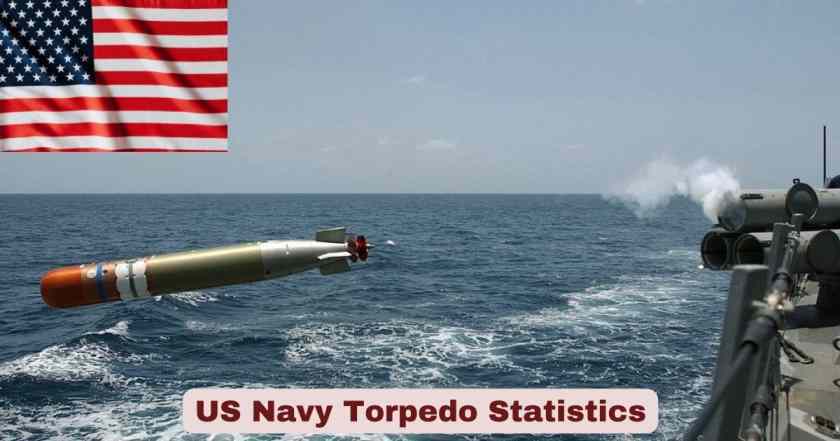
What Is US Navy Torpedo ?
The United States Navy torpedo is one of the most technically sophisticated, most feared, and — as of March 4, 2026 — most historically consequential underwater weapon in modern naval warfare, having just achieved the first confirmed torpedo sinking of an enemy warship since World War II when a U.S. Navy fast-attack submarine launched a single Mark 48 heavyweight torpedo into the hull of the Iranian frigate IRIS Dena in the Indian Ocean off the coast of Sri Lanka, sending a 1,500-ton warship to the bottom of the sea and confirming in one devastating strike that the American submarine force’s primary weapon remains as operationally decisive in 2026 as it was in the Pacific campaigns of 1942–1945. The U.S. Navy operates three primary torpedo systems in its active inventory: the Mark 48 Mod 7 ADCAP CBASS heavyweight torpedo — a 21-inch (533mm), 19-foot, 3,520-pound submarine-launched weapon manufactured by Lockheed Martin that is the sole offensive torpedo of every U.S. attack and ballistic missile submarine; the Mark 54 Lightweight Hybrid Torpedo (LHT) — a 12.75-inch (324mm) anti-submarine warfare weapon launched from surface ships, P-8A Poseidon aircraft, and MH-60R Sea Hawk helicopters, developed by Raytheon (now RTX) and currently being upgraded under a $808.6 million General Dynamics Mission Systems contract for the Mod 1 variant; and the legacy Mark 46 Mod 5 — still in limited inventory as the Mk 54’s production predecessor, being progressively replaced and converted to Mk 54 standard through conversion kit programs.
Together, these three systems form the complete U.S. Navy underwater weapons spectrum: the heavyweight Mk 48 for submarine-versus-submarine and submarine-versus-surface engagements at ranges of up to 38 miles; the Mk 54 for helicopter, aircraft, and surface ship anti-submarine warfare at up to 15,000 meters in shallow and deep water; and the Mk 46 still providing transition-period ASW coverage from legacy platforms being phased out. Every torpedo in the U.S. Navy inventory uses acoustic homing guidance — combining passive acoustic detection (listening for target noise), active sonar pinging (transmitting and receiving acoustic pulses to track position), and wire guidance (for the Mk 48, allowing submarine operators to remotely steer the weapon in real time until the wire is cut for autonomous terminal homing) — in a multi-layer guidance architecture that makes these weapons extremely difficult to deceive with countermeasures.
On March 4, 2026, U.S. Secretary of War Pete Hegseth and Chairman of the Joint Chiefs of Staff General Dan Caine stood at the Pentagon podium and confirmed to the world that an American fast-attack submarine had sunk the Moudge-class Iranian frigate IRIS Dena (hull number 75) with a single Mark 48 torpedo in the Indian Ocean — approximately 20 nautical miles south of Galle, Sri Lanka. Hegseth called it a “quiet death” — the characteristic description of how the Mark 48 works: launched with minimal acoustic signature, tracking at high speed through thousands of feet of ocean, detonating beneath the target’s hull to create a massive gas bubble that lifts the ship and breaks its keel, sending it to the bottom before any countermeasure can be deployed. General Caine confirmed the weapon was a single Mark 48 torpedo, that it achieved “immediate effect, sending the warship to the bottom of the sea,” and that as of the March 4 briefing, U.S. forces had sunk over 20 Iranian naval vessels since Operation Epic Fury began on February 28 — including the IRIS Dena, an Iranian submarine, the drone carrier Shahid Bagheri, and the forward base ship IRIS Makran. Sri Lanka’s navy confirmed 87 bodies recovered and 32 sailors rescued. The Pentagon released infrared periscope footage of the strike — a standard photonics mast recording showing the Mk 48’s underwater detonation lifting the IRIS Dena’s stern out of the water before the ship broke apart — the first such combat footage of an American torpedo strike ever publicly released in real time. It was the first U.S. torpedo sinking of an enemy vessel since World War II, the first time a guided torpedo fired from a nuclear-powered attack submarine has sunk a surface warship in combat anywhere in the world (HMS Conqueror’s sinking of ARA General Belgrano in 1982 used the older Mk 8 unguided torpedo), and the most consequential single submarine torpedo engagement since 1945.
US Navy Torpedo 2026 — Key Facts
| # | US Navy Torpedo Key Fact | Details |
|---|---|---|
| 1 | IRIS Dena Sunk by Single MK-48 Torpedo — First US Torpedo Kill Since WWII — March 4, 2026 | A U.S. Navy fast-attack submarine sank Iranian frigate IRIS Dena with a single Mark 48 torpedo in the Indian Ocean off Sri Lanka on March 3–4, 2026 — confirmed by Defense Secretary Pete Hegseth and Gen. Dan Caine at Pentagon — the first U.S. torpedo sinking of an enemy ship since World War II |
| 2 | “Quiet Death” — Hegseth’s Description of the MK-48 Strike | Defense Secretary Pete Hegseth called the Mark 48 torpedo strike a “quiet death” — referencing the weapon’s stealth launch from a submerged submarine that gave the IRIS Dena no warning before the detonation broke the ship’s keel and sent it to the bottom |
| 3 | Single MK-48 Sank a 1,500-Ton Warship Immediately — “Immediate Effect” | Gen. Dan Caine confirmed the single Mark 48 torpedo achieved “immediate effect, sending the warship to the bottom of the sea” — the IRIS Dena, a 1,500-ton Moudge-class frigate armed with anti-ship missiles, surface-to-air missiles, torpedoes, and a helicopter, was destroyed by one torpedo |
| 4 | MK-48 Has Speed of 55+ Knots in Attack Mode — Mach 0.085 Underwater | The Mark 48 ADCAP has a transport speed of approximately 55 knots — and can accelerate to a higher attack speed during terminal approach — making it faster than any surface ship or submarine it is targeting and functionally impossible to outrun |
| 5 | MK-48 Range: Up to 38 Miles (61 km) at Lower Speed | Published sources confirm the Mark 48’s operational range at up to 38 miles (61 km) at lower transit speeds — giving the launching submarine the ability to remain at safe standoff distance while the torpedo covers the full engagement envelope |
| 6 | MK-48 Warhead: 650-lb (295 kg) High Explosive — Designed to Break Keel, Not Just Penetrate Hull | The Mark 48’s 650-pound (295 kg) high explosive warhead is designed to detonate beneath the target’s hull, creating a massive gas bubble that lifts the ship and snaps the keel — a fundamentally more destructive mechanism than side-impact penetration; confirmed visible in Pentagon’s own IRIS Dena periscope footage |
| 7 | MK-48 Operational Since 1972 — 54 Years Continuous US Navy Service | The Mark 48 has been in continuous U.S. Navy service since 1972 — 54 years — making it the longest-serving primary offensive weapon of any major power’s submarine fleet, continuously upgraded through Mod 1 through Mod 7 CBASS variants |
| 8 | MK-48 Carried by ALL US Navy Submarines — Los Angeles, Virginia, Seawolf, Ohio | The Mark 48 ADCAP is the sole heavyweight torpedo carried by every single U.S. Navy submarine — Los Angeles-class, Virginia-class, Seawolf-class attack submarines, and even Ohio-class ballistic missile submarines for self-defense — approximately 50 submarines in total |
| 9 | US Navy Had 1,046 MK-48 ADCAP Torpedoes — Lockheed Producing ~50/Year in 2017 | The U.S. Navy inventory in 2001 stood at 1,046 Mk-48 torpedoes, with Lockheed Martin producing approximately 50 per year as of 2017 under the production and upgrade contract — program has been ongoing continuously since 1972 |
| 10 | MK-54 Mod 1 — $808.6 Million General Dynamics Contract — January 2025 | In January 2025, General Dynamics Mission Systems was awarded a contract worth up to $808.6 million to produce MK 54 Mod 1 Lightweight Torpedo Kits — the current generation lightweight torpedo upgrade program — with delivery across 2025–2029 |
| 11 | MK-54 Mod 2 SCEPS Propulsion Test Completed — L3Harris, August 1, 2025 | On August 1, 2025, L3Harris Technologies completed testing of the first energy module for the Stored Chemical Energy Propulsion System (SCEPS) powering the MK 54 Mod 2 Increment 2 — the next-generation lightweight torpedo propulsion system, with IOT&E planned 2027 |
| 12 | MK-54 Operators: India, Australia, Germany, South Korea, Netherlands, Canada, Norway | The MK 54 lightweight torpedo is exported to at least 12 nations including India, Australia, Germany ($300M for 80 torpedoes, Dec 2023), South Korea ($130M for 31 torpedoes, Jul 2022), Netherlands, Canada ($387M for 425 conversion kits, May 2019), and Norway (50 torpedoes) |
| 13 | US Sank 20+ Iranian Naval Vessels in Operation Epic Fury by March 4, 2026 | Gen. Dan Caine confirmed at the March 4 Pentagon briefing that U.S. forces had sunk or destroyed more than 20 Iranian naval vessels since Operation Epic Fury began Feb 28 — including IRIS Dena, an Iranian submarine, Shahid Bagheri, and IRIS Makran — “effectively neutralized Iran’s major naval presence in theater” |
| 14 | MK-48 Fires from 21-Inch Torpedo Tube — Wire-Guided Until Cut, Then Autonomous | The Mark 48 launches from standard 21-inch (533mm) submarine torpedo tubes and is connected to the submarine by a thin guidance wire during its run — the operator can steer in real time, update targeting, or abort — once the wire is cut the weapon switches to fully autonomous acoustic homing |
| 15 | MK-48 CBASS Mod 7 — 25,000+ High-Fidelity Simulation Runs — Optimized for Shallow and Deep Water | The MK 54 has undergone over 25,000 high-fidelity simulation runs at the Naval Undersea Warfare Center in Newport, Rhode Island — and the Mk 48 Mod 7 CBASS was specifically optimized for both deep-water and shallow-water environments including operations against diesel-electric submarines using advanced countermeasures |
Source: Fox News (foxnews.com, March 4, 2026 — Hegseth Pentagon briefing); Navy Times / Military Times (navytimes.com, March 4, 2026); The War Zone / TWZ (twz.com, March 4, 2026); USNI News (news.usni.org, March 4, 2026); Naval News (navalnews.com, March 4, 2026); Stars and Stripes (stripes.com, March 4, 2026); Times of Israel (timesofisrael.com, March 4, 2026); Lockheed Martin — 5 Fast Facts About the MK-48 (lockheedmartin.com, 2025); Wikipedia – Mark 48 torpedo (updated March 2026); Wikipedia – Mark 54 torpedo (updated October 2025); U.S. Navy Fact File – MK-48 (navy.mil); Army Recognition – MK-54 Mod 2 (armyrecognition.com, August 2025); Army Recognition – MK-54 GDMS Contract (armyrecognition.com, January 2025); Naval Technology – MK-54 (naval-technology.com); National Interest – MK-48 (nationalinterest.org); thetidesofhistory.com – MK-48 (July 2024)
These 15 US Navy torpedo key facts for 2026 are defined by a single historical event that changes the context of every other number in this article. The March 4, 2026 sinking of IRIS Dena is not simply the latest operational data point in a long record — it is the event that ends an 81-year gap in the U.S. Navy’s combat torpedo record, a gap that began on August 15, 1945 when the last Japanese ship was sunk by an American submarine torpedo in the final days of World War II. For eight decades, the Mark 48 and its predecessors sat in submarine torpedo rooms as the ultimate insurance policy — the weapon that no adversary could evade or survive if a U.S. submarine gained a firing solution, but a weapon whose combat use had never been tested against a real hostile warship since the propeller-driven piston submarines of the Pacific War. On March 4, 2026, that changed: a nuclear-powered fast-attack submarine, operating silently thousands of miles from any American base, launched a Mod 7 CBASS Mark 48 — a weapon with digital guidance systems, broadband sonar processing, and pump-jet propulsion that shares almost nothing with the Mk 14 steam-driven torpedoes of 1945 — and sent an Iranian frigate to the bottom in a single shot. Gen. Caine’s description — “immediate effect” — is the most clinically precise summary possible of what a 650-pound keel-breaking warhead does to a 1,500-ton warship.
The production and procurement statistics embed the combat event in its industrial context. 1,046 Mark 48 ADCAPs in the 2001 inventory, 50 produced per year by Lockheed in 2017, a 54-year continuous service history spanning Mod 1 through Mod 7 — and now, one of those torpedoes is at the bottom of the Indian Ocean, still embedded in the wreck of the IRIS Dena. The $808.6 million MK 54 Mod 1 contract awarded to General Dynamics in January 2025, the L3Harris SCEPS propulsion milestone of August 2025, and the planned MK 54 Mod 2 IOT&E in 2027 together confirm that the lightweight torpedo side of the U.S. Navy’s inventory is in active, well-funded development — ensuring that the MH-60R helicopters and P-8A Poseidons hunting submarines from surface ships and aircraft have weapons that are continuously improving against the most capable diesel-electric and nuclear submarines any adversary deploys.
US Navy Torpedo 2026 — Mark 48 ADCAP Full Technical Specifications
| Specification | MK-48 Mod 5 ADCAP (Baseline) | MK-48 Mod 6 ADCAP MODS | MK-48 Mod 7 CBASS (Current) |
|---|---|---|---|
| Designation | MK-48 ADCAP Mod 5 | MK-48 ADCAP Mod 6 (MODS) | MK-48 ADCAP Mod 7 CBASS |
| IOC Date | 1988 (ADCAP) | 1997 (Mod 6 IOC) | 2006 (Mod 7 IOC) |
| Manufacturer | Gould / Lockheed Martin | Lockheed Martin | Lockheed Martin |
| Diameter | 21 inches (533 mm) | 21 inches (533 mm) | 21 inches (533 mm) |
| Length | 19 feet (5.79 m) | 19 feet (5.79 m) | 19 feet (5.79 m) |
| Weight | ~3,434 lb (1,558 kg) | ~3,434–3,520 lb | ~3,520 lb (1,597 kg) |
| Warhead | 650 lb (295 kg) HBX-3 high explosive | 650 lb (295 kg) HE | 650 lb (295 kg) HE |
| Detonation Mode | Proximity (beneath hull) — keel-breaking | Proximity / contact | Proximity — beneath hull; creates gas bubble to break keel |
| Propulsion | Otto II liquid monopropellant — piston engine | Piston engine — reduced noise (TPU upgrade) | Pump-jet propulsor — ~15 rotor blades, 12 stator blades |
| Speed | 55+ knots (transport); higher attack speed | 55+ knots | 55+ knots |
| Range | Greater than 5 miles (official); up to 38 miles (61 km) published sources | Same | Same — up to 38 miles at low speed |
| Operating Depth | Greater than 1,200 ft (365 m) | Same | Same — exact depth classified |
| Guidance — Primary | Wire-guided + passive/active acoustic homing | Same | Same + CBASS broadband sonar |
| Guidance — Terminal | Active acoustic homing (2D phased array sonar) | Improved acoustic receiver | Active electronically steered “pinger” (2D phased array sonar) |
| Sonar System | Digital acoustic homing | MODS — improved noise isolation; advanced receiver | CBASS — Common Broadband Advanced Sonar System — wider frequency band; counter-countermeasures |
| Key Improvement (vs prior) | All-digital G&C; improved speed, depth, range | Reduced radiated noise; better acoustic receiver; more memory | Broadband processing; optimized for shallow water; diesel sub countermeasure defeat |
| Launch Mode | Standard 21-inch torpedo tube; compressed air or “swim out” | Same | Swim-out capability (quiet, under own power) |
| Wire Behavior | Wire dispenser on afterbody — operator steers; wire cut = autonomous | Same | Same |
| Autonomous Backup | If wire cut: active/passive acoustic homing | Same | Same |
| Targets | Fast, deep-diving submarines + high-performance surface ships | Same | Same |
| Submarines Carrying | All USN submarines — SSN + SSBN | Same | All USN submarines — ~50 hulls total |
| Export Operators | Australia, Canada, Netherlands | Same | Australia (Collins-class); Canada; Netherlands |
| Production Rate | Ongoing Lockheed production | ~50/year (2017 rate) | ~50/year; upgrades ongoing |
Source: U.S. Navy Fact File – MK-48 Heavyweight Torpedo (navy.mil); Wikipedia – Mark 48 torpedo (updated March 2026); Lockheed Martin – 5 Fast Facts About the MK-48 (lockheedmartin.com, 2025); The Tides of History – MK-48 Advanced Capabilities (thetidesofhistory.com, July 2024); nuclearcompanion.com – MK-48 (January 2025); National Interest – MK-48 (nationalinterest.org); FAS.org – MK-48 (man.fas.org); The War Zone (twz.com, March 4, 2026)
The Mark 48 Mod 7 CBASS technical specifications describe a weapon system whose external dimensions — 21-inch diameter, 19-foot length, 3,520 pounds — have remained essentially unchanged since the original Mk 48 entered service in 1972, but whose internal capabilities have been transformed across five decades of continuous upgrade into something that bears little operational resemblance to the original design. The choice to maintain the 21-inch (533mm) diameter across all Mk 48 variants is itself an engineering statement: the entire U.S. submarine fleet’s torpedo tubes, loading equipment, and handling systems are standardized to that dimension, meaning a capability upgrade that required a new diameter would also require a new fleet of submarines and handling systems. By keeping the external form factor constant, Lockheed Martin has been able to continuously improve the guidance electronics, propulsion system, warhead fuzing, sonar array, and software without disrupting the logistical infrastructure that supports 50 submarines carrying the weapon.
The CBASS (Common Broadband Advanced Sonar System) at the heart of the Mod 7 is the technical achievement that makes the torpedo effective against the most challenging modern target: a quiet diesel-electric submarine operating in shallow, acoustically complex littoral waters with deployed acoustic countermeasures. Where earlier Mk 48 variants were primarily optimized for deep-water operations against noisy nuclear submarines, the Mod 7’s broadband signal processing transmits and receives acoustic pulses across a much wider frequency range, applying broadband signal processing algorithms that can distinguish the target’s characteristic acoustic signature from background noise, false echoes, and deliberate countermeasures in environments where single-frequency narrowband sonar would be defeated. This capability was co-developed with the Royal Australian Navy under a 10-year Armaments Cooperative Project specifically because Australia — operating in the shallow, complex acoustic environment of the Indo-Pacific littoral — identified shallow-water diesel submarine defeat as its most demanding torpedo requirement. The IRIS Dena engagement on March 4, 2026 was conducted in deep ocean waters south of Sri Lanka — an environment where the Mk 48’s deep-water performance is at its most effective — validating in the most conclusive possible way that after 54 years of continuous service, the weapon can still destroy exactly what it was designed to destroy in a single shot.
US Navy Torpedo 2026 — Mark 54 Lightweight Torpedo Specifications
| Specification | MK-54 Mod 0 | MK-54 Mod 1 | MK-54 Mod 2 (Development) |
|---|---|---|---|
| IOC Date | 2004 | IOT&E update planned Q1 2026 | IOT&E planned 2027 |
| Formerly Known As | Lightweight Hybrid Torpedo (LHT) | — | — |
| Developer | Raytheon Integrated Defense Systems | General Dynamics Mission Systems (GDMS) | L3Harris (SCEPS propulsion) |
| Current Production Contract | — | $808.6M GDMS contract — January 2025 | SCEPS energy module tested August 2025 |
| Diameter | 12.75 inches (324 mm) | 12.75 inches | 12.75 inches |
| Length | 2.71 meters (8.9 ft) | Similar | Similar |
| Weight | 275.7 kg (608 lb) | Similar | TBD |
| Warhead | 43.9 kg (96.8 lb) high explosive | Enhanced | TBD |
| Propulsion | Legacy MK 46 propulsion (thermal — OTTO) | Upgraded propulsion | SCEPS — Stored Chemical Energy Propulsion System |
| Guidance — Inertial | TG-6000 inertial measurement unit | Updated IMU | Advanced IMU |
| Guidance — Acoustic | Active/passive acoustic homing — MK 50 sonar transceiver section | New sonar array + improved processing (Mod 1) | Advanced sonar |
| Counter-Countermeasure | COTS digital signal processing — distinguishes decoys from targets | Enhanced — advanced algorithms (GDMS) | Most advanced CCM to date |
| Simulation Testing | 25,000+ high-fidelity simulation runs (Naval Undersea Warfare Center, Newport, RI) | Continued | Ongoing |
| Launch Platforms | P-8A Poseidon, MH-60R Sea Hawk helicopter, surface ships (VLA/ASROC) | Same | Same |
| VLA (ASROC) Integration | IOC 2010 — launched from Mk 41 VLS on DDGs and CGs | Same | Same |
| Heritage Components | Sonar: MK 50 // Warhead + propulsion: MK 46 // Software: MK 48 ADCAP (PowerPC 603e) | Improved | Modernized |
| Key Capability | Deep and shallow water ASW; superior shallow-water vs Mk 46 | Better sonar; improved shallow water | Best-in-class shallow water + propulsion |
| Export Nations (confirmed) | India, Australia, UK (RAF P-8), Germany, South Korea, Netherlands, Canada, Brazil, Norway, New Zealand, Thailand | Same expanding | Same |
| Key Export Contracts 2022–2025 | Germany: $300M / 80 torpedoes (Dec 2023); South Korea: $130M / 31 torpedoes (Jul 2022); Canada: $387M / 425 conversion kits (May 2019) | GDMS Mod 1 export kits | TBD |
Source: U.S. Navy Fact File – MK-54 (navy.mil); Wikipedia – Mark 54 lightweight torpedo (updated October 2025); Naval Technology – MK-54 (naval-technology.com, August 2024); Army Recognition – MK-54 GDMS Contract (armyrecognition.com, January 2025); Army Recognition – MK-54 Mod 2 SCEPS (armyrecognition.com, August 2025); Naval News – GDMS MK-54 Contract (navalnews.com, January 2025); Raytheon / RTX – MK-54 (rtx.com); Military.com – MK-54; Wikipedia – Mark 54 export section
The Mark 54 Lightweight Torpedo’s technical architecture is one of the most pragmatic and cost-effective design decisions in U.S. naval weapons history. When the Navy evaluated its lightweight torpedo options in the late 1990s, it faced a painful choice: the MK 50 was highly capable but extremely expensive and optimized for deep-water nuclear submarine threats; the MK 46 was affordable and widely deployed but performed poorly in the shallow littoral environments where the post-Cold War threat increasingly lived — quiet diesel submarines hiding in the acoustic clutter of shallow coastal waters. The MK 54’s solution was to simply take the best component from each: the MK 50’s advanced sonar transceiver section (which the Navy had already paid to develop), the MK 46’s proven warhead and propulsion (which kept costs down), and wrap both in a modern commercial off-the-shelf digital signal processing architecture sharing software with the MK 48 ADCAP. The result is a torpedo that costs significantly less than the MK 50 while performing better than the MK 46 in the environments that matter most.
The $808.6 million General Dynamics Mod 1 contract of January 2025 and the L3Harris SCEPS propulsion milestone of August 2025 together map the MK 54’s development trajectory through the late 2020s: Mod 1 delivering improved sonar arrays and processing for the current fleet; Mod 2 introducing the Stored Chemical Energy Propulsion System that replaces the legacy MK 46 thermal propulsion with a modern high-energy propulsion unit developed in collaboration with Australia — a system that will give the next-generation MK 54 significantly improved speed, range, and reliability. The MK 54’s 12-nation export record — from the Royal Australian Navy’s P-8A Poseidons to Germany’s P-3C Orions and F126 frigates to India’s P-8Is — confirms that the lightweight torpedo is as much a coalition weapons standard as the MK 48 is a U.S.-exclusive heavyweight one. Every nation that buys a P-8A Poseidon effectively also buys the MK 54 to arm it — a procurement coupling that makes the torpedo’s export record almost directly traceable to the P-8’s own extraordinary export success.
US Navy Torpedo 2026 — Operation Epic Fury: IRIS Dena Sinking Statistics
| Detail | Data |
|---|---|
| Target Ship | IRIS Dena (hull 75) — Iranian Navy Moudge-class (Mowj-class) frigate |
| Target Displacement | 1,500 tons |
| Target Armament | 4 × Qader anti-ship missiles, 2 × Sayyad SAMs, 76mm main gun, 40mm gun, lightweight torpedoes, helicopter |
| Target Crew | 180 crew |
| Weapon Used | Single MK-48 heavyweight torpedo |
| Attacking Platform | U.S. Navy fast-attack submarine (SSN) — identity not disclosed (OPSEC) |
| Strike Date / Time | March 3, 2026 (Tuesday) — announced by Hegseth at Pentagon on March 4 (Wednesday) |
| Strike Location | Indian Ocean — approximately 20 nautical miles south of Galle, Sri Lanka |
| Confirmed by | Secretary of War Pete Hegseth + CJCS Gen. Dan Caine — Pentagon press briefing |
| Effect | “Immediate effect — sent the warship to the bottom of the sea” — Gen. Dan Caine |
| Iranian Crew Casualties | 87 bodies recovered; 32 rescued (critically wounded); 101+ missing (Sri Lanka navy) |
| Sri Lanka Role | First responder — Sri Lanka Navy conducted search and rescue; bodies recovered by two SL naval vessels |
| Pentagon Footage Released | Infrared periscope footage released by US Department of War (DeptofWar on X) showing large detonation at IRIS Dena’s stern |
| Historical Significance | First US torpedo sinking of an enemy ship since WWII (1945); first guided torpedo SSN kill ever; second ship sunk by SSN since HMS Conqueror / ARA Belgrano 1982 |
| Total Iranian Naval Vessels Destroyed (by March 4) | 20+ confirmed — including IRIS Dena, one Iranian submarine, Shahid Bagheri drone carrier, IRIS Makran forward base ship, 9+ additional vessels in Strait of Hormuz and Persian Gulf |
| Context — IRIS Dena’s Prior Activity | IRIS Dena had participated in India’s MILAN naval exercise in the Bay of Bengal until February 25 — was returning home through the Indian Ocean when sunk |
| Hegseth Quote | “An American submarine sunk an Iranian warship that thought it was safe in international waters. Instead, it was sunk by a torpedo. Quiet death. The first sinking of an enemy ship by a torpedo since World War Two.” |
Source: Fox News (foxnews.com, March 4, 2026); Navy Times / Military Times (navytimes.com, March 4, 2026); USNI News (news.usni.org, March 4, 2026); The War Zone / TWZ (twz.com, March 4, 2026); Naval News (navalnews.com, March 4, 2026); Stars and Stripes (stripes.com, March 4, 2026); Times of Israel (timesofisrael.com, March 4, 2026); Army Recognition (armyrecognition.com, March 4, 2026); Yahoo News / Washington Post live blog (yahoo.com, March 4, 2026); U.S. Department of War official X account (@DeptofWar)
The IRIS Dena sinking statistics capture a moment of rare operational clarity in undersea warfare — a domain that by its very nature operates in secrecy, with results rarely confirmed and almost never photographed in real time. The Pentagon’s decision to release the infrared periscope footage of the strike is an extraordinary act of institutional transparency: the world can see exactly what a Mark 48 torpedo strike against a surface warship looks like, in combat, against a real adversary. The footage shows the thermal signature of the IRIS Dena in the moments before impact, then the characteristic massive detonation at the stern — where the torpedo detonated beneath the hull — followed by the upward movement of the stern section as the gas bubble lifts the ship, and then the collapse as the keel breaks and the vessel loses structural integrity. This is the mechanism that Mk 48 engineers designed in the 1960s and have refined across six decades: not a penetration of the hull, but a void beneath the ship that the hull cannot bridge, created at detonation velocity that no ship can absorb intact.
The IRIS Dena’s prior activity adds an operational dimension to the data: she had been participating in India’s MILAN 2026 naval exercise in the Bay of Bengal through February 25 — a multilateral naval exercise involving dozens of nations — and was transiting back through the Indian Ocean toward Iranian home ports when she was struck. The distance from the Indian Ocean to the Persian Gulf is approximately 3,000 nautical miles — and the U.S. fast-attack submarine was already in position, already tracking, already with a firing solution, waiting for the authorization that came from the Pentagon on February 27 when President Trump gave the go order for Operation Epic Fury. The “quiet death” that Hegseth described was not improvised — it was the result of weeks of pre-positioning, continuous tracking, and the silent patience that defines submarine warfare at its most lethal. The 81-year wait for the first American torpedo combat kill since 1945 ended not with a massive fleet action but with a single, perfectly placed weapon, in the dark of the Indian Ocean, watched through a photonics mast by a crew that will be remembered as the first American submariners to send an enemy warship to the bottom since Harry Truman was president.
Disclaimer: This research report is compiled from publicly available sources. While reasonable efforts have been made to ensure accuracy, no representation or warranty, express or implied, is given as to the completeness or reliability of the information. We accept no liability for any errors, omissions, losses, or damages of any kind arising from the use of this report.