
US Navy Armada in 2026
The United States Navy maintains the most technologically advanced and combat-capable maritime fighting force on the planet as of 2026. With a battle force that represents over seven decades of continuous innovation and strategic maritime supremacy, the American naval armada serves as the cornerstone of global power projection and international security. The modern US Navy operates as the world’s preeminent blue-water fighting force, wielding capabilities that no other nation can match in terms of combined tonnage, technological sophistication, operational range, and sustained combat power. From nuclear-powered supercarriers that serve as floating air bases to stealth submarines prowling the ocean depths and advanced destroyers equipped with cutting-edge missile defense systems, the American fleet embodies military dominance across all domains of naval warfare.
As the United States navigates an increasingly complex global security environment in 2026, the Navy finds itself at a critical juncture of modernization and strategic reorientation. The service is transitioning from legacy Cold War platforms to next-generation warships while simultaneously confronting the reality of a rising Chinese naval power that now fields the world’s largest fleet by sheer number of hulls. The current American battle force comprises 293 ships as of January 2026, including 234 commissioned USS vessels and 59 USNS support ships operated by Military Sealift Command. This fleet carries the immense responsibility of maintaining freedom of navigation across the world’s strategic waterways, deterring aggression in the Indo-Pacific region, supporting NATO allies in European waters, and projecting American power to every corner of the globe. The Navy’s FY2026 budget request of $47.3 billion for new ship construction demonstrates the service’s commitment to maintaining qualitative superiority even as overall fleet numbers face downward pressure from decommissioning aging vessels faster than replacements enter service.
US Navy Armada in the US 2026: Interesting Facts and Latest Statistics
| Category | Verified Data |
|---|---|
| Total Battle Force Ships | 293 ships (234 USS commissioned, 59 USNS support vessels) |
| Active Aircraft Carriers | 11 nuclear-powered supercarriers (legally mandated minimum) |
| Destroyers and Cruisers | 89 surface combatants (approximately 72 destroyers, 17 cruisers) |
| Attack Submarines (SSN) | 50 Virginia-class and Los Angeles-class submarines |
| Ballistic Missile Submarines (SSBN) | 14 Ohio-class submarines (Columbia-class replacement beginning) |
| Amphibious Warfare Ships | 31 larger amphibious ships (10 LHA/LHD assault ships, 21 LPD/LSD transport docks) |
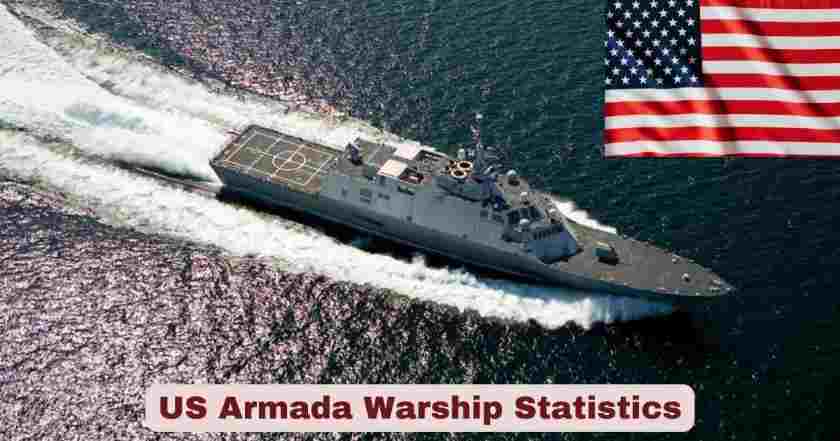
| Littoral Combat Ships | Over 30 LCS vessels (Freedom and Independence variants) |
| FY2026 Shipbuilding Budget | $47.3 billion for 19 new battle force ships |
| Planned Fleet Size FY2026 | 287 deployable battle force ships (down from 296 in early 2025) |
| Ships Under Construction/On Order | Over 95 new ships in planning, ordering, or construction stages |
| Currently Deployed Worldwide | 99 ships deployed (68 USS, 31 USNS) with 37 ships underway |
| Forward-Deployed Carrier | USS George Washington (CVN-73) homeported in Yokosuka, Japan |
| Numbered Fleets | 7 active numbered fleets (2nd, 3rd, 4th, 5th, 6th, 7th, 10th) |
| Total Personnel Capacity | Approximately 330,000+ sailors across active, reserve, and civilian workforce |
| Shipbuilding Industrial Base | 2 nuclear-capable shipyards (General Dynamics Electric Boat, HII Newport News) |
Data sources: USNI News Fleet Tracker, US Navy official records, Congressional Research Service, Department of Defense FY2026 budget documents, WDMMW.org, Wikipedia Naval Vessel Register (January 2026)
The warship statistics for the US Navy in 2026 reveal a force structure balancing global commitments against fiscal constraints and industrial capacity limitations. The total battle force of 293 ships represents the cumulative strength available to the fleet, though not all vessels are deployable simultaneously due to maintenance cycles, crew training requirements, and overhaul schedules. Of these, 99 ships are currently deployed around the world as of early January 2026, with 68 commissioned warships actively conducting operations in critical regions including the Western Pacific, Mediterranean Sea, Persian Gulf, and Caribbean. The 11 aircraft carriers represent the largest fleet of such vessels globally—China, the nation with the second-largest carrier fleet, operates only 3 carriers—and federal law (Title 10, U.S. Code, Section 8062) mandates that the Navy maintain no fewer than 11 operational carriers at all times to meet global operational requirements.
The surface combatant force of approximately 89 destroyers and cruisers forms the backbone of the Navy’s escort and strike capabilities. These vessels, primarily Arleigh Burke-class guided-missile destroyers and aging Ticonderoga-class cruisers, provide multi-mission offensive and defensive capabilities including ballistic missile defense, anti-submarine warfare, and land attack with Tomahawk cruise missiles. The submarine force of 50 attack submarines and 14 ballistic missile submarines represents the undersea component of American naval power, with Virginia-class boats becoming the most numerous active submarine class in the world following the July 2025 decommissioning of USS Helena. The FY2026 budget allocation of $47.3 billion for 19 new battle force ships marks a dramatic increase from the previous year’s procurement of just 5 ships, signaling a recognition of the urgent need to recapitalize the fleet. However, the planned reduction to 287 deployable ships in FY2026 highlights the challenge facing the Navy: older vessels are reaching the end of their service lives and must be decommissioned faster than new construction can replace them, creating a near-term capability gap even as long-term shipbuilding plans call for growing the fleet to nearly 390 ships by 2054.
Aircraft Carrier Fleet in the US 2026
| Carrier Name | Hull Number | Class | Commissioned | Current Status as of January 2026 |
|---|---|---|---|---|
| USS Nimitz | CVN-68 | Nimitz-class | 1975 | Final deployment completed; transferring to Norfolk for decommissioning by April/May 2026 |
| USS Dwight D. Eisenhower | CVN-69 | Nimitz-class | 1977 | Planned Incremental Availability maintenance (began January 2025); expected deployment early 2026 |
| USS Carl Vinson | CVN-70 | Nimitz-class | 1982 | Operating in Western Pacific/7th Fleet AOR |
| USS Theodore Roosevelt | CVN-71 | Nimitz-class | 1986 | Departed San Diego in late 2025; conducting operations |
| USS Abraham Lincoln | CVN-72 | Nimitz-class | 1989 | Deployed in South China Sea/Philippine Sea with Carrier Strike Group |
| USS George Washington | CVN-73 | Nimitz-class | 1992 | Forward-deployed to Yokosuka, Japan (replaced USS Ronald Reagan) |
| USS John C. Stennis | CVN-74 | Nimitz-class | 1995 | Refueling and Complex Overhaul (RCOH); expected return October 2026 |
| USS Harry S. Truman | CVN-75 | Nimitz-class | 1998 | Active fleet operations |
| USS Ronald Reagan | CVN-76 | Nimitz-class | 2003 | 17-month maintenance period (began April 2024); expected completion late 2026 |
| USS George H.W. Bush | CVN-77 | Nimitz-class | 2009 | Active fleet operations |
| USS Gerald R. Ford | CVN-78 | Ford-class | 2017 | Operating in Caribbean Sea conducting counter-drug operations (Operation Southern Spear) |
| Carriers in Construction | CVN-79, CVN-80, CVN-81 | Ford-class | Under construction | USS John F. Kennedy (2027 expected), USS Enterprise (2029 expected), USS Doris Miller (2032 projected) |
Data sources: USNI News, The National Interest, 24/7 Wall St., National Security Journal, TheDefenseWatch.com, US Navy official records (December 2025-January 2026)
The aircraft carrier fleet of the United States in 2026 stands at a critical transition point between the proven Nimitz-class and the revolutionary Ford-class designs. With 11 carriers currently in commission, the Navy meets its congressionally mandated minimum, but this number faces temporary pressure as USS Nimitz (CVN-68) approaches decommissioning in April-May 2026 after an unprecedented 51 years of service. The oldest nuclear-powered carrier in the fleet, Nimitz completed her final deployment and recently returned to Naval Base Kitsap in Bremerton, Washington, before transferring to Norfolk, Virginia, for the decommissioning process including defueling her nuclear reactors. This retirement, combined with delays in Ford-class construction, threatens to temporarily drop the fleet below the legal 11-carrier threshold—a situation that would occur precisely when global operational demands remain at historic highs.
The USS Gerald R. Ford (CVN-78), commissioned in 2017 at a cost of approximately $13 billion, represents the most expensive and most capable aircraft carrier ever constructed. After overcoming early developmental challenges, Ford has settled into routine operations and was deployed to the Caribbean in late 2025 as part of Operation Southern Spear supporting counter-drug efforts under U.S. Southern Command direction. The carrier features revolutionary systems including electromagnetic aircraft launch system (EMALS), advanced arresting gear, dual-band radar, and 250% more electrical capacity than Nimitz-class ships, enabling operation of energy-intensive future weapons systems. Her flight deck can accommodate over 75 aircraft, and she is designed for a 50-year service life with reduced manning requirements. The second Ford-class carrier, USS John F. Kennedy (CVN-79), initially scheduled for commissioning in 2025, has experienced construction delays and now expects to enter service in 2027. USS Enterprise (CVN-80) is under construction with sea trials planned for 2025 and commissioning in 2029, while USS Doris Miller (CVN-81) is slated for construction start in 2026 with projected delivery in 2032. In January 2025, the Navy announced two additional Ford-class carriers will be named USS William J. Clinton (CVN-82) and USS George W. Bush (CVN-83). The service plans to ultimately acquire 10 Ford-class carriers to completely replace the Nimitz class on a one-for-one basis, though Congressional Budget Office estimates suggest the Navy’s 30-year shipbuilding plan would cost an average of $40.1 billion per year—46 percent more than average annual funding received over the past five years, presenting significant fiscal challenges to maintaining carrier fleet strength at required levels while also funding submarine and surface combatant construction programs.
Destroyers and Cruisers in the US 2026
| Ship Class | Type | Number in Service | Primary Armament | Mission Capabilities |
|---|---|---|---|---|
| Arleigh Burke-class (Flights I, II, IIA, III) | Guided-Missile Destroyer (DDG) | Approximately 72 ships | 90-96 cell VLS, Tomahawk, SM-2/3/6, ASROC, Harpoon, 5-inch gun | Multi-mission: air warfare, ballistic missile defense, anti-submarine warfare, surface warfare |
| Zumwalt-class | Guided-Missile Destroyer (DDG) | 3 ships (DDG-1000, 1001, 1002) | 80-cell VLS, 2x 155mm Advanced Gun System, future hypersonic missiles | Land attack, multi-mission stealth destroyer |
| Ticonderoga-class | Guided-Missile Cruiser (CG) | 17 ships | 122-cell VLS, Tomahawk, SM-2/3, ASROC, 2x 5-inch guns, Harpoon | Air warfare commander, BMD, fleet escort, multi-mission |
| Total Surface Combatants | DDG + CG | Approximately 89 ships | Combined VLS cells: 8,000+ | Fleet air defense, power projection, strategic deterrence |
Data sources: USAMM, Wikipedia, WDMMW.org, United Service Organizations, US Navy fact files (2025-2026)
The destroyer and cruiser force of the US Navy in 2026 comprises the world’s most capable surface combatant fleet, with approximately 89 ships equipped with the Aegis Combat System and advanced multi-mission capabilities. The Arleigh Burke-class guided-missile destroyers, with approximately 72 ships in commission, represent the Navy’s longest-running class in continuous production, having entered service in 1991 and with construction continuing through multiple “Flights” of progressive improvements. These destroyers are named after World War II Admiral Arleigh Burke and were proclaimed at the commissioning of the lead ship as the most powerful surface warships ever built. Each Arleigh Burke is approximately 510 feet long, displaces around 9,200 tons fully loaded, and can carry 90-96 Vertical Launch System (VLS) cells capable of firing combinations of Tomahawk land-attack cruise missiles, Standard surface-to-air missiles (including SM-3 ballistic missile interceptors and SM-6 multi-role missiles), ASROC anti-submarine rockets, and eventually hypersonic weapons.
The Arleigh Burke-class comprises four distinct “Flights” representing technological evolution: Flight I consists of 21 ships; Flight II includes 7 ships; Flight IIA is designed to include 47 ships and represents the current production standard with enhanced helicopter facilities; and Flight III entered initial operating capability in 2023 with advanced AN/SPY-6 air and missile defense radar providing dramatically improved detection and tracking capabilities against ballistic missiles, cruise missiles, and aircraft. The FY2026 budget requests funding for 2 additional Arleigh Burke-class destroyers, continuing the backbone of the surface fleet well into the mid-21st century. The Zumwalt-class represents a bold but limited experiment in stealth destroyer design, with production capped at just 3 ships due to costs reaching $22.5 billion for the program including research and development. These futuristic vessels feature tumblehome hulls, composite deckhouses, advanced integrated power systems, and originally were to carry 155mm Advanced Gun Systems, though that program encountered difficulties. The ships are now being repurposed to carry hypersonic missiles, making them first-strike weapons platforms.
The aging Ticonderoga-class cruisers, with 17 ships remaining in service, have been the backbone of fleet air defense since their commissioning beginning in 1983. These multi-role warships carry 122 VLS cells—more than any destroyer—and serve as air warfare commanders for carrier strike groups and surface action groups, coordinating the defensive umbrella over high-value units. However, the class is reaching the end of its service life, with no direct replacement class planned. The Navy originally planned for up to 27 Cleveland-class ships, but post-Cold War budget constraints reduced procurement. The combination of destroyers and cruisers provides the fleet with over 8,000 VLS cells collectively, representing unprecedented magazine depth for sustained combat operations. These surface combatants operate independently or as part of carrier strike groups, surface action groups, amphibious ready groups, and underway replenishment groups, providing multi-layered defense against threats from air, surface, and subsurface domains while simultaneously projecting offensive power through Tomahawk strikes that can reach targets over 1,000 miles inland from international waters, making them indispensable to American power projection in the US 2026 naval strategy.
Submarine Force in the US 2026
| Submarine Class | Type | Number in Service/Construction | Propulsion | Armament | Key Capabilities |
|---|---|---|---|---|---|
| Virginia-class (Blocks I-VI) | Fast Attack Submarine (SSN) | 24 in service, 19 under construction or planned (total 43 planned through Block VI) | Nuclear-powered | 12x VLS Tomahawk (Block V+: 40 with VPM), Mk 48 torpedoes, mines | Multi-mission attack, intelligence gathering, special operations, land attack |
| Los Angeles-class | Fast Attack Submarine (SSN) | Decreasing numbers (being replaced by Virginia-class) | Nuclear-powered | Tomahawk (VLS), Mk 48 torpedoes | Attack submarine, Cold War veteran fleet |
| Seawolf-class | Fast Attack Submarine (SSN) | 3 ships | Nuclear-powered | 8x torpedo tubes, 50 weapons | Ultra-quiet hunter-killer, special operations capable |
| Ohio-class | Ballistic Missile Submarine (SSBN) | 14 submarines | Nuclear-powered | 24x Trident II D5LE SLBMs | Strategic deterrence, sea-based nuclear triad |
| Columbia-class | Ballistic Missile Submarine (SSBN) | 2 under construction, 10 additional planned (12 total) | Nuclear-powered electric drive | 16x Trident II D5LE SLBMs | Next-generation strategic deterrent (2031 deployment) |
| Total Attack Submarines | SSN | Approximately 50 | Nuclear | Various | Undersea warfare, ISR, strike |
| Total Ballistic Missile Submarines | SSBN | 14 (transitioning to 12 Columbia-class) | Nuclear | SLBMs | Strategic nuclear deterrence |
Data sources: Army Recognition, Wikipedia, Congressional Research Service, NTI, US Navy, GAO reports, Columbia-class.com (2024-2026)
The submarine force of the United States Navy in 2026 comprises the world’s most capable undersea warfare capability, with approximately 50 nuclear-powered attack submarines and 14 ballistic missile submarines providing unmatched strike, intelligence, and strategic deterrence capabilities. The Virginia-class attack submarine program represents the centerpiece of American undersea warfare modernization, with 24 boats in service as of 2026 and 19 additional vessels either under construction, fitting out, on contract, or in advanced planning stages. Following the decommissioning of USS Helena (SSN-725) on July 25, 2025, the Virginia-class became the most numerous active submarine class in the world, surpassing all other nations’ submarine types in total operational numbers. These submarines cost approximately $2 billion each in fiscal year 2012 dollars through cost-reduction initiatives, dramatically less than the $2.8 billion Seawolf-class boats they were designed to supplement.
The Virginia-class is being procured through 2043 in progressive “Blocks” representing technological improvements and mission adaptations. Blocks I and II comprise the initial boats built in sections to reduce costs and construction time. Block III introduced modular construction techniques and cost savings that brought boats under budget and ahead of schedule. Block IV added acoustic improvements and systems upgrades. Block V and subsequent boats incorporate the Virginia Payload Module (VPM)—a 75-foot hull extension containing four large-diameter vertical launch tubes capable of carrying up to 28 additional Tomahawk land-attack missiles, increasing total payload capacity by approximately 75 percent compared to earlier variants without VPM. This dramatically enhances the boats’ strike warfare capability, transforming them into true multi-mission platforms capable of prolonged independent operations. The FY2026 budget includes funding for 2 Virginia-class Block VI submarines named USS Potomac (SSN-814) and USS Portland (SSN-815), with a third Block VI boat USS Brooklyn (SSN-816) also confirmed, bringing the total Virginia program to 43 submarines when all currently planned boats are delivered.
The Ohio-class ballistic missile submarines, with 14 boats forming the sea-based leg of the American nuclear triad, are reaching the end of their designed 42-year service lives (two 20-year cycles with a 2-year midlife refueling). These submarines carry 24 Trident II D5LE submarine-launched ballistic missiles each—though treaty limits restrict loadings to 20 missiles per boat—with each missile capable of carrying multiple independently targetable reentry vehicles (MIRVs). Starting in 2027 and continuing through 2040 at a rate of approximately one boat per year, the Ohio-class will retire and be replaced by the revolutionary Columbia-class program. The Columbia-class, designed to carry 16 Trident II D5LE missiles (fewer than Ohio but with improved stealth and longer patrol endurance), represents the Navy’s top acquisition priority, with the first boat USS District of Columbia (SSBN-826) under construction and now projected for delivery in October 2027—an estimated 17-month delay from original schedules. The lead boat will cost an estimated $8.6 billion excluding testing costs, with subsequent boats projected at $10.54 billion each, bringing total program costs for 12 submarines to approximately $128-132 billion. The FY2026 budget funds one Columbia-class boat, and the Navy plans to procure one Columbia-class and two Virginia-class submarines per year starting in 2026 to meet fleet requirements, placing unprecedented demands on the American submarine industrial base of General Dynamics Electric Boat and HII Newport News Shipbuilding—the only two shipyards in the United States capable of building nuclear-powered vessels, creating significant workforce and production capacity challenges that are affecting delivery schedules across both programs in the US 2026 timeframe.
Amphibious Warfare Ships in the US 2026
| Ship Class | Type | Number in Service | Displacement | Aircraft Capacity | Well Deck | Troops |
|---|---|---|---|---|---|---|
| America-class | Amphibious Assault Ship (LHA) | 2 ships (LHA-6, LHA-7) + 1 under construction (LHA-8) | 45,000 tons | 20-25 F-35B or mix of rotary/fixed wing | LHA-6, LHA-7: None; LHA-8+: Restored | 1,800+ Marines |
| Wasp-class | Amphibious Assault Ship (LHD) | 8 ships | 41,000 tons | 6-8 F-35B + helicopters or 20+ helicopters | Yes (3 LCAC or 1 LCU) | 1,900+ Marines |
| San Antonio-class Flight I | Amphibious Transport Dock (LPD) | 11 ships (LPD-17 through LPD-27/28) | 25,000 tons | 4 CH-46 or 2 MV-22 | Yes (2 LCAC or 1 LCU) | 800 Marines |
| San Antonio-class Flight II | Amphibious Transport Dock (LPD) | 4 ships under construction (LPD-30 through LPD-33) + 1 requested FY2026 | 26,000+ tons | Enhanced aviation | Yes | 800 Marines |
| Whidbey Island/Harpers Ferry-class | Dock Landing Ship (LSD) | Several ships remaining in service | 16,000 tons | Platform only | Yes (4 LCAC) | 500 Marines |
| Total Larger Amphibious Ships | LHA/LHD/LPD/LSD | 31 operational (statutory minimum requirement) | – | – | – | 15,000+ Marines total lift |
Data sources: Congress.gov CRS reports, Wikipedia, USNI News, US Naval Academy Surface Warfare, Navy.mil (2023-2026)
The amphibious warfare ship fleet of the United States in 2026 provides the Navy and Marine Corps with unparalleled capability to project power from the sea, with 31 larger amphibious ships meeting the statutory minimum requirement established by Congress in 10 U.S.C. 8062. These vessels enable the Marine Corps’ doctrine of Operational Maneuver From the Sea (OMFTS) and Ship to Objective Maneuver (STOM), allowing rapid force deployment to hostile shores and sustained expeditionary operations ashore. The America-class amphibious assault ships, with USS America (LHA-6) commissioned in 2014 and USS Tripoli (LHA-7) commissioned in 2020, represent the latest generation of “big-deck” amphibious warships capable of operating as light aircraft carriers when configured with F-35B Lightning II joint strike fighters. Tripoli has demonstrated this capability operating with Marine Fighter Attack Squadron 242 embarked, launching F-35Bs for combat air patrols and strike missions from her flight deck while conducting amphibious operations in the Western Pacific.
The first two America-class ships were built without well decks to maximize aviation support space, dedicating more volume to aircraft maintenance facilities, fuel storage, and ordnance magazines. However, this design choice proved controversial as it eliminated the traditional amphibious ship capability to launch landing craft directly from the vessel. Consequently, LHA-8 and all subsequent America-class ships are being designed with restored well decks, providing balanced aviation and surface assault capabilities. The FY2026 budget requests procurement of one America-class amphibious assault ship, continuing the program to eventually replace older Wasp-class LHD vessels. The Wasp-class, with 8 ships commissioned between 1989 and 2009, combines the full-length flight deck of earlier helicopter carriers with well decks capable of accommodating three Landing Craft Air Cushion (LCAC) or one Landing Craft Utility (LCU), making them true multi-mission platforms capable of simultaneous air and surface assault operations.
The San Antonio-class amphibious transport docks form the backbone of the amphibious transport force, with 11 Flight I ships (LPD-17 through LPD-28) commissioned and 4 Flight II ships under construction. These vessels were the first LPDs designed to accommodate LCACs and featured permanent helicopter hangars, significantly enhancing operational flexibility compared to predecessor classes. However, the program has faced significant construction challenges—the Navy’s FY2026 budget documents project delays of 9 to 11 months for the first three Flight II ships due to workforce-related challenges at Huntington Ingalls Industries/Ingalls Shipbuilding in Pascagoula, Mississippi. USS Harrisburg (LPD-30), the lead Flight II ship, is now projected to deliver in February 2027 rather than May 2026, with similar delays affecting LPD-31 and LPD-32. The Navy attributes these delays to COVID-19-related labor shortfalls during the 2020-2022 timeframe, though the shipyard is conducting hiring events and accelerated training to grow its workforce. The FY2026 budget requests procurement of the fifth Flight II ship, continuing the class despite Navy proposals in previous years to truncate the program. The Marine Corps has consistently advocated for maintaining 31 larger amphibious ships including 10 LHA/LHD-type ships and 21 LPD-type ships, though Navy 30-year shipbuilding plans show amphibious ship numbers remaining below this requirement throughout the planning period. The statutory requirement for 31 operational larger amphibious ships was enacted by Congress in Section 1023 of the FY2023 National Defense Authorization Act, mandating the Navy maintain this minimum force structure to support Marine Corps amphibious warfare requirements in the US 2026 strategic environment.
FY2026 Shipbuilding Program in the US 2026
| Ship Type | Quantity Requested FY2026 | Estimated Unit Cost | Total Investment | Purpose/Capability |
|---|---|---|---|---|
| Columbia-class SSBN | 1 submarine | $10.54 billion | Part of $47.3 billion total | Strategic nuclear deterrence replacement for Ohio-class |
| Virginia-class SSN Block VI | 2 submarines | Approximately $3.6-3.7 billion each | ~$7.3 billion | Attack submarine with Virginia Payload Module (40 Tomahawks) |
| Arleigh Burke-class DDG Flight III | 2 destroyers | Approximately $2.4 billion each | ~$4.8 billion | Multi-mission destroyers with SPY-6 radar |
| America-class LHA | 1 amphibious assault ship | Estimated $3.8+ billion | $3.8+ billion | Big-deck amphibious assault (with well deck restoration) |
| San Antonio-class LPD-17 Flight II | 1 amphibious transport dock | $2.13 billion | $2.13 billion | Amphibious transport with enhanced systems |
| Landing Ship Medium (LSM) | 9 vessels | Varied | Included in total | Small amphibious vessels for distributed operations |
| John Lewis-class T-AO Fleet Oiler | 2 oilers | Approximately $500-600 million each | ~$1 billion+ | Underway replenishment, fleet sustainment |
| T-AGOS Ocean Surveillance Ship | 1 vessel | Approximately $500 million | ~$500 million | Surveillance, undersea warfare support |
| Total New Battle Force Ships | 19 ships | Variable by type | $47.3 billion | Force modernization, capability replacement |
Data sources: The National Interest, Army Recognition, Congressional Research Service, Department of Defense FY2026 budget documents, USNI News (June-July 2025)
The FY2026 shipbuilding program for the United States Navy in 2026 represents the most ambitious naval procurement effort in recent years, with a request for 19 new battle force ships funded by $47.3 billion—a dramatic increase from the previous year’s procurement of just 5 ships. This substantial expansion is embedded within a record-breaking $1.01 trillion national defense budget for fiscal year 2026, representing a 13.4 percent increase from FY2025. The Pentagon characterizes this budget request as supporting four primary objectives: strengthening homeland defense, deterring Chinese aggression in the Indo-Pacific region, revitalizing the American defense industrial base, and ensuring long-term fiscal accountability. The 19-ship procurement signals recognition that the Navy’s fleet size has been declining—from 296 ships in early 2025 to a planned 287 deployable battle force ships in FY2026—as older vessels are decommissioned faster than new construction can replace them.
The centerpiece of the FY2026 shipbuilding request is the Columbia-class ballistic missile submarine, which as the Navy’s top priority program receives funding regardless of budget pressures on other programs. This single submarine represents approximately $10.54 billion of the total shipbuilding budget, underscoring both the critical importance of strategic deterrence and the eye-watering costs of nuclear submarine construction. The program aims to deliver the first boat in October 2027 (delayed from earlier schedules) and maintain a production rate of one Columbia-class submarine per year starting in FY2026 through the mid-2030s to replace retiring Ohio-class boats before gaps emerge in the strategic deterrent force. The two Virginia-class Block VI attack submarines requested in FY2026 continue the Navy’s goal of procuring two SSNs per year to maintain attack submarine force levels, though construction delays and workforce challenges at General Dynamics Electric Boat and HII Newport News Shipbuilding have created delivery problems affecting both Virginia and Columbia programs.
The surface combatant request includes two Arleigh Burke-class Flight III guided-missile destroyers equipped with the advanced AN/SPY-6 radar system providing dramatically improved air and missile defense capabilities critical for countering advanced threats including hypersonic missiles and massed cruise missile attacks. At approximately $2.4 billion per ship, these destroyers represent significant investment yet remain cost-effective compared to developing entirely new hull designs. The amphibious warfare request of one America-class LHA and one San Antonio-class Flight II LPD totaling over $5.9 billion reflects the Marine Corps’ and Navy’s prioritization of maintaining amphibious assault capabilities despite budget pressures elsewhere. Perhaps most notably, the request includes nine Landing Ship Medium (LSM) vessels designed to support the Marine Corps’ new distributed maritime operations concept, providing smaller, more affordable platforms to complement the larger amphibious ships. The two John Lewis-class T-AO fleet oilers address critical underway replenishment needs, as sustaining operations across the vast Pacific requires massive logistics support. The Trump administration’s FY2026 defense budget characterizes this shipbuilding request as essential to countering China’s rapidly expanding naval capabilities, which now include over 370 ships in the People’s Liberation Army Navy—the largest navy in the world by hull count, though not by tonnage or capability in the US 2026 assessment.
Shipbuilding Industrial Base Challenges in the US 2026
| Challenge Category | Specific Issue | Impact on Fleet |
|---|---|---|
| Workforce Shortages | Recruiting and retaining sufficient production workers, welders, pipefitters, electricians | Delivery delays of 12-18 months on Virginia-class, Columbia-class, amphibious ships |
| Shipyard Infrastructure | Aging facilities, limited dry dock space, outdated equipment | Capacity constraints limiting production rate increases |
| Supply Chain Disruptions | COVID-19 impacts continuing, long-lead component delays, vendor consolidation | Materials delays, cost increases, schedule slippage |
| Design Workforce Limitations | Insufficient naval architects, engineers, design staff | Design completion delays, change orders during construction |
| Political Budget Instability | Continuing resolutions, inconsistent funding signals | Inefficient hiring/layoff cycles, deferred capital investment |
| Columbia-class Priority | Absorbing industrial capacity to meet strategic deterrent timeline | Competition with Virginia-class for workforce, facilities |
| Workforce Development Funding | $14 million announced January 8, 2026 for apprenticeship programs | Long-term solution; immediate productivity gains uncertain |
| Virginia-class Delays | Persistent delivery delays despite two-per-year goal | Attack submarine fleet shortfall projections |
| Amphibious Ship Delays | LHA-8 delayed to August 2026; LHA-9 delayed to September 2030 | 9-11 month delays due to labor challenges at HII Ingalls |
| GAO Assessment | 90 recommendations since 2015; only 30 addressed | Continued cost overruns, schedule delays, reduced capabilities |
Data sources: Army Recognition, US GAO, Congressional Research Service, Maritime Executive, CSIS, National Security Journal (September 2024-January 2026)
The shipbuilding industrial base challenges facing the United States in 2026 represent perhaps the most serious peacetime naval production crisis since the immediate post-World War II demobilization. Despite the Navy nearly doubling its shipbuilding budget over the past two decades, the fleet has not increased in size, and virtually every major shipbuilding program faces significant delays and cost overruns. The Government Accountability Office’s stark assessment finds that the Navy’s shipbuilding acquisition practices have consistently resulted in cost growth, delivery delays, and ships that do not perform as expected. The Columbia-class ballistic missile submarine, the Navy’s top priority program, exemplifies these challenges—originally projected to deliver the lead boat in 2030, the program now faces at least a 12-16 month delay with delivery pushed to October 2027, and construction costs for the first submarine are expected to exceed initial estimates by hundreds of millions of dollars.
The root causes are systemic and interconnected. Workforce challenges top the list, with shipyards struggling to recruit and retain sufficient numbers of experienced welders, pipefitters, marine electricians, planners, and supervisors. The industry faces competition from other sectors offering comparable or better pay for less demanding work, and newly hired workers demonstrate significantly lower productivity compared to experienced veterans—creating a downward spiral where delays necessitate hiring more workers, but those workers require extended training periods before becoming fully productive. The $14 million announced on January 8, 2026 by the U.S. Department of Labor to rebuild shipbuilding workforce capacity using training models from allied nations including South Korea and Finland represents federal recognition of the crisis, though observers note that apprenticeship programs typically take years to translate into measurable productivity improvements. The announcement specifically allocates $8 million to Delaware County Community College working with Hanwha Philly Shipyard and South Korea, plus $5.8 million to Massachusetts Maritime Academy working with Finland and Bollinger Shipyards, creating pipelines for advanced trade training.
Supply chain disruptions stemming from the COVID-19 pandemic continue to impact shipbuilding despite the passage of several years, with vendor consolidation, long-lead component shortages, and transportation bottlenecks creating cascading delays. Rising inflation has increased costs for raw materials, transportation, and energy, squeezing shipbuilders operating under fixed-price contracts negotiated before price spikes. Perhaps most damagingly, political budget instability created by reliance on continuing resolutions rather than timely appropriations bills prevents shipyards from making efficient long-term investments in facilities and workforce development. Programs are initiated, altered, delayed, or cancelled in response to shifting political pressures rather than strategic needs, creating cycles of hiring and layoffs that erode institutional expertise. The GAO has made 90 recommendations to the Navy since 2015 to improve shipbuilding acquisition practices and outcomes, yet the Navy has fully or partially addressed only 30, leaving 60 recommendations unaddressed—suggesting resistance to fundamental reform even as problems compound. The delays to amphibious assault ships LHA-8 and LHA-9 by approximately one year each due to persistent labor shortages at Huntington Ingalls Industries/Ingalls Shipbuilding illustrate how workforce challenges are not limited to nuclear submarine construction but affect conventional shipbuilding across the industrial base, making the US 2026 naval construction crisis a comprehensive challenge requiring solutions beyond any single policy intervention.
Global Naval Deployments in the US 2026
| Region/Theater | Assets Deployed (as of January 2026) | Primary Mission |
|---|---|---|
| Western Pacific / 7th Fleet | USS George Washington (CVN-73) forward-deployed Yokosuka; USS Abraham Lincoln (CVN-72) operating South China Sea/Philippine Sea; USS Tripoli (LHA-7) forward-deployed Sasebo | Deterrence against China, Taiwan contingency, freedom of navigation operations, alliance support (Japan, South Korea, Philippines) |
| Caribbean / Southern Command | USS Gerald R. Ford (CVN-78) conducting counter-drug operations | Operation Southern Spear, counter-narcotics, deterrence |
| Middle East / 5th Fleet | Various surface combatants and support vessels (specific carriers rotating as needed) | Freedom of navigation (Strait of Hormuz), counter-terrorism, maritime security, Iran deterrence |
| Mediterranean / 6th Fleet | Rotational surface combatants, submarines | NATO support, Russia deterrence, Mediterranean security |
| Numbered Fleet Structure | 7 active numbered fleets: 2nd (Atlantic), 3rd (Eastern Pacific), 4th (South America/Caribbean), 5th (Middle East), 6th (Europe/Mediterranean), 7th (Western Pacific), 10th (Cyber) | Global operational coverage, forward presence |
| Total Ships Deployed | 99 ships (68 USS commissioned, 31 USNS support) | Worldwide presence, crisis response |
| Total Ships Underway | 37-51 ships (varies week-to-week) | Training, transit, operations |
| Submarines (Not Publicly Disclosed) | Unknown number deployed worldwide | Strategic deterrence, intelligence gathering, strike warfare |
Data sources: USNI News Fleet Tracker, RANE Naval Update Maps, SouthFront Analysis (December 2025-January 2026)
The global naval deployments of the United States Navy in 2026 demonstrate the service’s unique capability to maintain sustained forward presence across multiple theaters simultaneously. As of mid-January 2026, the Navy has 99 ships deployed worldwide, including 68 commissioned warships and 31 Military Sealift Command support vessels. This represents approximately one-third of the total battle force actively operating away from homeports, conducting missions ranging from combat operations to training exercises to humanitarian assistance. The Western Pacific remains the highest-priority theater, with two carrier strike groups operating in the region—USS George Washington forward-deployed to Yokosuka, Japan, and USS Abraham Lincoln conducting operations in the South China Sea and Philippine Sea with her embarked air wing including Marine Fighter Attack Squadron 314 flying F-35C Lightning II joint strike fighters.
The forward-deployment of USS George Washington (CVN-73) to Japan marks a significant milestone, as she replaced USS Ronald Reagan (CVN-76), which entered a 17-month scheduled maintenance period beginning in April 2024 and is expected to emerge from dry dock in late 2026. Washington’s presence in Yokosuka provides the 7th Fleet with a continuously available carrier capable of responding to crises including potential Taiwan contingencies, North Korean provocations, or freedom of navigation operations in disputed waters of the South China Sea where China has constructed militarized artificial islands. USS Tripoli (LHA-7), forward-deployed to Sasebo, Japan, has demonstrated her capabilities operating with embarked F-35B aircraft from Marine Fighter Attack Squadron 242, functioning as a light carrier while maintaining amphibious assault capabilities—a dual-role flexibility that proves particularly valuable in the distributed maritime environment of the Indo-Pacific.
The deployment of USS Gerald R. Ford (CVN-78) to the Caribbean Sea for counter-drug operations under U.S. Southern Command represents the Trump administration’s emphasis on border security and narcotics interdiction. Defense Secretary Pete Hegseth directed Ford and her escorts to support ongoing counter-drug efforts under Operation Southern Spear, utilizing the carrier’s intelligence, surveillance, and reconnaissance capabilities along with her embarked helicopters and aircraft to detect and track drug trafficking vessels and aircraft. This deployment to 4th Fleet area of responsibility also serves to test Ford’s capabilities in a lower-threat environment while maintaining readiness. The Navy’s structure of seven active numbered fleets provides global coverage: 2nd Fleet (Atlantic), 3rd Fleet (Eastern Pacific), 4th Fleet (South America/Caribbean), 5th Fleet (Middle East), 6th Fleet (Europe/Mediterranean), 7th Fleet (Western Pacific), and 10th Fleet (Cyber/information warfare). This geographic command structure, combined with rotational deployments and forward-stationing, enables the Navy to maintain what defense planners call credible combat power in every region critical to American interests, though the shrinking overall fleet size means that maintaining this presence requires extended deployments, reduced maintenance periods, and accepting capability gaps in certain regions at certain times—trade-offs that stress both ships and crews in the US 2026 operational environment.
Disclaimer: This research report is compiled from publicly available sources. While reasonable efforts have been made to ensure accuracy, no representation or warranty, express or implied, is given as to the completeness or reliability of the information. We accept no liability for any errors, omissions, losses, or damages of any kind arising from the use of this report.