
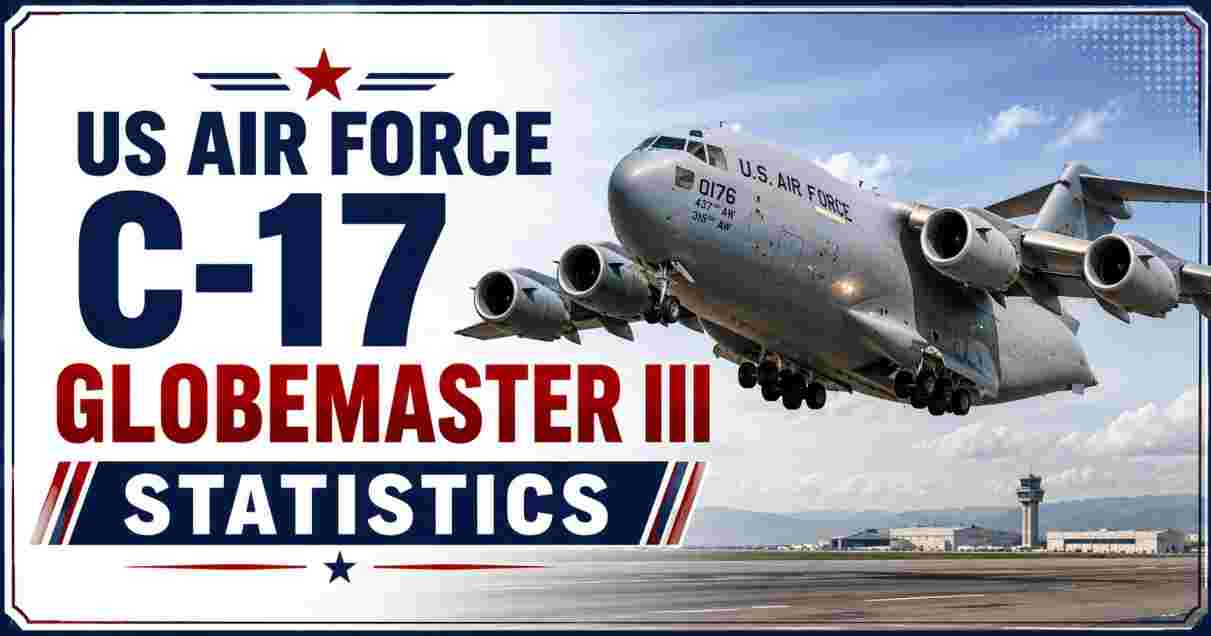
The C-17 Globemaster III in America 2026
The C-17 Globemaster III remains the single most flexible cargo aircraft in the entire United States airlift force, and heading into 2026 it is still the workhorse that keeps American troops, vehicles, and humanitarian supplies moving to almost any point on the planet within hours. Built by McDonnell Douglas and later sustained by Boeing, the C-17 was designed in the 1980s to solve a very specific problem: America needed an aircraft that could carry an M1 Abrams tank across an ocean and then land it on a rough, 3,500-foot dirt strip that no other heavy airlifter could touch. More than three decades after its first flight, that combination of intercontinental range and short-runway toughness is still unmatched by any aircraft in active US service.
With the Air Force’s original C-5 Galaxy fleet aging and the future Next-Generation Air Lifter (NGAL) program not expected to reach operational status until the early 2040s, the C-17 fleet is being asked to serve well beyond its originally planned retirement horizon. This report breaks down the newest verified US Air Force C-17 Globemaster III statistics for 2026 — covering fleet size, payload capacity, cost per flight hour, operating bases, and the aircraft’s projected service life — pulling from official Air Force fact sheets and current defense industry data so readers get a clear, numbers-first picture of America’s premier tactical and strategic airlifter.
Interesting Facts and Latest C-17 Globemaster III Statistics in the US 2026
| Fact / Statistic | Data Point |
|---|---|
| Total USAF C-17 fleet size | 223 aircraft |
| Active duty C-17s | 157 |
| Air National Guard C-17s | 47 |
| Air Force Reserve C-17s | 18 |
| Global C-17 fleet (all operator nations) | ~275 aircraft |
| Maximum payload capacity | 170,900 lbs (77,519 kg) |
| Cost per flight hour (FY2025 DoD rate) | $19,515 |
| Unit cost (fiscal 1998 dollars) | $202.3 million |
| Paratroopers deployable per aircraft | 102 |
| Mission completion success rate requirement | 92% |
Source: U.S. Air Force official fact sheet, Office of the Under Secretary of Defense (Comptroller) FY2025 reimbursable rate tables, and Boeing C-17 program data.
The numbers above show why the C-17 continues to be described as the backbone of American airlift even three decades after its introduction. A fleet of 223 aircraft, split between active duty, the Air National Guard, and the Air Force Reserve, gives the Air Force a distributed and resilient way to surge cargo capacity in a crisis while keeping day-to-day training and readiness missions running out of a dozen bases nationwide. The $19,515 hourly operating cost is strikingly efficient given the aircraft’s size, and it sits well below the far larger C-5M Galaxy’s per-hour rate, which is one of the main reasons the C-17 is tasked so much more frequently than its bigger sibling for everything from routine cargo runs to disaster relief.
What stands out most in this dataset is the gap between the aircraft’s original 1998 unit price of $202.3 million and its enormous operational value nearly three decades later — the production line closed in 2015, meaning every C-17 now flying is a finite, irreplaceable asset that the Air Force is sustaining rather than replenishing. The 92% mission completion success rate requirement, backed by a Boeing warranty since the program’s inception, also explains why this aircraft has become the default choice for the Pentagon whenever a mission absolutely has to succeed, whether that mission is delivering tanks to a forward base or evacuating patients under fire.
C-17 Fleet Composition and Distribution in the US 2026
| Command / Component | Number of Aircraft |
|---|---|
| Air Mobility Command (Active Duty) | 157 |
| Air National Guard | 47 |
| Air Force Reserve Command | 18 |
| Air Force Materiel Command (test aircraft) | 1 |
| Total USAF Fleet | 223 |
| Original programmed buy | 120 aircraft |
| Final delivered fleet size (vs. original plan) | +103 aircraft above plan |
Source: U.S. Air Force fact sheet, Air Mobility Command.
USAF C-17 Fleet Distribution (223 total)
Active Duty         |████████████████████████████████ 157
Air National Guard  |██████████ 47
Air Force Reserve   |████ 18
The Air Force originally planned to buy just 120 C-17s, but the aircraft’s unrivaled success at accomplishing a wide range of mobility missions pushed that number up to a final fleet of 223, an increase of well over 80% from the original program of record. This growth pattern is unusual in modern defense procurement, where cost overruns typically shrink fleet sizes rather than expand them, and it reflects just how quickly the C-17 proved indispensable once it entered service in the 1990s.
The distribution across active duty, Guard, and Reserve components also matters operationally: it means the aircraft is simultaneously available for immediate combat tasking through active-duty units at bases like Travis, Dover, and Joint Base Charleston, while Guard and Reserve units in states such as Mississippi, New York, and California provide a surge capacity that can be activated quickly during large-scale contingencies or natural disasters without needing to strip active squadrons of their primary mission aircraft.
For readers comparing airlift capability against America’s aerial refueling fleet, the Refueling Tanker Aircraft Statistics in US 2026 report offers useful context on how cargo movers like the C-17 rely on tanker support for truly global reach, available at Refueling Tanker Aircraft Statistics.
C-17 Payload, Performance, and Technical Specifications 2026
| Specification | Figure |
|---|---|
| Maximum payload | 170,900 lbs (77,519 kg) |
| Maximum takeoff weight | 585,000 lbs (265,352 kg) |
| Cruise speed | 450 knots (Mach 0.74) |
| Unrefueled range (with payload) | ~2,400 nautical miles |
| Minimum runway length required | 3,500 feet (1,064 meters) |
| Minimum runway width required | 90 feet (27.4 meters) |
| Maintenance man-hours per flying hour | 20 hours |
| Crew size (standard mission) | 3 (pilot, co-pilot, loadmaster) |
Source: U.S. Air Force official fact sheet.
C-17 vs Runway Requirement Comparison (Feet)
Standard Military Runway     |████████████████████████████████ 8,000–10,000 ft
C-17 Minimum Required Runway |██████████████ 3,500 ft
The C-17’s defining technical achievement is its ability to combine intercontinental-range performance with the short-field landing capability of a much smaller tactical aircraft, landing on runways as short as 3,500 feet and only 90 feet wide — dimensions that rule out virtually every other large military transport in the world. This capability comes from the aircraft’s high-lift wing design, slats, and externally blown flaps, engineering choices that let a 585,000-pound loaded aircraft touch down on austere, unpaved airstrips that would be completely unusable for a C-5 Galaxy or most commercial cargo jets.
Equally important is the aircraft’s 20 maintenance man-hours per flying hour requirement, a figure that is remarkably low for an aircraft of this size and one that Boeing guaranteed contractually when the program began. That low maintenance burden, combined with a standard three-person crew, keeps operating costs manageable even as the fleet ages, which is precisely why defense planners have been comfortable extending the C-17’s expected service life well past its originally envisioned retirement date rather than rushing a costly replacement program.
C-17 Cost, Sustainment, and Program Economics 2026
| Cost Category | Figure |
|---|---|
| DoD-to-DoD cost per flight hour (FY2025) | $19,515 |
| Cost per flight hour, non-federal users | $20,656 |
| Cost per flight hour, foreign military sales | $19,877 |
| Comparable C-5M Galaxy cost per flight hour | $34,499 |
| Original unit cost (FY1998 dollars) | $202.3 million |
| Estimated unit cost in current dollars | ~$312.8 million |
| Cumulative Boeing sustainment contract value (2026) | $8.04 billion |
Source: Office of the Under Secretary of Defense (Comptroller) FY2025 reimbursable rate tables; Boeing sustainment contract disclosures.
Cost Per Flight Hour Comparison
C-17 Globemaster III  |███████████ $19,515
C-5M Galaxy           |████████████████████ $34,499
Despite being one of the most capable heavy airlifters ever built, the C-17 remains comparatively affordable to operate, with a FY2025 DoD-to-DoD rate of $19,515 per flight hour — nearly 44% cheaper than the larger C-5M Galaxy’s $34,499 hourly rate. This cost efficiency is a major reason the C-17 is tasked far more frequently than the C-5 fleet for day-to-day airlift missions, reserving the Galaxy’s unmatched outsize cargo capacity for the specific missions that genuinely require it, such as moving oversized generators or heavy engineering equipment that cannot be broken down.
Boeing’s ongoing sustainment relationship with the Air Force, now valued at a cumulative $8.04 billion following an April 2026 contract modification, underscores just how central long-term maintenance economics have become to the program now that the production line has been closed for roughly a decade. With no new C-17s able to be built without effectively restarting the entire manufacturing supply chain at extraordinary cost, every dollar spent on sustainment is effectively an investment in extending the useful life of an irreplaceable fleet, a dynamic that mirrors the aging-fleet challenges documented in the KC-135 Stratotanker Statistics in US 2026 report, available at KC-135 Stratotanker Statistics in US.
C-17 Operating Bases and Command Structure in the US 2026
| Command | Primary Bases |
|---|---|
| Air Mobility Command | Travis AFB (CA), Dover AFB (DE), Joint Base Lewis-McChord (WA), Joint Base Charleston (SC), Joint Base McGuire-Dix-Lakehurst (NJ) |
| Pacific Air Forces | Joint Base Elmendorf-Richardson (AK), Joint Base Pearl Harbor-Hickam (HI) |
| Air National Guard | Jackson (MS), Stewart ANG Base (NY), Memphis (TN), Martinsburg (WV), Charlotte (NC) |
| Air Force Reserve Command | March Air Reserve Base (CA), Wright-Patterson AFB (OH) |
| Air Education and Training Command | Altus AFB (OK) — primary aircrew training base |
| Air Force Materiel Command | Edwards AFB (CA) — test aircraft, on loan from Charleston |
Source: U.S. Air Force official fact sheet.
The C-17 fleet’s operating footprint spans coast to coast and beyond, with active-duty squadrons based everywhere from Delaware to Hawaii and Alaska, reflecting the aircraft’s role as a genuinely global mobility asset rather than a regional one. Altus Air Force Base in Oklahoma serves as the dedicated training hub where all C-17 aircrews learn to fly the aircraft, a centralized training model that helps standardize procedures across active, Guard, and Reserve units flying out of a dozen different bases nationwide.
The presence of Guard units in states like Mississippi, New York, Tennessee, West Virginia, and North Carolina highlights how the C-17 mission has been deliberately distributed across the country, giving nearly every region direct access to strategic airlift capability during state emergencies, natural disasters, or federal mobilization, while the Reserve wings at March Air Reserve Base and Wright-Patterson provide additional surge capacity that draws on experienced part-time aircrews without the cost of maintaining them on full active-duty status.
Global C-17 Operators and Fleet Comparison 2026
| Operator Nation | C-17 Fleet Size |
|---|---|
| United States | 222–223 |
| India | 11 |
| United Arab Emirates | 8 |
| United Kingdom | Part of allied fleet |
| Australia | Part of allied fleet |
| Canada | Part of allied fleet |
| Kuwait, Qatar | Part of allied fleet |
| Global total (all operators) | ~275 aircraft |
| Total aircraft ever built | 279 |
Source: Global open-source military aircraft tracking data; Boeing program disclosures.
Global C-17 Fleet Share (approx. 275 aircraft)
United States                         |████████████████████████████████ ~81%
All Other Operators (7 nations + SAC) |███████ ~19%
The United States controls the overwhelming majority of the world’s C-17 fleet, operating roughly 81% of all aircraft still in service globally, with the remaining aircraft spread across just seven other nations plus the 12-nation Strategic Airlift Capability (SAC) consortium based in Hungary. This concentration exists partly because the production line delivered only 279 total aircraft before closing in 2015, meaning no new operator can enter the C-17 market and every existing fleet, foreign or domestic, is now a fixed, aging asset that must be carefully sustained for decades to come.
India’s fleet of 11 C-17s and the UAE’s 8 aircraft represent the two largest foreign operators, both of which rely on Boeing’s sustainment program for spare parts and technical support in the same way the USAF does, creating a genuinely international sustainment ecosystem around a single, no-longer-produced airframe. This global scarcity dynamic is a useful point of comparison for other irreplaceable American military platforms discussed in the B-52 Stratofortress Statistics 2026 report, which documents a similar situation for the Air Force’s aging strategic bomber fleet, available at B-52 Stratofortress Statistics.
C-17 Service Life and Future Replacement Timeline 2026
| Milestone | Year / Detail |
|---|---|
| First flight | September 15, 1991 |
| Entered USAF service | June 1993 (deployed), January 1995 (operational) |
| Production line closed | 2015 |
| Combined fleet flight hours (2021) | 4 million+ |
| Projected in-service retention (per AMC leadership) | Through 2075 |
| Next-Generation Air Lifter (NGAL) target IOC | ~2041 |
Source: U.S. Air Force fact sheet; Air Mobility Command leadership statements reported in defense trade press.
C-17 Projected Service Timeline
1993 First Delivery       |
1995 Operational          |██
2015 Production Ends      |████████████
2041 NGAL Target IOC      |████████████████████████████████████
2075 Projected Retirement |██████████████████████████████████████████████████
Perhaps the most striking figure in this entire dataset is the projection, voiced by Air Mobility Command leadership, that the C-17 could remain in active USAF service until 2075 — a service life of more than eight decades from its first delivery. That timeline places the C-17 on a trajectory similar to the B-52 bomber, another airframe originally expected to serve a few decades that has instead become a permanent fixture of American airpower thanks to a combination of sound original engineering and the enormous cost of designing, testing, and fielding a genuine replacement.
The Next-Generation Air Lifter (NGAL) program, now in early development, is not expected to reach initial operational capability until around 2041, meaning the C-17 fleet will need to keep flying front-line missions for at least another fifteen years before any meaningful replacement aircraft even begins entering service, let alone reaching the fleet size needed to retire C-17s at scale. This long overlap period underscores why sustainment spending, rather than new production, will remain the dominant cost driver for America’s heavy airlift capability well into the 2030s and beyond.
Disclaimer: This research report is compiled from publicly available sources. While reasonable efforts have been made to ensure accuracy, no representation or warranty, express or implied, is given as to the completeness or reliability of the information. We accept no liability for any errors, omissions, losses, or damages of any kind arising from the use of this report.