
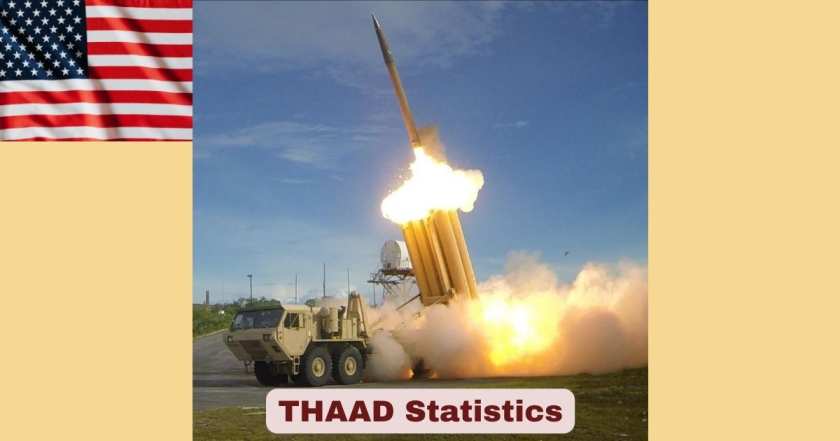
THAAD in America 2026
THAAD — Terminal High Altitude Area Defense — is the United States military’s most advanced ground-based upper-tier ballistic missile defense system, designed to intercept and destroy short-, medium-, and intermediate-range ballistic missiles during the final, or terminal, phase of their flight — both inside and just outside the Earth’s atmosphere. Developed by Lockheed Martin and managed by the Missile Defense Agency (MDA) under the umbrella of the U.S. Army, THAAD is the product of decades of research, failed early tests, and determined redesign effort that began in 1992 following the sobering reality of Iraq’s Scud missile attacks during the 1991 Gulf War. Unlike conventional interceptors that rely on explosive fragmentation, the THAAD interceptor carries no warhead whatsoever — it destroys incoming missiles purely through the kinetic energy of a direct hit, traveling at Mach 8.2 (approximately 6,300 mph) and colliding with the target at closing velocities that obliterate even hardened re-entry vehicles. As of 2026, the U.S. Army fields eight active THAAD batteries, with the eighth delivered by Lockheed Martin in June 2025, cementing the system’s role as America’s first line of defense against the world’s most dangerous ballistic missile arsenals.
In 2026, THAAD is not just a defense system on paper — it is a battle-proven asset that has been fired in anger multiple times across the most contested airspaces on earth. From the deserts of the UAE to the skies over Israel during Operation Epic Fury — the U.S.-Israel joint military offensive against Iran that began February 28, 2026 — where THAAD and Patriot batteries were confirmed by CENTCOM as actively intercepting Iranian ballistic missiles and drones fired in retaliation across the Middle East, the system has proven that hit-to-kill missile defense works in real combat at scale. The FY2026 U.S. defense budget allocates a combined $840.1 million for THAAD interceptor procurement — a record figure reflecting the acute demand on interceptor stockpiles and the growing urgency of the Golden Dome homeland missile defense initiative. Analysts have expressed concern that interceptor stocks — already strained by the 2025 12-day Israel-Iran war and U.S. supplies to Ukraine — could run critically low if Iran keeps up retaliatory strikes over an extended period during Operation Epic Fury, which began February 28, 2026. With adversaries including North Korea, China, Russia, Belarus, and Iran all fielding ballistic missiles capable of threatening U.S. forces and allies, THAAD in 2026 is more operationally relevant — and more strategically stressed — than at any point in its history.
Interesting Facts About THAAD Interceptor 2026
| Fact Category | Key Detail |
|---|---|
| Full Name | Terminal High Altitude Area Defense (formerly Theater High Altitude Area Defense) |
| Developer / Manufacturer | Lockheed Martin Corporation; manufactured in Troy, Alabama |
| Program Start | 1992 (Army selected Lockheed as prime contractor in September 1992) |
| First Deployment | May 2008, Fort Bliss, Texas |
| Warhead | None — pure hit-to-kill kinetic energy destruction |
| Interceptor Speed | Mach 8.2 (~6,300 mph / 2,800 m/s); 0 to 5,600 mph in 6 seconds |
| Intercept Altitude | Up to 150 km (above Earth’s atmosphere) |
| Intercept Range | Up to 200 km (124 miles) |
| Flight Test Record (Production Model) | 17 successful intercepts in 17 attempts — 100% success rate |
| First Ever Combat Intercept | UAE THAAD battery — January 2022 (first ever combat use by any nation) |
| First U.S. Combat Intercept | December 27, 2024 — THAAD intercepted a ballistic missile fired from Yemen |
| 900th Interceptor Delivered | 2025 milestone — Lockheed Martin delivered the 900th THAAD interceptor |
| 2025 12-Day Israel-Iran War Usage | ~92–150 THAAD interceptors fired; 15–25% of entire U.S. global THAAD stockpile expended |
| Operation Epic Fury (Feb. 28, 2026) | CENTCOM confirmed THAAD and Patriot actively intercepting Iranian ballistic missiles and drones in retaliation strikes across the Middle East |
| Interceptor Stockpile Concern (2026) | Analysts warn stocks could run low if Iran sustains retaliatory strikes — already strained by 2025 war and Ukraine supply |
| Cost to Replenish 2025 War Stockpile | Estimated 3 to 8 years to fully replenish at current production rates |
| AN/TPY-2 Radar | Largest air-transportable X-band radar in the world |
| AN/TPY-2 Radar Detection Range | Up to 1,000 km (search, track, discriminate) |
| Battery Manning | 90 soldiers per battery |
| U.S. Active Batteries (2026) | 8 batteries (eighth delivered June 2025) |
Source: U.S. Missile Defense Agency (mda.mil); Congressional Research Service (CRS) IF12645 Report, October 2024 / Updated 2025; Lockheed Martin Official Statements; CSIS Missile Defense Project (missilethreat.csis.org)
The facts above tell the story of a system that has traveled from repeated early test failures in the late 1990s to becoming the most operationally tested and combat-validated upper-tier missile defense platform on earth. The 100% production-model intercept success rate across 17 consecutive tests is a figure the Missile Defense Agency is rightly proud of — and it reflects the thorough redesign that occurred after the original THAAD prototype failed its first six consecutive intercept attempts between 1995 and 1999. The Mach 8.2 intercept speed and the extraordinary fact that the system accelerates from zero to 5,600 mph in just 6 seconds with no explosive warhead at all — relying entirely on kinetic energy — sets THAAD apart from every other air defense system in the world. The January 2022 UAE combat intercept (the first ever combat use of THAAD by any nation) and the December 2024 U.S. combat intercept against a Houthi ballistic missile confirmed what flight tests had suggested for years: THAAD works in real combat. The 15–25% depletion of the entire global U.S. arsenal during the 2025 12-day Israel-Iran war, and the ongoing demand since Operation Epic Fury began February 28, 2026, has raised urgent questions about production rates and stockpile sustainability that now drive the historic FY2026 procurement budget.
THAAD 2026 – Core Technical Specifications
| Specification | Official Data |
|---|---|
| System Classification | Ground-based, upper-tier ballistic missile defense (terminal phase) |
| Developer | Lockheed Martin Corporation, Bethesda, MD |
| Manufacturing Location | Troy, Alabama (interceptors); Andover, Massachusetts (AN/TPY-2 radar — Raytheon) |
| Interceptor Length | 6.17 meters (20 ft 3 in) |
| Interceptor Diameter (Booster) | 0.34 meters (13 inches) |
| Kill Vehicle Diameter | 0.37 meters (15 inches) |
| Interceptor Launch Weight | 662 kg (CSIS data) / 900 kg (launch weight per The Defense Post) |
| Propulsion | Single-stage solid-propellant booster (carbon fiber; HTPB propellant) |
| Kill Vehicle Propulsion | Liquid-fueled hydrazine divert thrusters |
| Guidance (Terminal Phase) | Gimbaled infrared seeker (tracks target in terminal phase after booster separation) |
| Interceptor Speed | Mach 8.2 (~2,800 m/s / ~6,300 mph) |
| 0–5,600 mph Acceleration | 6 seconds |
| Engagement Range | 150–200 km (93–124 miles) |
| Engagement Altitude | Up to 150 km — inside and just outside Earth’s atmosphere |
| Warhead | None — hit-to-kill kinetic energy only |
| Threat Coverage | Short-range (up to 1,000 km), Medium-range (1,000–3,000 km), Limited Intermediate-range (3,000–5,000 km) ballistic missiles |
| Airframe Material | Carbon-composite (withstands -65°F to 3,000°F) |
Source: CSIS Missile Defense Project (missilethreat.csis.org); The Defense Post Technical Guide (June 2025); U.S. Missile Defense Agency (mda.mil); Missile Defense Advocacy Alliance (missiledefenseadvocacy.org)
The THAAD interceptor is an engineering achievement that, on paper, seems almost impossible: a 6.17-meter missile with no explosive warhead that accelerates from a standing start to 5,600 mph in 6 seconds, then uses an infrared seeker and hydrazine divert thrusters to maneuver its kill vehicle directly into a collision course with a ballistic re-entry vehicle traveling at up to Mach 15. The physics of the engagement are brutal and unforgiving — at these closing velocities, the kinetic energy released on impact is equivalent to a small explosive detonation, which is precisely why no warhead is needed. The carbon-composite airframe, designed to endure temperatures from -65°F to 3,000°F, reflects the engineering reality of what happens when a missile punches through the upper reaches of the atmosphere at hypersonic speed — the thermal loads alone would destroy conventional materials.
The dual-atmosphere engagement capability — intercepting both inside and just outside the Earth’s atmosphere — is what separates THAAD from lower-tier systems like the Patriot PAC-3, which operates primarily within the lower atmosphere. By engaging threats at up to 150 km altitude, THAAD creates a much larger defended footprint on the ground — a single battery can protect a geographic area far larger than Patriot can cover — and critically buys time for lower-tier systems to take a second shot at any target that survives the THAAD engagement. The gimbaled infrared seeker, which separates from the booster mid-flight and uses independent divert thrusters to fine-tune its collision trajectory, is the precision element that makes the hit-to-kill philosophy viable rather than theoretical.
THAAD 2026 – Battery Composition & Fleet Inventory
| Battery / Fleet Metric | Data |
|---|---|
| Soldiers Per Battery | 90 soldiers |
| Launchers Per Battery | 6 truck-mounted launchers |
| Interceptors Per Launcher | 8 interceptors |
| Total Interceptors Per Battery | 48 interceptors |
| Radar Per Battery | 1 × AN/TPY-2 (X-band, largest air-transportable radar in the world) |
| Fire Control Component | 1 × Tactical Fire Control / Communications unit |
| Deployment Duration (Standard) | 120-day deployments (45 days entry operations + 75 days combat at 17 hrs/day) |
| Actual Deployment Tempo | 24 hours/day, 7 days/week, 365 days/year during active operations |
| U.S. Active Batteries (2026) | 8 batteries |
| First Battery Activated | May 2008, Fort Bliss, Texas (A Battery, 4th ADA Regiment) |
| Eighth Battery Delivered | June 2025 (Lockheed Martin minimum engagement package delivered) |
| Authorized By Congress | FY2021 NDAA (P.L. 116-283) authorized and funded 8th battery |
| Domestic Bases | Fort Bliss, Texas (3 batteries); Fort Cavazos, Texas (2 batteries) |
| Permanently Deployed | South Korea (Seongju); Guam (Camp Blaz) |
| Middle East Deployment | Battery deployed to Middle East in 2023; remains in region as of 2026 |
| Israel Deployment | Battery deployed October 2024; operational through Iran conflict |
| Total Interceptors Delivered (as of Oct. 2023) | 799 interceptors (U.S. Army + Foreign Military Sales customers — MDA data) |
| Milestone: 900th Interceptor | Delivered by Lockheed Martin in 2025 |
Source: Congressional Research Service Report IF12645 (Updated 2025) — congress.gov; U.S. Missile Defense Agency (mda.mil); Lockheed Martin Official Statements; Eurasian Review (July 2025 CRS Analysis)
The composition of a THAAD battery — 90 soldiers, 6 launchers, 48 interceptors, and one AN/TPY-2 radar — is deceptively compact for a system that defends territory the size of a small country. The truck-mounted, road-mobile design is not an afterthought; it is the foundational strategic concept of the entire THAAD program. A battery can be broken down, air-transported virtually anywhere on earth via C-5 or C-17 aircraft, and made operational within hours of arrival — a capability no fixed-site air defense system can match. The fact that the U.S. Army was simultaneously maintaining batteries in South Korea, Guam, the Middle East, and Israel in 2025–2026 while also keeping batteries in reserve for contingency operations at Fort Bliss and Fort Cavazos is a testament to this mobility — and a reflection of just how broadly the threat environment has expanded.
The 900th interceptor milestone achieved by Lockheed Martin in 2025 was a significant industrial benchmark, but it also underscores a sobering reality about the system’s supply chain. With 799 interceptors delivered to U.S. and foreign military customers as of October 2023 — and an estimated 92–150 fired during the 2025 Israel-Iran war — the gap between production capacity and operational demand is increasingly acute. With Operation Epic Fury ongoing from February 28, 2026, THAAD and Patriot batteries are actively firing against Iranian retaliatory strikes, compounding stockpile pressure further. The FY2026 procurement request for 37 interceptors ($840.1 million combined discretionary and mandatory funding) represents a massive increase in procurement urgency, but analysts estimate that at current production rates it would still take 3 to 8 years to fully replenish the stockpile expended in the 2025 war alone — let alone the ongoing 2026 conflict. This production gap is now a central concern for U.S. defense planners as they assess readiness for potential high-end conflict in the Indo-Pacific.
THAAD 2026 – AN/TPY-2 Radar Statistics
| AN/TPY-2 Radar Specification | Data |
|---|---|
| Full Designation | Army Navy / Transportable Radar Surveillance and Control Model 2 |
| Classification | Largest air-transportable X-band radar in the world |
| Frequency Band | X-band |
| Antenna Type | Active electronically scanned array (phased array) |
| Antenna Face Area | 9.2 m² |
| Antenna Modules | Over 25,000 antenna modules |
| Detection / Tracking Range | Up to 1,000 km (search, track, and discriminate) |
| Forward-Based Mode (FBM) | Detects missiles in ascent phase to cue other BMDS elements |
| Terminal Mode (TM) | Provides tracking and engagement data for THAAD intercepts |
| Radar Power Source | 1-megawatt generator (equivalent energy for ~900 homes) |
| Interoperability | Links with Aegis BMD, Patriot/PAC-3, GMD, and C2BMC network |
| Developer | Raytheon Technologies, Andover, Massachusetts |
| Unit Cost | ~$174 million per AN/TPY-2 unit |
| Forward-Based Deployments (FBM Mode) | Kyogamisaki, Japan; Shariki, Japan; Kürecik, Turkey; Mt. Keren, Israel; and likely Saudi Arabia |
| Discrimination Capability | High angular resolution distinguishes re-entry vehicle from debris, decoys, and penetration aids |
Source: CSIS Missile Defense Project (missilethreat.csis.org); Missile Defense Advocacy Alliance (missiledefenseadvocacy.org); The National (UAE, March 2026); Congressional Research Service
The AN/TPY-2 radar is, in many respects, the most strategically consequential single component of the entire THAAD system — and arguably one of the most capable radar systems deployed anywhere on earth. The fact that it is air-transportable while simultaneously being the largest X-band radar of its type is a genuine engineering paradox that Raytheon solved through the use of active electronically scanned array (AESA) technology, which eliminates the need for a mechanically rotating dish and concentrates enormous detection capability into a flat, phased-array antenna face packed with over 25,000 individual antenna modules. Its 1,000 km tracking range — roughly the distance from New York to Chicago — means a single AN/TPY-2 positioned in Japan can track North Korean missile launches from the moment they clear the launch pad, providing 2 to 4 additional minutes of warning for downstream BMDS elements compared to relying solely on the radar in terminal mode.
The 1-megawatt power requirement of the AN/TPY-2 — equivalent to powering 900 homes — gives a sense of the raw electromagnetic energy the system projects to achieve its detection and discrimination performance. Crucially, the radar’s ability to discriminate the actual re-entry vehicle from decoys, debris, and penetration aids is what gives THAAD its operational credibility against sophisticated adversaries that deliberately design their missiles to confuse air defense radars. A battery of interceptors directed at debris rather than the actual warhead wastes irreplaceable munitions — at $12.7 million per interceptor, that is a costly mistake. The AN/TPY-2’s angular resolution is specifically designed to prevent exactly that scenario, making every THAAD engagement as efficient as possible.
THAAD 2026 – Combat Use & Operational Deployment History
| Deployment / Combat Event | Date & Key Detail |
|---|---|
| Emergency Guam Deployment | April 2013 — Secretary of Defense deployed THAAD to Guam in response to North Korean threats |
| South Korea Deployment (Permanent) | May 1, 2017 — First THAAD battery activated at Seongju, South Korea |
| UAE Operational | 2015–2016 — UAE trained; batteries fully operational |
| First-Ever Combat Intercept (Any Nation) | January 2022 — UAE THAAD battery intercepted ballistic missiles (Houthi threat) |
| Romania Interim Deployment | 2019 — B Battery, 62nd ADA deployed to NSF Deveselu during Aegis Ashore maintenance |
| Middle East Deployment | 2023 — THAAD battery deployed to Middle East; remains as of 2026 |
| Israel Deployment (October 2024) | October 2024 — THAAD battery deployed to Israel ahead of Iran conflict |
| First U.S. Combat Intercept | December 27, 2024 — U.S. THAAD intercepted a Houthi ballistic missile fired from Yemen |
| Yemen/Houthi Failures (2025) | THAAD failed to intercept Houthi hypersonic missiles on at least two occasions in 2025; Arrow systems succeeded |
| 2025 12-Day Israel-Iran War | ~92–150 THAAD interceptors fired; accounted for ~half of all U.S./Israeli interceptors used; 15–25% of entire U.S. funded stockpile |
| % of Funded U.S. Stockpile Used (2025 war) | ~15–25% of all U.S. THAAD interceptors funded to date used during 2025 Israel-Iran hostilities |
| Cost of 2025 War Interceptions | $810 million–$1.215 billion estimated (60–100 interceptors at $12–15M each) |
| Operation Epic Fury — Feb. 28, 2026 | CENTCOM confirmed THAAD and Patriot batteries actively intercepting Iranian ballistic missiles and drones; Iran launched thousands of drones and missiles in retaliation across the Middle East |
| Replenishment Timeline | Estimated 3 to 8 years to replenish stockpile at current production rates |
Source: Congressional Research Service Report IF12645 (Updated 2025) — congress.gov; Wikipedia – Terminal High Altitude Area Defense (citing WSJ, The War Zone, July 2025); Military Watch Magazine (June 2025); Eurasian Review (July 2025)
The THAAD combat deployment record between 2022 and 2026 represents a compressed, high-intensity operational history that has fundamentally reshaped how the U.S. military and allied planners think about missile defense sustainability. The January 2022 UAE intercept — the first-ever combat use of THAAD by any nation — was celebrated as a validation of the entire hit-to-kill concept after years of theoretical testing. The scale of demand that emerged during the 2025 12-day Israel-Iran war — where an estimated 92–150 interceptors were fired — introduced a new and urgent challenge: THAAD works, but the world can use it faster than it can be built. With Operation Epic Fury beginning February 28, 2026 and Iran launching thousands of drones and missiles in retaliation across the Middle East, analysts have expressed concern that stocks of the interceptors, already taxed by last year’s conflict and by units supplied to Ukraine, could run low if Iran keeps up its retaliatory strikes over an extended time. The $12–15 million cost per interceptor and the 3–8 year replenishment timeline have moved missile defense industrial capacity from a background policy concern to a front-page strategic crisis, directly driving the record $840.1 million FY2026 procurement request.
The 2025 failures against Houthi hypersonic missiles — where THAAD was unable to intercept and Israeli Arrow systems had to step in — added a significant caveat to the system’s otherwise outstanding operational record. These engagements highlighted the emerging vulnerability of THAAD against hypersonic glide vehicles, which maneuver unpredictably during descent and do not follow the predictable ballistic arc that THAAD’s fire control algorithms are optimized for. The Missile Defense Agency has acknowledged that future THAAD upgrades, including the proposed THAAD-ER (Extended Range) two-stage variant and System Build 5.0 (planned for July 2026), are specifically aimed at addressing the hypersonic threat — a challenge that will define the next generation of U.S. missile defense investment well into the 2030s.
THAAD 2026 – Procurement Costs & Budget Statistics
| Cost / Budget Metric | Data |
|---|---|
| Cost Per THAAD Interceptor | ~$12.7 million (estimated; ~$12–15M range in operational reporting) |
| Earlier FY2017 Unit Cost | $12.6 million per interceptor |
| Full Battery Procurement Cost (incl. 192 interceptors) | $2.73 billion per battery (AEI September 2025 working paper estimate) |
| Annual Operations & Sustainment Per Battery | $32.5 million per year per battery |
| AN/TPY-2 Radar Unit Cost | ~$174 million per radar unit |
| Saudi Arabia FMS Deal (Oct. 2017) | $15 billion — 7 fire units, 360 interceptors, radars, mobile tactical stations |
| Qatar THAAD Deal (May 2025) | Part of $42 billion U.S. arms package announced by President Trump |
| FY2026 THAAD Interceptor Procurement Request | $840.1 million total ($523.1M discretionary + $317.0M mandatory/reconciliation) |
| FY2026 Interceptors Requested | 37 interceptors (25 discretionary + 12 mandatory) |
| Annual Production Capacity (Lockheed Martin) | ~650 interceptors per year (production estimate) |
| Total Interceptors Delivered (Oct. 2023) | 799 interceptors (U.S. Army and FMS customers — MDA official data) |
| Congress-Authorized 8th Battery Contract | April 21, 2022 — Lockheed Martin awarded $74 million contract |
| Earlier Large Production Contract | April 2019 — $2.457 billion contract modification for interceptors (U.S. + Saudi Arabia FMS) |
Source: Congressional Research Service Report IF12645 (Updated 2025) — congress.gov; American Enterprise Institute (AEI) Working Paper, September 2025; U.S. Missile Defense Agency (mda.mil); USNI News; The National (UAE, March 2026)
The $2.73 billion per-battery procurement cost figure — drawn from the September 2025 American Enterprise Institute working paper commissioned as part of the Golden Dome homeland defense analysis — represents one of the starkest data points in the entire American defense budget discussion. At that price per battery, even a modest expansion of the THAAD fleet by two or three additional batteries would require $5–8 billion in procurement funding before a single interceptor reload is purchased. The $32.5 million annual operations and sustainment cost per battery — while modest relative to procurement — compounds significantly across a fleet of 8 batteries operating at a sustained 24/7 tempo, and becomes particularly burdensome when batteries are forward-deployed to austere locations in the Middle East or the Pacific.
The FY2026 budget request of $840.1 million for just 37 interceptors illustrates why the 2025 Israel-Iran war’s consumption of ~92–150 interceptors, and the ongoing demand since Operation Epic Fury began February 28, 2026, is being treated as a near-crisis by defense appropriators. Analysts have expressed concern that stocks of the interceptors, taxed by last year’s 12-day war between Israel and Iran and by units supplied to Ukraine, could run low if Iran keeps up its retaliatory strikes over an extended time. The $42 billion Qatar arms deal and the ongoing Saudi Arabia delivery of 360 interceptors from the 2017 $15 billion contract reflect the global commercial success of the THAAD program, but Foreign Military Sales deliveries compete with U.S. Army replenishment for the same Lockheed Martin production line capacity in Troy, Alabama — a bottleneck that analysts say cannot be resolved without significant factory expansion investment.
THAAD 2026 – Global Deployments & Foreign Military Sales
| Country / Deployment | Status & Detail |
|---|---|
| United States | 8 active batteries — Fort Bliss TX, Fort Cavazos TX, Guam, South Korea, Middle East, Israel |
| United Arab Emirates (UAE) | 2 batteries — fully operational; conducted first-ever THAAD combat intercept (Jan. 2022) |
| Saudi Arabia | 1 battery activated July 2025; 6 more committed under $15 billion FMS deal |
| South Korea | 1 U.S. Army battery at Seongju (permanent); activated May 1, 2017 |
| Israel | 1 U.S. Army battery deployed October 2024; active through Iran conflict |
| Romania | Interim THAAD deployment 2019 (while Aegis Ashore was upgraded) |
| Guam | 1 U.S. Army battery (permanent requirement validated by DoD); relocated to Camp Blaz |
| Qatar | Acquisition announced May 2025 — part of $42 billion U.S.-Qatar arms agreement |
| Taiwan | Discussed but not confirmed; existing early warning radar built by AN/TPY-2 manufacturer |
| Japan (FBM Radars) | Forward-Based Mode AN/TPY-2 radars at Kyogamisaki and Shariki (not full batteries) |
| Turkey | AN/TPY-2 FBM radar at Site K (Kürecik) |
| Total Publicly Confirmed Batteries Worldwide | ~10 active batteries (7 U.S. + UAE 2 + Saudi Arabia 1 activated) |
Source: Wikipedia – Terminal High Altitude Area Defense (verified with official sources); Congressional Research Service IF12645; Missile Defense Advocacy Alliance; SIPRI Arms Trade Database 2023
The global footprint of THAAD in 2026 reflects the system’s evolution from a U.S. Army anti-missile tool into a cornerstone of American extended deterrence and alliance management. The UAE’s two batteries — the most combat-tested THAAD systems outside of the U.S. Army’s own fleet — have transformed the Emirates’ strategic posture in the Gulf, providing a credible defense against Iranian ballistic missile attacks that has been validated in live combat on multiple occasions since January 2022. The permanent deployment to South Korea, which China actively protested when it was announced in 2017 (arguing the AN/TPY-2 radar’s 1,000 km range gave the U.S. intelligence reach deep into Chinese territory), remains one of the most geopolitically sensitive THAAD deployments and a persistent irritant in U.S.-China relations.
The Saudi Arabia FMS deal — originally signed in 2017 for $15 billion — is finally becoming operational reality with the first battery activation in July 2025, and the Qatar acquisition announced by President Trump in May 2025 as part of a sweeping $42 billion arms package signals that demand for THAAD across the Gulf states is accelerating, not declining, as Iran’s ballistic missile threat has been demonstrated so lethally in recent months. The combined effect of these foreign deployments — UAE, Saudi Arabia, Qatar, South Korea — means that the Lockheed Martin production line in Troy, Alabama is now servicing a customer base far larger than the original U.S. Army-only program anticipated, creating both commercial success and production capacity challenges that will shape the THAAD program’s next decade.
THAAD 2026 – Modernization & Future Upgrades
| Upgrade / Future Program | Detail & Status |
|---|---|
| THAAD System Build 4.0 Region Specific | Added to MDS Operational Capability Baseline (OCB) — May 2022 |
| THAAD System Build 4.0 Global | Added to MDS OCB — August 2023 |
| THAAD System Build 4.0 — Key Capability | Delivers initial THAAD and Missile Segment Enhancement (MSE) integration |
| Missile Segment Enhancement (MSE) Launcher Integration | Increases engagement opportunities; conserves THAAD interceptors by supplementing with MSE interceptors |
| THAAD System Build 5.0 | In development — includes mission assurance updates and Configuration 3 hardware; planned addition to OCB July 2026 |
| THAAD-ER (Extended Range) | Two-stage interceptor concept by Lockheed Martin (industry-funded); not yet an official MDA program; designed for improved range and velocity to counter hypersonic threats |
| Hypersonic Boost-Glide Vehicle Defense | MDA actively evaluating THAAD’s role against hypersonic threats after May 2025 failures |
| Golden Dome Integration | THAAD being evaluated as potential ground-based element of Golden Dome U.S. homeland missile defense initiative |
| THAAD-in-National-Guard Proposal | Congress and MDA evaluating expanding THAAD to Army National Guard units |
| January 29, 2026 Lockheed Contract | Lockheed Martin signed new major agreement with U.S. government for continued THAAD production |
| C2BMC Integration | THAAD fully networked to Command, Control, Battle Management and Communications (C2BMC) for integrated kill chain with Aegis, GMD, and Patriot |
| MDA First THAAD-Cued Patriot Intercept | Demonstrated 2020 — THAAD radar cueing Patriot intercept in integrated kill chain |
Source: U.S. Missile Defense Agency (mda.mil); Congressional Research Service IF12645; Missile Defense Advocacy Alliance; Army Recognition (January 2026)
The THAAD modernization roadmap in 2026 is being shaped in real time by two forces: the operational lessons of the Iran conflict and the looming demand of the Golden Dome homeland missile defense initiative. System Build 5.0, planned for the MDS Operational Capability Baseline in July 2026, will deliver mission assurance updates and Configuration 3 hardware improvements that directly address reliability concerns identified during high-tempo combat operations in the Middle East. The Missile Segment Enhancement (MSE) integration delivered through Build 4.0 is particularly significant from an inventory management standpoint — by integrating MSE interceptors into the THAAD battery alongside standard interceptors, the Army can selectively use the less expensive MSE missiles against lower-end threats, conserving the $12.7 million THAAD interceptors for only the most demanding engagements. After the stockpile depletion of the Iran conflict, this conservation approach has taken on urgent strategic importance.
The FY2025 Load Adaptable Modular (LAM) pylon program is the upgrade that most directly defines the Lancer’s role in 2026 and beyond. The THAAD-ER concept — a two-stage design that Lockheed Martin has funded as an industry initiative — would dramatically expand the defended footprint of a single battery and provide improved maneuverability against hypersonic boost-glide vehicles — the class of weapons that exposed a limitation in the current system during Houthi engagements in 2025. Whether THAAD-ER becomes an official MDA program will likely depend on the outcome of the Golden Dome architecture review and how central the Army’s role is in any future homeland missile defense expansion — decisions that will define the THAAD program’s trajectory well into the 2030s.
Disclaimer: This research report is compiled from publicly available sources. While reasonable efforts have been made to ensure accuracy, no representation or warranty, express or implied, is given as to the completeness or reliability of the information. We accept no liability for any errors, omissions, losses, or damages of any kind arising from the use of this report.