
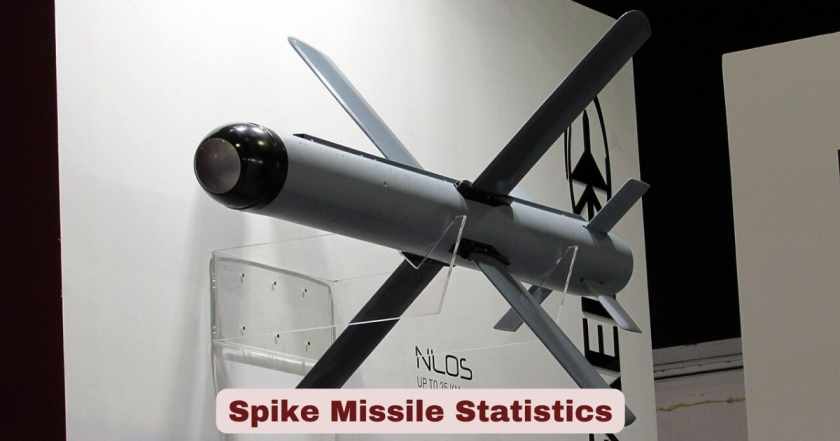
What Is Spike Missile?
The Rafael Spike missile — named in Hebrew ספייק — is the world’s most widely exported, most extensively combat-tested, and most continuously evolved anti-tank guided missile (ATGM) family in existence, and it is entirely Israeli in conception, development, and design. Built by Rafael Advanced Defense Systems, the state-controlled Israeli defense technology company headquartered in Haifa, the Spike family was born from one of the most traumatic military lessons in Israeli history: the 1973 Yom Kippur War, in which Egyptian and Syrian forces equipped with Soviet Sagger anti-tank missiles destroyed hundreds of Israeli tanks and nearly broke the IDF’s armored corps in the opening days of the conflict. In the years that followed, Rafael engineers set out to build an Israeli precision anti-tank weapon that would be superior in every dimension to anything fielded by adversaries — a fire-and-forget, imaging infrared-guided missile that the operator could launch and immediately take cover, with the missile’s own seeker autonomously tracking and destroying the target. Development began in 1981, the system entered IDF service under the designation Gill in the early 1990s, and the first export occurred in 1997 — the same year the Spike name was officially adopted for the export market. By 2023, Rafael had delivered over 40,000 Spike missiles to 41 countries, of which approximately 7,000 had been expended in trials, training, and combat — numbers that no Western ATGM competitor can come close to matching. The Spike family in 2026 spans eight distinct variants across five generations of development: Spike SR (50m–2km), Spike MR (200m–2.5km), Spike LR (200m–4km), Spike LR2 (200m–5.5km ground / 10km helicopter), Spike ER (400m–8km), Spike ER2 (400m–16km), Spike NLOS (up to 32km ground / 50km helicopter), and the newest loitering variants — L-Spike 1X (updated Firefly, 5km range) and the L-Spike 4X (unveiled at AUSA 2025, 40km, 25-minute loiter) — covering a range envelope from 50 meters to 50 kilometers in a single unified product family whose components, training infrastructure, and launcher systems are largely interoperable. In Europe, Spike is marketed and partially manufactured through EuroSpike GmbH — a joint venture between Rafael (20%), Diehl Defence (40%), and Rheinmetall Defence Electronics (40%) — established in 2004 and based in Röthenbach, Germany, which has made Spike the NATO anti-tank standard for the majority of Western European armies.
In 2026, the Spike missile is no longer simply the IDF’s premier anti-armor weapon — it is a global precision effects ecosystem deployed on over 45 different launch platforms including man-portable infantry launchers, infantry fighting vehicles, main battle tank turrets, attack helicopters, naval fast patrol boats, and unmanned aerial vehicles, used by 41+ nations, and continuously expanding into the loitering munition domain in direct response to the battlefield lessons of Ukraine, Gaza, and the Lebanon conflicts of 2024–2025. The 600+ Spike missiles fired in the 2006 Second Lebanon War alone validated the weapon’s performance against Hezbollah’s prepared defensive positions in southern Lebanon, and in the Gaza operations from 2008 through 2025, the Spike — including the Spike Firefly loitering variant first used in combat at Jenin in July 2023 and extensively in Gaza from October 2023 onwards — has been employed in every conceivable target scenario from moving vehicles to tunnel infrastructure to point targets inside dense urban terrain. Iran’s recognition of the Spike’s lethality is itself a form of flattery: Hezbollah captured Israeli Spike MR missiles during the 2006 Lebanon War and provided them to Iranian engineers, who reverse-engineered the guidance and seeker technology into the Almas ATGM — publicly unveiled in 2021 and already observed in combat use by Hezbollah in January 2024. The most advanced variant in development, L-Spike 4X — unveiled by Rafael USA at AUSA in Washington D.C. on October 13, 2025 — combines missile-speed transit (40km in 5 minutes) with 25-minute on-station loiter, AI-enabled automatic target recognition, and compatibility with existing NLOS launchers across air, land, and sea platforms. The Spike missile family’s development arc from a 1981 IDF anti-armor requirement to a 2025 AI-guided loitering munition is arguably the most complete single-family weapons evolution story in modern defense history.
Spike Missile 2026 — Key Facts
| # | Spike Missile Key Fact | Details |
|---|---|---|
| 1 | Over 40,000 Spike Missiles Delivered to 41 Countries — 7,000 Fired in Combat and Training | Rafael confirmed by 2023 that over 40,000 Spike missiles had been delivered to 41 countries, of which approximately 7,000 had been expended in trials, training, and combat — the largest export scale of any Western ATGM family |
| 2 | Launched from 45+ Different Platforms — Man-Portable to Naval | The Spike family can be launched from over 45 different platforms — infantry shoulder launchers, IFV turrets, MBT integrations, attack helicopters, fast patrol boats, and unmanned aircraft — giving it the broadest platform compatibility of any precision guided munition family |
| 3 | L-Spike 4X Unveiled AUSA 2025 — 40km Range, 5-Minute Transit, 25-Minute Loiter | On October 13, 2025, Rafael USA unveiled the L-Spike 4X at AUSA in Washington D.C. — a loitering missile with 40km range, capable of reaching max range in 5 minutes and loitering on-station for 25 minutes, with AI-enabled automatic target recognition and single-operator control of 4 simultaneous missiles |
| 4 | 600+ Spike Missiles Fired in 2006 Second Lebanon War Alone | During the 2006 Second Lebanon War, the IDF fired more than 600 Spike missiles against Hezbollah targets in southern Lebanon — one of the most extensive single-conflict deployments of any precision anti-tank weapon in history |
| 5 | Iran Reverse-Engineered Captured Spike MR into the Almas ATGM | Hezbollah captured Israeli Spike MR missiles during the 2006 Lebanon War and transferred them to Iran, which reverse-engineered the system into the Almas ATGM — unveiled July 2021 and used in combat against Israel by Hezbollah in January 2024 |
| 6 | Spike Firefly (L-Spike 1X) First Used in Combat — Jenin, July 2023 | The Spike Firefly — a miniature loitering munition (2.2 kg, 5 km range, 15-min armed / 30-min recon) — was first used in combat by the IDF in Jenin in July 2023, then extensively in Gaza from October 2023; renamed L-Spike 1X in 2025 with range extended from 1.5 km to 5 km |
| 7 | EuroSpike GmbH — NATO’s De Facto Anti-Tank Standard Since 2004 | EuroSpike GmbH — the Rafael / Diehl / Rheinmetall joint venture established in 2004 — has made Spike the standard anti-tank guided missile for the majority of NATO European armies, with Germany, the Netherlands, Poland, Spain, Finland, Denmark, Belgium, Norway, and others all operating Spike variants |
| 8 | Poland Ordered 2,675 Spike LR + 800 Follow-On — Largest Single Export Contract | Poland signed a 2003 contract for 2,675 Spike LR missiles with 264 launchers worth $425 million — the largest single Spike export contract, with local co-production at ZM Mesko — followed by 800 more Spike LRs in 2015 |
| 9 | Spike NLOS Mk.6 — 50 km Helicopter Range — Selected by US Army as Interim LRPM | Spike NLOS was selected by the U.S. Army in January 2020 as its Interim Long Range Precision Munition (LRPM) for AH-64E Apache helicopters — with Lockheed Martin as the U.S. prime contractor partnered with Rafael; first European live-fire from Apache conducted in Ustka, Poland, August 2025 |
| 10 | Spike LR2 — Reduced to 13 kg — 10 km Helicopter Range — Fiber-Optic + RF Datalink | The Spike LR2 (Gil-2) weighs just 13 kg (down from 14 kg LR1), has a 5.5 km ground / 10 km helicopter range, uses both fiber-optic cable and RF datalink, and is the most widely ordered current-generation Spike variant — in service with Israel, Slovakia, Estonia, Australia, Denmark, Netherlands, Germany, and more |
| 11 | Germany Ordered 4,326 Spike LR (MELLS) + 525 Launchers | Germany has ordered 4,326 MELLS (Spike LR) missiles and 525 iCLU launcher units, with September 2024 contract for Spike LR2 missiles worth €700 million — the largest sustained Spike procurement program by any single European nation |
| 12 | Spike NLOS Fired First in European Combat — August 2025, Ustka, Poland | On August 25, 2025, the U.S. Army with Rafael assistance conducted the first European live-fire of Spike NLOS from AH-64E Apaches at the Polish Air Force Training Center in Ustka, Poland — clearing Airworthiness Release for the platform integration |
| 13 | Spain Cancelled 2,630-Missile Spike Contract — June 2025 | In June 2025, the Spanish government cancelled its contract for 2,630 Spike LR missiles and 200 Spike ER missiles due to a stated disagreement with Israeli military actions in Gaza — a significant diplomatic and commercial development in the Spike export program |
| 14 | Spike NLOS Range: 32 km Ground / 50 km Helicopter — Warhead Penetrates 1,000 mm RHA | The Spike NLOS — the most advanced production variant — has a 32 km ground range (50 km from helicopter), penetrates over 1,000 mm of rolled homogeneous armor (RHA), and carries GPS/INS navigation for pre-planned trajectory plus EO seeker for terminal man-in-the-loop guidance |
| 15 | Spike Development Born from 1973 Yom Kippur War — IDF Service Since 1981 | The Spike’s design was driven directly by the IDF’s armor losses to Soviet Sagger missiles in the 1973 Yom Kippur War — development began 1981, first IDF operational service in the early 1990s under the designation Gill, and first export in 1997 |
Source: Wikipedia – Spike (missile), updated March 2, 2026 (en.wikipedia.org); Rafael Advanced Defense Systems (rafael.co.il); Army Technology – Spike Anti-Tank Guided Missiles (army-technology.com); Army Technology – Spike NLOS (army-technology.com, December 2025); Breaking Defense – L-Spike 4X (breakingdefense.com, October 14, 2025); Army Recognition – L-Spike 4X AUSA 2025 (armyrecognition.com, October 2025); European Security & Defence – L-Spike 4X (euro-sd.com, October 14, 2025); EDR Magazine – L-Spike 4X (edrmagazine.eu, October 9, 2025); The National Interest – L-Spike 4X (nationalinterest.org, November 5, 2025); Globes – Rafael Unveils New Spike Missile (globes.co.il, November 20, 2025); 19FortyFive – Spike Tank Killer (19fortyfive.com); MilitaryFactory.com; Lockheed Martin – Spike NLOS (lockheedmartin.com); DIMSE – Spike (dimse.info)
These 15 Spike missile key facts for 2026 tell the story of a weapon system whose relevance has not diminished over five decades of development — it has expanded, deepened, and accelerated. The 40,000-missile delivery figure confirmed by 2023 is the commercial headline, but the 7,000 fired in combat and training is the operational one: no other Western ATGM can claim that volume of real-world engagements, across that many conflict environments, against that diversity of targets. The figure also drives an exceptionally tight feedback loop between IDF combat experience and Rafael engineering — every Spike missile fired in Gaza, Lebanon, or the West Bank generates performance data that flows back to Rafael’s design teams in Haifa and eventually into the next variant’s specifications. The L-Spike 4X’s AI-enabled automatic target recognition and GPS-denied hardened communications are direct engineering responses to lessons learned from the jamming-saturated battlefield of Ukraine and the dense urban EW environment of Gaza — problems that theoretical weapons design cannot anticipate but 7,000 real combat firings can.
The EuroSpike joint venture’s transformation of Spike into NATO’s de facto ATGM standard is perhaps the single most geopolitically consequential commercial achievement in Israeli defense history. A 100% Israeli-designed weapon system is now the primary anti-armor munition of Germany’s Bundeswehr, the Royal Netherlands Army, Poland’s Armed Forces, the Finnish Army, the Belgian Army, the Danish Army, the Norwegian Army, and others — all procured through European manufacturing partnerships that give those nations domestic production stakes while keeping the core intellectual property in Rafael’s hands. The Spain cancellation in June 2025 — the only significant negative export event in Spike’s recent commercial history — illustrates how geopolitical pressures can disrupt even long-established programs, but the simultaneous expansion of orders in Germany (€700 million Spike LR2 contract, September 2024), the Netherlands (Spike LR2 for CV9035NL MLU), and the first-ever U.S. Army Spike NLOS combat readiness certification in August 2025 confirms that the overall trajectory remains strongly positive.
Spike Missile 2026 — Full Variant Specifications
| Variant | Generation | Range | Weight (Missile) | Guidance | Warhead / Penetration | Launch Platforms | Status (2026) |
|---|---|---|---|---|---|---|---|
| Spike SR | 3rd gen | 50 m – 2,000 m | 9.5 kg | IIR uncooled seeker — fire-and-forget | Tandem HEAT / PBF (anti-structure) | Man-portable, vehicle | In service — IDF, Singapore, others |
| Spike MR (Gill) | 3rd gen | 200 m – 2,500 m | 14 kg | IIR seeker + fiber-optic option | Tandem HEAT; reported >700 mm RHA | Man-portable, vehicle | In service — Finland, Netherlands, others; reverse-engineered as Iranian Almas |
| Spike LR (Gill LR / MELLS) | 4th gen | 200 m – 4,000 m (extended to 5.5 km from helicopter) | 14 kg | IIR + CCD dual seeker; fiber-optic cable | Tandem HEAT; >700 mm RHA | Man-portable, vehicle, helicopter | In service — 30+ nations; Germany: 4,326 ordered; Poland: 3,475 ordered |
| Spike LR2 (Gil-2) | 5th gen | 5.5 km ground / 10 km helicopter | 13 kg (reduced from 14 kg) | IIR + CCD; RF datalink + fiber-optic | Tandem HEAT; enhanced penetration | Man-portable, vehicle, helicopter | In service — Israel, Slovakia, Estonia, Australia, Denmark, Netherlands; Germany: €700M contract Sep 2024 |
| Spike ER | 4th gen | 400 m – 8,000 m | 33 kg | IIR + CCD dual seeker; fiber-optic | Tandem HEAT | Helicopter, vehicle, naval | In service — Spain (partial), Philippines, Colombia, others |
| Spike ER2 | 5th gen | 400 m – 16,000 m (16 km) | 34 kg | IIR + CCD; RF datalink | Tandem HEAT; PBF option | Helicopter, vehicle, naval | In service — growing adoption |
| Spike NLOS | 6th gen | 25–32 km (ground) / up to 50 km (helicopter) | ~71 kg (missile only); 74.8 kg all-up round | IIR + CCD + GPS/INS; RF wireless datalink; LOBL + LOAL | Tandem HEAT / Fragmentation / PBF; >1,000 mm RHA | Vehicle, AH-64E Apache, naval | In service — Israel, US Army (Interim LRPM), South Korea, Greece (from Aug 2025), others |
| Spike Firefly / L-Spike 1X | Loitering | 500 m – 5,000 m (upgraded from 1.5 km) | 2.2 kg | EO + thermal; VTOL electric rotors | 350–420 g omnidirectional blast-fragmentation | Man-portable; launched from vehicle | In IDF service as Maoz — combat-used Jenin Jul 2023, Gaza Oct 2023+; renamed L-Spike 1X 2025 |
| L-Spike 4X | Next-gen loitering | Up to 40 km | ~50 kg (with canister) | EO/IR seeker; AI auto-target recognition; RF-hardened GPS-denied | Tandem HEAT; Multi-Purpose; additional options planned | Compatible with legacy NLOS launchers — air, land, sea | Unveiled AUSA Oct 2025; TRL 5–6; production planned late 2027/early 2028 |
Source: Wikipedia – Spike (missile), March 2, 2026; Army Technology – Spike NLOS (army-technology.com, December 2025); Rafael Advanced Defense Systems (rafael.co.il); Breaking Defense – L-Spike 4X (breakingdefense.com, October 14, 2025); European Security & Defence – L-Spike 4X (euro-sd.com, October 14, 2025); Globes (globes.co.il, November 20, 2025); Wikipedia – Spike Firefly (updated December 2025)
The Spike missile full variant specifications table maps one of the most extraordinary range-coverage evolutions in the history of guided munitions. From the Spike SR’s 50-meter minimum range — designed specifically to protect the operator from fragmentation at near-point-blank engagement distances against threats attempting to overrun infantry positions — to the Spike NLOS’s 50-kilometer helicopter range and the L-Spike 4X’s 40-kilometer loitering engagement envelope, the Spike family covers a tactical engagement spectrum that no single competing system — neither the American Javelin, the European MILAN, nor any Chinese or Russian system — can match with a single unified product architecture. The fiber-optic cable guidance used in Spike MR, LR, LR2, and ER variants is a particularly elegant engineering choice: it provides a jam-proof, high-bandwidth data channel back to the operator during the missile’s flight, allowing the operator to redirect the missile to a new target, abort and redirect away from a no-strike area, or manually override the seeker’s autonomous tracking — capabilities that became operationally critical in dense urban environments where civilian presence near military targets demands human decision authority right up to the moment of detonation.
The L-Spike 4X’s transition from a pure anti-armor missile to a loitering precision effects weapon is the most significant single evolutionary step in the Spike family’s history — and it is a direct response to the dominant tactical lesson of the Ukraine conflict: that the most consequential targets on the modern battlefield are not stationary tanks that can be engaged at predictable positions, but fleeting, mobile, time-sensitive targets — artillery systems that fire and immediately relocate, command vehicles that move between strikes, air defense radars that activate briefly and shut down — that require a weapon capable of arriving quickly, staying overhead, and engaging at precisely the right moment. The L-Spike 4X’s five-minute transit to 40km combined with 25-minute loiter is Rafael’s answer to that requirement: fast enough to be tactically relevant against time-sensitive targets, persistent enough to wait out a target’s brief exposure window before engaging with the same tandem HEAT or multi-purpose warhead as the entire Spike family. At Technology Readiness Level 5–6 in October 2025 with production planned for late 2027 / early 2028, the L-Spike 4X is the clearest possible statement about where Rafael sees the Spike family going — not just further in range, but fundamentally different in its conception of how a missile interacts with the battlespace.
Spike Missile 2026 — IDF Combat History Statistics
| Conflict / Operation | Period | Variant(s) Used | Approximate Usage | Key Details |
|---|---|---|---|---|
| Second Intifada | 2000–2005 | Spike MR / LR | Multiple engagements | IDF usage kept classified until early 2000s; confirmed deployments against armed militants in West Bank and Gaza |
| Second Lebanon War | July–August 2006 | Spike LR / ER | 600+ missiles fired | Most extensive single-conflict Spike use at the time; Hezbollah captured several Spike MR missiles — later reverse-engineered into Iran’s Almas |
| Operation Cast Lead — Gaza | December 2008 – January 2009 | Spike LR / ER | Multiple engagements | Human Rights Watch confirmed Spike use from Hermes 450 UAVs as well as ground launchers |
| Operation Protective Edge — Gaza | July–August 2014 | Spike LR / ER | Extensive | IDF used Spike across all delivery modes — infantry, vehicle, helicopter |
| Operation Guardian of the Walls — Gaza | May 2021 | Spike LR / ER / Firefly | Multiple engagements | IDF Spike FireFly first development-stage use |
| Jenin Incursion — West Bank | July 2023 | Spike Firefly (L-Spike 1X) | First combat use of Firefly | IDF confirmed Spike Firefly combat debut in Jenin; September 2023 IDF announcement confirmed |
| Gaza War | October 2023 – 2025+ | Spike LR / ER / NLOS / Firefly | Thousands of firings | Full Spike family deployed; Spike Firefly extensively used in Gaza urban warfare; IDF has “thousands of SPIKE missiles including Spike SR customized for infantry” — Jerusalem Post |
| Syria (vs. Iranian/Hezbollah forces) | Ongoing since ~2012 | Spike NLOS / ER | Multiple confirmed strikes | IDF Spike NLOS used in cross-border strikes against Iranian IRGC and Hezbollah military infrastructure in Syria |
| Lebanon — October 2023–November 2024 | Oct 2023 – Nov 2024 | Spike LR / ER / NLOS | Extensive during cross-border exchange | IDF used Spike against Hezbollah positions in southern Lebanon during the prolonged exchange; Hezbollah used Iranian Almas (reverse-engineered Spike) against Israel — January 2024 confirmed combat use |
| Operation Rising (Hamas Leadership Strike) | October 2024 | Spike (drone-launched) | Targeted strike | Wikipedia confirms Spike-armed drone used in Operation Rising against Hamas leadership |
Source: Wikipedia – Spike (missile), March 2, 2026; DIMSE – Spike combat history (dimse.info); Wikipedia – Spike Firefly (updated December 2025); Jerusalem Post – IDF Spike SR for infantry (jpost.com, 2025); MilitaryFactory.com; Wikipedia – Hezbollah–Israel conflict (2023–present); Times of Israel; 19FortyFive (19fortyfive.com)
The IDF Spike missile combat history statistics represent one of the densest real-world operational records in the history of any precision guided weapon system. The 600+ missiles fired in the 2006 Second Lebanon War alone stands as the most concentrated single-conflict ATGM expenditure by any Western military since the Gulf War, validating the Spike LR’s performance against prepared defensive positions, anti-tank emplacements, and fortified buildings throughout southern Lebanon’s challenging terrain. The Spike Firefly’s combat debut at Jenin in July 2023 — and its subsequent extensive use across the Gaza War from October 2023 — represents a genuinely new dimension of Spike employment: no longer purely anti-armor, but a miniature loitering precision munition capable of engaging personnel behind cover, inside buildings, or in tunnel entrances where a direct-fire anti-tank missile cannot reach. The Jerusalem Post’s confirmation that the IDF has “thousands of SPIKE missiles including specially customized SPIKE SR launchers with 40% reduced weight” for infantry forces reflects the depth of the IDF’s Spike dependency at every level of the ground force — squad through brigade.
The Almas episode is arguably the most extraordinary validation of the Spike’s performance that Rafael could have received. When an adversary captures your weapon system and considers it sufficiently impressive that their most sophisticated defense engineers spend years reverse-engineering it into their own production missile — and that missile subsequently enters combat against your own forces — the original design has been validated in the most absolute way possible. Iran’s Almas ATGM, based on the captured Spike MR, is now operated by Hezbollah and was documented in combat use in January 2024 against Israeli positions in the north. The technical irony is complete: Israeli-designed guidance and seeker technology, captured in 2006, refined over 15 years of Iranian reverse-engineering, is now being used against Israeli forces in 2024 — while the Israeli forces respond with Spike LR2, Spike NLOS, and Spike Firefly variants that are five generations more advanced than the MR that was captured. The technology gap between the original Spike MR and the 2026 L-Spike 4X is the measure of how far Rafael has traveled in the 18 years since Hezbollah picked up those captured missiles in Lebanon.
Spike Missile 2026 — Global Operators & Major Contracts
| Nation | Variants Operated | Scale / Key Contract | Status / Notes |
|---|---|---|---|
| Israel (IDF) | SR, MR, LR, LR2, ER, NLOS, Firefly/L-Spike 1X | Thousands across all services — Army, Air Force, Navy | Most combat-experienced Spike operator globally; IDF operates from infantry launchers, vehicles, Hermes UAVs, Apache helicopters, and naval craft |
| Germany | Spike LR (MELLS), Spike LR2 | 4,326 MELLS missiles + 525 launchers ordered; €700M Spike LR2 Sep 2024 | Spike LR on Puma IFV, Marder, Wiesel; LR2 on next-gen vehicles; largest European Spike procurement program |
| Poland | Spike LR, LR2 | 2,675 LR + 264 launchers ($425M, 2003); 800 LR follow-on (2015) | Local co-production at ZM Mesko; Spike LR on Rosomak IFV; LR2 on order |
| United States (Army) | Spike NLOS | U.S. Army Interim LRPM — Lockheed Martin / Rafael partnership; Apache AH-64E integration | First European Apache live-fire in Ustka, Poland, August 2025; Airworthiness Release cleared |
| Netherlands | Spike MR, LR, LR2 | 516 Spike LR + 175 Spike ER (2001 order); Spike LR2 for CV9035NL MLU (Sep 2024 parliament approval) | Transitioning to LR2 as MR successor; fully integrated Royal Netherlands Army |
| Spain | Spike LR, ER | 2,630 Spike LR + 200 Spike ER (originally) | Contract CANCELLED June 2025 by Spanish government over Gaza disagreement — major export disruption |
| South Korea | Spike NLOS, LR | 350 Spike LR + 250 Spike NLOS | Spike NLOS on Plasan Sand Cat vehicles and Mi-17 helicopters; active ROKAF integration |
| Finland | Spike MR, LR | Original 2000 selection — first NATO Spike customer | Finnish Army fully integrated; ongoing follow-on procurement |
| Singapore | Spike SR, ER | Spike SR export debut (2016) — replaced Carl Gustaf M2 | First Spike SR export customer; Spike ER naval deployments |
| Greece | Spike NLOS, LR | 17 Spike NLOS systems on 4×4 vehicles + 9 AH-64 Apaches + 4 Machitis gunboats (Apr 2023 order) | Deliveries started August 2025 |
| Australia | Spike LR2 | LAND 400-3: 129 K21 Redback IFVs with Spike LR2; domestic manufacture under consideration | Spike LR2 in Royal Australian Army service |
| Philippines | Spike ER, NLOS | Spike ER on Multipurpose Assault Craft; Spike NLOS on AW159 Wildcat helicopters | Naval and helicopter deployments; active service |
| Canada | Spike LR, LR2 | Spike LR in CANSOFCOM since 2016; Spike LR2 ordered Dec 2023 for Canadian Brigade in Latvia | Spike LR2 batch had majority fail during testing — DND confirmed Dec 2024 |
| India | Under negotiation | $1B deal for 8,356 missiles + 321 CLUs originally signed 2014, cancelled 2017; restructured G2G deal reported | Complex procurement history; negotiations ongoing under revised government-to-government framework |
| Colombia | Spike NLOS | 85 Spike LR/ER + 110 Spike NLOS on AH-60L Arpia IV helicopters | Active Colombian Air Force helicopter integration |
| Total Nations (2026) | All variants | 41 countries confirmed by Rafael (2023); 45+ by 2026 estimate | Continuous new operator additions |
Source: Wikipedia – Spike (missile), March 2, 2026; Army Technology – Spike (army-technology.com); Lockheed Martin – Spike NLOS (lockheedmartin.com); Army Technology – Spike NLOS (army-technology.com, December 2025); Wikipedia – Spike Firefly (December 2025); Jerusalem Post (jpost.com, 2025); 19FortyFive (19fortyfive.com)
The Spike missile global operators and contracts table for 2026 is the commercial and strategic map of one of the most successful indigenous weapons programs in defense history. The 41-nation operator base confirmed by Rafael and the $425 million Polish contract (the largest single Spike export) together demonstrate the scale of the program’s international penetration — and the U.S. Army’s adoption of Spike NLOS as its Interim Long Range Precision Munition with Lockheed Martin as prime contractor is the most strategically significant single export in Rafael’s history. No Israeli-designed weapon had previously been selected as a major U.S. Army precision munition with a U.S. defense prime as the integration contractor — and the August 2025 Apache live-fire at Ustka represents the culmination of a five-year integration process that makes Spike NLOS operationally available to the entire AH-64E Apache fleet across the U.S. Army and its allies simultaneously.
The Spain cancellation in June 2025 and the Canadian LR2 testing failure confirmed in December 2024 are the two most significant negative data points in Spike’s 2025–2026 commercial record, and both are worth understanding in their full context. Spain’s cancellation was explicitly political — driven by the Spanish government’s stated disagreement with Israeli military operations in Gaza — and not a reflection of any technical or performance issue with the missiles themselves. General Dynamics Santa Barbara Sistemas had been the licensed production partner for Spike LR in Spain, and the cancellation affects that industrial relationship as much as the Spanish Army’s capability. The Canadian DND’s confirmation that “the majority of the first batch of Spike LR2 missiles did not function properly during testing” is a more direct technical issue — though Rafael has disputed the characterization publicly and the investigation into the specific failure modes is ongoing. Neither event has materially affected the program’s broader commercial momentum, as demonstrated by Germany’s €700 million September 2024 Spike LR2 contract and Greece’s deliveries starting August 2025 — both signed and proceeding on schedule in the same period.
Disclaimer: This research report is compiled from publicly available sources. While reasonable efforts have been made to ensure accuracy, no representation or warranty, express or implied, is given as to the completeness or reliability of the information. We accept no liability for any errors, omissions, losses, or damages of any kind arising from the use of this report.