
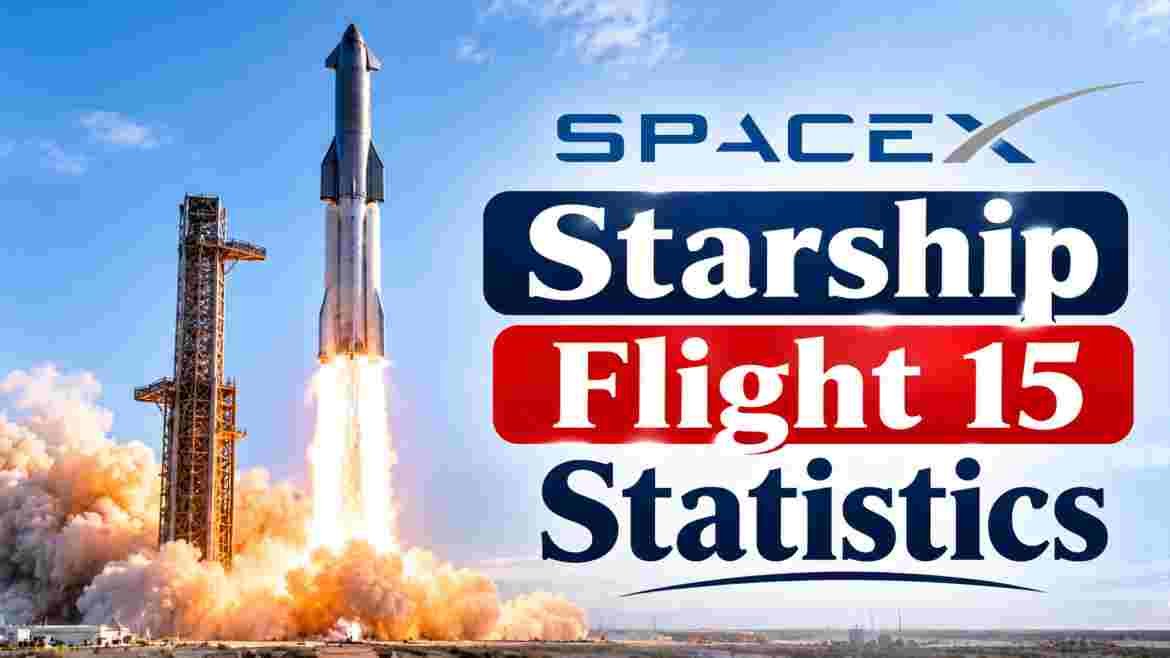
SpaceX Starship Flight 15 lifted off on November 13, 2026 at 22:47 UTC from Starbase, Texas, and its Ship 42 upper stage deployed all 26 Starlink V3 satellites by the 1 hour 17 minute mark. Booster 22 aborted its planned tower catch and splashed down in the Gulf of Mexico, while Ship 42 is on track for the first-ever Starship catch at about 21:20 UTC on November 14, an outcome not yet known at the time of writing.
SpaceX Starship Flight 15 in 2026 – Introduction
SpaceX Starship Flight 15 is the 15th launch of the world’s largest rocket and only the second operational flight of the system. It flew from Orbital Launch Pad 2 at Starbase on November 13, 2026, carrying 26 Starlink V3 satellites and attempting something no rocket has done: catching both stages of a launch vehicle at the tower after a single orbital flight. The mission is also the longest Starship flight to date, at about 22.5 hours.
Part of that plan worked on the first day. The ship reached orbit and deployed its satellites, while the Super Heavy booster aborted its catch and landed in the Gulf of Mexico. This report covers the launch numbers, the timeline, booster and ship recovery, the Starlink deployment, the flight history and the regulatory steps behind the flight. Figures run through November 14, 2026, about 13:00 UTC, and the ship’s landing attempt had not yet happened.
Interesting Facts about SpaceX Starship Flight 15 2026
STARSHIP FLIGHT 15 KEY NUMBERS
Starlink V3 satellites deployed  | ██████████████████████████ 26
Ship orbits planned              | ██████████████ 14
Planned mission length (hours)   | ██████████████████████ 22.5
Booster catches in history       | ███ 3 (Flights 5, 7 and 8)
| Fact | 2026 Data |
|---|---|
| Flight number | 15th Starship launch; second operational flight |
| Liftoff | November 13, 2026, 22:47 UTC (5:47 p.m. EST) |
| Launch site | Orbital Launch Pad 2, Starbase, Texas |
| Vehicles | Booster 22 and Ship 42 (Block 3, V3) |
| Starlink V3 satellites deployed | 26, complete by 1 hour 17 minutes |
| Orbit altitude | About 275 km (260 km while coasting) |
| Planned mission length | About 22.5 hours, 14 orbits |
| Booster 22 outcome | Catch aborted; splashdown in the Gulf of Mexico |
| Ship catch attempt | Planned for November 14 at 21:20 UTC (4:20 p.m. EST) |
| Propellant loaded | About 12 million pounds of liquid oxygen and methane |
Source: SpaceX statements via Space.com live coverage (November 14, 2026, 13:00 UTC); Next Spaceflight; The Week; Wikipedia, Starship flight 15.
The flight hit its main orbital goals. Ship 42 reached orbit about 26 minutes after liftoff and deployed all 26 Starlink V3 satellites by 1 hour 17 minutes. SpaceX then chose to skip the first early-return option and keep flying the full 14-orbit plan. The ship is on track to be the first Starship upper stage to attempt a tower catch.
The booster did not complete its recovery. Booster 22 was meant to be the first Block 3 booster caught at Orbital Launch Pad 2, but it aborted the catch and splashed down in the Gulf of Mexico. SpaceX spokesman Dan Huot said a guidance and navigation control problem was the likely cause. SpaceX has caught a booster three times before, on Flights 5, 7 and 8.
Starship Flight 15 Launch Statistics 2026: Date, Time and Launch Pad
LAUNCH TIME PLANNED VS ACTUAL (UTC)
Original target     | ██████████████████████ 22:45
Revised target      | ███████████████████████ 22:47
Actual liftoff      | ███████████████████████ 22:47
Launch window       | ███████████████████████████████████████ 75 minutes
| Launch Item | Data |
|---|---|
| Original target time | 22:45 UTC (4:45 p.m. CST) |
| Revised target time | 22:47 UTC, two minutes later |
| Actual liftoff | 22:47 UTC on November 13, 2026 |
| Launch window | 75 minutes |
| FAA launch license | Issued the afternoon of November 13 |
| Scope of license | Launch and return of both stages |
| Nationwide FAA ground stop | Occurred hours before launch; launch stayed on track |
| Propellant | About 12 million pounds |
Source: Space.com live updates, November 13-14, 2026; Wikipedia, Starship flight 15; Next Spaceflight.
The launch went off within about two minutes of the target. SpaceX opened a 75-minute window at 22:45 UTC and then moved liftoff two minutes later to 22:47 UTC. The FAA license arrived the afternoon of November 13, late for a mission of this size, and it covered the return of both stages. A rare nationwide FAA ground stop affected aircraft hours earlier, but SpaceX said it was still on track.
Fueling began about 45 minutes before launch with roughly 12 million pounds of liquid oxygen and liquid methane across both stages. SpaceX reported no technical, range or weather issues. Backup days on November 14 and 15 may have been available, based on road closure notices from Starbase officials. The launch happened on the first attempt.
Starship Flight 15 Timeline 2026: Liftoff to Orbit and Starlink Deployment
MISSION ELAPSED TIME OF KEY EVENTS (minutes after liftoff)
Stage separation (hot staging)     | ██ 2
Booster abort and splashdown       | ██████ 6
Orbit reached (engine cutoff)      | ████████ 8
Orbital insertion burn (planned)   | ██████████████ 26
Deployment starts (planned)        | █████████████████████ 35
All 26 Starlinks deployed          | ████████████████████████████████████████ 77
| Event | Time After Liftoff | Result |
|---|---|---|
| Liftoff | 0:00 | Success |
| Max Q | About 1 minute | Success |
| Stage separation and hot staging | About 2 minutes | Success; one booster engine may have shut down |
| Booster boostback and return | About 2 to 6 minutes | Catch aborted; splashdown in the Gulf |
| Ship engine cutoff (6 Raptors) | About 8 minutes | In orbit |
| Orbital insertion burn | About 26 minutes | Nominal |
| Starlink deployment begins | About 35 to 45 minutes | Under way |
| 12 of 26 satellites out | About 1 hour | Success |
| All 26 Starlinks deployed | 1 hour 17 minutes | Success |
| First early-return option (Hawaii) | About 1 hour 28 minutes | Skipped |
Source: Space.com live updates; Wikipedia, Starship flight 15 planned timeline; SpaceX statements via spokesman Dan Huot.
The ascent went almost to plan. The booster separated and began its return, and one of its 33 engines may have dropped out before the 13-engine boostback burn. The ship continued on all six Raptor engines and reached orbit at about 8 minutes. Its orbital insertion burn followed at about 26 minutes and lasted about 20 seconds.
Deployment started about 35 to 45 minutes after liftoff, slightly later than the 35-minute plan, and finished by 1 hour 17 minutes. SpaceX commentators said it would take about 40 minutes to release the satellites. Controllers skipped the first early-return option at the 90-minute point. The ship then began its long coast, which SpaceX said would be the longest Starship mission yet.
Booster 22 Super Heavy Recovery 2026: The Aborted Catch
SUPER HEAVY BOOSTER CATCHES BY FLIGHT
Flight 5  | ██████████ caught
Flight 7  | ██████████ caught
Flight 8  | ██████████ caught
Flight 15 | aborted, Gulf splashdown
| Booster Detail | Data |
|---|---|
| Booster | Booster 22, the first V3 booster planned for a return catch |
| Planned outcome | Tower catch at Orbital Launch Pad 2 about 6.5 minutes after launch |
| Actual outcome | Aborted catch; splashdown in the Gulf of Mexico |
| Likely cause (SpaceX) | Guidance and navigation control problem, under review |
| Previous catches | Flights 5, 7 and 8 |
| Engines | 33 Raptors; one may have dropped out early |
| Final catch test | November 10, including a suspended squeeze test at catch height |
| Static fire | October 25, 2026 |
Source: Space.com live updates; Wikipedia, Starship flight 15; The Week; SpaceX statements, November 2026.
SpaceX planned to catch Booster 22 in the tower’s chopstick arms about 6.5 minutes after liftoff, which would have been the first catch of a Block 3 booster and the first at Pad 2. The booster instead aborted and splashed down in the Gulf of Mexico, the planned fallback. SpaceX said it would investigate, and a guidance and navigation control issue is the likely cause. It did not give a definitive cause.
The abort does not undo earlier catch results. SpaceX caught Super Heavy boosters on Flights 5, 7 and 8, so the booster catch is not new, but this was the first try with the newest version. Booster 22 completed a squeeze test at catch height on November 10 before rollout. The company has not said when it will try another V3 booster catch.
Starlink V3 Deployment on Starship Flight 15 2026: 26 Satellites
STARLINK V3 SATELLITES DEPLOYED (cumulative)
After about 46 minutes | ███ 3
After about 1 hour     | ████████████ 12
After 1 hr 17 min      | ██████████████████████████ 26
| Deployment Metric | Data |
|---|---|
| Satellites carried | 26 Starlink V3 |
| Deployment started | About 35 to 45 minutes after liftoff |
| First checkpoint | 3 deployed |
| Second checkpoint | 12 deployed at about 1 hour |
| Deployment complete | 1 hour 17 minutes |
| Deployment duration | About 40 minutes, per SpaceX |
| Satellites on Flight 14 | 26 Starlink V3 |
| Heat shield check | Cameras on some Starlinks imaged the ship’s tiles |
Source: Space.com live updates, November 13-14, 2026; Wikipedia, Starship flight 15; SpaceX statements.
Ship 42 carried 26 Starlink V3 satellites, the same number deployed on Flight 14 in September. By about one hour after liftoff, 12 satellites were out, and the full set was deployed by 1 hour 17 minutes. The satellites came out of the ship’s payload bay, which Space.com described as Pez-dispenser-like. SpaceX said the process takes about 40 minutes.
Cameras on some of the Starlinks gave SpaceX a look at the ship. The ship rotated slowly during deployment so that a satellite camera could capture the heat shield. SpaceX’s heat shield team used that footage and ground cameras to confirm the shield was in good shape for reentry. That check matters for a mission built around landing the ship at the tower.
Ship 42 Orbital Flight Statistics 2026: 14 Orbits in 22.5 Hours
SHIP 42 FLIGHT PROFILE (hours after liftoff)
Early Hawaii return check      | █ 1.5
Mid Chile return check         | ███████ 7.3
Final Hawaii return check      | ████████████████████ 20.7
Deorbit burn                   | █████████████████████ 21.6
Planned landing                | ██████████████████████ 22.5
| Ship Metric | Data |
|---|---|
| Orbit altitude | About 275 km planned; 260 km while coasting |
| Orbital speed | About 26,442 km/h |
| Planned orbits | 14 |
| Planned flight length | About 22.5 hours |
| Early-return options | 3 (Hawaii at 1.5 hours, Chile at 7.3 hours, Hawaii at 20.7 hours) |
| Options used so far | 2 skipped; final check at about 20 hours into the flight |
| Deorbit burn | About 21.6 hours after liftoff |
| Landing burn start | About 22.5 hours after liftoff |
| Flight 14 comparison | Reached orbit; shortened by an engine shutdown; Pacific splashdown |
Source: Space.com live updates; Wikipedia, Starship flight 15 planned timeline; SpaceX statements via Dan Huot.
Ship 42 is on the longest Starship flight yet. By about 14 hours in, it was healthy and past the point where Flight 14 had to end early. Flight 14, on September 28, was the first orbital Starship flight, but one of the ship’s three vacuum Raptor engines shut down early, so SpaceX shortened the mission and splashed the ship down in the Pacific.
Flight controllers made two go decisions to continue, at 1.5 and 7 hours. The last early-return decision comes about 20 hours into the mission, around 19:00 UTC, when controllers must choose between landing at Starbase or splashing down near Hawaii. If the ship commits, it performs its deorbit burn around 21.6 hours, enters the atmosphere and attempts a landing burn at about 22.5 hours.
Starship Flight 15 Ship Catch Attempt 2026: First Catch of an Upper Stage
SHIP CATCH SEQUENCE (hours after liftoff, planned)
Deorbit burn           | ██████████████████████ 21.60
Atmospheric entry      | ██████████████████████ 22.18
Transonic              | ███████████████████████ 22.49
Landing burn start     | ███████████████████████ 22.54
Catch                  | ███████████████████████ 22.54
| Planned Step | Time After Liftoff |
|---|---|
| Deorbit burn start | 21:35:57 |
| Deorbit burn shutdown | 21:36:07 |
| Atmospheric entry | 22:10:46 |
| Transonic | 22:29:34 |
| Landing burn start | 22:32:16 |
| Landing flip | 22:32:18 |
| Landing burn shutdown and catch | 22:32:34 |
| Planned catch time | November 14, about 21:20 UTC (4:20 p.m. EST) |
Source: SpaceX planned timeline as reported by Wikipedia, Starship flight 15; Space.com live updates, November 14, 2026. Outcome not yet known at the time of writing.
The ship’s landing is the part of Flight 15 that has never been tried. SpaceX plans a deorbit burn about 21.6 hours after liftoff, entry at 22:10:46, a landing flip and a catch at 22:32:34, which falls around 21:20 UTC on November 14. The ship will fly a trajectory over the Pacific and glide back toward Starbase, with several ways to end the reentry safely if anything looks wrong.
Elon Musk said in September that a first-try ship catch had at least a 50 to 60 percent chance of success. If controllers or the tower are no-go, the ship has contingency options in the Gulf of Mexico or the Pacific. SpaceX posts a “Don’t Panic” message on the ship’s side. The outcome had not been reported when this report was written, so none is stated here.
Starship Flight History 2026: From Flight 5 to Flight 15
STARSHIP LAUNCHES AND BOOSTER CATCH RESULTS
Flight 5 (Oct 2024)  | █ first booster catch
Flight 7 (Jan 2025)  | █ booster caught, ship lost
Flight 8 (Mar 2025)  | █ booster caught, ship lost
Flight 14 (Sep 2026) | █ first orbital flight, 26 Starlinks
Flight 15 (Nov 2026) | █ first ship catch attempt
| Flight | Date | Result |
|---|---|---|
| Flight 5 | October 13, 2024 | First Super Heavy booster catch (Booster 12) |
| Flight 6 | November 19, 2024 | Booster catch called off after loss of tower communication |
| Flight 7 | January 16, 2025 | Booster 14 caught; ship lost to a propellant leak |
| Flight 8 | March 6, 2025 | Booster 15 caught; ship lost after engine shutdowns |
| Flight 14 | September 28, 2026 | First orbital flight; 26 Starlink V3 satellites deployed; Pacific splashdown |
| Flight 15 | November 13, 2026 | Ship orbit and 26 Starlinks; booster catch aborted; ship catch pending |
Source: Wikipedia flight test pages for Flights 5, 6, 7 and 8; Reuters via Wikipedia, Starship flight 15; Space.com, 2024-2026. Flights 9 to 13 are not listed here.
Starship’s catch approach developed in stages. Flight 5 caught a booster for the first time, on October 13, 2024. Flight 6 called off the catch when communication with the tower was lost. Flights 7 and 8 caught boosters again but lost their ships, one to a propellant leak and one after engine shutdowns. Flight 14 reached orbit and deployed 26 satellites.
Flight 15 is the next step: the ship’s first return to the launch site. The listed rows skip Flights 9 to 13, which this report did not verify. The Flight 14 mission ended early after one of the ship’s vacuum Raptor engines shut down. SpaceX called Flight 15 the second operational mission of the system, a shift from pure test flights toward satellite deployment and full reuse.
Block 3 Starship V3 Hardware 2026: What Flew on Flight 15
FLIGHT 15 VEHICLE FACTS
Booster engines (Raptors) | █████████████████████████████████ 33
Ship engines (Raptors)    | ██████ 6
Block 3 pairs flown       | ████ 4
| Hardware Item | Data |
|---|---|
| Vehicle generation | Block 3 (V3), the fourth pair to fly |
| Booster | Booster 22; first V3 booster planned for a return catch |
| Ship | Ship 42; first V3 ship planned for a return catch |
| Booster engines | 33 Raptors |
| Ship engines | 6 Raptors (3 sea-level, 3 vacuum) |
| Booster 22 static fire | October 25, 2026 |
| Ship 42 catch fit tests | September 11 and 12, 2026 |
| Special markings | “Don’t Panic” message; a tile installed by MrBeast |
Source: Wikipedia, Starship flight 15; Space.com live updates; SpaceX statements, 2026.
Flight 15 used the fourth pair of Block 3 vehicles. Booster 22 has 33 Raptor engines and Ship 42 has six. In September, Ship 42 was lifted by the tower’s chopstick arms in a simulated post-catch position, and it was tested against the ship quick-disconnect arm. Booster 22 fired its engines in a static fire on October 25.
The vehicles carried extra touches. Ship 42 had a “Don’t Panic” message on its side, a reference to The Hitchhiker’s Guide to the Galaxy. SpaceX also flew a heat shield tile that YouTube creator MrBeast installed. Neither affects performance. The Block 3 designs are meant to be fully reusable, and Flight 15 tests the recovery steps that reuse depends on.
Starship Flight 15 Preparations and Approvals 2026: Dates From October to Launch
DAYS BEFORE LAUNCH (November 13)
SpaceX announces double-catch plan (Oct 21) | ████████████████████████ 23
Booster 22 static fire (Oct 25)             | ███████████████████ 19
SpaceX releases flight details (Nov 7)      | ██████ 6
Booster 22 to pad, squeeze test (Nov 10)    | ███ 3
Ship 42 rolled out (Nov 12)                 | █ 1
| Date | Preparation Step |
|---|---|
| October 21, 2026 | SpaceX announces a simultaneous booster and ship catch attempt |
| October 25, 2026 | Booster 22 static fire |
| November 7, 2026 | SpaceX releases flight details and targets November 13 |
| November 10, 2026 | Booster 22 moves to the pad for final catch testing |
| November 12, 2026 | Ship 42 rolled out to the launch site |
| November 13, 2026 (afternoon) | FAA issues the launch license, including return of both stages |
| November 13, 2026, 22:47 UTC | Liftoff |
| November 14, 2026, about 21:20 UTC | Planned ship catch |
Source: Wikipedia, Starship flight 15; Space.com live updates and reporting, October-November 2026.
SpaceX announced the double-catch plan on October 21, 23 days before the launch, and released flight details on November 7. Booster 22 went to the pad on November 10 for final catch testing, and Ship 42 followed on November 12. The FAA license arrived on the afternoon of November 13, only hours before liftoff.
The sequence ran faster than some earlier campaigns. Flight 14 was moved to September 22 or later in earlier planning and flew on September 28. Flight 15 flew about 46 days after Flight 14. The gap between flights is a measure of SpaceX’s cadence, and the company says it aims for faster turnarounds as the V3 hardware matures.
SpaceX Starship Flight 15 in 2026 FAQ
When did Starship Flight 15 launch?
On November 13, 2026 at 22:47 UTC (5:47 p.m. EST) from Starbase, Texas.
What was the purpose of Starship Flight 15?
To deploy 26 Starlink V3 satellites and attempt the first catch of both Starship stages at the launch tower.
Did Starship Flight 15 deploy its Starlink satellites?
Yes. All 26 Starlink V3 satellites were deployed by 1 hour 17 minutes after liftoff.
Was the Super Heavy booster caught on Flight 15?
No. Booster 22 aborted its catch and splashed down in the Gulf of Mexico.
Why did the booster abort its catch?
SpaceX said a guidance and navigation control problem was the likely cause. A full review is under way.
Has a Starship upper stage ever been caught?
No. Ship 42 is planned to be the first, around 21:20 UTC on November 14.
Did the Starship Flight 15 ship land?
The landing attempt had not happened when this report was written. SpaceX planned it for about 21:20 UTC on November 14.
How long is Starship Flight 15?
About 22.5 hours, with 14 orbits.
How high did Ship 42 fly?
About 275 km planned, and about 260 km while coasting.
How many times has a Super Heavy booster been caught?
Three times, on Flights 5, 7 and 8.
What happened on Starship Flight 14?
Flight 14 on September 28, 2026 was the first orbital flight. It deployed 26 Starlink V3 satellites, then ended early after an engine shutdown.
What is a Block 3 Starship?
The V3 version of Starship. Flight 15 used the fourth pair of Block 3 vehicles, Booster 22 and Ship 42.
Did the FAA approve Starship Flight 15?
Yes. The FAA issued a license on November 13 that covered the launch and the return of both stages.
How much propellant does Starship use?
About 12 million pounds of liquid oxygen and liquid methane across both stages.
What are the chances of a successful ship catch?
Elon Musk estimated at least 50 to 60 percent in September for a first attempt.
What is the Don’t Panic message on Starship?
A message painted on Ship 42, a reference to The Hitchhiker’s Guide to the Galaxy.
Disclaimer: The data research report we present here is based on information found from various sources. We are not liable for any financial loss, errors, or damages of any kind that may result from the use of the information herein. We acknowledge that though we try to report accurately, we cannot verify the absolute facts of everything that has been represented.