
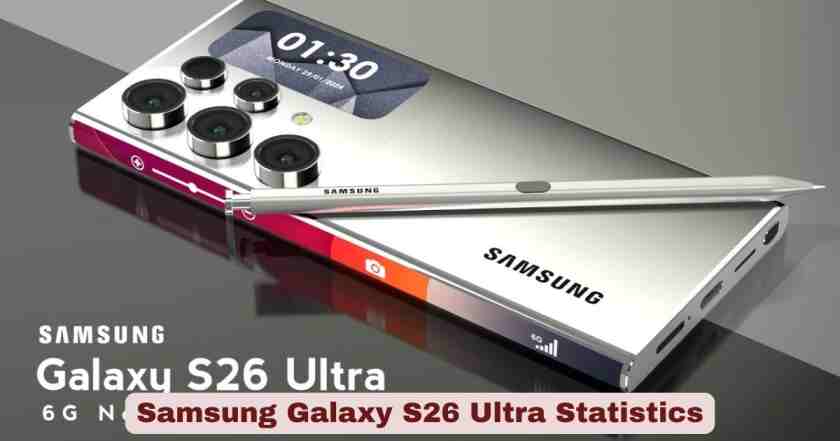
What is the Samsung Galaxy S26 Ultra?
The Samsung Galaxy S26 Ultra is Samsung’s most powerful flagship smartphone of 2026, officially announced at Galaxy Unpacked on February 25, 2026 in San Francisco and made available in stores globally from March 6–11, 2026. It sits at the apex of the three-model Galaxy S26 series — above the standard S26 and the S26+ — and continues the lineage of Samsung’s premium Ultra lineup that has defined Android’s high-end benchmark since the Galaxy S21 Ultra. The S26 Ultra arrives with a carefully curated set of upgrades rather than a ground-up redesign: a brighter main camera aperture widening from f/1.7 to f/1.4, the world’s first built-in Privacy Display on a smartphone, Samsung’s fastest-ever wired charging at 60W, and the overclocked Snapdragon 8 Elite Gen 5 for Galaxy chipset — exclusively reserved for the Ultra model across all global markets. What Samsung chose not to change is equally telling: the 5,000 mAh battery, 6.9-inch QHD+ AMOLED display, 200 MP main camera sensor, and S Pen all carry forward, confirming a philosophy of refinement over revolution. The result is a device that TechRadar described as “thinner, lighter, brighter — and a wild screen privacy feature” all in the same breath.
What makes the Galaxy S26 Ultra 2026 particularly significant in the broader smartphone landscape is the global pricing and chipset strategy Samsung deployed this time around. For the first time in the Galaxy S Ultra history, the Snapdragon 8 Elite Gen 5 for Galaxy is the universal chipset for the Ultra model worldwide — all markets, no exceptions. The starting price was held at $1,299 / £1,279 / AU$2,149 globally for the base 256 GB configuration, even as nearly all other Galaxy S26 storage variants saw price increases due to rising component costs and the elimination of the 128 GB entry tier. The S26 Ultra competes directly against the Apple iPhone 17 Pro Max, Google Pixel 10 Pro XL, Xiaomi 17 Ultra, and OnePlus 15 — a peer group that has aggressively pushed battery capacity, camera hardware, and charging speeds in 2026. Samsung’s decision to stay competitive on price while delivering measurable advances in display technology, performance, and AI capabilities reflects both the commercial pressure it faces from Chinese rivals and its supreme confidence in the enduring pull of the Galaxy Ultra brand worldwide.
Interesting Facts: Samsung Galaxy S26 Ultra 2026
| Fact | Detail |
|---|---|
| World first on the S26 Ultra | First smartphone ever to feature a built-in Privacy Display at the panel level |
| Announcement date | February 25, 2026 — Galaxy Unpacked, San Francisco |
| Global retail availability date | March 6, 2026 (most markets); March 11, 2026 (select markets incl. UK) |
| Chipset universality | Snapdragon 8 Elite Gen 5 for Galaxy on ALL global S26 Ultra units — no Exynos variant |
| AnTuTu benchmark score | 3.72 million — 71% faster than Galaxy S25 Ultra |
| Geekbench 6 single-core score | 3,629–3,761 range across verified benchmark runs |
| Geekbench 6 multi-core score | 10,981–11,454 — first Galaxy to cross 10,000 multi-core mark |
| Battery life improvement vs. S25 Ultra (Tom’s Guide test) | Nearly 2 hours longer in standardized web-browsing battery test |
| 30-minute charge level (Samsung claim) | 75% battery from 0% using Super Fast Charging 3.0 (60W PD) |
| Light improvement vs. S25 Ultra main camera aperture | f/1.4 captures 47% more light than the S25 Ultra’s f/1.7 |
| Vapour chamber thermal improvement | 21% greater thermal performance vs. S25 Ultra — Samsung official claim |
| Weight vs. S25 Ultra | 214 g vs. 218 g — 4 g lighter |
| Thickness vs. S25 Ultra | 7.9 mm vs. 8.2 mm — 0.3 mm slimmer — thinnest S Ultra ever |
| Galaxy AI language support as of March 2026 | Photo Assist and Creative Studio support 41 languages globally |
| Software update promise | 7 years of OS and security updates (through approximately Android 23) |
| S Pen retention | S Pen included — though air gesture remote control removed vs. S24 Ultra |
| S26 Ultra vs. S25 Ultra Geekbench single-core gap | Approx. +22% improvement (3,670 vs. S25 Ultra’s ~3,000 range) |
| Frame material change 2026 | Reverted from titanium back to Armor Aluminum — last used on Galaxy S23 Ultra |
| Charger in box | None — data cable and SIM ejection pin only |
| iRepairability note (March 2026) | New Galaxy S26 Ultra teardown praised for being significantly easier to open and replace battery vs. predecessors |
Source: Samsung.com, Wikipedia (Galaxy S26), GSMArena, PhoneArena, Sammy Fans, NotebookCheck, Tom’s Guide, Tech ARP (March 2026)
The Galaxy S26 Ultra 2026 facts above frame a device that has made bold architectural choices while playing it safe in others. The headline statistic is the one Samsung most wants the world to talk about: a 71% AnTuTu improvement over the S25 Ultra — which is, to put it plainly, one of the most dramatic generation-over-generation performance leaps in Samsung’s flagship history and one that comes entirely from the overclocked Snapdragon 8 Elite Gen 5 for Galaxy paired with a redesigned vapour chamber that allows the chip to sustain peak loads without throttling into thermal degradation. The world-first Privacy Display is not just a gimmick: it is panel-level technology developed under the codename “Flex Magic Pixel” by Samsung Display — meaning it integrates polarisation mechanics into the manufacturing process itself rather than layering a privacy film over an existing screen. The practical upshot is that the display looks completely normal to the user head-on while appearing dark to anyone trying to view it from the side — and it can be triggered automatically for specific apps, passwords, and notifications without any manual intervention.
The material and dimensional facts deserve more attention than they typically receive in reviews dominated by software features. Samsung’s decision to abandon the titanium frame it introduced on the S24 Ultra and return to Armor Aluminum was a deliberately counter-narrative move — the industry had spent two years declaring titanium the premium chassis material of choice, and Samsung reversed course because aluminum is a superior thermal conductor. With a Snapdragon 8 Elite Gen 5 running at overclocked prime core frequencies of 4.74 GHz, thermal management is not an afterthought but a core system design constraint, and the 21% thermal performance improvement that Samsung claims for the redesigned vapour chamber is directly enabled by the aluminum chassis conducting heat away from the SoC more efficiently. The fact that the S26 Ultra is now 4 grams lighter and 0.3 mm thinner than its predecessor while delivering all of these performance gains is a genuine engineering achievement that tends to get buried beneath the Privacy Display headlines — but for the hundreds of millions of people who carry a large-screen flagship in their pocket every day, it matters considerably.
Samsung Galaxy S26 Ultra Specs 2026 | Full Technical Specifications
| Specification | Samsung Galaxy S26 Ultra (2026) |
|---|---|
| Display size | 6.9 inches Dynamic LTPO AMOLED 2X |
| Display resolution | QHD+ (3,120 × 1,440 pixels) — ~522 ppi |
| Refresh rate | 1 Hz – 120 Hz adaptive (LTPO) |
| Peak brightness | 2,600 nits |
| Display glass | Corning Gorilla Armor 2 (front and back) |
| Display tech | HDR10+, 10-bit color, Samsung ProScaler, Privacy Display (world first) |
| Chipset | Qualcomm Snapdragon 8 Elite Gen 5 for Galaxy (TSMC 3nm N3P) |
| CPU configuration | 2+6 core layout; Prime cores at 4.74 GHz (overclocked) |
| RAM | 12 GB (256/512 GB models) / 16 GB (1 TB model) |
| Storage options | 256 GB / 512 GB / 1 TB — no microSD slot |
| Main camera | 200 MP, 1/1.3″ sensor, f/1.4 aperture, OIS, multi-directional PDAF |
| Ultra-wide camera | 50 MP, 1/2.5″ sensor, f/1.9, 120° FoV, dual-pixel PDAF |
| Telephoto 1 (3x) | 10 MP, 67mm equivalent, f/2.4, OIS, PDAF |
| Telephoto 2 (5x periscope) | 50 MP, 1/2.52″ sensor, f/2.9 (improved from f/3.4), OIS, ALoP mechanism |
| Max digital zoom | 100x Space Zoom |
| Front camera | 12 MP, Sony IMX874 sensor, wider FoV vs. S25 Ultra |
| Video | 8K@30fps, 4K@120fps, Super Steady with Horizon Lock (360° stabilisation) |
| Battery capacity | 5,000 mAh |
| Wired charging | 60W Super Fast Charging 3.0 (PD — charger not included) |
| Wireless charging | 25W Qi2.2 — no built-in magnets |
| Reverse wireless charging | Yes — can charge other Qi devices |
| Operating system | Android 16, One UI 8.5 at launch |
| Frame material | Armor Aluminum (reverted from titanium used on S24/S25 Ultra) |
| Dimensions | 163.6 × 78.1 × 7.9 mm |
| Weight | 214 g |
| Water resistance | IP68 (1.5 m for 30 minutes) |
| 5G support | Sub-6 GHz and mmWave; full 5G band list (n1–n261) |
| Connectivity | Wi-Fi 7, Bluetooth 5.4, NFC, UWB, USB 3.2 Gen 1 Type-C |
| S Pen | Included (no Bluetooth air gesture) |
| In-display fingerprint | Ultrasonic (3rd generation) |
| Colors (retail) | Black, White, Sky Blue, Cobalt Violet |
| Colors (Samsung.com exclusive) | Silver Shadow, Pink Gold |
| Satellite connectivity | Available via carrier network integration (select markets) |
Source: Samsung.com (official specs page), Wikipedia (Galaxy S26), GSMArena full specifications, PhoneArena, DXOMARK (camera spec sheet)
The full specification sheet of the Samsung Galaxy S26 Ultra 2026 confirms a device that is architecturally conservative in its core hardware — the 5,000 mAh battery and 200 MP main sensor are unchanged — but makes targeted improvements in the exact areas that affect real-world image quality and performance sustainability. The upgrade of the 5x periscope telephoto’s aperture from f/3.4 to f/2.9 is the kind of change that reads as a footnote but has substantial low-light zoom implications: a wider aperture on a telephoto lens is technically difficult to achieve while maintaining optical quality, and the introduction of Samsung’s new All Lens On Prism (ALoP) mechanism specifically enables this on the 5x module. Combined with the main camera’s jump to f/1.4 — capturing a confirmed 47% more light per frame than the S25 Ultra’s f/1.7 — the S26 Ultra now has two of its four rear cameras operating at significantly faster apertures than before. The Sony IMX874 front camera sensor replacing Samsung’s own ISOCELL unit is a notable procurement shift: Samsung chose a competitor’s sensor for selfies in a flagship product, signalling a pragmatic quality-first decision over in-house loyalty.
The connectivity and charging specifications reflect both Samsung’s strengths and its acknowledged weaknesses heading into 2026. The leap to 60W wired charging — ending years of criticism about the S Ultra series’ slow charging speeds — is genuinely meaningful: charging to 75% in 30 minutes from dead is a practical overnight-charge eliminator and addresses the single most consistent user complaint across the S24 and S25 Ultra cycles. However, the decision to support Qi2.2 wireless charging at 25W without built-in magnets is a notable omission — dbrand’s post-launch testing found that even Samsung’s own official magnetic cases cannot reliably deliver the full 25W wireless speeds, exposing an engineering compromise around the vertical camera array and S Pen that Samsung chose not to solve in 2026. The Wi-Fi 7 and Bluetooth 5.4 standards maintain parity with the latest Android flagship tier, and USB 3.2 Gen 1 at the port ensures fast wired data transfers for content creators who routinely move large 8K video files between the device and external storage.
Samsung Galaxy S26 Ultra Global Price 2026 | Regional Pricing Comparison
| Market | 256 GB (Base) | 512 GB | 1 TB |
|---|---|---|---|
| Global (USD reference) | $1,299 | $1,419 | $1,659 |
| United Kingdom | £1,279 | £1,399 | £1,659 |
| Australia | AU$2,149 | AU$2,349 | AU$2,749 |
| India | ₹1,39,999 | ₹1,59,999 | ₹1,89,999 |
| Europe (EUR) | €1,399 | €1,519 | €1,779 |
| UAE (AED) | AED 5,099 | AED 5,599 | AED 6,499 |
| Canada (CAD) | CAD 1,899 | CAD 2,099 | CAD 2,449 |
| Thailand (THB) | ฿47,900 | ฿52,900 | ฿61,900 |
| Malaysia | MYR 5,799 | MYR 6,399 | MYR 7,399 |
| South Korea | KRW 1,799,700 | KRW 1,955,700 | KRW 2,267,700 |
| Samsung.com global trade-in credit (max) | Up to $900 instant trade-in | — | — |
| Pre-order storage upgrade offer | 256 GB → 512 GB at no cost (selected regions, 48–72hr window) | — | — |
| 128 GB variant | Discontinued globally — S26 range now starts at 256 GB | — | — |
| Price change: 256 GB S26 Ultra vs. S25 Ultra (global average) | Unchanged at base — but 512 GB saw ~$120 increase and 1 TB saw larger hike | — | — |
Source: Tech ARP Samsung Galaxy S26 Series Price List (Feb 2026), My Mobile India (Feb 2026), Samsung.com regional pages, TechRadar review, Tom’s Guide review
The Samsung Galaxy S26 Ultra global pricing strategy in 2026 is one of the most deliberate competitive moves Samsung has made in the Ultra lineup’s history. Holding the 256 GB base price flat across all major markets — at a time when rising DRAM and NAND flash costs were pushing mid-range storage variants up by $80–$120 — was an explicit decision to protect market share against Apple’s iPhone 17 Pro Max and the rapidly improving Chinese flagship tier. Tech ARP’s global price analysis identified India and Malaysia as the markets with the highest year-over-year percentage price increases for the higher storage variants, driven by import duties and component sourcing costs that the base-model price freeze did not fully absorb. For the 1 TB configuration, the price jump has been universally acknowledged as steep: the $360 gap between the 256 GB and 1 TB models in the global reference pricing makes the mid-tier 512 GB variant a hard sell at $120 more than base — buyers in most markets are better served either accepting 256 GB or stretching to 1 TB than landing on the awkward middle configuration.
The pre-order ecosystem Samsung built around the S26 Ultra launch was extensive and regionally calibrated. The global headline offer — up to $900 instant trade-in credit applied at checkout rather than via monthly bill credits — represented a direct challenge to carrier-based trade-in models that consumers have historically found confusing. In select markets, the storage upgrade offer (getting the 512 GB model at the 256 GB price) during the first 48–72 hours of pre-order created genuine urgency that Samsung used to drive early sales volume. The discontinuation of the 128 GB tier globally is a structural shift that affects the entry price across the entire lineup — Samsung’s stated rationale is that 128 GB is no longer sufficient for modern app ecosystems and 4K–8K video recording habits, but the practical effect is to raise the floor price that any buyer must pay to enter the Samsung Galaxy S26 ecosystem, with the S26 Ultra in particular offering no path below $1,299 at retail.
Samsung Galaxy S26 Ultra Performance & Benchmark Statistics 2026
| Benchmark / Test | Galaxy S26 Ultra Score | Comparison |
|---|---|---|
| AnTuTu v10 (pre-launch leak) | 3,720,000 | 71% faster than Galaxy S25 Ultra |
| AnTuTu: vs. Galaxy S26+ (Exynos 2600) | S26 Ultra: 21% faster than S26+ in AnTuTu | — |
| Geekbench 6 — Single-core (post-launch verified) | 3,629–3,761 (multiple runs) | S25 Ultra: ~3,000 — ~22% improvement |
| Geekbench 6 — Multi-core (post-launch verified) | 10,981–11,454 | S25 Ultra: ~9,400 — first Galaxy to cross 10,000 |
| Geekbench 6 OpenCL (GPU) | 24,152 | Exynos 2600 scored 24,240 — near parity |
| Geekbench AI 1.5 vs. S25 Ultra | 71% higher NPU score | Reflects enhanced Snapdragon NPU generation |
| 3DMark Steel Nomad Light — Stress Test Stability | 53.2% | S25 Ultra: ~70% — lower sustained stability |
| CrossMark overall benchmark | Clear improvement vs. S25 Ultra | PCMark: Exynos S26+ ~8% ahead in work tasks |
| CPU improvement claim (Samsung official) | 19% faster CPU vs. S25 Ultra chipset | — |
| NPU improvement claim (Samsung official) | 39% faster NPU vs. S25 Ultra | Enables on-device Agentic AI tasks |
| GPU improvement claim (Samsung official) | 24% faster GPU vs. S25 Ultra | Adreno 840 with 18 MB dedicated HPM |
| Thermal performance improvement (Samsung) | 21% greater thermal efficiency vs. S25 Ultra | Redesigned vapour chamber + aluminum chassis |
| Peak temperature during intensive benchmarking | 44°C surface temperature reached | Heat dissipated to chassis — noticeable during gaming |
| Snapdragon 8 Elite Gen 5 prime core frequency | 4.74 GHz (overclocked “for Galaxy” from standard 4.61 GHz) | 6 perf cores at 3.63 GHz |
| Chip process node | TSMC 3nm (N3P) — refined from N3E on S25 generation | Samsung Exynos 2600 uses Samsung 2nm GAA |
Source: Sammy Fans (Feb 2026), NotebookCheck (Feb 2026), Gizmochina (Feb 2026), Tech ARP Performance Review (March 2026), MakeUseOf benchmark review (March 2026), Samsung official press release
The Samsung Galaxy S26 Ultra performance benchmark data for 2026 tells a story of extraordinary raw power tempered by interesting thermal trade-offs that distinguish it from its own predecessor. The 71% AnTuTu improvement is the figure that dominates every benchmark roundup, but it requires contextualisation: AnTuTu scores reflect a mix of CPU, GPU, memory, and UX performance in a brief burst test rather than sustained workload, which is why the 3DMark stress test stability score of 53.2% against the S25 Ultra’s roughly 70% is the more nuanced finding. The S26 Ultra is faster at peak but throttles more aggressively under sustained loads — the aluminium chassis dissipates heat better than titanium, but that heat goes directly into the chassis surface, which is why reviewers consistently reported the phone feeling warm to hot during extended gaming sessions. Samsung’s engineering solution — the redesigned vapour chamber delivering 21% greater thermal performance — keeps the Snapdragon from sustained thermal throttling while the temperature spike of 16.6°C above ambient during peak benchmark loads is something buyers planning marathon gaming sessions should be aware of before purchase.
The Exynos 2600 vs. Snapdragon 8 Elite Gen 5 debate — which has defined Samsung chipset conversations since the Exynos 990 era — has reached its most even point yet in 2026. The Exynos 2600 inside the Galaxy S26 and S26+ in non-Snapdragon markets trails the Snapdragon S26 Ultra by only 10–18% in CPU single-core while achieving near-parity or a slight lead in GPU OpenCL tests — marking a genuine breakthrough for Samsung Foundry’s first 2nm GAA production node. The commercial significance is substantial: if Samsung can eliminate the Exynos performance penalty entirely by the Galaxy S27 generation, it regains pricing and supply chain flexibility in markets where it currently has to absorb the cost of sourcing Qualcomm chips. For buyers of the S26 Ultra specifically, however, the chip question is settled globally — every unit ships with Snapdragon 8 Elite Gen 5 for Galaxy — making it the first S Ultra in recent years where no buyer anywhere in the world receives a second-tier chipset experience.
Samsung Galaxy S26 Ultra Camera Statistics 2026 | DXOMARK, Aperture & Zoom Data
| Metric | Galaxy S26 Ultra 2026 |
|---|---|
| Main camera resolution | 200 MP, 1/1.3″ sensor, 0.6 µm pixels |
| Main camera aperture | f/1.4 (widened from f/1.7 on S25 Ultra — 47% more light) |
| Ultra-wide camera | 50 MP, 1/2.5″ sensor, f/1.9, 120° FoV |
| 3x telephoto | 10 MP, f/2.4, 67mm equivalent — unchanged from S25 Ultra |
| 5x periscope telephoto | 50 MP, 1/2.52″ sensor, f/2.9 (improved from f/3.4) with new ALoP mechanism |
| Maximum optical zoom | 5x (optical) — 10x (optical quality via Adaptive Pixel) |
| Maximum digital zoom | 100x Space Zoom |
| Front camera | 12 MP, Sony IMX874 (new supplier vs. Samsung ISOCELL on S25 Ultra) |
| DXOMARK assessment | “Meaningful and well-implemented improvements over previous generation — particularly low-light“ |
| DXOMARK finding on competitors | “Does not yet challenge segment leaders” (Xiaomi 17 Ultra, etc.) |
| Low-light improvement driver | Faster aperture + AI noise reduction via new image signal processor |
| Video stabilization | Super Steady with Horizon Lock — 360° rotation stabilisation (gyro + accelerometer) |
| 8K video support | 8K @ 30 fps |
| 4K video support | 4K @ up to 120 fps |
| Default capture resolution | 12 MP (200 MP mode available manually) |
| Expert RAW new feature 2026 | Virtual Reflector — simulates fill reflector for balanced portrait exposure |
| Photo Assist (Galaxy AI) languages | 41 languages as of March 2026 |
| Autofocus in low light | Still lags behind best-in-class per DXOMARK — ultra-wide AF in low light a noted weakness |
| Compared to Xiaomi 17 Ultra | Xiaomi 17 Ultra has 1-inch main sensor vs. S26 Ultra’s 1/1.3-inch — larger sensor size |
| 3x telephoto criticism | Widely noted as feeling dated vs. competition — 10 MP sensor unchanged for multiple generations |
Source: DXOMARK Samsung Galaxy S26 Ultra Camera Test (March 2026), PetaPixel review (March 2026), Digital Camera World hands-on review (March 2026), Samsung official camera specs, Wikipedia (Galaxy S26)
The DXOMARK camera assessment and real-world review data for the Galaxy S26 Ultra 2026 reveals a camera system that has made genuine, measurable improvements in its two most-used scenarios — daylight main camera and night photography — while trailing the bleeding edge of Android camera technology in areas it has not meaningfully addressed in multiple generations. The 47% light-gathering improvement from the f/1.4 main aperture is not marketing spin — it is a physical optics reality, and reviewers across PetaPixel, Digital Camera World, and Tom’s Guide all confirmed that low-light main camera and 5x telephoto performance have taken a meaningful step forward in 2026, with DXOMARK specifically noting improvements in texture, noise trade-off, color accuracy, and telephoto consistency compared to the S25 Ultra. The new ALoP (All Lens On Prism) mechanism in the 5x periscope module — replacing the traditional moving-element periscope design — enables the wider f/2.9 aperture while maintaining the compact profile required for a 7.9 mm thin body.
Where the camera data gets complicated is in the competitive context. The Xiaomi 17 Ultra’s 1-inch main sensor is physically larger than the S26 Ultra’s 1/1.3-inch sensor, creating a light-gathering ceiling that aperture improvements alone cannot fully close. The 10 MP 3x telephoto — noted by GSMArena, Trusted Reviews, and Digital Camera World as a weak link — has remained at 10 MP for multiple generations while rivals have upgraded to 50 MP or larger mid-range telephoto sensors, and in a market where Chinese flagship cameras are advancing rapidly, the gap is widening rather than narrowing. DXOMARK’s summary finding that the S26 Ultra is “a substantial and coherent upgrade that strengthens Samsung’s position and brings it closer to the front of the pack without fully closing the gap” is diplomatically precise: Samsung’s camera is better, but it has not caught up with the leaders it is chasing. For the mainstream buyer who values consistent, reliable, well-processed photos across all conditions, the S26 Ultra remains one of the top two or three camera phones in the world — it is only at the rarefied technical top that the competitive position is under pressure.
Samsung Galaxy S26 Ultra Battery & Charging Statistics 2026
| Metric | Galaxy S26 Ultra 2026 |
|---|---|
| Battery capacity | 5,000 mAh (unchanged from S25 Ultra) |
| Wired charging speed | 60W Super Fast Charging 3.0 (PD) — first time on S Ultra |
| 0→75% charge time (Samsung claim) | 30 minutes |
| 0→70% charge time (Variety review test) | ~30 minutes (independently confirmed) |
| Wireless charging speed | 25W Qi2.2 |
| Reverse wireless charging | Yes (can charge Qi-compatible devices) |
| Charger included in box | No — data cable and SIM ejection pin only |
| Tom’s Guide battery test result | ~2 hours longer than Galaxy S25 Ultra |
| Tom’s Guide battery test result vs. iPhone 17 Pro Max | iPhone 17 Pro Max is ~2 hours ahead of S26 Ultra |
| Real-world screen-on time (Droid-life review) | 7.5 hours average screen-on time with 20–30% battery remaining at end of day (7am–10pm) |
| Variety review battery summary | “Almost two full days on a single charge with regular use” |
| Video playback endurance | Samsung claims over 30 hours continuous video |
| OnePlus 15 comparison (silicon-carbon battery) | OnePlus 15 with 7,300 mAh Si/C battery: 25+ hours in Tom’s Guide test |
| Samsung silicon-carbon battery status | “Still investigating” — per Samsung statement to Tom’s Guide |
| Qi2.2 magnet issue | No built-in magnets — dbrand testing confirmed max wireless speeds unreliable without external case magnets |
| Battery improvement source | Snapdragon 8 Elite Gen 5 efficiency gains + improved cooling (not larger battery) |
Source: Tom’s Guide Samsung Galaxy S26 Ultra Review (March 2026), Droid-Life full review (March 2026), Variety smartphone review (March 2026), TechRadar review (March 2026), Samsung official press release, dbrand testing (March 2026)
The battery and charging story of the Samsung Galaxy S26 Ultra 2026 is one of the most clearly bifurcated narratives in any flagship review cycle this year — genuinely impressive gains in certain dimensions, meaningful gaps to close in others. The arrival of 60W Super Fast Charging is not a trivial milestone: it ends three consecutive generations (S23, S24, S25 Ultra) where Samsung’s Ultra wired charging speed sat between 25–45W while Chinese rivals offered 65W, 80W, and even 120W. The confirmed 75% charge in 30 minutes figure has been independently replicated by multiple reviewers and represents a real change in daily charging behaviour for owners who previously needed to leave the phone on the charger for an hour or more to reach a comfortable level. The real-world battery endurance improvements — documented as nearly two hours longer than the S25 Ultra in Tom’s Guide’s standardised test — come from the efficiency improvements in the Snapdragon 8 Elite Gen 5 chip rather than any increase in battery capacity, which reflects Samsung’s approach of maximising what the existing chemistry can do rather than pursuing the silicon-carbon battery technology that now gives rivals like the OnePlus 15 a 7,300 mAh capacity in roughly the same device footprint.
The silicon-carbon battery gap is the clearest structural weakness in the Galaxy S26 Ultra’s 2026 battery data. Tom’s Guide’s finding that the iPhone 17 Pro Max beats the S26 Ultra by approximately two hours in standardised battery testing — and that the OnePlus 15’s 7,300 mAh silicon-carbon pack comfortably outlasts both — positions Samsung as the third-best performer on battery endurance among the three flagship Android-era competitors it most directly competes with. Samsung’s official statement confirming it is “still investigating” silicon-carbon technology, while competitors have already deployed it in mass-market products, signals that the Galaxy S27 Ultra will likely close this gap — but it is a gap that exists in 2026. The missing in-box charger — requiring a separate 60W PD purchase to unlock the flagship’s headline charging speed — continues to generate criticism across all major review outlets and represents a cost-of-ownership consideration that buyers in every global market need to factor into the real purchase price of the S26 Ultra.
Samsung Galaxy S26 Ultra vs. Competitors 2026 | Key Comparison Stats
| Feature | Galaxy S26 Ultra | iPhone 17 Pro Max | Google Pixel 10 Pro XL | Xiaomi 17 Ultra |
|---|---|---|---|---|
| Starting global price (approx.) | $1,299 | ~$1,199 | ~$1,099 | ~$1,099 |
| Display size | 6.9″ QHD+ AMOLED | 6.9″ Super Retina XDR | 6.8″ LTPO OLED | 6.73″ AMOLED |
| Chipset | Snapdragon 8 Elite Gen 5 | Apple A19 Pro | Google Tensor G5 | Snapdragon 8 Elite Gen 5 |
| Main camera | 200 MP f/1.4 | 48 MP f/1.78 | 50 MP f/1.68 | 200 MP f/1.63 |
| Main sensor size | 1/1.3″ | ~1/1.28″ | ~1/1.3″ | 1 inch |
| Battery capacity | 5,000 mAh | 4,685 mAh | 5,050 mAh | 6,200 mAh Si/C |
| Wired charging | 60W | ~25W | ~45W | 90W |
| Wireless charging | 25W Qi2.2 | 25W MagSafe | 23W | 80W wireless |
| Battery life (Tom’s Guide web test) | Solid — ~2 hrs ahead of S25 Ultra | ~2 hrs ahead of S26 Ultra | Competitive | Leads the field |
| Software update promise | 7 years | 5–6 years est. | 7 years | 4 years |
| S Pen | Yes (included) | No | No | No |
| Privacy Display | Yes (world first) | No | No | No |
| MagSafe / built-in magnets | No (Qi2.2, no magnets) | Yes (MagSafe) | Yes (Qi2 magnets) | No |
| OS | Android 16, One UI 8.5 | iOS 19 | Android 16 | Android 16 |
Source: TechRadar, Tom’s Guide, GSMArena, Trusted Reviews, MakeUseOf (all published March 2026)
The competitive comparison data for the Samsung Galaxy S26 Ultra in 2026 reveals a flagship that wins convincingly in some areas, holds its own in others, and clearly trails in specific metrics that a growing segment of the market is beginning to weight heavily. The S26 Ultra’s $1,299 global starting price places it higher than both the Google Pixel 10 Pro XL and technically above a base iPhone 17 Pro Max, which means Samsung is pricing the S26 Ultra as a premium product among premium products — and needs to justify that premium through differentiated capabilities. The case for the premium rests on three pillars that no competitor matches simultaneously: the S Pen stylus input, the world-first Privacy Display, and a camera system with 200 MP main and 50 MP periscope modules at apertures that no rival has matched. The case against the premium rests on battery capacity and endurance, where the Xiaomi 17 Ultra’s 6,200 mAh silicon-carbon battery and 90W wired charging make Samsung’s 5,000 mAh / 60W combination look restrained, and on camera raw quality, where DXOMARK has the Xiaomi and certain other Chinese flagships ahead.
The software and longevity comparison is where the Galaxy S26 Ultra builds its most durable competitive advantage. The 7-year OS update promise — matching Google Pixel but beating Apple’s iOS support trajectory for current models — means a buyer purchasing the S26 Ultra in March 2026 can reasonably expect to receive security patches and major Android versions through approximately 2033. In an era of $1,299 flagship prices, this is not an abstract feature: it is a total cost of ownership argument that fundamentally changes the per-year cost of the device. Divided across seven years, the S26 Ultra’s global base price works out to approximately $186 per year — a figure that changes the calculation significantly for buyers who previously replaced phones every two years under the assumption that software support would expire. The Snapdragon 8 Elite Gen 5’s NPU performance advantage over Google’s Tensor G5 — quantified at a 71% Geekbench AI gap — is also directly relevant to the AI feature trajectory, since more powerful NPU hardware enables more ambitious on-device AI processing without cloud dependency in future One UI versions.
Samsung Galaxy S26 Ultra Galaxy AI Features 2026 | Software & AI Data
| AI Feature | Detail |
|---|---|
| Galaxy AI suite branding | Galaxy AI — Samsung’s unified on-device + cloud AI platform |
| Now Nudge | Proactively surfaces contextual information before the user asks — powered by Snapdragon NPU |
| Now Brief | Single-view AI digest of news, weather, tasks, and calendar — personalized daily one-pager |
| Photo Assist | Natural-language photo editing: “Make this his birthday party” → AI adds decorations, objects |
| Photo Assist language support | 41 languages as of March 2026 |
| Now Nudge + Now Brief language support | 13 languages — more limited than Photo Assist |
| Creative Studio | 41 languages supported — AI video and image creative tools |
| Audio Eraser | Removes or reduces background noise in recordings and videos — works on previously captured content too |
| Live Interpreter | Real-time translation — 20+ languages |
| AI in front camera (new 2026) | AI Image Signal Processor (ISP) for more natural, realistic selfies |
| Call screening AI | Screens calls and extracts key information; works with Bixby, Google Gemini, and Perplexity |
| Virtual Reflector (Expert RAW) | New for 2026 — AI simulates a fill reflector in Expert RAW for balanced portrait exposure |
| Agentic AI direction | S26 Ultra marketed as the beginning of Samsung’s “Agentic AI” era — AI that takes actions, not just responds |
| AI features cost model | Samsung Galaxy AI basic features: free. Enhanced/third-party AI features may have separate terms or fees |
| On-device vs. cloud AI processing | Snapdragon 8 Elite Gen 5’s enhanced NPU enables more tasks on-device without internet |
| Samsung account requirement | Required for Photo Assist and several Galaxy AI tools |
| Bixby 2026 update | AI-infused Bixby via One UI 8.5 enables more natural conversational responses and settings control |
Source: Samsung.com (official Galaxy AI page), Samsung press release (Feb 2026), Tech Advisor review (Feb 2026), Variety review (March 2026), Samsung India FAQ
The Galaxy AI feature set on the Samsung Galaxy S26 Ultra in 2026 represents Samsung’s clearest articulation yet of what it wants AI on a smartphone to actually mean in daily life. The headline framing — “Agentic AI”, a term Samsung introduced at Galaxy Unpacked — positions the S26 Ultra not as a device that answers questions but as one that anticipates needs, takes initiative, and acts on behalf of the user without requiring explicit prompts. Now Nudge is the purest expression of this philosophy: instead of requiring the user to open an app and ask a question, it surfaces relevant information — a traffic alert before a scheduled meeting, a reminder about a prescription when passing a pharmacy — automatically, using context from the user’s calendar, location, and app activity. The Now Brief daily digest takes this further, compressing the morning information-gathering ritual into a single AI-generated screen that pulls from news, weather, messages, and calendar — a feature that reviewers at Variety described as genuinely useful rather than a demo-only capability.
The Photo Assist capability supporting 41 languages is the statistic that most accurately reflects the global reach and ambition of Samsung’s AI deployment. For a software feature that allows users to describe what they want in a photo — “Remove the person in the background,” “Add birthday decorations,” “Make this scene look like sunset” — to function fluently in 41 languages as of March 2026 marks a meaningful milestone in making AI editing tools accessible beyond English-speaking markets. The monetisation model Samsung has chosen — core Galaxy AI features free, enhanced and third-party AI tools potentially paid — is a commercially sensible hedge that avoids the consumer backlash that subscription paywall AI features have triggered elsewhere, while preserving optionality to charge for premium AI capabilities as the Agentic AI feature set matures over the device’s 7-year software support window. The 39% NPU improvement of the Snapdragon 8 Elite Gen 5 over its predecessor is not just a benchmark number — it is the hardware foundation that makes the entire Agentic AI ambition viable without routing every AI request through a cloud server, which matters acutely for privacy, latency, and global markets with slower or more expensive mobile data.
Disclaimer: This research report is compiled from publicly available sources. While reasonable efforts have been made to ensure accuracy, no representation or warranty, express or implied, is given as to the completeness or reliability of the information. We accept no liability for any errors, omissions, losses, or damages of any kind arising from the use of this report.