
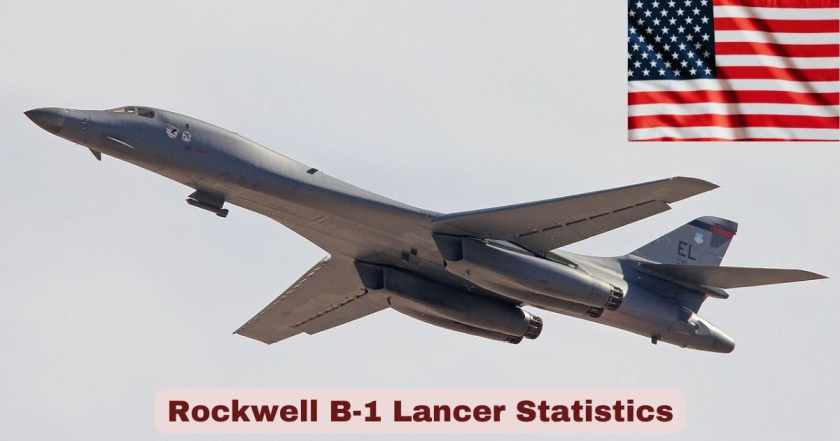
Rockwell B-1 Lancer in America 2026
The Rockwell B-1 Lancer — officially designated the B-1B and affectionately nicknamed “The Bone” (a phonetic nod to B-ONE) — stands as one of the most powerful and storied long-range strategic bombers ever built by the United States military. Originally conceived during the Cold War as a supersonic, low-altitude penetrating bomber designed to slip through Soviet air defenses, the B-1B Lancer has reinvented itself multiple times over four decades of service. Today, in 2026, it remains a cornerstone of the U.S. Air Force Global Strike Command (AFGSC), operated from two primary active-duty bases — Dyess Air Force Base in Texas and Ellsworth Air Force Base in South Dakota — and is regarded as the backbone of America’s conventional long-range bomber force.
In the most headline-grabbing mission of its career, B-1B Lancers flew non-stop from Ellsworth AFB, South Dakota, to strike Iranian ballistic missile sites and command and control centres in March 2026 as part of Operation Epic Fury — the first-ever direct continental U.S. to Iran combat strike by the Lancer, officially confirmed by CENTCOM. What makes the Rockwell B-1 Lancer uniquely remarkable in America’s 2026 defense posture is its unmatched combination of range, speed, and payload. No other aircraft in the entire U.S. Air Force (USAF) inventory can carry as large a conventional weapons load as the B-1B — up to 75,000 pounds (34,019 kilograms) of mixed guided and unguided munitions across three internal weapons bays. With a current active fleet of 45 aircraft, the B-1B is undergoing a carefully managed transition period, receiving critical avionics, weapons, and survivability upgrades even as the Air Force prepares to phase the aircraft out in favor of the next-generation B-21 Raider stealth bomber. The Lancer’s legacy of combat performance — from the deserts of Iraq to the mountains of Afghanistan — ensures it will remain a vital strike asset well into the early 2030s.
Interesting Facts About the Rockwell B-1 Lancer 2026
Before diving into the detailed statistics, here are some of the most striking and little-known facts about the B-1B Lancer that define its legacy and current status in 2026.
| Fact Category | Key Detail |
|---|---|
| Nickname | “The Bone” (from B-ONE phonetic pronunciation) |
| Original Developer | Rockwell International (North American Aircraft Division); now Boeing |
| Cold War Role | Designed to penetrate Soviet airspace at high speed and low altitude |
| Nuclear Role Eliminated | 1994 (START Treaty); conversion fully completed March 2011 under New START |
| First B-1B Combat Mission | Operation Desert Fox, December 1998 |
| World Records Held | Nearly 50 official records for speed, payload, range, and time-to-climb in its class |
| Operation Enduring Freedom Stat | 8 B-1Bs dropped ~40% of all coalition bomb tonnage in the first 6 months |
| Operation Iraqi Freedom Stat | Flew less than 1% of combat missions but delivered 43% of all JDAMs used |
| Operation Allied Force Stat | 6 B-1Bs delivered more than 20% of total ordnance while flying less than 2% of sorties |
| April 2018 Syria Strike | Two B-1Bs launched 19 JASSM cruise missiles — the first-ever combat use of JASSM |
| Only LRASM Carrier | The B-1B is the USAF’s sole carrier of the Long-Range Anti-Ship Missile (LRASM) |
| Maintenance Burden | A single flight hour requires approximately 48.4 hours of maintenance work |
| Post-9/11 Sorties | Flew over 12,000 sorties in Syria, Libya, Afghanistan, and Iraq since 2001 |
| 2011 Libya Milestone | First B-1Bs to fly a combat mission directly from the continental United States |
| Congressional Fleet Mandate | Congress mandates the USAF maintain a minimum fleet of 45 operational B-1Bs until B-21 transition |
Source: U.S. Air Force Official Fact Sheet, af.mil; Air & Space Forces Magazine Almanac; Wikipedia – Rockwell B-1 Lancer (verified citations from USAF and AFGSC)
The facts above reveal just how extraordinary the B-1B Lancer’s combat track record truly is. Few aircraft in aviation history have achieved the kind of weapons efficiency demonstrated by the Lancer in Iraq and Afghanistan — delivering nearly half of all precision-guided munitions used while flying a fraction of the total sorties. The revelation that 48.4 maintenance hours are required for every single flight hour underscores why the Air Force is carefully managing the fleet’s draw-down while simultaneously ensuring enough airframes remain operationally ready to meet current and near-term mission requirements. The JASSM milestone in Syria in 2018 marked a new chapter for the Bone, transitioning it from a legacy penetrating bomber to a potent standoff strike platform — a role it continues to develop in 2026 with new hypersonic and external pylon upgrades now in testing.
The B-1B’s record as the sole U.S. carrier of the Long-Range Anti-Ship Missile (LRASM) is particularly significant given the current strategic emphasis on the Indo-Pacific theater, where the ability to threaten adversary naval assets at long range is a critical deterrence tool. Meanwhile, the congressional mandate locking the fleet at 45 aircraft reflects the political and strategic reality that the B-21 Raider must reach sufficient operational numbers before the Lancer can be safely retired — a transition the Air Force currently targets for completion around 2032–2036.
Rockwell B-1 Lancer 2026 General Specifications – Core Performance Data
| Specification | Official Data |
|---|---|
| Primary Function | Long-range, multi-role, heavy bomber |
| Contractor | Boeing (formerly Rockwell International); Offensive Avionics: Boeing Military Airplane; Defensive Avionics: EDO Corporation |
| Power Plant | Four General Electric F101-GE-102 turbofan engines with afterburner |
| Thrust Per Engine | 30,000+ pounds with afterburner |
| Wingspan (Extended/Forward) | 137 feet (41.8 meters) |
| Wingspan (Swept Aft) | 79 feet (24.1 meters) |
| Length | 146 feet (44.5 meters) |
| Height | 34 feet (10.4 meters) |
| Empty Weight | Approximately 190,000 pounds (86,183 kilograms) |
| Maximum Takeoff Weight | 477,000 pounds (216,634 kilograms) |
| Internal Fuel Capacity | 265,274 pounds (120,326 kilograms) |
| Maximum Payload | 75,000 pounds (34,019 kilograms) |
| Maximum Speed | 900+ mph (Mach 1.2 at sea level) |
| Range | Intercontinental |
| Service Ceiling | More than 30,000 feet (9,144 meters) |
| Crew | Four (Aircraft Commander, Copilot, two Combat Systems Officers) |
| Unit Cost (Original) | $317 million per aircraft |
| Initial Operating Capability | October 1, 1986 |
Source: Official U.S. Air Force Fact Sheet – B-1B Lancer, af.mil (verified); Air & Space Forces Magazine B-1B Almanac Entry
The B-1B Lancer’s core performance figures paint the picture of a machine engineered at the absolute edge of Cold War aerospace technology. A maximum takeoff weight of 477,000 pounds — nearly a quarter of a million kilograms — combined with a fuel load exceeding 265,000 pounds gives the Lancer its defining characteristic: intercontinental reach without aerial refueling, and extended loiter time over target areas when tanker support is available. The variable-geometry swing-wing design, spanning from 137 feet extended to just 79 feet swept aft, is not merely an engineering curiosity — it directly enables the Bone to transition from a high-drag, stable takeoff and landing configuration to a low-drag, high-speed combat penetration profile, achieving Mach 1.2 at sea level — faster than many dedicated fighter aircraft at altitude.
The four General Electric F101-GE-102 turbofans, each producing over 30,000 pounds of thrust with afterburner, provide the raw power needed to push a 190,000-pound empty airframe to supersonic speeds while carrying a weapons load that no other aircraft in the American arsenal can match. The $317 million unit cost — reflecting the complexity of the avionics, airframe, and propulsion systems — helps explain why only 100 B-1Bs were ever produced, and why the Air Force has chosen to carefully sustain the 45-aircraft fleet with targeted upgrades rather than attempting a costly procurement of additional airframes.
Rockwell B-1 Lancer 2026 Fleet Inventory & Current Status
| Fleet Metric | Data |
|---|---|
| Total B-1Bs Produced | 104 aircraft |
| Current Active Inventory (2025–2026) | 45 aircraft |
| Test Aircraft | 2 (at Edwards AFB, California) |
| ANG / Reserve Inventory | 0 |
| Primary Operators | Air Force Global Strike Command (AFGSC), Air Force Materiel Command (AFMC) |
| Primary Bases | Dyess AFB, Texas; Ellsworth AFB, South Dakota |
| Test & Evaluation Base | Edwards AFB, California; Eglin AFB, Florida |
| FY2021 Retirements | 17 aircraft retired (least serviceable airframes) |
| Fleet After FY2021 Retirements | 45 aircraft |
| Congressional Floor Mandate | Minimum 45 operational B-1Bs required by law until B-21 replaces them |
| Planned Full Retirement | Approximately 2032–2036 (conditions-based) |
| B-21 Raider Replacement Target | B-21 production well underway; 100+ planned |
| Mission Capable Rate (2019 low) | Only 6 aircraft were available for regular operations in 2019 |
| Post-FY21 Mission Capable Rate | Improved significantly after retiring least serviceable airframes |
Source: Air & Space Forces Magazine 2025 Almanac; U.S. Air Force Fact Sheet, af.mil; Air Force Times (2021); 19FortyFive (2025–2026)
The B-1B fleet’s journey from 104 aircraft at peak production down to the current 45 is a story defined equally by operational over-use, budgetary constraints, and deliberate strategic reconfiguration. The 17 retirements executed in FY2021 were not a sign of the Lancer losing relevance — they were a calculated decision to concentrate maintenance resources on the most capable airframes and drive mission-capable rates back up after years of unsustainable operational tempo in the Middle East. The infamous 2019 readiness crisis, when only 6 B-1Bs were available for regular operations out of the entire fleet, served as a stark warning that continuous combat operations in harsh desert environments had pushed the airframes well beyond their original design parameters.
In 2026, the 45-aircraft fleet maintains a congressionally mandated floor, with a previously retired aircraft nicknamed “Lancelot” even pulled back from the Davis-Monthan “Boneyard” in Arizona to replace a fire-damaged active-duty Lancer. This underscores how tightly the Air Force is managing every single airframe as the critical bridge period to the B-21 Raider continues. The AFGSC has been clear: the B-1B will not be retired on a fixed date but rather on a conditions-based timeline, ensuring the U.S. long-range conventional strike capacity does not degrade during the transition.
Rockwell B-1 Lancer Weapons & Armament Capabilities
| Weapons System / Munition | Capacity / Detail |
|---|---|
| Internal Weapons Bays | Three internal bays |
| Maximum Payload | 75,000 pounds (34,019 kg) — largest conventional payload in USAF |
| Mk-82 General Purpose Bombs (500 lb) | Up to 84 |
| Mk-84 General Purpose Bombs (2,000 lb) | Up to 24 |
| Mk-62 Naval Mines (500 lb) | Up to 84 |
| Mk-65 Naval Mines (2,000 lb) | Up to 8 |
| CBU Cluster Munitions (CBU-87/89/97) | Up to 30 |
| Wind-Corrected Munitions Dispensers (CBU-103/104/105) | Up to 30 |
| GBU-31 JDAM (2,000 lb) | Up to 24 |
| GBU-38 JDAM (500 lb) | Up to 15 |
| GBU-54 Laser JDAM | Up to 15 |
| AGM-158A JASSM (Joint Air-to-Surface Standoff Missile) | Up to 24 internally; LAM pylons to enable 36 JASSM/LRASM |
| Long-Range Anti-Ship Missile (LRASM) | Sole USAF carrier of LRASM |
| Load Adaptable Modular (LAM) Pylons (FY2025+) | External pylons enabling hypersonic weapons, 5,000-lb class guided bombs |
| Hypersonic Attack Cruise Missile (HACM) | Under development for integration |
| First JASSM Combat Use | April 2018, Syria (19 missiles launched by 2 B-1Bs) |
Source: U.S. Air Force Official Fact Sheet, af.mil; Air & Space Forces Magazine B-1B Platform Entry; AFGSC Public Affairs
The B-1B Lancer’s weapons carrying capacity is, quite simply, unmatched in the American inventory — and this single fact is the primary reason the USAF continues to invest in the platform despite its age and maintenance challenges. The ability to carry 84 Mk-82 general-purpose bombs or 24 GBU-31 JDAMs in a single sortie, combined with the aircraft’s intercontinental range and Mach 1.2 speed, means one B-1B crew can deliver what would otherwise require multiple smaller strike aircraft and the logistical tail that goes with them. The transition to standoff weapons — particularly the AGM-158A JASSM and the Long-Range Anti-Ship Missile (LRASM) — has fundamentally extended the Lancer’s operational relevance into an era of advanced air defenses where penetrating strike missions are far riskier than they were in the 1990s and 2000s.
The FY2025 introduction of the Load Adaptable Modular (LAM) pylon system is perhaps the most significant capability leap for the B-1B in over a decade. By reactivating and modifying the aircraft’s external hardpoints — long dormant since their nuclear role was eliminated under START treaties — the LAM pylons will expand the Lancer’s JASSM and LRASM capacity from 24 internal missiles to 36 total, and will eventually allow carriage of developmental hypersonic weapons including the Hypersonic Attack Cruise Missile (HACM). This upgrade directly responds to the Indo-Pacific theater’s demand for mass, range, and precision — making the B-1B an even more formidable conventional deterrent in 2026 than it was five years ago.
Rockwell B-1 Lancer 2026 – Combat History Statistics
| Operation / Conflict | B-1B Role & Statistics |
|---|---|
| Operation Desert Fox (Dec. 1998) | First-ever B-1B combat deployment; struck Iraqi targets |
| Operation Allied Force (1999 – Kosovo) | 6 B-1Bs flew less than 2% of sorties, delivered 20%+ of total ordnance |
| Operation Enduring Freedom – First 6 Months (Oct. 2001–Mar. 2002) | 8 B-1Bs dropped ~40% of all coalition bomb tonnage; ~3,900 JDAMs dropped (67% of total) |
| Operation Iraqi Freedom | Flew less than 1% of combat missions; delivered 43% of all JDAMs used |
| Operation Enduring Freedom (through 2010) | Dropped 42% of weapons used despite flying only 16% of sorties |
| Afghanistan 2011 Operations | Flew 1,200 combat sorties; executed 3,000 tactical air requests; intervened in 432 ground engagements |
| Operation Odyssey Dawn (Libya, March 2011) | First combat mission flown directly from the continental U.S. (Ellsworth AFB, SD) |
| 2018 Syria Strikes (April 18, 2018) | 2 B-1Bs launched 19 JASSM missiles — first-ever combat use of JASSM |
| Post-9/11 Total Sorties | 12,000+ sorties across Syria, Libya, Afghanistan, and Iraq since 2001 |
| Bomber Task Force – Indo-Pacific (2025) | First-ever B-1B BTF deployment to Misawa Air Base, Japan (April 2025) |
| Operation Epic Fury – Iran (March 1–2, 2026) | 3 B-1Bs (BONE 01/02/03) flew non-stop from Ellsworth AFB, SD to strike Iranian ballistic missile sites and C2 centers — first-ever direct CONUS-to-Iran B-1B combat strike; CENTCOM confirmed |
Source: U.S. Air Force Fact Sheet, af.mil; USAF Official Airframe Profile Data; Air & Space Forces Magazine; AFGSC Public Affairs Releases
No combat aircraft in the post-Cold War U.S. Air Force has delivered a more disproportionate share of precision firepower relative to sorties flown than the B-1B Lancer. The statistics from Operation Enduring Freedom and Operation Iraqi Freedom are not just impressive — they are strategically defining. In Afghanistan, eight aircraft delivered 40 percent of all coalition bomb tonnage in the first six months of the war. In Iraq, the Bone flew less than 1 percent of combat sorties yet accounted for 43 percent of every JDAM dropped — a ratio that speaks to the aircraft’s unmatched combination of payload volume, precision targeting capability, and long loiter time over contested battlespace. The 2018 Syria strike added another historic chapter: the first operational firing of the AGM-158A JASSM in combat, validating the B-1B’s transformation into a long-range standoff strike platform for the modern era.
The April 2025 Bomber Task Force deployment to Japan — the first time B-1Bs have ever conducted a BTF mission from Misawa Air Base — signals how central the Lancer remains to U.S. Indo-Pacific deterrence strategy in 2026. As tensions with China over Taiwan and the broader Western Pacific theater have intensified U.S. military posture in the region, the B-1B’s ability to rapidly deploy, carry LRASM for anti-ship strike missions, and integrate with allied forces makes it a uniquely relevant asset that the USAF cannot yet afford to retire.
Rockwell B-1 Lancer 2026 – Operating Costs & Maintenance Statistics
| Cost / Maintenance Metric | Data |
|---|---|
| Operating Cost Per Flight Hour (FY2026 estimate) | ~$91,330 per flight hour |
| Maintenance Hours Per Flight Hour | ~48.4 maintenance hours per 1 flight hour |
| Cost of a 12-Hour Mission (baseline, 2010) | $720,000 (~$1.01 million in 2024 dollars) |
| Cost to Repair Least Serviceable FY2021 Airframes | $10 million–$30 million per aircraft (estimate, AFGSC) |
| Fire Damage to One Aircraft (2019 maintenance incident) | ~$15 million in damage |
| Comparison: B-52H Cost Per Flight Hour | ~$72,000 (per flight hour, for comparison) |
| Comparison: B-2 Spirit Cost Per Flight Hour | ~$135,000 (per flight hour, for comparison) |
| Number of Airframes Retired FY2021 to Cut Costs | 17 aircraft |
| Personnel Required per Aircraft | Significantly higher than B-21; contributes to sustainment challenges |
Source: Wikipedia – Rockwell B-1 Lancer (citing USAF data); National Priorities Project (citing DoD FY2026 rates, January 2026); Air Force Times (2021); AFGSC Public Affairs
The B-1B Lancer’s operating economics in 2026 reflect the brutal reality of maintaining a 40-year-old swing-wing bomber designed for a strategic mission that no longer exists in its original form. At approximately $91,330 per flight hour — a figure reported in January 2026 by the National Priorities Project citing Department of Defense fixed-rate data — the Lancer is substantially more expensive to operate than the B-52H (~$72,000/hour) but considerably cheaper than the B-2 Spirit (~$135,000/hour). The 48.4 maintenance hours required for every single flight hour is perhaps the most telling statistic of all: it means that for every hour a B-1B spends airborne, a team of maintainers has spent the equivalent of more than six standard work days preparing, inspecting, repairing, and certifying that aircraft for flight.
These cost and maintenance pressures are the primary drivers behind the decision to retire the 17 least serviceable airframes in FY2021, a move that cost the Air Force a portion of its bomber capacity but dramatically improved the mission-capable rates of the remaining 45 aircraft. The fact that one fire-damaged Lancer required $15 million in repairs — and the Air Force judged it cheaper to pull a retired aircraft (“Lancelot”) from the Davis-Monthan Boneyard — speaks directly to why the Bone is being carefully shepherded through its final operational decade rather than subjected to the same punishing operational tempo that crippled the fleet’s readiness in 2019.
Rockwell B-1 Lancer – Upgrades & Modernization Programs
| Upgrade Program | Detail & Status |
|---|---|
| Integrated Battle Station (IBS) | Three-part upgrade completed September 2020; added all-digital glass cockpit, FIDL Link-16 data link, and Central Integrated Test System (CITS) |
| Fully Integrated Data Link (FIDL) | Provides secure beyond-line-of-sight (BLOS) command and control connectivity |
| Load Adaptable Modular (LAM) Pylons | FY2025 installation program; enables external carriage of JASSM, LRASM, hypersonic weapons, 5,000-lb guided bombs |
| JASSM Capacity Increase via LAM | Expands from 24 internal JASSM to 36 JASSM/LRASM total |
| MIDS/JTRS Data Link Modernization | Improved situational awareness and retargeting capabilities |
| BLOS Cryptography Updates | Radio crypto modernization for MUOS secure, jam-resistant satellite comms |
| Synthetic Aperture Radar Upgrade | Improved reliability; potential ultra-high-resolution capability and automatic target recognition |
| Hypersonic Attack Cruise Missile (HACM) Integration | Under development; B-1B in testing as hypersonic weapons carrier |
| B-52 Hypersonic Test Role Transfer | B-1B being upgraded to replace B-52 in the hypersonic weapons test role |
| Radar Warning Receiver (ALQ-161) | Enhanced electronic countermeasures; detects full spectrum of adversary emitters |
| Towed Decoy System (ALE-50) | Integrated decoy for survivability in contested airspace |
Source: Air & Space Forces Magazine B-1B Platform Entry (2025); U.S. Air Force Fact Sheet, af.mil; AFGSC Official Statements
The B-1B Lancer’s modernization roadmap in 2026 tells the story of an aircraft being simultaneously prepared for retirement and made more capable than it has ever been — a paradox that reflects the strategic reality of a bomber fleet in transition. The Integrated Battle Station (IBS) upgrade, completed in September 2020, was described by the Air Force as the most comprehensive upgrade to the Lancer fleet to date, replacing analog cockpit instrumentation with a fully digital glass cockpit and fundamentally transforming how crews interact with mission systems, targeting data, and command networks. The addition of Link-16 connectivity via FIDL means B-1B crews can now receive and act on real-time targeting data from the Combined Air Operations Center and other assets — a critical capability for time-sensitive targeting in fast-moving, dynamic battlespaces.
The FY2025 Load Adaptable Modular (LAM) pylon program is the upgrade that most directly defines the Lancer’s role in 2026 and beyond. By reopening the aircraft’s external hardpoints — which have been inactive for decades — the USAF is dramatically expanding the B-1B’s weapons flexibility without requiring a new airframe. The ability to carry hypersonic weapons externally, alongside the ongoing work to integrate the Hypersonic Attack Cruise Missile (HACM), positions the Bone as a critical bridge platform between today’s subsonic standoff strike environment and the hypersonic warfare era that U.S. military planners are actively preparing for. Far from winding down, the B-1B Lancer in 2026 is flying missions, deploying to new theaters, and fielding weapons systems that did not exist when it was built — a remarkable achievement for any aircraft platform after four decades of continuous evolution.
Rockwell B-1 Lancer 2026 – Operation Epic Fury — Iran Strikes
In the most significant combat deployment of the B-1B Lancer in recent history, U.S. CENTCOM officially confirmed in March 2026 that B-1B Lancers struck targets deep inside Iran as part of Operation Epic Fury — a large-scale U.S. and Israeli joint military offensive targeting Iran’s ballistic missile infrastructure, command and control networks, and military sites.
| Operation Epic Fury — B-1B Lancer Key Facts (March 2026) | Confirmed Detail |
|---|---|
| Operation Name | Operation Epic Fury |
| Date of B-1B Strikes | Night of March 1–2, 2026 |
| Aircraft Involved | 3 B-1B Lancers (callsigns: BONE 01, BONE 02, BONE 03) |
| Home Base of Departure | Ellsworth Air Force Base, South Dakota |
| Flight Route | Ellsworth AFB → across the Atlantic → through the Mediterranean → Iran |
| Mission Type | Direct strike mission (non-stop intercontinental strike with aerial refueling support) |
| Targets Struck | Above-ground Iranian ballistic missile sites and command & control centres |
| CENTCOM Confirmation | Official CENTCOM social media post confirmed strikes; video released showing 3 B-1Bs departing at night |
| Day 1 Total Targets Hit (Operation-Wide) | More than 1,000 targets struck across Iran in the first 24 hours of the operation |
| Preceded By | B-2 Spirit stealth bomber raids on Night 1 (Feb. 28–Mar. 1) to degrade Iran’s S-400 and Bavar-373 air defenses |
| Significance | First confirmed B-1B combat strikes against Iran; first direct CONUS-to-Iran intercontinental B-1B strike mission |
| USAF Announcement | Chairman of the Joint Chiefs Gen. Dan Caine confirmed B-1B use at live Pentagon press conference |
Source: The Aviationist (March 2, 2026) — theaviationist.com; CENTCOM Official Statement (March 2, 2026); Times of Israel (Barak Ravid, March 2, 2026); Air & Space Forces Magazine
The B-1B Lancer’s role in Operation Epic Fury represents a defining moment in the aircraft’s operational legacy — and a powerful demonstration of the USAF’s ability to project devastating conventional strike power directly from the continental United States to targets anywhere on earth. The three Lancers — tracked by aviation enthusiasts under callsigns BONE 01, BONE 02, and BONE 03 as they departed Ellsworth AFB, South Dakota — flew non-stop across the Atlantic Ocean and through the Mediterranean, supported by a chain of aerial refueling tankers positioned along the route, before delivering precision strikes on Iranian ballistic missile sites and command and control centres in the early hours of March 2, 2026. The mission confirmed what military analysts had long argued: the B-1B, even in its fourth decade of service, remains the United States’ primary “bomb truck” for high-volume conventional strike operations.
The strategic sequencing of Operation Epic Fury itself tells a critical story about how the B-1B fits into modern high-end warfare. On Night 1, B-2 Spirit stealth bombers were dispatched to dismantle Iran’s sophisticated S-400 and Bavar-373 air defense networks — the most advanced surface-to-air missile systems in Iran’s arsenal, capable of threatening non-stealth aircraft. Only once those defenses were suppressed was it deemed safe to deploy the B-1B Lancers, which arrived on Night 2 to exploit the air superiority that the stealth aircraft had established and deliver the massive conventional payload that only the Bone can carry. This sequenced employment — stealth first, then the B-1B as the high-volume follow-on striker — is precisely the operational model the USAF has planned for the Lancer in any future high-end conflict, and Operation Epic Fury validated that concept in live combat for the first time.
Rockwell B-1 Lancer 2026 – Program History & Production Statistics
| Program Milestone | Date / Data |
|---|---|
| B-1A Program Initiated | Early 1970s (replacement for B-52) |
| B-1A Prototypes Built | 4 aircraft |
| B-1A Program Canceled | 1977 (President Carter administration) |
| B-1B Program Revived | 1981 (President Reagan administration) |
| First B-1B Production Flight | October 18, 1984 |
| First B-1B Delivered to USAF | June 1985 (Dyess AFB, Texas) |
| Initial Operating Capability | October 1, 1986 (Dyess AFB, Texas) |
| Final B-1B Delivered | May 2, 1988 |
| Total B-1Bs Produced | 104 aircraft |
| Original Fleet at Start of 2000s | 93 aircraft (7 lost in accidents by 2000) |
| Fleet Reduced to (2003) | 67 aircraft (33 retired for budget consolidation) |
| Fleet Restored (2004) | 67 aircraft (7 returned from storage) |
| Fleet After FY2021 Retirements | 45 aircraft |
| Aircraft Lost in Accidents (total) | Multiple; notable losses include training accidents and maintenance incidents |
| Ellsworth Landing Accident | January 4, 2023 (all 4 crew ejected safely) |
| World Records Held | Nearly 50 records for speed, payload, range, time-to-climb |
| Nuclear Mission Deactivated | 1994 |
| Full Conventional Conversion Completed | March 2011 (under New START Treaty) |
Source: U.S. Air Force Fact Sheet, af.mil; Air & Space Forces Magazine; Wikipedia – Rockwell B-1 Lancer (citing official USAF and program records)
The B-1 Lancer program is one of the most politically and strategically turbulent aircraft development histories in American military aviation. Conceived in the early 1970s as a supersonic replacement for the B-52, the original B-1A was canceled by President Carter in 1977 before a single production aircraft was delivered — a decision driven by faith in cruise missiles and intercontinental ballistic missiles as the primary nuclear deterrent. The program’s revival under President Reagan in 1981 produced the substantially improved B-1B, which addressed radar cross-section reduction, increased payload capacity by 74,000 pounds over the A model, and incorporated advanced electronic countermeasures — though at the cost of reducing the maximum speed from the B-1A’s Mach 2.2 to the B-1B’s Mach 1.2, a direct result of inlet modifications made during the stealth redesign.
From 104 aircraft produced between 1984 and 1988, the B-1B fleet has been shaped by combat, cost, and strategic evolution into the 45-aircraft force flying in 2026. The nearly 50 world records the aircraft holds — including benchmarks for speed with payload, range, and time-to-climb in its class — are a permanent testament to what American aerospace engineering achieved with the B-1B Lancer. As the B-21 Raider ramps up production and the B-1B approaches its final decade of service, the Lancer’s place in the history of American airpower is already secured — not as the Cold War nuclear penetrator it was designed to be, but as the most versatile and lethal conventional heavy bomber the United States has ever operated in combat.
Disclaimer: This research report is compiled from publicly available sources. While reasonable efforts have been made to ensure accuracy, no representation or warranty, express or implied, is given as to the completeness or reliability of the information. We accept no liability for any errors, omissions, losses, or damages of any kind arising from the use of this report.