
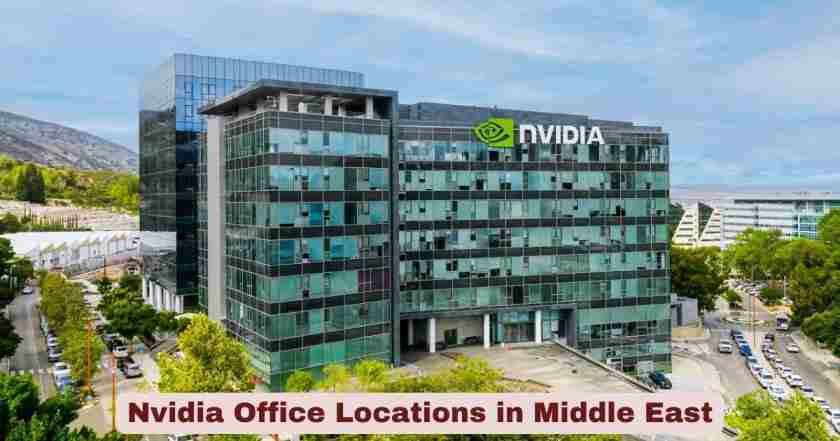
Where Are the Nvidia’s Office Locations in the Middle East?
Nvidia, the world’s most valuable semiconductor company and the undisputed engine of the global AI revolution, has built a Middle East presence unlike any other chip company on the planet — and it is growing faster than almost any comparable tech footprint in the region. As of April 2026, Nvidia operates across two very distinct dimensions in the Middle East. The first is Israel, where the company employs approximately 5,000 to 6,000 people across seven R&D centres — making it one of Israel’s largest private-sector technology employers and what CEO Jensen Huang has publicly called Nvidia’s “second home.” The second dimension is the Gulf, where Nvidia’s commercial and strategic presence is defined not by large office headcounts but by the extraordinary commercial weight of its chip and AI infrastructure deals — from the 18,000 Blackwell GPU sale to Saudi Arabia’s HUMAIN to the Stargate UAE AI campus and the first NVAITC joint AI and robotics lab in the Middle East, opened at Abu Dhabi’s Technology Innovation Institute in September 2025. Nvidia’s Middle East story in 2026 is simultaneously one of deep engineering roots — built through the $6.9 billion Mellanox acquisition — and transformational new commercial partnerships worth tens of billions of dollars.
What makes Nvidia’s Middle East position in 2026 uniquely dramatic is that it sits at the intersection of the biggest technology investment wave in the region’s history and an active geopolitical conflict that is directly threatening the company’s assets and employees. In early March 2026, as the Iran-Israel war escalated, Jensen Huang sent an internal company memo confirming that Nvidia had temporarily closed its Dubai office with employees switching to remote work — noting that its crisis management team was “working around the clock” to support roughly 6,000 employees based in Israel and their families. On March 31, 2026, Iran’s Revolutionary Guard Corps named Nvidia among 17 American tech companies it declared legitimate military targets in the region. Against this turbulent backdrop, the company’s long-term investment signals — most dramatically the $28 million land purchase in Kiryat Tivon for a 160,000 sq m, 10,000-employee campus planned for 2031 — tell the story of a company that is not flinching from the Middle East, but doubling down on it.
Interesting Facts About Nvidia Office Locations in the Middle East 2026
Here are the most striking and verified facts about Nvidia’s Middle East presence in 2026 — the data points that frame everything else in this article before the detailed section-by-section breakdown.
| # | Fact | Detail |
|---|---|---|
| 1 | Nvidia employees in Israel | ~5,000–6,000 — Nvidia is one of Israel’s largest private tech employers |
| 2 | Israel is Nvidia’s second-largest R&D hub globally | Outside the United States — confirmed by Calcalist, Ynet, Times of Israel (2025) |
| 3 | Yokneam — Israeli headquarters | ~3,000 employees at Yokneam, Nvidia’s primary Israeli site (former Mellanox HQ) |
| 4 | Jensen Huang’s own words on Israel | “Israel is home to some of the world’s most brilliant technologists and has become Nvidia’s second home” — December 18, 2025 |
| 5 | Kiryat Tivon campus announced | 160,000 sq m, accommodates up to 10,000 employees — construction starts 2027, occupancy 2031 |
| 6 | Land purchase for Kiryat Tivon | NIS 90 million (~$28 million) — first time Nvidia owns land outside the US for a campus |
| 7 | Mellanox acquisition | $6.9 billion — closed 2020 — transformed Israel into Nvidia’s global engineering hub |
| 8 | Israeli acquisitions post-Mellanox | Run:AI ($700–800M, 2024), Deci ($300M, 2024), Illumex (~$60M, 2026), Excelero (2022) |
| 9 | Combined value of Israeli acquisitions | Exceeds $8 billion including Mellanox |
| 10 | Nvidia’s annual revenue from Israel operations | Estimated at more than $30 billion annually (Calcalist, December 2025) |
| 11 | Networking division revenue (quarterly) | $7.25 billion in Q2 FY2025 — generated from Mellanox-based IP — already exceeds acquisition cost per quarter |
| 12 | Dubai office | Present in Dubai Internet City, UAE — temporarily closed March 2026 due to Iran-Israel conflict |
| 13 | TII-NVAITC Joint Lab Abu Dhabi | Middle East’s first Nvidia AI Technology Centre — launched September 22, 2025 with Abu Dhabi’s TII |
| 14 | HUMAIN chip deal (Saudi Arabia) | 18,000 Blackwell GB300 chips — powering 500 MW of Saudi data centres — announced May 2025 |
| 15 | HUMAIN 3-year GPU target | Up to 600,000 Nvidia GPUs deployed across Saudi Arabia over 3 years |
| 16 | Stargate UAE involvement | Nvidia supplies Blackwell hardware for the 1-gigawatt Stargate UAE AI campus (with OpenAI, Oracle, Cisco, G42) |
| 17 | Nvidia’s global revenue (FY2026, ending Jan 2026) | $215.94 billion — up 65.47% year-on-year |
| 18 | Nvidia named on IRGC target list | March 31, 2026 — named among 17 US tech companies threatened by Iran’s Revolutionary Guard Corps |
Source: Calcalist Tech (multiple editions, July–December 2025), Times of Israel (July 2025, December 2025), Ynet News (October 2025, December 2025), Israel Hayom (January 2025, January 2026), CNBC (March 3, 2026), Futunn News (March 2026), TII press release (September 22, 2025), Nvidia Newsroom (May 2025), Foreign Policy (March 31, 2026), MacroTrends (NVIDIA revenue)
Reading these facts together, Nvidia’s Middle East story in 2026 is fundamentally different from every other US tech company’s regional presence. Most companies in the region — Microsoft, Google, Meta, AWS — are primarily there to sell services, build cloud infrastructure, or manage commercial partnerships. Nvidia is there because Israel has become the engineering foundation of its most important product lines. The Mellanox-born networking division alone generates an estimated $30 billion annually from Israeli-developed technology — meaning that in a single recent quarter, the Mellanox IP generated more revenue for Nvidia than the entire $6.9 billion acquisition cost. That is not a commercial partnership; that is a core operational dependency that makes Israel irreplaceable to Nvidia’s global business.
The Gulf dimension is different in character but equally consequential in scale. 18,000 Blackwell chips to Saudi Arabia, 600,000 GPU target over three years, a 1-gigawatt AI campus in Abu Dhabi — these are not incremental sales; they are the hardware foundation of entire national AI strategies. Nvidia CEO Jensen Huang personally flew to Riyadh as part of President Trump’s May 2025 Gulf tour to announce the HUMAIN deal, standing alongside Crown Prince Mohammed bin Salman. The IRGC naming Nvidia as a military target on the last day of March 2026 — the same day this article was written — is a measure of just how deeply embedded Nvidia has become in the region’s technology infrastructure, and how significant a target that infrastructure now represents.
Nvidia Israel Office Locations 2026 — Overview
| Israeli Location | Role / Function | Key Facts |
|---|---|---|
| Yokneam | Israeli headquarters — primary R&D hub | ~3,000 employees; former Mellanox HQ; Nvidia expanding with additional 15,000 sq m building |
| Tel Aviv (Rubinstein Twin Towers) | Major R&D hub — AI software, language models | 18 floors (8 original + 10 added in 2025); doubled office space in one year |
| Ra’anana | R&D centre | Key site; part of original Mellanox/Nvidia Israel footprint |
| Mevo Carmel | R&D centre | Supports Yokneam cluster operations |
| Tel Hai | R&D centre — northern Israel | Development hub |
| Be’er Sheva | Expanding R&D centre — southern Israel | Moving to new 3,000 sq m facility in Gav-Yam Negev High-Tech Park (H1 2026); tripling footprint |
| Kiryat Tivon (planned) | Future mega-campus | 160,000 sq m, up to 10,000 employees — construction 2027, occupancy 2031 |
| Jerusalem | R&D centre | Listed in Times of Israel as one of 7 R&D centres |
Source: Times of Israel (July 7, 2025), Ynet News (October 26, 2025), Calcalist Tech (October 26, 2025; December 18, 2025; December 31, 2025), Israel Hayom (January 15, 2025), Israel National News (December 18, 2025)
Nvidia’s Israeli office network in 2026 is the most geographically distributed and fastest-growing R&D footprint of any US technology company in the country. Seven confirmed R&D centres spanning from the northern town of Tel Hai down to Be’er Sheva in the Negev desert — with Yokneam anchoring the northern cluster as the Israeli headquarters — represent a deliberate strategy of embedding Nvidia’s engineering talent across multiple Israeli cities and universities rather than concentrating everything in Tel Aviv. The Yokneam site, built on the foundations of Mellanox’s original headquarters in the Ofer Industrial Park, remains the largest single site with approximately 3,000 of Nvidia’s roughly 5,000 Israeli employees. It is the home of the networking and interconnect engineering teams that produce Nvidia’s InfiniBand and Ethernet products — the connective tissue of every major AI data centre in the world.
The Tel Aviv expansion in 2025 was one of the most visible signals of Nvidia’s accelerating Israeli ambitions. The company doubled its Tel Aviv footprint in a single year, going from 8 floors to 18 floors in the Rubinstein Twin Towers — an addition of ten floors that dwarfs what most companies add in several years. The teams housed in Tel Aviv increasingly work on AI software, language models, and the output of Nvidia’s acquisitions of Deci and Run:AI — meaning the city is becoming the software complement to Yokneam’s hardware engineering base. Meanwhile, the Be’er Sheva expansion — moving to a new 3,000 sq m facility in the Gav-Yam Negev High-Tech Park adjacent to Ben-Gurion University in the first half of 2026 — reflects Nvidia’s deliberate strategy of tapping Israel’s southern university ecosystem for the next generation of chip developers and software engineers.
Nvidia Kiryat Tivon Mega-Campus Statistics 2026
| Kiryat Tivon Campus Parameter | Data |
|---|---|
| Announced | December 18, 2025 |
| Location | Kiryat Tivon, northern Israel (near Yokneam) |
| Campus size | 160,000 square metres |
| Land size | 90 dunams (~22.5 acres / ~90,000 sq m) |
| Land acquisition | Purchased from Israel Land Authority (ILA) — first Nvidia-owned land outside the US |
| Land cost | NIS 90 million (~$28 million) — at a 51% discount (vs standard ILA rate of 91%) |
| Planned employee capacity | Up to 10,000 employees — double current Israeli workforce |
| Construction start | ~2027 (after planning processes complete) |
| Expected occupancy | 2031 |
| Design inspiration | Nvidia’s Santa Clara “spaceship” headquarters — first such campus outside the US |
| Amenities | Parks, visitor centre, cafés, restaurants, labs, collaborative workspaces |
| Competitive tender | Kiryat Tivon won a 4-month process against 100+ municipalities including Nesher, Kiryat Ata, Haifa, Megiddo |
| Annual taxes to Kiryat Tivon | NIS 7.5 million (~$2M) per year (after 50% discount for Nvidia) |
| If existing offices retained | Could give Nvidia 15,000+ total Israeli employees by ~2031 |
| Yokneam parallel expansion | Nvidia simultaneously negotiating additional 15,000 sq m in new building by Melisron in Yokneam |
| Jensen Huang’s statement | “Israel is home to some of the world’s most brilliant technologists and has become NVIDIA’s second home. Our new campus will be a place where our teams can collaborate, invent, and build the future of AI.” |
Source: Times of Israel (December 18, 2025), Calcalist Tech (December 18, 2025; December 31, 2025), Globes (December 18, 2025), Jerusalem Post (December 18, 2025), Israel National News (December 18, 2025), Ynet News (December 18, 2025)
The Kiryat Tivon campus announcement on December 18, 2025 was one of the most consequential moments in Israel’s tech history in recent years, and the statistics behind it are extraordinary. A 160,000 square metre campus designed for 10,000 employees — built on land that Nvidia actually owns rather than leases, which is unprecedented for an international tech company in Israel — represents a level of long-term institutional commitment that goes far beyond anything Nvidia or almost any comparable company has ever done in the region. Every other major tech campus in Israel — Intel, Microsoft, Google, Meta — is on leased property. Nvidia will be the first international tech company to build and own a major development campus in the country, sending a signal that even Intel’s legendary five-decade presence in Israel could eventually be surpassed.
The competitive dynamics of how Kiryat Tivon won the site are themselves fascinating. More than 100 Israeli municipalities submitted proposals after Nvidia’s July 2025 public request for information seeking 70–120 dunams near Yokneam. The winning bid came from Kiryat Tivon — a residential community of fewer than 20,000 people, located just minutes from Nvidia’s Yokneam headquarters — which offered a compelling combination of infrastructure access (proximity to Road 6 and a high-voltage power line), quality of life, and a 50% tax discount for Nvidia that still doubled the council’s business tax revenue. When completed in 2031, the campus is projected to become a catalyst for transforming the entire northern region, creating employment ripple effects across nearby towns including Ramat Yishai, Haifa, Nesher, Kiryat Ata, and Yokneam itself.
Nvidia Israel — Key Statistics 2026
| Israel Parameter | Data |
|---|---|
| Total employees in Israel | ~5,000–6,000 (5,000 confirmed October 2025; ~6,000 per Huang’s March 2026 memo) |
| Employees at Yokneam HQ | ~3,000 |
| Israel’s global ranking for Nvidia | Second-largest R&D hub outside the United States |
| Israeli workforce growth since Mellanox (2020) | More than doubled from 2,000 to 5,000+ |
| Annual hiring rate in Israel | ~1,000 new employees per year (2024 and 2025) |
| Open positions in Israel (typical) | ~250 positions — approximately one-fifth of all Nvidia’s global job openings |
| Mellanox acquisition price | $6.9 billion — closed April 2020 |
| Israel operations annual revenue contribution | Estimated $30 billion+ annually (Calcalist, December 2025) |
| Networking division quarterly revenue (Q2 FY2025) | $7.25 billion — already exceeds total Mellanox acquisition cost per quarter |
| Key Israeli R&D outputs | InfiniBand networking, Ethernet switches, Spectrum-X, AI software, language models, Run:AI orchestration, Deci model optimization |
| Israeli Israeli acquisitions (total) | Mellanox ($6.9B), Run:AI (~$700–800M), Deci ($300M), Illumex (~$60M), Excelero (~small) |
| Run:AI acquisition (2024) | ~$700–800 million — AI workload orchestration platform |
| Deci acquisition (2024) | ~$300 million — AI model optimization platform |
| Illumex acquisition (2026) | ~$60 million — enterprise AI semantic data platform |
| AI21 Labs acquisition talks (as of Jan 2026) | Advanced negotiations — potential deal value up to $3 billion |
| Tel Aviv office expansion (2025) | Added 10 new floors to reach 18 floors in Rubinstein Twin Towers |
| Be’er Sheva expansion (H1 2026) | New 3,000 sq m facility in Gav-Yam Negev High-Tech Park |
| Israeli AI R&D group leader | Prof. Gal Chechik — generative AI, machine learning, natural language processing |
Source: Calcalist Tech (July 2025, August 2025, October 2025, December 2025, February 2026), Times of Israel (July 2025, December 2025), Ynet News (October 2025, December 2025), Israel Hayom (January 2025, July 2025), Mobile App Daily (December 2025)
The numbers behind Nvidia’s Israeli operations are staggering in their scale and growth trajectory. Hiring approximately 1,000 new employees per year in a country of 9 million people — while simultaneously carrying about 250 open positions at any given time, representing one-fifth of all Nvidia’s global job openings — puts Israel’s tech labour market under constant Nvidia-related pressure. The salary premium that Nvidia pays, compared to Israeli startups, is one of the drivers behind the broader compensation inflation that has been reshaping Israel’s tech sector over the past several years. At the $30 billion+ annual revenue contribution estimated for Israel’s operations by Calcalist’s analysts, Nvidia’s Israeli R&D is generating more commercial value than many entire countries’ technology sectors — which is why Jensen Huang was willing to pay a 50% discount rate on Kiryat Tivon land and grant the council a substantial tax deal to secure the site.
The acquisition strategy is equally telling. Since Mellanox, Nvidia has bought four more Israeli companies — Run:AI, Deci, Excelero, and Illumex — with a combined value exceeding $1.1 billion (excluding Illumex’s undisclosed terms). And as of December 2025 / January 2026, the company was in advanced negotiations to acquire AI21 Labs, potentially for up to $3 billion — which would be Nvidia’s second-largest Israeli acquisition ever. The pattern is unmistakable: every major capability gap that Nvidia identifies in the AI stack — workload orchestration (Run:AI), model optimization (Deci), enterprise data semantics (Illumex), large language model research (AI21) — leads it back to an Israeli company with the world-class talent to fill that gap.
Nvidia Gulf Presence Statistics 2026 — UAE, Saudi Arabia
| Gulf Parameter | Data |
|---|---|
| Dubai office | Present in Dubai Internet City — corporate and sales office |
| Dubai office status (March 2026) | Temporarily closed — employees switched to remote work; CEO Jensen Huang sent internal memo |
| UAE — TII NVAITC Joint Lab | Abu Dhabi, UAE — launched September 22, 2025 at TII headquarters |
| TII-NVAITC significance | Middle East’s first NVIDIA AI Technology Centre — first NVAITC expanding into robotics |
| Key technology in TII lab | Nvidia Thor chip — edge GPU enabling advanced robotic systems |
| TII lab research areas | Generative AI models, embodied AI, humanoid robotics, large language models (incl. Falcon LLMs) |
| NVAITC Lab signed by | Marc Domenech, Regional Director Enterprise META Region at Nvidia |
| Carlo Ruiz quote | “By working with TII in Abu Dhabi, we are expanding the scope of these centres into robotics for the first time in the Middle East” |
| Stargate UAE involvement | Supplying Blackwell GPU hardware for 1-gigawatt AI cluster (with OpenAI, Oracle, Cisco, G42) |
| Stargate UAE Phase 1 | 200 MW coming online 2026; full campus 5 gigawatts, 10 square miles |
| US export approval for UAE | November 2025 — US Commerce Dept approved Blackwell GPU exports to G42; up to 35,000 GB300-class chips |
| Saudi Arabia — HUMAIN deal | 18,000 Blackwell GB300 chips — announced May 13, 2025 at Saudi-US Investment Forum, Riyadh |
| Saudi data centre capacity | 500 MW of Saudi AI data centre capacity powered by initial Nvidia HUMAIN deal |
| HUMAIN 3-year GPU target | Up to 600,000 Nvidia GPUs across Saudi Arabia and US |
| Saudi Arabia export approval | US Commerce Dept approved up to 35,000 GB300-class chips for HUMAIN — November 2025 |
| Oracle-Nvidia sovereign AI | Late 2025: Oracle and Nvidia deepened partnership on sovereign AI — collaboration with Abu Dhabi’s Dept. of Government Enablement |
| Jensen Huang at Saudi event | Personally attended Saudi-US Investment Forum, Riyadh, May 13, 2025 |
| Nvidia on IRGC target list | Named March 31, 2026 among 17 US tech companies |
Source: CNBC (March 3, 2026; May 13, 2025), TII press release / Abu Dhabi Media Office (September 22, 2025), The National (September 22, 2025; November 20, 2025), Nvidia Newsroom HUMAIN partnership (May 2025), TrendForce (March 4, 2026), Futunn News (March 2026), Foreign Policy (March 31, 2026), ThinkAutomated (November 2025)
Nvidia’s Gulf presence in 2026 operates on a fundamentally different model from its Israeli one. In Israel, Nvidia’s presence is built on owned engineering talent — thousands of Nvidia employees doing core product R&D. In the Gulf, Nvidia’s presence is built on chip sales, research partnerships, and infrastructure co-investment — its hardware is the foundation that all the Gulf AI ambitions are built upon. The Dubai office is a relatively modest commercial and sales operation compared to the thousands of engineers in Yokneam or Tel Aviv. But the commercial significance of what that office supports is enormous: every major AI data centre being built in the UAE and Saudi Arabia is running on Nvidia chips, procured through Nvidia’s regional sales organisation.
The TII-NVAITC Joint Lab in Abu Dhabi, launched on September 22, 2025, represents a new dimension to Nvidia’s Gulf strategy. This is not just a chip sale — it is the first Nvidia AI Technology Centre in the entire Middle East, and the first in Nvidia’s global NVAITC network to expand specifically into robotics and humanoid systems. By providing TII with access to the Nvidia Thor chip — specifically designed for real-time robotic systems — and embedding Nvidia researchers inside TII’s Abu Dhabi facility, the company is positioning itself as the foundational AI compute partner for the UAE’s sovereign robotics and physical AI ambitions. This is a long-term institutional relationship designed to outlast any single chip generation or commercial deal.
Nvidia Middle East Historical Timeline 2026
| Year | Milestone |
|---|---|
| 2016 | Nvidia establishes its first small R&D presence in Israel |
| March 2019 | Nvidia announces acquisition of Mellanox Technologies for $6.9 billion |
| April 2020 | Mellanox acquisition closes — Yokneam becomes Nvidia’s Israeli HQ; inherits ~2,000 employees |
| 2022 | Nvidia acquires Israeli storage startup Excelero |
| 2024 | Nvidia acquires Run:AI (~$700–800M) and Deci (~$300M) — combined ~$1.1B |
| May 13, 2025 | Jensen Huang at Saudi-US Investment Forum, Riyadh — announces 18,000 Blackwell chip deal with HUMAIN |
| May 2025 | Stargate UAE announced — Nvidia, OpenAI, Oracle, Cisco co-building 1-gigawatt AI campus in Abu Dhabi |
| July 2025 | Nvidia issues public Request for Proposals for a new campus near Yokneam — 100+ municipalities respond |
| September 22, 2025 | Nvidia and TII launch Middle East’s first NVAITC Joint Lab for AI and Robotics — Abu Dhabi, UAE |
| October 2025 | Nvidia expands Tel Aviv to 18 floors (Rubinstein Twin Towers); announces Be’er Sheva tripling |
| November 2025 | US approves Nvidia Blackwell chip exports to UAE (G42) and Saudi Arabia (HUMAIN) |
| November 2025 | Oracle and Nvidia deepen partnership on sovereign AI — Abu Dhabi Department of Government Enablement |
| December 18, 2025 | Nvidia officially confirms Kiryat Tivon as site for new mega-campus — 160,000 sq m, 10,000 employees |
| December 31, 2025 | Nvidia reveals plans to expand Yokneam with additional 15,000 sq m new building |
| January 2026 | Jensen Huang confirms plans to visit Israel and double Israeli workforce goal |
| February 2026 | Nvidia acquires Illumex (~$60M) — fifth Israeli acquisition |
| ~Early March 2026 | Nvidia temporarily closes Dubai office — Jensen Huang memo; crisis management for ~6,000 Israel-based staff |
| March 31, 2026 | Nvidia named on IRGC threat list — 17 US tech companies cited as military targets |
Source: Nvidia Newsroom, Calcalist Tech, Times of Israel, Ynet News, Globes, TII/Abu Dhabi Media Office, CNBC, Foreign Policy
Nvidia’s Middle East timeline reveals a company that has moved from a standing start in 2016 to becoming the most consequential foreign technology employer in Israel in under a decade. The Mellanox acquisition in 2020 is the decisive turning point — that single deal transformed Nvidia from a company with a small Israel R&D presence into one with 2,000 Israeli engineers doing mission-critical networking work, and set in motion the doubling that has brought it to 5,000+ today. Every subsequent move — the acquisitions of Run:AI and Deci, the Kiryat Tivon campus announcement, the Be’er Sheva expansion, the Tel Aviv doubling — follows the logic established by Mellanox: Israel is where Nvidia finds the networking and AI engineering talent that powers its most valuable product lines.
The Gulf timeline runs on a different but parallel track, shaped almost entirely by the Trump administration’s May 2025 Middle East tour. The HUMAIN chip deal, the Stargate UAE announcement, and the subsequent US export approvals for Blackwell GPUs in November 2025 represent a cascade of decisions that have placed Nvidia’s most advanced hardware at the centre of Gulf AI ambitions in a way that no previous US-Gulf tech partnership had managed. The NVAITC lab in Abu Dhabi in September 2025 shows that Nvidia is doing more than selling chips to the Gulf — it is building the research partnerships that will keep Gulf governments dependent on Nvidia’s technology ecosystem for the next generation of AI applications.
Nvidia Global Company Statistics 2026
| Global Company Metric | Data |
|---|---|
| Annual Revenue (FY2026, ending Jan 31, 2026) | $215.94 billion (+65.47% year-on-year) |
| Annual Revenue (FY2025, ending Jan 31, 2025) | $130.50 billion (+114.2% year-on-year) |
| Net Income (FY2025) | $72.88 billion |
| Gross Margin | ~75% |
| Market Capitalisation (peak, late Oct 2025) | $5 trillion — world’s most valuable company |
| Global Headcount (FY2025) | ~36,000 employees (+21.6% year-on-year from ~29,600) |
| Israel headcount as % of global | ~5,000 / 36,000 = ~14% of global workforce in a single country |
| Revenue per employee | $3.6–4.6 million per employee |
| Profit per employee | Over $2 million per employee |
| Global HQ | 2788 San Tomas Expressway, Santa Clara, California 95051, USA |
| Ticker / Exchange | NVDA — NASDAQ |
| Founder & CEO | Jensen Huang |
| Israel Site Leader | Amit Krig, Senior Vice President of Software Engineering |
| EMEA VP | Carlo Ruiz, VP Enterprise Solutions & Operations EMEA |
| Regional Director META | Marc Domenech, Regional Director Enterprise – META Region |
Source: MacroTrends NVIDIA Revenue (FY2026), Bullfincher NVIDIA Financial Statements, SQ Magazine NVIDIA Employees (November 2025), Calcalist Tech, TII press release (September 22, 2025), Nvidia Newsroom
Nvidia’s global financial performance in FY2026 (ending January 31, 2026) is extraordinary by any measure. A $215.94 billion annual revenue — growing at 65% in a single year, after growing 114% the year before — places Nvidia in a tier of revenue growth that almost no company in history has sustained at this scale. The company’s ~75% gross margin is among the highest of any hardware company ever recorded, reflecting the near-monopoly pricing power that Nvidia’s GPU architecture commands in the AI infrastructure market. When you break down the geography of that revenue, the Israeli dimension becomes even more striking: with approximately 14% of Nvidia’s global workforce in Israel — and the Israeli networking division alone generating an estimated $30 billion+ annually — Israel is contributing a disproportionately high share of the company’s commercial output relative to its headcount.
The market capitalisation of $5 trillion reached in late October 2025 made Nvidia the first semiconductor company in history to achieve that valuation, and cemented its position as the single most important company in the global AI revolution. For context: Nvidia’s market cap in 2022, before the AI boom, was approximately $300 billion. The $4.7 trillion increase in value since then was built primarily on the commercial output of its CUDA platform and its data centre chips — and a significant portion of the underlying engineering that makes those chips possible was done in Yokneam, Tel Aviv, Ra’anana, and Mevo Carmel. That is the commercial story behind Jensen Huang’s statement that Israel has become Nvidia’s “second home” — it is not sentiment. It is the numerical reality of where the company’s value is being created.
Nvidia Middle East AI Chip Deals — Key Statistics 2026
| Deal / Partnership | Partner | Volume / Value | Announced | Status |
|---|---|---|---|---|
| HUMAIN — Initial Blackwell deal | Saudi HUMAIN (PIF) | 18,000 GB300 Blackwell chips, powering 500 MW of data centres | May 13, 2025 | Active |
| HUMAIN — 3-year GPU target | Saudi HUMAIN (PIF) | Up to 600,000 Nvidia GPUs over 3 years | November 2025 | In progress |
| G42 / Stargate UAE — chip supply | UAE G42 / OpenAI | Up to 35,000 GB300-class chips (US export licence) | November 2025 | Approved, deploying |
| Stargate UAE — hardware partner | OpenAI, Oracle, Cisco, G42 | Blackwell hardware for 1-gigawatt compute cluster | May 2025 | Phase 1 (200MW) by 2026 |
| HUMAIN-AWS AI Zone | Saudi HUMAIN + AWS | Up to 150,000 accelerators in dedicated Riyadh AI Zone | 2025 | In development |
| TII Joint Lab (UAE) | Abu Dhabi TII | Thor edge GPU chips for robotics; open-ended research partnership | September 22, 2025 | Active |
| HUMAIN-xAI data centre | HUMAIN + xAI (Elon Musk) | 500 MW data centre in Saudi Arabia using Nvidia infrastructure | November 2025 | Planned |
| Oracle-Nvidia sovereign AI | Oracle + Abu Dhabi DGE | AI-first government systems; sovereign AI infrastructure | Late 2025 | Active |
Source: CNBC (May 2025, November 2025), Nvidia Newsroom (May 2025), TII press release (September 2025), ThinkAutomated (November 2025), TrendForce (March 2026), Rest of World (January 2026)
The scale of Nvidia’s chip commitments to the Middle East in 2025–2026 has no parallel in the company’s history of international sales. The combination of 18,000 Blackwell GB300 chips already committed to HUMAIN, a 600,000 GPU three-year target, approval for up to 35,000 chips for G42, and hardware supply for both the Stargate UAE and the HUMAIN-xAI 500 MW Saudi facility means that the Middle East has become one of Nvidia’s most commercially significant single-region chip customers almost overnight. The November 2025 US export approvals — which came with strict security and reporting conditions administered by the US Commerce Department’s Bureau of Industry and Security — were the regulatory breakthrough that unlocked this wave, formalising the US-Gulf AI technology partnership that had been building since President Trump’s May 2025 tour.
The geopolitical significance of these deals cannot be overstated. Each chip approved for export to the Gulf comes with conditions attached — G42 and HUMAIN have both committed to removing Chinese hardware (particularly Huawei) from their AI infrastructure, to complying with US trade and security laws, and to operating under intergovernmental monitoring frameworks. In exchange, they get access to the world’s most powerful AI processors. Nvidia sits at the centre of that exchange, not as a passive supplier but as an active participant in US technology diplomacy — its chips are simultaneously commercial products and instruments of American foreign policy in the most contested AI market on earth.
Disclaimer: This research report is compiled from publicly available sources. While reasonable efforts have been made to ensure accuracy, no representation or warranty, express or implied, is given as to the completeness or reliability of the information. We accept no liability for any errors, omissions, losses, or damages of any kind arising from the use of this report.