
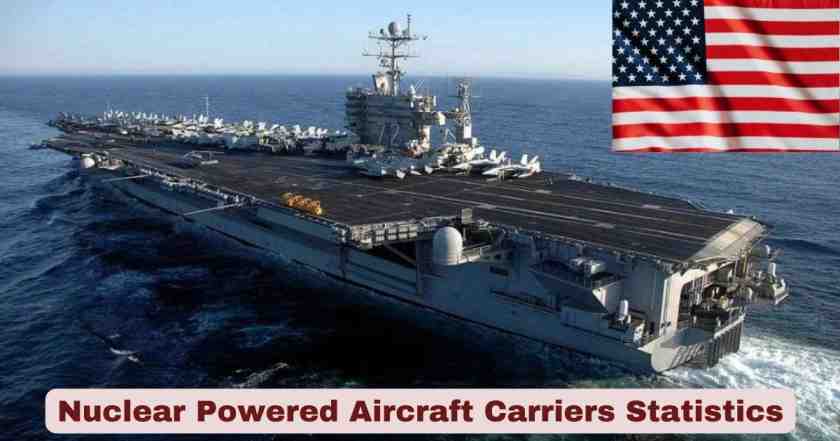
What Is Nuclear Powered Aircraft Carrier?
A nuclear-powered aircraft carrier (CVN) is the most powerful, most complex, and most strategically consequential single warship that any navy has ever put to sea — a floating sovereign military base, roughly 1,100 feet long and displacing over 100,000 tons, that travels the world’s oceans carrying its own private air force of up to 90 aircraft, its own hospital, its own power grid, and a crew population equivalent to a small town, entirely without the need for conventional fuel. Unlike diesel or gas-turbine-powered warships that must return to port or rendezvous with a replenishment tanker every few days, a nuclear carrier is driven by pressurized water reactors fueled by enriched uranium — reactors that generate steam which turns turbines for both propulsion and onboard electricity generation, providing an operating range that is, in practical naval terms, unlimited. A U.S. Navy nuclear carrier requires reactor refueling exactly once during its entire 50-year service life, during a multi-year Refueling and Complex Overhaul (RCOH) at Newport News Shipbuilding — the only facility in the United States capable of building or refueling them. The flight deck of a Nimitz-class or Gerald R. Ford-class supercarrier spans approximately 4.5 acres — roughly the size of three American football fields — while below the deck lies a city of aviation fuel lines, weapons elevators, machine shops, bakeries, medical suites, and the complex electrical infrastructure of a modern warship designed to sustain combat operations for months without shore support. As of March 2026, there are 11 nuclear-powered aircraft carriers in active service with the United States Navy — 10 Nimitz-class ships (CVN-68 through CVN-77) plus the lead ship of the next generation, USS Gerald R. Ford (CVN-78) — and 1 operated by France (FS Charles de Gaulle, R91), making the United States the operator of 91.7% of every nuclear-powered aircraft carrier currently afloat. The U.S. Navy is also building four additional Gerald R. Ford-class ships (CVN-79 through CVN-82), while China’s Type 004 — hull construction confirmed at Dalian Shipyard in September 2025 with nuclear reactor containment frames identified by satellite imagery in November 2025 — is assessed by top Western defense analysts as “extremely likely” to become the world’s first non-American nuclear carrier in over two decades when it commissions in the early 2030s.
In 2026, nuclear-powered aircraft carriers are not peacetime symbols or deterrence tools used at arm’s length — they are active, shooting warships in combat. USS Gerald R. Ford (CVN-78) transited the Strait of Gibraltar on February 20, 2026, entered the Eastern Mediterranean, and on February 28, 2026 launched the opening strike wave of Operation Epic Fury — the joint U.S.-Israeli military campaign targeting Iranian military infrastructure, nuclear facilities, and leadership. Simultaneously, USS Abraham Lincoln (CVN-72), which had been operating in the North Arabian Sea since January 2026, launched F/A-18F Super Hornets and F-35Cs from VMFA-314 against Iranian targets from the eastern axis. The Lincoln Carrier Strike Group was operating in the North Arabian Sea, while the Gerald R. Ford CSG was in the Eastern Mediterranean — two nuclear carriers, 3,000 miles apart, coordinating a single operational campaign that hit over 1,250 targets in the first 48 hours and 1,700+ by 72 hours. CENTCOM confirmed that the nuclear-powered aircraft carrier USS Abraham Lincoln was not struck by Iranian missiles, despite Tehran’s attempts and the broader Iranian ballistic missile and drone retaliation campaign. Meanwhile, USS Nimitz (CVN-68) — commissioned on May 3, 1975 and the world’s oldest active nuclear carrier for decades — completed her final deployment and in the weeks to come will transfer to Norfolk, Virginia, by April 2026 to begin decommissioning and deactivation, including the defueling of her nuclear reactors. These three simultaneous stories — active combat from two nuclear carriers, and the dignified retirement of the oldest — define the nuclear-powered aircraft carrier’s extraordinary moment in March 2026.
Nuclear Powered Aircraft Carriers 2026 — Key Facts
| # | Nuclear Carrier Key Fact | Details |
|---|---|---|
| 1 | 11 of 12 Global Nuclear Carriers Operated by the US Navy | As of March 2026, there are 12 nuclear-powered aircraft carriers worldwide — 11 US Navy (10 Nimitz-class + 1 Gerald R. Ford-class) and 1 French (Charles de Gaulle) — the United States alone operates 91.7% of all nuclear carriers on earth |
| 2 | USS Gerald R. Ford and USS Abraham Lincoln Both Active in Operation Epic Fury (Feb 28, 2026) | CENTCOM, USNI News, Army Recognition, and Axios confirmed both USS Gerald R. Ford (CVN-78) in the Eastern Mediterranean and USS Abraham Lincoln (CVN-72) in the North Arabian Sea as actively launching strike aircraft in Operation Epic Fury from February 28, 2026 |
| 3 | Ford Transited Strait of Gibraltar February 20, 2026 — Record 300-Day Deployment | USS Gerald R. Ford crossed the Strait of Gibraltar on February 20, 2026, redeploying from the Caribbean to the Middle East — marking what National Security Journal described as a record ~300-day deployment, the longest in the Ford’s service history |
| 4 | Ford-Class Generates ~150% More Electrical Power Than Nimitz-Class | The A1B nuclear reactor in the Gerald R. Ford-class delivers approximately 150% more electrical power than the A4W reactors of the Nimitz-class — specifically designed to power EMALS, Advanced Arresting Gear, and future directed-energy weapons |
| 5 | Ford-Class Increases Sortie Rate by ~30% Over Nimitz via EMALS | The Electromagnetic Aircraft Launch System (EMALS) on Gerald R. Ford-class carriers increases sortie generation rates by approximately 30% compared to Nimitz-class steam catapults, according to Naval Technology — critically relevant during Operation Epic Fury’s sustained high-tempo air operations |
| 6 | USS Nimitz — 51 Years of Service — Decommissioning Begins April 2026 | USS Nimitz (CVN-68), commissioned May 3, 1975, is the world’s oldest active nuclear carrier and will transfer to Norfolk, Virginia by April 2026 to begin decommissioning and nuclear defueling — a 51-year service life unmatched by any nuclear warship in history |
| 7 | US Law Requires Minimum of 11 Carriers — Statutory Requirement | The National Defense Authorization Act (NDAA) sets a statutory minimum of 11 aircraft carriers for the U.S. Navy — making the carrier fleet size a matter of federal law, not merely procurement preference |
| 8 | $13 Billion Per Gerald R. Ford-Class — Most Expensive Warship Ever Built | Each Gerald R. Ford-class nuclear carrier costs approximately $13 billion to build, making it the most expensive warship ever constructed in human history — with a designed 50-year service life and a class expected to remain in fleet service until 2105 |
| 9 | Only One Shipyard on Earth Can Build US Nuclear Carriers | Newport News Shipbuilding (Huntington Ingalls Industries) in Newport News, Virginia, is the only facility in the United States — and one of only a handful globally — capable of constructing nuclear-powered aircraft carriers |
| 10 | USS Dwight D. Eisenhower Life Extended to 2030 — Was Slated for 2026 Retirement | USS Dwight D. Eisenhower (CVN-69), originally scheduled for retirement in 2026, has had her service life extended to 2030 due to delays in Ford-class construction — CVN-79 John F. Kennedy slipped from 2025 to 2027 |
| 11 | China’s Type 004 Nuclear Carrier Under Construction at Dalian — Hull Frames Identified Nov 2025 | In November 2025, satellite imagery identified nuclear reactor containment vessel frames embedded in the Type 004 hull at Dalian Shipyard — CNAS analyst Tom Shugart called nuclear propulsion “extremely likely,” which would make China the third nation to operate nuclear carriers |
| 12 | China Plans 9 Total Carriers by 2035 Including 6 Type 004s — Pentagon December 2025 | The U.S. DoD revealed in December 2025 that China plans to build a total of 9 aircraft carriers by 2035, including 6 Type 004-class vessels — which would outnumber the 6 U.S. carriers currently forward-deployed in the Pacific |
| 13 | France’s PANG Next Nuclear Carrier: ~78,000 Tons, 3 EMALS Tracks, Service 2038 | France confirmed the Porte-Avions Nouvelle Génération (PANG) program — a nuclear carrier displacing approximately 78,000 tons (nearly double Charles de Gaulle) with 3 EMALS launch tracks and entry into service in 2038, replacing Charles de Gaulle |
| 14 | Iran Targeted USS Abraham Lincoln with Missiles During Operation Epic Fury — Missed | During Operation Epic Fury, Iran fired ballistic missiles and drones targeting USS Abraham Lincoln — CENTCOM officially confirmed the carrier was not struck, with “missiles launched did not even come close” — the most direct hostile targeting of a nuclear carrier in decades |
| 15 | Ford-Class Planned in US Fleet Until the Year 2105 — 90-Year Class Life | The U.S. Navy plans the Gerald R. Ford-class to serve until the year 2105 — a projected ~90-year class service life — meaning some ships being built today will serve crews not yet born, and will outlive every person currently in the U.S. Navy |
Source: USNI News Fleet and Marine Tracker (news.usni.org, March 2, 2026); U.S. Central Command (centcom.mil, February 28 – March 4, 2026); The National Interest (nationalinterest.org, February 2026); 19FortyFive (19fortyfive.com, January/February 2026); Naval Technology (naval-technology.com); Wikipedia – Nimitz-class (updated March 2026); Wikipedia – Gerald R. Ford-class (updated March 2026); Wikipedia – Type 004 aircraft carrier (updated January 2026); Newsweek (newsweek.com, February 2026); Army Recognition (armyrecognition.com, February/March 2026); NBC San Diego (nbcsandiego.com, March 2, 2026); Axios San Diego (axios.com, March 3, 2026); National Security Journal (nationalsecurityjournal.org, February 2026); SlashGear (slashgear.com, January 2026); Simple Flying (simpleflying.com); Defence Security Asia (defencesecurityasia.com, September–December 2025); The War Zone / TWZ (twz.com, February 2026)
These 15 nuclear-powered aircraft carrier key facts for 2026 define a moment unlike any in naval history since the Cold War. The 11-to-1 ratio of American to French nuclear carriers has held for 25 years — since FS Charles de Gaulle commissioned in 2001. In 2026, that ratio is holding, but everything around it is in motion. USS Nimitz is being decommissioned at 51 years old — an event with no precedent in nuclear carrier history, requiring novel defueling procedures and establishing the template for the nine Nimitz-class retirements that will follow over the next two decades. USS Gerald R. Ford is fighting a major combat campaign from the Eastern Mediterranean at the same time, demonstrating that the Ford-class’s troubled development years are definitively behind it. And China’s Type 004 at Dalian is the most consequential naval construction program in the world right now — not because its completion is imminent, but because of what it signals: within a decade, the nuclear carrier is going from a two-nation technology to a three-nation one, and the third nation has stated publicly that it plans to build six of them. The Pentagon’s December 2025 disclosure of China’s plan for 9 total carriers by 2035 — including 6 Type 004s — is the strategic context that makes every other nuclear carrier statistic in 2026 more significant than it would otherwise be.
The operational facts give human scale to the strategic numbers. Operation Epic Fury began with a presidential go order on February 27, followed by a major combined strike wave on February 28 that included more than 100 aircraft from land and sea and opened with Tomahawk cruise missile launches — and at the center of that operation were two nuclear carriers whose combined air wings of roughly 150 aircraft constituted the strike force’s tactical backbone. One of Lincoln’s fighter jets shot down an Iranian drone that was aggressively approaching the carrier in early February as the Lincoln operated in the Arabian Sea — a reminder that the carrier’s own self-defense was in play even before the campaign officially began. The $13 billion price tag per Ford-class carrier is enormous in isolation; in the context of a single operation generating 1,700+ target strikes in 72 hours from a self-contained, mobile, sovereign base that cannot be denied access by any host nation, it becomes the most consequential per-unit defense investment in history.
Nuclear Powered Aircraft Carriers 2026 — US Navy Fleet Ship-by-Ship Status
| Ship | Hull | Class | Commissioned | Home Port | Status (March 2026) |
|---|---|---|---|---|---|
| USS Nimitz | CVN-68 | Nimitz | May 3, 1975 | Bremerton, WA (departing) | Final deployment complete — transferring to Norfolk by April 2026 for decommissioning and nuclear defueling |
| USS Dwight D. Eisenhower | CVN-69 | Nimitz | Oct 18, 1977 | Norfolk, VA | Active — completed Planned Incremental Availability Jan 2025; service life extended to 2030 (was 2026) |
| USS Carl Vinson | CVN-70 | Nimitz | Mar 13, 1982 | San Diego, CA | Active — returned from 269-day deployment (longest in Carl Vinson history) Aug 2025; in maintenance |
| USS Theodore Roosevelt | CVN-71 | Nimitz | Oct 25, 1986 | San Diego, CA | Active |
| USS Abraham Lincoln | CVN-72 | Nimitz | Nov 11, 1989 | NAS North Island, Coronado, CA | Active — Operation Epic Fury, North Arabian Sea (Feb 28, 2026 onwards) |
| USS George Washington | CVN-73 | Nimitz | Jul 4, 1992 | Yokosuka, Japan | Active — forward-deployed carrier Japan; maintenance; unlikely to deploy until second half 2026 |
| USS John C. Stennis | CVN-74 | Nimitz | Dec 9, 1995 | Bremerton, WA | Active |
| USS Harry S. Truman | CVN-75 | Nimitz | Jul 25, 1998 | Norfolk, VA | Active — previously deployed to Middle East (Houthi operations); conducted high-speed evasive maneuvers losing an F/A-18 overboard |
| USS Ronald Reagan | CVN-76 | Nimitz | Jul 12, 2003 | Yokosuka, Japan | Active — forward-deployed Indo-Pacific |
| USS George H.W. Bush | CVN-77 | Nimitz | Jan 10, 2009 | Norfolk, VA | Active — most modern Nimitz-class; cost $6.2 billion |
| USS Gerald R. Ford | CVN-78 | Gerald R. Ford | Jul 22, 2017 | Norfolk, VA | Active — Operation Epic Fury, Eastern Mediterranean (Feb 20 – present, 2026); ~300-day record deployment |
| USS John F. Kennedy | CVN-79 | Gerald R. Ford | Est. 2027 | Newport News (building) | Under construction — delayed from 2025; launched October 2019 |
| USS Enterprise | CVN-80 | Gerald R. Ford | Est. 2029 | Newport News (building) | Under construction — scheduled launch 2025; commissioning 2029 |
| USS Doris Miller | CVN-81 | Gerald R. Ford | Est. 2032 | Newport News (building) | Under construction — first steel cut Aug 2021; keel laid 2026 |
| USS William J. Clinton | CVN-82 | Gerald R. Ford | Est. ~2035+ | Planned | Named January 2025 |
| USS George W. Bush | CVN-83 | Gerald R. Ford | Est. ~2037+ | Planned | Named January 2025 |
Source: The National Interest (nationalinterest.org, February 2026); 19FortyFive (19fortyfive.com, January 2026); thedefensewatch.com (November 2025); USNI News (news.usni.org); Wikipedia – List of US Aircraft Carriers (updated March 2026); Naval Technology (naval-technology.com); Army Recognition (armyrecognition.com)
The U.S. nuclear carrier fleet ship-by-ship status in March 2026 reveals an institution navigating its most complex generational transition since the Nimitz class first entered service in the 1970s — simultaneously fighting a major combat campaign from two hulls, retiring the oldest for the first time in nuclear carrier history, managing construction delays in the replacement program, and planning ships whose delivery dates stretch toward 2037 and beyond. The USS Carl Vinson’s 269-day deployment in 2025 — the longest in the ship’s entire history — is a data point that speaks directly to the strain that global commitments and maintenance cycles impose on an 11-carrier fleet when multiple hulls are simultaneously in maintenance, RCOH, or post-deployment stand-down. The USS Dwight D. Eisenhower (CVN-69) completed a Planned Incremental Availability maintenance period that began in January 2025 and is currently being readied for her next deployment, expected to leave port in early 2026 — with speculation she may relieve Ford in the Middle East, extending the Navy’s combat presence in that theater well into 2026.
The naming of CVN-82 and CVN-83 as USS William J. Clinton and USS George W. Bush in January 2025 is an organizational statement of intent: the U.S. Navy is committing to a 10-ship Gerald R. Ford-class replacing the 10-ship Nimitz-class on a one-for-one basis, with the class’s operational tenure designed to run until 2105. The CVN-79 John F. Kennedy’s slip from 2025 to 2027 is the most consequential near-term scheduling issue in the fleet, because every Ford-class delay directly forces Nimitz-class life extensions — most visibly in CVN-69 Eisenhower’s extension from 2026 to 2030, but with cascading effects across every retirement and replacement timeline in the Nimitz succession plan. Newport News Shipbuilding’s concurrent construction of CVN-79, CVN-80, and CVN-81 — three nuclear supercarriers simultaneously in various stages of assembly at a single shipyard — is an industrial undertaking without parallel anywhere else on earth.
Nuclear Powered Aircraft Carriers 2026 — Technical Specifications Comparison
| Specification | Nimitz-class (CVN-68 to CVN-77) | Gerald R. Ford-class (CVN-78+) | FS Charles de Gaulle (R91) |
|---|---|---|---|
| Nation | United States | United States | France |
| Ships Active (March 2026) | 10 | 1 | 1 |
| Overall Length | 1,092 ft (333 m) | 1,106 ft (337 m) | 858 ft (261.5 m) |
| Beam (Waterline) | 134 ft (40.8 m) | 134 ft (40.8 m) / flight deck 252 ft (77 m) | 103 ft (31.5 m) |
| Full Load Displacement | Over 100,000 long tons | ~100,000+ long tons | ~42,000 tons |
| Nuclear Reactor | 2 × Westinghouse A4W PWRs | 2 × Bechtel A1B PWRs | 2 × K15 PWRs |
| Propulsion Shafts | 4 shafts | 4 shafts | 2 shafts |
| Maximum Speed | 30+ knots (56+ km/h) | 30+ knots | 27 knots |
| Propulsion Power | ~260,000 shp (190 MW) | Exceeds Nimitz — classified | ~83,000 shp |
| Electrical Generation Advantage | Baseline | ~150% more than A4W | Limited |
| Flight Deck Area | ~4.5 acres | ~4.5 acres (larger, repositioned island) | ~2 acres |
| Aircraft Launch System | 4 × C-13-2 steam catapults | 4 × EMALS (electromagnetic) | 2 × BS2 steam catapults |
| Aircraft Recovery System | 4 × Mk 7 arresting wires | 3 × Advanced Arresting Gear (AAG) | 3 × DAG arresting wires |
| Aircraft Capacity | Up to 90 fixed-wing + helicopters | Up to 90 aircraft | ~40 aircraft |
| Typical Air Wing | F/A-18E/F, EA-18G, E-2D, MH-60R/S | F/A-18E/F, F-35C, EA-18G, E-2D, MH-60R/S | Rafale M, E-2C Hawkeye, helicopters |
| Sortie Rate | ~120–140/day (normal); ~160 surge | ~160/day — +30% over Nimitz | ~60–80/day |
| Ship’s Crew | ~3,200 | ~2,500 (500–900 fewer than Nimitz) | ~1,750 |
| Air Wing Personnel | ~2,500 | ~2,500 | ~550 |
| Total Embarked | ~5,000–6,000 | ~4,500–5,000 | ~2,000 |
| Service Life | 50 years (study underway for 55) | ~50 years (class to 2105) | Retiring 2038 (replaced by PANG) |
| Reactor Refueling | Once — RCOH at ~25-year mark | Once — RCOH | Once — completed 2007–2008 |
| New/Upgraded Systems | Baseline | 23 new or upgraded systems vs Nimitz | — |
| Unit Cost | ~$4.5–6.2 billion (varies by hull) | ~$13 billion (CVN-78) | ~€3 billion (~$3.3 billion, 2001) |
| Builder | Newport News Shipbuilding (HII) | Newport News Shipbuilding (HII) | DCNS / Naval Group, France |
Source: Naval Technology – Gerald R. Ford-class (naval-technology.com); Wikipedia – Nimitz-class; Wikipedia – Gerald R. Ford-class; Wikipedia – FS Charles de Gaulle; U.S. Navy Fact File (navy.mil); SlashGear (slashgear.com, January 2026); 19FortyFive (19fortyfive.com, February 2026); Simple Flying (simpleflying.com, 2026)
The technical specifications comparison between the Nimitz-class, Gerald R. Ford-class, and France’s Charles de Gaulle maps the full range of what “nuclear-powered aircraft carrier” means in operational practice — from the 42,000-ton French carrier with its 40-aircraft air wing to the 100,000+ ton American supercarriers with up to 90. The fundamental design philosophy gap is substantial: Charles de Gaulle was built as a capable, affordable, independent nuclear carrier for a nation that needed genuine power projection without American dependence — and she has delivered on that mission in every major French military operation since commissioning. But she is, by the metrics that matter in a sustained high-intensity campaign, a fundamentally different class of platform. Her 2 steam catapults versus the Ford’s 4 EMALS tracks means roughly half the aircraft launch throughput. Her 40-aircraft air wing versus the 90 embarked on USS Abraham Lincoln during Operation Epic Fury means that while France can conduct independent strike operations, she cannot generate the sustained 24/7 air cycle that two U.S. carriers maintained over Iran for days on end in late February and early March 2026.
The Gerald R. Ford-class’s 23 new or upgraded systems compared to the Nimitz-class — documented by Naval Technology from official NAVAIR program data — tells the story of what $13 billion buys in naval engineering over a 40-year design gap. The three most operationally consequential are: EMALS (30% more sorties, compatible with both heavy strike aircraft and lightweight UAVs, no steam infrastructure vulnerability); Advanced Arresting Gear (digital precision recovery, less mechanical stress on airframes, compatible with a wider weight range of aircraft than the Mk 7 wires); and the A1B reactor’s 150% electrical generation advantage, which is the system that makes every future technology on the ship possible. The Nimitz-class was brilliant engineering for its era but was designed around technologies of the 1960s and 1970s — steam catapults, mechanical arresting gear, a power budget sized for 1970s electronics. The Ford-class was designed knowing that directed-energy weapons, high-power active electronic warfare systems, and large unmanned combat aircraft will be the defining technologies of the 2030s–2060s — and that all of them demand electrical power in quantities the A4W reactor simply cannot provide.
Nuclear Powered Aircraft Carriers 2026 — Operation Epic Fury Combat Statistics
| Detail | Data | Source |
|---|---|---|
| Operation Name | Operation Epic Fury (US) / Operation Raging Lion (Israel) | CENTCOM official; IDF |
| Campaign Start | February 28, 2026, approximately 1:15 AM EST | CENTCOM official statement |
| Presidential Go Order | February 27, 2026 — President Trump order | Army Recognition; NBC San Diego |
| USS Gerald R. Ford (CVN-78) Location | Eastern Mediterranean Sea — transited Strait of Gibraltar Feb 20, 2026; operating near Israel | USNI News; Army Recognition; The War Zone |
| Ford Air Wing (CVW-8) | VFA-31 (F/A-18E “Tomcatters”), VFA-37 (F/A-18E “Ragin Bulls”), VFA-87 (F/A-18E “Golden Warriors”), VAQ-130 (EA-18G Growlers), VAW-124 (E-2D Hawkeyes), plus MH-60R/S | USNI News Fleet Tracker, March 2, 2026 |
| USS Abraham Lincoln (CVN-72) Location | North Arabian Sea — deployed since January 2026 under CENTCOM | USNI News; Axios San Diego; NBC San Diego |
| Lincoln Air Wing (CVW-9) | VFA-14 (F/A-18E “Tophatters”), VFA-41 (F/A-18F “Black Aces”), VFA-151 (F/A-18E “Vigilantes”), VMFA-314 (F-35C “Black Knights”), plus EA-18G, E-2D Hawkeyes, MH-60R/S | USNI News Fleet Tracker, March 2, 2026 |
| F-35C Combat Deployment | VMFA-314 F-35Cs embarked on Lincoln — stealth fifth-generation fighters used in Operation Epic Fury strikes | USNI News; Army Recognition |
| Combined Air Wing Size (Both Carriers) | ~150 carrier aircraft across both CVW-8 and CVW-9 | Army Recognition; National Security Journal |
| Opening Strike Wave | 100+ aircraft from land and sea in first combined strike wave | Army Recognition (March 2026); U.S. Army official (army.mil) |
| Total Targets Struck — 48 Hours | 1,250+ targets across Iran | CENTCOM official statement |
| Total Targets Struck — 72 Hours | 1,700+ targets across Iran | CENTCOM; multiple news sources |
| Iranian Retaliation vs Lincoln | Iran targeted USS Abraham Lincoln with ballistic missiles and drones — CENTCOM confirmed all missed, “didn’t even come close” | Zona Militar (March 1, 2026); CENTCOM |
| Iran Drone vs Lincoln — Pre-Campaign | A Lincoln F/A-18 shot down an Iranian drone approaching aggressively in early February — before the operation began | Axios San Diego (March 3, 2026); Reuters |
| Tomahawk Launches | USS Spruance (DDG-111) confirmed Tomahawk launch from Lincoln CSG; USS Winston S. Churchill (DDG-81) from Ford CSG | USNI News; NBC San Diego; Axios |
| Iranian Shahid Bagheri Drone Carrier Struck | US forces struck Iran’s Shahid Bagheri — a container ship converted into a drone/helicopter carrier | Army Recognition (March 2026); USNI News |
| Key Iranian Leadership Killed | Ayatollah Ali Khamenei killed in strikes — confirmed by President Trump and CENTCOM | USNI News (February 28, 2026); NBC San Diego |
| Ford Deployment Length | ~300 days — originally deployed June 24, 2025; extended twice; now estimated return late April–early May 2026 | National Security Journal; USNI News |
Source: USNI News Fleet and Marine Tracker (news.usni.org, March 2, 2026); U.S. Central Command (centcom.mil, Feb 28 – Mar 4, 2026); Army Recognition (armyrecognition.com, February–March 2026); NBC San Diego (nbcsandiego.com, March 2, 2026); Axios San Diego (axios.com, March 3, 2026); The War Zone (twz.com, February 2026); Zona Militar (zona-militar.com, March 1, 2026); U.S. Army official website (army.mil, March 3, 2026)
The Operation Epic Fury combat statistics for nuclear-powered aircraft carriers represent the most consequential real-world performance data for this class of warship since the 1991 Gulf War. In capability terms, Ford’s deployment is notable not only for what it brings to the fight, but for how fast it was surged — the carrier strike group was shifted from a Caribbean tasking to the Middle East and arrived after months of continuous operations, following Ford’s support to the early January raid that captured former Venezuelan President Nicolás Maduro. That compressed operational tempo — Caribbean operations in November–January, then a transatlantic crossing and immediate combat in February — is a stress test of carrier naval endurance, maintenance systems, and crew resilience that no scheduled exercise could replicate. Across two carriers in theater, roughly 150 aircraft can be massed for coordinated operations, a concentration of tactical aviation that becomes operationally decisive when paired with long-range tanking and standoff munitions from land-based forces.
The Iranian targeting of USS Abraham Lincoln with ballistic missiles is the most tactically significant single event in nuclear carrier operations in years — and the fact that CENTCOM could confirm the missiles “didn’t even come close” speaks as much to the layered air and missile defense architecture surrounding the carrier as to Iranian targeting limitations. The U.S. destroyers in the region are armed with Standard Missile 3s — which can intercept ballistic missiles — as well as SM-2s and SM-6s that counter traditional air threats like cruise missiles and attack drones. Additionally, the U.S. has other ground-based missile defense assets in the region, including U.S. Army Terminal High Altitude Area Defense (THAAD) Systems and Army Patriot anti-air PAC-3 missile batteries. The nuclear carrier does not operate alone — it operates at the center of an integrated, multi-layer defense architecture that is itself one of the most capable military systems ever assembled. The F-35C sorties from VMFA-314 aboard Lincoln are operationally noteworthy as well: the use of fifth-generation stealth fighters from a carrier deck in a contested anti-access environment against a nation with S-300 and Bavar-373 air defenses is exactly the mission the F-35C was designed for, and 2026 marks the first time that mission has been executed in combat against a modern integrated air defense system from a carrier air wing.
Nuclear Powered Aircraft Carriers 2026 — Global Programs & Future Nuclear Carrier Fleet
| Nation | Nuclear Carriers (Active) | Status (March 2026) | Next / Future Program |
|---|---|---|---|
| United States | 11 (10 Nimitz + 1 Ford) | Ford + Lincoln in Operation Epic Fury; Nimitz decommissioning April 2026 | CVN-79 (2027), CVN-80 (2029), CVN-81 (2032), CVN-82 and CVN-83 named Jan 2025 |
| France | 1 (FS Charles de Gaulle R91) | Active — Mediterranean and global operations; retiring 2038 | PANG (~78,000 tons; 3 EMALS; nuclear; entering service 2038) |
| China | 0 nuclear (3 conventional: Liaoning, Shandong, Fujian) | Fujian commissioned 2025; Type 004 under construction at Dalian | Type 004 — nuclear propulsion “extremely likely” per CNAS Tom Shugart; 110,000–120,000 tons; 4–5 EMALS; 90–100 aircraft; launch 2028–2029; commission early 2030s; DoD says China plans 6 Type 004s + 9 total carriers by 2035 |
| Russia | 0 nuclear (1 conventional: Admiral Kuznetsov) | Kuznetsov in prolonged refit at Murmansk — operational status highly uncertain | No confirmed nuclear carrier program |
| United Kingdom | 0 nuclear (2 STOVL: HMS Queen Elizabeth, HMS Prince of Wales) | Both active — F-35B operations | No nuclear carrier planned |
| India | 0 nuclear (2 conventional: INS Vikramaditya, INS Vikrant) | Both active; Vikrant fully operational 2024 | INS Vishal — future CATOBAR carrier under consideration; nuclear propulsion discussed but not confirmed |
| Total Nuclear Carriers (March 2026) | 12 active | 11 USN + 1 French | Grows to 13 if China’s Type 004 nuclear propulsion confirmed at commissioning (~early 2030s) |
Source: Wikipedia – Type 004 aircraft carrier (updated January 2026); Newsweek (newsweek.com, February 2026); Army Recognition (armyrecognition.com, September 2025); Defence Security Asia (defencesecurityasia.com, December 2025); Simple Flying (simpleflying.com, 2026); 19FortyFive (19fortyfive.com, February 2026); The National Interest (nationalinterest.org, February 2026); thedefensewatch.com (November 2025); Zona Militar (zona-militar.com, December 2025)
The global nuclear carrier program landscape in 2026 is undergoing its most consequential structural shift in a quarter century — and the change is being driven entirely by China. For the entirety of the post-Cold War era, the nuclear carrier has been an exclusive American technology with a single French outlier. The vessel known publicly as the Type 004 is under construction at the Dalian shipyard in Liaoning province. Recent imagery suggests work is shifting from basic hull assembly to engine rooms and features analysts believe are intended for nuclear reactors. CNAS analyst Tom Shugart — a former U.S. Navy submariner with direct technical knowledge of nuclear carrier construction — analyzed the February 2026 satellite imagery and stated his confidence that this will be a nuclear-powered carrier had risen to a level he was comfortable calling “extremely likely.” These indicators point to a construction timeline targeting launch between 2028 and 2029, followed by several years of sea trials and systems integration before operational commissioning in the early 2030s.
The US Defense Department revealed in December 2025 that China was planning on constructing 6 Type 004 carriers by 2035, which would give them a total fleet size of 9 aircraft carriers, outnumbering the 6 carriers currently deployed in the US Pacific Fleet. That single statistic — 6 Type 004s by 2035, each displacing an estimated 110,000–120,000 tons with 4–5 EMALS tracks and 90–100 aircraft — is the most alarming single data point in U.S. naval planning since China launched its first carrier Liaoning in 2012. The gap between announced intention and demonstrated delivery capability remains large: China has never built a nuclear surface warship, has never operated a CATOBAR carrier at full operational tempo, and has never sustained a carrier strike group at the distances that blue-water power projection requires. But the pace of Chinese naval construction — analysts noting that Chinese shipyards also tend to build faster than their U.S. counterparts — means that dismissing these timelines as aspirational would be a strategic miscalculation of historic proportions. France’s PANG program adds a complementary data point: the only other nation that has ever operated a nuclear carrier is spending the equivalent of ~$12 billion to build a far more capable replacement, deploying the same American EMALS technology that defines the Ford-class, and targeting a service life running to the 2060s. The nuclear carrier is not becoming obsolete — it is becoming more capable, more widespread, and more central to great-power naval competition than at any point since the Cold War.
Disclaimer: This research report is compiled from publicly available sources. While reasonable efforts have been made to ensure accuracy, no representation or warranty, express or implied, is given as to the completeness or reliability of the information. We accept no liability for any errors, omissions, losses, or damages of any kind arising from the use of this report.