
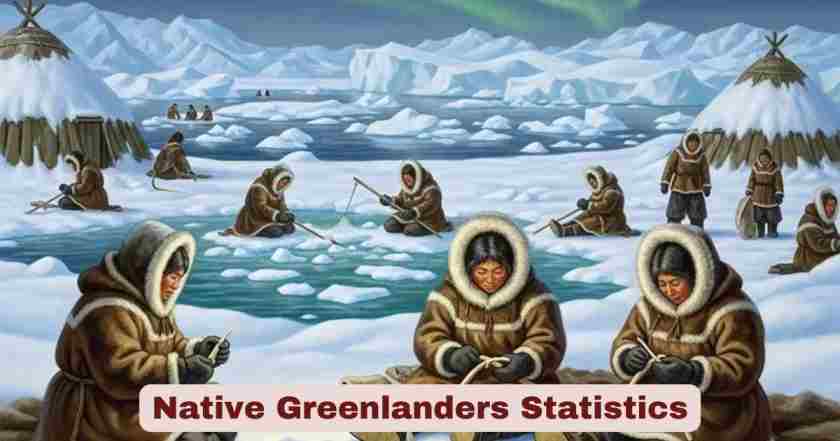
Native Greenlanders Statistics 2026
The native Greenlanders in 2026 represent one of the world’s most unique indigenous populations, maintaining their cultural identity while navigating the complexities of modern statehood within the Danish Realm. With approximately 50,500 native-born Greenlanders comprising 88.9 to 89.5 percent of the total population of 56,542 as of January 2025, Greenland stands as the only nation in the Americas where indigenous peoples constitute an overwhelming majority of residents. These Greenlandic Inuit, predominantly self-identifying as Kalaallit, trace their ancestry directly to the Thule culture that migrated from Arctic North America approximately 1,000 years ago, establishing permanent settlements across the ice-free coastal regions. The genetic profile reveals the complex colonial history—the average Greenlander possesses 75 percent Inuit ancestry and 25 percent European ancestry, with roughly half of paternal DNA tracing to Danish male ancestors from centuries of colonial interaction and intermarriage.
The demographic landscape of native Greenlanders in 2026 reflects both cultural resilience and contemporary challenges that distinguish this Arctic population from other indigenous groups globally. Unlike indigenous minorities struggling for recognition in settler-colonial societies, native Greenlanders govern their own territory through the Self-Government Act of 2009, controlling domestic affairs including education, healthcare, natural resources, and cultural policy while Denmark retains authority over foreign affairs, defense, and monetary policy. This self-governing status emerged from decades of political activism, with home rule granted in 1979 and expanded sovereignty achieved in 2009, positioning Greenland on a potential path toward full independence though economic realities—including annual Danish subsidies of approximately 5.4 billion DKK (roughly 724 million EUR)—make complete separation economically challenging. The indigenous majority status creates unique opportunities and responsibilities, as native Greenlanders must simultaneously preserve traditional knowledge and languages while developing modern institutions, addressing severe social problems including the world’s highest suicide rates, and managing economic development without sacrificing cultural identity or environmental stewardship.
Interesting Facts About Native Greenlanders 2026
| Fact Category | Statistical Detail | Global Significance |
|---|---|---|
| Native Population Percentage | 88.9% to 89.5% of total | Highest indigenous percentage of any American nation |
| Total Native Population | ~50,500 individuals (2025) | Small absolute number despite high percentage |
| Genetic Admixture | 75% Inuit / 25% European ancestry average | Reflects centuries of colonial interaction |
| Thule Culture Descendants | 100% direct descent verified | No mixture with earlier Paleo-Eskimo cultures |
| Native-Born in Greenland | 49,738 out of 56,542 total (2025) | 88% born on island |
| Greenlanders Living in Denmark | 17,079 to 17,287 (2023-2024) | Significant diaspora seeking opportunities |
| Official Language Speakers | ~50,000 speak Kalaallisut | 88-90% of population multilingual |
| Church Membership Rate | 91% to 96% Lutheran (native-born) | Highest Christian adherence rate |
| Life Expectancy (Men) | 69.3 years (2024-2025) | 10+ years below Western averages |
| Life Expectancy (Women) | 73.9 years (2024-2025) | Gender gap smaller than most nations |
| Suicide Rate | 79.6 per 100,000 (2022) | World’s highest national rate |
| Forced Sterilization Victims | 4,500 women (1960s-70s) | ~50% of fertile population affected |
Data sources: Demographics of Greenland Wikipedia 2026, Statistics Greenland 2025, Greenlandic Inuit Wikipedia 2026, IWGIA Indigenous World 2025, Life Expectancy Statistics Greenland 2026
The fascinating statistics about native Greenlanders 2026 reveal a population defined by both remarkable cultural continuity and profound modern challenges. The 88.9 to 89.5 percent indigenous population proportion makes Greenland unique among all nations colonized by European powers—no other country in the Americas approaches this level of indigenous demographic dominance. Bolivia, often cited for its indigenous majority, reports approximately 62 percent identifying as indigenous, while Guatemala’s indigenous population comprises roughly 43 percent of the total. This Greenlandic exceptionalism stems from the Arctic environment that limited European settlement to small administrative and commercial populations, the late timing of intensive colonization (primarily 20th century), and the absence of plantation agriculture or extractive industries that elsewhere drove massive European immigration and indigenous population collapse. The 50,500 native Greenlanders represent a small absolute population—roughly equivalent to a mid-sized town elsewhere—yet govern a territory of 2.16 million square kilometers, creating unique challenges for service delivery, infrastructure development, and cultural preservation across vast Arctic distances.
The genetic admixture data tells a complex story of colonial interaction without the complete demographic replacement seen elsewhere in the Americas. The 75/25 percent Inuit/European ancestry split, with approximately half of paternal DNA tracing to Danish males, reflects patterns of intermarriage between predominantly male Danish administrators, traders, missionaries, and workers with Inuit women over several centuries of colonial rule. This genetic legacy differs fundamentally from the near-total indigenous demographic collapse and replacement in regions like Argentina, Chile, the United States, or Canada where European settler populations came to vastly outnumber surviving indigenous peoples. The dark history of the 4,500 Inuit women forcibly sterilized during the 1960s and 70s—representing roughly half of the fertile female population at that time—constitutes one of history’s most devastating forced eugenics programs, implemented without informed consent and resulting in a 50 percent birthrate decline within one generation. This trauma continues reverberating through Greenlandic society today, contributing to multigenerational demographic effects, family disruption, and the profound social pathologies that manifest in the world’s highest suicide rate of 79.6 deaths per 100,000 annually—approximately nine times the global average and a staggering burden for a population of just 56,000 people where 40 individuals die by suicide each year.
Population Structure of Native Greenlanders in 2026
| Demographic Category | Total Numbers | Percentage Share | Gender/Age Breakdown | Comparative Context |
|---|---|---|---|---|
| Total Population | 56,542 (Jan 2025) | 100% | 29,770 males / 26,772 females | Slight growth from 2020 |
| Born in Greenland | 49,738 | 88.0% | Native-born majority | Includes mixed ancestry |
| Greenlandic Inuit | ~50,500 estimated | 89.5% | Kalaallit, Tunumiit, Inughuit | Highest indigenous percentage globally |
| Working-Age (18-64) | 37,169 | 65.7% | Productive age majority | Lower than Western averages |
| Youth (0-17 years) | 13,356 | 23.6% | Declining birth cohorts | Below replacement fertility |
| Elderly (65+ years) | 6,017 | 10.6% | Rapidly aging | Healthcare burden increasing |
| Gender Ratio | 111 males : 100 females | N/A | Male surplus | Work-related imbalance |
| Median Age | 35.1 years (2024) | N/A | Younger than Denmark (42 years) | Aging accelerating |
| Danish Citizens | 6,804 non-native | 12.0% | Mostly from Denmark | Professional/administrative roles |
| Diaspora in Denmark | 17,079-17,287 | N/A | Seeking education/employment | Brain drain concern |
Data sources: Demographics of Greenland Wikipedia 2026, Statistics Greenland Population Data 2025, Greenland in Figures 2025, IWGIA Reports 2025
The population structure of native Greenlanders 2026 reveals a society experiencing significant demographic transition from the high-fertility, young population characteristic of traditional Inuit societies toward aging patterns typical of developed nations, though with distinctive Arctic characteristics. The 49,738 native-born residents comprising 88 percent of the total population demonstrate the enduring indigenous numerical dominance, with the overwhelming majority self-identifying as Greenlandic Inuit across three ethnographic subgroups: the Kalaallit of western Greenland (by far the largest group with over 90 percent of native population), the Tunumiit of eastern Greenland (approximately 5-6 percent of natives), and the Inughuit/Avanersuarmiut of northern regions (less than 2 percent). Each group maintains distinct dialect variations of the Greenlandic language, cultural practices adapted to their specific geographic environments, and historical migration patterns, though modernization and urbanization are gradually homogenizing these regional identities as younger generations migrate to larger towns, particularly Nuuk.
The age structure presents concerning trends for native Greenlanders‘ demographic future. The working-age population of 37,169 individuals (ages 18-64) represents 65.7 percent of the total, slightly lower than most Western nations where this proportion typically exceeds 60-65 percent, reflecting both the young population legacy (higher proportion of youth) and improving life expectancy (growing elderly cohort). The youth contingent of 13,356 individuals under age 18 (23.6 percent of population) appears robust compared to ultra-aged societies like Japan or Italy, but fertility rates have collapsed to 1.8 children per woman in 2024—well below the 2.1 replacement rate—signaling future population decline absent immigration. The elderly population of 6,017 people over age 65 (10.6 percent) remains relatively small compared to Western nations where elderly typically comprise 15-20+ percent of populations, but this proportion is rising rapidly as life expectancy improvements allow more natives to reach retirement age. The gender imbalance of 111 males per 100 females reflects the imported workforce dominated by men in traditionally male-dominated industries like fishing, construction, and mining, though among native Greenlanders specifically the ratio is closer to balanced, with the surplus males concentrated in the non-native population working temporary contracts.
Language and Cultural Identity Among Native Greenlanders 2026
| Language Metric | Speaker Numbers | Usage Context | Regional Variation | Preservation Status |
|---|---|---|---|---|
| Kalaallisut (West Greenlandic) | ~44,000 speakers | Official language, education, media | 87-88% of natives | Stable, dominant dialect |
| Tunumiit (East Greenlandic) | ~3,000 speakers | Regional communication | East Greenland only | Vulnerable, declining |
| Inuktun (Polar Inuit) | ~800 speakers | Northern communities | Qaanaaq region | Endangered status |
| Total Greenlandic Speakers | ~50,000 estimated | 88-90% of population | All three dialects combined | Generally healthy |
| Danish Language Proficiency | ~50,000 bilingual | Government, higher education, business | Universal in urban areas | Colonial legacy language |
| Monolingual Greenlandic | <5% of natives | Elderly in settlements | Remote villages only | Declining rapidly |
| English Proficiency | 30-40% functional | Tourism, internet, media | Youth in cities | Growing rapidly |
| Language of Education (Primary) | Greenlandic-medium schools | K-10 compulsory | Danish increases at higher levels | Policy supports native language |
| Language of Government | Greenlandic official (2009) | Parliament, public services | Danish still widely used | Gradual Greenlandization |
| Church Services | 91% in Greenlandic | Lutheran congregations | Danish in some urban churches | Native language dominance |
Data sources: Demographics of Greenland Wikipedia 2026, Greenlandic Inuit Wikipedia 2026, IWGIA Linguistic Data 2025, Statistics Greenland Language Survey 2024
Language preservation represents one of the most successful aspects of native Greenlander cultural resilience in 2026, with Greenlandic (Kalaallisut) not merely surviving but thriving as the official language and primary tongue for the vast majority of citizens. The 50,000 Greenlandic speakers—representing nearly 90 percent of the population—constitute a remarkable linguistic achievement for an indigenous language in a former colonial territory, especially considering the small absolute speaker population. For comparison, many Native American languages with comparable historical speaker populations have declined to just hundreds or dozens of speakers by 2026, while Greenlandic maintains intergenerational transmission with children learning it as their mother tongue. The designation of Greenlandic as the sole official language in 2009 (replacing the previous Greenlandic-Danish bilingual status) symbolized indigenous political empowerment and cultural assertion, though Danish remains ubiquitous in practice for higher education, specialized government functions, and interaction with Denmark.
The three dialect groups reflect native Greenlanders‘ geographic diversity and the challenges of linguistic unity across vast Arctic distances. Kalaallisut (West Greenlandic), spoken by approximately 44,000 people, serves as the standard dialect used in government, media, and education, benefiting from the concentration of population on Greenland’s west coast where the capital Nuuk and major towns are located. Tunumiit (East Greenlandic), with roughly 3,000 speakers in the isolated eastern settlements including Tasiilaq and Ittoqqortoormiit, faces vulnerability as younger generations increasingly migrate westward to urban centers where Kalaallisut dominates, potentially learning the western dialect and abandoning their eastern heritage language. Most concerning is Inuktun (Polar Inuit or North Greenlandic), spoken by approximately 800 people in the remote Qaanaaq region near Thule Air Base—this tiny speaker population places the dialect on UNESCO’s endangered languages list, as young Inughuit increasingly adopt Kalaallisut through education, media exposure, and marriage with western Greenlanders. The near-universal bilingualism in Greenlandic and Danish (affecting approximately 50,000 residents) creates linguistic complexity, with code-switching common in urban areas and among educated professionals who seamlessly alternate between languages depending on context, audience, and topic—technical discussions about law, medicine, or science often default to Danish due to terminology development, while personal conversation, cultural topics, and emotional expression favor Greenlandic.
Health Statistics of Native Greenlanders 2026
| Health Indicator | Male Statistics | Female Statistics | National Average | Comparison (Denmark) |
|---|---|---|---|---|
| Life Expectancy at Birth | 69.3 years | 73.9 years | 71.6 years | Denmark: 79.3/83.2 years |
| Infant Mortality Rate | 18.5 per 1,000 live births | 18.5 per 1,000 | 18.5 per 1,000 (1999-2003) | Denmark: 3-4 per 1,000 |
| Suicide Rate | Higher among males | Lower but significant | 79.6 per 100,000 (2022) | Denmark: 10-11 per 100,000 |
| Smoking Prevalence | 60% current smokers | 60% current smokers | 60% total (2014) | Denmark: 16-20% |
| Alcohol Consumption | High binge pattern | Significant abuse | Historical peak 1970s-80s | Per-capita similar to Denmark |
| Obesity Rate | Rising epidemic | Rising epidemic | Estimated 20-30% | Denmark: 17-20% |
| Chronic Disease Burden | High musculoskeletal | Higher in women | Very high overall | Significantly worse than Denmark |
| Self-Rated Good Health | Declining trend | Lower than men | Decreasing since 1990s | Much worse than Denmark |
| Healthcare Access | Free universal care | Free universal care | National hospital in Nuuk | Specialized care requires Denmark |
| Mental Health Services | Critically understaffed | Critically understaffed | Major service gaps | Inadequate for needs |
Data sources: Life Expectancy Statistics Greenland 2026, Public Health Reviews Greenland 2018, Gender Health Expectancy Studies 2014, Statistics Greenland Health Data 2025
The health statistics of native Greenlanders 2026 reveal one of the most significant health disparities between an indigenous population and its colonial metropole anywhere in the developed world. The life expectancy gap between Greenland and Denmark approaches 10-12 years for both sexes—male native Greenlanders live to just 69.3 years versus 79.3 years for Danish men, while female natives reach 73.9 years compared to 83.2 years for Danish women. This enormous disparity exists despite Greenland receiving substantial Danish healthcare subsidies, free universal healthcare for all residents, and modern medical facilities including the national hospital in Nuuk equipped for most procedures. The explanation lies not in healthcare access but in the devastating burden of preventable deaths from suicide, accidents (particularly drowning and hunting-related incidents), alcohol-related causes, and chronic diseases exacerbated by lifestyle factors. Statistics Greenland explicitly attributes the stalled life expectancy improvements since 2000 to “high mortality rates caused by accidents and suicide,” identifying these as the primary obstacles preventing further gains.
The suicide crisis affecting native Greenlanders constitutes a humanitarian catastrophe that has persisted for nearly 50 years despite numerous intervention attempts. The rate of 79.6 suicides per 100,000 population in 2022 means approximately 1 in 1,400 Greenlanders dies by suicide annually—in absolute terms, 40 deaths in a population of just 56,000 people. This rate is approximately nine times the global average of roughly 9 per 100,000 and ranks as the highest national suicide rate globally, far exceeding other circumpolar indigenous populations in Alaska, Canada, or Siberia. The suicide burden falls disproportionately on young and middle-aged men, particularly those in remote settlements facing limited economic opportunities, family disruption from alcohol abuse, social isolation, and loss of traditional cultural identity that once provided meaning and purpose. The extraordinarily high smoking rate of 60 percent among native Greenlanders (both men and women) as of 2014 data—triple Denmark’s rate and among the world’s highest—drives epidemic levels of lung cancer, chronic obstructive pulmonary disease, and cardiovascular disease that kill Greenlanders decades before their time. Lung cancer alone accounts for 34 percent of all cancer deaths during 2000-2014, a staggering proportion reflecting the decades-long tobacco epidemic that public health interventions have failed to substantially reduce despite declining cigarette imports, as increased cigarette paper imports suggest widespread roll-your-own tobacco use that evades official statistics.
Educational Attainment of Native Greenlanders 2026
| Education Level | Percentage Achieved | Absolute Numbers | Gender Disparity | Comparison Context |
|---|---|---|---|---|
| Primary School Only (Highest) | 62% of adults 25+ | ~25,000 individuals | Higher male proportion | Extremely low by OECD standards |
| Education Above Grade 10 | 40% of total population | ~22,600 individuals | Slight female advantage | Denmark: ~78% |
| Upper Secondary Completion | 39.6% of adults 25+ (2015) | ~12,000 adults | Women slightly higher | Denmark: ~80% |
| Bachelor’s Degree or Higher (Male) | 7.8% of men 25+ (2015) | ~1,200 men | Significant gender gap | Denmark: ~32% male |
| Bachelor’s Degree or Higher (Female) | 13.8% of women 25+ (2015) | ~1,700 women | Women outperform men | Denmark: ~35% female |
| Youth in Education (16-25) | 28% actively enrolled (2023) | ~2,100 youth | Data not specified | Declined from 2016 |
| Youth in Employment (16-25) | 42% working (2023) | ~3,000 youth | Male-dominated sectors | Increased from 2016 |
| Youth Neither Education/Work | 31% NEET status (2023) | ~2,300 youth | Crisis indicator | Extremely high |
| Math Grade 10 Exam Pass | ~50% pass or barely pass | Half fail basic math | Male failure higher | Educational crisis |
| Students Studying Abroad | ~30% of higher ed students | ~600-900 students | Primarily in Denmark | Brain drain pipeline |
Data sources: Teacher Education Greenland Study 2020, IWGIA Indigenous World 2025, CEIC Education Statistics 2015, Statistics Greenland Education Data 2025
The educational statistics for native Greenlanders 2026 reveal a profound crisis that threatens the territory’s long-term development prospects and indigenous empowerment. The shocking reality that 62 percent of adults over age 25 have primary and lower secondary school (grade 10 or below) as their highest educational attainment places Greenland far below any developed nation and closer to developing countries in educational distribution. Only 40 percent of the total population has completed education above grade 10, meaning six in ten native Greenlanders lack the educational foundation for most professional careers, technical trades, or higher education, perpetuating dependence on imported Danish expertise for administrative, medical, engineering, and other skilled positions. The completion rate for upper secondary education of just 39.6 percent among adults 25+ (as of 2015 data) compares catastrophically with Denmark where approximately 80 percent complete upper secondary, creating a nearly two-to-one gap in educational achievement between the colonizer and colonized populations despite equal access to free education.
The gender disparity in higher education represents one of the most striking patterns, with native Greenlander women achieving bachelor’s degrees at nearly double the rate of men (13.8 percent versus 7.8 percent as of 2015). This female educational advantage, also observed in many Western nations, becomes particularly pronounced in Greenland where cultural factors, economic opportunities, and social expectations channel men toward immediate employment in fishing, hunting, or manual trades while women increasingly pursue education as pathway to professional employment in healthcare, education, and administration. However, even the female achievement rate of 13.8 percent remains less than half Denmark’s female tertiary attainment of approximately 35 percent, illustrating how even the highest-achieving demographic among native Greenlanders lags substantially behind Danish norms. The youth crisis is perhaps most alarming—by the end of 2023, 31 percent of Greenlanders aged 16-25 were neither in education nor employment (NEET status), representing approximately 2,300 young people adrift without productive engagement. This figure has remained stubbornly stagnant since 2016 despite policy interventions, with the share in education actually declining 2 percentage points while employment rose 3 points, suggesting youth are choosing immediate work over educational advancement, perpetuating the cycle of low attainment. The fact that approximately 50 percent of students fail or barely pass the written mathematics exam at grade 10 indicates systemic failures in instruction, curriculum design, teacher quality, or student preparation that leave half of native Greenlandic youth without basic quantitative skills essential for most technical careers or further education.
Employment and Economic Participation of Native Greenlanders 2026
| Employment Category | Participation Rate | Key Sectors | Income Levels | Challenges |
|---|---|---|---|---|
| Labor Force Participation | ~60-65% of working age | Fishing, public sector, services | Lower than Denmark (~75%) | Limited opportunities |
| Public Sector Employment | 40-50% of native workforce | Government, education, healthcare | Stable, higher wages | Concentration in Nuuk |
| Fishing Industry | 12.5% of workforce | Processing, boat crews, factories | Variable seasonal income | 90% of export economy |
| Private Sector | ~30% of employment | Retail, tourism, construction | Lower than public wages | Limited growth |
| Unemployment Rate | 8-12% varies by town | Highest in declining towns | Youth unemployment higher | Structural issues |
| Self-Employment | ~5-8% estimated | Hunting, guiding, crafts | Supplemental income often | Traditional activities |
| Income Disparity (Nuuk vs Other) | Nuuk average 2x higher | Capital concentration | ~200,000-300,000 DKK difference | Regional inequality |
| Educational Attainment Factor | Strong positive correlation | High school = 66% employed | No high school = 49% employed | Education critical |
| Health Status Factor | Positive self-assessed = higher | Physical jobs dominant | Poor health = exclusion | Barrier to participation |
| Youth Employment (16-25) | 42% actively working | Entry-level, seasonal | Below adult rates | Education vs work tension |
Data sources: Employment in Post-Colonial Greenland Study 2023, Statistics Greenland Labor Force Data 2025, Economy of Greenland Wikipedia 2026, IWGIA Reports 2025
The employment landscape for native Greenlanders 2026 reflects the profound challenges of building a modern economy in an Arctic environment with a tiny domestic market, limited industrial diversity, and heavy dependence on fishing and public sector employment. The labor force participation rate of approximately 60-65 percent among working-age native Greenlanders falls short of Denmark’s ~75 percent, indicating that roughly 35-40 percent of adults who should be working are either unemployed, discouraged from seeking work, disabled, or engaged in informal subsistence activities not captured in official statistics. This gap represents thousands of native Greenlanders whose productive potential remains unrealized, contributing to poverty, social problems, and the territory’s inability to generate sufficient tax revenue to fund government services without Danish subsidies. The research shows that educational attainment is the single strongest predictor of employment among natives—those who completed high school have 66 percent employment rates compared to just 49 percent for those without secondary education, illustrating how the educational crisis directly perpetuates economic marginalization.
The dominance of public sector employment, absorbing 40-50 percent of the native workforce, creates an economy structurally dependent on government jobs that ultimately require Danish financial support to sustain. For native Greenlanders, public employment offers stable year-round work, better wages than most private sector alternatives, social benefits, and often indoor work environments preferable to the physically demanding and weather-dependent fishing industry. The concentration of government employment in Nuuk means native Greenlanders seeking these desirable positions must migrate to the capital, accelerating urbanization and the depopulation of regional towns and settlements. The fishing industry, despite generating 90 percent of export income and employing 12.5 percent of workers, offers less attractive conditions—seasonal work patterns, physically demanding boat and factory labor, exposure to harsh Arctic weather, and income volatility tied to fish stock fluctuations and international market prices. The regional income disparity is stark, with Nuuk residents earning on average twice what residents of other towns earn, creating a powerful economic gradient that pulls ambitious native Greenlanders toward the capital while leaving regional communities with aging, less educated populations unable to support local economies. The youth employment rate of 42 percent among 16-25 year-olds, while superficially positive, masks the problematic reality that many young natives choose immediate employment over educational advancement, accepting entry-level positions that offer short-term income but long-term limitations due to lack of credentials for advancement.
Traditional Practices and Cultural Continuity Among Native Greenlanders 2026
| Traditional Practice | Current Status | Regional Variation | Modern Context | Preservation Efforts |
|---|---|---|---|---|
| Subsistence Hunting | Active in settlements | Essential in remote areas | Regulated with quotas | Cultural + economic importance |
| Commercial Fishing | Dominant livelihood | All coastal communities | Industrial scale transformation | 90% of exports |
| Seal Hunting | Declining participation | Stronger in north | Anti-sealing campaigns impact | Traditional food source |
| Whale Hunting | Strictly quota-managed | Permitted species only | International controversy | Cultural tradition |
| Dog Sledding | Protected in north | Mandatory in Qaanaaq region | Tourism attraction growing | Heritage preservation |
| Kayak Building/Use | Recreational revival | Historical skills taught | Traditional knowledge programs | Cultural education |
| Drum Dancing (qilaat) | Performance art mainly | Revival efforts ongoing | Special occasions | Cultural centers active |
| Traditional Clothing (National Dress) | Ceremonial occasions | Expensive, special events | Beadwork highly valued | Artisan crafts continue |
| Greenlandic Language Arts | Music, poetry flourishing | Hip-hop in Kalaallisut | Modern indigenous expression | Youth cultural identity |
| Traditional Food (kalaalimernit) | Valued but declining | More common in settlements | Imported food dominant cities | Health benefits recognized |
Data sources: Culture of Greenland Wikipedia 2026, Greenlandic Inuit Cultural Practices 2025, IWGIA Traditional Knowledge Reports 2024-2025, Visit Greenland Cultural Information
The traditional practices of native Greenlanders 2026 exist in a complex state of simultaneous decline, transformation, and revival, as indigenous peoples navigate between maintaining cultural continuity and adapting to modern urban lifestyles. Subsistence hunting remains economically essential and culturally meaningful in smaller settlements where store-bought food is prohibitively expensive and traditional activities provide supplemental protein, cultural identity, and connection to ancestral practices. In remote villages, native Greenlanders still hunt seals, caribou, Arctic birds, and (where permitted under strict quotas) whales, using modern rifles and GPS navigation rather than traditional harpoons, illustrating how practices evolve while retaining cultural significance. However, in Nuuk and larger towns, hunting has largely become recreational—a weekend activity for those maintaining tradition—while most urban natives purchase imported meat from supermarkets and rarely engage in subsistence activities their grandparents depended upon for survival.
The transformation of fishing from traditional small-boat subsistence activity to industrial-scale commercial operation represents one of the most profound economic and cultural shifts affecting native Greenlanders. Where ancestors fished from kayaks or small boats for family consumption, contemporary Greenlandic fishing involves sophisticated trawlers, factory ships, and processing plants employing thousands of natives in wage labor producing cold-water shrimp and Greenland halibut for export markets. This transition brought higher incomes and modern consumer goods but also created dependence on international markets, vulnerability to fish stock fluctuations, and the erosion of self-sufficiency that characterized traditional Inuit life. Cultural revival efforts focus particularly on practices threatened with extinction—dog sledding remains mandatory in the Qaanaaq region where importing non-sledding dog breeds is illegal to preserve the ancient Greenlandic sleddog breed and maintain traditional Arctic transportation methods, though in most regions snowmobiles have largely replaced dog teams. Drum dancing and traditional music, once central to Inuit spiritual and social life, now survive primarily as performance art at cultural centers and special occasions, though younger native Greenlanders are creating innovative fusions, rapping in Kalaallisut about contemporary indigenous experiences and blending traditional drum rhythms with hip-hop beats, demonstrating how cultural expression adapts while maintaining indigenous linguistic and thematic foundations.
Social Challenges Facing Native Greenlanders 2026
| Social Issue | Prevalence/Impact | Primary Affected Groups | Underlying Causes | Intervention Status |
|---|---|---|---|---|
| Suicide Epidemic | 79.6 per 100,000 (2022) | Young/middle-aged men primarily | Colonial trauma, loss of identity | Inadequate mental health services |
| Alcohol Abuse | Very high binge pattern | All demographics affected | Historical trauma, social disruption | Some alcohol-free towns |
| Domestic Violence | Elevated rates | Women, children victims | Alcohol, intergenerational trauma | Limited shelters/services |
| Sexual Abuse | Higher than Denmark | Youth particularly vulnerable | Social dysfunction, alcohol | Underreported, stigma |
| Unemployment | 8-12% official rate | Youth, less educated natives | Limited economic opportunities | Training programs insufficient |
| Housing Shortage | Acute in growing cities | Young families in Nuuk | Construction costs, Arctic climate | Building programs ongoing |
| Educational Failure | 50% fail math grade 10 | Boys disproportionately | System design, Danish language | Reform efforts limited success |
| Brain Drain | 17,000+ in Denmark | Educated youth, professionals | Educational/economic migration | Scholarship programs limited |
| Intergenerational Trauma | Pervasive psychological impact | All age groups affected | Colonial policies, forced sterilization | Recognition growing |
| Cultural Identity Loss | Moderate to severe | Youth in urban areas | Westernization, urbanization | Language/culture programs |
Data sources: Life Expectancy Greenland 2026, Public Health Violence Studies 1993-2014, IWGIA Social Issues Reports 2024-2025, Statistics Greenland Social Data 2025
The social challenges confronting native Greenlanders 2026 represent interconnected pathologies rooted in colonial trauma, rapid modernization, and the psychological devastation of cultural disruption. The suicide epidemic, with 79.6 deaths per 100,000 annually in 2022 (declining slightly from a peak of 120 per 100,000 in the 1980s), affects primarily young and middle-aged men facing unemployment, social isolation, alcohol abuse, and existential despair in communities where traditional masculine roles centered on hunting and providing have been replaced by wage labor or joblessness. Research identifies lack of education and employment access as primary suicide risk factors, with young people in smaller communities particularly vulnerable due to limited opportunities. The geographic variation is stark—East Greenland had the highest sexual abuse prevalence at 46 percent in 2014, while violence and alcohol problems peak in Nuuk and larger towns, creating different but equally devastating social dysfunction patterns across native communities.
Violence affects native Greenlanders at catastrophic rates that shock international observers familiar with violence statistics from other societies. Survey data from 1993-94 found that 47 percent of women and 48 percent of men had been victims of violence at some point in their lives, while 25 percent of women and 6 percent of men reported sexual abuse, with 8 percent of women and 3 percent of men sexually abused as children. These extraordinarily high victimization rates reflect the alcohol abuse epidemic, intergenerational trauma transmission, overcrowded housing conditions, and social breakdown in communities experiencing rapid change without adequate support systems. The alcohol consumption trajectory illustrates both progress and ongoing crisis—from 7 liters of pure alcohol per adult annually in 1950, consumption skyrocketed to 22 liters by 1987, then declined to 12-13 liters in the late 1990s, roughly matching Danish consumption levels. However, the pattern in Greenland involves more dangerous binge drinking rather than moderate daily consumption, driving domestic violence, sexual assault, accidental deaths, and chronic health problems. The youth crisis is particularly alarming, with 31 percent neither in education nor employment as of 2023, representing over 2,300 young natives disconnected from productive pathways, vulnerable to substance abuse, depression, and the social pathologies that have devastated their parents’ generation.
Gender Dynamics Among Native Greenlanders 2026
| Gender Indicator | Male Statistics | Female Statistics | Gender Gap | Implications |
|---|---|---|---|---|
| Population Ratio | 29,770 total males | 26,772 total females | 111:100 male surplus | Workforce-driven imbalance |
| Life Expectancy | 69.3 years | 73.9 years | 4.6 years female advantage | Smaller gap than global average |
| Suicide Rate | Significantly higher male | Lower but increasing female | Male rate 3-4x higher | Men disproportionately affected |
| Educational Attainment (Bachelor+) | 7.8% of men 25+ | 13.8% of women 25+ | Women nearly 2x male rate | Female educational advantage |
| Labor Force Participation | Higher male participation | Growing female participation | Gap narrowing | Traditional patterns shifting |
| Unemployment | Moderate male unemployment | Similar or slightly lower female | Relatively balanced | Sector-dependent variation |
| Violence Victimization | 48% lifetime violence | 47% lifetime violence | Nearly equal violence | Universal trauma |
| Sexual Abuse Victimization | 6% ever abused | 25% ever abused | 4x higher female rate | Women severely affected |
| Smoking Prevalence | 60% male smokers (2014) | 60% female smokers | Equal epidemic rates | No gender protection |
| Public Sector Employment | Lower male representation | Higher female representation | Women favor stable employment | Gender sector sorting |
Data sources: Demographics of Greenland 2026, Violence Studies 1993-2014, Education Statistics 2015, Statistics Greenland Gender Data 2025
Gender dynamics among native Greenlanders 2026 reveal complex patterns where women outperform men educationally while both sexes suffer devastating health and social problems, creating a society where traditional gender roles have collapsed without stable replacement structures emerging. The educational gender gap is striking—native Greenlander women achieve bachelor’s degrees at nearly double the rate of men (13.8 percent versus 7.8 percent), reflecting broader patterns where females increasingly dominate higher education globally but particularly pronounced in Greenland where male culture emphasizes immediate employment in fishing, hunting, or manual labor over academic achievement. This educational advantage translates into occupational patterns, with native women disproportionately employed in public sector positions (teaching, healthcare, administration) offering stable year-round work, while men concentrate in fishing, construction, and seasonal industries with variable income and employment security.
However, the apparent female educational and employment advantages mask devastating gender-specific traumas. Native Greenlander women experience sexual abuse at catastrophically high rates—25 percent report having been sexually abused at some point in their lives, with 8 percent abused as children, approximately four times the male rates of 6 percent and 3 percent respectively. This pervasive sexual violence shapes women’s mental health, physical wellbeing, and life trajectories in ways that educational credentials cannot fully compensate. The violence statistics show both sexes affected nearly equally (48 percent of men, 47 percent of women experiencing violence), indicating that native Greenlandic society suffers universal trauma rather than gender-specific victimization patterns seen in some societies. The smaller gender gap in life expectancy (4.6 years) compared to typical differences of 5-7 years in Western nations reflects the particularly high mortality affecting native men from suicide, accidents, and alcohol-related deaths, killing men at younger ages and narrowing the usual female survival advantage. The equal smoking prevalence of 60 percent for both sexes (as of 2014 data) illustrates how the tobacco epidemic affects native Greenlanders without the gender protection that exists in many societies where female smoking rates are lower, condemning both men and women to premature deaths from lung cancer and cardiovascular disease.
Historical Trauma and Colonial Legacy for Native Greenlanders 2026
| Historical Event/Policy | Time Period | Native Population Impact | Long-Term Consequences | Contemporary Recognition |
|---|---|---|---|---|
| Danish Colonization Begins | 1721 (Hans Egede) | Cultural disruption initiated | Centuries of colonial rule | Historical fact, limited reparations |
| Forced Christianization | 1700s-1900s | Traditional spirituality suppressed | 95% Lutheran today | Syncretic Christianity accepted |
| Tuberculosis Epidemic | 1950s | Mass deaths, forced sanatorium | Population trauma, family separation | Health system improvements |
| G60 Modernization Program | 1960s | Forced urbanization, housing projects | Social breakdown, identity crisis | Recognized as destructive policy |
| Forced Sterilization Campaign | 1960s-1970s | 4,500 Inuit women sterilized | 50% birthrate decline | Formal apology 2022 |
| Boarding School System | 1950s-1970s | Children removed from families | Language/culture loss, abuse | Trauma recognition growing |
| “Experiment Children” Scandal | 1951 | 22 Inuit children sent to Denmark | Psychological devastation | Apology 2020 |
| Home Rule Granted | 1979 | Self-government begins | Political empowerment initiated | Foundation for sovereignty |
| Self-Government Act | 2009 | Expanded autonomy achieved | Control over resources, domestic policy | Path toward independence |
| UN Declaration Indigenous Rights | 2007 (ratified) | International recognition | Legal framework for rights | Implementation ongoing |
Data sources: Greenlandic Inuit Wikipedia 2026, History of Greenland 2025, IWGIA Historical Documentation 2024, Danish Government Apology Records 2020-2022
The historical trauma affecting native Greenlanders 2026 stems from systematic colonial policies that deliberately sought to erase indigenous identity, forcibly modernize traditional societies, and assimilate Inuit populations into Danish culture, leaving multigenerational psychological wounds that manifest in contemporary social pathologies. The forced sterilization of approximately 4,500 Inuit women during the 1960s and 70s—representing roughly half of all fertile-age women—constitutes one of history’s most devastating eugenics programs, implemented without informed consent by Danish authorities concerned about population growth straining resources. This program resulted in a 50 percent birthrate decline within one generation and left thousands of women psychologically traumatized, infertile against their will, and mourning the children they could never have. Denmark finally issued a formal apology in 2022, but survivors continue fighting for compensation, with many having died before receiving acknowledgment of the violation committed against them.
The “Experiment Children” scandal of 1951 represents another particularly cruel colonial policy, where 22 Greenlandic Inuit children aged 5-8 were forcibly separated from their families and sent to Denmark for one year to be raised as “little Danes” in an explicit social experiment to test whether Inuit children could be successfully assimilated into Danish culture. These children were forbidden from speaking Greenlandic, denied contact with their families, and subjected to psychological manipulation intended to erase their indigenous identity. When returned to Greenland, they could no longer speak their native language, felt alienated from their families and communities, and suffered severe psychological trauma that affected them throughout their lives—many died prematurely, struggled with alcohol abuse, and never recovered psychologically from the violation. Denmark formally apologized in 2020, though by then only six of the original 22 were still alive to receive it. The boarding school system that operated from the 1950s through 1970s forced thousands of native children to leave their families and communities for months or years at institutions where Danish language and culture were enforced, traditional practices forbidden, and sexual and physical abuse was rampant but covered up by authorities. This system, similar to residential schools that devastated indigenous populations across Canada, Australia, and the United States, severed cultural transmission between generations, created populations unable to speak their ancestral language, and produced adults traumatized by childhood abuse who often perpetuated violence in their own families.
Self-Government and Political Status of Native Greenlanders 2026
| Political Milestone | Year Achieved | Powers Granted | Remaining Danish Control | Indigenous Empowerment |
|---|---|---|---|---|
| Colonial Status | 1721-1953 | None – full Danish control | Complete colonial administration | Zero indigenous self-rule |
| Danish County Status | 1953-1979 | Limited municipal representation | Called “Northern Danes” officially | Assimilation policy explicit |
| Home Rule Granted | 1979 | Domestic policy control | Foreign affairs, defense, currency | Parliament established |
| Greenlandic Official Language | 2009 | Language sovereignty achieved | Danish still widely used | Cultural recognition |
| Self-Government Act | 2009 | Expanded resource control | Constitutional matters, foreign policy | Near-independence status |
| Control Over Natural Resources | 2009 forward | Mineral/oil rights | Revenue sharing with Denmark | Economic development authority |
| UN Indigenous Rights Recognition | 2007 | International legal status | Implementation varies | Rights framework established |
| Danish Subsidy Dependence | Ongoing 2026 | None – receives aid | 5.4 billion DKK annually | Economic dependence continues |
| Independence Movement | Active 2026 | Political discussion | Timeline uncertain | Sovereignty aspirations |
| Native Majority Governance | 1979-present | 88% indigenous population rules | Unique indigenous democracy | Global minority example |
Data sources: Politics of Greenland Wikipedia 2026, Self-Government Act 2009, IWGIA Political Status 2025, Danish-Greenland Relations 2026
The political status of native Greenlanders 2026 represents a unique achievement among colonized indigenous peoples globally—an overwhelming indigenous majority governing their ancestral territory with substantial autonomy while maintaining formal ties to the former colonizer. The Home Rule Act of 1979 ended the assimilationist “Northern Danes” fiction that had denied Greenlandic separate identity and established the Greenlandic Parliament (Inatsisartut) with authority over domestic affairs including education, healthcare, natural resources to the extent developed at that time, and cultural policy. This represented the first major step toward indigenous self-determination after 258 years of colonial rule since Hans Egede’s arrival in 1721. The Self-Government Act of 2009 expanded these powers dramatically, granting Greenland control over mineral and petroleum resources—previously a Danish monopoly—along with policing, courts, and the coast guard, and establishing Greenlandic as the sole official language, replacing the previous bilingual status.
However, the economic reality constrains political sovereignty aspirations. The annual Danish subsidy of approximately 5.4 billion DKK (roughly 724 million EUR or 810 million USD) from 2019-2023 constitutes over 20 percent of Greenland’s GDP and finances government operations, healthcare, education, and infrastructure that the domestic economy—dependent on fishing for 90 percent of export income—cannot support independently. This creates profound tension for native Greenlanders between the aspiration for full independence, which enjoys substantial popular support, and the economic impossibility of maintaining current living standards without Danish transfers. The political parties debate whether to prioritize rapid independence despite economic hardship, or focus on economic development (potentially through controversial mining projects like the Kvanefjeld uranium/rare earth deposit) before pursuing sovereignty. The 88-89 percent indigenous population majority makes Greenland unique—in no other colonial territory did the indigenous population maintain such overwhelming demographic dominance, allowing native Greenlanders to achieve self-government through democratic means rather than revolutionary struggle. This positions Greenland as both an international model for indigenous political empowerment and a case study in the challenges of achieving economic independence sufficient to support full political sovereignty in the modern global economy.
Future Prospects for Native Greenlanders 2026
| Development Area | Current Trajectory | Opportunities | Challenges | Projected Outcomes (2026-2035) |
|---|---|---|---|---|
| Population Growth | Minimal/declining | Immigration potential | Low fertility (1.8 children/woman) | Stable 56,000-58,000 projected |
| Economic Development | Fishing-dependent | Mining, tourism diversification | Environmental concerns, expertise shortage | Gradual diversification possible |
| Educational Attainment | Crisis levels | University expansion | 62% with only primary school | Slow improvement expected |
| Political Sovereignty | Self-governing | Full independence potential | Economic dependency on Denmark | Status quo likely continues |
| Language Preservation | Relatively healthy | 50,000 speakers maintaining | Danish dominance higher education | Greenlandic will survive |
| Health Improvements | Stalled since 2000** | Lifestyle interventions possible | Suicide, smoking, violence | Modest gains if interventions succeed |
| Climate Change Impact | Arctic warming accelerating | Longer shipping season, agriculture | Traditional hunting disrupted | Major environmental transformation |
| Cultural Identity | Strong but evolving | Urban Inuit identity developing | Westernization, tradition loss | Hybrid indigenous modernity |
| Youth Engagement | 31% NEET crisis | Education/employment programs | Limited opportunities, migration | Improvement requires major investment |
| Suicide Prevention | Rate declining slowly | 79.6 to potentially 60-70 | Deep-rooted social problems | Progress possible but gradual |
Data sources: IWGIA Future Projections 2025, Greenland Development Plans 2024-2030, Arctic Climate Studies 2025, Statistics Greenland Population Forecasts 2025
The future prospects for native Greenlanders 2026 balance between cautious optimism about continued indigenous self-determination and governance, against sobering realities of persistent social dysfunction, economic dependency, and demographic stagnation that threaten long-term viability of the current model. The population projection of approximately 56,000 to 58,000 by 2030-2035 reflects fertility rates below replacement (1.8 children per woman) offset partially by improved life expectancy and minimal net immigration, suggesting the native population will remain essentially stable in size though gradually aging as the proportion of elderly increases and youth cohorts shrink. This demographic stagnation, combined with the ongoing brain drain of approximately 17,000 Greenlanders living in Denmark (many permanently), threatens the human capital necessary for economic development, professional service delivery, and the technical expertise required to manage modern institutions from universities to healthcare systems to resource extraction industries.
Economic diversification remains the holy grail for native Greenlanders seeking to reduce Danish subsidy dependency and make independence economically feasible. Tourism offers genuine growth potential—visitor numbers increasing 20-30 percent projected through 2030, particularly to Ilulissat’s spectacular icefjord and northern lights tourism—though this remains a seasonal industry concentrated in a few locations that will never generate the revenues necessary to replace fishing as the economic backbone. Mining presents more transformative possibilities but also greater controversies, with the massive Kvanefjeld uranium and rare earth deposit capable of generating billions in revenue but also risking environmental catastrophe, radioactive contamination, and destruction of fishing grounds that currently sustain coastal communities. The 2021 election that removed the pro-mining party from power demonstrated native Greenlanders’ ambivalence about exchanging environmental purity for economic development. The health crisis, particularly the suicide epidemic, shows modest improvement—rates declining from the peak of 120 per 100,000 in the 1980s to 79.6 in 2022—suggesting interventions are having some effect, though the current rate remains catastrophically high by any international standard. Achieving further reductions requires addressing root causes including unemployment, educational failure, cultural identity loss, and intergenerational trauma, challenges that will require decades of sustained effort and resources that Greenland struggles to afford. The most likely scenario for native Greenlanders through 2035 involves continued self-government under Danish sovereignty, gradual economic diversification without revolutionary change, slow improvements in social indicators from crisis levels toward merely problematic levels, and the ongoing challenge of maintaining indigenous cultural identity while fully participating in the modern global economy—a balancing act that will define native Greenlandic society for generations to come.
Disclaimer: This research report is compiled from publicly available sources. While reasonable efforts have been made to ensure accuracy, no representation or warranty, express or implied, is given as to the completeness or reliability of the information. We accept no liability for any errors, omissions, losses, or damages of any kind arising from the use of this report.