
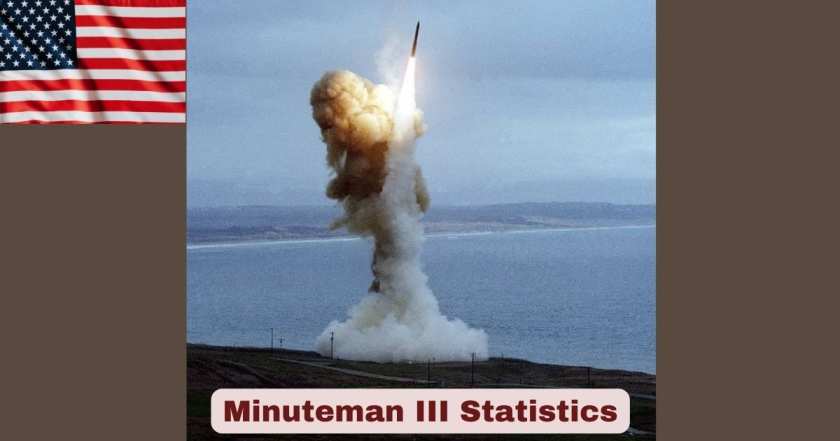
What Is Minuteman III?
The Minuteman III — formally designated the LGM-30G — is the United States’ sole land-based intercontinental ballistic missile (ICBM) currently in active service, operated under the Air Force Global Strike Command (AFGSC). The designation itself tells a story: “L” stands for silo-launched, “G” for surface attack, and “M” for guided missile. First deployed in 1970, this three-stage, solid-fuel missile was born from a Cold War necessity — the urgent need for a weapon that could survive a surprise Soviet nuclear strike and retaliate within minutes. Named after the colonial minutemen of the American Revolutionary War, the Minuteman III was engineered to be ready to fight at a moment’s notice, representing a transformative leap beyond the slow-reacting, liquid-fueled missiles of its era. Its guidance system uses inertial navigation, and unlike its predecessors, the missile’s targeting data can be updated in a matter of hours — a flexibility that made it a dominant strategic asset for more than five decades.
As of 2026, the Minuteman III remains the backbone of America’s land-based nuclear triad, representing one leg of the broader nuclear deterrence strategy alongside submarine-launched Trident II ballistic missiles and nuclear-armed strategic bombers. The missile is stationed at three operational wings — the 90th Missile Wing at F.E. Warren Air Force Base in Wyoming, the 341st Missile Wing at Malmstrom AFB in Montana, and the 91st Missile Wing at Minot AFB in North Dakota — collectively covering five US states and spread across roughly 40,000 square miles of American heartland. With its replacement, the LGM-35A Sentinel, now delayed well into the early 2030s, the Minuteman III faces the extraordinary prospect of remaining in service through 2050 — making it one of the longest-serving strategic weapons systems in military history. This article compiles the latest verified 2026 statistics, facts, and data sourced directly from US government reports, the Department of the Air Force, and the Government Accountability Office (GAO).
Interesting Minuteman III Facts 2026
| Fact Category | Detail |
|---|---|
| Official Designation | LGM-30G (L = silo-launched, G = surface attack, M = guided missile) |
| Year First Deployed | 1970 |
| Current Active Inventory (FY 2025–2026) | 400 missiles |
| Total Silo Infrastructure | ~450 hardened silos (not all active) |
| Missile Length | 59.9 feet (18.3 meters) |
| Missile Diameter | 5.5 feet |
| Launch Weight | 79,432 pounds (36,030 kg) |
| Maximum Range | Over 8,000 miles (14,000 km) |
| Peak Speed | Mach 23 (~17,500 mph / 28,200 km/h) |
| Maximum Flight Altitude | ~700 miles (1,120 km) |
| Propulsion | Three-stage solid-fuel rocket motors |
| Stage 1 Thrust | 202,600–203,158 pounds |
| Stage 2 Thrust | 60,793 pounds |
| Stage 3 Thrust | 35,086 pounds |
| Guidance System | NS-50 Gimballed Inertial Navigation |
| Targeting Accuracy (CEP) | ~200 meters (~656 feet) |
| Current Warhead Configuration | Single warhead (W78 or W87) |
| W78 Yield | 335–350 kilotons |
| W87 Yield | 300–475 kilotons |
| MIRV Capability (design) | Up to 3 warheads (de-MIRVed since 2016) |
| Time to Target (from US to Asia/Europe) | Approximately 30 minutes |
| Operational Wings | 3 wings (Wyoming, Montana, North Dakota) |
| States Covered | 5 states (WY, MT, ND, CO, NE) |
| Missile Alert Facilities (MAFs) | 45 |
| Launch Control Centers per Squadron | 5 LCCs, each managing 10 Launch Facilities |
| Launch Crew | 2 officers per crew on 24-hour alert |
| Test Launches Conducted (total) | Over 300 |
| Most Recent Test Launch | GT 255 — March 3, 2026, Vandenberg Space Force Base |
| Test Launch in 2025 | GT 254 — November 2025; GT — May 21, 2025; GT — February 2025; GT — June 2025 |
| Test Range | Vandenberg Space Force Base, CA → Kwajalein Atoll, Marshall Islands (~4,200 miles) |
| Service Life (Originally Expected) | Until 2036 |
| Extended Service Life (Post-2025 GAO) | Potentially until 2050 |
| Successor Missile | LGM-35A Sentinel (Northrop Grumman) |
| Sentinel IOC (Initial Operational Capability) | Now expected early 2030s (delayed from 2029) |
Source: US Air Force Fact Sheet; Air Force Global Strike Command; GAO Report GAO-26-108755, February 2026; Federation of American Scientists — LGM-30 Minuteman
The facts table above paints a striking picture of a weapon system that has aged far beyond its original design parameters yet continues to be one of the most formidable strategic deterrents on Earth. The Minuteman III was fielded during the Nixon administration and has now outlived the Cold War, three major arms reduction treaties, and two planned successors. What stands out most is the missile’s continued precision: a circular error probability (CEP) of roughly 200 meters after more than five decades in service means it can still reliably target hardened military installations anywhere on the globe. The Mach 23 terminal velocity and sub-30-minute flight time to targets across Europe or Asia remain virtually unmatched by any ground-launched alternative in the American inventory.
The test launch data is equally compelling. The GT 255 test on March 3, 2026 — the most recent as of this writing — and the multiple tests in 2025 (February, May, June, and November) confirm that the Air Force is ramping up its testing cadence to compensate for aging components and Sentinel delays. With the GAO’s February 2026 report (GAO-26-108755) now flagging that the Air Force needs a formal transition risk management plan, the Minuteman III’s path to 2050 operation is becoming less theoretical and more operationally real with every passing quarter. The 45 Missile Alert Facilities and two-officer launch crews working around the clock are a reminder that this is not a museum artifact — it is a live, alert, and constantly validated nuclear deterrent.
Minuteman III Fleet Size & Deployment Statistics 2026
| Deployment Category | Data |
|---|---|
| Total Deployed Missiles (FY 2026) | 400 |
| Total Silo Infrastructure | ~450 hardened silos |
| Active/Loaded Silos | Approximately 400 (not all 450 are currently active) |
| 90th Missile Wing (F.E. Warren AFB, Wyoming) | 150 missiles |
| 341st Missile Wing (Malmstrom AFB, Montana) | 150 missiles (approx.) |
| 91st Missile Wing (Minot AFB, North Dakota) | 100 missiles (approx.) |
| States with Active Missiles | Wyoming, Montana, North Dakota, Colorado, Nebraska |
| Total Geographic Spread | Approximately 40,000 square miles |
| Missile Alert Facilities (MAFs) | 45 |
| Launch Facilities (LFs) per Squadron | 50 LFs (5 flights × 10 LFs) |
| Launch Control Centers (LCCs) per Squadron | 5 |
| Minimum Separation: LF from LCC | At least 3 nautical miles (5.6 km) |
| Personnel on Alert (per LCC crew) | 2 officers, around-the-clock |
| Command Authority | President and Secretary of Defense |
| Backup Launch Command | E-6B Mercury airborne launch control aircraft |
Source: Air Force Global Strike Command; GAO Report GAO-26-108755, February 2026; Department of the Air Force — FY 2025 Active Inventory Data
The Minuteman III fleet of 400 missiles deployed across five states represents one of the most geographically dispersed nuclear forces in the world — a deliberate survivability strategy that ensures no single adversary strike could eliminate the entire force. The ~450 hardened silos, of which approximately 400 are currently loaded and active, form an underground infrastructure that spans roughly 40,000 square miles of American territory. Each silo is independently hardened and connected to its Launch Control Center (LCC) through reinforced underground cables, allowing two-officer crews to manage and launch missiles while remaining protected from a nuclear blast. The dispersal across Wyoming, Montana, North Dakota, Colorado, and Nebraska means any first-strike attempt would require hundreds of enemy warheads — a fundamental pillar of the deterrence calculus.
What makes this deployment architecture particularly resilient is the layered command structure. While the President and Secretary of Defense hold the ultimate launch authority, the E-6B Mercury aircraft provides an airborne backup command capability, ensuring that even if ground-based command infrastructure were destroyed in a first strike, the United States could still authorize a retaliatory launch. The 45 Missile Alert Facilities serve as the nerve centers for this system, each one staffed continuously and linked to multiple launch facilities simultaneously. The 91st Missile Wing at Minot AFB contributed the actual missile used for the GT 255 test launch on March 3, 2026 — pulled from its operational complex and transported by truck to Vandenberg Space Force Base, California, underscoring the logistical complexity required to maintain even routine operational testing.
Minuteman III Technical Specifications & Performance Statistics 2026
| Specification | Value |
|---|---|
| Designation | LGM-30G |
| Missile Length | 59.9 feet (18.3 m) |
| Missile Diameter | 5.5 feet (~1.7 m) |
| Launch Weight | 79,432 lbs (36,030 kg) |
| Maximum Range | 8,000+ miles (14,000+ km) |
| Operational Range (Test Verified) | ~4,200 miles (Vandenberg to Kwajalein) |
| Maximum Flight Altitude | ~700 miles (1,120 km) |
| Peak Terminal Velocity | Mach 23 (~28,200 km/h / ~17,500 mph) |
| Propulsion Type | Three-stage solid-fuel rocket |
| Stage 1 Motor | Thiokol M-55 — 203,158 lbs thrust |
| Stage 2 Motor | Aerojet SR-19 — 60,793 lbs thrust |
| Stage 3 Motor | ATK Refurbished SR-73 — 35,086 lbs thrust |
| Guidance System | NS-50 Gimballed Inertial Navigation System |
| Circular Error Probability (CEP) | ~200 meters (~656 feet) |
| Warhead Type (Current) | W78 (335–350 kT) or W87 (300–475 kT) |
| Reentry Vehicle | Mk-12A (W78) or Mk-21 (W87) |
| Warheads per Missile (Current) | 1 (de-MIRVed since 2016) |
| Maximum MIRV Capacity (Design) | Up to 3 warheads |
| Time to Target (USA to Eurasia) | Approximately 30 minutes |
| Post-Boost Vehicle | Yes — maneuvering “bus” for warhead delivery |
Source: US Air Force Fact Sheet; Air Force Global Strike Command; Army Recognition — AFGSC Verified Data
The sheer physical and engineering scale of the Minuteman III becomes clear when you examine its propulsion data. A 79,432-pound missile accelerating to Mach 23 through a three-stage solid-fuel propulsion sequence — starting with 203,158 pounds of first-stage thrust — produces one of the most powerful ballistic trajectories of any weapon system in human history. The NS-50 inertial guidance system, introduced through the Guidance Replacement Program that concluded in 2008, replaced the older NS-20A system and extended service life past 2030 while maintaining or improving targeting accuracy to a CEP of approximately 200 meters. This level of precision means that a single Minuteman III warhead — whether the W78 at 335–350 kilotons or the W87 at 300–475 kilotons — can reliably destroy hardened targets including enemy missile silos, command bunkers, and military infrastructure anywhere within its 8,000-mile range.
The decision to de-MIRV the fleet in 2016, reducing each missile to a single warhead, was a product of arms control agreements rather than technical limitations. The missile’s Post-Boost Vehicle (PBV) — the maneuvering “bus” deployed after the booster phases — retains the physical capacity to carry up to three independently targetable warheads, a capability the GAO September 2025 report noted could be re-activated if Sentinel’s delays require the Minuteman III to compensate through a Multiple Independently Targetable Reentry Vehicle (MIRV) reconfiguration. The W87 warhead, originally built for the retired LGM-118A Peacekeeper missile and transferred to Minuteman III from 2007 onward, is particularly notable for its pairing with the Mk-21 reentry vehicle — the most accurate reentry vehicle available in the US arsenal — giving portions of the Minuteman III force unmatched terminal-phase precision.
Minuteman III Test Launch Statistics 2026
| Test / Event | Date | Details |
|---|---|---|
| GT 255 Test Launch | March 3–4, 2026 | Unarmed ICBM launched from Vandenberg SFSB; missile sourced from 91st Missile Wing (Minot AFB); mission to validate readiness |
| GT 254 Test Launch | November 2025 | Multiple reentry vehicles; traveled ~4,200 miles to Kwajalein Atoll; terminal data collected by advanced radar & optical sensors |
| Operational Test Launch | June 2025 | Routine test from Vandenberg SFSB; affirmed system reliability |
| Operational Test Launch | May 21, 2025 | Unarmed Minuteman III; 12:01 a.m. PT; Vandenberg SFSB |
| Operational Test Launch | February 19, 2025 | Joint AFGSC team; traveled ~6,760 km to Reagan Test Site, Marshall Islands |
| Total Test Launches (All-Time) | — | Over 300 |
| Annual Test Launch Frequency | — | 4–6 launches per year |
| Test Organization | — | 377th Test and Evaluation Group |
| Test Range Used | — | Vandenberg SFSB (CA) → Kwajalein Atoll, Marshall Islands |
| Data Shared With | — | DoD, Department of Energy, and national laboratories |
| Future Test Authorization | — | Air Force evaluating extending test launches past 2030, potentially through 2045 |
Source: Vandenberg Space Force Base Public Affairs — GT 255, March 2026; Air Force Global Strike Command Press Releases; GAO Report GAO-26-108755, February 2026; Air and Space Forces Magazine
The GT 255 test launch on March 3, 2026 — the most recent confirmed Minuteman III test at the time of this publication — underlines just how aggressively the Air Force is maintaining confidence in its aging ICBM fleet. Conducted by Air Force Global Strike Command Airmen from Vandenberg Space Force Base in California, the test used a missile pulled directly from the 91st Missile Wing’s complex at Minot Air Force Base, transported to the California coast, reassembled, and launched across the Pacific. The 377th Test and Evaluation Group — the Air Force’s dedicated ICBM test organization — planned and executed the mission, collecting performance data that is shared with the Department of Defense, the Department of Energy, and national laboratories for verification against long-term system reliability models.
With over 300 cumulative test launches completed since the missile’s debut and a current pace of 4–6 launches per year, the Minuteman III has arguably the most validated ballistic missile flight test record of any weapon in the world. The GAO’s February 2026 report highlighted a critical emerging challenge: as Sentinel’s delays push the Minuteman III’s service life toward 2050, the Air Force must manage its dwindling inventory of spare parts carefully enough to sustain test launches all the way through 2045. To address this, the Air Force has already received authorization to conduct fewer tests annually when necessary to preserve component stocks — a measured but telling sign that the program is being stretched well beyond its original design boundaries. The GT 254 test in November 2025, which involved multiple reentry vehicles and detailed terminal-phase sensor collection at the Kwajalein Atoll test site, was specifically used to validate long-term performance assumptions for a force that the US government now expects to operate for another two-plus decades.
Minuteman III Replacement & Modernization Statistics 2026
| Category | Data |
|---|---|
| Successor Program | LGM-35A Sentinel (formerly Ground Based Strategic Deterrent / GBSD) |
| Prime Contractor | Northrop Grumman (awarded 2020) |
| Original Sentinel Cost Estimate | $77.7 billion |
| Revised Cost Estimate (July 2024, DoD) | ~$160 billion |
| Restructured Cost Estimate (Post-Nunn-McCurdy) | At least $140 billion (~81% above original estimate) |
| 50-Year Life Cycle Cost Estimate | ~$264 billion |
| Nunn-McCurdy Cost Breach Declared | January 2024 |
| GAO Report Published | February 18, 2026 (GAO-26-108755) |
| Sentinel Original IOC | 2029 |
| Sentinel Revised IOC (as of Feb 2026) | Early 2030s |
| Sentinel First Test Launch (Planned) | 2027 |
| Minuteman III Originally Expected End-of-Service | 2036 |
| Revised Minuteman III End-of-Service (GAO 2025) | Potentially 2050 |
| Missiles to Be Replaced (1-for-1) | 400 Minuteman IIIs → 400 Sentinels |
| Silos Being Reused | None — new silos required (existing silos found unfit) |
| Infrastructure Affected | 450+ silos, 600+ facilities, across ~40,000 sq miles |
| Warhead for Sentinel | W87-1 (W87-0 initially, W87-1 from 2030 onward) |
| Funds Diverted from Sentinel (2025) | $934 million redirected to Air Force One refurbishment (reported July 2025) |
| Air Force Restructuring Completion | Expected end of 2026 |
Source: GAO Report GAO-26-108755, February 2026; Department of Defense — LGM-35A Sentinel Program Records; Defense News, September 2025; Air and Space Forces Magazine, February 2026
The Sentinel program’s cost explosion — from an original estimate of $77.7 billion to a revised figure of at least $140 billion, with the DoD’s own July 2024 projection reaching $160 billion — is one of the most significant defense acquisition failures of the modern era. The Nunn-McCurdy breach declared in January 2024 effectively forced a full restructuring of the program, during which the Air Force discovered a problem that compounded every other issue: the existing Minuteman III silos cannot be reused for the Sentinel. The silos, some over 50 years old, are not in adequate structural condition to house the new missile, requiring the construction of entirely new silos at massive additional expense not reflected in the original acquisition estimate. This revelation alone has contributed significantly to both the cost overrun and the schedule slip pushing Sentinel’s Initial Operational Capability from 2029 to the early 2030s.
The February 2026 GAO report (GAO-26-108755) is particularly pointed in its findings: the Air Force has undertaken what GAO formally classifies as a “megaproject” — one costing $1 billion or more, affecting 1 million or more people, and running for years — without a formal transition risk management plan. Compounding this is the politically controversial revelation, reported by the New York Times in July 2025, that approximately $934 million was diverted from the Sentinel program to fund refurbishments on a Qatari jet intended for use as Air Force One. With Sentinel’s first test launch not expected until 2027 and full operational capability not until the early 2030s, the Minuteman III will continue as the sole US land-based ICBM for at minimum another 7–9 years — and potentially through 2050 if program delays persist further. Every additional year the Minuteman III must serve represents a growing parts obsolescence challenge, increasing sustainment costs, and pressure on a shrinking supply chain.
Minuteman III Budget & Procurement Statistics 2026
| Budget Category | FY 2026 Data |
|---|---|
| Program Status | Active — sustained pending Sentinel transition |
| FY 2026 Procurement Focus | Sustaining Minuteman III operations through Sentinel fielding |
| Ballistic Missile Items (< $5M) | Procuring low-cost support equipment for component life extensions |
| Payload Transporter Replacement (PTR) | Air Force seeking 5 additional PTRs (RFI/Sources Sought, March 2026) |
| HACTS 2.0 (Communications Test System) | New start — replaces obsolete communication system test equipment; advance procurement in FY 2026 for materials with up to 81-week lead times |
| PADS (Performance Assessment Data System) | Legacy system (developed late 1970s, redesigned 1996–1999) — No FY 2026 funding |
| Guidance Replacement Program | Completed February 25, 2008 — NS-50 replaces NS-20A |
| Propulsion Replacement Program | Completed — solid propellant boost replaced 1998–2009 |
| Sustainment Cost Trend | Increasing — driven by aging components and parts obsolescence |
| GAO Concern (Sept 2025) | Air Force must manage spare parts supply for flight tests potentially through 2045 |
Source: FY26 Air Force Missile Procurement Document — Secretary of the Air Force Financial Management; GAO Report GAO-26-108755, February 2026; Defense News, March 2026
The FY 2026 Air Force Missile Procurement budget for the Minuteman III is centered on a single critical mission: keeping a 55-year-old missile system operational long enough for its replacement to arrive. The emphasis on low-cost support equipment under $5 million for component life extensions reflects the program’s fundamental challenge — the Minuteman III was never designed to operate this long, and the industrial base that originally built and supported it has largely atrophied. The Payload Transporter Replacement (PTR) program, for which the Air Force issued a new Request for Information in March 2026 seeking five additional armored transporters, exemplifies the cascading obsolescence problem: even the specialized trucks used to ferry warheads and rocket engines between bases and launch facilities are now aging out and cannot meet current nuclear security requirements.
The HACTS 2.0 program — a new start in FY 2026 — highlights yet another layer of the sustainment challenge. The existing Higher Authority Communications Test System, used to test the communications equipment that connects the President and Secretary of Defense to launch crews, is obsolete and no longer supportable. With up to 81-week lead times for production materials, the Air Force began advance procurement in FY 2026 to ensure continuity. The GAO’s finding that the Air Force needs a coordinated ICBM flight test plan to manage spare parts availability for potentially another two decades of Minuteman III testing underscores just how resource-intensive sustaining this system through 2045–2050 will be. The cost trajectory is clearly upward — and with Sentinel’s $140–160 billion price tag looming over every defense budget cycle, the financial pressure on maintaining the Minuteman III in parallel is unlikely to ease anytime soon.
Minuteman III Warhead & Nuclear Yield Statistics 2026
| Warhead / Category | Data |
|---|---|
| Current Warheads Deployed | W78 and W87 (both in active service) |
| W78 Yield | 335–350 kilotons (kT) |
| W87-0 Yield | 300 kilotons (kT) (upgradable to 475 kT with added oralloy rings) |
| W78 CEP (Mk-12A RV) | ~720 feet |
| W87 CEP (Mk-21 RV) | ~400 feet (most accurate US RV) |
| Total W78 Warheads Manufactured | ~1,083 |
| Total W87 Warheads Manufactured | ~560 |
| Warheads per Missile (2026) | 1 (de-MIRVed since 2016) |
| Maximum MIRV Capacity (design) | 3 warheads |
| Combined Warhead Yield (400 missiles) | Approximately 120,000 kT (120 megatons) total theoretical yield |
| W87 Transfer to Minuteman III | From 2007 (from retired Peacekeeper missiles) |
| W78 Deployment Started | December 1979 (replacing W62) |
| W78 Deployment Completed | February 1983 |
| W62 (Original Warhead) Yield | 170 kT — fully retired by 2009 |
| Warhead for Sentinel (Future) | W87-1 — selected March 2019 |
| First W87-1 Plutonium Pit Completed | October 2024 (NNSA announcement) |
Source: Federation of American Scientists — W78 and W87 Warhead Data; Minuteman Missile National Historic Site; Nuclear Weapon Archive
The Minuteman III’s nuclear payload tells its own story of American strategic evolution. The missile began its operational life carrying the W62 warhead at 170 kilotons — itself more than 11 times the yield of the atomic bomb dropped on Hiroshima — before transitioning to the more powerful W78 (335–350 kT) starting in December 1979. Today’s force carries either a W78 paired with the Mk-12A reentry vehicle or a W87 paired with the more precise Mk-21 reentry vehicle, with the W87 variant offering both greater accuracy (CEP of ~400 feet vs. ~720 feet for the W78) and an upgradable yield path to 475 kilotons. The W87 warheads currently on some Minuteman IIIs were originally built for the now-retired LGM-118A Peacekeeper missile and transferred to the Minuteman III from 2007 onward under the Safety Enhanced Reentry Vehicle (SERV) program, which also introduced improved safety features like insensitive high explosives.
The strategic significance of the de-MIRV decision in 2016 — reducing every missile to a single warhead from a potential three — cannot be overstated. While the 400-missile fleet now carries a combined theoretical yield of approximately 120,000 kilotons (120 megatons), the original Cold War configuration of 1,000 Minuteman missiles each carrying three warheads represented a force of 3,000 warheads — a number that would have been sufficient to blanket every significant city and military installation in the Soviet Union multiple times. The GAO’s September 2025 report noted that converting the existing force back to a MIRV configuration is technically feasible and is being evaluated as a potential strategy to maintain deterrence coverage if the Sentinel transition continues to fall behind schedule. The warhead destined for the Sentinel — the W87-1 — had its first plutonium pit completed by the National Nuclear Security Administration in October 2024, marking a critical production milestone even as the missile itself remains years from deployment.
Disclaimer: This research report is compiled from publicly available sources. While reasonable efforts have been made to ensure accuracy, no representation or warranty, express or implied, is given as to the completeness or reliability of the information. We accept no liability for any errors, omissions, losses, or damages of any kind arising from the use of this report.