
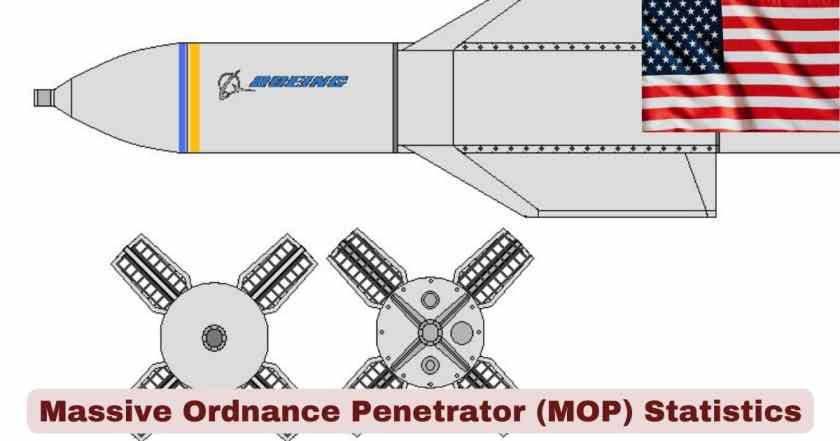
What Is Massive Ordnance Penetrator (MOP) ?
The GBU-57 Massive Ordnance Penetrator (MOP) — formally designated the GBU-57A/B in its primary production standard, with the current generation GBU-57F/B as the most advanced fielded variant — is the largest, most powerful, most deeply penetrating conventional bomb ever built, a 30,000-pound (13,608 kg), 20.5-foot-long (6.2 m), 31.5-inch-diameter GPS-guided precision munition developed by Boeing for the United States Air Force (USAF) under a program originally initiated by the Defense Threat Reduction Agency (DTRA) in 2004, designed for one singular, uncompromising purpose: to reach and destroy hardened, deeply buried targets (HDBTs) — underground nuclear enrichment facilities, buried weapons of mass destruction production sites, and hardened command-and-control bunkers — that every other conventional weapon in the U.S. arsenal cannot touch. The MOP is not a bomb in the conventional sense of the word. It is a kinetic energy penetrator of extraordinary mass — dropped from altitude by a Northrop Grumman B-2 Spirit stealth bomber, gathering speed as it falls, striking the ground at over 1,000 feet per second, driving through reinforced concrete and limestone rock with the momentum of a 15-ton steel projectile, and detonating its 5,300-pound (2,400 kg) explosive payload of AFX-757 and PBXN-114 deep inside the buried structure — creating a lethal combination of blast, fragmentation, and overpressure that travels through tunnels and chambers destroying hardware, equipment, and personnel that no surface explosion could reach. The USAF officially states that the GBU-57 can penetrate up to 200 feet (61 m) of unspecified material before detonating — with independent analysts at Janes Information Services confirming approximately 200 feet (61 m) of earth or 60 feet (18 m) of reinforced concrete — making it the only weapon in any nation’s inventory capable of threatening Iran’s deeply buried Fordow Uranium Enrichment Plant, carved into the side of a mountain at approximately 300 feet underground.
The bomb carries 7 variants — from the original GBU-57/B through the current GBU-57F/B — each incorporating progressively improved fuzing, guidance, and warhead technology, and it is equipped with the Large Penetrator Smart Fuze (LPSF), which adjusts detonation timing based on the depth and structural characteristics of the target encountered during penetration, including void-sensing capability that triggers detonation upon entering large underground chambers even if the weapon has not reached its programmed depth. Due to its extraordinary size and weight, the GBU-57 MOP can only be deployed operationally from the B-2 Spirit stealth bomber, which carries two bombs — one in each internal weapons bay — the only aircraft in the U.S. inventory with payload bays large enough to accommodate the 20.5-foot weapon while maintaining the stealth profile necessary to penetrate defended airspace over a target hardened enough to justify the MOP’s use.
On June 22, 2025, the GBU-57 Massive Ordnance Penetrator made the transition from the most consequential weapon in the U.S. arsenal that had never been used in combat to the most consequential weapon in the U.S. arsenal that had just changed the strategic landscape of the Middle East. Seven B-2 Spirit stealth bombers — departing from Whiteman Air Force Base, Missouri, flying a 36-hour, 13,000-mile round trip in the longest B-2 mission since the opening of the Afghanistan war in 2001, supported by dozens of aerial refueling tankers, more than 125 total aircraft, and hundreds of maintenance and operational personnel — dropped 14 GBU-57 MOP bombs on Iran’s Fordow Uranium Enrichment Plant and Natanz Nuclear Facility in the early hours of June 22, 2025. Gen. Dan Caine, Chairman of the Joint Chiefs of Staff, confirmed at a Pentagon press briefing that the lead B-2 dropped its first two MOPs on Fordow at approximately 6:40 p.m. Eastern / 2:10 a.m. Iran time, with all seven bombers completing their target runs for a total of 14 MOPs dropped against two nuclear target areas.
Defense Secretary Pete Hegseth described the strike as the first operational employment of the MOP — confirming it was the longest B-2 Spirit mission since 2001 and that the weapon carries explosive power more than 10 times that of its predecessor. Gen. Caine confirmed that all 14 bombs guided to their intended aim points, functioned as designed, and detonated — and that the primary kill mechanism was a combination of overpressure and blast energy driving through the open tunnel network and destroying critical hardware throughout the facility interior. A trailing B-2 pilot who observed the first weapon detonations described the explosions as the brightest he had ever witnessed, appearing as full daylight despite occurring in complete darkness at 2:10 a.m. local time. Satellite imagery from Maxar Technologies taken immediately after the strikes showed multiple large-diameter holes or craters on the ridge above the Fordow complex, tunnel entrances blocked by debris, and a layer of grey-blue ash across a large swath of the surrounding area. Initial battle damage assessments confirmed all three target sites sustained extremely severe damage and destruction — and as of March 2026, the USAF is actively replenishing its MOP stocks with a Boeing $100 million+ sole-source contract, acknowledging the weapon’s combat expenditure in the most direct possible terms. The MOP had been designed, built, tested, and stored for 20+ years for exactly one scenario. On June 22, 2025, that scenario arrived — and the weapon worked.
Massive Ordnance Penetrator (MOP) 2026 — Key Facts
| # | MOP Key Fact | Details |
|---|---|---|
| 1 | First Combat Use — 14 MOPs Dropped on Fordow and Natanz — June 22, 2025 | Seven B-2 Spirit stealth bombers dropped 14 GBU-57 MOP bombs during Operation Midnight Hammer on June 22, 2025 — the first-ever operational employment of the weapon — confirmed by Defense Secretary Hegseth and Gen. Dan Caine at the Pentagon briefing — the bomb’s debut after 20+ years of development |
| 2 | 12 MOPs on Fordow’s Two Ventilation Shafts — 6 Down Each Hole | Gen. Caine confirmed 12 MOPs were dropped on Fordow — six down each of two ventilation shaft openings — specifically targeting the underground enrichment facility’s ventilation infrastructure to channel blast and overpressure into the buried chambers |
| 3 | Trailing B-2 Pilot Described MOP Detonations as Appearing Like Daylight Despite Complete Darkness | A trailing B-2 pilot confirmed at the June 26, 2025 Pentagon briefing that the MOP detonations at Fordow — occurring at 2:10 a.m. Iran time in complete darkness — were the brightest explosions he had ever witnessed, with the sky appearing as full daylight from his cockpit |
| 4 | 30,000 lb Weight — 10× the Explosive Power of Its Predecessor BLU-109 | The GBU-57 weighs 30,000 pounds (13,608 kg) — nearly six times heavier than the 5,000-lb GBU-28 it supersedes — and carries explosive power more than 10 times that of the BLU-109, confirmed by the U.S. Air Force fact sheet |
| 5 | Penetrates 200 ft of Earth or 60 ft of Reinforced Concrete Before Detonating | The USAF officially states the MOP penetrates up to 200 feet (61 m) of unspecified material — Janes Information Services independently confirms 200 ft (61 m) of earth or 60 ft (18 m) of reinforced concrete (5,000 psi) — the only conventional weapon capable of threatening Iran’s Fordow facility at approximately 300 ft depth |
| 6 | 36-Hour, 13,000-Mile B-2 Round Trip — Longest B-2 Mission Since 2001 | The seven B-2 Spirit bombers flew a 36-hour, non-stop, 13,000-mile round trip from Whiteman AFB, Missouri — the longest B-2 mission since the Afghanistan war opened in 2001 — supported by dozens of aerial refueling tankers and 125+ total aircraft |
| 7 | Weapons Traveled Down Ventilation Shafts at Speeds Exceeding 1,000 Feet Per Second | Gen. Caine confirmed at the June 26, 2025 Pentagon briefing that the MOPs traveled down the Fordow ventilation shafts at speeds exceeding 1,000 feet per second — the extreme kinetic energy of a 30,000-pound steel bomb at terminal velocity driving through rock and concrete |
| 8 | Kill Mechanism: Overpressure + Blast Driving Through Open Tunnel Network | Gen. Caine confirmed the primary damage mechanism was a combination of overpressure and blast energy driven through Fordow’s open tunnel network — the bomb’s internal detonation turned the facility’s own tunnel system into a pressure wave conduit that destroyed critical hardware throughout the interior |
| 9 | Boeing Awarded $100M+ Sole-Source Contract to Replenish MOP Stocks — February 2026 | Per USAF documents published February 12, 2026, the Air Force is finalizing a Boeing sole-source deal worth over $100 million to replace GBU-57s expended in Operation Midnight Hammer — official USAF language describes the acquisition as critically needed to replenish the inventory |
| 10 | $61.5 Million Boeing Contract Confirmed — Tailkits + Fuzes + Complete Assemblies | The U.S. Department of War awarded Boeing a $61.5 million contract for Wing Drop Ship Kit sets, KMU-612 E/B tailkits, GBU-57 G/B fuze cable guides, and complete MOP containers — work to be completed between September 2028 and May 2030 |
| 11 | MOP Production Concluding — Next Generation Penetrator (NGP) Replaces It | USAF documents confirm the MOP program production is concluding after current procurement efforts — the successor Next Generation Penetrator (NGP) was contracted to Applied Research Associates + Boeing in September 2025 with prototypes due within 18–24 months |
| 12 | Production Capacity Tripled or Quadrupled in 2024 — Oklahoma Facility Expanded | Per Bloomberg (2024), a facility in Oklahoma was expanded to triple or even quadruple the annual output of GBU-57 bombs — a pre-Midnight Hammer production surge that helped support the combat inventory built ahead of the Iran strikes |
| 13 | ATACMS Technology Reverse-Engineered Into MOP in August 2025 — Saved 4 Years of Work | Per USAF contracting documents, in August 2025 the Government successfully reverse-engineered a critical MOP subcomponent using existing Army ATACMS technology — eliminating an obsolescence issue and saving an estimated 4 years of design work |
| 14 | At Least 20 MOPs in USAF Inventory by November 2015 — Exact Current Number Classified | The USAF confirmed at least 20 GBU-57s delivered by November 2015 — with production continuing since; current inventory is classified, but with 14 expended in Midnight Hammer and the $100M+ replenishment contract underway, operational stocks continue to be maintained |
| 15 | B-21 Raider Will Carry MOP — But NGP (<22,000 lb) Designed to Fit Smaller B-21 Bay | The B-21 Raider is expected to carry the MOP, but its smaller payload bay — roughly two-thirds the size of the B-2’s — is likely the key design driver behind the NGP’s 22,000-pound weight ceiling, enabling full carriage without compromising the B-21’s stealth profile |
Source: DefenseScoop – Air Force drops 14 MOP bombs on Iranian nuclear sites, June 22–23, 2025; DefenseScoop – Joint Chiefs chairman supplies new details about MOP bomb attack, June 26, 2025; DefenseScoop – Battle damage assessment from Iran strikes, July 10, 2025; DefenseScoop – Air Force taps ARA to develop Next Generation Penetrator prototypes, September 8, 2025; Air & Space Forces Magazine – Pentagon to Restock Massive Bombs Dropped by B-2s on Iran, February 12, 2026
These 15 GBU-57 MOP key facts for 2026 document the complete arc of a weapons program from a 2004 DTRA technology demonstration through a 2025 combat debut that immediately validated everything its designers intended — and triggered an immediate replenishment cycle as the USAF moves to maintain its stock of the only conventional weapon capable of threatening the world’s most deeply buried military infrastructure. The 14-bomb employment at Fordow and Natanz consumed a meaningful fraction of the U.S. MOP inventory — and the February 2026 sole-source Boeing contract confirms in the most direct possible terms that the Air Force considers the MOP mission not complete but ongoing. Official USAF language describing the acquisition as critically needed to replenish inventory is the institutional confirmation that a military has used its most powerful conventional weapon in combat and intends to be ready to use it again. The ATACMS reverse-engineering milestone of August 2025 — saving four years of work to eliminate obsolescence in a critical MOP subcomponent — confirms that the program is investing in long-term sustainability even as its production concludes, ensuring that the bombs being replenished will remain serviceable and effective for years of potential future use.
The Next Generation Penetrator program launched in September 2025 with Applied Research Associates and Boeing as the development team is the acknowledgment that even the MOP has limits — and that those limits were partially exposed by Operation Midnight Hammer’s battle damage assessments. DTRA’s confirmed posture after Midnight Hammer — that all facilities were struck as planned and as intended — combined with independent reporting that Fordow suffered severe damage while Natanz and Isfahan may recover faster than anticipated is the operational feedback driving the NGP’s design requirements. The 22,000-pound weight ceiling for the NGP — roughly two-thirds the MOP’s weight — signals that the next penetrator will trade some raw mass for greater accuracy, faster aircraft integration, and compatibility with the B-21 Raider. The NGP’s defining improvement will almost certainly be its fuzing technology: Gen. Caine’s confirmation that each MOP was individually programmed with a unique target impact angle, arrival heading, and fuze setting reveals that the intelligence about the exact depth, structure, and internal layout of the target is as decisive as the bomb itself — and the Large Penetrator Smart Fuze that senses voids and adjusts detonation in real time is the engineering answer to that requirement.
GBU-57 MOP 2026 — Full Technical Specifications
| Specification | GBU-57A/B (Production Standard) | GBU-57F/B (Latest Variant) | Notes |
|---|---|---|---|
| Full Designation | GBU-57A/B Massive Ordnance Penetrator | GBU-57F/B | 7 total variants: /B through F/B |
| Developer / Manufacturer | Boeing (prime); DTRA / AFRL as sponsors | Boeing | Sole-source production — only Boeing |
| Total Weight | ~30,000 lb (13,608 kg) | Same class | One source cites 13,600 kg; another 12,300–13,600 kg range |
| Length | 20.5 feet (6.2 m) | 20.5 feet (6.2 m) | CBS News / USAF confirmed |
| Diameter | 31.5 inches (0.8 m / 80 cm) | 31.5 inches | Army Recognition; Boeing specs |
| Warhead Designation | BLU-127A/B (early); BLU-127B/B (mid); BLU-127C/B (current) | BLU-127C/B | Modular design — same body, improved fills |
| Explosive Fill | AFX-757 + PBXN-114 (polymer-bonded explosive) | Same type | AFX-757: ~4,590 lb (2,082 kg); PBXN-114: ~752 lb (341 kg) |
| Total Explosive Payload | ~5,300 lb (2,400 kg) | ~5,300–5,740 lb | USAF fact sheet: approximately 5,300 pounds |
| Explosive Power vs Predecessor | 10× greater than BLU-109 | Same | USAF confirmed — BLU-109 weighs only 910 kg |
| Casing Material | Eglin Steel (ES-1) high-density alloy | Same | Engineered to survive kinetic penetration intact before detonation |
| Guidance System | GPS + INS (Inertial Navigation System) dual-mode | GPS/INS + enhanced | KMU-612/B tail kit contains guidance package |
| Accuracy | Within meters of target | Sub-meter capable (latest) | USAF: able to strike within meters of its intended target |
| Fuze System | Large Penetrator Smart Fuze (LPSF) | LPSF enhanced | Adjusts detonation based on depth + void sensing + preprogrammed depth setting |
| Fuze Capability | Void-sensing; adjustable delay; depth-counting | Advanced void sensing | Each bomb individually programmed with unique impact angle, heading, and fuze settings — confirmed Gen. Caine, June 26, 2025 |
| Wing / Fin Configuration | 4 × fixed trapezoidal wings (midsection) + 4 × cropped lattice tail fins | Same | Lattice fins enable internal carriage + trajectory control |
| Penetration — Earth | Up to 200 ft (61 m) | Greater (classified) | USAF official + Janes analysts confirmed |
| Penetration — Reinforced Concrete (5,000 psi) | Up to 60 ft (18 m) / some sources 200 ft | Enhanced | Janes: 60 ft RC at 5,000 psi; USAF: 200 ft unspecified material |
| Penetration — Reinforced Concrete (10,000 psi) | ~8 ft (2.4 m) | Enhanced | Wikipedia / separate source cited in MOP entry |
| Terminal Velocity | Exceeds 1,000 feet per second (305 m/s) | Same | Gen. Caine — June 26, 2025 Pentagon briefing confirmed |
| Launch Platform — Current | Northrop Grumman B-2 Spirit — 2 bombs per sortie (one per bay) | Same | Only aircraft operationally cleared |
| Launch Platform — Future | B-21 Raider — integration planned | Same / NGP likely primary | B-21 smaller — may carry 1 MOP; NGP designed to fit B-21 |
| B-2 Carriage | 2 × GBU-57 — one per internal weapons bay | Same | B-52 tested but not operationally cleared |
| IOC Date | 2011 (early fielding; operational stockpile Whiteman AFB March 2012) | 2016+ (E/B and F/B) | USAF received first 16 MOPs by November 2011 |
| Program Manager | Air Force Global Strike Command (AFGSC) — since 2017 program of record | Same | Originally DTRA program; transitioned to USAF 2010 |
| Unit Cost | Classified — estimated tens of millions USD | Classified | Grey Dynamics; no official figure released |
| Production Status (2026) | Concluding — last lot being procured | Concluding | USAF documents February 2026 confirm MOP program production is concluding |
| Successor Program | Next Generation Penetrator (NGP) | NGP | ARA + Boeing; prototype contract September 2025; prototypes due March–September 2027 |
Source: U.S. Air Force GBU-57 Fact Sheet; CBS News – MOP specifications, June 22, 2025; DefenseScoop – Gen. Caine June 26 briefing, June 26, 2025; Wikipedia – GBU-57A/B MOP, updated December 2025; Army Recognition – GBU-57; Defence Today – GBU-57 MOP, June 27, 2025; DOT&E Annual Report 2012 – MOP
The GBU-57 MOP full technical specifications confirm a weapon whose engineering is as much about mass and velocity as it is about explosive power — and where the distinction matters enormously. A conventional bomb achieves destruction primarily through explosive blast radius from a surface or shallow detonation — the bigger the explosive fill, the wider the kill circle above ground. The MOP operates on an entirely different principle: it achieves destruction by converting its 30,000-pound mass into kinetic penetration energy, then detonating its explosive fill deep inside the structure where the surrounding rock and concrete have nowhere to absorb the blast wave except inward through the target’s own tunnel and chamber network. The overpressure and blast energy driving through Fordow’s open tunnels and destroying critical hardware — as confirmed by Gen. Caine — is the operational articulation of this physics: the ventilation shafts that provided Fordow’s air supply became the delivery mechanism for the bomb’s lethal pressure wave throughout the facility’s interior.
The Eglin Steel (ES-1) high-density alloy casing is the engineering achievement that makes this possible. At 1,000+ feet per second terminal velocity, a 30,000-pound steel bomb encounters deceleration forces during penetration that would shatter any conventional bomb body before the weapon reached its design depth. The ES-1 alloy was specifically engineered — developed at Eglin Air Force Base, Florida — to maintain the structural integrity of the penetrator case during impact, preserving the explosive fill and fuze electronics through the extreme deceleration of penetrating reinforced concrete or limestone rock, until the weapon reaches its programmed detonation depth. The Large Penetrator Smart Fuze then does what no fixed-delay fuze could: it reads the structural environment of the penetration in real time — sensing voids when the bomb enters underground chambers, counting material layers as they are penetrated — and triggers detonation at the optimal moment to maximize internal destructive effect. Each of the 14 MOPs dropped on Fordow and Natanz on June 22, 2025 carried a uniquely programmed fuze setting tailored to its specific aim point — the targeting precision of a sniper rifle applied to a 15-ton bomb.
GBU-57 MOP 2026 — Operation Midnight Hammer: Complete Statistics
| Detail | Confirmed Data | Source |
|---|---|---|
| Operation Name | Operation Midnight Hammer | Pentagon press briefing; DefenseScoop; CBS News |
| Strike Date / Time | June 21–22, 2025 — lead B-2 dropped first MOP at 6:40 PM Eastern / 2:10 AM Iran time | Gen. Caine — Pentagon briefing, June 22, 2025 |
| Ordered by | President Donald Trump | Hegseth — Pentagon briefing |
| Targets | Fordow Uranium Enrichment Plant, Natanz Nuclear Facility, Esfahan Nuclear Facility | Gen. Caine; DefenseScoop; CBS News |
| B-2 Bombers Used | 7 Northrop B-2 Spirit stealth bombers — each carrying 2 MOPs | Gen. Caine; The Aviationist; CBS News |
| Decoy B-2s | Additional B-2s sent to Guam as decoys to mislead Iran away from the real attack route | Hegseth; CBS News; The Aviationist |
| Total GBU-57 MOPs Dropped | 14 GBU-57 bombs total — 12 on Fordow + 2 on Natanz | Gen. Caine — confirmed June 22 and June 26, 2025 |
| Fordow MOPs — Distribution | 12 MOPs — 6 down each of 2 ventilation shafts | Gen. Caine — June 26, 2025 Pentagon briefing |
| Natanz MOPs | 2 MOPs | Gen. Caine — June 26, 2025 |
| Esfahan Strike Weapon | More than two dozen Tomahawk TLAMs from a single submarine (not MOP) | The War Zone; Pentagon briefing |
| Total Aircraft Involved | More than 125 aircraft including B-2s, tankers, ISR, fighters | Gen. Caine — June 22 briefing |
| Aerial Refueling Tankers | Dozens of tankers — mission required multiple refueling cycles | Gen. Caine; DefenseScoop |
| Total Precision Weapons Employed | ~75 precision guided weapons including the 14 MOPs | Gen. Caine — June 22 briefing |
| B-2 Mission Duration | ~36 hours — non-stop round trip from Whiteman AFB, Missouri | CBS News; The Aviationist; DefenseScoop |
| Mission Distance | ~13,000 miles round trip | The Aviationist |
| Historical Comparison | Longest B-2 mission since 2001 (Afghanistan war opening) | Hegseth — Pentagon; The Aviationist |
| First-Ever Use of MOP | Yes — Hegseth confirmed this as the first operational employment of the MOP | Hegseth — Pentagon briefing, June 22, 2025 |
| MOP Performance | All weapons released on correct speed and parameters, guided to intended targets, and functioned as designed with confirmed detonation | Gen. Caine — June 26, 2025 |
| Kill Mechanism Confirmed | Primary kill mechanism: overpressure and blast energy driven through open tunnels, destroying critical hardware throughout the facility | Gen. Caine — June 26, 2025 |
| Terminal Velocity Confirmed | Exceeds 1,000 feet per second through ventilation shafts | Gen. Caine — June 26, 2025 |
| Pilot Observation | Trailing B-2 pilot described MOP detonations as the brightest explosions he had ever witnessed, with the sky appearing as full daylight at 2:10 AM local time | Gen. Caine — June 26, 2025 |
| Shots Fired at US Aircraft | None — DoD unaware of any shots fired at U.S. aircraft inbound or outbound | Gen. Caine — June 22, 2025 |
| Initial BDA (June 22) | All three target sites confirmed to have sustained extremely severe damage and destruction | Gen. Caine — June 22, 2025; CBS News; The Aviationist |
| Satellite Evidence | Maxar Technologies imagery — multiple large craters on Fordow ridge; tunnel entrances blocked by debris; grey-blue ash layer across surrounding area | Maxar Technologies, June 22, 2025; CBS News |
| DIA Assessment | DIA reportedly assessed Iran’s nuclear program was set back, though exact timeline debated | The War Zone; Hegseth disputed more pessimistic estimates |
| Pentagon Claim on Impact | President Trump described the sites as completely and totally obliterated; Hegseth stated Iran’s nuclear ambitions had been obliterated | CBS News; DefenseScoop |
| Independent Assessment | Fordow: severe damage confirmed by U.S. officials; Natanz and Isfahan may recover faster | Jerusalem Post; The War Zone |
| Replenishment Funded | August 2025 budget reprogramming request: $123 million to replace MOP and other munitions expended in Midnight Hammer | The Aviationist; Air & Space Forces Magazine |
Source: DefenseScoop, June 22, 23, 26, and July 10, 2025; The War Zone, June 22 and July 10, 2025; CBS News, June 22, 2025; The Aviationist, June 22, 2025; Air & Space Forces Magazine, February 12, 2026; Jerusalem Post, 2025; Wikipedia – GBU-57A/B MOP, updated December 2025; Maxar Technologies satellite imagery, June 22, 2025
The Operation Midnight Hammer MOP employment statistics constitute the most complete verified public record of a bunker-busting munition’s first combat use in military history — made possible by the decision of Gen. Caine and the Pentagon to provide an unusual level of technical detail across two separate press briefings on June 22 and June 26, 2025. The second briefing, specifically dedicated to MOP technical details, is extraordinary in the history of U.S. weapons employment transparency: Caine described the individual bomb fuze programming, the terminal velocity through the ventilation shafts, the specific kill mechanism, and the pilot’s eyewitness account of the detonations — a level of operational detail that confirms the Pentagon wanted the world to understand not just that the MOP had been used, but precisely how it worked and what it did. The specific statistic that 12 of the 14 MOPs were dropped six-per-shaft into Fordow’s two ventilation holes — rather than distributed across the target area — is the most revealing operational detail: the U.S. was not attempting to crater the surface above Fordow but to deliver 12 separate explosive charges into the interior of the underground facility through the only openings available, each bomb driving deeper than the last, the final bombs detonating at maximum depth after the preceding ones had pre-fractured the surrounding rock.
The Maxar satellite imagery released publicly within hours of the strike is the visual confirmation that matches Gen. Caine’s verbal description: the craters visible on the Fordow ridgeline are not from the bombs themselves but from the upward blast and ejecta of weapons detonating inside the mountain — the kinetic energy of the impact forced the bombs underground, and the explosive detonation forced debris and blast energy back up through the shaft path. The grey-blue ash layer across the surrounding area is the combustion residue of 14 bombs’ worth of AFX-757 and PBXN-114 explosive venting from inside the mountain through every available path. The distinction between severe damage at Fordow and the faster potential recovery at Natanz and Isfahan reflects the weapons’ targeting logic: Fordow received 12 MOP bombs specifically directed into its deepest infrastructure; Natanz received only 2 MOPs in conjunction with prior Israeli strikes; and Isfahan received Tomahawk missiles rather than MOPs. The allocation of 86% of the MOP employment to Fordow confirms the strategic priority that drove the entire GBU-57 program’s development: this weapon was built for one specific target, and on June 22, 2025, it was used against exactly that target.
GBU-57 MOP 2026 — Development History & Program Timeline
| Year / Event | Detail | Source |
|---|---|---|
| 2002 | Big BLU program initiated — USAF seeks very powerful conventional munitions; MOP identified as penetrator variant alongside MOAB blast variant | Wikipedia – GBU-57A/B MOP |
| 2003 | Iraq War BDA reveals inadequacy — existing bunker-buster bombs fail to destroy fortified military bunkers; USAF requirement for deeper-penetrating weapon confirmed | Wikipedia; GlobalSecurity |
| July 2004 | USAF formally requests MOP development — defense contractors asked to develop a large, precision-guided bomb capable of destroying deeply buried and hardened targets | Wikipedia |
| 2004 | DTRA / AFRL contract with Boeing — development led by Air Force Research Laboratory with Boeing as industry partner under DTRA Hard Target Defeat Program | Defence Today; designation-systems |
| 2007 | First MOP test — conducted at White Sands Missile Range, New Mexico; three live warhead drops + two inert drops from B-2 | Wikipedia; designation-systems |
| 2008–2010 | Flight testing from B-52 and B-2 — extensive testing at White Sands Missile Range under various conditions including rocket sled tests at Holloman HSTT | Wikipedia; Air & Space Forces Magazine |
| October 2007 | Congress funds $88M to modify B-2 bombers to carry MOP — Northrop Grumman performs B-2 integration | GlobalSecurity; Wikipedia |
| October 2009 | Congress accelerates MOP project — funding approved for production; Boeing contracted for B-2 integration | Wikipedia; Defence Today |
| September 2011 | USAF begins receiving MOP production units — 16 delivered by November 2011 | Wikipedia |
| March 2012 | Operational stockpile at Whiteman AFB confirmed — MOP deployed to home of the B-2 fleet | Wikipedia; GlobalSecurity |
| April 2012 | DOT&E publishes classified Early Fielding report — summarizes FY08–FY11 testing; USAF executes additional B-2 live drops and sled tests | DOT&E Annual Report |
| Early 2013 | Full B-2 integration completed | Wikipedia |
| By November 2015 | At least 20 MOPs delivered to USAF | Wikipedia; designation-systems |
| 2014–2016 | B-2 test drops validate ETR-IV upgrades — multiple test drops at White Sands | Air & Space Forces Magazine – GBU-57 archive |
| 2017 | Multiple B-2 test drops at White Sands — validate Enhanced Threat Response IV (ETR-IV) modifications; MOP transitions to Air Force program of record | Air & Space Forces Magazine; DOT&E 2017 |
| 2018 | USAF awards $20.9M contract to procure additional GBU-57s | Air & Space Forces Magazine |
| October 2019 | USAF awards $90 million contracts to two steel forging plants for BLU-127C/B warhead case assemblies | Wikipedia |
| 2020 | Large Penetrator Smart Fuze (LPSF) tested against tunnel target | Air & Space Forces Magazine |
| 2021–2022 | Three additional LPSF tests conducted | Air & Space Forces Magazine |
| 2024 | Production capacity announced to be tripled or quadrupled — Oklahoma facility expanded | Bloomberg, 2024; Wikipedia |
| 2024 | Two full-scale tests verify B-2 integration issue fix | DOT&E Annual Report; Air & Space Forces Magazine, February 12, 2026 |
| June 22, 2025 | FIRST COMBAT USE — 14 MOPs dropped on Fordow and Natanz in Operation Midnight Hammer | Pentagon; DefenseScoop; all major media |
| August 2025 | Budget reprogramming request: $123M to replace MOP and other Midnight Hammer munitions | The Aviationist, February 13, 2026 |
| August 2025 | ATACMS technology reverse-engineered into critical MOP subcomponent — saves 4 years of design work | The War Zone, February 2026; USAF contracting documents |
| September 2025 | NGP (Next Generation Penetrator) contract awarded to Applied Research Associates + Boeing — 24-month prototype development | DefenseScoop, September 8, 2025 |
| February 12, 2026 | USAF publishes sole-source justification for Boeing $100M+ MOP replenishment contract | Air & Space Forces Magazine; The Aviationist; The War Zone |
| 2027 (planned) | NGP prototypes (sub-scale + 3–5 full-scale) to be delivered — per 24-month ARA contract timeline | DefenseScoop |
| 2028–2030 | Boeing MOP replenishment deliveries — tailkits beginning January 2028; complete assemblies through May 2030 | Defense Mirror; Air & Space Forces Magazine |
Source: Wikipedia – GBU-57A/B MOP, updated December 2025; DOT&E Annual Report FY2012 – MOP; Air & Space Forces Magazine – GBU-57 MOP archive; DefenseScoop, June–September 2025; The War Zone, June 2025–February 2026; The Aviationist, June 2025 and February 2026; Boeing / DTRA historical documentation; GlobalSecurity; designation-systems; Grey Dynamics, 2025
The GBU-57 MOP development history and program timeline spans exactly 23 years from the Big BLU program’s initiation in 2002 through the weapon’s combat debut in 2025 — a development arc that includes three separate periods of funding suspension, two accelerations driven by emerging intelligence about Iran’s underground nuclear program, and a continuous cycle of testing and upgrade that produced seven distinct variants between initial fielding and the F/B version used in Midnight Hammer. The 2007–2010 testing period at White Sands and Holloman generated the empirical data that all subsequent MOP modeling and simulation has been built on — and Gen. Caine’s confirmation at the June 26, 2025 briefing that DTRA was able to study how the MOP behaves across specific geographies and structural architectures during that testing program is the most direct confirmation that the 23-year testing investment paid off in operational accuracy on the night of June 22, 2025. The 2009 intelligence revelations about Fordow — the deeply buried uranium enrichment facility carved into a mountain specifically to be protected from air strikes — are explicitly cited by Gen. Caine as the urgency that drove the program’s acceleration in the final years before fielding, confirming that the weapon and the target were effectively developed in response to each other across the decade between 2009 and 2019.
The concluding production status confirmed in February 2026 USAF documents marks the end of a 23-year era in U.S. bunker-busting weapons development. The MOP’s final lot of production will be the $100M+ Boeing replenishment contract triggered by its own combat use in Midnight Hammer, a fitting conclusion to a program that existed specifically to be ready for one type of mission and executed that mission on its first deployment. The NGP’s design requirement of under 22,000 pounds — roughly two-thirds the MOP’s mass — signals that the next generation of deep penetrators will achieve their effect through improved guidance precision, more effective fuzing, and compatibility with the B-21 Raider rather than through additional raw mass. But the MOP’s fundamental contribution — proving that a conventional weapon can penetrate and destroy targets at 200+ feet underground through rock and reinforced concrete — will define the architecture of every hard-target defeat weapon that follows it for decades to come.
Disclaimer: This research report is compiled from publicly available sources. While reasonable efforts have been made to ensure accuracy, no representation or warranty, express or implied, is given as to the completeness or reliability of the information. We accept no liability for any errors, omissions, losses, or damages of any kind arising from the use of this report.