
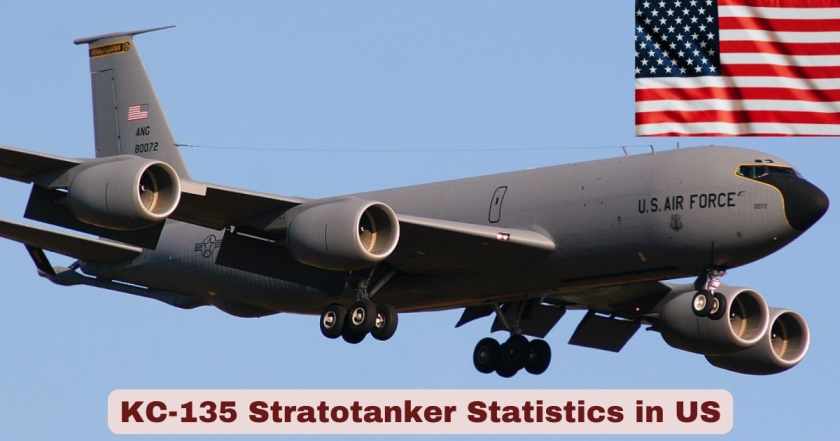
What is KC-135 Stratotanker?
The KC-135 Stratotanker is the United States Air Force’s primary jet-powered aerial refueling tanker aircraft — and by any measure, one of the most operationally significant military aircraft ever built. Developed by Boeing from the same Model 367-80 “Dash 80” prototype that gave rise to the commercial Boeing 707, the KC-135 carries the internal Boeing designation of Model 717 and entered USAF service in June 1957, replacing the slower, piston-powered KC-97 Stratofreighter. Its four swept-wing-mounted turbofan engines power it to takeoffs at gross weights of up to 322,500 pounds, carrying a maximum fuel load of 200,000 pounds — nearly all of which can be pumped through its iconic flying boom to receiver aircraft at altitudes and speeds that keep pace with the fastest combat jets in the inventory. The aircraft’s boom operator, stationed in the rear of the fuselage with a dedicated downward-facing window and flight controls for the boom, is one of the most specialized crew positions in all of military aviation. From the first days of the Cold War to the opening strikes of Operation Epic Fury in February 2026, the Stratotanker has been the enabling backbone behind every major US air campaign for nearly seven decades — because without fuel, even the most advanced fighter is just a very expensive glider.
As of March 2026, the KC-135 Stratotanker remains the numerically dominant aerial refueling platform in the USAF inventory, with approximately 370 airframes still active — a number that represents the bulk of the ~75% share of the world’s entire military tanker fleet that the United States controls. The youngest KC-135 in USAF service today is over 60 years old, and the oldest active aircraft in the entire US military is KC-135 tail number 57-1419, built in 1957 and still flying with the 161st Air Refueling Wing of the Arizona Air National Guard at Goldwater Air National Guard Base. The Air Force has actively sought to retire portions of the fleet and transition to the KC-46A Pegasus, its modern replacement, but Congressional intervention — most recently through the FY2026 NDAA — has blocked early divestments and mandated that KC-135s remain available as primary mission aircraft while KC-46A deliveries continue at a slower-than-planned pace. As the most recent proof of its enduring relevance, KC-135s were deployed to Israel and operated actively over Iranian airspace during Operation Epic Fury, which commenced on February 28, 2026 — described by US Central Command as the largest regional concentration of American military firepower in a generation.
Interesting KC-135 Stratotanker Facts in the US 2026
| Fact Category | Detail |
|---|---|
| Official Designation | KC-135R / KC-135T Stratotanker (current active variants) |
| Nickname | “Stratotanker” (formal); “STRATOTANKER,” “Gasser,” “The Hose” (informal) |
| Primary Mission | Aerial Refueling — Air Force, Navy, Marine Corps, and allied aircraft |
| Secondary Missions | Cargo transport, aeromedical evacuation, atmospheric sampling (WC-135R) |
| Manufacturer | Boeing (Seattle, Washington) |
| Prototype First Flight | August 31, 1956 (Boeing Model 367-80 basis) |
| First KC-135A Production Flight | August 31, 1956 |
| Initial Operational Capability (IOC) | June 1957 — Castle AFB, California |
| First KC-135R Conversion Flight | August 4, 1982 |
| First KC-135R Delivery | July 1984 |
| Last KC-135 Delivered to USAF | 1965 |
| Total Airframes Built (all KC/C-135 variants) | 732 KC-135s (820 total C-135 family including all variants) |
| Total Production Run | 1956–1965 |
| Current Active Inventory (as of Sept. 2024) | 376 KC-135s (151 active duty, 62 Air Force Reserve, 163 Air National Guard) |
| Estimated Active Fleet (FY2026) | ~370 aircraft (following recent retirements and before FY2026 divestments) |
| Peak Fleet Size (all-time) | ~732 KC-135As in original inventory |
| KC-135Rs Converted | ~420 aircraft re-engined with CFM56/F108 turbofans |
| KC-135Ts in Inventory | 54 (re-engined former KC-135Qs for SR-71 fuel missions, now general use) |
| Wingspan | 130 ft 10 in (39.9 m) |
| Length | 136 ft 3 in (41.5 m) |
| Height | 41 ft 7 in (12.7 m) |
| Maximum Takeoff Weight | 322,500 lbs (146,284 kg) |
| Maximum Fuel Load (KC-135R) | 200,000 lbs (90,719 kg) |
| Maximum Fuel Offload | ~200,000 lbs (nearly all internal fuel transferable) |
| Fuel Transfer Rate | 6,500 lbs (2,948 kg) per minute via flying boom |
| Maximum Cargo Payload | 83,000 lbs (37,648 kg) |
| Passenger Capacity | Up to 80 passengers |
| Engines (KC-135R/T) | Four CFM International CFM56-2B (USAF: F108-CF-100) turbofans |
| Thrust per Engine | 21,634 lbs-force (96.2 kN) |
| Maximum Speed | 580 mph (Mach 0.87 / 504 knots) |
| Cruise Speed | 552 mph (Mach 0.80 / 479 knots) |
| Service Ceiling | 50,000 feet |
| Ferry Range (unrefueled) | ~11,015 miles |
| Boom Refueling Altitude | Typically 230 mph / 47 ft separation between tanker and receiver |
| Multipoint Refueling System (MPRS) Aircraft | ~45 KC-135Rs fitted with wing pods — refuel 2 probe/drogue aircraft simultaneously |
| Crew | 4 (two pilots, navigator, boom operator); +5 medical crew for aeromedical missions |
| Operating Cost per Flight Hour (est. FY2025–2026) | Approximately $13,000–$15,000/hour |
| Total Fleet O&S Cost (FY2001 baseline) | $2.2 billion (~$3.71 billion in 2024 dollars) |
| Oldest Active USAF Aircraft (as of 2025) | KC-135 serial 57-1419 — built 1957, 161st Air Refueling Wing, Arizona ANG |
| USAF Planned Service Life | Until at least 2050 |
| Replacement Aircraft | KC-46A Pegasus (primary); notional NGAS (Next-Generation Air-Refueling System, long-term) |
| Most Recent Combat Deployment | Operation Epic Fury — February 28, 2026 — US/Israel joint strikes on Iran |
| Tankers Deployed for Operation Epic Fury | Over 100 combined KC-135 and KC-46A aerial refueling aircraft (open-source estimate) |
| Block 45 Cockpit Upgrade | Completed at rate of 38 aircraft/year through 2027 |
| Iridium SATCOM Replacement | Replacing Aero-I fleetwide — targeted completion 2026 |
| Vietnam War “First Tanker War” | 194,687 sorties, 813,878 refuelings, 1.4 billion gallons of fuel offloaded |
| Desert Storm Sorties (tankers) | 4,900+ sorties, 19,700 flying hours, 28.2 million gallons offloaded |
| US Share of Global Military Tanker Fleet | Approximately 75% |
Source: US Air Force Fact Sheet — KC-135 Stratotanker; Air and Space Forces Magazine — KC-135 Fact Sheet (October 2025); Wikipedia — Boeing KC-135 Stratotanker (verified against USAF records, September 2024 inventory data); US Central Command Public Affairs — Operation Epic Fury, February 28, 2026; Air and Space Forces Magazine — Weapons of Epic Fury, March 2026; Breaking Defense — Operation Epic Fury Tanker Strain Analysis, March 2026
The scale of the KC-135’s operational record is almost impossible to fully absorb. An aircraft that first flew in 1956 is still the platform that made the opening strikes of Operation Epic Fury on February 28, 2026 possible — deployed to Israel alongside KC-46As and F-22s, flying seven-hour round-trip missions over Iranian airspace and serving as the silent enabler for every bomber, fighter, and strike aircraft that reached its target that night. The 194,687 sorties flown in Vietnam, the 813,878 refueling contacts executed in that conflict alone, and the 1.4 billion gallons of fuel transferred during the Southeast Asia campaign constitute a sustained operational record that no other aircraft type in history has matched in sheer tonnage of strategic capability delivered. The fuel transfer rate of 6,500 pounds per minute via flying boom means that a KC-135 can fill an F-16 to combat-ready capacity in under three minutes while both aircraft are traveling at 230 mph at altitude — a feat of precision engineering that still defines the outer edge of what is physically possible in military aviation.
What is equally striking is the sheer breadth of the FY2026 operational picture. With roughly 370 KC-135s still active — split across 151 active-duty aircraft, 62 Air Force Reserve, and 163 Air National Guard aircraft as of September 2024 — and the US controlling approximately 75% of the entire global military tanker fleet, the Stratotanker is not merely a legacy platform enduring gracefully toward retirement. It is, right now in March 2026, the single most heavily deployed aerial refueling asset in what is arguably the largest US military air operation since the Iraq War. The Block 45 cockpit upgrade program proceeding at 38 aircraft per year through 2027 and the Iridium SATCOM fleetwide replacement targeting completion in 2026 confirm that the USAF continues to invest actively in a platform it knows will be flying operational missions well into the 2030s and potentially beyond 2050.
KC-135 Stratotanker Fleet Size & Inventory Statistics in the US 2026
| Fleet / Inventory Category | Data |
|---|---|
| Total KC-135 Inventory (September 2024) | 376 aircraft |
| Active Duty Aircraft | 151 |
| Air Force Reserve Command (AFRC) Aircraft | 62 |
| Air National Guard (ANG) Aircraft | 163 |
| Estimated Active Fleet (FY2026, post-retirements) | ~370 aircraft |
| Air Force FY2026 Budget Request (KC-135 retirements) | 14 KC-135s sought for retirement in FY2026 |
| FY2026 NDAA — Congressional Response | KC-135s must remain as primary mission aircraft; shift to storage/backup roles blocked |
| KC-135s Retired — FY2022 | 18 aircraft |
| KC-135s Retired — FY2023 | 13 aircraft |
| Active Variant (primary) | KC-135R — re-engined with CFM56 turbofans |
| Active Variant (secondary) | KC-135T — 54 aircraft (modified former KC-135Qs) |
| WC-135R Atmospheric Sampling Variant | 2 aircraft (converted from KC-135 airframes in 2022) |
| Aircraft Stored at AMARG (“Boneyard”) | Significant inventory of earlier KC-135E/A models |
| Operators | AETC, AFMC, AMC, PACAF, USAFE, ANG, AFRC |
| Active-Duty Wings Operate KC-135 | 22nd ARW (McConnell); 92nd ARW (Fairchild); 97th AMW (Altus, training); 6th ARW (MacDill); others |
| ANG Units (states operating KC-135) | Alabama, Alaska, Arizona, Hawaii, Illinois, Iowa, Kansas, Maine, Michigan, Mississippi, Nebraska, New Jersey, New York, Ohio, Pennsylvania, Tennessee, Utah, Washington, Wisconsin |
| Overseas Deployments (permanent) | RAF Mildenhall, UK (USAFE); Kadena AB, Japan (PACAF) |
| Congress Minimum Tanker Requirement | 466 total tanker aircraft (all components combined) |
| FY2025 Projected Inventory | ~350 KC-135s + ~120 KC-46As |
| US Share of Global Tanker Fleet | Approximately 75% |
Source: Air and Space Forces Magazine — KC-135 Fact Sheet (October 2025); Wikipedia — Boeing KC-135 Stratotanker (September 2024 inventory data); FY2026 National Defense Authorization Act (enacted December 2025); Defense One — Air Force FY2026 Retirements List, June 2025; Aerospace Global News — NDAA 2026 USAF Retirements Analysis, December 2025
The KC-135’s inventory structure in 2026 tells the story of a platform simultaneously aging out and being held in place by a Congress that will not let it go. The September 2024 inventory figure of 376 active aircraft — divided almost evenly between active-duty (151), Air Force Reserve (62), and Air National Guard (163) — represents a fleet that is more than half reserve-component, a structural reality with profound implications for Operation Epic Fury. Breaking Defense analysis in March 2026 highlighted that with over 100 combined KC-135 and KC-46A tankers deployed for the Iran operation, the Air Force was drawing heavily on Air Force Reserve and Air National Guard tanker crews — the same personnel and airframes that Congress had specifically mandated remain accessible as primary mission aircraft under the FY2026 NDAA. The Congressional calculus has been proven correct in real time: had the Air Force successfully retired 14 KC-135s in FY2026 as it requested, those aircraft and their reserve crews would have been unavailable exactly when the largest US air operation in a generation called for maximum tanker capacity.
The geographic spread of the KC-135 fleet is itself a statement about American global reach. Permanent overseas deployments at RAF Mildenhall in the United Kingdom and Kadena Air Base in Japan place Stratotankers within range of both European and Pacific theaters around the clock, while the ANG units in 19 states ensure that no single base shutdown or regional event can ground the entire tanker force. The 22nd Air Refueling Wing at McConnell AFB, Kansas — the largest tanker base in the Air Force — and the 92nd Air Refueling Wing at Fairchild AFB, Washington are the two highest-density active-duty KC-135 installations, each maintaining dozens of aircraft and thousands of flight line personnel. The 97th Air Mobility Wing at Altus AFB, Oklahoma, operating as the formal training center for the KC-135, is the pipeline through which every USAF boom operator and tanker crew earns their wings — a training mission that will continue until the last KC-135 leaves service.
KC-135 Stratotanker Technical Specifications & Performance Statistics in the US 2026
| Specification | Value |
|---|---|
| Designation | KC-135R (primary) / KC-135T (secondary) |
| Crew | 4 — two pilots, one navigator, one boom operator |
| Wingspan | 130 ft 10 in (39.88 m) |
| Length | 136 ft 3 in (41.53 m) |
| Height | 41 ft 7 in (12.7 m) |
| Empty Weight | 98,466 lbs (44,663 kg) |
| Maximum Takeoff Weight | 322,500 lbs (146,284 kg) |
| Maximum Fuel Load | 200,000 lbs (90,719 kg) — in 22 fuel cells across wing and fuselage |
| Maximum Cargo Payload | 83,000 lbs (37,648 kg) |
| Passenger Capacity | Up to 80 passengers |
| Engines | Four CFM International CFM56-2B (USAF: F108-CF-100) high-bypass turbofans |
| Thrust per Engine | 21,634 lbs-force (96.2 kN) |
| Engine Bypass Ratio | 6:1 high-bypass ratio |
| Original Engines (KC-135A) | Pratt and Whitney J57-P-59W turbojet — 13,750 lbf each |
| CFM56 vs J57 Thrust Improvement | CFM56 produces ~22,500 lbf — roughly double the J57’s output |
| Maximum Speed | 580 mph (Mach 0.87 / 504 knots) |
| Cruise Speed | 552 mph (Mach 0.80 / 479 knots) |
| Service Ceiling | 50,000 feet (15,200 m) |
| Ferry Range | Approximately 11,015 miles (17,720 km) unrefueled |
| Refueling Altitude / Speed | Typical boom contact at approximately 230 mph / 47 feet separation |
| Fuel Transfer Rate (boom) | 6,500 lbs (2,948 kg) per minute |
| Wing Sweep Angle | 35 degrees |
| Fuel Cells | 22 total — integral wing tanks between spars + lower fuselage tanks |
| Refueling Systems | Flying boom (primary); drogue adapter (secondary); MPRS wing pods (45 aircraft) |
| MPRS Refueling | Simultaneously refuel 2 probe/drogue aircraft from wing pods |
| KC-135R vs KC-135A Fuel Offload | KC-135R offloads up to 50% more fuel on long-duration sorties |
| KC-135R vs KC-135A Fuel Efficiency | KC-135R is 25% more fuel-efficient |
| KC-135R vs KC-135A Operating Cost | KC-135R costs 25% less to operate |
| KC-135R vs KC-135A Noise | Noise reduced by 96% — takeoff decibels from 126 dB down to 99 dB |
| KC-135R vs KC-135E Range | KC-135R operational range 60% greater than KC-135E for comparable offloads |
| Receiver Capable Aircraft | 8 KC-135R(RT) — capable of receiving fuel in flight |
| Block 45 Cockpit (FY2024 completion) | Color MFDs for engine instrumentation, radar altimeter, advanced autopilot, modern flight director |
| Avionics Upgrades (FY2025–2026) | MUOS secure/jam-resistant BLOS comms; SATURN NATO LOS; HF radio replacement; Iridium SATCOM |
| Winglet Test Program | AFRL tested prototype winglets — potential 7% range increase at cruise speeds |
Source: US Air Force Fact Sheet — KC-135 Stratotanker; Air and Space Forces Magazine — KC-135 Technical Data (October 2025); Federation of American Scientists — KC-135R Technical Data; Boeing KC-135 Stratotanker — The Aviation Zone; Wikipedia — Boeing KC-135 Stratotanker
The CFM56 re-engining program that produced the KC-135R is one of the most economically significant aircraft modification programs in US military history, and its numbers tell the story plainly. Replacing the 1950s-era Pratt and Whitney J57 turbojets with CFM International’s high-bypass CFM56 essentially doubled available thrust while simultaneously cutting fuel consumption by 25%, reducing operating costs by 25%, and cutting takeoff noise from 126 decibels to 99 decibels — a 96% noise power reduction that made KC-135R operations from civilian and joint-use airports vastly more politically manageable. The result was so dramatic in performance terms that two re-engined KC-135Rs could accomplish the refueling work of three KC-135As, which is the single most important reason why the Air Force was able to operate a fleet a fraction of the original size while meeting roughly the same operational demands. The 22 fuel cells spread across the wings and lower fuselage, holding up to 200,000 pounds of jet fuel at maximum load, give each sortie a transfer potential that is simply unmatched by any other platform currently in service.
The Block 45 cockpit upgrade completed across the fleet through FY2024 completed the transformation of the KC-135R from an analog, 1950s-technology flight deck into a genuinely modern glass cockpit. The addition of color multifunction displays for engine instrumentation, a radar altimeter, an advanced autopilot, and a modern flight director dramatically reduced pilot workload and improved situational awareness, particularly in the oceanic and long-range legs that define most tanker missions. The FY2025–2026 avionics wave — bringing the Mobile User Objective System (MUOS) for secure, jam-resistant beyond-line-of-sight communications, SATURN for NATO interoperability, and Iridium SATCOM replacing the aging Aero-I system — brings the communications suite of a 1957 airframe into full alignment with the 2026 joint force network architecture. The AFRL winglet test program, which demonstrated a potential 7% range increase at cruise speeds, hints at the possibility of further life extension investments ahead.
KC-135 Stratotanker Combat History & Operational Record in the US 2026
| Operation / Period | Data |
|---|---|
| Service Entry | June 1957 — Castle AFB, California |
| Vietnam War (1965–1973) — Total Sorties | 194,687 sorties |
| Vietnam War — Total Refueling Contacts | 813,878 individual refuelings |
| Vietnam War — Total Fuel Offloaded | 1.4 billion gallons (~9.5 billion lbs) |
| Vietnam War — Record Month (September 1972) | 3,902 refueling sorties in a single month |
| Vietnam War — Record Single Month Fuel | 159.6 million lbs offloaded in September 1972 |
| Operation Desert Shield/Storm (1990–1991) | 4,900+ tanker sorties in 19,700 flying hours |
| Desert Storm — Fuel Offloaded | 28.2 million gallons to 14,588 receiver contacts |
| Desert Storm — Mission Completion Rate | 98% despite challenging combat conditions |
| Operation Allied Force (Kosovo, 1999) | KC-135s supported around-the-clock air campaign from European bases |
| Operation Enduring Freedom (Afghanistan, 2001+) | KC-135s enabled persistent coverage; flew alongside RC-135 reconnaissance variants |
| Operation Iraqi Freedom (2003–2011) | KC-135s supported continuous air operations; averaged ~435 flight hours/aircraft/year |
| Operation Midnight Hammer (June 2025) | KC-135s refueled B-2 Spirit bombers for strikes on Iran; B-2s refueled multiple times over US and allied airspace |
| Operation Epic Fury — Start Date | February 28, 2026 at 1:15 AM local time |
| Operation Epic Fury — Joint Partners | US and Israel (designated “Operation Roaring Lion” by IDF) |
| KC-135 Role in Operation Epic Fury | Pre-positioned in Israel with KC-46As; flew 7-hour round-trip missions supporting strikes on Iran |
| Total Tankers Deployed — Epic Fury | Over 100 combined KC-135 and KC-46A aircraft (open-source estimate) |
| Targets Struck in Epic Fury (first 72 hours) | Over 1,700 targets (DoD Fact Sheet, March 3, 2026) |
| Tanker Impact on Epic Fury | KC-135s enabled B-2s from Whiteman AFB (Missouri) to reach Iran and return; extended F-15E, F-35, F/A-18 combat radius and loiter time |
| CENTCOM Epic Fury Description | “The largest regional concentration of American military firepower in a generation” |
| Continuous Combat Service (all-time) | 69 consecutive years (1957–2026) — one of only nine military aircraft types globally with 60+ years continuous service |
| Total Combat/Operational Sorties (all-time estimated) | Well over 1 million sorties across all conflicts since 1957 |
Source: US Air Force Fact Sheet — KC-135 Stratotanker; Defense Technical Information Center (DTIC) — “A Comparative Study of KC-135 Operations in Vietnam” (DTIC ref. ADA430855); The Aviation Geek Club — “KC-135 Stratotanker in Operation Desert Storm” (verified against AMC records); DoD Fact Sheet — Operation Epic Fury, March 3, 2026; Wikipedia — Boeing KC-135 Stratotanker; Aviation Week and Space Technology — Operation Epic Fury, February 28, 2026
The KC-135’s operational record across 69 years of continuous service is defined by a single, relentless truth: no major US air campaign since 1957 has been possible without it. The Vietnam figures alone are staggering — 194,687 sorties and 813,878 individual refueling contacts in a war that Defense historians now formally designate as “the world’s first tanker war” specifically because of the Stratotanker’s transformative impact. The record-setting month of September 1972, when KC-135 crews flew 3,902 refueling sorties and offloaded 159.6 million pounds of fuel, reflects the kind of operational tempo that physically and logistically strained the entire tanker fleet — yet the aircraft kept flying. The Desert Storm mission completion rate of 98% across 4,900 sorties in a 40-day air campaign that saw fighters launching around the clock to hit Iraqi targets is a reliability figure that most commercial airlines would be proud to claim in normal peacetime operations.
Operation Epic Fury, beginning February 28, 2026, may ultimately be recorded as the KC-135’s most strategically significant single deployment. The positioning of KC-135s and KC-46As in Israel ahead of the strikes — confirmed by Aviation Week and Space Technology and multiple open-source trackers — provided the refueling architecture that allowed B-2 Spirit stealth bombers to fly from Whiteman Air Force Base in Missouri, cross the Atlantic and Mediterranean, strike targets deep inside Iran, and return safely, all in a single continuous sortie supported by multiple in-flight refueling contacts. As Breaking Defense’s analysis noted on March 3, 2026, those over-100 deployed tankers were identified as “the most likely limiting factor” in sustaining the campaign — a finding that validated everything Congressional tanker fleet advocates have been arguing for years and that the FY2026 NDAA’s protection of KC-135 primary mission status now looks remarkably prescient in light of.
KC-135 Stratotanker Retirement & Replacement Statistics in the US 2026
| Retirement / Replacement Category | Data |
|---|---|
| Original Total Fleet Built | 732 KC-135As delivered to USAF (1957–1965) |
| Peak Operational Inventory | ~732 aircraft (original delivery period) |
| Inventory at Start of FY2021 | ~396 aircraft (blocked from any retirement that year by Congress) |
| KC-135s Retired — FY2022 | 18 aircraft |
| KC-135s Retired — FY2023 | 13 aircraft |
| Air Force FY2026 Retirement Request | 14 KC-135s (part of 340 total USAF aircraft retirement request) |
| FY2026 NDAA Congressional Response | KC-135s blocked from early storage/backup status; must remain primary mission aircraft |
| Current Active Inventory (est. FY2026) | ~370 aircraft |
| Planned Service Life End | At least 2050 |
| Projected Maximum Service Life | Some aircraft potentially serviceable to 2040+ (36,000–39,000 flight hour limits) |
| Oldest Active Aircraft (2025) | 57-1419 — built 1957, 68 years old as of 2025, Arizona ANG |
| Average Aircraft Age (FY2026 est.) | ~62 years |
| Replacement Aircraft (primary) | KC-46A Pegasus (Boeing — based on 767) |
| KC-46A Deliveries — FY2022 | 15 aircraft |
| KC-46A Deliveries — FY2023 | 13 aircraft |
| KC-46A Deliveries — FY2024 | 10 aircraft |
| KC-46A Deliveries — Q1–Q3 FY2025 | 9 aircraft |
| KC-46As Delivered/Accepted (as of Jan. 2026) | ~105 aircraft |
| KC-46A Lot 12 Contract | Signed November 25, 2025 — $2.47 billion for 15 more aircraft through June 30, 2029 |
| Total KC-46As Planned for USAF | 188 aircraft (current contract basis) |
| Final KC-46A Delivery Estimate (current rate) | No earlier than 2035 |
| Long-Term Replacement Concept | NGAS — Next-Generation Air-Refueling System (notional; no contract awarded) |
| Bridge Tanker Concept | Under evaluation — possible interim aircraft between KC-135 and NGAS |
| Congressional Minimum Fleet Requirement | 466 tanker aircraft across all components combined |
| FY2025 Projected Fleet (KC-135 + KC-46A) | ~350 KC-135s + ~120 KC-46As = ~470 aircraft (meets congressional floor) |
| France Retires KC-135 (June 30, 2025) | French Air and Space Force retired remaining C-135FRs at Istres AB; replaced by Airbus A330 MRTT |
Source: Air and Space Forces Magazine — KC-135 Fact Sheet (October 2025); Wikipedia — Boeing KC-135 Stratotanker and KC-46 Pegasus; Simple Flying — “Why the USAF Still Relies on the Boeing 767” (November 2025); Simple Flying — “5 Fast Facts on the KC-135 Stratotanker Replacement” (December 2024)
The KC-135 replacement story is one of the most drawn-out procurement sagas in US military aviation. The Air Force began formally planning KC-135 replacement around 2001, but the program that eventually became the KC-46A Pegasus did not receive its first delivery until January 2019 — nearly two decades after initial planning began, and during which time the KC-135 fleet aged another 18 years. Even with the KC-46A now delivering at a rate of roughly 9–15 aircraft per year, the math is unforgiving: at the current pace, the final KC-46A under the existing 188-aircraft contract will not be delivered until at least 2035. The $2.47 billion Lot 12 contract signed November 25, 2025 for 15 more aircraft through June 30, 2029 confirms that the production line remains active, but it also confirms that the KC-46A is not replacing the KC-135 on any timeline that resembles urgency. With the Congressional minimum of 466 total tanker aircraft only barely met by combining roughly 350 KC-135s and 120 KC-46As, there is zero margin to accelerate KC-135 retirements beyond the trickle-rate Congress has reluctantly permitted since FY2022.
The FY2026 NDAA’s explicit block on early storage/backup status for KC-135s is the most direct statement yet that Congress does not trust the Air Force’s tanker transition plan. France’s retirement of its final C-135FRs on June 30, 2025, after 60 years of service, is an instructive contrast — the French Air and Space Force was able to execute a clean retirement because it had a fully funded 1-for-1 replacement in the Airbus A330 MRTT. The USAF faces no such luxury: the KC-46A remains partially capability-limited in contested environments where its survivability is questioned, the NGAS next-generation tanker has not yet received a development contract, and the “bridge tanker” concept floated as an interim solution remains unfunded speculation. Until one of those future programs materializes with actual contracts and deliveries, the KC-135 will continue flying combat missions — exactly as it has in every decade since Eisenhower was president.
KC-135 Stratotanker Upgrade, Modernization & Budget Statistics in the US 2026
| Upgrade / Budget Category | Data |
|---|---|
| CFM56 Re-Engining Program (1984–2005) | ~$3.7 billion investment; 420+ aircraft converted |
| Annual Fuel Savings from CFM56 Re-Engining | 2.3–3.2 million barrels per year (~3–4% of USAF annual fuel consumption) |
| 15-Year Fuel Savings Estimate (re-engining) | ~$1.7 billion |
| Total Fleet O&S Cost (FY2001 baseline) | $2.2 billion/year (~$3.71 billion in 2024 dollars) |
| Estimated O&S Cost per Aircraft per Year | ~$4.6–6 million/year (FY2025 est.) |
| Operating Cost per Flight Hour | ~$13,000–$15,000 (FY2025–2026 estimate) |
| Block 45 Cockpit Upgrade Contractor | Rockwell Collins |
| Block 45 Upgrade Rate | 38 aircraft per year — completed across fleet through FY2024 |
| Block 45 Upgrade Components | Glass cockpit MFDs, radar altimeter, advanced autopilot, modern flight director |
| MUOS Secure Comms — Launch Year | FY2025 — Mobile User Objective System (jam-resistant BLOS communications) |
| SATURN NATO Comms — Launch Year | FY2025 — NATO-interoperable line-of-sight UHF radio |
| HF Radio Replacement — Status | Launched FY2025 |
| Iridium SATCOM — Replaces Aero-I | Fleetwide completion targeted: 2026 |
| Rudder Position Indicator Retrofit | Ongoing — increases crew safety awareness; addressing 2013 Kyrgyzstan crash lessons |
| AFRL Winglet Test Program | Tested prototype winglets — 7% potential range increase demonstrated |
| WC-135R Conversion | 2 aircraft converted from KC-135 airframes in 2022 — replace Constant Phoenix atmospheric sampling mission |
| KC-135 Structural Lifetime (R model) | 39,000 flight hours (projected USAF limit) |
| Average Annual Flight Hours per Aircraft | ~435 hours/year (post-9/11 average per USAF data) |
| Years to Reach 39,000-Hour Limit at Current Rate | ~90 years from service entry — meaning most KC-135Rs will not reach structural limits before 2050 |
| Wing Reskin Program (completed 1988) | 746 C/KC-135 aircraft had lower wing surfaces replaced over 13 years — 1,500 sq ft of aluminum per aircraft, 564 parts, 32,200 steel fasteners, 19,500 aluminum rivets each |
Source: US Air Force Fact Sheet — KC-135 Stratotanker; Air and Space Forces Magazine — KC-135 Fact Sheet (October 2025); Federation of American Scientists — KC-135R Technical Data; Wikipedia — Boeing KC-135 Stratotanker; GAO Report NSIAD-96-160 — “U.S. Combat Air Power: Aging Refueling Aircraft Are Costly to Maintain” (verified against current cost data); Simple Flying — KC-135 Replacement Analysis (November 2025)
The financial investment made in the KC-135 over its operational life is staggering and largely invisible to the public debate about whether to retain or retire the aircraft. The CFM56 re-engining program, costing roughly $3.7 billion and converting over 420 aircraft between 1984 and 2005, generated estimated fuel savings of $1.7 billion over 15 years — nearly half the program cost recovered in fuel economy alone, before accounting for the 50% improvement in fuel offload capacity that made each sortie dramatically more capable. The 2.3–3.2 million barrels of annual fuel savings achieved through re-engining represent roughly 3–4% of the USAF’s entire annual fuel consumption — equivalent to the fuel needed to power a city of 350,000–400,000 people for 145 days — a scale of conservation that goes entirely unrecognized in the policy debate. The structural lifetime of 39,000 flight hours for the KC-135R means that at the current average utilization rate of ~435 hours per year, most of the re-engined fleet will not reach physical structural limits until well after 2050 — a fact that makes the retirement timeline primarily a question of political will and procurement budgets rather than airframe physics.
The ongoing FY2025–2026 avionics modernization wave is particularly important context for anyone tempted to dismiss the KC-135 as a relic. The MUOS secure communications system, providing jam-resistant beyond-line-of-sight connectivity, and the SATURN NATO-interoperable UHF radio bring the KC-135R into full compliance with the joint and allied communications standards that define Operation Epic Fury-style coalition operations. The Iridium SATCOM replacement, targeting fleetwide completion in 2026, eliminates the last major communications gap between the KC-135R and the KC-46A. And the AFRL winglet demonstration — showing a 7% potential range improvement at cruise speeds — hints that if Congress and the Air Force ultimately agree on a path to 2050 service life, there are still meaningful performance upgrades available. A 1957 aircraft receiving jam-resistant satellite communications, modern autopilot systems, and structural life extension wing modifications in 2026 is not simply surviving — it is being actively invested in as a long-term strategic asset.
Disclaimer: This research report is compiled from publicly available sources. While reasonable efforts have been made to ensure accuracy, no representation or warranty, express or implied, is given as to the completeness or reliability of the information. We accept no liability for any errors, omissions, losses, or damages of any kind arising from the use of this report.