
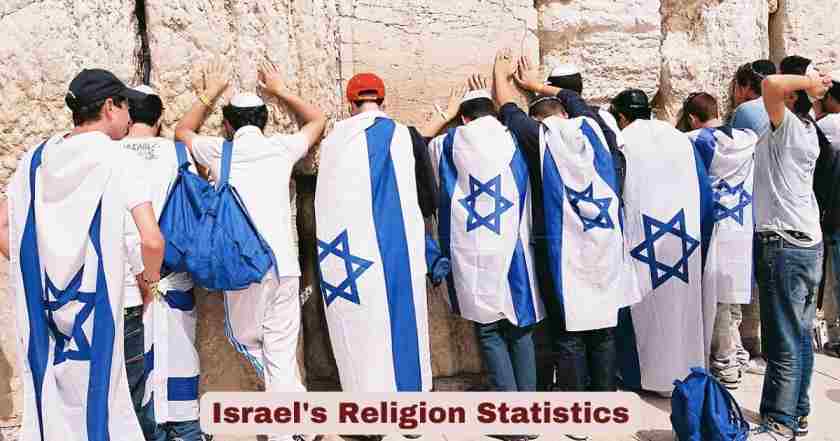
Religion in Israel 2026
Israel’s religious landscape is unlike anything else on the planet — and that is not hyperbole. It is the only country in the world where Judaism is the majority religion, home to the single largest concentration of Jewish people anywhere on earth. As of 2026, the country’s total population has crossed 10 million for the first time in its history, and the religious composition of those 10 million people tells a story that spans thousands of years of faith, conflict, migration, and coexistence. According to the Israel Central Bureau of Statistics (CBS), the country’s official government statistical agency, 73–74% of the population is Jewish, approximately 18–21% is Muslim, roughly 2% is Christian, and 1.6% is Druze — with the remaining share classified as “other,” a heterogeneous category that includes foreign nationals, non-Arab Christians, and individuals with no registered religious affiliation. The country officially recognises 14 distinct religious communities, and religion is interwoven into nearly every dimension of law, politics, education, and daily life in ways that have no real parallel among other democracies.
What makes Israel’s religion statistics in 2026 particularly compelling to analyse is the degree to which these communities are not static. The Haredi (ultra-Orthodox) Jewish population has grown from just 5% of Israel’s total population in 1990 to 14.3% by end-2025 — and projections from the CBS and the Israel Democracy Institute (IDI) suggest it will reach 16% by 2030 and nearly 25% by 2050. Meanwhile, Muslim fertility rates have dropped dramatically over the past four decades, falling from above 9 children per woman in the 1960s to approximately 2.71 today, while Christian Arab fertility has fallen below replacement level at just 1.48 children per woman. The post-October 7, 2023 war period has also injected new complexity into Israel’s religious sociology: surveys conducted in late 2024 and 2025 by the Jewish People Policy Institute (JPPI) and Hiddush show measurable increases in religious observance and belief in God among traditionally-identifying Jewish Israelis — even as secular Jewish Israelis have trended slightly in the opposite direction.
Interesting Facts: Israel Religion Statistics 2026 at a Glance
The table below captures the most important key facts about religion in Israel for 2026, drawn exclusively from verified official government and institutional sources.
| Fact / Indicator | Data |
|---|---|
| Only country with a Jewish majority in the world | Yes — the only one |
| Total Population (CBS Jan 1, 2026) | 10.178 million |
| Jewish Share of Population (2025 CBS) | ~73–74% (Jews + Others = 77.6%) |
| Muslim Share of Population | ~18–21% (2022: 18.1%) |
| Christian Share of Population | ~1.9–2% |
| Druze Share of Population | ~1.6% |
| “Other” (no religion / unclassified, incl. non-Arab Christians) | ~4–5% |
| Number of officially recognised religious communities | 14 |
| Five officially recognised faiths | Judaism, Islam, Christianity, Druze, Baha’i Faith |
| World Jewry residing in Israel (end-2023) | ~45% of global Jewish population |
| Israel-born Jewish Israelis (% of all Jewish Israelis) | 80% |
| Haredi (Ultra-Orthodox) population (end-2025) | 1,452,350 — 14.3% of total population |
| Haredi population annual growth rate | 4–4.2% per year |
| Haredi as % of total population in 1990 | 5% |
| Haredi projected share by 2030 (CBS forecast) | 16% |
| Haredi projected share by 2050 (CBS forecast) | 24.4% |
| Haredi children as % of all Israeli school students | 20% (401,000 students, 2023–24) |
| Israeli Jews identifying as secular (Hiloni) — 2022–2025 CBS | ~43–45% |
| Israeli Jews identifying as traditional (Masorti) | ~33% |
| Israeli Jews identifying as religious (Dati/Orthodox) | ~12% |
| Israeli Jews identifying as Haredi (ultra-Orthodox) | ~10% |
| Arab Israelis identifying as Muslim | 82.7% |
| Arab Israelis identifying as Christian | 8.3% |
| Arab Israelis identifying as Druze | 8.4% |
| Pew Research Israel religion tension ranking (global) | 5th globally for inter-religious tension |
| % of Jewish Israelis who believe in God (2009 CBS survey) | 80% |
| % of secular Jews who said belief in God decreased after Oct 7 | 20% |
| % of traditional / religious Jews who increased observance post-Oct 7 | 27% (JPPI, 2025) |
Source: Israel Central Bureau of Statistics (CBS), Annual Population Report January 2026 and Independence Day 2025 Report; Israel Democracy Institute Statistical Report on Ultra-Orthodox Society 2025; Jewish People Policy Institute (JPPI) Israeli Society Index 2025; Pew Research Center Survey 2024; Hiddush Religion and State Index 2025; Wikipedia Religion in Israel (CBS data)
The facts table above tells a story of extraordinary religious diversity compressed into one of the smallest land masses of any sovereign nation. The standout figure that demands immediate attention is the Haredi community’s explosive growth — from roughly 750,000 people in 2009 to 1,452,350 by end-2025 — in just sixteen years. No comparable religious sub-community in any OECD nation has grown at this pace, and the Israel Democracy Institute’s 2025 report confirms the growth rate remains at approximately 4–4.2% per year, making the Haredi community the fastest-growing population group in the entire developed world. At the same time, the country’s Muslim population of roughly 18–21% represents the second-largest religious bloc — a community whose fertility rate has dropped from above 9.0 children per woman in the 1960s to approximately 2.71 today, a demographic transition of historic proportions driven by rising education levels, urbanisation, and later marriage ages.
What is equally striking is the portrait of Jewish Israeli religious identity itself. Despite being nominally “Jewish,” the community is deeply internally segmented. Around 43–45% of Jewish Israelis describe themselves as completely secular (Hiloni) according to CBS surveys — and yet 80% of all Israeli Jews say they believe in God, and the vast majority observe at least some Jewish traditions, such as Passover seders, Yom Kippur fasting, and Hanukkah candle-lighting. The Pew Research Center’s 2024 survey data confirms this Israeli religious paradox: virtually every Israeli who identifies as Jewish says their religion is Jewish, even those who describe themselves as entirely secular and do not observe Jewish law. This is a fusion of ethnic, national, and religious identity that has no real equivalent elsewhere in the world.
Israel Religion Population Distribution (2022–2025)
The most current breakdown of Israel’s population by religion, using CBS-verified figures, is presented in the table below.
| Religious Group | Estimated Population (2025) | Share of Total Population | CBS Data Year |
|---|---|---|---|
| Jewish (incl. non-Arab “Others”) | ~7.77–7.9 million | ~73–77.6% | 2025 CBS |
| Muslim | ~1.80–2.05 million | ~18.1–20.1% | 2022–2025 |
| Druze | ~147,000–160,000 | ~1.6% | 2022–2024 |
| Christian (all types) | ~182,000–190,000 | ~1.9–2.0% | 2024 CBS |
| Other / No Religion / Unclassified | ~260,000–554,000 | ~2.5–5.6% | 2025 CBS |
| Foreign Nationals (temporary residents) | ~250,000–330,000 | ~2.5% | 2025 CBS |
| Haredi (sub-group of Jews) | ~1,452,350 | 14.3% of total pop. | End-2025, IDI |
| Dati / Religious Orthodox (sub-group) | ~900,000–1,000,000 est. | ~9–10% of pop. | 2022 CBS |
| Masorti / Traditional Jews (sub-group) | ~2,000,000–2,300,000 est. | ~20–23% of pop. | 2022 CBS |
| Hiloni / Secular Jews (sub-group) | ~3,100,000–3,500,000 est. | ~31–35% of pop. | 2022–2025 CBS |
| Bedouin Muslims (Negev + North) | ~260,000–280,000 | ~2.6% of pop. | 2022–2025 est. |
| Circassians (Sunni Muslim, non-Arab) | ~3,000–4,000 | < 0.05% | CBS est. |
Source: Israel Central Bureau of Statistics (CBS) 2022–2025; Religion in Israel (Wikipedia, citing CBS); US State Department International Religious Freedom Report 2022; Israel Democracy Institute Statistical Report on Ultra-Orthodox Society 2025; Times of Israel, Independence Day 2025 CBS Report
Israel’s religious composition as of 2025–2026 reflects decades of demographic forces colliding: immigration waves, differential fertility rates, and the natural increase of distinct religious communities. The CBS Independence Day 2025 report — the most current official data available — reports that the “Jewish and Others” category now comprises 77.6% of Israel’s population (7.77 million people), a combined figure that merges both halakhically Jewish citizens and those who entered Israel through the Law of Return on the basis of Jewish ancestry but are not formally registered as Jewish by the Orthodox Chief Rabbinate. The Muslim Arab population stands at approximately 20.9% of total population according to the CBS’s own most recent counts, with the Christian and Druze communities accounting for the remainder of the Arab population alongside a smaller share of non-Arab minorities. The “Others” category — those classified by the CBS as neither Jewish, Muslim, Arab Christian, nor Druze — has been the fastest-growing subpopulation in Israel during certain years, partly driven by immigration from the former Soviet Union of individuals with Jewish-heritage eligibility but no formal Jewish religious affiliation.
One of the most consequential tensions in Israel’s 2026 religious landscape concerns the growing divide between the rapidly expanding Haredi community and the secular Jewish majority. The Hiddush Religion and State Index 2025 — the 17th annual such survey — found that 73% of Israeli Jews view the tension between ultra-Orthodox and secular Jews as one of the two most severe social conflicts in the country today, second only to the left-right political divide. Simultaneously, 80% of Jewish Israelis support requiring Haredi men to serve in the IDF, and 75% support punishing draft evaders — a deeply charged issue given that approximately 1.45 million Haredim, who as a bloc largely avoid military conscription, now constitute over 14% of the country’s population and 23.5% of all those designated for military service by age cohort. This tension is not merely cultural — it has direct implications for national security, fiscal policy, and the sustainability of Israel’s public finances.
Jewish Religious Identity in Israel: Self-Reported Observance (Latest Data)
Jewish Israelis classify themselves along a widely recognised four-category spectrum of religious observance. The figures below reflect the most recent CBS surveys and institutional studies.
| Religious Identity Group | Hebrew Term | Share of All Israeli Jews | Share of Total Population | Data Source / Year |
|---|---|---|---|---|
| Secular | Hiloni | ~43–45% | ~31–35% | CBS 2024–2025; JPPI 2025 |
| Traditional | Masorti | ~33% | ~23–25% | CBS 2022; Pew 2024 |
| Religious / Modern Orthodox | Dati | ~12% | ~9–10% | CBS 2022; Pew 2024 |
| Ultra-Orthodox | Haredi | ~10% | ~14.3% of pop. | IDI 2025; CBS 2024 |
| Belief in God (all Israeli Jews) | — | ~80% | — | CBS 2009 survey |
| Haredi retention rate (remain Haredi as adults) | — | >90% | — | Pew 2024 |
| Hiloni retention rate (remain secular as adults) | — | ~93% | — | Pew 2024 |
| Jewish Israelis who increased observance post-Oct 7 | — | 27% | — | JPPI Nov 2025 |
| Jewish Israelis who decreased observance post-Oct 7 | — | 8% | — | JPPI Nov 2025 |
| Secular Jews who said belief in God declined post-Oct 7 | — | 20% | — | JPPI Nov 2025 |
| Religious Jews who said belief in God increased post-Oct 7 | — | 28% (national avg.) | — | JPPI Nov 2025 |
| Support for religion-state separation (general Jewish public) | — | 57% | — | Hiddush 2025 |
| Support for equal status for all Jewish streams (Reform, Conservative, Orthodox) | — | 57% | — | Hiddush 2025 |
Source: Israel Central Bureau of Statistics (CBS), Israeli Social Survey 2022 and 2024; Jewish People Policy Institute (JPPI) Israeli Society Index, November 2025; Pew Research Center, Israel Survey 2024 (published March 2025); Hiddush Religion and State Index 2025
The breakdown of Jewish Israeli religious identity is one of the most studied and most misunderstood statistics about the country. The headline figure — that roughly 43–45% of Jewish Israelis describe themselves as completely secular (Hiloni) — is accurate but misleading if taken out of context. The CBS’s Israeli Social Survey and multiple subsequent studies consistently confirm that most Hilonim do not live in a vacuum of religious practice. The majority of self-described secular Jews in Israel observe Passover seders, fast on Yom Kippur, attend Jewish lifecycle ceremonies, and would never describe themselves as “non-Jewish” despite rejecting Orthodox religious authority. This reflects a distinctly Israeli fusion of ethnic, national, and cultural Jewish identity that sits entirely outside the framework of diaspora Jewish denominationalism. There is no real equivalent of “Reform Judaism” or “Conservative Judaism” as organised institutional movements in Israeli Jewish life — rather, the spectrum runs from Haredi at one end through Dati, Masorti, and Hiloni on the other.
The post-October 7, 2023 war dynamics have introduced a fascinating sociological wrinkle into this picture. The JPPI’s November 2025 Israeli Society Index found that among the Jewish population, 27% reported increased religious observance since the start of the war, against only 8% who said observance had decreased — a net positive swing toward tradition. But this aggregate figure conceals a sharp divergence: virtually every increase in observance was concentrated among traditional (Masorti), religious (Dati), and ultra-Orthodox (Haredi) respondents, while among the secular Hiloni — who represent about 40% of Jewish Israeli adults — observance actually drifted slightly downward. Israel’s religious landscape in 2026 is not moving uniformly toward greater piety or greater secularism; it is polarising, with the observant becoming more observant and the secular becoming more secular.
Israel’s Haredi (Ultra-Orthodox) Population: Key Statistics 2025–2026
The Haredi community is the single most demographically dynamic group in Israel today, with implications that reach into every domain of public life.
| Haredi Indicator | Data | Year / Source |
|---|---|---|
| Total Haredi population (end-2025) | 1,452,350 | IDI / CBS 2025 |
| Total Haredi population (end-2024) | ~1,392,000 | IDI / CBS 2024 |
| Total Haredi population (end-2023) | ~1,335,000 | IDI / CBS 2023 |
| Total Haredi population in 2009 | 750,000 | CBS |
| Haredi share of total Israel population (end-2025) | 14.3% | IDI 2025 |
| Haredi share in 1990 | 5% | CBS historical |
| Haredi annual growth rate | 4–4.2% per year | IDI 2025 |
| Projected Haredi share by 2030 | 16% | CBS forecast |
| Projected Haredi share by 2050 (CBS) | 24.4% | CBS / IDI 2025 |
| Projected year Haredi reach 2 million | 2033 | CBS forecast |
| Haredi TFR (fertility rate per woman, 2021–2023) | 6.5 children | IDI 2025 |
| Haredi under-20s as share of their own population | 57% | IDI 2025 |
| Haredi as % of all Israeli school students | 20% (401,000 students) | IDI 2024 |
| Haredi as % of primary school students | 28% | IDI 2024 |
| Haredi men employed (employment rate, 2024) | 54% | IDI 2025 |
| Haredi women employed | 80% | IDI 2025 |
| Haredi men paying income tax | 23% | CBS / IDI 2025 |
| Haredi children below poverty line (2022) | 47% | IDI 2024 |
| Haredi contribution to national GDP (2023) | 4% of tax revenue | IDI 2025 |
| Estimated GDP loss from Haredi non-integration (2023) | ~$52 billion (10%+ of GDP per capita) | IDI 2025 |
| Haredi as % of those designated for IDF service (2025) | 23.5% | IDI 2025 |
| Projected Haredi share of IDF-eligible cohort by 2050 | 40% | IDI 2025 |
| Primary Haredi cities: Jerusalem share | 22.6% of all Haredim | IDI 2025 |
| Primary Haredi cities: Bnei Brak share | 15.6% of all Haredim | IDI 2025 |
Source: Israel Democracy Institute, Statistical Report on Ultra-Orthodox Society in Israel 2025 (published January 2026); Israel Democracy Institute report “By 2050, Almost One in Four Israelis Will Be Ultra-Orthodox” (February 2026); Times of Israel, CBS Independence Day 2025; Wikipedia, Haredi Judaism (CBS data)
The Haredi population trajectory in Israel is without precedent in any developed country. From just 750,000 in 2009 to 1,452,350 by the end of 2025 — a near-doubling in sixteen years — the ultra-Orthodox community has reshaped Israeli demographics in ways whose full consequences are only now beginning to materialize. The IDI’s 2025 Statistical Report describes the Haredi growth rate of 4–4.2% per year as the highest of any population in any developed country, driven by a combination of a still-very-high fertility rate (now approximately 6.5 children per woman, moderating slightly from the 7.5 recorded in 2003–2005), very low average age at first marriage (23 for men, 22 for women), and the modern medical and living standards that keep infant mortality low. Crucially, 57% of the Haredi population is under the age of 20, meaning the community’s enormous growth inertia — the result of so many young people not yet having had their children — will continue pushing numbers upward for decades regardless of any future fertility moderation.
The economic and civic dimension of Haredi growth is one of the most intensely debated policy questions in contemporary Israel. The IDI’s figures are stark: while Haredim constitute 14% of Israel’s working-age population, they generate only 4% of national tax revenue. The average Haredi man earns 49% of what a non-Haredi Jewish man earns, and only 23% of Haredi men pay income tax. An IDI analysis estimates the GDP loss from Haredi non-integration at over $52 billion annually, equivalent to more than 10% of Israel’s GDP per capita. These figures do not reflect a judgment on the Haredi community’s values or way of life — rather, they quantify the fiscal challenge that the Israeli state will face as this community grows from its current 14.3% share to a projected 24.4% by 2050. The IDI’s February 2026 report is explicit: unless there is substantial improvement in Haredi education (currently only 16% of Haredi students are eligible for state matriculation exams) and workforce integration, the state’s capacity to maintain prosperity will be materially tested.
Israel’s Muslim Population: Key Religion Statistics (2025)
Islam is the second-largest religion in Israel. Israel’s Muslim community is predominantly Arab, with the Bedouin sub-population representing a distinct demographic group.
| Muslim Population Indicator | Data | Year / Source |
|---|---|---|
| Total Muslim Population (est. 2025) | ~1.80–2.10 million | CBS 2022–2025 |
| Muslim share of Israel’s total population | ~18.1–20.9% | CBS 2022–2025 |
| Muslim share in 1994 | 14.1% | CBS historical |
| Predominantly Sunni Muslim | Yes — vast majority | CBS / State Dept. |
| Muslim TFR (mid-1980s to 2000) | 4.6–4.7 children per woman | CBS historical |
| Muslim TFR (2022) | 2.91 | Taub Center 2023 |
| Muslim TFR (latest 2025 est.) | ~2.71 | Various CBS-based |
| Muslim TFR in the 1960s | More than 9.0 children per woman | CBS historical |
| Bedouin TFR (Negev, 1998) | 10.06 | CBS |
| Bedouin TFR (Negev, 2022) | 4.4 | CBS 2022 |
| Bedouin population (Negev + Galilee) | ~260,000–280,000 | CBS est. |
| Median age of Muslim Israelis | 24 years | Statista / CBS 2023 |
| Muslim Arab share of Arab Israeli population | ~82.7% | CBS 2008–2022 |
| Muslim population growth rate | ~2.0–2.2% per year (slowing) | CBS / Taub Center |
| Average Muslim household size | 4.35 persons | CBS 2024 |
| Arab Muslim cities: largest concentration | Galilee (Northern District) | CBS |
| Negev Bedouin average household (2007) | 6.03 persons | CBS 2007 |
| Muslim population in Jerusalem (2020) | 353,800 | Jerusalem Institute |
Source: Israel Central Bureau of Statistics (CBS); Taub Center for Social Policy Studies, State of the Nation Report 2023 (Demography Chapter); US State Department International Religious Freedom Report 2022; Jerusalem Institute for Policy Research 2020; Wikipedia Demographics of Israel (CBS data)
Israel’s Muslim community in 2025 is in the midst of a demographic transition that has been decades in the making. The collapse of Muslim fertility from above 9 children per woman in the 1960s to approximately 2.71 today is one of the steepest fertility declines ever recorded for any religious group in modern demographic history. This transformation was driven by rising female education levels (the average age of first marriage among Arab women rose from 15 in the 1960s to 24 today), growing urbanisation among Muslim Israeli citizens, and greater integration into Israel’s labour market and educational institutions. By 2020, for the first time ever, the Jewish TFR in Israel (3.00) actually surpassed the Muslim TFR (2.99) — a demographic milestone the CBS highlighted as historically significant, given that for most of Israel’s history the Muslim fertility rate was substantially higher. At 2.91 (Taub Center 2023) to approximately 2.71 (2025 estimate), Muslim women in Israel now have fertility rates that are below the Jewish national average — a reversal that would have been unthinkable just thirty years ago.
The Bedouin sub-community deserves particular attention. Concentrated primarily in the Negev desert (approximately 192,000 in the Negev as of 2009, growing substantially since) and the Galilee (approximately 50,000), Bedouin Israelis are Muslim Arabs who historically lived semi-nomadic lives but have increasingly settled in permanent townships. Even as the national Muslim TFR has converged toward Jewish levels, the Bedouin TFR remains significantly elevated at 4.4 children per woman (2022 CBS data), down from a world-record 10.06 in 1998 but still roughly twice the national average. The average Bedouin household in the Negev was recorded at 6.03 persons compared to 4.64 for non-Bedouin Arab households and 3.09 for Jewish households. The median age of Muslim Israelis is 24 years — far lower than the national median of 29.3 years and reflecting the youth-heavy demographic pyramid of a still-high-fertility community.
Israel’s Christian Population: Religion Statistics (2024–2025)
Israel’s Christian community, while small in absolute terms, is one of the most highly educated and demographically distinctive groups in the country.
| Christian Population Indicator | Data | Year / Source |
|---|---|---|
| Total Christian Population (2024) | ~182,000–190,000 | CBS 2024 |
| Christian population growth rate (2024) | 0.7% | CBS 2024 |
| Christian share of total Israel population | ~1.9% | CBS 2022 |
| Arab Christians as % of all Israeli Christians | 78.7% | CBS 2024 |
| Arab Christians as % of Israel’s Arab population | 6.8% | CBS 2024 |
| Christian TFR (women, Jan–May 2024) | 1.61 children | CBS 2024 |
| Arab Christian women TFR | 1.48 children | CBS 2024 |
| Average Christian household size | 2.89 persons | CBS 2024 |
| Average Muslim household size (for comparison) | 4.35 persons | CBS 2024 |
| Average Jewish household size (for comparison) | 3.02 persons | CBS 2024 |
| Arab Christians in Northern District | 68.3% | CBS 2024 |
| Arab Christians in Haifa District | 14.7% | CBS 2024 |
| Non-Arab Christians in Tel Aviv + Central Districts | 42.0% | CBS 2024 |
| Median age of Christians in Israel | 35 years | Statista / CBS 2023 |
| Christian 12th-grade students eligible for matriculation | 87.7% | CBS 2023–2024 |
| Average age of Christian grooms at marriage (2023) | 30.8 years | CBS 2024 |
| Average age of Christian brides at marriage (2023) | 27.8 years | CBS 2024 |
| Christians in Jerusalem (2020) | 16,300 | Jerusalem Institute 2020 |
| Messianic Jews in Israel (estimate) | 10,000–20,000 | Wikipedia / CBS est. |
Source: Israel Central Bureau of Statistics (CBS) Christian community demographic report 2024 (published ahead of Christmas); Jerusalem Post report citing CBS, December 2024; Jerusalem Institute for Policy Research 2020; Statista Demographics of Israel 2023
Israel’s Christian community is small but remarkably distinct in its demographic character compared to every other religious group in the country. The CBS’s most recent Christian-community report — published in December 2024 ahead of the Christmas season — shows a community of roughly 182,000–190,000 people that grew by just 0.7% in 2024, the most modest growth rate of any religious group in Israel. The community is predominantly Arab Christian, with 78.7% of Israeli Christians identifying as Arab, primarily belonging to Greek Orthodox, Greek Catholic (Melkite), Roman Catholic, and other Eastern Christian traditions — concentrated in the Galilee region, Haifa, and Nazareth. Non-Arab Christians, largely immigrants from the former Soviet Union who entered Israel through the Law of Return alongside Jewish relatives, tend to be concentrated in the Tel Aviv and Central Districts.
What sets the Christian community apart most starkly is its educational attainment. A remarkable 87.7% of Christian 12th-grade students were eligible for a state matriculation certificate (bagrut) in 2023–2024 — a figure that surpasses every other religious group in the country, including non-Haredi Jews. The Israeli newspaper Maariv has described the Christian-Arab sector as the most successful in the Israeli education system, and the data consistently support this. The Christian TFR of 1.61 children per woman — and Arab Christian TFR of just 1.48 — places this community well below the national replacement level of approximately 2.08, with the lowest fertility of any religious group in Israel. The median age of Christians at 35 years and their average household size of only 2.89 persons (compared to 4.35 for Muslim households) speak to a community that is ageing, shrinking in relative terms, and in a pattern of demographic convergence with secular Western European communities.
Israel’s Druze Population: Religion Statistics (2024–2025)
The Druze are a unique ethno-religious community in Israel, distinguished by their military service loyalty and distinct religious tradition.
| Druze Population Indicator | Data | Year / Source |
|---|---|---|
| Total Druze Population (Israel) | ~147,000–160,000 | CBS 2022–2024 |
| Druze share of total Israel population | ~1.6% | CBS 2022 |
| Druze TFR (Jan–May 2024) | 1.64 children per woman | CBS 2024 |
| Druze TFR (2018–2022 range) | 1.85–2.16 | Taub Center 2023 |
| Druze TFR (2022 cities data) | 1.8 | CBS 2022 |
| Druze men subject to mandatory IDF service | Yes — unlike most Arab Israelis | Israeli law |
| Druze % of Arab Israeli population | ~8.4% | CBS 2008–2022 |
| Main Druze concentrations | Galilee, Mount Carmel, Golan Heights | CBS |
| Two Druze villages served by Galilee Druze community | Kfar Kama-adjacent (Circassian); main in Galilee | — |
| Druze religious classification | Classified separately from Muslims by CBS | CBS |
| Israeli law recognition of Druze | Recognised as separate religious community (status aparte) | MOI |
| Druze share of total Arab population | ~7–8% | CBS est. |
Source: Israel Central Bureau of Statistics (CBS); Taub Center State of the Nation Report 2023 (Demography); US State Department International Religious Freedom Report 2022; Wikipedia Demographics of Israel (CBS); Religion in Israel (Wikipedia)
The Druze community of Israel occupies a singular and fascinating position in the country’s religious mosaic. Numbering approximately 147,000–160,000 people and comprising ~1.6% of Israel’s total population, the Druze practice a religion that incorporates elements drawn from Ismaili Islam, Neoplatonism, and other traditions, and is considered a distinct and closed faith — members are born into it and conversion is not accepted in either direction. The Israeli government recognises the Druze as a separate religious community (status aparte) with their own religious courts, separate from both the Jewish and Muslim judicial systems. Unlike the vast majority of Arab Israeli citizens, Druze men are subject to mandatory IDF military conscription — a status the Druze leadership itself requested when Israeli independence was established, and which has created a bond of military service and shared civic identity with Jewish Israel that is unique among non-Jewish communities. This has given the Druze a reputation within Israeli society as steadfast and trusted allies of the state.
Demographically, the Druze are undergoing the same fertility transition as Christian Arabs. The Druze TFR of 1.64 children per woman (CBS, Jan–May 2024) places them below the national replacement level of 2.08 — a significant fall from their historical rates of above 3.0 children per woman in the late 20th century. The Taub Center’s 2023 demography report noted that the Druze TFR had fallen from 2.16 in 2018 to 1.85 by 2022, with further decline recorded into 2024. Like Christian Arabs, the Druze community’s below-replacement fertility means its population share within Israel will gradually contract in the coming decades unless offset by some other demographic factor. However, their concentrated presence in specific Galilee villages and their distinctive civic and military role in Israeli society ensure that the Druze will remain a culturally prominent community well beyond what their absolute numbers alone might suggest.
Israel’s Officially Recognised Religious Communities and Legal Framework
Israel’s law formally recognises a specific set of religious communities, each with significant legal and civic authority over personal status matters.
| Recognised Community / Institution | Details | Notes |
|---|---|---|
| Orthodox Judaism | Administered by the Chief Rabbinate of Israel | Controls marriage, divorce, conversion for Jews |
| Islam (Sunni) | Sharia courts for Muslim citizens | Controls Muslim personal status law |
| Druze Faith | Separate Druze religious court | Separate from Muslim courts |
| Catholic Church (multiple rites) | Latin, Armenian Catholic, Maronite, Melkite, Syriac Catholic, Chaldean | All recognised separately |
| Greek Orthodox Church | Recognised | Largest Christian denomination in Israel |
| Syriac Orthodox Church | Recognised | — |
| Armenian Apostolic Church | Recognised | — |
| Anglicanism (Episcopal) | Recognised | — |
| Baha’i Faith | Recognised | World HQ at Haifa; pilgrimage site |
| Reform Judaism | Not officially recognised for civil procedures | Not recognised by Chief Rabbinate |
| Conservative Judaism | Not officially recognised for civil procedures | Not recognised by Chief Rabbinate |
| Total officially recognised communities | 14 | — |
| Civil marriage (in Israel) | Only if proven lack of any religion | Secular marriages abroad are recognised |
| Pew ranking: religious restrictions | “High restrictions” — 5th globally | Pew Research Center |
Source: Religion in Israel (Wikipedia, citing Israeli Ministry of Interior and Knesset law); US State Department International Religious Freedom Report 2022; Pew Research Center, Government Restrictions Index; Israeli Basic Laws
Israel’s legal-religious framework is one of the most complex of any democracy in the world. Under the system inherited from the Ottoman millet structure and modified under the British Mandate, personal status matters — marriage, divorce, burial, and inheritance — are governed not by a unified civil code but by the religious community to which each individual belongs. This means that a Jewish Israeli must use the Orthodox Chief Rabbinate to marry within Israel, a Muslim Israeli must use Sharia courts for divorce proceedings, and a Druze must use Druze religious courts. The consequence is stark: civil marriage does not generally exist in Israel for citizens with a registered religion, and an Israeli Jew who wishes to marry outside the Orthodox framework must either travel abroad (where civil marriages are legally recognised upon return) or prove they have no religious affiliation. This structure is a constant source of tension, particularly for secular Jewish Israelis, for non-Orthodox Jewish converts not recognised by the Chief Rabbinate, and for immigrants from the former Soviet Union who hold citizenship under the Law of Return but are not recognised as Jewish by Orthodox definitions.
The non-recognition of Reform and Conservative Judaism for civil purposes is among the most contentious aspects of this framework. The Hiddush 2025 Religion and State Index found that 57% of Israeli Jews support equal legal status for Reform, Conservative, and Orthodox Judaism — a majority position that has consistently not been translated into law due to the political influence of Haredi and Orthodox political parties in successive coalition governments. This disconnect between public opinion and policy is a defining feature of Israel’s religion-state relationship heading into 2026. Despite the Baha’i Faith’s recognition as an official community (with the world headquarters of the Baha’i Faith located in Haifa, making Israel a pilgrimage destination for Baha’is globally), progressive Jewish movements that collectively represent millions of Diaspora Jews have no formal standing in the country that defines itself as the homeland of the Jewish people.
Disclaimer: This research report is compiled from publicly available sources. While reasonable efforts have been made to ensure accuracy, no representation or warranty, express or implied, is given as to the completeness or reliability of the information. We accept no liability for any errors, omissions, losses, or damages of any kind arising from the use of this report.