
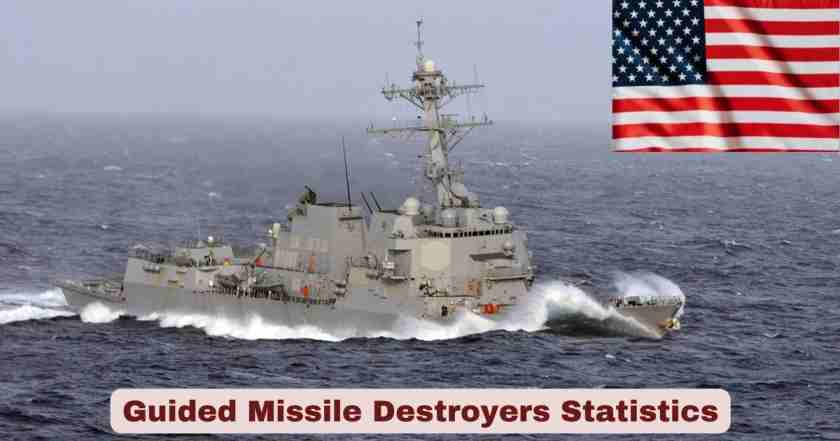
What Is Guided Missile Destroyer?
A guided missile destroyer (DDG) is the premier multi-mission surface combatant of the modern era — a warship large enough to carry a formidable arsenal of precision missiles, fast enough to accompany carrier strike groups at flank speed, and sophisticated enough to simultaneously conduct anti-air warfare (AAW), anti-submarine warfare (ASW), anti-surface warfare (ASUW), and ballistic missile defense (BMD) within a single hull. The term “guided missile destroyer” as a formal naval designation dates to the 1950s, when the United States Navy first retrofitted World War II-era destroyers with surface-to-air missiles — but the modern DDG of 2026 bears virtually no resemblance to those early conversions. Today’s guided missile destroyer is a 9,000-to-13,000-ton warship, longer than one and a half U.S. football fields, powered by gas turbines capable of exceeding 30 knots, armed with 90 to 128 missiles in vertical launch system (VLS) cells that can fire everything from Tomahawk land-attack cruise missiles and SM-3 exo-atmospheric ballistic missile interceptors to ASROC antisubmarine rockets and SM-6 dual-role air and anti-ship missiles — all controlled by Aegis-class combat management systems that simultaneously track hundreds of airborne targets. As of March 2026, the U.S. Navy operates 74 Arleigh Burke-class DDGs as its active fleet, with 25 more under construction or planned, making it by far the most numerous class of warship in the U.S. Navy and the largest single class of guided missile destroyers operated by any navy in the world. Globally, guided missile destroyers form the backbone surface combatant of every major blue-water navy, from China’s Type 055 (which the U.S. DoD classifies as a cruiser given its 12,000–13,000 ton displacement and capability depth) to Japan’s Maya-class, South Korea’s Sejong the Great-class, the UK’s Type 45 Daring-class, and India’s rapidly growing Visakhapatnam-class.
In 2026, the guided missile destroyer has proven its operational indispensability in the most public way possible. The USNI News Fleet and Marine Tracker for March 2, 2026 — the most authoritative open-source U.S. Navy deployment tracker in existence — confirmed that multiple Arleigh Burke-class DDGs fired Tomahawk Land Attack Missiles (TLAMs) in direct support of Operation Epic Fury on February 28, 2026, with official U.S. Navy photographs showing USS Frank E. Petersen Jr. (DDG-121) and USS Winston S. Churchill (DDG-81) launching TLAMs from the Red Sea and Mediterranean respectively. In the Arabian Sea, six independently deployed DDGs — USS McFaul (DDG-74), USS John Finn (DDG-113), USS Milius (DDG-69), USS Delbert D. Black (DDG-119), USS Spruance (DDG-111), and USS Michael Murphy (DDG-112) — operated as both strike platforms and layered air defense nodes, while Destroyer Squadron 2 with USS Bainbridge (DDG-96) and USS Mahan (DDG-72) deployed with USS Gerald R. Ford in the Eastern Mediterranean, and Destroyer Squadron 21 with USS Spruance and USS Michael Murphy operated with USS Abraham Lincoln in the Arabian Sea. Simultaneously, the Ted Stevens (DDG-128) — the second Flight III Arleigh Burke and the most advanced guided missile destroyer ever built — was delivered to the U.S. Navy by HII Ingalls Shipbuilding in December 2025, marking the beginning of the DDG’s next capability era. In every dimension — from historical combat performance to present-day shipbuilding output to active warfighting in 2026 — the guided missile destroyer remains the world’s dominant surface combatant.
Guided Missile Destroyer 2026 — Key Facts
| # | Guided Missile Destroyer Key Fact | Details |
|---|---|---|
| 1 | 74 Arleigh Burke DDGs Active — Most Numerous Warship Class in US Navy | As of January 2025 / early 2026, the U.S. Navy has 74 active Arleigh Burke-class DDGs, with 25 more under construction or planned — making it by far the most numerous class of warship in the U.S. Navy |
| 2 | DDG-121 and DDG-81 Fire Tomahawks in Operation Epic Fury — Feb 28, 2026 | Official U.S. Navy photos confirmed USS Frank E. Petersen Jr. (DDG-121) and USS Winston S. Churchill (DDG-81) firing Tomahawk Land Attack Missiles in direct support of Operation Epic Fury on February 28, 2026 — confirmed by USNI News Fleet and Marine Tracker |
| 3 | 6 Independent DDGs Deployed in Arabian Sea During Epic Fury | USNI News confirmed 6 independently deployed guided-missile destroyers in the Arabian Sea on March 2, 2026 as part of Operation Epic Fury’s strike and defense posture |
| 4 | Ted Stevens (DDG-128) — Second Flight III — Delivered December 2025 | HII Ingalls Shipbuilding delivered the Ted Stevens (DDG-128), the second Flight III Arleigh Burke-class DDG, to the U.S. Navy in December 2025 — the most advanced guided missile destroyer ever commissioned |
| 5 | Flight III Carries AN/SPY-6(V)1 AESA Radar — 35x More Sensitive Than SPY-1D | The Flight III Arleigh Burke is equipped with the AN/SPY-6(V)1 Air and Missile Defense Radar (AMDR) — a Raytheon AESA system described as 35 times more sensitive than the earlier AN/SPY-1D radar |
| 6 | Over 90 Missiles Per Ship | An Arleigh Burke-class DDG carries over 90 missiles across its 96-cell Mk 41 VLS — larger and more heavily armed than many previous classes of guided-missile cruisers |
| 7 | Arleigh Burke Larger and Better Armed Than Most WWII Cruisers | At 505–509.5 feet long and displacing 8,300–9,700 tons, modern Arleigh Burkes are larger and more heavily armed than the vast majority of World War II-era guided missile cruisers |
| 8 | Takes Approximately 4 Years to Build One DDG | One Arleigh Burke-class guided missile destroyer takes approximately 4 years to build at either Bath Iron Works (Maine) or HII Ingalls Shipbuilding (Mississippi), containing 322 miles of cable, 185,000 feet of pipe, and 450,000 sq ft of hull insulation |
| 9 | South Korea’s Sejong the Great Has World’s Largest DDG VLS — 128 Cells | South Korea’s Sejong the Great-class (KDX-III) carries 128 VLS cells — the highest missile capacity of any destroyer-class warship in the world — surpassing the U.S. Arleigh Burke’s 96 cells and China’s Type 055’s 112 cells |
| 10 | China’s Type 055 Classified as Cruiser by US DoD | China’s Type 055 “Renhai-class” DDG — displacing 12,000–13,000 tons with a 112-cell VLS — is officially classified as a guided-missile cruiser by the U.S. Department of Defense due to its size and capability level |
| 11 | 51+ BMD-Capable Arleigh Burkes (January 2023) | By January 2023, there were 51 BMD-capable Arleigh Burke-class destroyers in the U.S. fleet — and all ships of the class are being updated with Ballistic Missile Defense capability |
| 12 | USS Arleigh Burke + USS Carney Shot Down 6+ Iranian Ballistic Missiles — April 2024 | On April 13–14, 2024, USS Arleigh Burke (DDG-51) and USS Carney (DDG-64) together shot down at least 6 Iranian ballistic missiles during the 2024 Iranian strikes against Israel — the most significant real-world DDG BMD demonstration in history |
| 13 | 9 New Flight III DDGs Under Contract — August 2023 | In August 2023, HII Ingalls and Bath Iron Works were awarded contracts to build 9 new Arleigh Burke-class Flight III DDGs, with Ingalls constructing 6 (2023–2027) and BIW building 3 |
| 14 | DDG-125 Jack H. Lucas — First Flight III — Commissioned October 2023 | The USS Jack H. Lucas (DDG-125) — the first Flight III Arleigh Burke — was commissioned in October 2023, beginning the Flight III era that will define the DDG fleet for the next two decades |
| 15 | Zumwalt-class (DDG-1000): World’s Largest Destroyer at 15,000+ Tons | The USS Zumwalt (DDG-1000) displaces over 15,000 tons — the largest destroyer hull ever built by the United States — though only 3 Zumwalt-class ships are in service, vs. 74 active Arleigh Burkes |
Source: USNI News Fleet and Marine Tracker (news.usni.org, March 2, 2026); U.S. Navy Fact File – DDG-51 Destroyers (navy.mil); HII Ingalls Shipbuilding (hii.com, December 2025); Naval Technology (naval-technology.com, January 30, 2026); Wikipedia – Arleigh Burke-class destroyer (updated March 2026); Wikipedia – Sejong the Great-class destroyer; Wikipedia – Type 055 destroyer; Wikipedia – USS Arleigh Burke; Military.com – DDG-51 data; Army Recognition (armyrecognition.com, January 2025)
These 15 guided missile destroyer key facts for 2026 define a class of warship whose operational importance in today’s threat environment is arguably greater than at any point since the Cold War. The 74 active Arleigh Burkes represent a force that cannot be replicated by any other navy on earth — not in numbers, not in the depth of individual capability, and certainly not in the combination of both. China’s Type 055 is impressive — the U.S. DoD’s decision to classify it as a cruiser is itself a backhanded acknowledgment of its capability — but the PLAN operates just 8 commissioned Type 055s versus 74 Arleigh Burkes. South Korea’s 128-cell Sejong the Great is the world’s most missile-heavy destroyer hull, but the Republic of Korea Navy operates only three of them. The United Kingdom’s 6 Type 45s are widely regarded as the world’s best air defense destroyers per unit, but six ships cannot provide the global persistent presence that the 74-ship Arleigh Burke fleet generates across every ocean simultaneously. Numbers and quality together are what matter — and in 2026, the U.S. Navy Arleigh Burke force delivers both at a scale no rival can approach.
The Operation Epic Fury deployment data from USNI News makes the tactical reality concrete. Eight or more DDGs active in the Arabian Sea and Mediterranean simultaneously — some in carrier strike group (CSG) formation, some independently deployed — strikes, defends, and coordinates across a theater stretching from the Eastern Mediterranean to the Arabian Sea without requiring any of them to leave their assigned patrol boxes. The official Navy photographs of DDG-121 and DDG-81 launching Tomahawks on February 28, 2026 are the latest entry in a long line of DDG combat photography stretching back to the 1991 Gulf War — but they carry special weight because they show a Flight III-era surface force employing the strike doctrine that was pioneered by earlier Arleigh Burkes in Desert Storm, refined in Iraq and Libya, and is now being applied against the most sophisticated air defense network any American surface combatant force has faced in a generation.
Guided Missile Destroyer 2026 — Arleigh Burke Technical Specifications
| Specification | Flight I/II | Flight IIA | Flight III (DDG-125+) |
|---|---|---|---|
| Hull Numbers | DDG-51–71 (Flight I); DDG-72–78 (Flight II) | DDG-79–124, DDG-127 | DDG-125–126, DDG-128 onwards |
| Overall Length | 505 feet (153.9 m) | 509.5 feet (155.3 m) | 509.5 feet (155.3 m) |
| Beam | 66 feet (20.1 m) | 66 feet (20.1 m) | 66 feet (20.1 m) |
| Displacement (Full Load) | 8,300 tons | 9,200–9,500 tons | ~9,700 tons |
| Propulsion | 4 × GE LM 2500-30 gas turbines — 100,000 shp total | Same | 4 × GE LM 2500-30 gas turbines |
| Speed | 30+ knots | 30+ knots | 30+ knots |
| Range | 4,400 nm at 20 knots | 4,400 nm at 20 knots | ~4,400 nm |
| Crew | 276–330 | ~330–350 | ~330–350 |
| VLS Cells (Mk 41) | 90 cells | 96 cells | 96 cells |
| Primary Radar | AN/SPY-1D (phased array, PESA) | AN/SPY-1D(V) | AN/SPY-6(V)1 (AESA — 35x more sensitive) |
| Combat System | Aegis Baseline 2–7 | Aegis Baseline 7–9 | Aegis Baseline 10 |
| Main Gun | 1 × 5-inch (127mm) / 54-cal Mk 45 | 1 × 5-inch / 62-cal Mk 45 Mod 4 (DDG-100+) | 1 × 5-inch / 62-cal Mk 45 Mod 4 |
| CIWS | 2 × 20mm Phalanx Block 1B | 1–2 × Phalanx; some with ODIN laser | 1 × Phalanx; ODIN / HELIOS laser options |
| Anti-Sub Torpedoes | 2 × triple Mk 32 torpedo tubes (6 × Mk 46/54) | Same | Same |
| Key Missiles — VLS | SM-2, SM-3, SM-6, Tomahawk TLAM, ASROC, ESSM | Same + SM-3 IIA | Same + full Aegis BMD Baseline 10 |
| Anti-Ship | Harpoon launchers (Flight I/II) | No Harpoon launchers; NSM integration in testing | NSM integration |
| Helicopter | None (no hangar on Flight I/II) | 2 × MH-60R/S LAMPS III (hangar) | 2 × MH-60R/S LAMPS III (hangar) |
| Directed Energy | None | ODIN on select hulls; HELIOS (DDG-88) | HELIOS / future high-energy laser |
| BMD Capable | Select ships (Aegis BMD upgrade) | 51+ BMD-capable as of Jan 2023 | All ships — BMD built in |
| Unit Cost | ~$1.0–1.3 billion (FY1990s) | ~$1.8–2.0 billion | ~$2.5–2.7 billion |
| Build Time | ~4 years | ~4 years | ~4 years |
Source: U.S. Navy Fact File – DDG-51 (navy.mil); Naval Technology (naval-technology.com, January 2026); HII Ingalls Shipbuilding (hii.com); Military.com – DDG-51 data; Wikipedia – Arleigh Burke-class destroyer (updated March 2026); destroyerhistory.org; Army Recognition (January 2025)
The Arleigh Burke-class technical evolution across Flights I, IIA, and III tells the story of an intelligent, continuously upgraded warship design that has remained the U.S. Navy’s primary surface combatant across three and a half decades without needing replacement — only enhancement. The jump from the AN/SPY-1D phased array of Flight I/II to the AN/SPY-6(V)1 AESA radar of Flight III is not incremental — 35 times greater sensitivity means the Flight III can detect threats that would be invisible to the earlier radar, including the small drones, low-observable cruise missiles, and maneuvering ballistic missiles that define the 2026 threat environment. The expansion from 90 VLS cells (Flight I) to 96 cells (Flight IIA/III) and the addition of two helicopter hangars in Flight IIA each addressed real operational gaps identified through years of fleet feedback. The directed energy additions — ODIN laser dazzlers on six hulls and HELIOS (60+ kW) on DDG-88 — represent the leading edge of what future Arleigh Burke DDGs will carry as standard armament, not optional extras.
The cost trajectory of the Arleigh Burke program is an essential piece of the broader naval procurement picture. From approximately $1.0–1.3 billion per hull in the early 1990s to $2.5–2.7 billion per Flight III ship today — a real-terms cost growth that reflects both the genuine capability increases across each flight and the industrial realities of a two-shipyard competition between Bath Iron Works and HII Ingalls. The four-year build time is a constraint that has strategic implications: when the U.S. Navy determines it needs more DDGs to cover growing mission requirements — and the simultaneous deployment of 8+ DDGs in Operation Epic Fury while maintaining Pacific, Atlantic, and Arctic commitments demonstrates exactly that requirement — the earliest any newly authorized hull could join the fleet is four years later. This is why the August 2023 contracts for 9 new Flight III DDGs and the sustained production line at both shipyards represent not just procurement decisions but long-term strategic force planning decisions whose consequences will be felt through the 2030s and beyond.
Guided Missile Destroyer 2026 — Operation Epic Fury Deployment Statistics
| Ship | Hull | Squadron / Group | Location (Feb 28, 2026) | Role / Action | Source |
|---|---|---|---|---|---|
| USS Winston S. Churchill | DDG-81 | Destroyer Squadron 2 / Gerald R. Ford CSG | Eastern Mediterranean | Launched Tomahawk TLAMs — Operation Epic Fury | USNI News, March 2, 2026 |
| USS Bainbridge | DDG-96 | Destroyer Squadron 2 / Gerald R. Ford CSG | Eastern Mediterranean | Carrier escort — air defense and strike support | USNI News, March 2, 2026 |
| USS Mahan | DDG-72 | Destroyer Squadron 2 / Gerald R. Ford CSG | Eastern Mediterranean | Carrier escort — BMD and AAW | USNI News, March 2, 2026 |
| USS Frank E. Petersen Jr. | DDG-121 | Destroyer Squadron 21 / Abraham Lincoln CSG | Arabian Sea | Launched Tomahawk TLAMs — Operation Epic Fury | USNI News, March 2, 2026 |
| USS Spruance | DDG-111 | Destroyer Squadron 21 / Abraham Lincoln CSG | Arabian Sea | Carrier escort — multi-mission | USNI News, March 2, 2026 |
| USS Michael Murphy | DDG-112 | Destroyer Squadron 21 / Abraham Lincoln CSG | Arabian Sea | Carrier escort — ASW and AAW | USNI News, March 2, 2026 |
| USS McFaul | DDG-74 | Independent | Arabian Sea | Independent strike / air defense | USNI News, March 2, 2026 |
| USS John Finn | DDG-113 | Independent (Yokosuka-homeported) | Arabian Sea | Independent deployment | USNI News, March 2, 2026 |
| USS Milius | DDG-69 | Independent (Yokosuka-homeported) | Arabian Sea | Independent deployment | USNI News, March 2, 2026 |
| USS Delbert D. Black | DDG-119 | Independent (Norfolk-homeported) | Arabian Sea | Independent deployment | USNI News, March 2, 2026 |
| USS Roosevelt | DDG-80 | Independent (Rota-homeported) | Mediterranean Sea | Independent — Rota forward deployment | USNI News, March 2, 2026 |
| USS Bulkeley | DDG-84 | Independent (Rota-homeported) | Mediterranean Sea | Independent — Rota forward deployment | USNI News, March 2, 2026 |
| USS Thomas Hudner | DDG-116 | Independent | Mediterranean Sea | Independent deployment | USNI News, March 2, 2026 |
| Total DDGs in Operation Epic Fury Region (Arabia + Med) | 13 confirmed | — | Arabian Sea + Mediterranean | Strike, BMD, AAW, escort | USNI News Fleet Tracker |
Source: USNI News Fleet and Marine Tracker (news.usni.org, March 2, 2026); U.S. Navy official photographs (DVIDSHUB, February 28, 2026); Navy.mil operational releases
The Operation Epic Fury DDG deployment data from the USNI News Fleet and Marine Tracker of March 2, 2026 — the most authoritative real-time public source for U.S. Navy ship positions — reveals a surface force commitment of historic scale. 13 confirmed Arleigh Burke-class DDGs operating simultaneously in the Arabian Sea and Mediterranean Sea during the opening phase of Operation Epic Fury represents approximately 17.5% of the entire active 74-ship Arleigh Burke fleet deployed in direct combat or combat-support roles in a single theater complex. The split into carrier strike group assignments (three DDGs with Gerald R. Ford, three with Abraham Lincoln) and six independently operating DDGs in the Arabian Sea reflects the operational doctrine of distributed lethality — spreading strike-capable surface combatants across the theater rather than concentrating them where a single adversary salvo could neutralize multiple hulls simultaneously. Each independently deployed DDG carries its own Tomahawk magazine (up to 56 TLAMs in 96 VLS cells alongside other missiles), its own BMD capability, and its own self-defense suite — making each ship a self-contained offensive and defensive node.
The photographic evidence from Operation Epic Fury is particularly striking in its operational transparency. The U.S. Navy’s release of official photographs showing DDG-121 Frank E. Petersen Jr. launching Tomahawks from the Arabian Sea and DDG-81 Winston S. Churchill launching from the Mediterranean on February 28, 2026 — the very first day of the campaign — is an institutional decision to let the world see what American guided missile destroyers can do in combat at full operational tempo. The choice of DDG-81 Winston S. Churchill — a ship named for the British wartime Prime Minister and literally commissioned in the presence of Sir Winston’s granddaughter — to fire the opening Tomahawk salvos of a campaign targeting Iranian military infrastructure carries its own historical symbolism. What the deployment data makes equally clear is the logistics and sustainment stretch it represents: with 13 DDGs forward in the Epic Fury theater, the Atlantic and Pacific Fleet DDG presence in other regions is proportionally reduced, and the tempo of maintenance schedules, crew rotations, and parts supply chains at Rota, Spain; Yokosuka, Japan; and Norfolk, Virginia is being driven at near-wartime intensity.
Guided Missile Destroyer 2026 — Global Fleet Comparison Statistics
| Navy / Class | Designation | Active Ships (2026) | Displacement (Full Load) | VLS Cells | Primary Radar | Key Distinction |
|---|---|---|---|---|---|---|
| United States — Arleigh Burke (Flight III) | DDG-51 | 74 active + 25 planned | 8,300–9,700 tons | 96 cells (Mk 41) | AN/SPY-6(V)1 AESA (Flight III); SPY-1D (earlier) | World’s largest DDG fleet; proven in Operation Epic Fury (Feb 2026) |
| United States — Zumwalt-class | DDG-1000 | 3 active | 15,000+ tons | 80 cells | AN/SPG-78 AMDR | World’s largest and stealthiest destroyer hull ever built |
| China — Type 055 (Renhai-class) | Type 055 | 8 commissioned (9th in testing) | 12,000–13,000 tons | 112 cells | Type 346B dual-band AESA (S + X band) | Classified as cruiser by U.S. DoD; China’s carrier strike group lead ship |
| China — Type 052D | Luyang III | 24+ active | 7,500 tons | 64 cells | Type 346A AESA | PLAN’s most numerous modern DDG type |
| South Korea — Sejong the Great (KDX-III) | DDG-991 | 3 active (Batch II under construction) | 11,000 tons (full load) | 128 cells (Mk 41 + K-VLS) | AN/SPY-1D(V) | World’s highest VLS capacity destroyer — 128 cells |
| Japan — Maya-class | DDG-179 | 2 active | 10,250 tons | 96 cells (Mk 41) | AN/SPY-1D(V) | Japan’s most capable DDG; Aegis BMD-capable from commissioning |
| Japan — Atago-class | DDG-177 | 2 active | 10,000 tons | 96 cells (Mk 41) | AN/SPY-1D | Aegis-equipped; precursor to Maya-class |
| Japan — Kongō-class | DDG-173 | 4 active | 9,485 tons | 90 cells (Mk 41) | AN/SPY-1D | Japan’s first Aegis destroyers — now BMD-upgraded |
| United Kingdom — Type 45 (Daring-class) | D32–D37 | 6 active | 8,500 tons | 48 Sylver A70 + CAMM | Sampson AESA radar | Widely regarded best-in-class single-ship air defense DDG |
| Australia — Hobart-class | DDG | 3 active | 7,000 tons | 48 Mk 41 VLS | AN/SPY-1D(V) | Aegis-equipped; expanding with Hunter-class future build |
| India — Visakhapatnam-class | P15B | 2 active | 7,400 tons | 32 Barak-8 + 16 BrahMos VLS | MF-STAR AESA | India’s first indigenously designed, AESA-equipped DDG |
| Russia — Udaloy-class | Project 1155 | ~8 active | 7,900–8,900 tons | No standard VLS | Polinom sonar system | Anti-submarine focus; aging fleet |
Source: Wikipedia – Arleigh Burke-class (updated March 2026); Wikipedia – Type 055; Wikipedia – Sejong the Great-class; Wikipedia – Maya-class; Wikipedia – Type 45; GlobalSecurity.org; USNI News (news.usni.org); Army Recognition (armyrecognition.com); HII (hii.com); Naval Technology (naval-technology.com)
The global guided missile destroyer comparison table for 2026 maps the surface combatant power balance across the world’s major navies with a clarity that no political summary can match. The most consequential number in the entire table is not any individual ship’s specifications — it is the 74-to-8 ratio between active U.S. Arleigh Burkes and active Chinese Type 055s. China’s Type 055 is genuinely impressive: its 12,000–13,000 ton displacement, 112-cell VLS, and dual-band AESA radar place it in the same capability tier as the Ticonderoga-class cruisers that the U.S. Navy is retiring — which is precisely why the U.S. DoD classifies it as a cruiser rather than a destroyer. But 8 ships — however capable individually — cannot match what 74 distributed, combat-experienced, carrier-integrated DDGs can accomplish simultaneously across six oceanic theaters. China’s 24 Type 052D destroyers add significant mass, but their 64-cell VLS and 7,500-ton displacement place them in a clearly lower capability tier.
The South Korean and Japanese destroyer forces deserve particular attention in the 2026 global comparison because they represent the most capable allied surface combatant fleets that the U.S. Navy can count on in any Indo-Pacific contingency. South Korea’s Sejong the Great-class — with 128 VLS cells — carries more missiles than any destroyer in any fleet, and with the Batch II ships transitioning to Aegis Baseline 9 with SM-3 capability, they are evolving into genuine theater ballistic missile defense assets alongside their air defense role. Japan’s Kongō, Atago, and Maya-class destroyers — all Aegis-equipped, all BMD-capable — form a coherent 8-ship BMD layer that integrates directly into the U.S. Navy’s own Aegis BMD architecture under the Bilateral Aegis Data Transfer agreement. The UK’s 6 Type 45 Daring-class destroyers are exceptional per-hull air defense platforms — equipped with the Sampson AESA radar and Aster 30 missiles in a 48-cell Sylver VLS — but their small numbers and the well-documented WR-21 propulsion reliability issues that limited their operational availability for years have constrained their strategic impact. The Power Improvement Project (PIP) currently upgrading the Type 45 propulsion systems is expected to resolve those issues and restore the class to sustained high-availability service in the late 2020s.
Guided Missile Destroyer 2026 — US Fleet Production & Modernization Statistics
| Program / Milestone | Detail | Status / Value (2026) |
|---|---|---|
| USS Jack H. Lucas (DDG-125) | First Flight III Arleigh Burke commissioned | October 2023 — Ingalls Shipbuilding |
| USS Fitzgerald (DDG-126) | Second Flight III — first Flight III from Bath Iron Works | Commissioned 2025 |
| USS Ted Stevens (DDG-128) | Second Flight III from Ingalls | Delivered December 2025 |
| 9-Ship Flight III Contract (August 2023) | Ingalls: 6 ships (2023–2027); BIW: 3 ships | Contract awarded — production underway |
| AN/SPY-6(V)1 Radar (Flight III) | 35x more sensitive than SPY-1D; detects stealthy cruise missiles and maneuvering ballistic missiles | In production — delivered on all Flight III ships |
| AN/SPY-6(V)4 Retrofit (Flight IIA) | Smaller SPY-6 variant for Flight IIA mid-life upgrades | Planned — FY2027 onwards |
| Aegis Baseline 10 (Flight III) | Most advanced Aegis version — integrated IAMD, BMD and air defense simultaneously | Delivered on DDG-125 onwards |
| HELIOS Laser (DDG-88) | 60+ kW laser; destroys small boats and UAVs at 8 km; tested against cruise missile 2024 | Operational on USS Preble (DDG-88) |
| ODIN Laser Dazzler | Anti-drone optical blinding system | Installed on 6 ships: DDG-100, 104, 105, 106, 111, 113 |
| DDG Flight IIA Mid-Life Upgrade Phase 2 | Warfighting improvements including BMD, SEWIP, Cooperative Engagement Capability | Ongoing — 45 completed or underway Phase 1; 15 more planned |
| FY2026 SM-3 Block IIA Procurement | 12 SM-3 Block IIA missiles for fleet replenishment | FY2026 purchase confirmed — Army Recognition |
| Service Life Extension | Baseline mid-life modernization extends Arleigh Burke service life | 40-year service life target |
| Total Program Ships Planned | Total Arleigh Burke program planned | 92 ships (74 active + 25 under construction / planned) |
Source: HII Ingalls Shipbuilding (hii.com, December 2025); Naval Technology (naval-technology.com, January 30, 2026); Wikipedia – Arleigh Burke-class; Army Recognition (armyrecognition.com, January 2025); USNI News (news.usni.org); Raytheon / RTX (rtx.com)
The Arleigh Burke production and modernization statistics for 2026 show a program that is simultaneously building new ships, upgrading existing ones, and pioneering new capabilities — all at the same time, on two separate production lines, for a fleet that is simultaneously deployed in active combat. The Flight III’s AN/SPY-6(V)1 radar is the most transformative single capability improvement in the Arleigh Burke’s history: a system that is 35 times more sensitive than the radar it replaces doesn’t just improve performance incrementally — it changes the threat categories the ship can engage. Low-observable cruise missiles that would have been difficult to detect until within terminal range of an older DDG can now be tracked at long distances by a Flight III ship, giving the Aegis Baseline 10 combat system the time to engage, assess, and re-engage if needed before a threat reaches the defended asset. The AN/SPY-6(V)4 retrofit planned for Flight IIA ships will eventually bring a scaled-down version of this capability to the bulk of the fleet.
The directed energy timeline embedded in the production statistics is equally significant for what it says about where the DDG is headed. HELIOS on USS Preble successfully tested against a cruise missile target in 2024 — the first such operational demonstration by any laser system on a U.S. surface combatant. ODIN laser dazzlers on six hulls are already providing drone-blinding capability without the logistics cost of missile expenditure. These are not experimental payloads — they are operational systems in the hands of deploying crews. The trajectory from 6 ODIN-equipped hulls today to HELIOS standard equipment on future Flight III builds is already visible in the program data, and it mirrors exactly the progression that the Israeli Iron Beam / Or Eitan has followed from laboratory to IDF combat service. For the guided missile destroyer, 2026 marks the transition from an exclusively kinetic weapons platform to a hybrid kinetic-directed energy warship — a transition that will define the DDG for the next 30 years.
Disclaimer: This research report is compiled from publicly available sources. While reasonable efforts have been made to ensure accuracy, no representation or warranty, express or implied, is given as to the completeness or reliability of the information. We accept no liability for any errors, omissions, losses, or damages of any kind arising from the use of this report.