
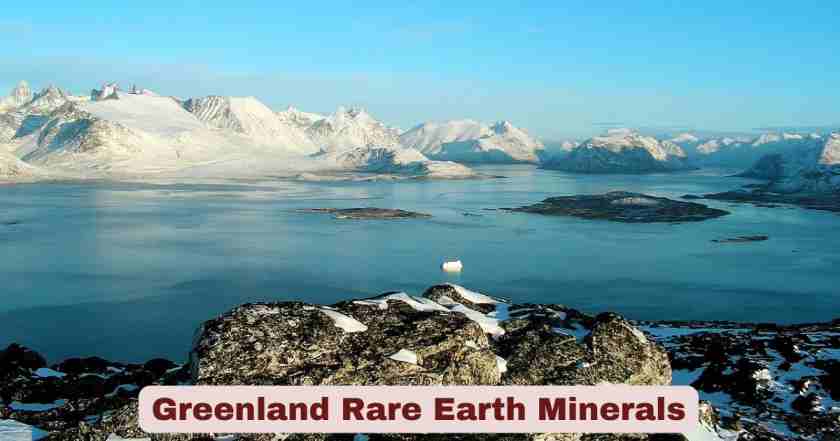
Greenland Rare Earth Minerals 2026
Greenland rare earth minerals represent one of the world’s most significant untapped reserves of critical materials essential for modern technologies, clean energy transitions, and national defense systems, with the US Geological Survey (USGS) estimating Greenland’s proven reserves at approximately 1.5 million metric tons as of 2025 data, ranking the Arctic territory 8th globally despite its total land area being 81% covered by the Greenland Ice Sheet. This substantial reserve base, concentrated primarily in southern Greenland’s Gardar geological province where alkaline intrusions created ideal conditions for rare earth element (REE) accumulation over millions of years, rivals the United States’ 1.9 million metric tons and substantially exceeds Canada’s 830,000 metric tons, South Africa’s 860,000 metric tons, and most European nations’ combined reserves. However, alternative estimates suggest Greenland’s actual rare earth wealth may be far greater, with Fortune magazine and geological analysts citing 36-42 million metric tons of rare earth oxides potentially existing beneath both ice-free and ice-covered terrain, which if verified would establish Greenland as possessing the world’s second-largest reserves after China’s 44 million metric tons.
The strategic importance of Greenland’s rare earth deposits extends beyond sheer volume to encompass the specific composition of elements present in key sites including the Kvanefjeld deposit containing over 11 million metric tons of reserves and resources (third-largest known land deposit globally) and the Tanbreez deposit estimated at 4-28.2 million metric tons depending on measurement methodology, with both locations featuring substantial concentrations of heavy rare earth elements (HREEs) including dysprosium, terbium, and yttrium that command premium prices and serve critical roles in permanent magnets for electric vehicles, wind turbines, military weapon systems, and advanced electronics. Tanbreez specifically contains over 27% HREEs compared to typical global deposits averaging 5-10% heavy rare earths, making it one of the most strategically valuable undeveloped REE resources worldwide, while geologists project that Greenland holds sufficient sub-ice reserves of dysprosium and neodymium to satisfy more than 25% of predicted future global demand – a combined total of nearly 40 million tonnes of these two critical elements alone. Despite this extraordinary mineral wealth, zero commercial rare earth mining has occurred in Greenland as of January 2026, with development stalled by multiple barriers including the 2021 uranium mining ban that blocked the Kvanefjeld project, harsh Arctic climate conditions with temperatures reaching -40°F or colder limiting operational seasons, minimal mining infrastructure with no roads connecting most settlements, environmental concerns from local communities protecting traditional livelihoods, and regulatory complexity navigating Greenlandic self-governance within the Kingdom of Denmark framework.
Interesting Facts About Greenland Rare Earth Minerals Statistics in 2026
| Key Mineral Fact Category | Statistical Data | Source / Period |
|---|---|---|
| Total Proven REE Reserves | 1.5 million metric tons | US Geological Survey (2025) |
| Alternative Total Estimate | 36–42 million metric tons (REO) | Fortune / Geological Analysis (2026) |
| Global Reserve Ranking | 8th largest worldwide | USGS (2025) |
| Percentage of Global Reserves | 1.6–2% of world total (proven) | Calculated from USGS data |
| Alternative Global Share | ~25% of undiscovered deposits | WION News / Geological Surveys |
| Comparison: United States | US holds 1.9 million MT (≈26% more) | USGS (2025) |
| Comparison: China | China holds 44 million MT (≈29× larger) | USGS (2025) |
| Comparison: Canada | Greenland has ~81% more than Canada (830,000 MT) | USGS (2025) |
| Kvanefjeld Total Resource | ~11 million metric tons REE | CSIS (Jan 2026) |
| Kvanefjeld Proven + Probable Reserve | 108 million tonnes ore @ 1.43% TREO+ | JORC / Wikipedia (2015) |
| Kvanefjeld Heavy REE Content | ~370,000 metric tons HREEs | CSIS (2026) |
| Kvanefjeld Uranium Content | ~270,000 tonnes uranium (8th largest globally) | CSIS / ETM |
| Kvanefjeld Ore Grade | 1.43% TREO+ | Feasibility Study (2015) |
| Kvanefjeld Global Ranking | 3rd largest known land-based REE deposit | CSIS (Jan 2026) |
| Tanbreez Mineral Resource | 4–28.2 million metric tons REE (varied estimates) | Multiple sources (2025–2026) |
| Tanbreez Heavy REE Share | >27% HREEs | Critical Metals Corp (2025) |
| Tanbreez Global Significance | Potentially world’s largest REE deposit | CSIS Preliminary (2025) |
| Dysprosium + Neodymium Reserves | ~40 million tonnes (sub-ice estimate) | The Conversation / Geological Research |
| Global Demand Potential | Can supply 25%+ of future global demand | Analyst consensus (2025–2026) |
| EU Critical Minerals Present | 25 of 34 EU critical raw materials | GEUS Report (2023) |
| US Critical Minerals Present | 43 of 50 US national security minerals | Benchmark Minerals Intelligence |
| Current Commercial Production | None (no active REE mining) | Jan 2026 |
| Active Mineral Licenses | 147 exploration/exploitation licenses | CSIS (2026) |
| Exploitation Licenses Granted | 2 projects (incl. Tanbreez) | CSIS (2026) |
| Uranium Mining Ban | Enacted 2021 (Act No. 20) | Greenland Parliament |
| Kvanefjeld Legal Arbitration | $11.5 billion compensation claim | Energy Transition Minerals (2022– ) |
| US EXIM Bank Support | $120M letter of interest (Tanbreez) | June 2025 |
| Tanbreez Mining Target Start | End of 2028 | Company timeline |
| Ice-Free Land Area | 19–20% of total territory | Geographic data |
| Ice Sheet Coverage | ~81% of territory | Permanent glaciation |
| Infrastructure: Inter-Town Roads | None | Transportation data |
| Avg. Mine Development Time | ~10 years (discovery → production) | Industry standard |
Data Sources: US Geological Survey Mineral Commodity Summaries 2025, CSIS Analysis January 2026, Fortune Magazine January 2026, Newsweek January 2026, Wikipedia Kvanefjeld Article, Energy Transition Minerals Reports, Critical Metals Corp Project Data, GEUS Report 2023, Benchmark Minerals Intelligence, The Conversation January 2026, Foreign Policy January 2026, Northern Miner January 2026, IER Analysis January 2025
Analysis of Greenland Rare Earth Mineral Reserves and Global Significance in 2026
The substantial disparity between reserve estimates – ranging from the USGS’s conservative 1.5 million metric tons of proven reserves to geological projections of 36-42 million metric tons including potential sub-ice deposits – reflects both the extraordinary uncertainty inherent in Arctic mineral assessment and the reality that approximately 81% of Greenland remains permanently covered by ice sheets averaging 1,500-2,000 meters thick, making comprehensive geological surveys impossible without advanced ground-penetrating radar and other remote sensing technologies that can peer through kilometers of ice to assess bedrock mineralization. The USGS figure of 1.5 million metric tons represents only proven and economically demonstrated reserves in currently accessible ice-free areas where drilling, sampling, and resource modeling have met international reporting standards (JORC/NI 43-101), while the higher estimates incorporate inferred resources, undiscovered potential, and sub-glacial deposits that satellite imagery, aeromagnetic surveys, and geological extrapolation suggest exist but cannot yet be fully quantified without prohibitively expensive exploration beneath the ice sheet.
Greenland’s 8th place global ranking based on proven reserves positions the territory ahead of major players including Thailand (390,000 MT), Madagascar (320,000 MT), and Norway (250,000 MT) while trailing the dominant producers led by China’s 44 million metric tons (48% of global total), Brazil’s 21 million MT, India’s 6.9 million MT, Australia’s 5.7 million MT, Russia’s 3.8 million MT, and Vietnam’s 3.5 million MT. However, this ranking fundamentally understates Greenland’s strategic importance because it measures only currently proven reserves rather than total geological potential, where the territory’s unique alkaline intrusive complexes including the Ilímaussaq intrusion that hosts both Kvanefjeld and Tanbreez represent world-class REE mineralization systems comparable to or exceeding famous deposits like Australia’s Mount Weld, California’s Mountain Pass, and China’s Bayan Obo. The geological setting – specifically the Gardar alkaline province’s 1.3-1.1 billion year old intrusions where magmatic differentiation concentrated incompatible elements including rare earths into late-stage crystallization products – created ideal conditions for economic REE grades that few other global locations replicate, suggesting that comprehensive exploration across Greenland’s ice-free and sub-ice terrain could substantially increase documented reserves.
Greenland Major Rare Earth Deposits: Kvanefjeld and Tanbreez in 2026
| Deposit Characteristic | Kvanefjeld (Kuannersuit) | Tanbreez (Kringlerne) |
|---|---|---|
| Total REE Resource | 11 million metric tons reserves/resources | 4-28.2 million metric tons (varying estimates) |
| JORC Proven+Probable Reserve | 108 million tonnes ore @ 1.43% TREO+ | Preliminary Economic Assessment 2025 |
| Total Resource Tonnage | 1.01 billion tonnes @ 1.10% TREO+ | 28.2 million MT (one estimate) |
| Heavy REE Content | 370,000 metric tons HREEs | Over 27% HREEs of total |
| Ore Grade (TREO) | 1.43% (reserve), 1.10% (resource) | Eudialyte ore, kakortokite host |
| Global Deposit Ranking | 3rd largest known land REE deposit | Potentially world’s largest |
| Uranium Content | 270,000 tonnes U3O8 (8th largest uranium deposit) | Minimal uranium/thorium (environmental advantage) |
| Zinc Content | ~0.24% zinc | Tantalum, niobium, zirconium co-products |
| Gallium Present | Not primary focus | Yes – critical mineral under Chinese export controls |
| Project Status | Blocked by 2021 uranium ban | Advanced – exploitation license granted |
| Ownership | Energy Transition Minerals (Australian, ASX-listed) | Critical Metals Corp (US-based, Nasdaq: CRML) |
| Chinese Shareholding | Shenghe Resources 9.21% (May 2024) | Blocked from Chinese buyers by US |
| Legal Status | Arbitration – seeking $11.5B compensation | Progressing toward production |
| License Situation | Repeatedly denied since 2019 | Extension granted October 2024 |
| Development Timeline | Indefinite hold | Mining by end of 2028 |
| Location | Ilímaussaq Complex, near Narsaq | Same region, <16 km from Kvanefjeld |
| Host Rock | Lujavrite (agpaitic nepheline syenite) | Kakortokite (layered alkaline intrusion) |
| Exploration Start | 1950s (uranium), 2007 (REE focus) | Australian Tanbreez exploration 2000s |
| Feasibility Completion | 2015 | Preliminary Economic Assessment 2025 |
| Key REE Elements | Neodymium, dysprosium, praseodymium, terbium | Neodymium, cerium, lanthanum, yttrium |
| Environmental Concern | High – uranium byproduct | Lower – minimal radioactive elements |
| Community Opposition | Strong – led to political change 2021 | Moderate – environmental monitoring required |
Data Sources: CSIS Analysis January 2026, Wikipedia Kvanefjeld Article January 2026, Critical Metals Corp Project Data, Energy Transition Minerals Reports, JORC Resource Estimates 2015-2025, SEC Technical Report March 2025, Strategic Metals Invest February 2025, IER Analysis
The Kvanefjeld deposit’s 11 million metric ton resource established through decades of exploration beginning in the 1950s when uranium potential first attracted attention during the Cold War, ranks as the third-largest known land-based rare earth accumulation globally after only China’s Bayan Obo (48 million MT estimated) and potentially Mount Weld in Australia (depending on classification), with the 1.01 billion tonne total resource at 1.10% TREO+ representing an extraordinary concentration of strategic minerals including 370,000 metric tons of heavy rare earths – elements like dysprosium, terbium, and yttrium that command prices 5-10 times higher than light rare earths and serve irreplaceable roles in permanent magnets achieving the high magnetic strength and thermal stability required for electric vehicle motors, large wind turbine generators, and military applications. The ore grade of 1.43% TREO+ in the proven reserve significantly exceeds marginal projects like Brazil’s Serra Verde (0.15%) and Texas’s Round Top (0.033%), though falling short of world-class Australian Mount Weld (6.40%), California Mountain Pass (5.96%), and Chinese Bayan Obo (2.55%), placing Kvanefjeld in a competitive middle tier where economies of scale through the massive 108 million tonne reserve could compensate for moderate ore grades.
However, Kvanefjeld’s development faces an apparently insurmountable barrier in the form of its 270,000 tonne uranium content (equivalent to approximately 362 ppm U3O8 in the ore) that makes this the world’s 8th largest uranium deposit and created the political crisis when Greenland’s 2021 parliament passed Act No. 20 establishing a 100 ppm uranium threshold for mining after the left-wing Inuit Ataqatigiit party won elections on an anti-uranium platform, effectively expropriating Energy Transition Minerals’ $200+ million investment over 15 years of exploration and feasibility studies and triggering ongoing international arbitration where the company seeks $11.5 billion in compensation – nearly ten times Greenland’s entire annual budget – through investor-state dispute mechanisms. Meanwhile, the Tanbreez deposit’s estimated 4-28.2 million metric tons of rare earth resources (with the wide range reflecting differences between conservative measured resources and total geological potential including inferred categories) positions this project as potentially exceeding even Kvanefjeld in ultimate size, with the Critical Metals Corp March 2025 technical report describing Tanbreez as among the world’s largest undeveloped REE resources and specifically highlighting the exceptional 27%+ heavy rare earth percentage that dramatically exceeds typical global deposits where HREEs represent 5-10% or less of total rare earth content, creating premium economics as these elements command substantially higher prices reflecting supply scarcity and critical applications.
Greenland Rare Earth Elements: Specific Minerals and Applications in 2026
| Rare Earth Element | Presence in Greenland | Classification | Critical Applications | Market Price Tier |
|---|---|---|---|---|
| Neodymium (Nd) | Abundant in Kvanefjeld, Tanbreez | Light REE | EV motors, wind turbines, permanent magnets | High value |
| Dysprosium (Dy) | Significant – Kvanefjeld strength | Heavy REE | High-temperature magnets, EVs, military systems | Very high value |
| Praseodymium (Pr) | Present in major deposits | Light REE | Permanent magnets (paired with Nd), glass | High value |
| Terbium (Tb) | Present – HREE component | Heavy REE | Magnets, lasers, defense electronics | Very high value |
| Yttrium (Y) | Present in Tanbreez, others | Heavy REE | LEDs, phosphors, ceramics, lasers | Moderate-high value |
| Cerium (Ce) | Present in Tanbreez | Light REE | Catalytic converters, polishing compounds | Lower value |
| Lanthanum (La) | Present in Tanbreez | Light REE | Battery electrodes, camera lenses | Moderate value |
| Europium (Eu) | Minor component | Heavy REE | Red phosphors in displays, nuclear reactors | High value |
| Gadolinium (Gd) | Minor component | Heavy REE | MRI contrast agents, neutron capture | Moderate value |
| Samarium (Sm) | Minor component | Light REE | Samarium-cobalt magnets (high-temp) | Moderate value |
| Scandium (Sc) | Potential presence | Light REE | Aerospace alloys, solid oxide fuel cells | Very high value |
| Ytterbium (Yb) | Discovered in igneous layers | Heavy REE | Lasers, steel alloys | Moderate value |
| Sub-Ice Dy+Nd Potential | ~40 million tonnes combined | Mix of light/heavy | Same as above – strategic reserve | Combined valuation |
Data Sources: USGS Rare Earth Element Profiles, Critical Metals Corp Technical Data, Kvanefjeld Feasibility Studies, The Conversation Analysis, IER Mineral Inventory, Industry Applications Research
Greenland’s rare earth deposits contain exceptionally valuable distributions of specific elements rather than generic rare earth ore, with the concentration of neodymium and dysprosium – the two most strategically critical rare earths for clean energy and defense applications – representing the primary driver of international interest in developing Greenlandic mines. Neodymium serves as the essential component in neodymium-iron-boron (NdFeB) permanent magnets that achieve the highest magnetic field strength of any commercially available magnet technology, with a typical 300-kilowatt electric vehicle motor requiring approximately 1-2 kilograms of neodymium and a 3-megawatt wind turbine requiring roughly 600 kilograms of rare earth permanent magnets predominantly composed of neodymium with dysprosium additions, meaning that the global transition to electric transportation and renewable energy generation creates exponentially increasing demand for precisely the elements where Greenland demonstrates geological abundance.
Dysprosium’s strategic value stems from its unique property of dramatically improving magnet performance at elevated temperatures, with additions of just 5-10% dysprosium to neodymium magnets increasing the maximum operating temperature from 80-100°C to 200°C or higher while maintaining magnetic strength, making dysprosium-enhanced magnets essential for electric vehicle traction motors that experience substantial heat generation during operation, large wind turbines operating in varying environmental conditions, and military applications including missile guidance systems, targeting lasers, and advanced radar requiring reliable performance across extreme temperature ranges. China’s dominance of global dysprosium production (estimated >90% of supply) and periodic export restrictions – most recently in 2025 when China imposed controls disrupting Western automotive supply chains – have elevated this element to top-tier national security concern for the United States, European Union, Japan, and other industrialized nations seeking supply diversification, with Greenland’s heavy rare earth-rich deposits offering one of few potential alternative sources capable of meaningful production volumes outside Chinese control.
Greenland vs Global Rare Earth Reserves Comparison in 2026
| Country/Region | Rare Earth Reserves (Million MT) | % of Global Total | Global Ranking | Greenland Comparison |
|---|---|---|---|---|
| China | 44.0 | 48% | 1st | China has 29-30x more than Greenland |
| Brazil | 21.0 | 23% | 2nd | Brazil has 14x more |
| India | 6.9 | 7.5% | 3rd | India has 4.6x more |
| Australia | 5.7 | 6.2% | 4th | Australia has 3.8x more |
| Russia | 3.8 | 4.1% | 5th | Russia has 2.5x more |
| Vietnam | 3.5 | 3.8% | 6th | Vietnam has 2.3x more |
| United States | 1.9 | 2.1% | 7th | US has 27% more than Greenland |
| Greenland | 1.5 | 1.6% | 8th | Baseline |
| South Africa | 0.86 | 0.9% | 9th | Greenland has 74% more |
| Canada | 0.83 | 0.9% | 10th | Greenland has 81% more |
| Madagascar | 0.32 | 0.3% | 11th | Greenland has 369% more |
| Norway | 0.25 | 0.3% | 12th | Greenland has 500% more |
| Global Total | ~91.9 | 100% | – | Greenland is 1.6% of world |
| Greenland Alternative Estimate | 36-42 | 39-46% (if accurate) | 2nd (potential) | Would trail only China |
Data Sources: US Geological Survey Mineral Commodity Summaries 2025, Newsweek Analysis January 2026, CSIS Database, Fortune Magazine Geological Estimates, Global Reserve Calculations
The proven reserve ranking placing Greenland 8th globally with 1.5 million metric tons positions the territory as a significant but not dominant player in the rare earth supply landscape, holding reserves comparable to the United States (1.9 million MT) while substantially trailing the top four countries (China, Brazil, India, Australia) that collectively control 83.2% or 76.6 million metric tons of documented global reserves. However, this conservative assessment fails to capture Greenland’s full geological potential because the USGS methodology counts only proven and probable reserves that have undergone comprehensive drilling, sampling, metallurgical testing, and economic assessment meeting international reporting standards, whereas vast areas of Greenland remain unexplored or incompletely surveyed due to ice cover and logistical challenges, with the 36-42 million metric ton estimates including both measured resources and inferred potential based on geological analogues, remote sensing data, and extrapolation from known deposits.
If the higher range estimate of 42 million metric tons proves accurate through future exploration, Greenland would leapfrog to 2nd place globally with reserves rivaling China’s 44 million MT and representing approximately 45-46% of total world reserves, fundamentally transforming global rare earth geopolitics by providing Western nations with a massive alternative supply source to China’s current near-monopoly. The geological basis for these optimistic projections stems from the recognition that Greenland’s Gardar alkaline province extends across large areas of southern Greenland both onshore and potentially offshore, with only a fraction thoroughly explored to date, while the 80%+ ice-covered interior likely contains additional alkaline intrusions similar to Ilímaussaq that could host comparable or even larger rare earth deposits currently inaccessible beneath 1-3 kilometers of glacial ice, with climate change-driven ice sheet retreat potentially exposing these resources over coming decades though at enormous environmental cost including accelerated sea level rise.
Greenland Critical Minerals Beyond Rare Earths in 2026
| Mineral/Resource | Reserve Status | Strategic Importance | Known Locations | Development Status |
|---|---|---|---|---|
| Graphite | 8.28 million MT (Amitsoq deposit) | EV battery anodes, steelmaking | Widespread occurrences | GreenRoc – 99.97% purity achieved |
| Uranium | 270,000 tonnes (Kvanefjeld + others) | Nuclear power, weapons | Ilímaussaq, other sites | Banned since 2021 (Act No. 20) |
| Copper | Significant deposits | Electrical systems, construction | Multiple locations | Limited development |
| Zinc | Present with REEs | Galvanizing, alloys | Kvanefjeld (~0.24% grade), others | Co-product potential |
| Gold | Discovered deposits | Monetary, electronics | South, west, northwest regions | Exploration stage |
| Diamonds | Reported occurrences | Industrial, gemstone | South, west, northwest | Early assessment |
| Iron Ore | Major deposits | Steelmaking | Isua, Itilliarsuk, NW coast | Exploration only |
| Titanium | Known deposits | Aerospace, industrial, medical | Southwest, east, south | Early stage |
| Vanadium | Present | Steel alloys, batteries | Southwest, east, south | Early stage |
| Molybdenum | Giant Malmbjerg deposit | Steel alloys, catalysts | East Greenland | Undeveloped |
| Platinum Group Elements | Skaergaard intrusion | Automotive catalysts, electronics | East Greenland | Exploration |
| Tungsten | Assessed deposits | Industrial applications, defense | Central-east, northeast, south, west | Early stage |
| Niobium | Present with REEs | Superalloys, superconductors | Tanbreez co-product, others | Tanbreez pathway |
| Tantalum | Present with REEs | Electronics capacitors, aerospace | Tanbreez co-product | Tanbreez pathway |
| Zirconium | Present with REEs | Nuclear reactors, ceramics | Tanbreez, kakortokite units | Co-product potential |
| Hafnium | Reported | Nuclear control rods, aerospace | Associated with zirconium | Early assessment |
| Lithium | Potential deposits | EV batteries, energy storage | Various locations | Exploration stage |
| Strontium | Karstryggen deposit | Pyrotechnics, ferrite magnets | East Greenland | Undeveloped |
| Gallium | Present at Tanbreez | Semiconductors, LEDs, military | Tanbreez co-product | Chinese export controls 2025 |
| Oil & Natural Gas | ~31 billion barrels oil-equivalent (est.) | Energy | Northeast onshore, offshore basins | Extraction banned |
Data Sources: GEUS Report 2023, IER Analysis January 2025, Northern Miner January 2026, USGS Minerals Yearbook, The Conversation January 2026, Greenland Mineral Resources Database
Greenland’s mineral wealth extends far beyond rare earths to encompass 25 of 34 minerals designated as critical raw materials by the European Commission and 43 of 50 minerals deemed critical to US national security according to Benchmark Minerals Intelligence, establishing the territory as a potential multi-commodity strategic resource capable of supplying diverse industrial, technological, and defense applications. The Amitsoq graphite project’s achievement of 99.97% purity – exceeding the 99.95% threshold required for EV battery anode material – through innovative purification processes developed by GreenRoc’s technical consultants represents a breakthrough that could position this 8.28 million metric ton resource among the world’s premier natural graphite sources at a time when battery manufacturers seek alternatives to synthetic graphite production’s high energy consumption and carbon emissions, with the combination of world-class grade and exceptional purity potentially making Amitsoq one of the most profitable graphite mines globally if development proceeds.
The uranium ban implemented through Act No. 20 in 2021, while specifically blocking Kvanefjeld rare earth development due to its 270,000 tonne uranium content, also prevents exploitation of Greenland’s substantial uranium resources more broadly at a time when global nuclear renaissance driven by climate concerns and energy security is creating renewed demand for uranium to fuel new reactor construction, representing a policy choice where Greenlandic voters prioritized environmental protection and traditional livelihoods over potential mining revenues. The oil and gas potential estimated by USGS at approximately 31 billion barrels of oil-equivalent in onshore northeast Greenland – comparable to the entire US proven crude oil reserves – remains similarly locked away by Greenland’s comprehensive ban on oil and gas extraction implemented due to climate change concerns and desire to avoid fossil fuel dependency, though some analysts suggest these policies could face reconsideration if commodity prices surge or if Greenland seeks greater economic independence from Denmark’s annual subsidy currently ~$600 million that funds approximately half of the territorial government budget.
Greenland Rare Earth Mining Infrastructure and Development Challenges in 2026
| Challenge Category | Specific Barriers | Impact on Development | Required Solutions |
|---|---|---|---|
| Climate/Weather | Temperatures -40°F or colder in winter | Limits operational season, equipment stress | Specialized Arctic mining technology |
| Ice Coverage | 81% of territory under ice sheet | Inaccessible deposits, unknown resources | Climate change melting (problematic solution) |
| Transportation | Zero roads between settlements | Material/equipment transport only by air/sea | Massive infrastructure investment |
| Port Infrastructure | Limited deep-water ports | Ore export bottlenecks | Port construction/expansion |
| Power Generation | Insufficient electricity for industrial mining | Operations impossible without power | Power plant construction, imports |
| Skilled Workforce | Population only ~56,000, limited mining expertise | Labor shortages for technical positions | International recruitment, training |
| Processing Facilities | Zero REE separation plants in Greenland | Ore must be exported for processing | Multi-billion dollar processing infrastructure |
| Environmental Regulations | Uranium threshold 100 ppm, strict assessments | Project delays, outright bans | Regulatory reform vs environmental protection |
| Community Opposition | Local resistance to mining impacts | Political barriers, license denials | Community benefit agreements, consultation |
| Regulatory Complexity | Self-governance within Denmark framework | Unclear jurisdiction, policy conflicts | Clarity on authority, stakeholder alignment |
| Capital Requirements | Estimates “billions upon billions” over decades | Deterrent to investment | Government support, international financing |
| Distance to Markets | Remote Arctic location | Transport costs, supply chain complexity | Logistical planning, partnerships |
| Development Timeline | Average ~10 years discovery to production | Long payback period, risk | Patient capital, government backing |
| Geopolitical Tensions | US-Denmark-Greenland sovereignty questions | Investment uncertainty, political risk | Political stability, clear ownership |
| Chinese Competition | Shenghe ownership stakes, buyer interest | Technology transfer concerns, security issues | Western investment priority, ownership restrictions |
| Ore Grade Concerns | Kvanefjeld 1.43% vs world-class 6%+ | Economics marginal at lower prices | Scale economies, co-product revenues |
| Climate Change Ethics | Mining enables tech transition but damages Arctic | Moral dilemma for climate-conscious policy | Balance environmental protection vs green tech needs |
Data Sources: CSIS Analysis January 2026, Fortune Magazine Expert Interviews January 2026, Foreign Policy Analysis January 2026, Pulitzer Center German Report, Expert Congressional Testimony 2025, Industry Development Assessments
Greenland’s rare earth mining sector in 2026 faces severe infrastructure and environmental constraints that directly affect project feasibility and timelines. Extreme Arctic climate conditions, with winter temperatures reaching −40°F or colder, significantly shorten the operational season and place heavy stress on equipment, requiring specialized cold-weather mining technology. Around 81% of Greenland’s territory is covered by an ice sheet, leaving many rare earth deposits inaccessible or poorly mapped, while ice melt driven by climate change presents environmental risks rather than a practical solution. Transportation infrastructure is minimal, with zero roads connecting settlements, forcing all materials, fuel, and ore to be moved by air or sea. Limited deep-water port infrastructure creates export bottlenecks, and insufficient power generation capacity makes industrial-scale mining impossible without constructing new power plants or importing electricity—both costly and time-consuming investments.
Beyond physical infrastructure, human, regulatory, financial, and geopolitical challenges further complicate development. Greenland’s population of only ~56,000 people results in a limited skilled workforce, creating labor shortages that require international recruitment and specialized training. The absence of REE separation and processing facilities means ore must be exported unless multi-billion-dollar processing infrastructure is built locally. Strict environmental regulations, including a 100 ppm uranium threshold, have led to project delays and outright bans, while community opposition and political resistance often result in license denials unless strong consultation and benefit agreements are in place. Regulatory complexity under Greenland’s self-governance framework within the Danish system creates jurisdictional uncertainty. High capital requirements—often described as “billions upon billions” of dollars over decades—combined with Greenland’s remote distance from markets, an average 10-year development timeline, geopolitical tensions involving the US, Denmark, and Greenland, and Chinese competition through ownership stakes and buyer interest all increase investor risk. Economic viability is further challenged by ore grade concerns, such as Kvanefjeld’s ~1.43% TREO+ compared with 6%+ world-class deposits, while the broader climate ethics dilemma forces policymakers to balance Arctic environmental protection with the need for rare earths critical to the global clean energy transition.
Disclaimer: This research report is compiled from publicly available sources. While reasonable efforts have been made to ensure accuracy, no representation or warranty, express or implied, is given as to the completeness or reliability of the information. We accept no liability for any errors, omissions, losses, or damages of any kind arising from the use of this report.