
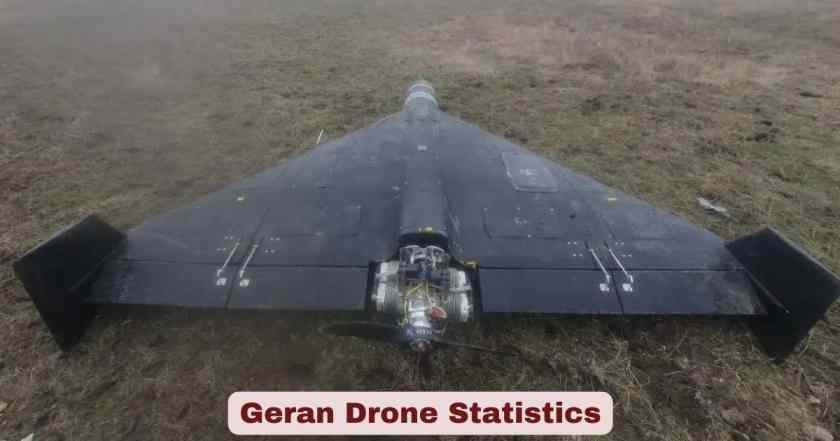
What is the Geran Drone?
The Geran drone (Russian: Герань, literally “Geranium”) is Russia’s domestically manufactured family of one-way attack loitering munitions — direct derivatives of the Iranian-designed HESA Shahed-136 and Shahed-131 — that have become the single most consequential aerial weapon system of the ongoing Russo-Ukrainian War and, by early 2026, a critical tool in Iran’s attacks on US and allied forces during Operation Epic Fury. The name is a deliberate act of obfuscation: when Russia’s Ministry of Defence began renaming Iranian Shaheds as “Geraniums” (Geran-1, Geran-2) in 2022, it was simultaneously denying that Iranian weapons were being used while building the domestic production infrastructure needed to manufacture them without Iranian supply chains. The Geran-2 — corresponding to the Shahed-136 — is the backbone of Russia’s drone campaign, distinguished by its cropped delta-wing shape, Mado MD-550 pusher propeller engine in the rear, 30–50 kg warhead in the nose, and an operational range of up to 2,500 kilometres — sufficient to reach any point in Ukraine from Russian-held territory. It was first used in combat against Ukraine on 17 October 2022, killing four civilians in Kyiv including a woman who was six months pregnant, and has since been deployed in thousands of attacks on Ukrainian cities, energy infrastructure, water systems, military positions, and civilian residential areas. The Geran family has expanded dramatically through 2024–2026 to include jet-powered variants (Geran-3, Geran-4, Geran-5), a reconnaissance version with a Raspberry Pi 5 microcomputer, a MANPAD-carrying variant designed to shoot down Ukrainian interceptors, and a Starlink-controlled guidance variant — making what began as a simple one-way kamikaze drone into a rapidly evolving family of increasingly sophisticated weapons.
As of March 14, 2026, the Geran programme sits at the intersection of three simultaneous crises. In Ukraine, Russia is producing 404 Geran/Shahed-type drones per day according to Ukrainian Commander-in-Chief Oleksandr Syrskyi (January 18, 2026), with a stated target of 1,000 per day — a production surge that, if achieved, would enable 30,000 drone attacks per month and fundamentally transform the aerial bombardment landscape. In the Middle East, Iran directly deployed Geran/Shahed-type weapons in its own attacks on Israel and US forces during Operation Epic Fury, confirming that the technology transfer between Iran and Russia was genuinely bilateral — Russia received the design, manufactured it at scale, and in the process helped Iran refine and improve its own production. And in a remarkable technological twist, the US military announced in December 2025 that it had reverse-engineered a captured Shahed-136 to create the LUCAS drone — a clone of the Geran/Shahed — and deployed a squadron in the Middle East, suggesting that the Geran’s fundamental design is now considered so effective that America’s own military planners have incorporated its architecture into their own arsenal. A weapon that began as an Iranian design, manufactured in Russia, used against Ukraine, and now replicated by the United States, is perhaps the most remarkable illustration of how drone technology proliferates in the modern era.
Interesting Facts About the Geran Drone 2026
| Fact | Detail |
|---|---|
| Russian Name | Geran (Герань) — Russian word for “Geranium” |
| Why “Geranium” | Russia renamed Iranian Shahed drones to deny use of foreign weapons; “Geranium” is a common Russian garden plant — deliberately mundane name for a lethal weapon |
| Original Iranian Design | HESA Shahed-136 (Geran-2) and HESA Shahed-131 (Geran-1) — developed by Shahed Aviation Industries, Iran |
| “Shahed” Meaning | “Witness” (شاهد) — in both Persian and Arabic |
| Original Iran-Russia Supply Deal | Agreed November 2022 — Iran exports key components to Russia; Russia begins domestic manufacturing |
| Franchise Deal Value (2023) | $1.75 billion — Russia-Iran manufacturing franchise signed early 2023 |
| Primary Factory | Alabuga Special Economic Zone, Tatarstan, Republic of Tatarstan, Russia |
| Alabuga Factory Location Advantage | Adjacent to the Kama River — permits direct transport by ship from Iran via Caspian Sea |
| Factory Operator | Company Albatross — operates Alabuga facility |
| Labour Scandal | Workers include students as young as 15 from Alabuga Polytechnic College; over 1,000 African women (mainly from Uganda) lured under false pretences — Wall Street Journal and South Africa government confirmed |
| South Africa Investigation | November 2025 — South Africa opened official investigation and issued warning to citizens after Russia accused of making false promises to workers |
| Second Factory | IEMZ Kupol, Izhevsk — manufactures Garpiya (Harpy) A-1 drones, based on Geran-2 design; also manufactures Italmas loitering munitions |
| Russian Geran Family (2026) | Geran-1 (Shahed-131), Geran-2 (Shahed-136), Geran-3 (jet-powered), Geran-4 (new variant), Geran-5 (jet, air-launched) |
| First Ukraine Combat Use | 17 October 2022 — Kyiv attack; 4 civilians killed including a woman 6 months pregnant |
| UN War Crimes Assessment (Oct 2025) | UN concluded Russia’s use of short-range UAVs against civilians in southern Ukraine constituted a crime against humanity and a war crime |
| US Military Clone | December 2025 — US CENTCOM announced LUCAS drone — reverse-engineered from a captured Shahed-136; deployed in Middle East as Task Force Scorpion Strike under SOCC |
| LUCAS Drone Launch Method | Can be launched via catapult, rocket-assisted takeoff, mobile ground and vehicle systems |
| Ukrainian LUCAS Target Drone | SpektreWorks FLM-136 — publicly shown at Pentagon event July 16, 2025; range 822 km, speed 194 km/h, payload 18 kg |
| Airframe Material (Russian-built) | Fibreglass over woven carbon fibre fuselage — different from original Iranian honeycomb construction (Conflict Armament Research, July 2023) |
| Iranian Component Sourcing | Despite sanctions, components include parts from companies in US, Switzerland, Netherlands, Germany, Canada, Japan, and Poland — confirmed by multiple investigations |
Source: Wikipedia (HESA Shahed 136 — updated March 13, 2026; Shahed drones — updated March 13, 2026), The Conversation (January 28, 2026), Kyiv Independent (September 6, 2025), IRIA News (September 8, 2025), Medium/Haye Kesteloo (January 19, 2026), ISIS — Institute for Science and International Security (2025 comprehensive review), Conflict Armament Research (July 2023), Wall Street Journal, Autonomy Global (November 2025)
The naming story of the Geran is one of the most revealing acts of informational camouflage in modern warfare. Russia’s Ministry of Defence announced in autumn 2022 that the drones being used were “Geraniums” — a name so deliberately innocent and botanical that it initially generated confused responses from Western analysts who spent days confirming that the flower-named drones were indeed the Iranian Shaheds. The strategy served a dual purpose: it gave Russian officials a technically deniable label to use when asked about Iranian-origin weapons, and it created a new Russian national identity for what was genuinely becoming a domestically manufactured product. By July 2023, when UK-based Conflict Armament Research examined the remains of two Geran-2s and found “major differences in the airframe construction” compared to original Iranian Shaheds — including the new fibreglass over woven carbon fibre fuselage — it confirmed that Russia had moved beyond simply relabelling Iranian imports to genuinely re-engineering and manufacturing its own improved version of the design. The “Geranium” had bloomed into something distinctly Russian.
The Alabuga factory’s labour practices represent the darkest chapter of the Geran programme — and one that the international community has been slow to address despite mounting evidence. The use of students as young as 15 from the adjacent Alabuga Polytechnic College as drone assembly workers violates multiple international labour conventions. The trafficking of over 1,000 African women — primarily from Uganda, lured with promises of hospitality work or university scholarships — to assemble weapons in a factory that is itself an active Ukrainian military strike target is a documented human rights catastrophe that has been confirmed by the Wall Street Journal, investigated by South Africa’s government, and raised at multiple UN forums. The fact that this factory simultaneously produces weapons that the UN has classified as tools of crimes against humanity is a confluence of violations that spans international humanitarian law, international labour law, and international human rights law simultaneously.
Geran-2 (Shahed-136) Technical Specifications 2026
| Specification | Data |
|---|---|
| Designation | Geran-2 (Russia) / HESA Shahed-136 (Iran) |
| Type | Loitering munition / one-way attack drone (kamikaze) |
| Airframe Shape | Cropped delta-wing — central fuselage blending into wings; vertical stabilising rudders at wing tips |
| Fuselage Length | 3.5 metres (11.5 ft) |
| Wingspan | ~2.5 metres (8.2 ft) |
| Weight (Launch) | ~200 kg (441 lb) |
| Warhead Location | Nose section |
| Warhead Weight | 30–50 kg (66–110 lb) |
| Warhead Type | High-explosive fragmentation |
| Engine | Iranian-made Mado MD-550 piston engine; rear-mounted two-bladed pusher propeller |
| Cruise Speed | ~185 km/h (115 mph) |
| Maximum Speed | Up to 240 km/h (150 mph) |
| Operational Range | Up to 2,500 km (1,550 miles) |
| Operational Altitude | 60–1,000 metres (200–3,300 ft) — typically flies low to avoid radar |
| Guidance System (base) | INS (Inertial Navigation System) + GPS / GLONASS — pre-programmed route |
| Guidance Upgrade (2025) | 2G, 3G, 4G mobile antennas added — enables real-time operator adjustments in flight |
| Guidance Upgrade (Jan 2026) | Starlink internet connections — Russia mastered remote control via Starlink by January 2026; used to attack a moving passenger train near Kharkiv on late January 2026 |
| AI Upgrade (late 2025) | Nvidia Jetson AI processor integration — autonomous target recognition; real-time video processing; operates in GPS-denied environments |
| Camera (reconnaissance variant) | Raspberry Pi 5 microcomputer + Russian-branded Mini PC running Windows 11 (Chinese-made) — vision processing system; confirmed by Ukrainian military intelligence February 2026 |
| Launch Method | Ground launch rack — multiple drones launched in rapid sequence (salvo) |
| Attack Profile | Terminal dive at steep angle — delta-wing design optimises precision diving; prevents stalling at low speeds; increases stability in attack phase |
| Noise | Distinctive lawnmower-like sound — audible approach warning; psychologically effective on civilian populations |
| Export by Iran to Russia (2022) | Hundreds of Shahed-131 and Shahed-136 delivered directly before domestic production began |
| Production Material | Fibreglass over woven carbon fibre fuselage (Russian version) vs original Iranian lightweight honeycomb |
| Cost (2022 — Iranian import) | ~$200,000 per unit (Russia paid Iran) |
| Cost (2025 — domestic production) | ~$35,000–$70,000 per unit (CSIS: as low as $35,000; some estimates $48,000–$80,000) |
Source: Wikipedia (HESA Shahed 136, updated March 13, 2026), The Conversation (January 28, 2026), ISIS Annual Review (2025), Conflict Armament Research (July 2023), Medium/Haye Kesteloo (January 19, 2026), Autonomy Global (November 2025), CSIS, Ukrainian Main Directorate of Intelligence (February 2026)
The technical specification evolution of the Geran-2 between 2022 and 2026 is as remarkable as any weapons platform improvement in modern history — achieved not through a formal R&D programme but through continuous field modification driven by battlefield failure analysis. The base Geran-2 that Russia deployed in October 2022 was essentially a direct copy of the Iranian Shahed-136: GPS-guided, pre-programmed, flying a fixed route with no ability to deviate or respond to countermeasures. Within a year, Russia had added 2G/3G/4G cellular antennas to allow mid-flight operator adjustments. By January 2026, Russia had implemented Starlink-based control — using Elon Musk’s satellite internet service to remotely pilot Gerans against targets including a moving passenger train near Kharkiv, requiring real-time tracking and guidance that no pre-programmed route could achieve. By late 2025, Nvidia Jetson AI processors were being integrated into Geran-2 units, giving them autonomous target recognition and GPS-denied operation — transforming what began as a simple flying bomb into a semi-intelligent weapon capable of identifying and attacking targets without any external guidance signal.
The Starlink guidance development deserves particular attention because of its geopolitical implications. Elon Musk’s SpaceX operates the Starlink satellite internet network — a network that simultaneously provides Ukraine with military communications, navigation, and drone coordination capability, and that Russia has now reportedly turned into a guidance system for weapons killing Ukrainian civilians. The Ukrainian government raised the Starlink Russia connection with SpaceX on multiple occasions from 2024 onwards. The January 2026 confirmation by Ukrainian military intelligence that Gerans were being controlled via Starlink during attacks represents a documented case where a commercial satellite internet service was being used by both sides of the same conflict — an unprecedented and deeply problematic commercial neutrality problem that has no clear resolution in current international law.
Geran Drone Variants Statistics 2026
| Variant | Russian Name | Iranian Original | Engine | Speed | Warhead | Key Difference / Status |
|---|---|---|---|---|---|---|
| Geran-1 | Герань-1 | Shahed-131 | Piston propeller | ~130 km/h | 15–25 kg | Smaller; shorter range; used for precision strikes on hardened targets |
| Geran-2 | Герань-2 | Shahed-136 | Mado MD-550 propeller | ~185 km/h | 30–50 kg | Primary backbone of Russia’s drone campaign; most produced |
| Geran-3 | Герань-3 | Shahed-238 | Jet turbofan (Telefly, Chinese-made) | 230–340 km/h (143–211 mph) | Larger | Jet-powered; 2× speed of Geran-2; jamming-resistant 12-element adaptive antenna array; first downed by Sting Dec 2025 |
| Geran-4 | Герань-4 | New variant | Jet | Unknown | Unknown | Tested end of 2025; emerged early January 2026 (HUR); limited confirmed use |
| Geran-5 | Герань-5 | Shahed-related | Telefly turbofan | ~600 km/h (demonstration) | 90 kg | Air-launched from Su-25 aircraft; deployed January 11, 2026 (HUR); 1,000 km range |
| Geran-2 (MANPAD variant) | N/A | N/A | Piston | ~185 km/h | N/A | Carries 9K333 Verba MANPAD missile on back; launches IR-homing SAM in drone’s travel direction; Chinese nose camera for targeting; confirmed early 2026 |
| Geran-2 (AAM variant) | N/A | N/A | Piston | ~185 km/h | N/A | Carries R-60 air-to-air missile (Soviet-era); designed to engage Ukrainian interceptor aircraft; confirmed 2025 |
| Geran-2 (Recon variant) | N/A | N/A | Piston | ~185 km/h | None | Raspberry Pi 5 + Windows 11 Mini PC vision processing system; live reconnaissance; confirmed February 2026 (Ukrainian intelligence) |
| Geran-2 (Starlink-guided) | N/A | N/A | Piston | ~185 km/h | 30–50 kg | Starlink internet-controlled; can attack moving targets (confirmed January 2026 Kharkiv train attack) |
| Geran-2 (AI / Nvidia Jetson) | N/A | N/A | Piston | ~185 km/h | 30–50 kg | Nvidia Jetson onboard AI; autonomous target recognition; GPS-denied operation; deployed late 2025 |
| Gerbera / Parody (decoy) | Герберa | N/A | Small motor | Slow | None | Foam and plywood decoy construction; mimics Shahed radar signature; designed to exhaust air defence; ~⅓ of all Russian mass-attack drone launches |
| Italmas | N/A | Russian design | Piston | Unknown | Unknown | Manufactured by IEMZ Kupol, Izhevsk; separate from Alabuga; emerging in statistics from January 2026 |
| Garpiya (Harpy) A-1 | N/A | Russian | Various | Unknown | Unknown | Manufactured by IEMZ Kupol; JSC Izhevsk Electromechanical Plant; based on Geran-2 design |
Source: Wikipedia (HESA Shahed 136, Shahed drones — March 13–14, 2026), Medium/Haye Kesteloo (January 19, 2026), HUR Ukraine (January 11, 2026 — Geran-5 confirmation), ISIS Annual Review 2025, IRIA News (September 2025), Autonomy Global (November 2025), TheConversation (January 28, 2026), Ukraine Arms Monitor Substack (December 2025)
The Geran variant statistics reveal a development philosophy diametrically opposed to the Western model of long procurement cycles and incremental capability upgrades. Russia is modifying the Geran-2 platform in real time, on the battlefield, with each new variant addressing a specific Ukrainian defensive capability that emerged in the preceding weeks or months. The MANPAD-carrying variant — a Geran-2 with a 9K333 Verba infrared-homing surface-to-air missile mounted on its back — was developed specifically to counter Ukrainian pilots who had begun flying manned aircraft on intercept missions against swarms of Gerans. When Ukrainian helicopters and aircraft began successfully shooting down Gerans, Russia responded within months by deploying a Geran that could shoot back: the MANPAD locks on to the heat signature of an approaching aircraft and fires autonomously when the target enters range. The AAM variant carrying an R-60 air-to-air missile serves the same anti-intercept function against faster fixed-wing aircraft.
The Gerbera/Parody decoy drone — constructed from foam and plywood at a cost of a few hundred dollars — is the most economically efficient weapon in Russia’s entire arsenal measured by the cost it imposes on Ukraine. A foam decoy that mimics the radar signature of a Shahed-136 costs essentially nothing to produce but forces Ukraine to either fire a $1 million NASAMS missile to intercept it or allow it to potentially pass through as a real Shahed. By mixing one third decoys with two thirds real Shaheds in mass attack packages — as confirmed by ISIS’s monthly analysis — Russia effectively tripled the cost of Ukraine’s defence without spending any more money on real warheads. The psychological effect on Ukrainian air defence operators — who must make split-second decisions about which radar returns justify a missile expenditure — is an additional, unquantifiable cost that foam and plywood imposes on some of the most expensive military hardware on earth.
Geran Drone Production Statistics 2026
| Metric | Data |
|---|---|
| Initial Production Target (2022–2023) | 6,000 Geran-2s by summer 2025 — original Alabuga target |
| Initial Rate (Alabuga launch, early 2023) | 7–10 drones per workday — single shift |
| Production After First Ramp (mid-2023) | 20 drones per workday — two shifts |
| Production (Sept 2024) | ~300 per month (early estimates) |
| Production (June 2025) | ~2,700 Shahed-type drones per month — HUR spokesperson Andrii Yusov, September 2025 |
| Production (Late Spring 2025) | 170 Geran-2s per day — The World Data / Syrskyi data |
| Production (Late 2025 — Alabuga) | 5,000+ upgraded Geran-2s per month at Alabuga — Autonomy Global, November 2025 |
| Production (January 2026 — Syrskyi) | 404 Shahed/Geran-type drones per day — all types combined — Syrskyi, LB.ua, January 18, 2026 |
| Production Target (2026 — Syrskyi) | 1,000 drones per day — being actively pursued |
| If 1,000/day Target Reached | ~30,000 attack drones per month |
| Planned Geran-2 Output in 2025 | 40,000 Geran-2 + 24,000 Gerbera decoys — Ukrainian Defence Intelligence (HUR) estimate |
| Actual Shahed-type drones launched in 2025 | Over 38,000 — confirmed by Ukrainian data (Wikipedia) |
| Fraction of Total = Strike Drones | ~60% = strike drones; ~40% = decoys — ISIS analysis (Q4 2025 average) |
| Geran-2 Unit Cost (2025 domestic) | ~$35,000–$70,000 (CSIS: as low as $35,000; Wikipedia: $48,000 predicted; upgraded to $80,000 by April 2024) |
| Geran-2 Cost at Launch (Iran, 2022) | ~$200,000 — Russia paid Iran per drone |
| Cost Reduction from Iran to Domestic | From $200,000 to $35,000–$70,000 = 65–82% cost reduction |
| September 2025 Production/Attack Rate | ~5,000 Shaheds in September 2025 alone — Ukrainian Air Force data |
| Largest Single-Night Attack | 810 drones launched in one night — September 6–7, 2025 — largest in history |
| January 2026 Daily Average (all types) | 143 per day (strike + decoys); 94 per day (strike types only) — ISIS monthly analysis |
| Ukraine Defence Intelligence 2025 Estimate | 2,700 Shahed-type per month capable (September 2025 baseline) |
| Iran Ongoing Role | Continues supplying key components and technical support for Geran production; learns from Russian modifications |
Source: Medium/Haye Kesteloo (January 19, 2026), Kyiv Independent (September 6, 2025), IRIA News (September 8, 2025), ISIS comprehensive 2025 review, ISIS monthly January 2026 analysis, Wikipedia (Shahed drones and HESA Shahed 136), Autonomy Global (November 2025), CSIS, The Conversation (January 28, 2026), Ukrainian HUR statements
The production statistics tell a story of industrial mobilisation that has consistently outrun every Western intelligence estimate. When the $1.75 billion Russia-Iran franchise agreement was signed in early 2023, the initial plan called for 7–10 drones per workday — roughly 3,000 per year. By late spring 2025, daily output had climbed to 170 Geran-2s per day — equivalent to 62,000 per year, twenty times the original projection. By January 2026, Ukraine’s own commander-in-chief put the figure at 404 per day across all types — an annualised rate of 147,000 drones per year. And Russia was actively targeting 1,000 per day: if achieved, that would represent an annualised production of 365,000 Geran/Shahed-type drones per year — a number that would make this single weapons family the most mass-produced combat aircraft in history within a single year. To put that in context, the United States built approximately 300,000 aircraft total during the entire six-year span of World War II.
The cost compression achieved through domestic production is the economic engine powering the entire escalation. At Russia’s original $200,000 per drone cost paid to Iran in 2022, launching 38,000 drones in 2025 would have cost $7.6 billion — a sum that would have strained even Russia’s wartime budget. At the $35,000–$70,000 domestic production cost of 2025, the same 38,000 drones cost between $1.33 billion and $2.66 billion — a budget the Russian defence ministry can absorb as a single line item. This cost reduction is what transforms Geran drones from a supplementary weapon into a strategic attrition instrument: at $35,000 per drone, Russia can afford to launch enough drones to exhaust Ukrainian air defence missile inventories through sheer volume, knowing that the missiles being expended cost 20 to 100 times more than the threats they are intercepting.
Geran Drone Deployment & Attack Statistics 2026
| Metric | Data |
|---|---|
| First Ukraine Combat Use | 17 October 2022 — Kyiv; 4 killed including pregnant woman |
| Total Drones Launched vs Ukraine (2025) | Over 38,000 Shahed/Geran-type UAVs — Ukrainian Air Force |
| September 2025 Total | ~5,000 Shaheds in September alone |
| Largest Single-Night Attack (History) | 810 Shahed/Geran drones — night of September 6–7, 2025 |
| July 2025 Daily Average | ~203 drone launches per day — highest monthly average of 2025 |
| Q4 2025 Daily Average (all types) | ~175 per day |
| January 2026 Daily Average (all types) | ~143 per day (lower — shifted to combined cruise + drone packages) |
| January 2026 Strike Drone Rate | 94 strike drones per day — highest strike drone % of total ever (66% of launches) |
| October–December 2025 Breakdown | ~60% strike drones, ~40% decoys in mass attacks |
| Overall Hit Rate (Jan 2025) | ~2–3% of total Shahed-type launches hit targets |
| Overall Hit Rate (April–Dec 2025) | 11.5–18.7% of total launches; 19.5–32.3% of strike drone launches — ISIS |
| Geran % of Ukraine Air Threat | Majority of nightly attacks — supplemented by cruise missiles, KN-23 ballistic missiles, guided aerial bombs |
| Combined Strike Packages | 2025: Russia increasingly pairs Gerens with cruise missiles and guided bombs to overwhelm layered defence |
| Civilian Infrastructure Targets | Power plants, heating substations, water treatment facilities, grain silos, hospitals, residential housing |
| November 22, 2024 Sumy Attack | Residential area struck; 2 killed, 12 wounded |
| May 17, 2025 Multi-City Attack | Multiple waves across Ukraine; 13 civilians killed, 32 injured — Kyiv Post |
| Children Assembly (July 2025) | Russian documentary channel Zvezda broadcast footage of children and teenagers assembling Shaheds at Alabuga |
| Geran-5 First Deployment | January 11, 2026 — confirmed by Ukrainian HUR; air-launched from Su-25; 90 kg warhead; 1,000 km range |
| Iran’s Own Deployment (Mar 2026) | Iran directly deployed Geran/Shahed variants against Israel and US forces in Operation Epic Fury — 2,000+ drones in first 6 days (CENTCOM) |
| Iran Drone Attacks Reduced | Down 73% by Day 4; 95% by Day 13 of Operation Epic Fury — US interception campaign |
| LUCAS US Deployment | December 2025 — US deployed reverse-engineered Geran clone (LUCAS) to Middle East as offensive weapon under Task Force Scorpion Strike |
Source: Wikipedia (HESA Shahed 136, Shahed drones — March 13–14, 2026), ISIS comprehensive 2025 review, ISIS January 2026 monthly analysis, IRIA News (September 2025), Kyiv Post (May 2025), Medium/Haye Kesteloo (January 2026), CSIS (March 2026), DefenseScoop (March 2026), HUR Ukraine official statements, CENTCOM (March 3–13, 2026)
The deployment and attack statistics for the Geran in 2025–2026 document an aerial bombardment campaign of a scale and persistence that has no post-WWII precedent. 38,000+ drones launched in a single year against one country, with a single-night record of 810 drones — a figure that exceeds the entire drone arsenal of most NATO member states — establishes the Geran campaign as a defining feature of 21st-century warfare. The improvement in hit rates — from just 2–3% of launches in January 2025 to 11.5–18.7% of total launches and up to 32.3% of strike-drone launches by mid-to-late 2025 — reflects three simultaneous factors: Russia’s guided navigation upgrades reducing miss rates; Ukraine’s air defence resources being progressively depleted; and Russia’s tactical refinement of combined packages that use Gerbera decoys to draw fire and create gaps for real Gerans to penetrate.
The Geran-5’s January 11, 2026 debut — a jet-powered, air-launched drone with a 90 kg warhead and 1,000 km range, deployable from a Su-25 ground attack aircraft in flight — represents the most significant capability escalation in the Geran family’s history. It transforms the Geran from a ground-launched weapon into an air-launched standoff munition that can be deployed from aircraft flying in Russian airspace, outside the engagement range of all but Ukraine’s most advanced air defence systems. The combination of a 600 km/h demonstration speed, a warhead nearly twice the size of the Geran-2, and an air-launch capability that keeps the delivery aircraft safely distant from Ukrainian air defences makes the Geran-5 qualitatively different from everything that preceded it in the family. In an environment where Ukraine’s interceptor drones are optimised for propeller-speed targets and where Geran-3 at 230–340 km/h has already pushed the interceptor speed envelope, a 600 km/h air-launched variant poses genuinely unsolved interception challenges as of March 2026.
Disclaimer: This research report is compiled from publicly available sources. While reasonable efforts have been made to ensure accuracy, no representation or warranty, express or implied, is given as to the completeness or reliability of the information. We accept no liability for any errors, omissions, losses, or damages of any kind arising from the use of this report.