
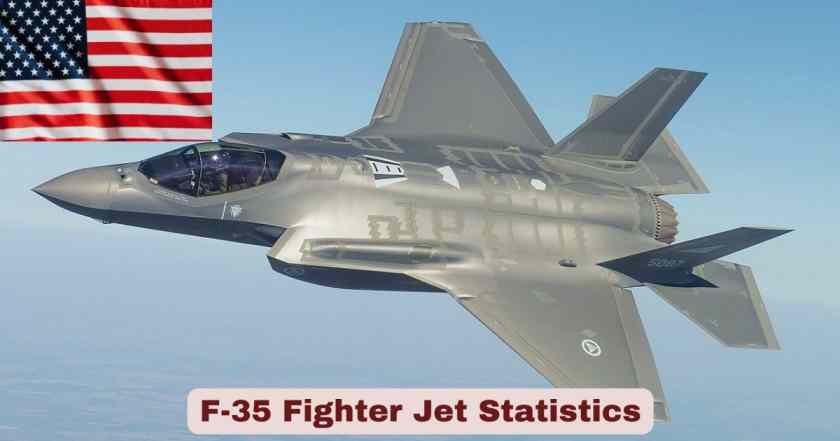
F-35 Fighter Jet in America 2026
The F-35 Lightning II is the most consequential and most debated fighter jet program in the history of American military aviation — and in 2026, it is also unambiguously the backbone of U.S. and allied air power for the foreseeable future. As of early 2026, the global F-35 fleet stands at approximately 1,300 aircraft, with the United States Air Force operating over 500 F-35As, making it the largest single F-35 operator in the world by a margin of roughly double the next largest fleet. The U.S. Marine Corps is on track to operate 261 F-35B/C aircraft by the end of 2026 per its own officially released aviation plan, and the U.S. Navy has taken delivery of well over 100 F-35Cs, with the carrier variant growing as the fleet gradually transitions away from the Super Hornet. Built by Lockheed Martin with principal partners Northrop Grumman and BAE Systems, the F-35 Lightning II is a single-seat, single-engine, supersonic stealth multirole strike fighter that exists in three variants: the conventional F-35A for the Air Force, the short takeoff and vertical landing F-35B for the Marines, and the carrier-based F-35C for the Navy and Marine Corps. In 2025, Lockheed Martin delivered a record 191 F-35s — nearly doubling the 110 delivered in 2024 and blowing past the previous record of 142 set in 2021 — pushing the program to 1 million cumulative flight hours by March 2025 and setting production at a pace 5 times faster than any other allied fighter jet currently in production. The Lots 18–19 production contract, finalized in September 2025, covers up to 296 aircraft for $24 billion — the single largest production contract in the program’s history — confirming that the F-35 is not slowing down.
What makes 2026 the defining year for the F-35 Lightning II is not just its production dominance — it is the aircraft’s increasingly documented combat record in real-world, high-threat environments. U.S. Air Force F-35As from the 34th Expeditionary Fighter Squadron (388th Fighter Wing, Hill AFB, Utah) were the first aircraft to penetrate Iranian airspace during Operation Midnight Hammer on June 22, 2025 — flying ahead of the B-2 Spirit stealth bombers, suppressing Iran’s integrated air defense systems, and remaining in Iranian airspace until the last B-2 had exited. During that deployment, the 34th EFS also recorded the first air-to-air kills by an F-35A — shooting down Houthi one-way attack drones over Yemen during Operation Rough Rider — a historic milestone for the program. In January 2026, F-35As participated in U.S. strikes in Venezuela, disabling air defense systems to enable helicopter operations that resulted in the capture of President Nicolas Maduro. And on February 28, 2026, Israeli F-35s flew alongside U.S. forces in Operation Epic Fury, with the Israeli Air Force striking approximately 500 Iranian targets as part of a joint operation in which ~200 IAF aircraft including F-35Is and F-15s participated. The F-35 in 2026 is not a future-generation promise anymore — it is the present-day instrument of strategic air power for the United States and its closest allies.
Interesting Facts About F-35 Fighter Jet 2026
| Fact | Data |
|---|---|
| First Flight (X-35 Concept Demonstrator) | October 24, 2000 |
| F-35A First Flight | December 15, 2006 |
| F-35B (USMC) Declared IOC | July 31, 2015 |
| F-35A (USAF) Declared IOC | August 2, 2016 |
| F-35C (USN) Declared IOC | February 28, 2019 |
| Full-Rate Production (Milestone C) Declared | March 2024 |
| Global F-35 Fleet Size (early 2026) | ~1,300 aircraft across 17 nations and services |
| Total F-35s Delivered Cumulatively by End of 2025 | ~1,370+ aircraft |
| Lockheed Martin 2025 Delivery Record | 191 F-35s — all-time record (previous: 142 in 2021; 110 in 2024) |
| U.S. Air Force F-35A Fleet (2026) | 500+ total (500th F-35A delivered August 2025; 439 active per FlightGlobal 2026) |
| USAF F-35A Program of Record | 1,763 aircraft — unchanged under Trump administration |
| USMC F-35B/C Fleet (end of 2026 target) | 261 aircraft — 205 F-35Bs + 56 F-35Cs (USMC 2026 Aviation Plan, February 2026) |
| U.S. Navy F-35C Fleet (early 2026) | ~110+ (100th F-35C delivered December 2024) |
| Program Cumulative Flight Hours Milestone | 1 million flight hours — reached March 3, 2025 |
| Annual Production Rate (Lockheed capacity) | 156/year current; targeting 100/year for USAF by FY2030 |
| Lots 18–19 Production Contract (Sept 2025) | Up to 296 F-35s for $24 billion — largest contract in program history |
| Nations Operating F-35 in 2026 | 17 nations — U.S., UK, Australia, Israel, Japan, Netherlands, Italy, Norway, Denmark, Belgium, Poland, Germany, Finland, South Korea, Singapore, Switzerland, Canada |
| First-Ever F-35A Air-to-Air Kills (U.S.) | 2025 (Yemen) — 34th EFS shot down Houthi one-way attack drones |
| First NATO F-35 Air-to-Air Kill | 2025 — NATO F-35s downed Russian drones over Poland |
| Operation Midnight Hammer Role (June 22, 2025) | F-35As first to enter Iranian airspace — led SEAD ahead of B-2 Spirit bombers |
| Venezuela Operation (January 2026) | F-35As disabled Venezuelan air defense systems; resulted in capture of President Maduro |
| Operation Epic Fury (February 28, 2026) | Israeli F-35Is among ~200 IAF aircraft striking ~500 Iranian targets in joint U.S.-Israeli operation |
| DoD Planned F-35 Fleet (mid-2040s) | ~2,500 aircraft — per Congressional Budget Office |
| F-35 Planned Service Life | Through 2070s–2088 — DoD projections |
Sources: Lockheed Martin Official Press Release — F-35 Breaks Delivery Record (f35.com, January 7, 2026); USMC 2026 Aviation Plan (marines.mil, February 2026); Army Recognition — USMC 261 F-35s by End of 2026 (armyrecognition.com, February 2026); Simple Flying — Air Force Largest F-35 Fleet (November 2025); The Aviationist — 191 F-35s Delivered in 2025 (theaviationist.com, January 2026); AeroTime — US Air Force F-35 Iran Mission Details (November 2025); Wikipedia — Lockheed Martin F-35 Lightning II (updated March 2, 2026); Congressional Budget Office F-35 Availability and Costs Report (cbo.gov, June 2025)
The facts packed into this table represent one of the most extraordinary defense acquisition stories in modern history. The F-35 program was born from the Joint Strike Fighter (JSF) competition of 1996, designed to produce a single affordable platform that could serve three different military services simultaneously. The word “affordable” has haunted the program ever since — but the production reality of 2025 and 2026 tells a different story from the troubled development years: 191 aircraft delivered in a single year, a global fleet of 1,300 airframes across 17 nations, and a $24 billion production contract signed in September 2025 covering nearly 300 more aircraft. When Lockheed Martin states that F-35 annual production is running at a pace 5 times faster than any other allied fighter currently in production, that is not marketing language — it is a statement about the degree to which the F-35 has become the default fighter jet of the Western world, from the 388th Fighter Wing at Hill AFB, Utah to the Finnish Air Force, which flew its first F-35A with tail number JF-501 on December 8, 2025. The fact that 17 sovereign nations now operate or are taking delivery of the F-35 in 2026 means the program’s political and industrial staying power is essentially unassailable regardless of per-unit cost debates in any individual country’s parliament.
The combat record in this table marks the decisive transition from a program that proved its concept in controlled exercises to one validated in the most contested airspace on Earth. The 34th Expeditionary Fighter Squadron’s account of Operation Midnight Hammer, published officially by Hill Air Force Base in November 2025, is remarkable in its specificity: F-35As were the first aircraft into Iranian airspace and the last to leave, conducting Suppression of Enemy Air Defenses (SEAD) by detecting, targeting, and destroying Iranian surface-to-air missile systems while remaining undetected. No F-35 was targeted by Iranian defensive fire during the entire operation, per U.S. officials — validating the aircraft’s core stealth and sensor fusion design in a way no exercise could. Add to this the first F-35A air-to-air kills over Yemen, the NATO F-35 kill over Poland, the Venezuela operation in January 2026, and the Operation Epic Fury role on February 28, 2026 — and the F-35 Lightning II has compiled a combat record in 2025–2026 that no other fifth-generation fighter on the planet can match.
F-35 Fighter Jet Technical Specifications 2026
| Specification | F-35A (CTOL — Air Force) | F-35B (STOVL — Marines) | F-35C (CV — Navy/USMC) |
|---|---|---|---|
| Takeoff Mode | Conventional | Short takeoff / Vertical landing | Catapult-assisted; arrested recovery |
| Engine | Pratt & Whitney F135-PW-100 | F135-PW-600 (+lift fan) | F135-PW-400 |
| Engine Thrust (dry) | 28,000 lbs | 27,000 lbs | 28,000 lbs |
| Engine Thrust (afterburner) | 43,000 lbs | 43,000 lbs | 43,000 lbs |
| Wingspan | 35 ft (10.7 m) | 35 ft (10.7 m) | 43 ft (13.1 m) folding |
| Length | 51.4 ft (15.7 m) | 51.3 ft (15.6 m) | 51.5 ft (15.7 m) |
| Height | 14.4 ft (4.38 m) | 14.3 ft (4.36 m) | 14.7 ft (4.48 m) |
| Empty Weight | 29,300 lbs (13,290 kg) | 32,300 lbs (14,650 kg) | 34,800 lbs (15,785 kg) |
| Max Takeoff Weight | 70,000 lbs (31,751 kg) | 60,000 lbs (27,215 kg) | 70,000 lbs (31,751 kg) |
| Maximum Speed | Mach 1.6 (~1,200 mph) | Mach 1.6 | Mach 1.6 |
| Combat Radius (internal fuel) | ~590 nm (669 miles) | ~450 nm | ~615 nm (706 miles) |
| Ferry Range | ~1,380 nm | ~900 nm | ~1,445 nm |
| Combat Ceiling | 50,000 ft (15,240 m) | 50,000 ft | 50,000 ft |
| Rate of Climb | ~62,000 ft/min | ~62,000 ft/min | ~62,000 ft/min |
| Crew | 1 pilot | 1 pilot | 1 pilot |
| Internal Weapons Bays | 2 bays | 1 main bay | 2 bays |
| Internal Payload (stealth clean) | ~5,700 lbs | ~3,000 lbs | ~5,700 lbs |
| Total Payload (all hardpoints) | 18,000 lbs | 15,000 lbs | 18,000 lbs |
| Internal Gun | GAU-22/A 25mm, 182 rounds (internal) | External gun pod only | External gun pod only |
| Total Hardpoints | 10 (6 internal + 4 external) | 8 (2 internal + 6 external) | 10 (2 internal + 6 ext + 2 tip) |
| Primary Radar | AN/APG-81 AESA | AN/APG-81 AESA | AN/APG-81 AESA |
| Electronic Warfare | AN/ASQ-239 Barracuda | AN/ASQ-239 | AN/ASQ-239 |
| Electro-Optical Targeting | AN/AAQ-40 EOTS | AN/AAQ-40 EOTS | AN/AAQ-40 EOTS |
| Distributed Aperture System | AN/AAQ-37 DAS (6 sensors, 360-degree IR) | AN/AAQ-37 DAS | AN/AAQ-37 DAS |
| Helmet Display | Gen III HMDS — projects imagery through cockpit floor | Gen III HMDS | Gen III HMDS |
| Fuel Capacity | ~18,500 lbs (2,760 gal) | ~13,500 lbs | ~19,750 lbs |
| Fuel Burn (dry) | ~1,480 gal/hr | ~1,480 gal/hr | ~1,480 gal/hr |
| Fuel Burn (afterburner) | ~3,960 gal/hr (5,600 liters/hr) | Similar | Similar |
| Airframe Service Life | 8,000 hours | 8,000 hours | 8,000 hours |
| Software (current, 2026) | TR-3 (Technology Refresh 3) — delivered 2025 | TR-3 | TR-3 |
Sources: F-35 Joint Program Office Official Data (f35.com); NAVAIR F-35C Product Page (navair.navy.mil); Lockheed Martin F-35 Lightning II Wikipedia (updated March 2, 2026); GAO-24-106703 F-35 Sustainment Report (gao.gov); WION News — Fighter Jet Hourly Costs 2025; Jane’s All The World’s Aircraft F-35 Entry
The F-35 Lightning II’s three-variant architecture is a study in engineering compromise that has, in 2026, been validated by real combat operations. The F-35A, the most numerous with over 500 in USAF service, is the cleanest and cheapest variant — no lift fan, no folding wing, no arresting hook — and is accordingly the lightest at 29,300 lbs empty and the only one with an internal 25mm GAU-22/A cannon loaded with 182 rounds. Its combat radius of ~590 nautical miles on internal fuel significantly exceeds the F-16C’s ~295 nm, and its AN/APG-81 AESA radar combined with the AN/AAQ-37 Distributed Aperture System’s 360-degree infrared coverage gives it sensor capabilities that simply cannot be replicated by any fourth-generation aircraft. The Generation III Helmet-Mounted Display System projects sensor data, targeting cues, and even a live infrared view through the aircraft floor onto the pilot’s visor — a capability that allowed 34th EFS pilots over Iran to maintain complete situational awareness while maneuvering in zero-visibility darkness at 50,000 feet in one of the most defended airspace environments on the planet. The AN/ASQ-239 Barracuda electronic warfare suite provides both passive threat detection and active jamming, making the aircraft a self-protecting strike platform without the need for a dedicated escort jammer in most scenarios.
The Pratt & Whitney F135 engine — the single most powerful fighter jet engine ever installed in a production aircraft at 43,000 lbs of thrust with afterburner — is the common heartbeat of all three variants, and its shared design philosophy is what makes the tri-service program logistically viable. The F-35B’s shaft-driven lift fan system, which redirects F135 engine power through a clutch-driven shaft to a downward-blowing fan in the forward fuselage, adds ~3,000 lbs of empty weight relative to the A model but enables the Marine Corps to deploy fifth-generation stealth airpower from amphibious assault ships without requiring aircraft carrier-scale infrastructure. The F-35C’s 43-foot folding wing — 8 feet wider than the A/B models — generates more lift for carrier approaches, while strengthened landing gear and a full-length tailhook enable the arrested carrier recoveries that define carrier aviation. Its ~615 nautical mile combat radius is the greatest of the three variants, reflecting the larger internal fuel capacity that the bigger wing accommodates. With TR-3 software now delivered and operational across the fleet as of 2025 — the first software version to unlock the full Block 4 hardware capabilities — the F-35 in 2026 is genuinely closer to its intended combat potential than at any point in its operational history.
F-35 Fighter Jet Cost and Financial Statistics 2026
| Cost Metric | F-35A | F-35B | F-35C |
|---|---|---|---|
| Average Flyaway Cost (Lots 15–17, official f35.com) | $82.5 million | $109 million | $102.1 million |
| F135 Engine Cost (August 2025) | $20.4 million | $20.4 million | $20.4 million |
| Total Unit Cost Including Engine | ~$103 million | ~$129 million | ~$122.5 million |
| DoD Reimbursable Rate Per Flight Hour (FY2024) | ~$17,500 | Higher | Higher |
| Full Sustainment Cost Per Flight Hour | ~$33,000–$42,000 | ~$35,000–$42,000 | ~$36,000–$45,000 |
| Lockheed Martin Target CPFH (2025) | ~$25,000 (F-35A target only) | Higher | Higher |
| Annual Sustainment Cost Per Aircraft (USAF) | ~$6.6–$7.5 million/year | Higher | Higher |
| GAO Projected Annual Cost Per Tail (Steady State) | $7.5 million/year — above $6.8M DoD target (GAO-24-106703, 2024) | — | — |
| Maintenance Hours Per Flight Hour | ~13 hours of maintenance per 1 hour of flight | Higher (lift fan) | Higher |
| Fuel Consumption (dry/cruise) | ~1,480 gal/hr; afterburner: ~3,960 gal/hr (5,600 liters/hr) | Similar | Similar |
| Fuel Cost Per Flight Hour | ~$4,480 (fuel alone, at ~$0.80/liter) | Similar | Similar |
| Programwide O&S Costs (FY2023) | $5+ billion across all variants (CBO, June 2025) | — | — |
| Total Lifetime Sustainment Cost (2024 GAO estimate) | $1.58 trillion — a 44% increase from $1.1 trillion in 2018 | — | — |
| Lots 18–19 Production Contract (Sept 2025) | Up to 296 aircraft for $24 billion — largest in program history | — | — |
| FY2024 USAF Procurement | 51 F-35As for ~$5.5 billion | — | — |
| FY2025 USAF Procurement | 44 F-35As for ~$4.8 billion | — | — |
| FY2026 USAF Procurement Requested | 24 F-35As for ~$4 billion (reduced from 74; Congress seeking to restore) | — | — |
| Block 4 Upgrade Cost (latest estimate) | $16.5 billion — up from original $10.6 billion (56% increase; GAO, 2023) | — | — |
| Block 4 Completion (revised) | 2031 at earliest (originally planned for 2026) | — | — |
| USAF Annual Maintenance Shortfall (GAO) | $400 million/year underfunding in aircraft maintenance contract fund | — | — |
| F-35A vs. F-22 Raptor CPFH | F-35A: ~$33K–$42K vs. F-22: ~$54,500–$85,325 (Raptor costs 1.5–2.4x more) | — | — |
| F-35A vs. F-16C/D CPFH | F-35A: ~$33K–$42K vs. F-16C: ~$22,500–$27,000 (F-35 costs ~50% more per hour) | — | — |
| F-35 Lifetime Cost (single aircraft, procurement + ops) | ~$300–$400 million over full service life | Higher | Higher |
Sources: F-35 Joint Program Office Official Cost Data (f35.com); GAO Report GAO-24-106703 — F-35 Sustainment (gao.gov, 2024); Congressional Budget Office — F-35 Availability Use and Costs (cbo.gov, June 2025); Simple Flying — How Much Does F-35 Cost in 2026 (simpleflying.com, February 2026); Economy Insights — F-35 Price Tag (economyinsights.com, August 2025); Air & Space Forces Magazine — F-35 Deliveries 2025 (airandspaceforces.com, January 2026); Bolt Flight — F-35 Cost Per Flight Hour Analysis (boltflight.com, April 2025); WION News — How Fighter Jet Hourly Costs Reach $40,000 per Hour; DoD FY2024 Reimbursable Rates
The F-35 Lightning II’s financial story in 2026 is a masterclass in the gap between official unit pricing and real-world program economics. The official flyaway cost of $82.5 million for the F-35A (Lots 15–17) represents a genuine reduction from early production lots that cost over $200 million per aircraft — a decline driven by learning-curve efficiencies, supply chain maturation, and the economy of scale from producing over 1,300 aircraft globally. But the flyaway figure excludes the $20.4 million F135 engine, bringing the true procurement cost to roughly $103 million per F-35A — and even that number excludes the training simulators, mission data files, spare parts packages, and infrastructure modifications that every new operator must purchase alongside the jet. The GAO’s 2024 finding — that projected lifetime sustainment costs have grown 44% from $1.1 trillion in 2018 to $1.58 trillion — represents an obligation stretching to 2088 and commits the U.S. government to F-35 sustainment spending for 62 more years from today. At over $5 billion per year just for current programwide operating and support costs (per CBO’s June 2025 report), the F-35 is the most expensive single tactical aviation sustainment line item in history.
The FY2026 procurement cut — from 74 planned F-35As to just 24 requested — reflects a real budget stress point that has nothing to do with the aircraft’s capabilities and everything to do with the $400 million annual maintenance contract shortfall cited by GAO, the Block 4 upgrade overruns (now $16.5 billion vs. the original $10.6 billion estimate), and the competing demands of funding the new F-47 sixth-generation program. The Lockheed Martin target of $25,000 per flight hour for the F-35A remains ambitious for direct operating costs, but every independent analysis from the GAO, CBO, and think tanks consistently arrives at $33,000–$42,000 per hour when all sustainment elements are included. The $17,500 DoD reimbursable rate for FY2024 represents only the costs Lockheed Martin directly charges — fuel, on-base maintenance, and consumables — and excludes depot maintenance, software sustainment contracts, the ODIN logistics system, and the government personnel costs of the military maintenance workforce. When a single main landing gear replacement costs ~$180,000 and certain sensor modules exceed $500,000 each, with ~70% of spare parts proprietary to Lockheed Martin-approved suppliers, the structural cost architecture of the program becomes clear: the F-35 was engineered for performance, and the price of that performance is an operating cost burden that will define U.S. Air Force, Navy, and Marine Corps budgets for decades.
F-35 Fighter Jet Fleet Status and Operations 2026
| Fleet / Program Metric | Data |
|---|---|
| USAF F-35A Active Inventory (FlightGlobal 2026 Directory) | 439 F-35As active; 500+ total including test and training |
| USAF F-35A Program of Record | 1,763 aircraft — unchanged under Trump administration |
| 500th F-35A Delivery to USAF | August 2025 — Hill AFB, Utah |
| USMC F-35B Target Fleet (end of 2026) | 205 F-35Bs (USMC 2026 Aviation Plan, February 2026) |
| USMC F-35C Target Fleet (end of 2026) | 56 F-35Cs (USMC 2026 Aviation Plan) |
| USMC Total F-35 Fleet (end of 2026) | 261 aircraft across 14 operational fleet squadrons + FRS + test units |
| USN F-35C Fleet (early 2026) | ~110+ aircraft |
| USN F-35C Program of Record | 273 aircraft |
| Total U.S. F-35s Across All Services (2026) | ~870+ aircraft |
| USAF F-35A Primary Operating Bases (2026) | Hill AFB (UT), Eglin AFB (FL), Luke AFB (AZ), Burlington ANG (VT), Eielson AFB (AK), Mountain Home AFB (ID), Shaw AFB (SC), Nellis AFB (NV), Dannelly Field ANG (AL), Selfridge ANG (MI) |
| F-35B Marine Corps Primary Bases | MCAS Beaufort (SC), MCAS Yuma (AZ), MCAS Iwakuni (Japan), USS America / USS Tripoli amphibious ships |
| Mission Capable Rate (DoD Goal) | 80% — official mandate |
| USAF F-35A Mission Capable Rate (Approx. FY2024) | ~65–70% — below 80% target; spare parts shortages cited as primary cause |
| Maintenance Challenges (GAO, 2024) | Heavy contractor reliance, inadequate spare parts, lack of technical data, contractor-dependent training |
| USAF Annual Maintenance Shortfall | $400 million/year underfunded in aircraft maintenance contract fund |
| TR-3 Software Status | Delivered and complete — 2025 (enables Block 4 hardware capabilities) |
| Block 4 Hardware/Software Upgrade Status | Truncated — critical changes by 2031; engine-dependent upgrades deferred to mid-2030s |
| USAF Total Fighter Inventory (FY2026) | 1,271 combat-coded fighters (Air Force Fighter Roadmap, October 2025) |
| USAF Target Fighter Inventory (2035) | 1,558 combat-coded fighters — requires maximizing F-35A and F-15EX production |
| F-35A Procurement Goal to Reach 1,558 Target | USAF must procure at rate approaching 100 F-35As/year by FY2030 per its own roadmap |
| F-47 (NGAD) Program Status | Boeing selected; announced as USAF No. 1 modernization priority; planned fleet ~185+ aircraft |
| CCA (Collaborative Combat Aircraft) Status | Additive to fighter inventory (not included in 1,271 count); coming online later this decade |
| F-35 Planned Service Retirement | 2070s–2088 — DoD planning horizons |
Sources: Air & Space Forces Magazine — Air Force Fighter Roadmap (airandspaceforces.com, November 2025); USMC 2026 Aviation Plan (marines.mil, February 2026); Army Recognition — USMC 261 F-35s (February 2026); Breaking Defense — Air Force Needs Hundreds More Fighters (October 2025); Simple Flying — Air Force Largest F-35 Fleet (November 2025); FlightGlobal World Air Forces Directory 2026; GAO-24-106703 (gao.gov, 2024); Air & Space Forces Magazine — F-35 Deliveries Soared in 2025 (January 2026); Wikipedia — F-35 Lightning II (March 2, 2026)
The F-35 fleet picture in 2026 is one of simultaneous expansion and readiness challenge. The USAF’s 439 active F-35As — with 500+ total including test and training aircraft — represent the result of a production ramp substantially delayed by Technology Refresh 3 (TR-3) software development issues that caused a one-year delivery halt from July 2023 to July 2024. The 191 deliveries in 2025 cleared that backlog, and with TR-3 now complete and distributed, the program enters 2026 on firmer footing than at any point in the last three years. The 10 primary USAF F-35A bases stretch from Eielson AFB, Alaska — where F-35As operate in Arctic conditions relevant to near-peer threat scenarios — to Eglin AFB, Florida, where the multi-service F-35 training enterprise produces pilots and maintainers for all three variants. The USMC’s 261-aircraft target by end of 2026, driven by its official published aviation plan, reflects a service that has committed almost entirely to the F-35 as its sole fixed-wing combat aircraft — a strategic bet that paid off visibly during Operation Midnight Hammer and Operation Epic Fury in 2025 and 2026.
The mission capable rate remains the most persistent operational challenge the F-35 faces in 2026, and the GAO’s audit trail explains why. An F-35A mission capable rate of ~65–70% — against a DoD mandate of 80% — is driven by spare parts shortages, contractor-dependent maintenance logistics, inadequate maintenance training programs, and the fundamental reality that the F-35’s maintenance ecosystem is still maturing from a developmental program model toward a true operational support model. The $400 million annual maintenance contract shortfall documented by GAO means the fleet is structurally underfunded for the readiness rates the mission demands. Yet despite these readiness challenges, the services continue to prioritize F-35 because no alternative delivers its combination of stealth, sensor fusion, and multi-role capability. The F-47 NGAD program, now formally assigned to Boeing as the sixth-generation successor, is planned for only ~185+ aircraft — confirming that the F-35 will remain the numerical backbone of U.S. air power long after its successor enters service, with DoD planning horizons extending to 2088.
F-35 Fighter Jet Combat History and Recent Operations 2026
| Operation / Combat Event | Year | Key F-35 Role and Statistics |
|---|---|---|
| First-Ever F-35 Combat Mission (Israeli F-35I) | May 2018 | Israeli F-35I struck targets in Syria — first-ever combat use of the F-35 |
| First U.S. F-35B Combat Mission (USMC) | September 27, 2018 | VMFA-211 F-35Bs struck Taliban targets in Afghanistan from USS Essex |
| First U.S. F-35A Air Combat | April 2019 | USAF F-35As deployed Middle East; flew combat sorties in Afghanistan and Iraq |
| Operation Inherent Resolve (Syria/Iraq) | 2019–2022 | F-35As and F-35Bs flew hundreds of sorties; SEAD and precision strike |
| Israeli Strikes — Lebanon | August–September 2024 | Israeli F-35Is conducted airstrikes in Lebanon during Israel-Hezbollah conflict |
| Israeli Strikes — Yemen | September 29, 2024 | Israeli F-35Is used in strikes on Houthi targets in Yemen |
| Israeli Strikes — Iran (initial) | October 2024 | Israeli F-35Is reportedly involved in first Israeli strikes on Iran |
| Operation Rough Rider — Yemen/Houthi | March–May 2025 | 34th EFS (388th FW, Hill AFB) F-35As flying combat within 24 hours of arriving in theater; destroyed air defense systems, C2 nodes, weapons depots, SAM and ballistic missile sites |
| First F-35A Air-to-Air Kills — U.S. | 2025 (Red Sea/Yemen) | 34th EFS F-35As shot down Houthi one-way attack drones — first-ever air-to-air kills by a USAF F-35A |
| First NATO F-35 Air-to-Air Kill | 2025 (Poland) | NATO F-35s downed Russian drones over Polish airspace — first time allied F-35s engaged airborne threats in NATO airspace (confirmed Lockheed Martin, January 7, 2026) |
| U.S. Marine Corps F-35B — 5,000 Mishap-Free Hours | 2025 | USMC F-35B deployment recorded ~5,000 mishap-free flight hours during high-tempo expeditionary operations (cited by Lockheed Martin, January 2026) |
| Operation Midnight Hammer (Iran Nuclear Sites) | June 22, 2025 | F-35As first to penetrate Iranian airspace — entered ahead of 7 B-2 Spirit bombers; conducted SEAD destroying Iranian SAM systems; employed weapons; were last aircraft to leave Iranian airspace; no F-35 targeted by Iranian systems |
| Israeli Operation Rising Lion (Iran) | June 2025 | Israeli F-35Is flew over 1,400 sorties over 12 days striking Iran’s nuclear facilities and missile infrastructure; zero manned Israeli aircraft lost; Israeli commanders stated they “refused to enter Iranian airspace without F-35s” (JINSA Report, December 2025) |
| USAF Confirms F-35 Iran Mission | November 2025 | Official Hill AFB article confirmed 34th EFS mission details — rare disclosure of F-35 classified combat operations inside Iranian airspace |
| U.S. Strikes in Venezuela | January 2026 | F-35As alongside F-22s, B-1s, F/A-18s, EA-18Gs; disabled Venezuelan air defense systems to enable helicopter operations; resulted in capture of President Nicolas Maduro (Gen. Dan Caine confirmed) |
| Operation Epic Fury (Iran) | February 28–March 1, 2026 | Israeli F-35Is among ~200 IAF aircraft (F-35s + F-15s) striking ~500 Iranian targets; U.S. F-35s also participated alongside B-2 Spirit bombers, F-22s, B-1s, and F/A-18s; over 1,000 total Iranian targets struck in first 24 hours |
| Nations that Have Used F-35 in Live Combat (as of March 2026) | 2026 | United States and Israel — only two nations confirmed to have used the F-35 in live combat operations |
Sources: AeroTime — U.S. Air Force F-35 Iran Mission Details (aerotime.aero, November 26, 2025); Lockheed Martin Official Press Release — F-35 2025 Combat (f35.com, January 7, 2026); The Aviationist — F-35 in Operation Midnight Hammer (January 2026); Defense.info — F-35 Role in Israel’s Iran Campaign (JINSA Report, December 2025); Army Recognition — USMC 261 F-35s and Operation Epic Fury (February–March 2026); Wikipedia — Lockheed Martin F-35 Lightning II (updated March 2, 2026); Air & Space Forces Magazine (airandspaceforces.com); U.S. Central Command Official Statements (centcom.mil)
The F-35 Lightning II’s combat record across 2025 and 2026 has answered the questions that shadowed the program for decades. The Operation Midnight Hammer account, confirmed through an official Hill Air Force Base article in November 2025, describes F-35As that had already recorded the first-ever USAF F-35A air-to-air kills during Houthi drone intercepts over Yemen, and were then selected as the tip of the spear for the most consequential strike mission in American aviation since World War II. The 34th Expeditionary Fighter Squadron entered Iranian airspace in full stealth configuration, ahead of the B-2 Spirit bombers, using the AN/APG-81 AESA radar, AN/AAQ-37 Distributed Aperture System, and AN/ASQ-239 Barracuda electronic warfare suite to detect and destroy Iran’s surface-to-air missile systems before the B-2s arrived. The F-35s employed weapons against Iranian defenses, per the official account. No F-35 was targeted by Iranian systems throughout the entire operation — a feat that confirms the aircraft’s low-observable design performs exactly as advertised against one of the most seriously armed air defense networks in the Middle East. The F-35s were the last aircraft to leave Iranian airspace once all seven B-2s had safely exited — covering the entire package from first ingress to final egress.
The Israeli experience with the F-35I in June 2025 and February 28, 2026 adds a strategic dimension that validates U.S. investment in the platform from the perspective of an allied operator that has used the aircraft in actual combat over hostile territory more than any other air force in the world. The JINSA report of December 2025 — based on direct access to Israeli pilots and commanders after Operation Rising Lion — states that Israeli leadership “refused to enter Iranian airspace without F-35s leading the way”, and that the aircraft’s ability to share sensor data across a networked wolfpack of jets transformed what individual pilots could see and react to in real time. Over 1,400 sorties in 12 days, with zero manned Israeli aircraft lost and Iran’s nuclear facilities systematically destroyed, the F-35I delivered results that exceeded the most optimistic pre-mission projections. When ~200 Israeli aircraft returned to Iranian airspace on February 28, 2026 as part of Operation Epic Fury — striking ~500 targets as part of a joint U.S.-Israeli operation that also involved U.S. B-2 Spirit bombers and resulted in the killing of Ayatollah Khamenei — the F-35’s status as the defining combat aircraft of this era was no longer a debate. It was a documented, verified, irreversible historical fact.
F-35 Fighter Jet Weapons Capabilities 2026
| Weapon / System | Carriage | Notes |
|---|---|---|
| GAU-22/A 25mm Rotary Cannon | 182 rounds internal (F-35A only); external pod for B/C | 4-barrel; ~3,300 rounds/min |
| AIM-9X Block II Sidewinder | 2 wingtip stations | Short-range IR air-to-air; off-boresight and network-cued |
| AIM-120C/D AMRAAM | 4 internal + 4 external = 8 | Primary BVR radar-guided air-to-air missile |
| AIM-260 JATM (Joint Advanced Tactical Missile) | Being integrated | Classified BVR missile; longer range, advanced seeker vs. AMRAAM; F-35’s future primary AAM |
| GBU-31 JDAM (2,000-lb) | 2 internally or up to 8 total | GPS-guided; primary air-to-ground strike munition |
| GBU-32 JDAM (1,000-lb) | Internal and external | Medium GPS-guided bomb |
| GBU-39/B Small Diameter Bomb (SDB I) | Up to 8 internally | 250-lb; GPS/INS guided; high-density precision strike |
| GBU-53/B StormBreaker (SDB II) | Up to 8 internally | Tri-mode seeker (IR + millimeter-wave radar + laser); engages moving targets in all weather |
| GBU-12 Paveway II (500-lb LGB) | Internal and external | Laser-guided bomb |
| GBU-24 Paveway III (2,000-lb LGB) | External | Laser-guided penetrator |
| AGM-154 JSOW-C | External | Joint Standoff Weapon glide munition |
| AGM-158 JASSM | External | Long-range stealthy cruise missile |
| AGM-158B JASSM-ER | External | Extended range; ~1,000 km range; low-observable |
| AGM-88 HARM / AARGM-ER | External | Anti-radiation missile — destroys enemy radar emitters; primary SEAD weapon |
| B61-12 Nuclear Gravity Bomb | 2 internally | Guided, dial-a-yield nuclear bomb; F-35A NATO-certified for dual-key nuclear missions |
| Spear 3 (UK) | Under integration | UK-specific small cruise missile |
| Brimstone 3 (UK) | Under integration | UK-specific precision anti-armor missile |
| AN/AAQ-40 EOTS | Internal (nose-mounted) | Electro-Optical Targeting System — IR and laser designation for all-weather precision strike |
| AN/AAQ-37 Distributed Aperture System | 6 sensors embedded in airframe | 360-degree infrared situational awareness — pilots can see in any direction around the aircraft |
| AN/ASQ-239 Barracuda EW Suite | Internal | Passive threat detection + active jamming — self-protecting electronic warfare |
| AN/APG-81 AESA Radar | Internal (nose) | Air-to-air and air-to-ground simultaneously; LPI (Low Probability of Intercept) radar |
| Gen III HMDS (Helmet) | Pilot helmet | Projects all sensor data including IR view through cockpit floor onto pilot’s visor |
| Internal Stealth Payload Limit | ~5,700 lbs (F-35A/C); ~3,000 lbs (F-35B) | Full stealth mode — zero external pylons; maintains low-observable radar cross-section |
| Maximum Total Payload | ~18,000 lbs (F-35A/C); ~15,000 lbs (F-35B) | All hardpoints loaded; stealth profile degraded with external stores |
Sources: F-35 Joint Program Office Weapons Page (f35.com); Lockheed Martin F-35 Capabilities Brief (lockheedmartin.com); Wikipedia — Lockheed Martin F-35 Lightning II (March 2, 2026); AeroTime — F-35 SEAD Mission Iran (November 2025); Defense.info — F-35 Wolfpack in Iran Strikes (December 2025); Military.com F-35 Armament Data; Jane’s Weapons — F-35 Integration Status 2025
The F-35 Lightning II’s weapons suite in 2026 is built around a philosophy that no previous fighter has embodied so completely: the aircraft itself is the weapon system, and the munitions it carries are simply extensions of its sensors. Every weapon the F-35 carries is cueable from the AN/APG-81 AESA radar, the AN/AAQ-37 Distributed Aperture System, the AN/AAQ-40 EOTS targeting pod, and the Gen III Helmet-Mounted Display — meaning the pilot can designate targets, confirm weapon impact, and re-engage without ever maneuvering the aircraft into a predictable weapons-release profile that older targeting systems required. The GBU-53/B StormBreaker is the clearest example of this philosophy: a 250-lb bomb with a tri-mode seeker that can autonomously lock onto a moving armored vehicle in rain, smoke, or darkness after release, requiring only a designation from the F-35’s sensors at launch. During Operation Rough Rider over Yemen and the subsequent Operation Midnight Hammer over Iran, this weapon system combination — stealth airframe + advanced sensors + precision munitions — allowed 34th EFS F-35As to detect, designate, and destroy Iranian surface-to-air missile batteries without ever triggering those systems’ engagement sequences. The Iranians did not know the F-35s were there. Their SAMs did not get a targeting solution. The F-35s destroyed them anyway.
The B61-12 nuclear bomb integration on the F-35A represents the most strategically significant weapons capability in the entire suite, yet it receives the least public attention. As the NATO-certified nuclear delivery aircraft for the alliance’s dual-key nuclear sharing arrangements — replacing the F-16C/D at bases in the Netherlands, Belgium, Germany, Italy, and Turkey — the F-35A can now conduct nuclear strike missions in full stealth configuration, approaching targets at 50,000 feet without radar detection and releasing B61-12 guided nuclear bombs with dial-a-yield capability ranging from 0.3 to 50 kilotons. Unlike the F-16 it replaced — which was visible on radar and required deep penetration of defended airspace in a non-stealthy profile — the F-35A nuclear mission can be flown against the most heavily defended targets in the world with a survivability profile that fundamentally changes NATO’s nuclear deterrence calculation. The AIM-260 JATM, currently being integrated and expected to fully replace the AIM-120 AMRAAM as the primary BVR air-to-air weapon over the next several years, will close the last significant gap in the F-35’s air-to-air capability — giving it a beyond-visual-range missile with the range, seeker sophistication, and electronic counter-countermeasure resistance to defeat the advanced radar jamming systems that China and Russia have specifically developed to defeat the AMRAAM. When that integration is complete, the F-35 Lightning II will have a weapons suite with no meaningful gap across any of the mission sets it was designed to perform.
Disclaimer: This research report is compiled from publicly available sources. While reasonable efforts have been made to ensure accuracy, no representation or warranty, express or implied, is given as to the completeness or reliability of the information. We accept no liability for any errors, omissions, losses, or damages of any kind arising from the use of this report.