
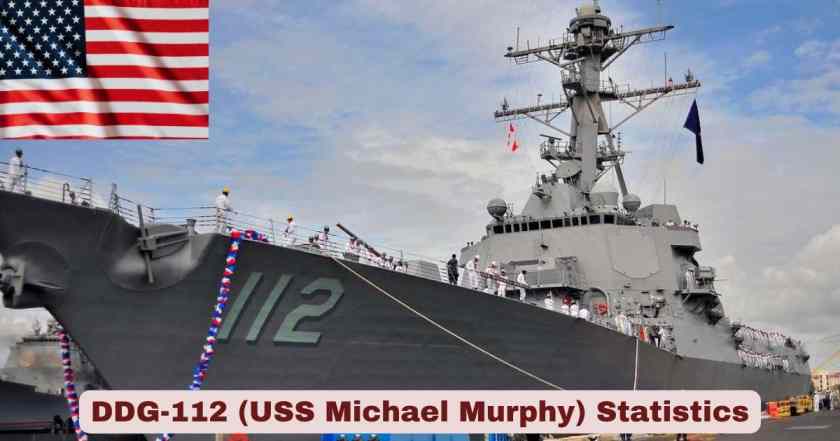
USS Michael Murphy (DDG-112)
USS Michael Murphy (DDG-112) is an Arleigh Burke-class (Flight IIA) Aegis guided-missile destroyer in the United States Navy — and carries the particular distinction of being the last Flight IIA variant ever built. Commissioned on October 6, 2012, and homeported at Naval Station Pearl Harbor, Hawaii, she is one of the most capable surface combatants afloat, carrying a weapons suite capable of defeating aircraft, submarines, surface ships, and ballistic missiles simultaneously. The ship is named for Lieutenant Michael P. Murphy (May 7, 1976 – June 28, 2005), a United States Navy SEAL officer who was posthumously awarded the Medal of Honor for his extraordinary actions during Operation Red Wings in Kunar Province, Afghanistan on June 28, 2005 — where, mortally wounded, he exposed himself to enemy fire to radio his position and request support for his team, sacrificing his life in the act. Murphy was the first member of the United States Navy to receive the Medal of Honor since the Vietnam War, and the first Navy SEAL to receive it posthumously. Ship name announcement came on May 7, 2008 — what would have been Murphy’s 32nd birthday — by Secretary of the Navy Donald C. Winter. The christening ceremony was held on May 7, 2011 — Murphy’s 35th birthday — by his mother Maureen Murphy, who serves as the ship’s sponsor. Murphy’s family signatures were inscribed on an iron plate affixed to the ship’s hull at the keel laying ceremony on June 18, 2010, a tradition that connects the ship permanently to the man she honors. The ship’s motto — “Lead the Fight” — reflects both Murphy’s tactical actions under fire and his broader legacy of leadership under impossible circumstances.
USS Michael Murphy represents the apex of the Arleigh Burke Flight IIA design line that ran for 34 ships, beginning with USS Oscar Austin (DDG-79) in 2000. She was originally intended to be the last Arleigh Burke-class destroyer ever built — the Navy had planned to transition to the Zumwalt-class (DDG-1000) stealth destroyer program as its next-generation surface combatant. That plan changed when the Zumwalt program was cut to just three ships after cost overruns, leaving a capability and numbers gap the Navy could only fill by continuing to build Arleigh Burkes. DDG-112’s singular place in destroyer history — the intended endpoint of a 62-ship program that was then extended indefinitely because nothing better was affordable — makes her both the culmination of a decades-long design tradition and the bridge to the continuing Arleigh Burke construction program that carries on today into Flight III variants. She is assigned to Destroyer Squadron 31 of Naval Surface Group Middle Pacific and has compiled a service record across more than a decade of operations in the Pacific, Indian Ocean, and beyond that includes humanitarian rescue, multinational exercises across 27 nations, multiple Western Pacific deployments, and the Arleigh Burke Fleet Trophy for 2024 — the Navy’s top award for battle efficiency among destroyers.
Interesting Facts: USS Michael Murphy (DDG-112) | Key Stats at a Glance
| Fact | Detail |
|---|---|
| Hull designation | DDG-112 |
| Ship class | Arleigh Burke-class (Flight IIA) — the last Flight IIA variant built |
| Ship type | Aegis guided-missile destroyer |
| Named for | Lieutenant Michael P. Murphy, USN (May 7, 1976 – June 28, 2005) |
| Murphy’s award | Medal of Honor — posthumously awarded; first US Navy recipient since Vietnam War |
| Ship’s motto | “Lead the Fight” |
| Ship name announced | May 7, 2008 — by Secretary of the Navy Donald C. Winter |
| Keel laid | June 18, 2010 — Bath Iron Works, Bath, Maine |
| Christened | May 7, 2011 — Murphy’s birthday; christened by his mother Maureen Murphy |
| Commissioned | October 6, 2012 |
| Home port | Naval Station Pearl Harbor, Hawaii |
| Squadron assignment | Destroyer Squadron 31, Naval Surface Group Middle Pacific |
| Builder | Bath Iron Works (contract awarded September 13, 2002) |
| Displacement | 9,200 tons |
| Length | 510 feet (160 m) |
| Beam | 66 feet (20 m) |
| Draft | 33 feet (10 m) |
| Speed | 35+ knots |
| Crew complement | 323 sailors — 23 officers and 300 enlisted |
| Propulsion | 4 × General Electric LM2500-30 gas turbines, 2 shafts, 100,000 shaft horsepower (75 MW) |
| VLS capacity | 96 total cells (1 × 32-cell + 1 × 64-cell Mk 41 Vertical Launch System) |
| Aircraft carried | 2 × MH-60R Seahawk helicopters |
| Call sign | NMPH |
| MMSI number | 303966000 |
| Awards received | Battle “E” (2021); Coast Guard Meritorious Team Commendation (2020); Canadian Forces’ Unit Commendation (2014); Arleigh Burke Fleet Trophy (2024) |
| Historical significance | Originally intended to be the last Arleigh Burke-class destroyer before Zumwalt-class replaced the line |
Source: USS Michael Murphy Wikipedia (updated April 2026); USS Michael Murphy SURPAC page; Wikipedia — Michael P. Murphy; Murph Foundation biography; CMOHS Medal of Honor recipient page; Wikipedia — Arleigh Burke-class destroyer; destroyerhistory.org Flight IIA page
The “last Flight IIA” designation is not a trivial detail. DDG-112 was the closing chapter on a design line that began with USS Arleigh Burke (DDG-51) in 1991 and evolved across three flights over two decades of construction. Flight IIA itself brought the most significant changes to the class — the addition of dual helicopter hangars and a lengthened hull specifically to enable the ship to carry and maintain two MH-60 helicopters as organic ASW and attack assets, substantially expanding multi-mission capability over the original Flight I and II ships. DDG-112 incorporated all of the refinements developed across 33 preceding Flight IIA hulls while also representing the transition point at which the Navy decided to keep building Burkes rather than abandon the class. The irony is complete: the ship that was supposed to end a program instead became the argument for continuing it.
Murphy’s Medal of Honor citation places DDG-112’s namesake in a specific tactical and moral context that gives the ship’s motto genuine weight. Between 30 and 40 Taliban fighters had surrounded a four-man SEAL reconnaissance element in rugged, enemy-controlled terrain near Asadabad. With communications impossible in the mountain terrain, Murphy left the cover of the ridgeline and moved into open ground — exposing himself completely to enemy fire — to get a satellite phone signal. He reached his headquarters, gave his position, and requested immediate support. He was shot during the call but finished it, reportedly signing off with “Thank you.” He then returned to the fight from his exposed position until he was mortally wounded. That act — deliberately surrendering cover to ensure his teammates could be located and eventually recovered — is what the Medal of Honor citation describes, and what DDG-112’s motto “Lead the Fight” honors every day she is at sea.
DDG-112 Technical Specifications | Weapons & Combat Systems
| Technical / Weapons Specification | Detail |
|---|---|
| Ship class | Arleigh Burke-class (Flight IIA) Aegis guided-missile destroyer |
| Hull number | DDG-112 |
| Displacement | 9,200 tons full load |
| Length | 510 feet (160 m) overall |
| Beam | 66 feet (20 m) |
| Draft | 33 feet (10 m) |
| Propulsion | 4 × General Electric LM2500-30 gas turbines — 2 shafts |
| Total shaft horsepower | 100,000 shp (75 MW) |
| Speed | 35+ knots |
| Crew | 323 total — 23 officers + 300 enlisted |
| Main gun | 1 × 5-inch (127 mm)/62 Mk 45 Mod 4 (lightweight gun) — range ~13 nautical miles, 16–20 rounds per minute |
| Close-in defense | 1 × 20 mm Phalanx CIWS |
| Secondary guns | 2 × 25 mm Mk 38 machine gun system |
| Heavy machine guns | 4 × 0.50 caliber (12.7 mm) guns |
| Vertical Launch System | 96 total cells — 1 × 32-cell + 1 × 64-cell Mk 41 VLS |
| VLS missiles: surface-to-air | RIM-66M Standard Missile; RIM-156 Standard Missile; RIM-174A Standard ERAM (SM-6) |
| VLS missiles: ballistic missile defense | RIM-161 Standard Missile 3 (SM-3) — exoatmospheric interceptor |
| VLS missiles: short-range SAM | RIM-162 ESSM (Evolved Sea Sparrow — quad-packed) |
| VLS missiles: land attack | BGM-109 Tomahawk cruise missiles |
| VLS missiles: anti-submarine | RUM-139 Vertical Launch ASROC |
| Torpedo tubes | 2 × Mark 32 triple torpedo tubes (6 torpedoes total) |
| Torpedo types | Mark 46, Mark 50, Mark 54 lightweight torpedoes |
| Combat system | Aegis Combat System with AN/SPY-1D phased array radar |
| ASW combat system | AN/SQQ-89 — integrates AN/SQS-53C bow-mounted sonar |
| Aircraft carried | 2 × MH-60R Seahawk helicopters (dual hangars — Flight IIA feature) |
| Flight IIA dual hangar feature | Side-by-side helicopter hangars — introduced with Flight IIA; not present on Flight I or II |
| Minehunting | Kingfisher mine-avoidance capability — Flight IIA feature |
| Hull construction | All-steel construction |
| Class endurance | ~4,890 nautical miles at 20 knots (class specification) |
Source: Wikipedia USS Michael Murphy (DDG-112) — updated April 2026; Wikipedia Arleigh Burke-class destroyer; destroyerhistory.org Arleigh Burke Flight IIA page; Military.com DDG-51 Arleigh Burke specifications; US Navy Fact File Destroyers DDG-51; man.fas.org DDG-51 specifications
DDG-112’s 96-cell Mk 41 Vertical Launch System is the heart of the ship’s combat power and what distinguishes a guided-missile destroyer from virtually every other surface warship in the world. The VLS is not a magazine — it is a flexible, multi-mission weapons node that can be loaded with any combination of missiles from the approved catalog. In a single deployment, the same 96 cells can be loaded with Tomahawk cruise missiles for deep-strike land attack, SM-3 interceptors for ballistic missile defense, SM-6s for anti-air and anti-ship operations at extended ranges, Evolved Sea Sparrow Missiles for self-defense, and vertical-launch ASROC for anti-submarine warfare. The exact mix is determined by the mission and threat environment. This flexibility — the ability to shift emphasis from land attack to ballistic missile defense to anti-air simply by loading different weapons before sailing — is why Arleigh Burke-class destroyers have become the US Navy’s most operationally demanded surface ships, regularly deployed beyond the capacity of their maintenance schedules.
The MH-60R Seahawk helicopter pair carried in DDG-112’s dual hangars extends the ship’s sensory reach dramatically beyond what the ship’s own sonar and radar can achieve. An MH-60R operating 50–100 nautical miles from the ship can hold contact on a submarine, attack it with torpedoes or ASROC, perform anti-surface surveillance, conduct search and rescue, or provide fire support for special operations forces. The dual-hangar configuration — one of the key features introduced in Flight IIA and absent from the 28 earlier Arleigh Burkes — transforms the ship from a powerful combatant into a miniature carrier air wing at sea. Murphy’s aviation capability, combined with her sensor suite and weapons load, makes her as capable in the anti-submarine warfare role as any surface ship ever built.
Lieutenant Michael P. Murphy | Biography, Operation Red Wings & Legacy
| Lt. Michael P. Murphy Biographical Fact | Detail |
|---|---|
| Full name | Michael Patrick Murphy |
| Birth date | May 7, 1976 — Smithtown, New York |
| Death date | June 28, 2005 — Kunar Province, Afghanistan |
| Age at death | 29 years old |
| Hometown | Patchogue, New York (Long Island) |
| Burial | Calverton National Cemetery, Calverton, New York — full military honors, July 13, 2005 |
| Education | Pennsylvania State University — graduated with honors, dual B.A. in political science and psychology, 1998 |
| BUD/S class | Class 236 — completed Basic Underwater Demolition/SEAL training |
| SEAL commissioning | Commissioned as Ensign, December 13, 2000; earned SEAL Trident, July 2002 |
| First SEAL unit | SEAL Delivery Vehicle Team 1 (SDVT-1), Pearl Harbor, Hawaii |
| BUD/S start | January 2001, Naval Amphibious Base Coronado, California |
| Rank at time of death | Lieutenant (O-3), US Navy |
| Operation | Operation Red Wings — June 27–28, 2005 — Kunar Province (Asadabad area), Afghanistan |
| Mission objective | Locate high-level anti-coalition militia leader (Ahmad Shah) |
| SEAL element size | 4-man team — Murphy (OIC), Axelson, Dietz, Luttrell |
| Enemy force | Between 30 and 40 Taliban fighters besieged the team |
| How team was compromised | Three local goat herders spotted the team; after being released, they reportedly alerted Taliban |
| Murphy’s decisive action | Left cover, moved into open terrain to transmit satellite phone call to headquarters — exposing himself to direct enemy fire |
| Murphy’s final words | Signed off his transmission: “Roger that, sir. Thank you.” |
| Helicopter QRF | MH-47 Chinook with 8 Navy SEALs and 8 Army Night Stalkers (160th SOAR) — shot down by RPG, killing all 16 |
| Total US fatalities | 19 — Murphy, Dietz, Axelson from SEAL element + 16 aboard the QRF helicopter |
| Lone survivor | Marcus Luttrell — SEAL, rescued July 2, 2005 by US Forces after sheltering with Afghan villagers |
| Bodies recovered | Murphy, Dietz, and Axelson recovered July 4, 2005 |
| Medal of Honor presented | October 22, 2007 — President George W. Bush presented award to Murphy’s parents |
| Medal of Honor significance | First US Navy recipient since Vietnam War; first Navy SEAL to receive it posthumously |
| Murphy’s decorations (total) | 11 military decorations including Medal of Honor, Silver Star, Purple Heart, Joint Service Commendation Medal, Navy Commendation Medal |
| SEAL team distinction | Murphy’s team became the most decorated team in Navy SEAL history |
| Team’s other awards | Dietz, Axelson, and Luttrell each awarded the Navy Cross (Navy’s second-highest honor) |
Source: Wikipedia — Michael P. Murphy (updated 2025); Murph Foundation biography (murphfoundation.org); CMOHS Medal of Honor recipient page (cmohs.org); Penn State News feature (November 2025); Wikipedia — Operation Red Wings; Study.com — Lt. Michael P. Murphy lesson; armywarhog.com — honoring bravery (2024)
Operation Red Wings is among the most studied small-unit actions in the history of the post-9/11 wars, in large part because of the moral decisions Murphy and his team faced at every turn — decisions that remain genuinely difficult even in retrospect and that continue to be taught in military leadership programs worldwide. The team’s detection by goat herders, and the subsequent decision about what to do with them, placed four SEALs in an impossible position that military ethicists and operational planners have analyzed extensively. Murphy’s final decision — to expose himself to enemy fire rather than concede that his team was already dying undetected — reflects a leader’s calculus that placed his men’s potential survival above his own almost certain death. The satellite phone call that cost him his life is what ultimately allowed Luttrell to be located and rescued, and allowed the bodies of Murphy, Axelson, and Dietz to be recovered and returned to their families.
The 19 American deaths on June 28, 2005 — three from Murphy’s ground team plus 16 aboard the MH-47 Chinook quick reaction force helicopter shot down by an RPG — made Operation Red Wings the deadliest special operations mission in Naval Special Warfare history at the time. Marcus Luttrell’s account, published as the book Lone Survivor in 2007 and later adapted into a film, brought the operation to a broad public audience. Murphy’s posthumous Medal of Honor — presented to his parents Dan and Maureen Murphy by President Bush on October 22, 2007, in the White House — was the first awarded to a US sailor since the Vietnam War, and established a precedent for SEAL posthumous recognition that has since been followed. The Murph Challenge — a CrossFit workout of 1-mile run, 100 pull-ups, 200 push-ups, 300 squats, and another 1-mile run, traditionally performed in a weighted vest — has become a global annual event on Memorial Day, conducted by military units, CrossFit gyms, and individuals in dozens of countries to honor his memory.
USS Michael Murphy Service History & Awards | Key Deployments 2012–2024
| Service History / Award Metric | Detail |
|---|---|
| Contract awarded | September 13, 2002 — Bath Iron Works |
| First steel cut | Made by Vice Admiral John Morgan, first CO of lead ship USS Arleigh Burke |
| Keel laid | June 18, 2010 — Bath Iron Works, Bath, Maine |
| Christened | May 7, 2011 — Murphy’s birthday; sponsored by Maureen Murphy (his mother) |
| Commissioned | October 6, 2012 — New York |
| Arrived home port | November 21, 2012 — Naval Station Pearl Harbor |
| First international port call | Barbados (October 16, 2012) — sailors assisted children at Boscobelle Primary School and Queen Elizabeth Hospital |
| First family day cruise | February 15, 2013 |
| HMCS Protecteur rescue (2014) | February 28, 2014 — dispatched to assist HMCS Protecteur (Canadian ship stranded after fire, ~340 nautical miles northeast of Pearl Harbor) — received 17 crew family members and 2 civilian contractors |
| Canadian Forces’ Unit Commendation | Awarded May 26, 2015 for assistance to HMCS Protecteur |
| RIMPAC 2014 | Participated in all 36 days of Rim of the Pacific 2014 — world’s largest international maritime exercise |
| First Western Pacific deployment | Departed October 20, 2014 — joined US Seventh Fleet |
| Carl Vinson CSG deployment (2017) | Deployed with USS Carl Vinson carrier strike group to western Pacific; CSG redirected toward Korean Peninsula amid North Korea nuclear tensions |
| KAKADU 2018 | Participated in multinational exercise hosted by Royal Australian Navy — forces from 27 countries |
| UNITAS LX / Teamwork South 2019 | Participated in exercises in Valparaiso, Chile — deployed to US Fourth Fleet area of operations |
| Coast Guard Meritorious Team Commendation | Awarded 2020 |
| Battle “E” Award | Awarded 2021 — Battle Efficiency Award, US Navy |
| Colombo, Sri Lanka port visit | July 23–26, 2024 — formal visit to Port of Colombo |
| Colombo replenishment visit | November 16–17, 2024 — replenishment visit; captained by Commander Jonathan B. Greenwald |
| Arleigh Burke Fleet Trophy | Awarded 2024 — the US Navy’s top award for battle efficiency among destroyers, presented annually to the most combat-ready destroyer in the fleet |
| Squadron assignment | Destroyer Squadron 31, Naval Surface Group Middle Pacific |
| Status (2026) | In active service |
Source: Wikipedia USS Michael Murphy (DDG-112) — updated April 2026; SURPAC USS Michael Murphy page; destroyerhistory.org Arleigh Burke Flight IIA
The Arleigh Burke Fleet Trophy awarded to DDG-112 in 2024 is the most prestigious recognition available to a US Navy destroyer. Awarded annually by the Chief of Naval Operations, it recognizes the destroyer that has achieved the highest level of combat readiness and battle efficiency across all warfare areas — anti-air, anti-surface, anti-submarine, strike, and damage control. Winning it requires a ship to demonstrate that every crew member is trained, every system is operational, and the ship can fight and win across the full spectrum of naval warfare. For a crew that sails under the motto “Lead the Fight” and bears the name of an officer who gave his life to do exactly that, the 2024 Arleigh Burke Fleet Trophy represents an institutional completion of the circle — not just honoring Murphy’s name on the hull but demonstrating in operational terms the same excellence he showed on that Afghan mountainside in 2005.
DDG-112’s rescue response to HMCS Protecteur in February 2014 is worth dwelling on as an example of the kind of operations Arleigh Burke destroyers conduct that never make headlines but constitute the day-to-day fabric of allied naval relationships. The Canadian naval vessel HMCS Protecteur — an underway replenishment ship — suffered a fire and catastrophic power failure approximately 340 nautical miles northeast of Pearl Harbor, leaving it dead in the water without propulsion, lighting, or water. Michael Murphy, already at sea, was immediately dispatched. The ship received 17 family members of Protecteur’s crew and two civilian contractors from the stricken vessel during adverse weather conditions, while attempting unsuccessfully to take the Canadian ship under tow. The Canadian Forces’ Unit Commendation awarded the following year reflected the Canadian Navy’s genuine gratitude for a response that was swift, professionally executed, and ultimately contributed to saving the ship. That award — from a foreign military — sits alongside the American Battle “E” and Arleigh Burke Fleet Trophy in DDG-112’s awards record as testament to the full range of her service.
Disclaimer: This research report is compiled from publicly available sources. While reasonable efforts have been made to ensure accuracy, no representation or warranty, express or implied, is given as to the completeness or reliability of the information. We accept no liability for any errors, omissions, losses, or damages of any kind arising from the use of this report.