
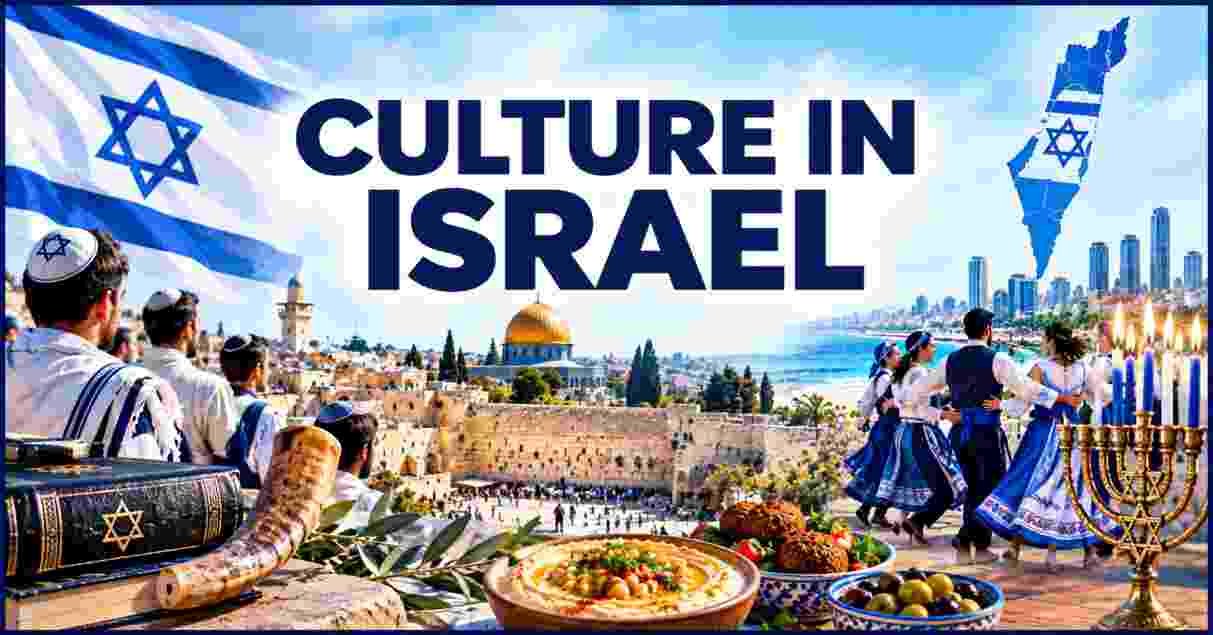
Culture in Israel 2026 is shaped by a population of 10.305 million, of whom 78.3% are Jews and others and 21.7% are Arabs, according to the Central Bureau of Statistics in September 2026. Hebrew and Arabic are the main languages, and Judaism (73.6%), Islam (18.1%), Christianity (1.9%), and the Druze faith (1.6%) are the main religions in the latest religion breakdown.
Culture in Israel 2026 – Introduction
Culture in Israel 2026 is a mix of old traditions and a young, fast-changing society. About 10.305 million people live in the country, and the Jewish calendar sets the rhythm of the year. Hebrew is the main language of daily life, while Arabic is spoken by about one in five residents. Food, music, and family life draw on communities that arrived from Europe, North Africa, the Middle East, Ethiopia, and the former Soviet Union.
This report uses Central Bureau of Statistics data, Pew Research Center surveys, and the 2026 World Happiness Report. It covers ethnic groups, population change, religion, Jewish religiosity, languages, festival dates, and lifestyle. Some language and religiosity figures come from older surveys, and each table names its year. The report describes social patterns and does not take a political position.
Interesting Fact(s): Culture in Israel 2026 Confirmed Data
Total Fertility Rate, Children per Woman
Israel       | █████████████████████████████ 2.88
OECD average | ██████████████ 1.41
| Fact | Confirmed 2026 Data |
|---|---|
| Total population (Rosh Hashanah 2026) | 10.305 million |
| Jews and others | 7.828 million (78.3%) |
| Arabs | 2.173 million (21.7%) |
| Total fertility rate | 2.88 children per woman |
| Share of world Jewish population living in Israel | 46% of 15.9 million |
| Life expectancy | 81.4 years (men), 85.9 years (women) |
| World Happiness Report 2026 rank | 8th |
| Rosh Hashanah 5787 | September 11 (evening) to September 13, 2026 |
Source: Israel Central Bureau of Statistics, Israel in Numbers (September 9, 2026); World Happiness Report 2026; Jerusalem Post holiday calendar.
Israel’s fertility rate of 2.88 is more than double the OECD average of 1.41. That gap shapes the age profile and the family culture. The country holds 46% of the world’s 15.9 million Jews. The population count includes 304,000 foreign nationals, so the 78.3% and 21.7% shares apply to Israeli residents only.
Life expectancy reaches 81.4 years for men and 85.9 years for women, which places Israel in the top ten of OECD countries. Israel ranked 8th in the 2026 World Happiness Report. That ranking reflects a three-year average of how people rate their lives. Rosh Hashanah 5787 begins at sundown on September 11, 2026, which sets the 2026 holiday calendar covered below.
Ethnic Groups in Israel 2026: Jews, Arabs and Others by Population
Population by Group, Rosh Hashanah 2026
Jews and others     | ████████████████ 7.828M
Arabs               | ████ 2.173M
Foreign nationals   | █ 0.304M
| Group | Population | Share of Israeli Residents |
|---|---|---|
| Jews and others | 7.828 million | 78.3% |
| Arabs | 2.173 million | 21.7% |
| Foreign nationals | 304,000 | Not applicable |
| Total population | 10.305 million | Not applicable |
| Growth in the past year | About 124,000 (1.2%) | Not applicable |
| Jews worldwide | 15.9 million (46% in Israel) | Not applicable |
Source: Israel Central Bureau of Statistics, Israel in Numbers (September 9, 2026); CBS estimate for January 1, 2026.
The CBS category “Jews and others” covers 7.828 million people, or 78.3% of Israeli residents. It includes non-Arab Christians, members of other religions, and people whose religion is not classified in the Population Registry. Arabs number 2.173 million, or 21.7%. The total of 10.305 million adds 304,000 foreign nationals, who are not in either share.
The population grew by about 124,000, or 1.2%, in the past year. Jews in Israel make up 46% of the 15.9 million Jews worldwide. Jewish society itself is diverse. More than half of Israeli Jews have at least partial Mizrahi roots, and large communities trace their families to Europe, Ethiopia, and the former Soviet Union.
Israel Population Growth 2026: Births, Immigration and Emigration
Population Movements, 12 Months to Rosh Hashanah 2026
Births              | ████████████████████████████████████ 182,000
Emigrants           | ███████████ 57,000
Deaths              | ██████████ 50,000
New immigrants      | ████ 24,000
Returning Israelis  | ████ 21,000
| Movement | Figure |
|---|---|
| Births | 182,000 |
| Deaths | About 50,000 |
| New immigrants | About 24,000 |
| Family reunification | About 4,000 |
| Returning Israelis | About 21,000 |
| Israelis recorded as emigrating | About 57,000 |
| Net migration balance | About −8,000 |
Source: Israel Central Bureau of Statistics, Israel in Numbers (September 9, 2026).
Births of 182,000 exceeded deaths of about 50,000, a natural increase of about 132,000. Migration reduced the total by about 8,000. New immigrants numbered about 24,000, plus about 4,000 through family reunification and 21,000 returning Israelis. Against that, about 57,000 Israelis were recorded as having emigrated. The figures add up to the 124,000 net gain.
Emigration has risen since 2023. A Tel Aviv University study found 268,930 Israelis left across 2023, 2024, and 2025, compared with 83,219 across 2013, 2014, and 2015. The CBS uses a specific rule for classifying emigrants, and its data are provisional. Immigration to Israel slowed too, from 31,100 in 2024 to 20,900 in 2025 under the annual method.
Religion in Israel 2026: Jewish, Muslim, Christian and Druze Shares
Religious Affiliation, CBS Classification
Jewish      | █████████████████████████████████████ 73.6%
Muslim      | █████████ 18.1%
Other       | ██ 4.8%
Christian   | █ 1.9%
Druze       | █ 1.6%
| Religion | Share of Population |
|---|---|
| Jewish | 73.6% |
| Muslim | 18.1% |
| Christian | 1.9% |
| Druze | 1.6% |
| Other or unclassified | 4.8% |
Source: Israel Central Bureau of Statistics religion classification, 2022 data, as reported by the US Department of State and other references.
Judaism accounts for 73.6% of the population, and Islam for 18.1%. Christians make up 1.9%, about 185,000 people, and about 76% of them are Arab Christians. The Druze community holds 1.6%. The remaining 4.8% are classed as other or without a religion in the registry, which includes many immigrants from the former Soviet Union.
Among Arab citizens, about 84% are Muslim, 8% are Christian, and 8% are Druze. The state recognized the Druze as an independent religious community in 1956. These shares come from the 2022 classification, which is the latest detailed breakdown found. The September 2026 CBS release reports only the Jews-and-others and Arab split.
Jewish Religiosity in Israel 2026: Secular, Traditional, Religious and Haredi
Passover Seder Attendance by Group, 2015
Secular (hiloni)      | █████████████████ 87%
Traditional (masorti) | ███████████████████ 97%
Religious (dati)      | ████████████████████ 99%
Haredi                | ████████████████████ 100%
| Group | Share of Israeli Jews (Pew 2016) | Attended a Seder (2015) |
|---|---|---|
| Secular (hiloni) | 49% | 87% |
| Traditional (masorti) | 29% | 97% |
| Religious (dati) | 13% | 99% |
| Haredi (ultra-Orthodox) | 9% | 100% |
Source: Pew Research Center, Israel’s Religiously Divided Society (2016).
Pew found that 49% of Israeli Jews call themselves secular, 29% traditional, 13% religious, and 9% Haredi. A more recent survey, reported in 2022, put secular Jews near 45% and Haredim near 10%, with traditional Jews near 33% and religious Jews near 12%. The groups differ sharply in daily practice, school, and community life.
Cultural practice cuts across the groups. 87% of secular Jews attended a Passover Seder in 2015, and 97% of traditional Jews did. Religious Jews reached 99%, and every Haredi respondent attended. Among homes where the main language was Hebrew, 95% held a Seder, against 70% in Russian-speaking homes. For many Israelis, holidays are a national and family custom as well as a religious one.
Languages in Israel 2026: Hebrew, Arabic, Russian and English Speakers
Native Language, CBS Social Survey 2011 (each █ = 2 percentage points)
Hebrew   | ████████████████████████ 49%
Arabic   | █████████ 18%
Russian  | ████████ 15%
Other    | █████ 10%
Yiddish  | █ 2%
French   | █ 2%
English  | █ 2%
Spanish  | █ 1.6%
| Language | Native Speakers |
|---|---|
| Hebrew | 49% |
| Arabic | 18% |
| Russian | 15% |
| Yiddish | 2% |
| French | 2% |
| English | 2% |
| Spanish | 1.6% |
| Other languages | 10% |
Source: Israel Central Bureau of Statistics, Social Survey 2011 (adults aged 20 and over). The most recent full native-language breakdown found.
Hebrew is the main language of government and daily life. 49% of adults named it as their native language in the 2011 survey. Arabic followed at 18%, and Russian at 15%. Yiddish, French, and English each held 2%, and Spanish held 1.6%. Another 10% spoke other languages, including Amharic and Romanian. About 90% of Israeli Jews and over 60% of Arab citizens had a good grasp of Hebrew.
Arabic has a special status under Israeli law, and English appears on road signs and in schools. Russian-speaking Israelis are now about 15% of the population, according to a 2022 estimate, and Russian media remain widely available. These figures are older than the other data in this report, so treat them as a guide to structure and not an exact 2026 count.
Israel Festivals 2026: Jewish Holiday Dates and Public Observances
Length of Major Holidays in Israel, Days (each █ = 1 day)
Hanukkah       | ████████ 8
Sukkot         | ███████ 7
Passover       | ███████ 7
Rosh Hashanah  | ██ 2
Shavuot        | ██ 2
Purim          | █ 1
Yom Kippur     | █ 1
Independence   | █ 1
| Holiday | 2026 Dates (Begins at Sundown) |
|---|---|
| Purim | March 2–3 |
| Passover | April 1–8 |
| Memorial Day | April 21 |
| Independence Day | April 22 |
| Shavuot | May 21–22 |
| Rosh Hashanah | September 11–13 |
| Yom Kippur | September 20–21 |
| Sukkot | September 25–October 2 |
| Hanukkah | December 4–12 |
Source: Jerusalem Post and Unpacked Jewish holiday calendars for 2026; Hebcal. Dates begin at sundown on the first date listed.
The year starts its holiday cycle with Purim on March 2–3, then Passover from April 1 for 7 days in Israel. Memorial Day falls on April 21, and Independence Day follows on April 22. Shavuot arrives on May 21–22. The autumn run opens with Rosh Hashanah on September 11–13, Yom Kippur on September 20–21, and Sukkot from September 25 to October 2. Hanukkah closes the year from December 4 to 12.
Shabbat, from Friday sundown to Saturday night, is the weekly rest day. Muslim and Christian communities keep their own holidays, including Eid al-Fitr, Eid al-Adha, Easter, and Christmas, whose dates follow the lunar and church calendars. The Ethiopian Jewish community marks Sigd on November 9, 2026. Public life slows sharply on Yom Kippur, when traffic nearly stops.
Israeli Lifestyle 2026: Households, Marriage, Work and Happiness
Average People per Household (each █ = 0.1)
Israel       | ████████████████████████████████ 3.17
OECD average | █████████████████████████ 2.5
| Lifestyle Measure | Figure |
|---|---|
| Average household size | 3.17 people (OECD: about 2.5) |
| Marriages (2024) | 53,025 |
| Divorces (2024) | 16,499 |
| Unemployment rate | 2.9% |
| Employment rate, ages 15 and over | 60.9% |
| Average monthly rent | NIS 4,919 (up 4.3%) |
| World Happiness Report 2026 rank | 8th (under-25s ranked 3rd) |
Source: Israel Central Bureau of Statistics, Israel in Numbers (September 9, 2026); World Happiness Report 2026.
Israeli households are larger than the OECD norm, at 3.17 people against about 2.5. About 53,025 couples married in 2024, and 16,499 divorced. The labor market is tight, with unemployment at 2.9% and employment at 60.9%. Rent averages NIS 4,919 a month, up 4.3%, while the average home price is about NIS 2.33 million.
Israel ranked 8th in the 2026 World Happiness Report, down from 5th in 2024, and young people under 25 ranked 3rd globally. The ranking averages three years of life evaluations. The same report shows worry, sadness, and anger rising, with Israel moving from 119th to 39th on that measure. High life satisfaction and high stress exist side by side in the data.
Culture in Israel 2026 FAQs
What is the population of Israel in 2026?
10.305 million on the eve of Rosh Hashanah 2026, according to the Central Bureau of Statistics. That includes 304,000 foreign nationals.
What ethnic groups live in Israel?
Jews and others make up 78.3% of Israeli residents, and Arabs make up 21.7%. Jewish communities include Mizrahi, Ashkenazi, Ethiopian, and Russian-speaking Israelis.
What languages are spoken in Israel?
Hebrew is the main language, with Arabic, Russian, and English widely used. In the 2011 CBS survey, 49% named Hebrew as native, 18% Arabic, and 15% Russian.
What is the main religion in Israel?
Judaism, at 73.6%. Islam accounts for 18.1%, Christianity for 1.9%, and the Druze faith for 1.6%.
How religious are Israeli Jews?
Pew found 49% secular, 29% traditional, 13% religious, and 9% Haredi in 2016. Even among secular Jews, 87% attended a Passover Seder in 2015.
When is Rosh Hashanah in 2026?
It begins at sundown on September 11, 2026 and ends on September 13.
When is Hanukkah in 2026?
Hanukkah runs from sundown on December 4 to December 12, 2026.
When is Israel’s Independence Day in 2026?
April 22, 2026, after Memorial Day on April 21.
What is the fertility rate in Israel?
2.88 children per woman, compared with an OECD average of 1.41.
How long do people live in Israel?
Men live 81.4 years on average and women live 85.9 years.
How happy are Israelis?
Israel ranked 8th in the 2026 World Happiness Report. Young people under 25 ranked 3rd in the world.
Disclaimer: This research report is compiled from publicly available sources. While reasonable efforts have been made to ensure accuracy, no representation or warranty, express or implied, is given as to the completeness or reliability of the information. We accept no liability for any errors, omissions, losses, or damages of any kind arising from the use of this report.