
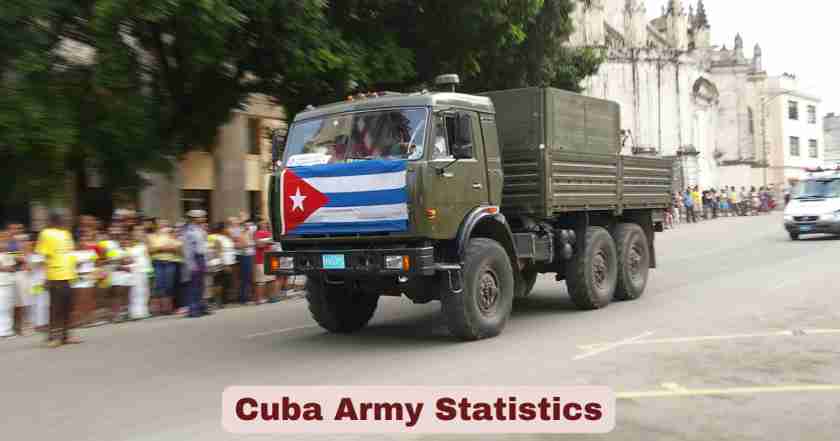
Cuba Army in 2026
The Cuban Revolutionary Armed Forces (Fuerzas Armadas Revolucionarias – FAR) in 2026 represent a military institution in severe decline, operating with predominantly Soviet-era equipment and facing critical shortages of fuel, ammunition, spare parts, and basic resources. According to GlobalFirepower’s 2025 Military Strength Rankings, Cuba ranks 89th globally among 145 nations assessed, with the armed forces maintaining approximately 50,000 active personnel, 39,000 reserve personnel, and 90,000 paramilitary forces primarily composed of the Territorial Troops Militia and Committees for the Defense of the Revolution. The Revolutionary Army comprises 35,000 personnel, the Revolutionary Navy maintains 5,000 sailors, and the Revolutionary Air and Air Defense Force operates with 10,000 airmen. Despite once being considered the best-equipped military in Latin America during the height of Soviet support in the 1980s, Cuba’s armed forces have been dramatically downsized and degraded since the end of the Cold War, with the World Bank reporting 76,000 total armed forces personnel in 2020—a figure that reflects continued decline.
The Cuban military in 2026 faces an unprecedented crisis stemming from the country’s catastrophic economic collapse, infrastructure failures including five total electrical grid collapses in 2025, and decades of underinvestment following the loss of Soviet subsidies in the early 1990s. The FAR operates primarily with equipment from the 1950s-1980s, including 300+ main battle tanks (predominantly T-54/T-55 variants with some T-62s), 1,200+ armored fighting vehicles, and an air force of 45 total aircraft including 14 combat aircraft that analysts describe as “currently inoperable” due to lack of spare parts, fuel shortages, and inadequate maintenance. Recent analysis from January 2026 indicates that Cuban MiG-29s are “completely out of service,” while older MiG-23 and MiG-21 aircraft stand “no chance against fifth-generation fighters” and would likely be “downed swiftly” in any conflict scenario. The navy operates 33 naval assets but lacks blue-water capabilities, functioning solely for coastal defense and patrol. These Cuba army statistics in 2026 reveal a force designed around the doctrine of “War of All the People“—mass mobilization and asymmetric resistance against a superior adversary—but one whose material readiness and morale have been severely compromised by economic exhaustion, population migration, and the terminal decay of Cuba’s socialist economic model.
Key Interesting Stats & Facts About Cuba Army in 2026
| Fact Category | Statistic | Year/Period | Source |
|---|---|---|---|
| Global Military Ranking | 89th of 145 nations | 2025 | GlobalFirepower 2025 |
| Active Military Personnel | 50,000 | 2025 | Military Power Rankings 2025 |
| Reserve Personnel | 39,000 | 2025 | Military Power Rankings 2025 |
| Paramilitary Forces | 90,000 | 2025 | Military Power Rankings 2025 |
| Total Armed Forces (World Bank) | 76,000 | 2020 | World Bank/Trading Economics 2025 |
| Army Personnel | 35,000 | 2025 | Military Power Rankings 2025 |
| Navy Personnel | 5,000 | 2025 | Military Power Rankings 2025 |
| Air Force Personnel | 10,000 | 2025 | Military Power Rankings 2025 |
| Main Battle Tanks | 300+ (T-54/T-55, T-62) | 2025 | GlobalFirepower/Military Power Rankings 2025 |
| Armored Fighting Vehicles | 1,200+ | 2025 | GlobalFirepower 2025 |
| Total Aircraft | 45 | 2025 | GlobalFirepower 2025 |
| Combat Aircraft | 14 (inoperable) | 2026 | Cuba Headlines Analysis Jan 2026 |
| Naval Assets | 33 vessels | 2025 | GlobalFirepower 2025 |
| Defense Budget | Estimated <$500M | 2025 | Various Analysts |
| MiG-29 Operational Status | 0 operational | 2026 | Cuba Headlines Analysis Jan 2026 |
Data Sources: GlobalFirepower.com 2025, MilitaryPowerRankings.com 2025, World Bank 2020, Trading Economics 2025, Cuba Headlines Military Analysis January 2026, Wikipedia Cuban Revolutionary Armed Forces 2025
The statistics above paint a stark picture of Cuba’s military in 2026 as a force in terminal decline despite maintaining relatively large nominal personnel numbers. The 50,000 active personnel figure represents a massive reduction from Cold War peaks when Cuba maintained over 200,000 active troops and deployed tens of thousands to conflicts in Angola, Ethiopia, and other African nations during the 1970s-1980s. The 89th global ranking out of 145 nations places Cuba behind most Latin American neighbors including Brazil, Colombia, Mexico, Argentina, and Peru, reflecting both the small size of the force and its obsolete equipment base. The 90,000 paramilitary forces—primarily Territorial Troops Militia (MTT) and Committees for the Defense of the Revolution—theoretically provide mass mobilization capability under the “War of All the People” doctrine, but their actual combat readiness in 2026 is questionable given the population’s exhaustion from economic crisis and mass emigration.
The equipment statistics reveal the depth of material decay. 300+ main battle tanks sounds substantial, but these are exclusively 1950s-1970s Soviet designs (T-54/T-55 from the Korean War era, T-62 from the 1960s) that lack modern fire control systems, armor protection, or mobility compared to contemporary tanks. The 1,200+ armored fighting vehicles similarly date from the 1960s-1980s, including BMP-1 infantry fighting vehicles and BTR series armored personnel carriers. Most critically, the air force’s 14 combat aircraft are described as “currently inoperable” as of January 2026, with Cuban MiG-29s (the most modern fighters, delivered in the 1980s) completely out of service due to lack of Russian spare parts, fuel shortages, and maintenance failures. The 33 naval vessels include patrol boats and coastal defense assets but no submarines, destroyers, or frigates capable of meaningful naval operations beyond Cuba’s territorial waters. The Cuba army statistics in 2026 demonstrate that while the FAR maintains organizational structure and doctrine developed during its Cold War peak, the force’s actual combat capability has degraded to the point where analysts describe it as “more decorative than functional” except in scenarios of asymmetric resistance against an occupying force.
Personnel Breakdown and Force Structure in 2026
| Component | Personnel | Role | Readiness Assessment |
|---|---|---|---|
| Revolutionary Army | 35,000 active | Ground forces, territorial defense | Degraded – fuel/ammo shortages |
| Revolutionary Navy | 5,000 active | Coastal defense, patrol | Minimal – aging vessels, no blue-water capability |
| Revolutionary Air Force | 10,000 active | Air defense, close air support | Critical – aircraft inoperable |
| Territorial Troops Militia (MTT) | ~50,000 | Mass mobilization, asymmetric resistance | Unknown – untested in modern era |
| Youth Labor Army (EJT) | ~40,000 | Military-style labor force | Non-combat – construction/agriculture |
| Defense and Production Brigades | Variable | Economic/military integration | Non-combat – enterprise management |
| Committees for Defense of Revolution | Variable | Neighborhood surveillance/mobilization | Minimal military value |
| Reserves | 39,000 trained | Wartime augmentation | Degraded – minimal training since 1990s |
Data Source: Military Power Rankings 2025, Wikipedia Cuban Revolutionary Armed Forces 2025, GlobalMilitary.net 2025
The personnel structure of Cuba’s armed forces in 2026 reflects a military designed for total war mobilization but operating at peacetime minimums due to resource constraints. The Revolutionary Army’s 35,000 active personnel are distributed across ground forces units including mechanized and tank battalions equipped with Soviet-era equipment, anti-aircraft artillery and missile units operating S-125 Pechora and SA-3 Goa systems, and territorial defense formations. However, fuel shortages severely limit training activities, with armored units reportedly conducting vehicle operations only during rare exercises rather than routine training. Artillery units face ammunition shortages that restrict live-fire training to minimal levels.
The Revolutionary Navy’s 5,000 personnel operate a fleet that has contracted dramatically since the Cold War, when Cuba maintained Soviet-supplied frigates and submarines. As of 2026, the navy operates primarily coastal patrol boats, fast attack craft armed with obsolete P-15 Termit (Styx) anti-ship missiles, and minesweepers—none capable of operations beyond Cuba’s territorial waters. The force functions primarily for fisheries protection, anti-trafficking interdiction, and coastal surveillance rather than naval warfare. The Revolutionary Air Force’s 10,000 personnel face the most critical readiness crisis, operating 45 total aircraft (including transports and helicopters) but with combat aircraft described as “currently inoperable” as of January 2026. The fleet includes MiG-29 fighters (all grounded), MiG-23 interceptors (limited operations), older MiG-21 fighters (few operational), transport aircraft, and attack helicopters—but chronic fuel shortages, lack of spare parts, and degraded maintenance capabilities mean that actual sortie generation is minimal. The Cuba army statistics in 2026 indicate that while organizational structure remains intact with officers, bases, and units formally established, the operational readiness across all services has degraded to levels that would make sustained combat operations impossible without external logistical support.
Main Battle Tanks and Armored Vehicles in 2026
| Vehicle Type | Quantity | Model/Variant | Origin | Operational Status |
|---|---|---|---|---|
| Main Battle Tanks | 300+ | T-54/T-55 (majority) | Soviet (1950s-1960s) | Limited operational – fuel/parts |
| Main Battle Tanks | ~50 | T-62 | Soviet (1960s) | Limited operational – fuel/parts |
| Infantry Fighting Vehicles | ~400 | BMP-1 | Soviet (1960s-1970s) | Degraded – mechanical issues |
| Armored Personnel Carriers | ~800 | BTR-60/BTR-152/BTR-40 | Soviet (1950s-1970s) | Degraded – many non-operational |
| Total Armored Vehicles | 1,200+ | Mixed Soviet-era | Various | Minority operational |
Data Source: GlobalFirepower 2025, Military Power Rankings 2025, Cuba Headlines Military Analysis January 2026
Cuba’s armored vehicle fleet in 2026 consists entirely of Soviet-era designs that are 50-70 years old and represent at least two generations of technological obsolescence compared to modern armored warfare systems. The T-54/T-55 main battle tanks, which constitute the majority of Cuba’s 300+ tank fleet, were designed in the immediate aftermath of World War II and entered Soviet service in 1947-1958. These tanks feature 100mm rifled guns, primitive optical fire control systems lacking computerized ballistics, armor protection effective only against weapons from the 1950s-1960s, and mechanical reliability that requires constant maintenance Cuba can no longer provide. The T-62 tanks, representing Cuba’s “modern” armor with 115mm smoothbore guns, date from the 1960s and similarly lack the thermal sights, composite armor, active protection systems, and fire-on-the-move capability standard on contemporary tanks.
A January 2026 analysis noted that in a hypothetical conflict scenario, these T-55/T-62 tanks would be “irrelevant in a lightning operation” due to lack of fuel for deployment, absence of air support, and vulnerability to modern anti-tank weapons. The tanks would “lack the time and fuel for effective deployment” and their role would be limited to “post-incursion, during prolonged resistance,” but “without air support or logistics, they would collapse quickly.” The 1,200+ armored fighting vehicles include approximately 400 BMP-1 infantry fighting vehicles featuring 73mm guns and AT-3 Sagger anti-tank missiles (1960s technology), and ~800 BTR-series wheeled armored personnel carriers ranging from BTR-40 (1950s) to BTR-60 (1960s) designs. Analysts estimate that only a minority of these vehicles remain operational as of 2026, with fuel shortages, lack of spare parts for engines and transmissions, and tire degradation rendering many immobile. The Cuba army statistics in 2026 indicate that the armored force, once capable of combined arms operations during deployments to Angola and Ethiopia, now functions primarily as a static reserve unable to conduct mobile warfare without massive external logistics support.
Air Force Aircraft and Capabilities in 2026
| Aircraft Type | Quantity | Model/Variant | Origin/Era | Operational Status 2026 |
|---|---|---|---|---|
| Total Aircraft | 45 | All types including transport/helos | Mixed | Minimal readiness |
| Combat Aircraft | 14 | MiG-29/MiG-23/MiG-21 | Soviet 1960s-1980s | “Currently inoperable” |
| MiG-29 Fighters | ~6-8 | MiG-29A/UB Fulcrum | Soviet/Russian 1980s delivery | “Completely out of service” |
| MiG-23 Interceptors | ~8-10 | MiG-23ML/MF Flogger | Soviet 1970s | Few operational, no spare parts |
| MiG-21 Fighters | ~6-8 | MiG-21bis/MF Fishbed | Soviet 1960s | “Stand no chance” vs modern fighters |
| Transport Aircraft | ~10-15 | An-2, An-24, An-26, Il-76 | Soviet | Limited operations |
| Attack Helicopters | ~8-10 | Mi-24/Mi-35 Hind | Soviet 1970s-1980s | Degraded readiness |
| Utility Helicopters | ~8-10 | Mi-8/Mi-17 Hip | Soviet | Some operational |
Data Source: GlobalFirepower 2025, Cuba Headlines Military Analysis January 2026, Wikipedia Cuban Revolutionary Armed Forces 2025
The Cuban Air Force in 2026 exists as a force on paper but lacks operational capability due to the combination of obsolete aircraft, chronic fuel shortages, absence of spare parts, and maintenance failures. A January 2026 detailed military analysis stated bluntly that Cuban MiG-29s are “currently inoperable” and that “without Russian parts, limited fuel, and poor maintenance, the Air Force is more decorative than functional.” The MiG-29 Fulcrum fighters, delivered by the Soviet Union in the late 1980s and representing Cuba’s most modern combat aircraft, are “completely out of service” as spare parts from Russia are unavailable due to both cost and Russia’s own military commitments. These aircraft, even when operational, lack modern avionics, radar systems, and beyond-visual-range missile capability compared to fourth and fifth-generation fighters.
The older MiG-23 and MiG-21 aircraft, dating from the 1960s-1970s, are described as having “no chance against fifth-generation fighters and would likely be downed swiftly” in any air combat scenario. The MiG-21, a design from the late 1950s, represents technology from the early Cold War era and lacks the radar, weapons systems, and performance to engage modern combat aircraft. The transport fleet of Antonov and Ilyushin aircraft provides limited cargo and personnel movement capability when fuel is available, but operations are restricted to essential missions. The Mi-24/Mi-35 Hind attack helicopters and Mi-8/Mi-17 Hip utility helicopters represent the most operationally relevant aircraft, capable of close air support, troop transport, and disaster relief missions, but fuel shortages limit flight hours to minimal levels. The Cuba army statistics in 2026 reveal an air force that has effectively ceased to function as a combat force, unable to defend Cuban airspace, provide air support to ground forces, or conduct any offensive operations—a stark decline from the 1980s when Cuba operated over 200 combat aircraft and conducted complex air operations during interventions in Africa.
Air Defense Systems and Readiness in 2026
| System | Quantity | Variant | Origin/Era | Effectiveness Assessment |
|---|---|---|---|---|
| S-125 Pechora | 144 launchers | S-125 Pechora-2BM (modernized) | Soviet 1960s, Belarus upgrade 2025 | Obsolete vs. modern threats |
| SA-3 Goa | Multiple batteries | Various | Soviet 1960s | Ineffective vs. stealth/EW |
| SA-2 Guideline | Unknown quantity | Various | Soviet 1950s | Obsolete, museum pieces |
| Anti-Aircraft Artillery | Numerous | ZSU-23-4, S-60, etc. | Soviet 1950s-1960s | Minimal effectiveness |
| Integrated Air Defense | None | N/A | N/A | No modern IADS |
Belarusian Modernization Program (May 2025):
| Component | Description | Improvement | Limitations |
|---|---|---|---|
| S-125 Pechora-2BM | 144 launchers upgraded | Mounted on T-55 chassis for mobility | Still 1960s technology |
| Electronics | Updated systems | Modern electronics, improved radar | Cannot counter stealth |
| Mobility | T-55 tank chassis | Self-propelled vs. fixed sites | Chassis itself is 1950s |
Data Source: Cuba Headlines Military Analysis January 2026, GlobalMilitary.net 2025, Military Power Rankings 2025
Cuba’s air defense systems in 2026 represent the most capable element of the degraded military, having received a significant modernization upgrade from Belarus in May 2025 that installed 144 S-125 Pechora-2BM surface-to-air missile launchers. This modernization program mounted the missiles on T-55 tank chassis for increased mobility (replacing static installations), upgraded electronics and radar systems, and theoretically improved capability against certain aerial threats. However, the fundamental limitations remain: the S-125 (SA-3) missile system was originally designed in the 1960s to intercept subsonic bombers and is “ineffective against modern stealth aircraft with advanced electronic warfare capabilities” according to January 2026 analysis.
The assessment notes that “without long-range systems like S-300 or S-400, and lacking an integrated IADS [Integrated Air Defense System] comparable to Venezuela’s, the S-125 remains outdated” and that “it was originally designed in the 1950s to intercept subsonic bombers.” While the Belarusian upgrades improved reliability and usability, they could not overcome fundamental physics limitations—the missiles lack the speed, altitude, and guidance sophistication to engage fifth-generation stealth fighters, cruise missiles, or aircraft employing electronic warfare jamming. The SA-2 Guideline systems, if still operational, date from the 1950s and are primarily of historical interest (these shot down Francis Gary Powers’ U-2 in 1960). The anti-aircraft artillery including ZSU-23-4 Shilka self-propelled systems and towed S-60 57mm guns provide point defense against helicopters and low-flying aircraft but are ineffective against modern precision weapons. The Cuba army statistics in 2026 indicate that while the air defense network might complicate low-altitude operations and could theoretically impose some costs on an adversary, it would be rapidly suppressed by modern air forces employing stand-off weapons, electronic attack, and stealth capabilities—fundamentally unable to deny airspace over Cuba to a technologically advanced opponent.
Naval Capabilities and Coastal Defense in 2026
| Vessel Type | Quantity | Class/Type | Origin/Era | Capability |
|---|---|---|---|---|
| Total Naval Assets | 33 | Mixed types | Soviet-era | Coastal patrol only |
| Patrol Boats | ~15-20 | Osa-class, Zhuk-class | Soviet 1960s-1970s | Anti-ship missiles (P-15 Termit) |
| Fast Attack Craft | ~8-10 | Various | Soviet | Limited operations |
| Minesweepers | ~3-5 | Various | Soviet | Harbor/coastal |
| Frigates | 0 | Retired | N/A | No blue-water capability |
| Submarines | 0 | Retired | N/A | No subsurface capability |
Coastal Defense Systems:
| System | Details | Effectiveness |
|---|---|---|
| P-15 Termit (SS-N-2 Styx) | Anti-ship missiles on patrol boats | Obsolete (1960s, subsonic, easily countered) |
| Coastal Artillery | Various Soviet-era guns | Minimal threat to modern ships |
| Port Defenses | Mines, obstacles | Static defense only |
Data Source: GlobalFirepower 2025, Military Power Rankings 2025, Wikipedia Cuban Revolutionary Armed Forces 2025
The Cuban Navy in 2026 operates as a minimal coastal defense force with 33 naval assets consisting primarily of small patrol boats, fast attack craft, and minesweepers—none capable of blue-water operations beyond Cuba’s territorial waters. The force has contracted dramatically from the Cold War era when Cuba operated Soviet-supplied Koni-class frigates and Foxtrot-class submarines that provided limited but real naval warfare capability. The retirement of these vessels in the 1990s-2000s due to maintenance costs and lack of spare parts reduced the navy to its current configuration of light forces suitable only for fisheries enforcement, anti-trafficking interdiction, and coastal surveillance.
The primary offensive capability comes from 15-20 patrol boats of the Osa-class and other types armed with P-15 Termit (NATO: SS-N-2 Styx) anti-ship missiles. However, these missiles date from the 1960s, fly at subsonic speeds with predictable trajectories, lack modern guidance systems, and are easily countered by modern naval countermeasures including electronic warfare, close-in weapon systems, and soft-kill decoys. The minesweeping capability provides some harbor defense utility but is primarily oriented toward peacetime mine clearance rather than wartime minelaying operations. Analysts note that the navy “lacks airlift, blue-water naval assets, and long-range weapons, limiting its role entirely to island defense and symbolic regional influence.” The Cuba army statistics in 2026 indicate a navy incapable of power projection, anti-submarine warfare, sea control, or any naval mission beyond immediate coastal waters—functioning essentially as an armed coast guard rather than a conventional navy.
Military Doctrine and “War of All the People” Strategy in 2026
| Doctrine Element | Description | 2026 Viability | Assessment |
|---|---|---|---|
| Mass Mobilization | 1 million+ militiamen theoretically available | Questionable | Morale crisis, population exhausted |
| Territorial Defense | Decentralized resistance across island | Doctrine intact | Requires resources Cuba lacks |
| Asymmetric Warfare | Guerrilla tactics vs. superior force | Historical precedent | “Requires leadership” that may be absent |
| Anti-Aircraft Focus | Deny airspace through SAM network | Degraded | Systems obsolete, easily suppressed |
| Coastal Defense | Prevent amphibious assault | Limited | Navy minimal, coastal artillery obsolete |
| People’s Militias | MTT provides mass for resistance | Unknown readiness | Untested since 1990s |
Resource Requirements vs. Reality:
| Requirement | Need | 2026 Reality | Gap |
|---|---|---|---|
| Ammunition | Stockpiles for sustained operations | Depleted or expired | Critical shortage |
| Fuel | Diesel/gasoline for vehicles/generators | Severe shortages, rationing | Crippling deficit |
| Food | Rations for mobilized forces | National food crisis | Cannot feed military |
| Electricity | Power for command/control | 5 total grid collapses 2025 | Unreliable infrastructure |
| Morale | Population willing to fight | Mass exodus, exhaustion | Doubtful fighting spirit |
Data Source: Cuba Headlines Military Analysis January 2026, Military Power Rankings 2025, Wikipedia Cuban Revolutionary Armed Forces 2025
The “War of All the People” (Guerra de Todo el Pueblo) doctrine remains Cuba’s only potentially viable military strategy in 2026, designed for asymmetric resistance against a technologically superior adversary through mass mobilization, decentralized territorial defense, and guerrilla warfare tactics. The doctrine envisions that in the event of invasion, over 1 million militiamen from the Territorial Troops Militia would be activated alongside active forces, dispersing throughout Cuba’s cities, mountains, and countryside to conduct protracted resistance that would inflict casualties and make occupation prohibitively costly. The doctrine draws on Cuba’s historical experience with guerrilla warfare dating to the independence wars of the 19th century and the revolutionary war of 1953-1959, as well as tactics learned during military interventions in Africa.
However, a January 2026 military analysis noted critical limitations: “This requires resources like ammunition, fuel, and food that Cuba lacks in 2026.” The assessment identified multiple factors undermining the doctrine’s viability: a “crisis of morale” with an “exhausted population, mass exodus, doubtful fighting spirit in 2026 vs. 1961“; “lack of resources: ammunition, food, fuel, and electricity depleted“; and the fact that the “doctrine requires leadership: with Díaz-Canel captured, the chain of command would be fractured, questioning its effectiveness.” The analysis concluded that Cuba in January 2026 is in “worse state than Venezuela in December 2025” with a “terminal electrical crisis (5 total collapses in 2025),” “completely inoperative aviation,” and “no credible external support” as “Russia and China have symbolic agreements but wouldn’t militarily intervene in the Caribbean against the U.S.“
The Cuba army statistics in 2026 suggest that while the “War of All the People” doctrine represents “Cuba’s only strategic card” and could theoretically “wear down an occupying force over time,” the combination of resource depletion, infrastructure collapse, population demoralization, and leadership vulnerabilities mean that the doctrine’s effectiveness in 2026 is highly questionable compared to the 1961 Bay of Pigs invasion when Cuba successfully mobilized against an external threat with Soviet backing, functioning infrastructure, and revolutionary fervor still intact.
Historical Military Deployments and Experience in 2026
| Deployment | Years | Personnel | Role | Outcome |
|---|---|---|---|---|
| Angola | 1975-1989 | 50,000+ (peak) | Combat operations vs. South Africa, UNITA | Strategic victory – forced South African withdrawal |
| Ethiopia | 1977-1978 | 17,000 | Combat operations vs. Somalia | Tactical success – Somali forces expelled |
| Mozambique | 1970s-1980s | Thousands | Training, advisory | Support role |
| Nicaragua | 1980s | 2,000-3,000 | Advisory, training | Support for Sandinistas |
| Algeria | 1963 | Medical brigade | Humanitarian support | Medical assistance |
| Syria | 1973 | Tank crews | Yom Kippur War support | Combat experience |
| Afghanistan | 1980s (alleged) | Unknown | Soviet support (disputed) | Unconfirmed |
Battle of Cuito Cuanavale (1987-1988):
| Aspect | Details | Significance |
|---|---|---|
| Cuban Forces | 40,000+ troops, armor, artillery | Largest Cuban deployment |
| Opponent | South African Defense Forces, UNITA | Professional Western-equipped military |
| Result | Strategic stalemate, forced negotiations | Ended South African intervention in Angola |
| Legacy | Military credibility for Cuban forces | Demonstrated conventional warfare capability |
Data Source: Wikipedia Cuban Revolutionary Armed Forces 2025, Historical Military Records 1960s-1990s
Cuba’s military experience from 1960-1990 represents a unique Cold War phenomenon of a small island nation deploying substantial expeditionary forces to multiple conflicts on different continents, gaining combat experience that few militaries outside major powers could match. The Angolan deployment from 1975-1989 involved over 50,000 Cuban troops at peak strength, conducting conventional and counter-insurgency operations against South African forces, UNITA rebels, and other adversaries. Cuban forces operated T-55/T-62 tanks, MiG-21/MiG-23 fighters, artillery, and air defense systems in combined arms warfare, gaining experience that would be impossible for a nation of Cuba’s size without Soviet logistical support.
The Battle of Cuito Cuanavale in 1987-1988 stands as Cuba’s most significant conventional military engagement, where 40,000+ Cuban troops with armor and air support fought South African Defense Forces to a strategic stalemate that forced diplomatic negotiations and ultimately contributed to South Africa’s withdrawal from Angola and Namibian independence. Military historians note this as a demonstration of Cuban forces’ capability to conduct complex operations against a modern Western-equipped military. The Ethiopian deployment in 1977-1978 involved 17,000 Cuban troops supporting Ethiopia against the Somali invasion of the Ogaden region, with Cuban forces conducting offensive operations that expelled Somali forces.
However, all these deployments occurred 35-50 years ago with a military that operated functional equipment, received Soviet logistics support, and maintained morale through revolutionary ideology and relatively better living standards than 2026. The Cuba army statistics in 2026 reveal that virtually none of the personnel who fought in Angola or Ethiopia remain in active service, institutional memory has faded, the equipment used in those conflicts has degraded beyond repair or been retired, and the logistical capability to support expeditionary operations has completely disappeared. The current generation of Cuban military personnel has no combat experience, operates in a severely resource-constrained environment, and faces a population that has lost faith in the revolutionary project—making the impressive military history of the 1970s-1980s largely irrelevant to assessing 2026 capabilities.
Disclaimer: This research report is compiled from publicly available sources. While reasonable efforts have been made to ensure accuracy, no representation or warranty, express or implied, is given as to the completeness or reliability of the information. We accept no liability for any errors, omissions, losses, or damages of any kind arising from the use of this report.