
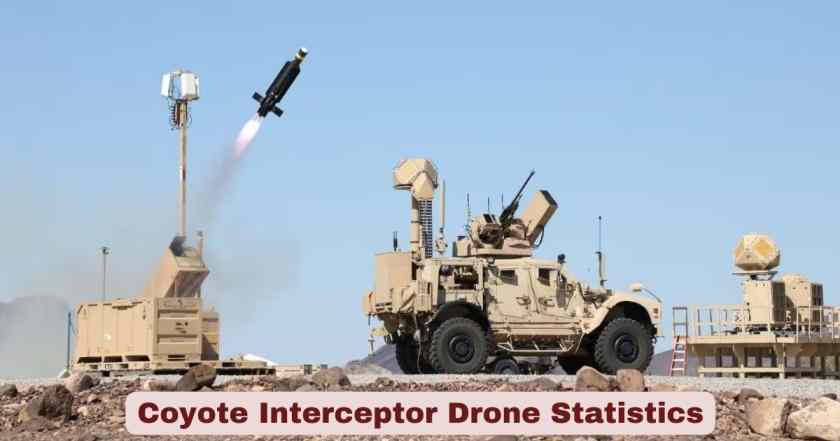
What is the Coyote Interceptor Drone?
The Raytheon Coyote is one of the most versatile and combat-tested counter-drone weapons systems in existence — a family of small, tube-launched unmanned aircraft built by Raytheon, an RTX Corporation business, that has evolved over nearly two decades from a simple surveillance tool into the US military’s frontline answer to the global drone swarm threat. Originally developed by Advanced Ceramic Research (ACR) of Tucson, Arizona under US Office of Naval Research contracts, the Coyote first flew in 2007, was acquired by BAE Systems in 2009, sold to a successor firm, and ultimately acquired by Raytheon in 2015 — which folded it into its Tucson-based Raytheon Missiles & Defense division and systematically transformed it into a family of counter-unmanned aerial system (C-UAS) interceptors. Today that family spans three major production blocks — Block 1B, Block 2, and Block 3NK — each progressively faster, smarter, and more capable than the last, covering a spectrum of missions from intercepting a single Class I micro-drone to defeating simultaneous swarms of dozens of enemy UAS in a single engagement. The system pairs with the Ku-band Radio Frequency Sensor (KuRFS) radar to form the Howler C-UAS — a detect-and-defeat architecture that achieved Initial Operational Capability with the US Army in June 2019 after just 17 months of development. The Coyote is also operated by NOAA’s Hurricane Hunters aboard P-3 aircraft, where it flies into hurricane eye walls to collect atmospheric data at altitudes too dangerous for manned aircraft — a civilian application that runs in parallel to its military role and reflects the airframe’s extraordinary versatility.
As of March 14, 2026, the Coyote interceptor is a confirmed active combat system in the most intense drone warfare environment in modern history — the US-Iran conflict Operation Epic Fury, which began on February 28, 2026. Iran launched over 2,000 drones and 500 ballistic missiles against US and allied targets across the Middle East in the first six days of the war, creating a counter-drone demand unlike anything the US military had previously faced in a single theatre. The Center for Strategic and International Studies (CSIS) calculated that the first 100 hours of Operation Epic Fury cost $3.7 billion, or $891.4 million per day — a figure driven substantially by the cost of the missiles being used to intercept Iran’s cheap Shahed drones. In this environment, where every $30,000 Shahed forcing a $4 million PAC-3 intercept represents a strategic win for Iran, the Coyote’s position as a cost-exchange equaliser — intercepting Shahed-class drones at a fraction of the cost of a Patriot — has made it one of the most strategically important US defence assets of the entire conflict. Defence Secretary Pete Hegseth confirmed the use of “cost-effective drone interceptors” by CENTCOM, while RTX’s largest counter-drone contract ever — awarded under the US Army’s LIDS programme — positions Coyote as the centrepiece of America’s counter-drone strategy for the rest of this decade.
Interesting Facts About the Coyote Interceptor Drone 2026
| Fact | Detail |
|---|---|
| Full Name | Raytheon Coyote — Counter-Unmanned Aircraft System (C-UAS) |
| Manufacturer | Raytheon, an RTX Corporation business (NYSE: RTX) |
| Manufacturer HQ | Arlington, Virginia (RTX corporate); production at Tucson, Arizona |
| RTX 2025 Annual Revenue | $88 billion+ — confirmed in RTX February 2026 press release |
| RTX Global Employees | 180,000+ |
| Original Developer | Advanced Ceramic Research (ACR), Tucson, Arizona — under US Office of Naval Research contracts |
| First Flight | 2007 — launched from a Beechcraft C-12 Huron aircraft |
| BAE Systems Acquisition | 2009 — BAE acquired ACR, then sold it back to former owners as “Sensintel” |
| Raytheon Acquisition of Sensintel | 2015 — folded into Raytheon Missiles & Defense, Tucson |
| Current Production Blocks | Block 1B (original C-UAS), Block 2 (turbine-powered, faster), Block 3NK (non-kinetic, recoverable), Coyote LE SR (Launched Effect Short Range, multi-role) |
| Launch Method | Sonobuoy-style pneumatic canister — wings pop out during early flight phase |
| Civilian Application | Used by NOAA aboard P-3 Hurricane Hunter aircraft for hurricane eye wall data collection — first operational deployment: Hurricane Edouard, September 16, 2014 |
| NOAA Role | Gathers atmospheric pressure, temperature, moisture, wind speed/direction at altitudes too low and dangerous for manned aircraft |
| Paired Radar System | Ku-band Radio Frequency Sensor (KuRFS) — combined system called “Howler C-UAS” |
| Howler C-UAS IOC | June 2019 — Initial Operational Capability with US Army after just 17 months of development |
| US Army C-UAS Programme | LIDS (Low, Slow, Small Unmanned Aircraft Integrated Defeat System) — Coyote is the primary effector |
| Latest Major Contract | RTX’s largest counter-drone contract ever — awarded as part of LIDS programme (announced February 2026) |
| 2025–2029 Procurement Plan | US Army plans to purchase 6,700 Coyote interceptors from 2025 to 2029 |
| December 2023 Army Disclosure | 6,000 Block 2s (jet-powered, $100,000 each) + 700 Block 3NKs (electric, non-kinetic) |
| Qatar Sale (Nov 2022) | 10 FS-LIDS systems sold to Qatar in a $1 billion deal — includes 200 Coyote Block 2s and AN/TPQ-50 radars |
| System Swarm Capability | Demonstrated in 2016: over two dozen Coyotes launched in a swarm, moving in autonomous formation |
| Operation Epic Fury Role | Confirmed by CSIS as one of the primary counter-drone interceptors used against Iranian Shahed-136 attacks — March 2026 |
Source: Wikipedia (Raytheon Coyote, updated February 9, 2026), RTX official press release (February 11, 2026), RTX Raytheon product page, Axios (February 11, 2026), Army Technology (February 11, 2026), CSIS (March 2026), Defence Blog (February 11, 2026), Raytheon MediaRoom, UST (February 20, 2026)
The origin story of the Coyote reads as a classic US defence procurement tale of a small-company innovation that found its way, through multiple ownership transitions, into the hands of a prime contractor capable of scaling it to industrial production. Advanced Ceramic Research — a modest Tucson company founded by ceramics and materials engineers — developed the Coyote airframe as a low-cost, tube-launched UAS under small business contracts from the Office of Naval Research. The sonobuoy canister launch method, where the drone is inserted into a standard cylindrical tube and ejected pneumatically with wings deploying mid-air, was a stroke of logistical genius: it meant the Coyote could be launched from any platform already equipped for sonobuoy use — maritime patrol aircraft, surface ships, ground vehicles — without modification. When BAE Systems acquired ACR in 2009, it gained the Coyote as part of a broader unmanned systems portfolio, but divested it during a later restructuring. Raytheon’s 2015 acquisition was the transformative moment — pairing the proven airframe with Raytheon’s KuRFS radar expertise, electronic warfare capabilities, and precision warhead engineering to create the Howler system that would achieve Army operational status just four years later.
The civilian NOAA application deserves more attention than it typically receives in defence coverage, because it reveals something important about what the Coyote airframe actually is: a highly reliable, weather-hardened, all-conditions autonomous aircraft that can sustain flight in the most extreme atmospheric environments on earth. When NOAA’s P-3 Hurricane Hunters deploy Coyotes into the eye walls of Category 4 and Category 5 hurricanes, the drones are operating in conditions of catastrophic turbulence, extreme wind shear, heavy rainfall, and electrical activity that would destroy most commercial UAVs instantly. The fact that the Coyote routinely survives and transmits real-time data in those conditions — first demonstrated during Hurricane Edouard on September 16, 2014 — tells you the airframe was built to an engineering standard well above anything required for calm-weather surveillance. That same durability translates directly to battlefield resilience in the Persian Gulf’s heat, dust, humidity, and electromagnetic jamming environments of Operation Epic Fury.
Coyote Block Variants Technical Specifications 2026
| Metric | Block 1B | Block 2 | Block 3NK / LE SR |
|---|---|---|---|
| Primary Role | C-UAS kinetic intercept | C-UAS kinetic intercept (larger/faster targets) | C-UAS non-kinetic / multi-role Launched Effect |
| Length | 36 inches (0.91 m) | Larger (exact classified) | Redesigned; no wings/strakes on TOW version |
| Wingspan | 58 inches (1.47 m) | N/A (no fixed wing) | Varies by configuration |
| Weight | 13 lb (5.9 kg) | Heavier (exact classified) | ~Similar weight class |
| Propulsion | Electric motor | Turbine (jet) engine with rocket booster | Electric motor (pusher propeller) |
| Max Speed | 81 mph (130 km/h) | 345–370 mph (555–595 km/h) | Lower than Block 2; optimised for loiter |
| Engagement Range | Short range | 10–15 km (6.2–9.3 miles) | Similar or extended via loiter |
| Loiter Time | ~1 hour+ | Up to 4 minutes (intercept mode) | Extended — designed for loiter and recall |
| Warhead / Payload | 4 lb (1.8 kg) kinetic warhead + RF seeker | Fragmentation warhead (shrapnel optimised for small drones) | Non-kinetic payload (likely EW/directed energy) |
| Seeker Type | Radio-frequency (RF) seeker | Improved sensors + RF | Electro-optical / non-kinetic disruptor |
| Proximity Fuze | Yes (proximity warhead) | Yes | N/A (non-kinetic) |
| Re-attack Capability | No | Yes — can re-attack if it misses first pass | Yes — recalled and redeployed |
| Recoverable / Reusable | No (expendable) | No (expendable) | Yes — lands via net recovery |
| Control Fins | Standard | 4 pop-out tail fins for maneuverability | Triple pop-out grid fins (TOW variant) |
| Launch Platform (ground) | Pneumatic box launcher | M-ATV with 2-round launcher; FS-LIDS 4-round pallet | Bradley IFV TOW launcher; Bell 407 helicopter |
| Target Classes | Class I–II small drones | Class I–IV including larger, faster, higher drones | Class I–IV; swarm defeat; urban/infrastructure |
| KuRFS Radar Detection Range | 9.9 miles (16 km) for Class I UAS | Same | Same |
| KuRFS Minimum Detectable Object | 9 mm bullet | Same | Same |
| Army Procurement Unit Cost (2023) | N/A | ~$100,000 per interceptor | Lower (non-kinetic; recoverable) |
| Jan 2024 Army Contract | — | $75 million for 600 Coyote 2C interceptors | — |
| Block 3 Renamed (2025) | — | — | Renamed Coyote Launched Effect Short Range (Coyote LE SR); Army internal code “670” |
| LE SR Launch Demo (March 2025) | — | — | Successfully fired from M2 Bradley TOW launcher and Bell 407 helicopter |
Source: Wikipedia (Raytheon Coyote, updated February 9, 2026), RTX official product page, Raytheon MediaRoom, Axios (February 11, 2026), RTX press release (February 11, 2026), US Army contract notice (January 2024), Defence Blog, Army Technology, UST (February 20, 2026)
The technical evolution across three Coyote blocks captures the entire trajectory of modern counter-drone thinking compressed into a single product family. The Block 1B was designed for the threat environment that existed in 2018 — small, slow, commercial-shelf drones operated by ISIS and similar groups in Iraq and Syria, flying at low altitude and short range. Its 81 mph maximum speed and Radio-Frequency seeker were adequate for catching a DJI Phantom or similar commercial drone. The Block 2’s turbine engine — pushing the interceptor to 345–370 mph with a range of 10–15 kilometres and the ability to re-attack after a miss — was the direct response to the emergence of the Shahed-136 as a battlefield-scale threat: a drone that cruises at 120 mph, flies at medium altitude, and requires an interceptor fast enough to chase it down before it reaches its target. The four pop-out tail control fins on Block 2 give it the aerodynamic agility needed to close on a manoeuvring target at range — a capability the Block 1B simply could not provide.
The Block 3NK’s non-kinetic approach represents the most philosophically significant step in the family’s evolution. When Raytheon’s engineers asked why every counter-drone intercept needed to involve an explosion — and whether a system that could disable a drone’s electronics without detonating near it would be safer, cheaper to operate in urban environments, and recoverable for reuse — they were addressing a problem that had frustrated military planners for years. Kinetic intercepts in urban areas produce falling debris: fragments of both the interceptor warhead and the destroyed drone, which can injure civilians and damage infrastructure. The Block 3NK’s non-kinetic payload — almost certainly an electronic warfare or directed-energy emitter capable of disrupting a drone’s avionics or command link without physical contact — produces no debris, no explosion, and no blast radius. The net recovery system, where the Block 3NK lands in a catch net after completing its mission, means a single interceptor can potentially be relaunched multiple times in a single engagement cycle, fundamentally changing the economics of swarm defeat.
Coyote Combat Performance & Procurement Statistics 2026
| Metric | Data |
|---|---|
| Howler C-UAS IOC Date | June 2019 — US Army Initial Operational Capability (17 months after start of development) |
| Block 3NK Swarm Demo (August 2021) | Non-kinetic warhead defeated swarm of 10 drones in intercept test; first confirmation of swarm defeat capability |
| Block 3NK Operation Clear Horizon (Oct 2025) | Defeated at least 10 drones simultaneously (Group 1 and 2 drones) during US Army exercise |
| Operation Clear Horizon Date | October 2025 — Raytheon disclosed exclusively to Axios (February 2026) |
| Block 3NK Army Demo (Feb 2026) | Successfully demonstrated launch, flight, intercept, and recovery at US Army exercise, Tucson, AZ |
| RTX Largest Counter-Drone Contract | Awarded as part of LIDS programme — described as company’s “largest counter-drone contract ever” (September 2025) |
| US Army 2023–2029 Buy Plan (Dec 2023) | 6,700 total interceptors: 6,000 Block 2 + 700 Block 3NK |
| Block 2 Planned Unit Cost | ~$100,000 per interceptor |
| Block 2 Total Contract Value (6,000 units) | ~$600 million at $100,000/unit |
| 600 Coyote 2C Contract (Jan 2024) | $75 million — US Army contract to RTX; specific 2C interceptor variant |
| Qatar FS-LIDS Sale (Nov 2022) | $1 billion deal — 10 FS-LIDS systems + 200 Coyote Block 2s + AN/TPQ-50 radars |
| Jordan KuMRFS FMS (Feb 2026) | US approved Foreign Military Sale of KuMRFS radars (Coyote radar partner) to Jordan — Defence Blog, February 2026 |
| Coyote LE SR Bradley TOW Test (March 2025) | Successfully launched from unmodified M2 Bradley Fighting Vehicle’s TOW missile launcher — expands platforms dramatically |
| Coyote LE SR Helicopter Test (March 2025) | Successfully launched from Bell 407 helicopter Modular Effects Launcher rack |
| Total Coyote Engagements (lifetime) | Thousands of C-UAS intercepts across Iraq, Syria, Middle East since 2019 |
| RTX Production Expansion Commitment | Raytheon committed to “significantly” increased production across the Coyote family in 2026 — Tom Laliberty, February 11, 2026 |
| Tom Laliberty Quote | “Coyote provides warfighters a cost-effective defense for individual drones and swarms. We continue to invest in Coyote’s combat-proven capabilities.” |
| RTX Investment Focus | Coyote kinetic variant production investment; performance enhancements for faster launches, higher speeds, greater range at higher altitudes |
| Block 3NK Demo Kill Type | Non-contact defeat: drones “almost immediately tumble out of the sky” with no physical contact, explosions, or fireballs — Axios witness description |
| Block 3NK Recovery Method | Drone lands in a net — fully recovered and redeployed for subsequent engagements |
Source: RTX official press release (February 11, 2026), Axios (February 11, 2026), Wikipedia (Raytheon Coyote), US Army contract notices (January 2024, December 2023), Defence Blog (February 2026), RTX product page, Raytheon MediaRoom, CSIS (March 2026), UST (February 20, 2026)
The procurement and performance trajectory of the Coyote system through 2026 tells a story of accelerating demand meeting accelerating capability. The US Army’s December 2023 announcement of plans to buy 6,700 interceptors between 2025 and 2029 — split between 6,000 Block 2s at approximately $100,000 each and 700 Block 3NKs — represented the largest single C-UAS procurement commitment in US history at that point. The subsequent LIDS contract awarded in September 2025, which RTX described as its “largest counter-drone contract ever”, escalated that commitment further — driven by the exploding real-world demand signal from Ukraine, where Russia was launching hundreds of Shahed drones per week, and from the Middle East, where intelligence assessments predicted exactly the kind of mass drone campaign that Iran ultimately launched on February 28, 2026. Tom Laliberty’s commitment to “significantly increased production” announced just 17 days before Operation Epic Fury began now looks either prescient or informed by intelligence — either way, the timing underscores how closely Raytheon’s production expansion decisions track actual operational requirements.
The February 2026 Block 3NK demonstration at Tucson — filmed by Axios and witnessed by US Army officials — provided the clearest public evidence yet of what non-kinetic drone defeat actually looks like in practice. The Coyote passed near enemy drones without physical contact, and the drones “almost immediately tumbled out of the sky” — their avionics disrupted by the non-kinetic payload without any explosion, debris, or blast effect. The net landing system was then demonstrated, with the Coyote descending cleanly into a recovery net for immediate reuse. For a US Army that is simultaneously trying to defend forward operating bases, partner force positions, civilian infrastructure, and international shipping lanes in the congested, populated Persian Gulf environment, the Block 3NK’s ability to defeat drones without creating secondary hazards from falling debris is not a minor operational convenience — it is the difference between an interceptor that can be used in an urban port environment and one that cannot.
Coyote LIDS System Architecture Statistics 2026
| Component | Detail |
|---|---|
| Programme Name | LIDS — Low, Slow, Small Unmanned Aircraft Integrated Defeat System |
| Sub-variants | M-LIDS (Mobile); FS-LIDS (Fixed Site) |
| M-LIDS Vehicle 1 | M-ATV with turret — electro-optical sensors + 2-round Coyote launcher + 30 mm XM914 automatic cannon + mast-mounted Ku-band radar |
| M-LIDS Vehicle 2 | Second M-ATV with additional sensors and electronic warfare capabilities |
| FS-LIDS Configuration | Palletised system: one unit with 4-round Coyote launcher + sensor array; second unit with larger Ku-band radar |
| Primary Radar (Coyote Pair) | KuRFS — Ku-band Radio Frequency Sensor |
| KuRFS Detection Range (Class I) | 9.9 miles (16 km) |
| KuRFS Minimum Detection Size | Objects as small as a 9 mm bullet |
| Engagement Sequence | KuRFS detects → tracks → passes targeting data → Coyote launches and homes on target |
| Marine Corps GBAD System | RPS-42 S-band radar + Modi EW system + visual sensors + Coyote — deployed by USMC from FOBs or M-ATV/MRZR vehicles |
| Qatar System (Nov 2022) | Includes AN/TPQ-50 counterfire radar + EO cameras + EW + 200 Coyote Block 2 interceptors — part of $1B FS-LIDS package |
| Navy USV/UUV Role (Feb 2021) | US Navy contracted Coyote Block 3 for ISR and strike when launched from unmanned surface vessels (USVs) and unmanned underwater vehicles (UUVs) |
| M-LIDS 30mm XM914 Integration | Provides close-in kinetic backup to Coyote — complementary effector for targets that Coyote misses or that come too close |
| Full System Mobility | M-LIDS is vehicle-mounted — “shoot and relocate” doctrine; not static like Patriot |
| NOAA P-3 Launch Platform | Coyote launched via sonobuoy canister from NOAA P-3 Hurricane Hunter aircraft at altitude — demonstrates air-launch versatility |
| New Platform (2025) | M2 Bradley Fighting Vehicle’s TOW launcher + Bell 407 helicopter rack — significantly expands Army’s organic C-UAS capability without dedicated platforms |
| Army Organic C-UAS Goal | Every manoeuvre battalion to have organic C-UAS capability using existing vehicle fleets + Coyote LE SR |
Source: Wikipedia (Raytheon Coyote), RTX product page, US Army programme documentation, CSIS, Defence Blog, UST (February 2026), Raytheon MediaRoom
The LIDS architecture statistics reveal a C-UAS philosophy centred on layered, mobile, integrated defeat rather than point defence. The M-LIDS configuration — two M-ATVs working as a unit, one carrying the Coyote launcher and 30mm gun, one carrying EW and additional sensors — is specifically designed to move with manoeuvre forces and provide organic counter-drone protection to infantry and armoured units without requiring them to return to a fixed base for air defence coverage. This mobility is not incidental; it reflects the fundamental lesson of Ukraine, where static air defence positions become high-priority targets themselves, but mobile units can shoot and relocate before enemy fires can be brought to bear on their last known position. The integration of the 30 mm XM914 automatic cannon as a backup effector in M-LIDS ensures that even if a Coyote misses or is unavailable, the vehicle has an immediate last-ditch kinetic option — a layered defence in a single vehicle package.
The March 2025 demonstration of Coyote LE SR from an M2 Bradley’s TOW launcher is arguably the most strategically significant single test result in the Coyote programme’s history. The M2 Bradley Fighting Vehicle is the US Army’s primary infantry fighting vehicle — thousands are fielded in manoeuvre units worldwide. If every Bradley can launch Coyote LE SR from its existing TOW missile tube without any modification, the US Army’s organic counter-drone capacity multiplies overnight by the size of the Bradley fleet. No new vehicles, no new procurement cycles, no new training syllabus for vehicle crews who already train on TOW. The same logic applies to the Bell 407 helicopter rack launch — the Bell 407 is one of the most widely used utility helicopters in the US military inventory. Both demonstrations signal that Raytheon and the Army have deliberately designed the Coyote LE SR to be platform-agnostic at its launch interface, trading aerodynamic optimisation for universal compatibility.
Coyote Drone & Operation Epic Fury Statistics 2026
| Metric | Data |
|---|---|
| Operation Start Date | February 28, 2026 — US-Israel war against Iran (Operation Epic Fury / Operation Roaring Lion) |
| Iran Total Drones Fired (First 6 Days) | 2,000+ drones — confirmed by CENTCOM Adm. Brad Cooper, March 3, 2026 video |
| Iran Total Ballistic Missiles Fired (First 6 Days) | 500+ ballistic missiles — confirmed by CENTCOM, March 3, 2026 |
| Primary Iranian Drone Used | Shahed-136 — delta-winged loitering munition; cruises at 120 mph; engine equivalent to a lawn mower (Gen. Waters, Defense One) |
| Shahed Unit Cost | ~$20,000–$30,000 |
| PAC-3 Interceptor Cost | ~$4 million — CSIS and Defense One confirmed |
| THAAD Interceptor Cost | ~$4 million+ |
| F-35/F-22 vs Shahed Verdict | “Overkill” — Gen. Waters, Defense One March 12, 2026: “F-35s and F-22s are overkill when it comes to shooting down a drone with an engine you might find in a lawn mower” |
| Early US Intercept Method | F-35s and F-22s using AIM-120 ($1.5M) and AIM-9 ($400,000) missiles — per Defense One March 12, 2026 |
| Evolved US Intercept Method | F-15E/F-16 + APKWS (Advanced Precision Kill Weapon System II) — cost $25,000–$40,000 per shot |
| Coyote Role | CSIS confirmed: “systems like Coyote” used against Shahed-136 drones — March 2026 report |
| US Counter-Drone Shift | Adm. Cooper: military “embracing more cost-effective drone interceptors” — Pentagon briefing, March 2026 |
| Drone Attacks Reduced (Day 4) | Iranian drone attacks down 73% from opening days (Gen. Caine, March 4, 2026) |
| Drone Attacks Reduced (Day 13) | Iranian drone attacks down 95% — DefenseScoop, March 13, 2026 |
| Ballistic Missile Attacks Reduced | Down 90% from Day 1 — Gen. Caine confirmed at Pentagon briefing |
| Total US Targets Struck in Iran (March 11) | Over 5,500 targets inside Iran — Adm. Cooper, CENTCOM video released March 11, 2026 |
| Total Targets Struck (March 13) | Over 15,000 enemy targets — Sec. Def. Hegseth (more than 1,000/day since war began) |
| US Troops Deployed (as of March 4) | 50,000+ US troops, 200 fighters, 2 aircraft carriers, B-2 and B-1 bombers — Adm. Cooper |
| US Service Members Killed | At least 13 confirmed killed: 7 by Iranian attack (incl. 6 in Port Shuaiba, Kuwait drone strike) + 6 KC-135 crash |
| US Service Members Wounded | ~200 as of March 13, 2026 — CENTCOM (nearly 170 already returned to duty) |
| Coalition Intercepts (as of March 3) | Qatar, Bahrain, Kuwait, UAE collectively intercepted 500 cruise/ballistic missiles + 1,300 drones |
| Operation First 100 Hours Cost | $3.7 billion (~$891.4M/day) — CSIS analysis, March 2026 |
| Coyote Cost Comparison | Coyote Block 2 at $100,000 vs PAC-3 at $4 million = 40× cheaper per intercept |
| Hegseth on Force Protection | “We ensured that maximum possible defense and maximum possible force protection was set up before we went on offense” |
| Pentagon AI Integration | CENTCOM commander Adm. Cooper confirmed AI tools helping “sift through vast amounts of data in seconds” — DefenseScoop, March 11, 2026 |
Source: CSIS (March 2026), DefenseScoop (March 4 and March 13, 2026), Defense One (March 12, 2026), Flashpoint (March 11, 2026), Defense Update (March 4, 2026), Wikipedia (Raytheon Coyote), RTX press release (February 11, 2026), CENTCOM official video statements (March 3, 4, 11, 13, 2026)
The Operation Epic Fury statistics place the Coyote’s role in sharp context against the sheer industrial scale of Iran’s drone campaign. When CENTCOM confirmed 2,000 drones fired in the first six days — a pace of approximately 333 drones per day, nearly 14 per hour around the clock — the inadequacy of relying primarily on Patriot and THAAD systems became immediately obvious. At $4 million per PAC-3 intercept against a $25,000 Shahed, intercepting all 2,000 drones with Patriot missiles alone would cost approximately $8 billion — more than twice the entire daily operational cost of the war including all other expenditures. The strategic logic of deploying Coyote alongside fighter-based APKWS rockets and other cost-efficient interceptors was not about capability preference but about financial survival: the US military’s expensive missile inventories are finite, take months to manufacture, and cannot be depleted at the rate that Iran can produce Shaheds without creating catastrophic readiness gaps in other theatres — particularly Taiwan.
The decline curve of Iranian attacks — from a maximum of thousands of drones and hundreds of ballistic missiles in the first days, down 73% by Day 4 and 95% by Day 13 — is partly a tribute to the effectiveness of counter-drone systems including Coyote, but more substantially a result of CENTCOM’s upstream targeting strategy: Gen. Caine explicitly confirmed the US was targeting Iran’s drone manufacturers and missile production infrastructure to “get upstream of the shooters out in the field.” The combination of destroying production capacity on one end and deploying cost-effective interceptors like Coyote on the other end created a pincer effect on Iran’s drone campaign that has, as of March 14, 2026, reduced the threat to a fraction of its opening intensity. For RTX and the Coyote programme, the result is an unambiguous combat validation delivered on the global stage at exactly the moment the US Army’s largest-ever counter-drone procurement was being finalised — a confluence of timing that will drive international demand for Coyote exports for years to come.
Disclaimer: This research report is compiled from publicly available sources. While reasonable efforts have been made to ensure accuracy, no representation or warranty, express or implied, is given as to the completeness or reliability of the information. We accept no liability for any errors, omissions, losses, or damages of any kind arising from the use of this report.