
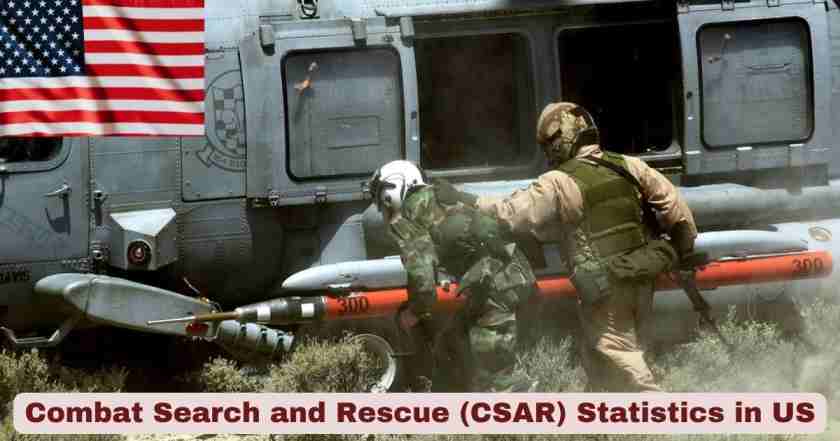
What Is Combat Search and Rescue (CSAR)?
Combat Search and Rescue (CSAR) is one of the most demanding and morally consequential missions the United States military performs — recovering isolated, downed, or captured military personnel from within or near hostile territory during active conflict. It is not simply a rescue operation. A full CSAR mission typically requires a coordinated task force of helicopters, fighter escorts to suppress enemy air defenses, electronic warfare aircraft to jam radar and communications, aerial refueling tankers to extend helicopter range, and airborne command-and-control platforms orchestrating everything in real time. The humans at the center of it all are the Pararescuemen — known universally as PJs (Pararescue Jumpers) — who parachute, dive, or fast-rope into hostile terrain as fully qualified combat paramedics and special operations fighters, and who operate under the motto “That Others May Live.” The United States Air Force (USAF) has been designated by the Department of Defense as the lead service for CSAR, and USAF CSAR is classified as one of the 12 Air Force Core Functions — a mission so fundamental to how the US military operates that it carries the same institutional weight as strategic deterrence and global strike. The promise embedded in that designation is one of the most powerful in all of American military culture: no service member who goes down in hostile territory will be abandoned.
The history of CSAR in the United States stretches back to improvised rescues in World War I, but the modern doctrine was forged in the crucible of Vietnam, where US SAR forces saved 3,883 to 4,120 lives at the cost of 71 rescuers and 45 aircraft — numbers that reflect both the extraordinary capability and the terrible human price of the mission. Since then, the US CSAR enterprise has evolved through the Gulf War, Bosnia, Kosovo, Afghanistan, Iraq, and beyond, with USAF CSAR Airmen having rescued over 470 members of the joint and coalition team in the Central Command area of responsibility alone since 9/11, and PJs having executed over 12,000 life-saving combat rescue missions since September 11, 2001. In 2026, the CSAR community finds itself at a critical inflection point — the HH-60W Jolly Green II is replacing the aging HH-60G Pave Hawk fleet, a Pacific conflict scenario with China presents rescue challenges unlike anything seen since World War II, and the entire personnel recovery architecture of the joint force is being urgently re-examined for a high-threat environment where the familiar low-risk rescue model of Iraq and Afghanistan will simply not apply.
Interesting Facts: CSAR in the US | Key Stats at a Glance
| Fact | Detail |
|---|---|
| Full name | Combat Search and Rescue (CSAR) |
| DOD lead service for CSAR | United States Air Force (USAF) |
| CSAR status in USAF | One of 12 Air Force Core Functions |
| First US CSAR mission (recognized) | August 1943 — Lt. Col. Don Flickinger and two medics parachute into Burma to rescue downed aircrew |
| First helicopter rescue (history) | 1944 — US lieutenant rescued four soldiers from behind Japanese lines |
| CSAR principle | “Leave no one behind” — moral and ethical imperative |
| Primary CSAR forces | Pararescuemen (PJs) — Air Force Special Warfare |
| PJ motto | “That Others May Live” |
| PJ maroon beret significance | Symbolizes the blood shed by past PJs and willingness to shed more to save lives |
| PJ force size | 500+ PJs assigned across Active Duty, Guard, and Reserve Air Force components |
| PJ training pipeline duration | Approximately 2 years from start to finish |
| CSAR missions since 9/11 (PJs) | Over 12,000 life-saving combat rescue missions |
| Rescues in CENTCOM AOR since 9/11 | Over 470 joint and coalition members rescued by USAF CSAR Airmen |
| PJ saves in Iraq and Afghanistan | Over 750 saves credited to USAF CSAR teams |
| Vietnam War SAR lives saved | 3,883 to 4,120 personnel (including ~2,780 in combat) |
| Vietnam War CSAR cost | 71 rescuers and 45 aircraft lost |
| Korean War CSAR rescue rate | ~1,000 aircrew rescued (~10% of those shot down) |
| Vietnam War CSAR rescue rate | ~71% of downed aircrew rescued |
| PJ patient survival rate (2012–2024) | 97.2% survival rate for patients alive at PJ contact (PubMed, 2025) |
| PJ case fatality rate (2012–2024) | 12.2% case fatality rate across 197 patient encounters |
| PJ patient cases involving trauma (2012–2024) | 86% of PJ encounters involved trauma |
| HH-60G replacement aircraft | HH-60W Jolly Green II — IOC declared October 4, 2022 |
| HH-60W contract value | $1.28 billion (awarded to Sikorsky June 26, 2014) |
| Total HH-60W planned procurement | 96 aircraft (updated — FY2024 added aircraft increasing from 85 to 96) |
| HC-130J Combat King II | Fixed-wing command, refueling, and coordination aircraft for CSAR |
| PJ killed in action — Vietnam | 19 PJs killed in action |
| PJ killed in action — War on Terrorism | 16 PJs/Combat Rescue Officers killed in action |
| PJ killed in line of duty (total) | 53 additional PJs killed in training and operations |
| Air Force Crosses awarded to PJs | 12 of 22 enlisted Air Force Cross recipients are Pararescuemen |
Source: CSAR Wikipedia, US Air Force Pararescue Wikipedia, GlobalSecurity.org CSAR page, PJ History website (pjhistory.org), PubMed / Military Medicine (January 2025 — “From Combat to Search and Rescue: The Modern Air Force Pararescue Medical Experience”), Air & Space Forces Magazine (HH-60W fact sheet), MSAR HH-60W DoD report, Athlon Outdoors CSAR spotlight, Simple Flying CSAR article
The numbers in this table — especially the 97.2% patient survival rate for those alive at PJ contact, drawn from a peer-reviewed retrospective study published in Military Medicine in January 2025 covering 197 patient encounters from 2012 to 2024 — reveal how extraordinarily effective the modern CSAR system is when it can reach its patients. That survival rate is not a product of luck. It is the outcome of a two-year training pipeline that produces operators who are simultaneously world-class combat fighters, military free-fall parachutists, combat divers, rescue swimmers, and Nationally Registered Paramedics capable of performing cricothyrotomies, blood transfusions, tourniquet applications, and extended trauma care in the most austere, dangerous environments imaginable. The 12.2% case fatality rate across all encounters reflects the severity of the cases PJs take on — not limitations in their capability. When PJs reach patients, they save nearly all of them.
The contrast between the Korean War’s 10% rescue rate and Vietnam’s 71% rescue rate illustrates how rapidly CSAR doctrine and technology can improve with focused investment and operational experience. The evolution from improvised World War II air-sea rescue using modified bombers and submarines to the sophisticated HH-60W Jolly Green II / HC-130J Combat King II / PJ triad of today represents decades of painful, often lethal, lessons learned. The 12,000 combat rescue missions since 9/11 and the Air Force Crosses awarded disproportionately to PJs (12 of the 22 enlisted recipients) speak to a community that does not merely accept risk — it deliberately takes on the hardest, most dangerous missions specifically so that the rest of the joint force can operate with the confidence that rescue is coming if they go down.
CSAR Units & Aircraft in the US | Force Structure Data
| Component | Details | Role | Source |
|---|---|---|---|
| Lead DOD Service | US Air Force | Designated lead for CSAR by the Department of Defense | GlobalSecurity.org |
| Primary CSAR aircraft (new) | HH-60W Jolly Green II | Combat rescue helicopter; armed, all-weather, day/night | Air & Space Forces Magazine |
| Primary CSAR aircraft (legacy) | HH-60G Pave Hawk | Being replaced by HH-60W; still partially in service during transition | Air & Space Forces Magazine |
| Fixed-wing CSAR/refueling | HC-130J Combat King II | Commands rescue operations; refuels helicopters en route; may deploy lifeboats | Task & Purpose |
| PJ command structure | AFSOC (Air Force Special Operations Command) and ACC (Air Combat Command) | Guardian Angel and Special Tactics Squadrons | USAF Pararescue Wikipedia |
| Active duty locations (HH-60W) | Moody AFB (GA), Davis-Monthan AFB (AZ), Nellis AFB (NV), Aviano AB (Italy), Kadena AB (Japan) | Primary operational bases as of late 2024/early 2025 | The Aviationist (July 2025) |
| Reserve/ANG locations (HH-60W) | Francis S. Gabreski ANGB (NY), Moffett Field (CA) | Air National Guard rescue squadrons | The Aviationist / Air & Space Forces |
| Training location | Kirtland AFB (NM), Duke Field (FL) | Development, testing, and initial training | Air & Space Forces Magazine |
| Navy CSAR | MH-60S Knighthawk within carrier-based HSC squadrons | Carrier strike group organic rescue | USNI Proceedings (August 2024) |
| Marine Corps CSAR concept | TRAP (Tactical Recovery of Aircraft and Personnel) | Implied tasking, self-supporting recovery; differs from CSAR in lacking extended air search | GlobalSecurity.org |
| Army CSAR | No dedicated CSAR units; CSAR is secondary for aviation and MEDEVAC units | Supplementary rescue support | GlobalSecurity.org |
| 501+ PJs total | 500+ PJs across active, reserve, and guard components | Ground/water rescue specialists; combat paramedics | PJ History website |
| Combat Rescue Officers (CROs) | Leaders of PJ teams; same training standards as PJs | Mission planning and leadership | PJ History website / USAF |
| Special Tactics Teams | PJs + Combat Controllers (CCTs) under AFSOC | Elite USAF teams embedded in USSOCOM missions | Simple Flying |
| Alaska ANG PJs | Notable for civil SAR — averaging one rescue per week in extreme Alaska conditions | Highest civil SAR operational tempo | AF Special Warfare website |
| CSAR Task Force (CSARTF) | Multiple F/A-18s or F-16s; E/A-18G Growlers; E-2 Hawkeye; rescue helicopters | Full escort, suppression, communications, recovery | USNI Proceedings (August 2024) |
Source: GlobalSecurity.org CSAR page, Air & Space Forces Magazine (HH-60W fact sheet, October 2025), USNI Proceedings (August 2024), USAF Pararescue Wikipedia, PJ History website, Task & Purpose (January 2026), The Aviationist (July 2025), AF Special Warfare website
The three-element CSAR triad — the rescue helicopter (now the HH-60W Jolly Green II), the fixed-wing HC-130J Combat King II, and the PJ ground team — represents the most sophisticated dedicated personnel recovery force in the world. What distinguishes USAF CSAR from every other military’s rescue capability is the PJ’s unique dual identity as both a combat special operator and an advanced medical practitioner. No other branch of the US military, and no other military in the world, fields operators who can HALO-parachute from 25,000 feet, fight their way to a downed pilot through enemy resistance, and then perform emergency surgery in a jungle clearing before calling in a helicopter for extraction. The Guardian Angel concept — PJs and Combat Rescue Officers working as integrated teams — is the operational expression of the promise that every American service member serving in harm’s way has heard: we will come for you.
The Navy’s MH-60S Knighthawk and the Marine Corps’ TRAP mission provide additional layers of CSAR capability within their own operational environments, but both are explicitly secondary to or architecturally simpler than the USAF model. The standard Navy Carrier Strike Group CSAR Task Force (CSARTF) — integrating F/A-18 Super Hornets for air defense, E/A-18G Growlers for radar suppression, an E-2 Hawkeye as a communications relay, and MH-60S helicopters for recovery — reflects the joint nature of modern CSAR: no helicopter can survive in a contested air environment without fighter and electronic warfare support, and no fighter escort can conduct a rescue without a helicopter. The Alaska Air National Guard PJs’ one rescue per week in extreme cold-weather conditions is a reminder that CSAR and civil SAR exist on a continuum — the same operators who rescue a downed Navy pilot over the Pacific also rescue stranded hikers in the Alaskan wilderness.
HH-60W Jolly Green II | CSAR Aircraft Statistics 2026
| Specification / Data Point | Data |
|---|---|
| Aircraft designation | HH-60W Jolly Green II |
| Contractor | Lockheed Martin / Sikorsky |
| Based on | UH-60M Black Hawk |
| Contract awarded | June 26, 2014 |
| Initial contract value | $1.28 billion (for first aircraft) |
| Total program value (original max) | Up to $7.9 billion (112 aircraft) |
| First flight | May 17, 2019 |
| Jolly Green II name announced | February 2020 |
| First two HH-60Ws delivered | November 5, 2020 to 41st Rescue Squadron, Moody AFB |
| Initial Operational Capability (IOC) | October 4, 2022 |
| First HH-60W rescue mission | Days before IOC declaration — Moody AFB crew |
| First operational deployment | October 2022 — CJTF–Horn of Africa AOR |
| First combat CASEVAC | January 2023 — Combined Joint Task Force–Horn of Africa AOR |
| Program of record (current) | 96 aircraft (FY2024 added aircraft; up from 85, up from original 75 cut) |
| Rotor diameter | 53.6 ft |
| Overall length | 64.7 ft |
| Height | 16.7 ft |
| Max takeoff weight | 22,500 lb |
| Engines | Two GE Aviation T700-GE-701D turboshafts, 1,857 shp each |
| Speed | 176 mph |
| Range | 690 miles (air refuelable — extended range) |
| Ceiling | 20,000 ft |
| Armament | Two 7.62 mm miniguns or two .50-caliber machine guns |
| Crew | Two pilots, flight engineer, two gunners; plus 2–4 PJ paramedics |
| Key upgrades over HH-60G | Fully digital glass cockpit; double internal fuel capacity; improved hot/high performance; LINK 16; IR-masking exhausts; armor; advanced countermeasures |
| Norway FMS approval | July 2025 — 9 HH-60Ws approved for Foreign Military Sale; estimated $2.6 billion |
| DVE system (Degraded Visual Environment) | FY25 delivery — prevents disorientation in takeoff/landing |
| DAIRCM (Distributed Aperture IR Countermeasures) | Delayed — now projected FY29 or beyond |
| Jam-resistant GPS | Under development integration |
Source: Air & Space Forces Magazine HH-60W fact sheet (October 2025), Sikorsky HH-60 Pave Hawk Wikipedia (updated April 2026), The Aviationist (July 2025), MSAR HH-60W DoD document (December 2023), Militaeraktuell (July 2025)
The HH-60W Jolly Green II represents the most significant upgrade to US Air Force CSAR helicopter capability in over three decades. Named in honor of the legendary Vietnam-era HH-3E “Jolly Green Giant” and HH-53 “Super Jolly Green” rescue helicopters — whose crews earned two Medals of Honor, 39 Air Force Crosses, and countless Silver Stars — the HH-60W carries that heritage forward into a threat environment far more complex than Vietnam ever was. The doubled internal fuel capacity compared to the HH-60G, combined with air refueling capability, gives the Jolly Green II dramatically extended reach — addressing one of the most persistent operational shortfalls of the previous platform. The fully digital glass cockpit, LINK 16 data link, SADL, and integrated cockpit/cabin displays make it interoperable with the F-35 and other fifth-generation aircraft that would escort it into contested territory, while the IR-masking exhausts and upgraded countermeasures give it improved survivability against the infrared-guided missiles that have proliferated in modern battlefields.
The procurement history of the HH-60W is itself a telling story about CSAR’s contested place in USAF budget priorities. The original plan for 113 aircraft was cut to 65 in February 2022, then restored to 75, then raised to 85 by Congress in FY2024, then raised again to 96 as of the most recent reporting. Even 96 dedicated rescue helicopters falls dramatically short of the ~200 aircraft that a 2017 analysis calculated would be needed to provide adequate CSAR coverage for a two-theater major conflict. The $1.28 billion initial contract and up to $7.9 billion total program value represent a significant national investment — but as the Pacific scenario planning discussed later in this article makes clear, the current rescue fleet may be dangerously undersized for the conflicts the joint force may face.
CSAR Historical Statistics in the US | War-by-War Data
| Conflict / Era | Key CSAR Statistics | Notable Details |
|---|---|---|
| World War II | Air/sea rescue forces covered nuclear strikes — 48 amphibians, 8 B-17s, B-29s in Task Group; 152 surface vessels | Covered atomic strikes on Japan; 1st “all-American” ETO mission July 4, 1943 |
| Korean War (1950–1953) | ~1,000 aircrew rescued — approximately 10% of those shot down | First major test of organized US Air Rescue Service in war |
| Vietnam War (1964–1973) | 3,883 to 4,120 lives saved (including ~2,780 in combat) | 71 rescuers killed; 45 aircraft lost; rescue rate rose to 71% |
| Bat*21 Rescue (1972) | Lt. Col. Iceal Hambleton rescued after 11.5 days evading capture | 5 USAF aircraft shot down; 11 killed, 2 captured during rescue attempt; called “largest, longest, most complex SAR in Vietnam War” |
| Son Tay Raid (1970) | CSAR aircraft flew alongside SOF crews in the famous POW camp rescue attempt | No prisoners found; still considered a model of mission planning |
| Battle of Mogadishu (1993) | TSgt Tim Wilkinson (PJ) awarded Air Force Cross | Part of 15-man CSAR team; Black Hawk Down incident |
| Bosnia — Scott O’Grady (1995) | Capt. O’Grady F-16C shot down June 2, 1995; rescued June 8 by US Marines | Evaded capture for 6 days eating insects; 40 aircraft in rescue escort; both rescue helicopters took ground fire |
| Operation Desert Storm (1991) | Dozens of aircrew rescued; Pave Hawks in western Iraq, Saudi Arabia, Kuwait, Persian Gulf | Nearly all ejected pilots recovered; Lt. Devon Jones rescued by USAF SOF |
| Kosovo / Serbia 1999 | F-117 pilot rescued; multiple CSAR missions by AFSOC and USAF units | AFSOC conducted successful CSAR missions |
| Operation Enduring Freedom (Afghanistan 2001+) | Lone Survivor rescue (2005) — Navy SEAL recovered from Afghan village | Made into major film; part of broader 12,000+ mission record |
| Iraq/CENTCOM post-9/11 | Over 470 joint and coalition rescues in CENTCOM AOR alone | Over 750 saves in Iraq and Afghanistan combined |
| Horn of Africa (Jan 2023) | First-ever HH-60W combat CASEVAC — in Africa AOR | Historical milestone: first new-generation CSAR helicopter in real-world combat rescue |
| Iran 2026 (reported) | US F-15 pilot reportedly rescued from Iran; second crew member search ongoing | USAF CSAR units pre-deployed ahead of Iran operations per standard practice |
| All wars since 9/11 | Over 12,000 combat rescue missions by PJs | 16 PJs/CROs killed in action; 53 additional killed in line of duty |
Source: CSAR Wikipedia, US Air Force Pararescue Wikipedia, GlobalSecurity.org CSAR page, PJ History website (pjhistory.org), Scott O’Grady Wikipedia, Jerusalem Post (2026), CSAR Heritage pamphlet (rotorheadsrus.us), AUL LibGuides, Athlon Outdoors, Yahoo News (April 2026)
The arc of US CSAR capability across these conflicts reveals a consistent pattern: every major war teaches painful lessons that drive doctrine and technology improvements for the next one. The Korean War’s 10% rescue rate — driven by the chaotic early days of the conflict and limited helicopter capability — led directly to the massive investment in CSAR doctrine and aircraft that produced Vietnam’s 71% rate. The Bat*21 rescue of 1972 — the single most costly rescue operation of the Vietnam War, in which five US aircraft and eleven Americans were lost to recover one downed airman — taught the military that CSAR missions must be evaluated for feasibility before launch, and that some rescue attempts can cost more than they recover. That bitter lesson was codified into doctrine: if a rescue is predestined to fail, alternative options including special operations or diversionary tactics should be considered first.
Scott O’Grady’s rescue in Bosnia in June 1995 remains one of the most celebrated CSAR operations in the post-Cold War era and one of the most widely publicized demonstrations of what the system can do when it works. Six days of evasion, improvised nutrition (leaves, grass, and insects), constant movement to avoid Serb patrols, and finally the 40-aircraft rescue armada that descended on his position at dawn on June 8 — all under enemy fire on the way out — captured exactly the human drama at the heart of the CSAR mission. The 2026 reported rescue of a US F-15 pilot from Iran — with CSAR units that had been pre-deployed ahead of the conflict per standard US practice — suggests the chain of operational excellence that runs from the first PJ parachute mission in 1943 Burma through to the present day remains unbroken.
US CSAR Pacific Gap & Future Capability | 2024–2026 Strategic Data
| Strategic Concern / Data Point | Data |
|---|---|
| Current dedicated US Air Force rescue helicopters | ~75–96 HH-60Ws (procurement in progress through 2029) |
| Estimated rescue aircraft needed for 2-theater major conflict | ~200 rescue aircraft (based on Vietnam/Desert Storm precedent analysis) |
| Current shortfall vs estimated need | Approximately 100+ aircraft short of two-theater coverage requirement |
| Taiwan conflict wargame — US aircraft losses | 200 to 484 aircraft in unclassified China-Taiwan invasion wargames |
| Taiwan conflict wargame — aircrew needing maritime rescue | 20 to 48 American aircrew estimated awaiting rescue at sea |
| Pacific CSAR challenge — range | Rescue assets may need to transit hundreds of miles to reach each survivor |
| HH-60W combat radius issue | HH-60W range 690 miles (air refuelable) — Pacific distances far exceed unrefueled radius |
| HC-130J exercise in Pacific | HC-130J performed air-to-air refueling for HH-60Ws in Saipan, Northern Mariana Islands, July 2025 (Resolute Force Pacific exercise) |
| Navy CSAR framework | Carrier Strike Group CSAR Task Force (CSARTF) — MH-60S + F/A-18s + E/A-18Gs + E-2 Hawkeye |
| Marine Corps EABO for Pacific CSAR | Expeditionary Advanced Base Operations (EABO) — forward staging to expand rescue range |
| Future CSAR: autonomous lifeboat concept | HC-130J-dropped autonomous gliders carrying motorized lifeboats — outside enemy weapons range |
| Future CSAR: drone escort concept | Loitering drones for escort + eVTOL (electric vertical takeoff and landing) recovery aircraft |
| Angry Kitten EW pod on HC-130J | Spotted September 2025 — projects false radar tracks to confuse enemy air defense |
| Norway HH-60W FMS — 2025 | State Dept approved sale of 9 HH-60Ws to Norway; estimated $2.6 billion — July 2025 |
| Saudi Arabia HH-60W interest | Saudi Arabia submitted Letter of Request for Price & Availability in September 2023 |
| PJ patient encounter study (2012–2024) | 197 encounters across CONUS, combat zones, Alaska, and at sea — 97.2% survival rate |
| Mackay Trophy CSAR awards | USAF has awarded 7 Mackay Trophies for rescue missions since 1979 |
Source: Task & Purpose (January 2026), USNI Proceedings (August 2024), Air & Space Forces Magazine, PubMed / Military Medicine (January 2025 — “From Combat to Search and Rescue”), The Aviationist (July 2025), MSAR HH-60W DoD SAR document, Yahoo News / How Elite Teams article (2026)
The Pacific CSAR problem is one of the most urgent capability gaps in the entire US military force structure — and it is one that, as of 2026, remains unsolved. The USNI Proceedings analysis from August 2024 laid out the dilemma with uncomfortable clarity: unclassified wargames simulating a Chinese invasion of Taiwan estimated 200 to 484 US aircraft losses, with 20 to 48 American aircrew at sea simultaneously awaiting rescue in a maritime environment where the US Navy cannot establish the kind of local sea control that enabled even Vietnam-era rescues close to the enemy coast. Modern Chinese anti-ship missiles and submarines make the “lifeboat submarine” concept of World War II (which famously rescued Lt. j.g. George H.W. Bush after he was shot down in 1944) entirely impractical. And rescue helicopters, even with in-flight refueling, face a fundamental physics problem: the distances involved in the Pacific simply dwarf what the HH-60W’s 690-mile range can cover without extensive forward staging.
The July 2025 Resolute Force Pacific exercise — in which HC-130J Combat King II aircraft practiced air-to-air refueling of HH-60Ws over Saipan in the Northern Mariana Islands — shows the CSAR community is actively working to extend its Pacific reach, but the operational analysts are blunt: 75 to 96 dedicated rescue helicopters cannot provide the CSAR coverage that a two-theater major conflict requires. The proposed solutions being explored include autonomous gliders carrying motorized lifeboats dropped outside enemy weapons range, drone escorts for rescue helicopters, electric vertical takeoff and landing (eVTOL) recovery aircraft that can operate at longer ranges, and the use of Marine Corps EABO forward bases as CSAR staging points closer to potential rescue sites. The Angry Kitten electronic warfare pod spotted on an HC-130J in September 2025 — capable of projecting hostile radar signals back at adversary receivers to create false tracks — is a concrete example of how the CSAR community is integrating new technology to improve survivability in the contested airspace where the next major war will be fought.
Disclaimer: This research report is compiled from publicly available sources. While reasonable efforts have been made to ensure accuracy, no representation or warranty, express or implied, is given as to the completeness or reliability of the information. We accept no liability for any errors, omissions, losses, or damages of any kind arising from the use of this report.