
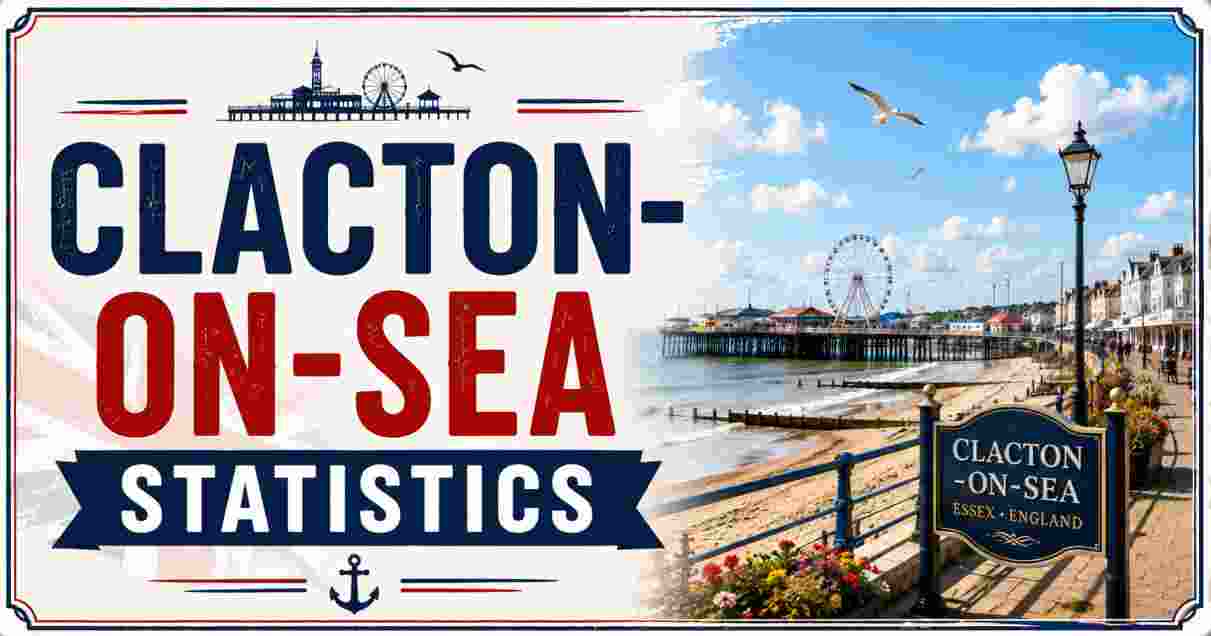
Clacton-on-Sea Statistics 2026
Clacton-on-Sea carry unusual national weight this week after the seaside town’s parliamentary constituency staged one of the strangest elections in modern British political history. On 13 August 2026, Nigel Farage, leader of Reform UK, won the Clacton by-election with 63.3% of the vote (22,239 ballots), defeating a field of 34 candidates — a record number for any UK parliamentary contest — after every mainstream party boycotted the race. His nearest challenger was Count Binface, a satirical “intergalactic space warrior” candidate wearing a rubbish bin on his head, who took 26.9% (9,455 votes). The by-election was triggered by Farage’s own resignation in July amid an ongoing parliamentary standards investigation into an unreported £5 million donation from an overseas cryptocurrency figure.
Beyond the political spectacle, Clacton-on-Sea itself is a coastal town on the Essex coast with a built-up area population of 53,200 as of the 2021 census, making it the largest settlement in the Tendring District. The wider Clacton parliamentary constituency, which also includes Frinton-on-Sea and Walton-on-the-Naze, has a population of 98,191 and covers 22 wards. This report breaks down the latest verified Clacton-on-Sea Statistics 2026 — covering population, election results, deprivation data, and area figures — using data from the UK Parliament, Office for National Statistics, and Tendring District Council.
Interesting Facts About Clacton-on-Sea Statistics 2026
| Fact Category | Details |
|---|---|
| Clacton-on-Sea Town Population (2021) | 53,200, largest settlement in Tendring District |
| Clacton Constituency Population | 98,191 |
| Constituency Population (2011 Census) | 85,359 |
| Constituency Density | 447 people per km² |
| 2026 By-Election Winner | Nigel Farage (Reform UK), 63.3%, 22,239 votes |
| Runner-Up | Count Binface, 26.9%, 9,455 votes |
| Total Candidates (Record Number) | 34 candidates — the most ever in a UK parliamentary election |
| By-Election Turnout | 44.37% |
| Reform UK’s Total Commons Seats (post-win) | 8 of 650 seats |
| Distance from London | 77 miles (124 km) northeast |
Data Source: UK Parliament (members.parliament.uk), State.com Constituency Data, Associated Press
The 34-candidate field that contested the Clacton by-election is believed to be the largest for any UK parliamentary election, surpassing the previous record of 26 candidates set at the 2008 Haltemprice and Howden by-election. Every major party — Labour, Conservative, Liberal Democrat, and Green — declined to field a candidate, dismissing the contest as a “stunt” designed to let Farage demonstrate voter support amid the standards investigation rather than a genuine electoral test. That left Count Binface, a recurring joke candidate known for contesting high-profile elections including against Boris Johnson in the 2021 London mayoral race, as Farage’s most prominent opponent.
Farage’s 63.3% vote share on a 44.37% turnout translated into 22,239 votes, comfortably ahead of Binface’s 9,455. The result returned Farage to the House of Commons after a roughly one-month absence, though a parliamentary watchdog investigation into the £5 million donation — suspended when he originally resigned — resumed within hours of the result being declared, meaning the seat’s political drama is unlikely to be fully resolved even now.
Clacton-on-Sea Population Statistics in UK 2026
| Population Metric | Data |
|---|---|
| Clacton-on-Sea Built-Up Area (2021) | 53,200 |
| Clacton Constituency (2026, State.com) | 98,191 |
| Clacton Constituency (2011 Census) | 85,359 |
| Constituency Electorate (2023) | 75,959 |
| Tendring District Total Population (2024) | 156,759 |
| Tendring District Population Density | 1,210 per sq mi (466/km²) |
| Constituency Population Density | 447 people per km² |
| Average Constituency Age | 56.6 years, vs. 49.5 nationally |
Data Source: Office for National Statistics, UK Parliament, State.com Constituency Database
Population Comparison: Clacton-on-Sea Town vs Constituency vs District
Clacton-on-Sea Town         |####################                    |  53,200
Clacton Constituency        |##########################              |  98,191
Tendring District (Total)   |########################################| 156,759
The gap between Clacton-on-Sea’s town population of 53,200 and the wider constituency figure of 98,191 reflects how the parliamentary seat extends well beyond the town itself, encompassing the neighbouring resorts of Frinton-on-Sea and Walton-on-the-Naze alongside numerous smaller villages across the Tendring Peninsula. The constituency’s growth from 85,359 residents at the 2011 census to a current estimate approaching 98,191 reflects broader growth across the Tendring District, which now houses 156,759 people as of 2024 figures, making it the 143rd-ranked district by population nationally.
Perhaps the most striking demographic figure is the constituency’s average age of 56.6 years, more than seven years above the national average of 49.5, a gap that reflects Clacton’s long-standing popularity as a retirement destination. This older population profile has direct political consequences: it correlates with the area’s 75% Brexit vote share in 2016 and helps explain why Reform UK’s platform has found such durable support here, first propelling Farage to victory in 2024 and now returning him to Parliament in 2026.
Clacton By-Election 2026 Results Statistics in UK
| Candidate | Party | Votes | Vote Share |
|---|---|---|---|
| Nigel Farage | Reform UK | 22,239 | 63.3% |
| Count Binface | Count Binface Party | 9,455 | 26.9% |
| John Stevens | Rejoin EU | 492 | 1.4% |
| Tony Francis | Independent | 432 | 1.2% |
| Remaining 30 Candidates | Various | 2,493 combined | 7.1% combined |
| Majority | — | 12,784 | — |
| Turnout | — | ~35,111 votes cast | 44.37% |
Data Source: UK Parliament Election Results (members.parliament.uk), State.com
Clacton By-Election Result, 13 August 2026
Nigel Farage (Reform UK)      |########################| 63.3%
Count Binface                 |##########              | 26.9%
Other 32 candidates combined  |###                     |  9.7%
Farage’s 12,784-vote majority over Count Binface represents a decisive result by any conventional measure, even accounting for the unusual absence of mainstream party competition. His 63.3% vote share in the by-election actually exceeds the 46.2% with which he first won the seat in the 2024 general election, when he defeated sitting Conservative MP Giles Watling — though direct comparison is complicated by the boycott, since a genuinely contested field would likely have split the anti-Farage vote very differently. PollCheck’s pre-election modelling had anticipated an even larger margin, projecting Farage at roughly 73% on the low expected turnout, with Binface around 20%, making the actual result somewhat closer than forecasters expected.
The scattered remainder of the vote — 2,493 ballots spread across 30 additional candidates, none exceeding 1.5% individually — illustrates the genuinely chaotic character of a boycotted by-election, where fringe, single-issue, and novelty candidates fill the vacuum left by the absence of serious opposition. John Stevens of the Rejoin EU party and independent Tony Francis were the only other candidates to clear even 400 votes, underscoring just how thoroughly the contest became a referendum on Farage himself rather than a genuine multi-party electoral contest.
Clacton Constituency Deprivation Statistics in UK 2026
| Deprivation Metric | Data |
|---|---|
| Constituency Population Classed as Deprived | 64%, vs. 52% nationally |
| Over-16s Unemployed | 46.8% (work is typically seasonal) |
| Jaywick Deprivation Rank (2019 Indices) | Most deprived neighbourhood in England (3rd time: also 2010, 2015) |
| Jaywick Deprivation Share | 77% of population classed as deprived |
| Economic Activity Rate, Clacton Constituency | 60%, vs. 81% Essex average, 78% UK average |
| Tendring Neighbourhoods in Bottom Half for Health | 90% |
| Tendring Neighbourhoods in Poorest Fifth for Health | 41% |
| Jaywick Population | 4,665 |
| Jaywick Sands Regeneration Investment | £120 million project underway |
Data Source: Ministry of Housing, Communities and Local Government (MHCLG) English Indices of Multiple Deprivation, Onward “Levelling Up in Practice” Report
Deprivation Rate: Clacton Constituency vs National vs Jaywick
National Average          |##########################              | 52%
Clacton Constituency      |################################        | 64%
Jaywick (within Clacton)  |########################################| 77%
Jaywick, a small coastal village roughly 2 miles west of Clacton-on-Sea, was named the most deprived neighbourhood in England for the third time in the government’s decennial Indices of Multiple Deprivation, having previously topped the ranking in 2010 and 2015. Originally built in the 1930s as an affordable holiday resort for working-class Londoners, many of its structures became permanent, poorly insulated year-round homes after post-war housing shortages, and the settlement has struggled with chronic underinvestment ever since — a £120 million regeneration project is now underway in an attempt to address decades of neglect.
The broader constituency’s economic profile reflects a seaside town that has never fully recovered from the decline of traditional British domestic tourism, accelerated by the closure of Butlins Holiday Camp in 1983 and the rise of cheap overseas package holidays. With economic activity at just 60% against an Essex average of 81%, and 46.8% of over-16s unemployed in work that is frequently seasonal, Clacton’s deprivation statistics have long been central to understanding why the constituency proved such fertile ground for the populist, anti-establishment politics that first delivered Farage his seat in 2024 and reaffirmed it decisively in this week’s by-election. Given the town’s low economic activity and heavy reliance on seasonal income, residents here are also especially exposed to the pressures documented in our Cost of Living Statistics in UK report, which shows nearly 8 in 10 British households still reporting rising living costs even as headline inflation has eased from its 2022 peak. For a broader picture of how these local deprivation patterns fit within England’s national housing and homelessness crisis, see our Homelessness Statistics in UK report, which documents record levels of temporary accommodation and rough sleeping across the country.
Clacton-on-Sea Area and Geography Statistics 2026
| Geographic Metric | Data |
|---|---|
| Coordinates | 51°47′N, 1°08′E |
| Distance from London | 77 miles (124 km) northeast |
| Distance from Colchester | 16 miles (26 km) southeast |
| Distance from Harwich | 16 miles (26 km) south |
| Location | Tendring Peninsula, Essex, East of England |
| Tendring District Total Area | 141 sq mi (366 km²) |
| Tendring District Land Area | 130 sq mi (336 km²) |
| Tendring District National Area Rank | 110th |
| Postcode Districts | CO15, CO16 |
| Clacton Pier Length | 1,180 feet (360m), opened 27 July 1871 |
Data Source: Office for National Statistics, Ordnance Survey, Tendring District Council
Distance from Clacton-on-Sea to Nearby Cities (Miles)
London      |########################################| 77 miles
Colchester  |########                                | 16 miles
Harwich     |########                                | 16 miles
Situated on the Tendring Peninsula in northeast Essex, Clacton-on-Sea sits at coordinates 51°47′N, 1°08′E, roughly 77 miles northeast of London and 16 miles from both Colchester and Harwich. The town’s coastal position on the North Sea has defined its identity since Victorian times, when Clacton Pier, opened on 27 July 1871 and now stretching 1,180 feet, first established the settlement as one of England’s classic seaside resort towns. Named “Pier of the Year” by the National Piers Society in 2020, the pier remains a central visitor attraction alongside sites including West Cliff Theatre, Princes Theatre, and the historic Jaywick Martello Tower.
Clacton-on-Sea functions as the administrative headquarters of Tendring District Council, which governs a total area of 141 square miles, ranking 110th by size among England’s local authority districts. The district’s continued reliance on coastal tourism — including the Clacton Air Show, which draws hundreds of thousands of visitors annually — sits alongside genuine economic promise from nearby infrastructure investment, including Freeport East in neighbouring Harwich, which analysts project could generate hundreds of new jobs in logistics and related industries. For readers interested in how Clacton’s tourism economy compares against the UK’s broader visitor trends, our Tourism Statistics in UK report documents record inbound visitor numbers and spending nationally, offering useful context for the domestic seaside tourism market Clacton has depended on for over 150 years.
Reform UK and National Political Context Statistics 2026
| Political Metric | Data |
|---|---|
| Reform UK House of Commons Seats (post-by-election) | 8 of 650 |
| Farage’s Original Clacton Win (2024 General Election) | 46.2%, defeating Conservative MP Giles Watling |
| Farage’s Attempts to Enter Parliament | 7th attempt, succeeded in 2024 |
| 2024 Majority (General Election) | Swing from Conservative predecessor’s 24,702-vote majority (2019) |
| Farage’s Resignation Date (2026) | 8 July 2026 |
| Reform UK Polling Lead (Feb 2025, YouGov) | 25%, first-ever national poll lead |
| Reason for Standards Investigation | Unreported £5 million (~$6.7 million) overseas crypto donation |
| Watchdog Investigation Status | Resumed hours after by-election result declared |
Data Source: UK Parliament, YouGov/The Times, Associated Press, Al Jazeera
Reform UK Seats in House of Commons (of 650 total)
Reform UK Seats     |#                                       | 8
Remaining Seats     |########################################| 642
Despite holding just 8 of 650 House of Commons seats, Reform UK’s influence on British politics has grown disproportionately to its parliamentary footprint, a dynamic underscored by a YouGov poll for The Times published in February 2025 that showed Reform leading a hypothetical general election for the first time in the party’s history, at 25% against Labour’s 24% and the Conservatives’ 21%. Farage’s personal journey to this point has been unusually persistent: Clacton represented his seventh attempt to enter Parliament before finally succeeding in 2024, following earlier failed campaigns dating back years under both the Reform UK and UK Independence Party banners.
The standards investigation that triggered this week’s by-election in the first place remains unresolved even after Farage’s decisive re-election, with the parliamentary watchdog’s inquiry into the unreported £5 million donation resuming almost immediately once the by-election count concluded. This creates a genuinely unusual political situation: a sitting MP, freshly re-elected with an overwhelming mandate from his constituents, still facing formal scrutiny that could theoretically force yet another election in the same seat, a scenario that would be virtually unprecedented in modern British parliamentary history and one that political observers on both sides of the aisle will be watching closely as 2026 progresses.
Disclaimer: This research report is compiled from publicly available sources. While reasonable efforts have been made to ensure accuracy, no representation or warranty, express or implied, is given as to the completeness or reliability of the information. We accept no liability for any errors, omissions, losses, or damages of any kind arising from the use of this report.