
Geely, the Chinese conglomerate that owns Volvo, Polestar, and a majority stake in Lotus, remains the only Chinese automaker with an active US factory, a South Carolina plant that built the Volvo EX90 and, until a June 2026 federal ban, the Polestar 3. No Chinese-branded vehicle is sold through US dealerships in 2026.
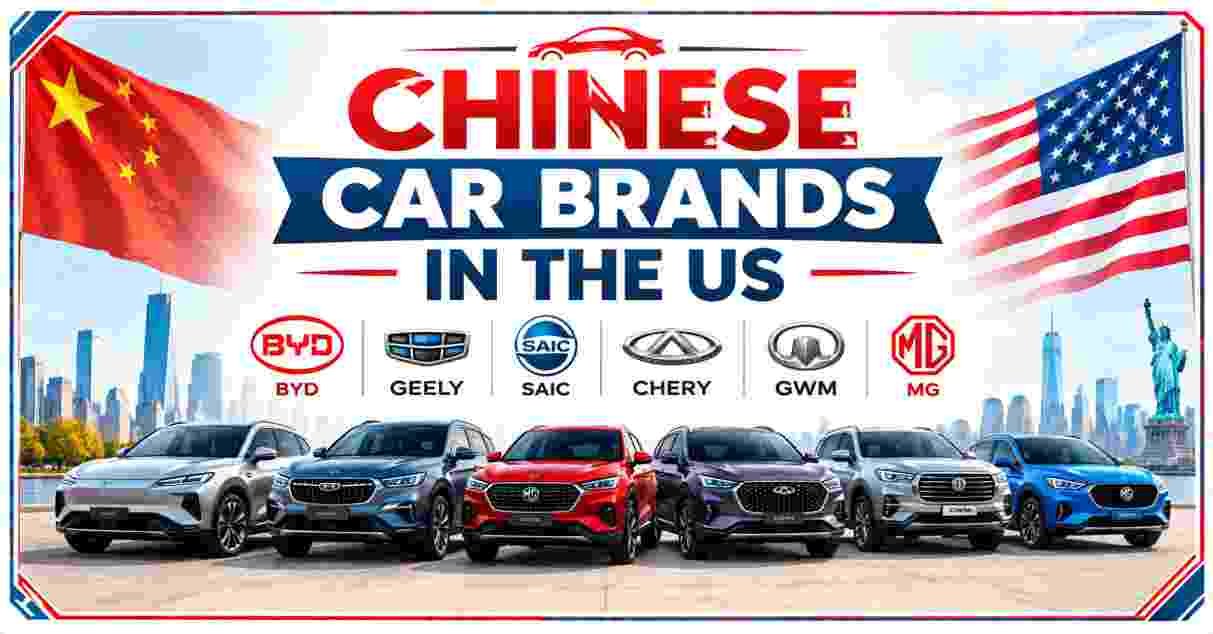
Chinese Car Brands in the US – Introduction
Chinese car brands in the US occupy a strange middle ground in 2026: fully absent as recognizable Chinese names on dealer lots, yet quietly embedded in the American auto industry through ownership stakes, battery technology licensing, and one active factory. Geely, the Hangzhou-based conglomerate, stands out as the clearest example. It owns Volvo outright, controls a majority stake in Polestar, and holds a 51% stake in Lotus, giving a Chinese company real production capacity on US soil even though no vehicle wears a Chinese nameplate at any American dealership.
That quiet embedding became a public flashpoint in June 2026, when the Commerce Department barred Polestar, despite building its flagship SUV in South Carolina, from selling any new vehicles in the US starting with the 2027 model year. The decision landed weeks after Volvo, Polestar’s sister brand under the same Geely ownership and built at the very same factory complex, received the opposite ruling. Understanding how these overlapping ownership structures, factories, and battery partnerships actually work reveals a far more complicated picture than a simple ban on “Chinese cars” suggests.
Beyond Geely’s automaking footprint, Chinese battery technology has found its way into American EV supply chains through licensing arrangements that keep manufacturing on US soil while relying on Chinese intellectual property. Ford’s newest battery plant in Michigan, several Detroit automakers’ commercial ties to Chinese battery suppliers, and Geely’s own stated ambitions to bring additional Chinese-designed brands to American factories all point to a market where the line between “Chinese” and “American” automotive manufacturing has become far blurrier than tariff headlines alone would suggest.
Interesting Facts
| Fact | Figure |
|---|---|
| Chinese Company With Active US Auto Factory | Geely (owns Volvo Cars outright) |
| Geely’s Stake in Polestar | Majority ownership (Geely-affiliated entities) |
| Geely’s Stake in Lotus | 51% |
| Volvo/Polestar Plant Location | Ridgeville, South Carolina |
| Plant Investment by Volvo | More than $1 billion |
| Plant Annual Capacity | 150,000 vehicles |
| Plant Actual 2025 Production | Approximately 18,500 vehicles |
| Polestar US Sales Ban Effective | Model year 2027 |
Source: Geely Holding Group, Volvo Cars, US Department of Commerce Bureau of Industry and Security
These interesting facts about Chinese car brands in the US highlight how far below capacity the country’s only Chinese-owned auto plant is currently running. The Ridgeville, South Carolina facility, capable of producing 150,000 vehicles annually, built only about 18,500 vehicles in 2025, a utilization rate below 13% that reflects both soft EV demand and the regulatory uncertainty surrounding Geely’s various brands.
The June 2026 Polestar ban stands out as the year’s most consequential development, since it marks the first time an established automaker has been formally barred from the US new-car market under the federal Connected Vehicle Rule, even while its sister brand, built in the identical factory, continues selling freely.
That contrast, two brands sharing an assembly line but facing opposite regulatory outcomes, illustrates just how narrowly the current rules are drawn. Ownership structure and data infrastructure, not factory location or country of assembly, ultimately determined which brand could keep selling. For a company like Geely with stakes spanning multiple Western automotive brands, that distinction carries enormous strategic weight heading into future expansion decisions.
Geely’s US Manufacturing Footprint in 2026
| Brand | Geely Ownership Stake | US Manufacturing Status |
|---|---|---|
| Volvo Cars | 100% | Builds EX90 in South Carolina, cleared to sell |
| Polestar | Majority (Geely-affiliated) | Built Polestar 3 in South Carolina, banned from new sales starting MY2027 |
| Lotus | 51% | No confirmed US manufacturing |
| Zeekr | Geely Auto subsidiary | No US manufacturing; used by Waymo for robotaxi hardware |
| Lynk & Co | Geely Auto subsidiary | No US manufacturing or sales |
Source: Zhejiang Geely Holding Group Corporate Disclosures, CNBC Reporting
Geely is widely described by industry analysts as the only Chinese automotive company with a genuine operating foothold inside the United States. The distinction matters because “Geely” can refer to two separate entities: the parent holding company that owns Western brands like Volvo, Polestar, and Lotus, and the separately listed Chinese subsidiary, Geely Auto, which produces the more explicitly Chinese-market brands Zeekr, Lynk & Co, and the Geely-branded vehicles sold across Asia and Europe.
Automobile Sales Statistics compiled for the broader US market provide useful context for how small Geely’s American footprint remains relative to the overall industry, since the roughly 18,500 vehicles built at the South Carolina plant in 2025 represent a tiny fraction of the tens of millions of vehicles sold nationally each year. Despite that modest scale, Geely’s ownership stakes give it a rare structural advantage: an existing, functioning American factory that consultants say could, in principle, be adapted to build other Geely-group platforms with relatively little difficulty.
Industry consultants tracking Geely’s US operations note that dealer network access represents just as important an asset as the factory itself. Lotus, Polestar, and Volvo collectively give Geely Holding an established dealer and service infrastructure across the United States, a network that would take any brand-new entrant years and significant capital to replicate from scratch. That existing infrastructure is precisely why analysts view Zeekr and Lynk & Co as far more likely near-term entrants than any entirely new Chinese-branded dealership network built from the ground up.
Which Chinese-Linked Car Models Are Sold in the US in 2026
| Model | Brand | Where It’s Built | US Sales Status (2026) |
|---|---|---|---|
| Volvo EX90 | Volvo | Ridgeville, South Carolina | Actively sold |
| Polestar 3 | Polestar | Ridgeville, South Carolina | Existing stock only; no new MY2027 sales |
| Polestar 4 | Polestar | Hangzhou, China | Existing stock only; no new MY2027 sales |
| Polestar 2 | Polestar | Chengdu, China (Geely Luqiao plant) | Discontinued from US lineup |
| Zeekr Models | Zeekr (Geely Auto) | China | Not sold in US; used in Waymo robotaxi hardware |
Source: Polestar Corporate Statements, Volvo Cars, Company Model Specifications
The list of Chinese-linked models available in the US has narrowed sharply through 2026. The Volvo EX90, built at the Ridgeville plant and cleared under the Connected Vehicle Rule in May 2026, remains the clearest example of a Geely-affiliated vehicle actively sold to American consumers. The Polestar 3, despite rolling off the very same South Carolina assembly line, can no longer be sold as a new model beyond existing inventory, since Commerce denied Polestar’s authorization request weeks after granting Volvo’s.
One especially striking detail involves Zeekr, the Geely Auto subsidiary that cannot legally sell passenger vehicles to US consumers, yet whose hardware already carries paying passengers on American streets through Waymo’s robotaxi fleet in San Francisco. Alphabet’s self-driving unit builds its vehicles using Zeekr hardware, an arrangement that has drawn attention from policy analysts who note the apparent inconsistency between banning private ownership of Chinese-linked connected vehicles while allowing the same underlying hardware to operate commercially in a different business structure.
The Polestar 2’s removal from the US lineup predates the broader 2026 ban and reflected an earlier shift in the company’s product strategy toward its larger, more profitable SUV models. That earlier discontinuation, combined with the newer restriction on the Polestar 3 and Polestar 4, means American buyers now have access to a steadily shrinking pool of Chinese-linked electric vehicles, even as Volvo’s own EX90 lineup remains fully available and continues to be built at the same South Carolina facility.
The Polestar Ban and Connected Vehicle Rule in 2026
| Event | Date |
|---|---|
| Connected Vehicle Rule Finalized | January 2025 |
| Software Attestation Process Began | March 2026 |
| Volvo Cars Granted Authorization | May 26, 2026 |
| Polestar Denied Authorization | June 25, 2026 |
| Sales Prohibition Takes Effect | Model year 2027 |
| Hardware Restrictions Take Effect | Model year 2030 |
Source: US Department of Commerce Bureau of Industry and Security, Polestar Corporate Statement (June 25, 2026)
The Connected Vehicle Rule, finalized in the final days of the Biden administration and maintained under the Trump administration, restricts vehicles whose software or hardware is owned by, controlled by, or subject to the jurisdiction of China or Russia. On June 25, 2026, the Commerce Department’s Bureau of Industry and Security formally denied Polestar’s request for authorization, meaning the company cannot sell any new model year 2027 or later vehicle in the United States, regardless of where that vehicle is physically assembled.
The distinction between Polestar and Volvo turned out to hinge on data infrastructure rather than factory location. Reporting following the decision indicated that Polestar’s vehicle telematics and connectivity systems routed data through servers tied to Geely’s China-based infrastructure, while Volvo had restructured its own data pipeline away from China ahead of its May 2026 clearance. Polestar’s stock fell 13% following the announcement, and the company confirmed it would “increase its strategic focus on Europe,” noting that 94% of its retail sales volume in the first quarter of 2026 already came from markets outside the United States.
The Commerce Department has not publicly detailed the exact technical criteria that separated the two outcomes, leaving other automakers with Chinese-linked ownership or supply chains to guess at what specifically constitutes sufficient distance from Chinese data infrastructure. That ambiguity has reportedly prompted several other manufacturers to begin auditing their own connected-vehicle software and data routing arrangements well ahead of the 2027 model year deadline, hoping to avoid Polestar’s fate through their own version of the data pipeline restructuring that appears to have saved Volvo’s US sales authorization.
Chinese Battery Technology Inside US Factories 2026
| Facility | Chinese Partner | Location | Status (2026) |
|---|---|---|---|
| BlueOval Battery Park Michigan | CATL (technology licensing) | Marshall, Michigan | Began production June 30, 2026 |
| Gotion Battery Plant | Gotion High-Tech | California | Under construction, supplies VW North America |
| BYD Bus Plant | BYD (wholly owned) | Lancaster, California | Operating, buses only, no passenger cars |
Source: Ford Motor Company, Gotion High-Tech, BYD Corporate Disclosures
Even where no Chinese passenger vehicle is sold, Chinese battery technology has quietly become embedded in American EV manufacturing. Ford’s BlueOval Battery Park Michigan, located in Marshall, Michigan, began lithium iron phosphate cell production on June 30, 2026, using technology licensed from China’s CATL, the world’s largest battery maker. Ford structured the arrangement as a licensing deal rather than a joint venture, meaning Ford wholly owns the plant, equipment, and workforce, while CATL employees help train workers on the manufacturing process itself.
The plant’s scope has shifted considerably since Ford first announced it in February 2023, when the company committed $3.5 billion and promised roughly 2,500 jobs. Facing declining EV demand, Ford later downsized the investment to closer to $2.5 billion and revised its job target down to 1,700, while Michigan state officials granted the company a one-year extension on meeting the original incentive package’s obligations. Despite that scaling back, Ford executives have publicly defended the CATL licensing approach, arguing that building the batteries domestically with American workers, even while relying on licensed Chinese technology, remains preferable to continuing to import finished battery packs from overseas suppliers.
South Korea Tariffs affecting rival Korean battery and auto suppliers offer a useful comparison point for how differently the US government treats allied-country supply chains versus Chinese technology partnerships, even when both ultimately support the same domestic EV manufacturing goal. The arrangement has drawn sustained congressional scrutiny, including a formal letter from Congressman John Moolenaar, chairman of the House’s China Select Committee, demanding information on the CATL partnership over concerns about supply chain independence.
Gotion High-Tech, China’s second-largest LFP battery supplier, is separately building a battery plant in California specifically to supply Volkswagen’s North American operations, a facility that mirrors the licensing-style structure seen at Ford’s Michigan plant. Both arrangements reflect the same underlying strategic calculation: American automakers gain access to cost-competitive, mature Chinese battery chemistry and manufacturing know-how, while the physical plants, jobs, and ownership remain domestically controlled, a structure that has so far allowed these deals to proceed even as outright vehicle sales from Chinese brands remain blocked entirely.
Geely’s Future US Brand Expansion Plans in 2026
| Brand | Planned US Timeline | Potential Production Site |
|---|---|---|
| Zeekr | Announcement expected within 3 years (per CES 2026 statement) | Volvo’s Ridgeville, South Carolina plant |
| Lynk & Co | Announcement expected within 3 years (per CES 2026 statement) | Volvo’s Ridgeville, South Carolina plant |
| Geely (core brand) | Company spokesperson: possible entry after 2030 | Not yet determined |
Source: Geely Communications Statements, CES 2026
Despite the tariff and regulatory barriers already covered in detail elsewhere, Geely’s leadership has continued signaling ambitions to expand its US brand lineup well beyond Volvo and Polestar. At CES 2026, Geely’s communications chief stated the company would announce US entry plans for Zeekr and Lynk & Co within the next three years, suggesting the underused Ridgeville, South Carolina plant, currently running at a fraction of its 150,000-vehicle annual capacity, as the most likely production site for any locally assembled Zeekr or Lynk & Co models.
US Trading Partners Statistics covering the broader US-China trade relationship underscore how unusual Geely’s position has become relative to the general trajectory of US-China automotive trade, which has moved almost entirely toward restriction rather than expansion. A separate Geely spokesperson indicated the core Geely-branded vehicles, as opposed to its Western-facing brands, would likely not be considered for US entry until after 2030, reflecting the far steeper political and regulatory hurdles facing any vehicle marketed explicitly under a Chinese brand name rather than through an acquired Western nameplate.
The Polestar precedent adds a substantial complication to any such plans. If ownership structure and data routing, rather than assembly location, determine whether a Geely-affiliated brand can sell in the United States, then any future Zeekr or Lynk & Co launch would need to satisfy the same Connected Vehicle Rule requirements that Polestar failed to meet. Industry observers now view Geely’s ability to replicate Volvo’s data-infrastructure restructuring, rather than simply building cars domestically, as the true gating factor determining whether Zeekr and Lynk & Co ever reach American consumers on the timeline Geely’s leadership has described.
Chinese Car Brands in the US – FAQ
Which Chinese company has an actual car factory in the United States?
Geely, through its ownership of Volvo Cars, operates a plant in Ridgeville, South Carolina, the only active US auto factory tied to a Chinese-owned automotive conglomerate.
Can Americans still buy a Polestar in 2026?
Only existing inventory of the Polestar 3 and Polestar 4. Commerce denied Polestar authorization to sell any new model year 2027 or later vehicles.
Why was Polestar banned but not Volvo, even though Geely owns both?
The distinction came down to vehicle data routing. Volvo restructured its connectivity data pipeline away from China before its May 2026 clearance, while Polestar’s system still routed through Geely’s China-based servers.
Does Ford use Chinese battery technology in its US plants?
Yes. Ford’s BlueOval Battery Park Michigan uses lithium iron phosphate battery technology licensed from China’s CATL, though Ford wholly owns and operates the facility itself.
Is Zeekr, the Geely brand used by Waymo, sold to US consumers?
No. Zeekr vehicles are not sold to private US consumers, though Zeekr-built hardware is used in Waymo’s robotaxi fleet operating commercially in San Francisco.
When might Zeekr or Lynk & Co officially launch in the US?
Geely’s communications leadership indicated at CES 2026 that an announcement on US entry for both brands could come within the next three years.
What percentage of Polestar’s global sales now come from outside the US?
94% of Polestar’s retail sales volume in the first quarter of 2026 came from markets outside the United States, a share that is expected to grow further as the company shifts focus to Europe.
How much has Volvo invested in its South Carolina plant?
Volvo has invested more than $1 billion in the Ridgeville, South Carolina facility over the past decade to build it into a North American manufacturing hub.
Why is the Ridgeville, South Carolina plant running so far below capacity?
The plant can build 150,000 vehicles annually but produced only about 18,500 in 2025, reflecting soft demand for Volvo and Polestar EVs alongside broader regulatory uncertainty.
Could core Geely-branded vehicles ever be sold in the US?
A Geely spokesperson indicated the company would consider entering the US market with its core Geely-branded vehicles only after 2030, a much longer timeline than its plans for Zeekr and Lynk & Co.
Does Congress have concerns about Chinese battery partnerships at US plants?
Yes. Congressman John Moolenaar, chairman of the House’s China Select Committee, sent a formal letter to Ford demanding information about its CATL licensing partnership at the Michigan battery plant.
What happens to Polestar owners who already have a 2026 model year vehicle?
Existing Polestar owners retain full access to the brand’s US service network, even though the company cannot sell any new model year 2027 or later vehicles.
Disclaimer: This research report is compiled from publicly available sources. While reasonable efforts have been made to ensure accuracy, no representation or warranty, express or implied, is given as to the completeness or reliability of the information. We accept no liability for any errors, omissions, losses, or damages of any kind arising from the use of this report.