
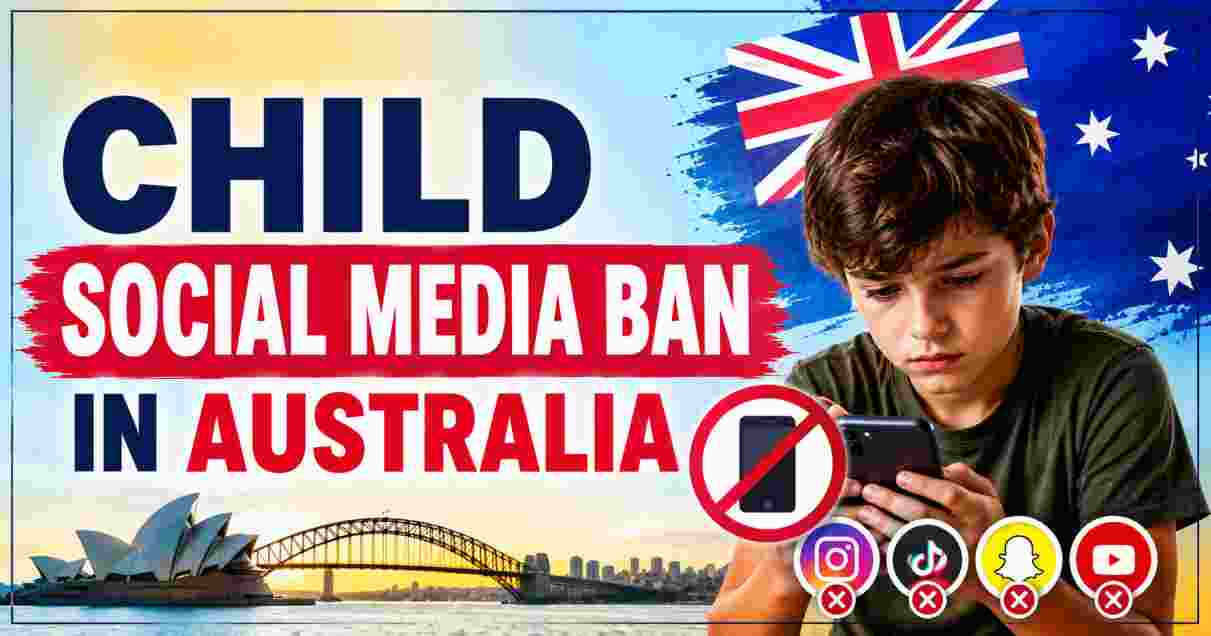
Child Social Media Ban in Australia 2026
Australia became the first country in the world to legislate a hard age limit banning children under 16 from social media when the Online Safety Amendment (Social Media Minimum Age) Act 2024 came into force on 10 December 2025. Six months on, the law is in crisis and being dramatically strengthened. On 27 June 2026 — yesterday — the government announced it would double the maximum fine for platforms that systematically fail to enforce the ban, from AUD $49.5 million to AUD $99 million (~USD $68 million). This follows a British Medical Journal (BMJ) study finding that 85% of Australians aged 12–15 who should not have social media accounts are still actively using them. Prime Minister Anthony Albanese vowed to “bullet-proof” the legislation, questioning whether eSafety Commissioner Julie Inman Grant had “every power at her disposal.” The government also announced strengthened information-gathering powers — enabling eSafety to compel platforms to provide compliance evidence — and authority to gather data from third parties including age-assurance providers and app store operators.
The political context is one of mounting frustration at platform behaviour. Communications Minister Anika Wells stated bluntly: “Based on the regular updates I receive from the eSafety Commissioner, it is clear to me that social media platforms are adopting tricks straight out of the big tech playbook and doing the bare minimum to get by.” eSafety had accused platforms of allowing children who had already declared themselves under-age to make repeated attempts at age verification — effectively giving children multiple goes at defeating the check until they succeeded. Five platforms — Meta’s Instagram and Facebook, Google’s YouTube, Snap’s Snapchat, and TikTok — are under active investigation for possible non-compliance, with court action being prepared. An industry body representing tech suppliers noted in April that enforcement problems stemmed from platforms’ weak deployment of age-check tools, not from limitations in the technology itself. Meanwhile, legal challenges are mounting from multiple directions: the Digital Freedom Project is pursuing a High Court challenge arguing the law violates the implied freedom of political communication in the Constitution, and Reddit is pursuing separate legal action arguing — among other things — that a person under 16 is “more easily protected from online harm if they have an account.”
Interesting Facts: Australia Child Social Media Ban Statistics 2026
| Fact | Figure |
|---|---|
| Law came into effect | 10 December 2025 |
| Minimum age for social media | 16 years |
| Law name | Online Safety Amendment (Social Media Minimum Age) Act 2024 |
| Regulator | eSafety Commissioner (Julie Inman Grant) |
| Original maximum fine (corporations) | AUD $49.5 million (150,000 penalty units) |
| New maximum fine announced (June 27, 2026) | AUD $99 million (~USD $68 million) |
| Fine increase | Doubled — announced yesterday |
| Children under 16 still on social media (BMJ study, 2026) | 85% of 12–15s with banned accounts still active |
| Social media accounts deactivated/removed (mid-Jan 2026) | More than 4.7 million |
| Platforms under active eSafety investigation | 5: Instagram, Facebook, YouTube, Snapchat, TikTok |
| Platforms in scope of the ban (eSafety, March 2026) | 10 platforms including Facebook, Instagram, Snapchat, Threads, YouTube |
| Platforms NOT in scope | Discord, WhatsApp, GitHub, Google Classroom, Steam, YouTube Kids |
| BlueSky minimum age for Australians | 16 (notified eSafety November 12, 2025) |
| Platforms maintaining age 18+ | Yubo, Match services (Tinder, Hinge, etc.), BigoLive |
| Public support for the ban (YouGov, Nov 2024) | 77% of Australians |
| Public support (Resolve Political Monitor, Dec 2025) | 70% of voters |
| People believing the ban will work (Dec 2025) | Only 25% (67% said it would not) |
| Countries enacting similar bans (as of April 2026) | Indonesia, Malaysia, China |
| Countries announcing similar bans | Canada, Denmark, Greece, Austria, France, Spain, UK |
| High Court legal challenges | 2: Digital Freedom Project + Reddit |
| Scam warning issued | Children fined for being on social media = scam (eSafety) |
| Children/parents fined under the law? | No — only platforms face penalties |
| Compliance update published | 31 March 2026 (eSafety) |
| Age-Restricted Material Codes in effect (social media) | From 9 March 2026 |
| BMJ study conclusion on effectiveness | “More effective in preventing access for children under 8 than restricting adolescents who already use it” |
Source: Wikipedia — Online Safety Amendment (Social Media Minimum Age) Act 2024 (updated June 25, 2026); CNBC, “Australia toughens kids’ social media ban, doubles tech firm fines,” June 27, 2026; NPR, June 26, 2026; Deseret News, June 26, 2026; eSafety Commissioner — Social Media Age Restrictions page (updated March 2026); eSafety Commissioner — FAQs and Family guidance pages (March 2026); Privacy Matters (DLA Piper), February 17, 2026; British Medical Journal study cited in Deseret News June 2026
The doubling to AUD $99 million reflects a government that concluded the original $49.5 million was insufficient to deter the world’s largest technology companies. For Meta — which reported net income of USD $62.4 billion in 2024 — a $49.5 million Australian fine represents approximately 0.00079% of annual net income. The doubled $99 million is still a fraction of 1% of any major platform’s earnings, but the government’s stated intention to use it in court — backed by new information-compulsion powers — changes the calculus by adding legal costs, regulatory reputational risk, and the precedent of a court-ordered “systemic failure” finding.
The 85% figure from the BMJ study is the most damaging empirical finding the ban has faced. The methodology involved surveying Australian families with children aged 12–15 who were active on at least one of the restricted platforms before the December 2025 implementation date. Of those children, 85% were still actively using the same or similar platforms after the ban took effect — either through continued access on existing accounts, new accounts using false age information, or migration to platforms not in scope of the current restrictions. The BMJ study noted the ban may be “more effective in preventing or delaying access to social media in children under 8” — a considerably narrower claim than the policy’s stated purpose of protecting all children under 16.
Platforms In and Out of Scope of the Australian Social Media Ban 2026
Platform Scope Under Australian Social Media Minimum Age Act (eSafety, March 2026)
====================================================================================
IN SCOPE (banned for under-16s):
Facebook       |████████████████████████████████████████████████████| Meta — under investigation
Instagram      |████████████████████████████████████████████████████| Meta — under investigation
YouTube        |████████████████████████████████████████████████████| Google — under investigation
Snapchat       |████████████████████████████████████████████████████| Snap — under investigation
TikTok         |████████████████████████████████████████████████████| ByteDance — under investigation
X (Twitter)    |████████████████████████████████████████████████████| In scope
Threads        |████████████████████████████████████████████████████| Meta — in scope
Twitch         |████████████████████████████████████████████████████| Added November 2025
Reddit         |████████████████████████████████████████████████████| Pursuing separate High Court challenge
Kick           |████████████████████████████████████████████████████| In scope
Lemon8         |█████████████████████████████████████████           | ByteDance — 16+ for Australians
BlueSky        |█████████████████████████████████████████           | 16+ for Australians
Wizz           |█████████████████████████████████████████           | 16+ for Australians

NOT IN SCOPE:
WhatsApp, Discord, YouTube Kids, GitHub, Steam, Steam Chat, Google Classroom, Messenger
------------------------------------------------------------
Source: eSafety Commissioner FAQs (March 2026); Wikipedia (June 2026)
| Platform | In Scope? | Status / Notes |
|---|---|---|
| Yes | Under active eSafety investigation | |
| Yes | Under active eSafety investigation | |
| YouTube | Yes | Under active eSafety investigation |
| Snapchat | Yes | Under active eSafety investigation |
| TikTok | Yes | Under active eSafety investigation |
| X (Twitter) | Yes | In scope |
| Threads | Yes | Meta — in scope |
| Twitch | Yes | Added to scope November 21, 2025 |
| Yes | Pursuing separate High Court challenge | |
| Kick | Yes | In scope |
| Lemon8 | Yes | ByteDance confirmed; 16+ for Australians |
| BlueSky | Yes | 16+ for Australians (eSafety notified Nov 12, 2025) |
| Wizz | Yes | 16+ for Australians (eSafety notified Jan 13, 2026) |
| Tinder / Hinge / Match services | Yes | Maintain 18+ — stricter than law requires |
| Yubo | Yes | Maintains 18+ |
| Not in scope | Excluded by eSafety | |
| Discord | Not in scope | Excluded |
| YouTube Kids | Not in scope | Excluded |
| GitHub, Steam, Google Classroom, Messenger | Not in scope | Excluded |
Source: eSafety Commissioner — Social Media Age Restrictions FAQs (updated March 2026); eSafety Commissioner — Social Media Age Restrictions platform list (updated March 2026); Wikipedia — Online Safety Amendment (Social Media Minimum Age) Act 2024 (updated June 25, 2026)
The exclusion of WhatsApp, Discord, and Messenger from the ban’s scope is one of its most debated design choices. These platforms are widely used by Australian teenagers for group communication — in many schools, class groups and sporting teams operate via WhatsApp or Discord. Critics of the ban argue that excluding the most used private messaging platforms while restricting public-feed social media creates a perverse outcome where teenagers migrate to excluded platforms rather than reduce their screen time overall. eSafety’s position is that the law targets services “with the sole or significant purpose of enabling online social interaction between 2 or more end users” through public-facing content feeds — which private messaging services do not primarily serve.
Platforms applying age 18 or over — Tinder, Hinge, BigoLive, Yubo — are applying restrictions stricter than required, recognising legal and reputational risks of hosting under-18 users on adult-oriented services. Pinterest was excluded on November 21, 2025, alongside Twitch’s addition — reflecting eSafety’s iterative, ongoing reassessment approach. The 9 March 2026 Age-Restricted Material Codes added obligations beyond account creation, requiring platforms to prevent children accessing age-inappropriate content through core features and messaging.
Enforcement, Investigations and Legal Challenges in 2026
Key Enforcement Timeline — Australia Social Media Ban (Dec 2025 – Jun 2026)
============================================================================
10 Dec 2025  |████████████████████████████████████████████████████| Law in effect — 10-platform scope announced
Mid-Jan 2026 |████████████████████████████████████████████████████| 4.7M+ accounts deactivated/removed/restricted
Feb 2026     |████████████████████████████████████████████████████| Guardian: teens still accessing platforms
Mar 2026     |████████████████████████████████████████████████████| eSafety compliance update published
Late Mar 2026|████████████████████████████████████████████████████| 5 platforms (FB, IG, YT, SC, TikTok) under investigation
Apr 2026     |████████████████████████████████████████████████████| eSafety considering court action; industry body criticises platforms
Jun 26, 2026 |████████████████████████████████████████████████████| PM Albanese vows to "bullet-proof" law
Jun 27, 2026 |████████████████████████████████████████████████████| Fines doubled to AUD $99M; enforcement powers strengthened (CNBC)
------------------------------------------------------------
High Court challenges: Digital Freedom Project (commenced Nov 26, 2025) + Reddit (separate action)
Source: Wikipedia June 2026; eSafety; CNBC June 27, 2026; NPR June 26, 2026
| Enforcement Metric | Data |
|---|---|
| Accounts deactivated / removed / restricted (mid-Jan 2026) | More than 4.7 million |
| Platforms under active investigation (late March 2026) | 5: Facebook, Instagram, YouTube, Snapchat, TikTok |
| Court action planned against which platforms | Same 5 + X, Kick, Reddit, Threads, Twitch |
| Original corporate fine | AUD $49.5 million |
| New corporate fine (announced June 27, 2026) | AUD $99 million — doubled |
| eSafety new powers (June 27, 2026) | Compel platforms to provide evidence; gather from third parties |
| High Court challenge 1 | Digital Freedom Project — implied freedom of political communication |
| High Court challenge 2 | Reddit — Constitution + argument that accounts protect children |
| Plaintiffs in Digital Freedom Project challenge | Two 15-year-olds (Macy Neyland and Noah Jones) |
| States opposing Digital Freedom Project challenge | NSW, South Australia, Western Australia |
| eSafety compliance update published | 31 March 2026 |
| Complaint about false reports (scam) | eSafety warned scammers impersonating age checks |
| Children fined under the law? | No — the law explicitly does not penalise children or parents |
Source: CNBC, June 27, 2026; NPR, June 26, 2026; Wikipedia — Online Safety Amendment June 2026; eSafety Commissioner March 2026; Privacy Matters, February 2026
The 4.7 million accounts removed in the first five weeks is the government’s headline evidence of early impact. But the BMJ finding that 85% of targeted 12–15 year-olds remain active substantially undercuts what it represents. Accounts removed may include duplicates, anticipated removals, or platforms acting on their own pre-existing under-13 policies — not specifically the Australian legislation. Disentangling Australian law-driven removals from ordinary platform enforcement is difficult from public disclosures alone.
The eSafety accusation that platforms allowed under-aged children to make repeated age verification attempts is the most specific bad faith evidence publicly cited. A robust system should deny account creation the moment a child declares they are under 16; continuing to prompt the same user to try again implicitly invites false information. Minister Wells’s “tricks straight out of the big tech playbook” characterisation signals the government’s conclusion that non-compliance is strategic rather than logistical.
Public Opinion and Effectiveness Evidence in 2026
Australian Public Opinion on Social Media Ban (2024–2025 polling)
==================================================================
YouGov Nov 2024 support          |████████████████████████████████████████████████| 77% support
SMH Resolve Monitor Dec 2024     |███████████████████████████████████             | 58% support
SMH Resolve Monitor Dec 2025     |█████████████████████████████████████████████   | 70% support
People believing ban will work   |████████████████                                | 25%
People believing ban won't work  |████████████████████████████████████████████████| 67%
BMJ study — 12-15s still on SM   |████████████████████████████████████████████████| 85%
------------------------------------------------------------
Source: YouGov Nov 2024; Resolve Political Monitor Dec 2024 / Dec 2025; BMJ 2026
| Public Opinion / Effectiveness Metric | Data |
|---|---|
| YouGov support for age limit (November 2024) | 77% of Australians |
| Resolve Political Monitor support (December 2024) | 58% |
| Resolve Political Monitor support (December 2025) | 70% of voters |
| Resolve Political Monitor opposition (December 2025) | 15% |
| Believe ban will work (December 2025 polling) | Only 25% |
| Believe ban will not achieve its aims (December 2025) | 67% |
| BMJ study — 12–15s still active on restricted platforms | 85% |
| BMJ study conclusion | “More effective preventing access for under-8s than restricting teens” |
| Guardian Australia (Feb 2026) finding | Teens still accessing platforms; some felt more isolated |
| Teens reporting feeling more isolated (Feb 2026) | Some — reported by Guardian Australia |
| PM Albanese on enforcement (June 26, 2026) | Vowed to “bullet-proof” laws |
| Albanese statement on AI apps | Cited “increased presentations in hospitals of young women choked, strangled” |
Source: Wikipedia — Online Safety Amendment citing YouGov, Resolve Political Monitor; Deseret News citing BMJ study, June 26, 2026; NPR June 26, 2026; eSafety Commissioner
Australia’s polling gap — 70% of voters supporting the ban while 67% believe it will not achieve its aims — captures an unusual political dynamic: widespread normative support for the policy objective coexisting with widespread scepticism about practical outcomes. This is not contradictory. Many Australians can simultaneously believe that children should not be on social media platforms and that a law requiring platforms to take “reasonable steps” will be systematically avoided by technology companies with vast resources and global legal operations. The polling data suggests Australians support the attempt while doubting its efficacy.
The BMJ “under-8” finding reframes the ban’s realistic impact: rather than removing already-embedded 12–15 year-olds who can easily obtain false age verification, the law may be most effective at delaying first exposure for children currently aged 8–11 who have not yet joined. That is a measurable long-term benefit, but considerably narrower than the government’s rhetoric implied. PM Albanese’s reference to “increased hospital presentations of young women who have been choked, strangled” linked to AI apps signals that AI-generated harmful content is the next legislative target beyond the current ban.
Impact on Children and Schools in Australia 2026
Early Observed Impacts — Australia Social Media Ban (Dec 2025 – Jun 2026)
==========================================================================
Accounts removed/restricted     |████████████████████████████████████████████████| 4.7M+
12-15s still active on platforms|████████████████████████████████████████████████| 85% (BMJ study)
Teen isolation reported          |████████████████████████                        | Reported by Guardian Australia Feb 2026
Different feed content noted     |████████████████████████                        | Some teens reporting altered algorithms
Schools with banned policies     |████████████████████████████████████████        | State government policies vary
Age-Restricted Material Codes    |████████████████████████████████████████████████| In effect March 9, 2026
------------------------------------------------------------
Source: Guardian Australia Feb 2026; BMJ study Jun 2026; eSafety Mar 2026
| Social Impact Metric | Data |
|---|---|
| Accounts deactivated/removed/restricted | 4.7 million+ (mid-January 2026) |
| 12–15s still active on restricted platforms | 85% (BMJ study 2026) |
| Teens reporting feeling more isolated (Feb 2026) | Reported subset — Guardian Australia |
| Teens reporting different content in feeds (Feb 2026) | Some — algorithmic changes noted |
| Ban on children or parents being fined | Explicit — eSafety: children face NO penalties |
| Age check scams reported | eSafety issued public warning — “If asked to pay a fine, it’s a scam” |
| Age-Restricted Material Codes (social media) | Effective 9 March 2026 |
| Excluded services — school tools | Google Classroom, YouTube Kids not in scope |
| WhatsApp class groups | Not affected — WhatsApp excluded from ban |
| School mobile phone bans | Complementary policy — multiple state governments |
| Mental health rationale | Algorithm-driven content exposure linked to “increased stress, reduced sleep and concentration” — eSafety |
Source: eSafety Commissioner family guidance pages (March 2026); Guardian Australia February 2026 (cited in Wikipedia); BMJ study cited in Deseret News June 2026; eSafety scam warning (esafety.gov.au)
The social isolation concern from Guardian Australia’s February 2026 reporting — teenagers feeling cut off from peer communication after account restrictions — is the most significant welfare counterargument to the ban’s premise. If teenagers are excluded from social and academic networks they relied on, the law may generate new harms alongside the ones it intended to prevent. This is especially acute for 15-year-olds months away from legal access whose entire social network has migrated to now-restricted platforms.
eSafety’s explicit warning — “if your child is asked to pay a fine for being on social media, it’s a scam” — reflects a rapidly emerging problem: within weeks of the law’s passage, scammers began impersonating age verification processes, threatening account deletion unless users paid fees or provided identity documents. The regulator directed users not to pay and to verify requests directly through each platform’s official Support section. This scam proliferation is a direct side effect of public confusion about what compliance looks like — confusion that bad actors are systematically exploiting.
International Context and Future of Australia’s Social Media Ban in 2026
Countries with Social Media Age Restrictions (June 2026)
==========================================================
Australia    |████████████████████████████████████████████████████| 16+ ban — world's first; in effect Dec 10, 2025
China        |████████████████████████████████████████████████████| Similar ban enacted (as of April 2026)
Indonesia    |████████████████████████████████████████████████████| Similar ban enacted (as of April 2026)
Malaysia     |████████████████████████████████████████████████████| Similar ban enacted (as of April 2026)
United Kingdom|███████████████████████████████████████████████    | Announced — 16+ across SM, gaming, live-streaming; effective 2027
Canada       |███████████████████████████████████████████████    | Announced — legislation introduced
France       |████████████████████████████████████████           | Announced / studying
Denmark      |████████████████████████████████████████           | Announced
Spain        |████████████████████████████████████████           | Announced
Greece, Austria|████████████████████████████████████████         | Announced
------------------------------------------------------------
Source: Wikipedia — Online Safety Amendment (April 2026 international data); NPR June 2026
| Country | Status | Age Limit |
|---|---|---|
| Australia | In effect — December 10, 2025 | 16 |
| China | Similar ban enacted by April 2026 | Varies by platform |
| Indonesia | Similar ban enacted by April 2026 | Varies |
| Malaysia | Similar ban enacted by April 2026 | Varies |
| United Kingdom | Announced — includes gaming, live-streaming | 16 (from 2027) |
| Canada | Legislation introduced | To be confirmed |
| France | Announced / under development | 16 (proposed) |
| Denmark | Announced | Under consideration |
| Spain | Announced | Under consideration |
| Greece, Austria | Announced | Under consideration |
| Brazil | Restrictions announced | Under consideration |
| South Korea, Thailand | Studying / developing | — |
Source: Wikipedia — Online Safety Amendment (Social Media Minimum Age) Act 2024 (updated June 2026); NPR June 26, 2026; Deseret News June 2026
Australia’s law is being “closely watched by many nations seeking to emulate it”, according to CNBC’s June 27, 2026 report — but the evidence base that those nations are watching has become far more complicated than the law’s proponents anticipated. The UK’s announced plan — due in 2027 — goes further than Australia’s, applying to gaming platforms and live-streaming services in addition to conventional social media, and banning children under 16 from communicating with strangers on platforms like Roblox. That broader scope reflects a lesson the UK drew partly from Australia’s experience: excluding certain platforms from the scope creates migration pathways that teenagers readily exploit.
Australia is now on a path of continuous legislative strengthening: doubled fines, new compulsion powers, third-party information-gathering authority, and a Prime Minister publicly questioning whether existing powers are sufficient. The eSafety Commissioner’s framing — that the full impact “could take years, as bans and their enforcement naturally evolve” — acknowledges that the six-month report card is not dispositive. Whether stronger enforcement and doubled fines will change platform behaviour where $49.5 million did not is the central unresolved question of the world’s most closely watched child online safety experiment.
Disclaimer: This research report is compiled from publicly available sources. While reasonable efforts have been made to ensure accuracy, no representation or warranty, express or implied, is given as to the completeness or reliability of the information. We accept no liability for any errors, omissions, losses, or damages of any kind arising from the use of this report.