
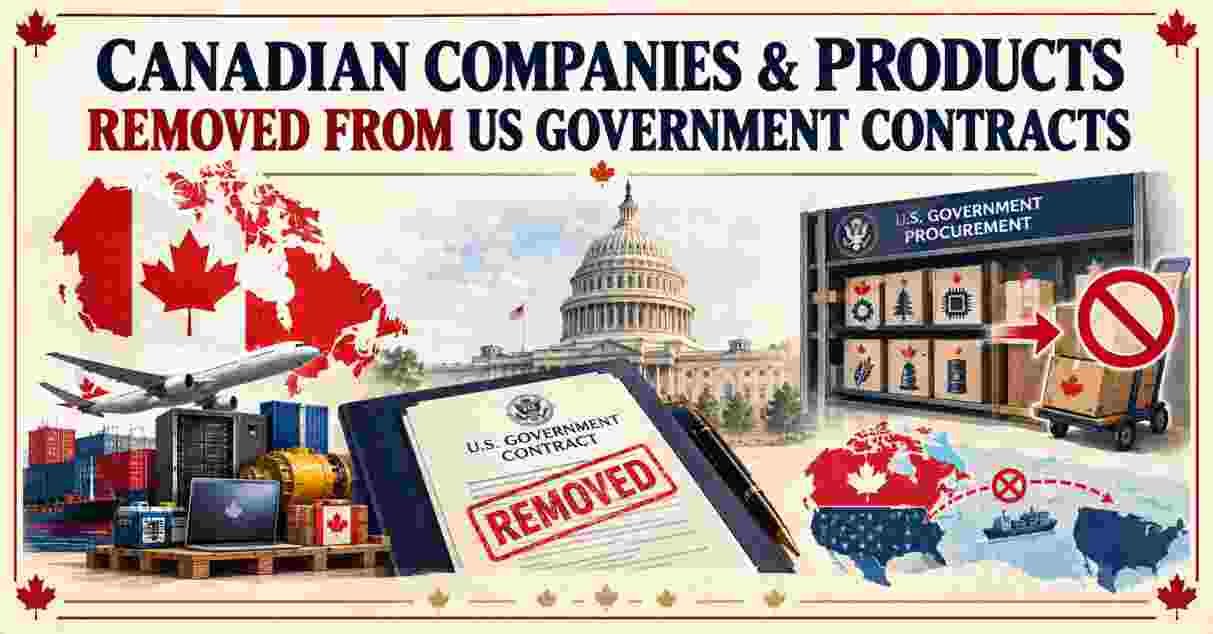
President Trump directed the GSA and USTR on September 8, 2026, to remove Canadian-origin products from federal government contracts, targeting the Multiple Award Schedules program worth more than $50 billion annually. As of this report’s publication, no complete official list of individually removed companies or products has been released; confirmed categories include alcohol and dairy, and the directive follows Canada’s retaliatory tariffs of 15% to 50% on American goods.
Canadian Companies & Products Removed from US Government Contracts 2026
The move to strip Canadian companies and products from US government contracts marks one of the sharpest escalations yet in the trade dispute between Washington and Ottawa. On September 8, 2026, President Trump posted on Truth Social that he was directing the General Services Administration, working with the Office of the US Trade Representative, to remove Canadian-origin products from the GSA’s Multiple Award Schedules “unless Canada restores full and fair reciprocity for American Farmers and Companies.” Trump specifically criticized Canadian federal and provincial procurement rules that he said block American small businesses from competing for Canadian government contracts.
The directive came one day after Canada’s retaliatory tariffs took effect, targeting roughly $28 billion in American goods following Washington’s earlier decision to impose 50% duties on about $20 billion in Canadian products under Section 338 trade authority. This report covers what is confirmed so far about the scope of the removal, the timeline of the broader trade dispute, the product categories named specifically, and the Canadian companies identified in current reporting as having meaningful exposure to US federal contracting.
Interesting Facts About Canadian Companies & Products Removed from US Government Contracts 2026
| Fact | Detail |
|---|---|
| Directive Announced | September 8, 2026 |
| Ordered By | President Donald Trump, via Truth Social |
| Agencies Directed to Act | GSA and USTR |
| Program Targeted | GSA Multiple Award Schedules (MAS) |
| Annual Value of MAS Program | More than $50 billion |
| Confirmed Affected Categories | Alcohol and dairy |
| US Tariffs on Canadian Goods (Aug 22, 2026) | 50% on roughly $20 billion in goods |
| Canada’s Retaliatory Tariffs (Sept 8, 2026) | 15% to 50% on roughly $28 billion in US goods |
Source: Presidential statements via Truth Social, Bloomberg, and Canadian Press reporting, September 2026.
The Canadian companies and products targeted by this directive sit inside one of the federal government’s largest procurement vehicles, the Multiple Award Schedules, which lets federal, state, and local agencies buy commercial goods and services from pre-approved vendors at negotiated prices. Because the directive was announced through a social media post rather than a formal executive order or published regulation, the practical scope, implementation timeline, and enforcement mechanism remained unclear even as of the announcement date.
That ambiguity matters for anyone searching for a definitive roster of banned companies or products. As multiple news outlets reported at the time, it was not immediately clear exactly what would be affected by the directive, despite Trump’s claim that the schedules represent more than $50 billion in annual government purchasing. The sections below lay out everything that has been confirmed, while being explicit about what remains undetermined.
Timeline of the US-Canada Trade Dispute Leading to the 2026 Contract Removal
Key Dispute Milestones (2026)
Late August  |████████████████ US-Canada trade talks collapse
Aug 22       |████████████████████████████ 50% US tariffs on ~$20B Canadian goods take effect
Sept 8       |██████████████████████████████████████ Canada's retaliatory tariffs take effect
Sept 8       |████████████████████████████████████████ Trump orders GSA/USTR contract removal
| Date | Event |
|---|---|
| Late August 2026 | US-Canada trade negotiations collapse |
| August 22, 2026 | US imposes 50% tariffs on roughly $20 billion in Canadian goods under Section 338 |
| September 8, 2026 | Canada’s retaliatory tariffs on ~$28 billion in US goods take effect |
| September 8, 2026 | Trump directs GSA and USTR to remove Canadian-origin products from federal contracts |
| September 9, 2026 | Officials on both sides signal continued openness to further talks |
Source: Bloomberg, Canadian Press, and Washington Times reporting on the 2026 US-Canada trade dispute.
The contract removal directive did not emerge in isolation; it followed a rapid breakdown in trade talks between the two countries during late August 2026. Once negotiations collapsed, Washington moved first with 50% tariffs on close to $20 billion worth of Canadian goods, invoking Section 338 of the Tariff Act of 1930, an authority rarely used in modern trade disputes. Ottawa’s response came just over two weeks later, applying tariffs ranging from 15% to 50% on a nearly matching $28 billion in American products, including steel, dairy, appliances, farm equipment, and electronics.
Trump’s Truth Social directive landed the same day Canada’s countermeasures took effect, framing the contract removal explicitly as retaliation for what he called a “Canadian Trade Scam.” Despite the sharp rhetoric on both sides, reporting from September 9, 2026 indicated officials in Washington and Ottawa remained open to further negotiations even as businesses on both sides of the border began modeling higher input costs and potential contract delays.
GSA Multiple Award Schedules and Federal Contract Exposure 2026
GSA Multiple Award Schedules (MAS) Overview
Annual Program Value    |███████████████████████████████████ $50 billion+
Federal Buyers Covered  |█████████████████████ Federal, state, local agencies
Contract Structure      |█████████████ Long-term, pre-negotiated pricing
| Metric | Detail |
|---|---|
| Program Name | GSA Multiple Award Schedules (MAS), also called Federal Supply Schedule |
| Annual Program Value | More than $50 billion |
| Managing Agency | General Services Administration (GSA) |
| Coordinating Agency for Trade Enforcement | US Trade Representative (USTR) |
| Contract Type | Long-term, indefinite delivery, indefinite quantity (IDIQ) |
| Buyer Access | Federal, state, local, and tribal agencies |
Source: US General Services Administration program documentation and White House trade policy statements.
The Multiple Award Schedules program exists specifically to streamline government purchasing, allowing agencies to buy commercial products and services from vendors whose pricing has already been vetted as fair and reasonable. That structure is exactly why the program became the target of Trump’s directive: removing Canadian-origin products from MAS effectively cuts off one of the most efficient pathways Canadian companies have used to sell into the US public sector, without requiring new legislation or a formal trade action through Congress. You can see how this program compares with other elements of US trade policy in this overview of US global tariff statistics, which tracks the broader tariff actions the administration has taken across multiple trading partners in 2026.
Because MAS contracts are long-term and indefinite-quantity by design, Canadian vendors already holding active schedule contracts face a different kind of disruption than a company simply being blocked from bidding on new work. Existing contracts, ongoing deliveries, and ordering agreements would all need explicit guidance from GSA on how removal gets implemented, which is part of why officials and reporters described the practical effects of the directive as unclear immediately after it was announced.
Confirmed Product Categories Affected by the 2026 Removal
Categories Named Specifically in the Directive
Alcohol          |████████████████████████████████████████ Confirmed
Dairy            |████████████████████████████████████████ Confirmed
Other Categories |██████ Not yet specified
| Category | Status |
|---|---|
| Alcohol | Confirmed as targeted by the directive |
| Dairy | Confirmed as targeted by the directive |
| Other product categories | Not specifically detailed as of the announcement |
| Services contracts | Scope not clarified in initial reporting |
Source: Washington Times and Canadian Press reporting on the September 8, 2026 directive.
Among the specifics that have been confirmed, alcohol and dairy stand out as the two product categories named directly in coverage of the administration’s directive. Both sectors have been recurring flashpoints in the broader US-Canada trade relationship for years, particularly dairy, where American negotiators have long argued that Canadian supply-management rules restrict US access far more than reciprocal Canadian access to American markets.
Beyond those two named categories, the directive’s language, focused on removing “Canadian-origin products” broadly from the Multiple Award Schedules, leaves open the possibility that additional product lines could be affected once GSA and USTR issue implementation guidance. Until that guidance appears, treating alcohol and dairy as the only two confirmed categories, rather than assuming a complete list exists, remains the most accurate way to describe the situation.
Canadian Companies with Known US Federal Contract Exposure 2026
Notable Companies with US Federal/Government Ties
Bombardier      |██████████████████ Wichita, KS defense/aerospace operations
CGI Group       |███████████████████████████ Major US federal IT contractor history
| Company | US Federal Exposure |
|---|---|
| Bombardier | Wichita, Kansas manufacturing operations supporting 1,000+ local jobs tied to defense and aerospace work |
| CGI Group / CGI Federal | Long-standing US federal IT contracting relationships, including past healthcare.gov development work |
| US Senator Response | Kansas Senator Jerry Moran publicly raised concerns about Bombardier’s Wichita operations |
Source: BNN Bloomberg reporting and congressional statements, September 2026.
Two Canadian companies have surfaced prominently in coverage of the broader trade dispute because of their significant US operations and government-adjacent business. Bombardier’s presence in Wichita, Kansas drew direct public attention when US Senator Jerry Moran said he had contacted the Trump administration to flag the company’s importance to the state, noting its Wichita facility supports more than 1,000 employees contributing to national defense and aerospace work. For a broader look at how trade actions ripple through the domestic manufacturing base, this breakdown of US trading partners statistics puts Canada’s position in context alongside America’s other major trade relationships.
CGI Group, a Montreal-headquartered technology firm, represents a different kind of exposure entirely. Through its US subsidiary CGI Federal, the company has held major federal information technology contracts for well over a decade, including its widely publicized role building the original Healthcare.gov exchange system. Whether a company like CGI, whose services rather than physical products make up the bulk of its federal work, falls within the scope of a directive aimed at “Canadian-origin products,” is one of the open questions the current announcement leaves unresolved, since services contracts were not explicitly addressed in initial reporting.
Canada’s Retaliatory Measures and Trade Response 2026
Canadian Countermeasures, September 2026
Tariff Range                 |██████████████████████████ 15% to 50%
Value of US Goods Targeted   |█████████████████████████████ $28 billion
Provincial Procurement Rules |████████████████ Local-business preference orders
| Measure | Detail |
|---|---|
| Retaliatory tariff range | 15% to 50% |
| Value of US goods targeted | Nearly $28 billion |
| Sectors targeted by Canada | Steel, dairy, appliances, farm equipment, electronics |
| Provincial procurement action | Quebec order-in-council favoring local and Canadian businesses |
| Framing of Canadian policy | “Dollar for dollar, rate for rate” |
Source: BNN Bloomberg and Canadian government statements, September 2026.
Canada’s response didn’t stop at matching tariffs; several provinces moved to reinforce “buy local” procurement rules even before Washington’s contract-removal directive was announced. Quebec’s government adopted an order-in-council specifically requiring public bids to favor businesses with a physical presence in the province and in Canada more broadly, a policy Trump directly cited as evidence of what he called an unfair Canadian procurement system.
Canada’s own tariff schedule, described by officials as calibrated “dollar for dollar, rate for rate” against the US measures, covers a wide range of consumer and industrial goods and mirrors the sectoral breadth of the American tariffs it responds to. That parallel structure, tariffs on similar dollar amounts, similarly broad sector coverage, and near-simultaneous timing, illustrates how closely this trade dispute has followed a tit-for-tat pattern since talks broke down in late August.
Tariff Rates and Trade Value Statistics 2026
Comparative Tariff Actions (2026)
US Tariffs on Canada (Aug 22)   |█████████████████████████ 50% on $20B
Canada Tariffs on US (Sept 8)   |████████████████████ 15-50% on $28B
GSA Schedule Value at Stake     |███████████████████████████████ $50B+ annually
| Metric | Figure |
|---|---|
| US tariff rate on targeted Canadian goods | 50% |
| Value of Canadian goods tariffed by the US | ~$20 billion |
| Canadian tariff rate range on US goods | 15% to 50% |
| Value of US goods tariffed by Canada | ~$28 billion |
| Annual value of GSA schedules at stake | $50 billion+ |
Source: Bloomberg and Canadian Press trade reporting, September 2026.
Comparing the dollar values at stake helps put the government contract dispute into proper proportion against the wider trade war. The $50 billion annual value of the GSA Multiple Award Schedules actually exceeds either side’s tariff totals individually, which explains why the contract removal threat carries real weight even though procurement rules typically get far less public attention than tariff rates do.
At the same time, the 50% tariff rate the US applied to Canadian goods matches the top end of Canada’s own retaliatory range, suggesting neither side has held back in matching the other’s most aggressive tariff level. The roughly $8 billion gap between the US tariff total ($20 billion) and Canada’s retaliatory total ($28 billion) reflects Canada’s broader sectoral targeting rather than a proportionally larger economy, since Canada’s total trade volume with the US is considerably smaller than the reverse.
Political and Economic Reactions to the 2026 Contract Removal
Key Reactions
US Senator (Kansas)      |██████████████████████ Raised Bombardier concerns
Quebec Government        |██████████████████████████████ Adopted local-preference order
Businesses (Both Sides)  |█████████████████ Modeling higher costs, delays
| Stakeholder | Reaction |
|---|---|
| Sen. Jerry Moran (R-KS) | Publicly raised concerns about Bombardier’s Wichita operations |
| Quebec Government | Adopted an order-in-council favoring local and Canadian businesses in public bids |
| Businesses, both countries | Modeling higher input costs and possible contract delays |
| Washington and Ottawa officials | Signaled continued openness to further negotiations |
Source: BNN Bloomberg live coverage and congressional public statements, September 2026.
The political reaction inside the United States has been more nuanced than a simple partisan split, illustrated clearly by Senator Moran’s public intervention on behalf of Bombardier’s Wichita facility. That response shows how a trade measure aimed broadly at “Canadian-origin products” can create friction even within the administration’s own political coalition once a specific, locally significant employer gets caught in the crossfire. For readers tracking how this dispute fits into the US’s overall trade posture this year, this look at US trade statistics provides broader context on trade flows and policy shifts across 2026.
On the business side, the uncertainty itself has become a cost. Companies on both sides of the border, not just those with confirmed federal contract exposure, have started factoring higher input costs and potential delays into their planning, according to reporting from September 9, 2026. That reaction reflects a broader pattern seen throughout the year’s trade disputes: the announcement of a policy often produces measurable economic effects well before the policy’s actual implementation details are finalized.
Frequently Asked Questions About Canadian Companies & Products Removed from US Government Contracts 2026
Has an official full list of removed Canadian companies been published?
No. As of this report’s publication, no complete official list of specific companies or products removed from US government contracts has been released by the GSA or USTR.
What did Trump order regarding Canadian products and government contracts?
On September 8, 2026, Trump directed the GSA and USTR to take all necessary steps to remove Canadian-origin products from the GSA’s Multiple Award Schedules.
Which product categories are confirmed to be affected?
Alcohol and dairy have been specifically confirmed as targeted categories in current reporting on the directive.
How much is the GSA Multiple Award Schedules program worth?
The program represents more than $50 billion in annual federal, state, and local government purchasing.
Why did Trump order this action against Canada?
Trump cited Canadian federal and provincial procurement rules that he said restrict American small businesses from selling into Canada’s government markets, calling the imbalance a “Canadian Trade Scam.”
What tariffs led up to this contract removal directive?
The US applied 50% tariffs on about $20 billion in Canadian goods on August 22, 2026, and Canada responded with 15% to 50% tariffs on nearly $28 billion in US goods effective September 8, 2026.
Which Canadian companies have significant US federal contract exposure?
Bombardier, with major operations in Wichita, Kansas, and CGI Group, through its US subsidiary CGI Federal, are among the Canadian companies identified in reporting as having notable ties to US federal contracting or defense-related work.
Is this contract removal directive already in effect?
As of the announcement date, it was not immediately clear how or when the directive would be implemented, since it was issued via social media rather than a formal executive order or published regulation.
How has Canada responded at the provincial level?
Quebec adopted an order-in-council requiring public bids to favor businesses with a presence in the province and in Canada more broadly, ahead of the US contract removal announcement.
Are US and Canadian officials still negotiating?
Yes. Reporting from September 9, 2026 indicated that officials in both Washington and Ottawa remained open to further talks despite the escalating measures.
Disclaimer: This research report is compiled from publicly available sources. While reasonable efforts have been made to ensure accuracy, no representation or warranty, express or implied, is given as to the completeness or reliability of the information. We accept no liability for any errors, omissions, losses, or damages of any kind arising from the use of this report.