
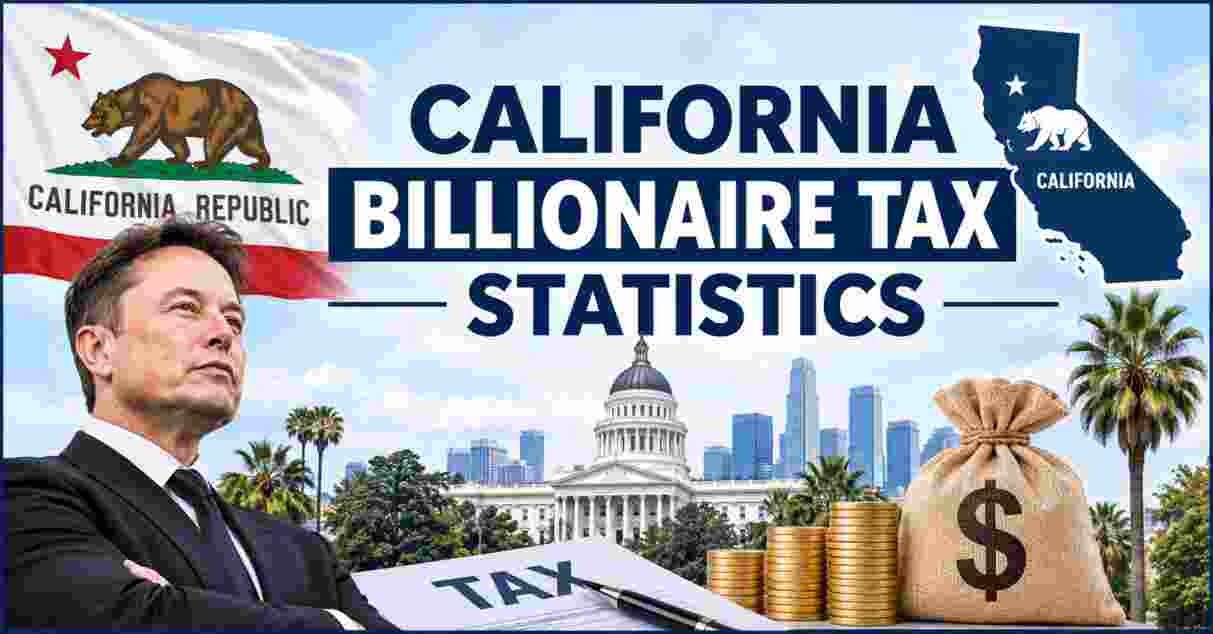
California billionaire tax for 2026 center on Proposition 40, a one-time 5% tax on the net worth of California residents worth more than $1 billion, on the November 3, 2026 ballot: backers project about $100 billion, while a Stanford and Hoover working paper estimates about $30 billion collected and a long-run net loss. Forbes counts 255 billionaires in California, and Propositions 41 and 42 could block Prop 40 even if it wins a majority of votes.
California Billionaire Tax 2026 – Introduction
The California billionaire tax goes to voters on November 3, 2026. Proposition 40 would charge a one-time 5% tax on the net worth of billionaires who lived in the state on January 1, 2026. Supporters call it a way to replace federal health care cuts. Opponents warn that it will drive wealth and future income tax payments out of the state. The measure has split California Democrats, and two rival ballot measures could cancel it.
The numbers behind California billionaire tax claims vary widely. Revenue forecasts run from about $30 billion to about $104 billion, depending on who counts and how many billionaires stay. Polls show a tight race. This report covers the measure’s terms, the revenue estimates, the wealthiest residents, the departures already under way, and the polling. It describes what each side claims and stops short of predicting the result.
Interesting Facts about California Billionaire Tax 2026
CALIFORNIA BILLIONAIRE TAX REVENUE ESTIMATES (billions of dollars)

Stanford/Hoover estimate  | ██████ 30
Backers' estimate         | ████████████████████ 100
Forbes estimate (Jan)     | █████████████████████ 104
| Fact | 2026 Data |
|---|---|
| Ballot designation | Proposition 40 |
| Tax rate | 5%, one time |
| Net worth threshold | $1 billion |
| Election date | November 3, 2026 |
| California billionaires, Forbes | 255 |
| Backers’ revenue estimate | About $100 billion |
| Stanford and Hoover revenue estimate | About $30 billion |
| Share of tax base already lost to departures | Nearly 30% |
Source: California Secretary of State; Forbes, October 14, 2026; Fortune and National Bureau of Economic Research working paper, October 2026; Forbes, January 14, 2026.
Proposition 40 is a one-time 5% excise tax on net worth above $1 billion, sponsored by the health care workers’ union SEIU-UHW. Residency is fixed on January 1, 2026, and assets are valued on December 31, 2026. Forbes counts 255 billionaires in California, more than any other state. Backers project about $100 billion. A Stanford and Hoover paper estimates about $30 billion would be collected.
The estimates differ because billionaires keep moving. The same paper says departures have already removed nearly 30% of the tax base. Two rival measures complicate the vote. If Proposition 41 or 42 gets more yes votes than Proposition 40, courts could stop Prop 40 even if it passes. Every dollar figure here is a projection, because nothing has been collected and the tax is not yet law.
California Billionaire Tax Proposal Details 2026
ALLOCATION OF PROPOSITION 40 REVENUE

Health care programs           | ██████████████████ 90%
Education and food assistance  | ██ 10%
| Provision | Detail |
|---|---|
| Type of tax | One-time excise tax on net worth |
| Rate | 5% |
| Threshold | $1 billion, phased in between $1 billion and $1.1 billion |
| Residency date | January 1, 2026 |
| Valuation date | December 31, 2026 |
| Payment schedule | Five annual installments of 1% |
| Revenue use | 90% health care, 10% education and food assistance |
| Votes needed to pass | Simple majority |
Source: California Secretary of State; Ernst & Young Tax News, October 29, 2026; PwC; Institute on Taxation and Economic Policy summary, 2026; NBC Los Angeles, 2026.
The measure combines a constitutional amendment with a statute. It taxes net worth, not income, and worldwide assets count. The 5% applies in full above $1.1 billion, with a phase-in between $1 billion and $1.1 billion. A supporter-aligned analysis says payment can be spread over five years in installments of 1%, with a small charge for deferral. The measure would create a dedicated 2026 Billionaire Tax Reserve Fund, kept apart from the general fund. It needs a simple majority, and proponents turned in about 1.6 million signatures against 874,641 required.
The Secretary of State certified the measure with 980,438 valid signatures, 12.1% above the requirement by our calculation. The money is split 90% to health care and 10% to education and food assistance. Backers say the funds would offset federal Medicaid cuts. Gov. Gavin Newsom opposes the measure, says it dedicates almost all of the revenue to health care, and supports a federal billionaire tax instead.
California Billionaire Tax Revenue Estimates 2026
ESTIMATED REVENUE FROM PROPOSITION 40 (billions)

Backers (includes 10% evasion allowance)  | ████████████████████ 100
Forbes analysis, January 2026             | █████████████████████ 104
Stanford/Hoover, midpoint                 | ██████ 30
Stanford/Hoover, low end                  | ██████ 28
Stanford/Hoover, high end                 | ███████ 36
| Source | Revenue Estimate | Note |
|---|---|---|
| Proposition 40 backers | About $100 billion | Allows 10% for avoidance and evasion |
| Forbes analysis | $104 billion | Net worths as of January 11, 2026 |
| Stanford and Hoover paper | About $30 billion | Range of $28 billion to $36 billion |
| Legislative Analyst’s Office | Tens of billions of dollars | Spread over several years |
Source: California Legislative Analyst’s Office; Forbes, January 14, 2026; National Bureau of Economic Research working paper, October 2026, via Fortune; CNBC, October 22, 2026. All figures are projections.
The estimates cluster in two camps. Backers project about $100 billion, and a Forbes analysis from January reached $104 billion using net worths as of January 11. The Stanford and Hoover paper estimates about $30 billion, within a range of $28 billion to $36 billion, after counting departures that have already happened. The nonpartisan Legislative Analyst’s Office offers no single figure and says revenue would reach tens of billions of dollars over several years.
The gap of about $70 billion between the $100 billion and $30 billion estimates is our calculation. Because payment can be spread over five years, annual receipts would be a fraction of any total. It reflects different assumptions on who stays, how assets are valued, and how much tax is avoided. Some economists, including UC Berkeley’s Enrico Moretti, call the higher estimate far too optimistic. Supporters say their number already includes a 10% allowance for avoidance and evasion, and that billionaires who lived in California on January 1 owe the tax regardless of where they live later.
California’s Wealthiest Residents and 5% Tax Estimates 2026
NET WORTH OF CALIFORNIA'S RICHEST (billions)

Larry Page      | ████████████████████████████ 282.0
Sergey Brin     | █████████████████████████ 259.5
Mark Zuckerberg | ████████████████████████ 242.0
Jensen Huang    | ██████████████████ 188.1
Eric Schmidt    | ███ 38.3
| Name | Net Worth | Reported Residence | 5% of Net Worth |
|---|---|---|---|
| Larry Page | $282.0 billion | Miami, Florida | $14.1 billion |
| Sergey Brin | $259.5 billion | Crystal Bay, Nevada | $13.0 billion |
| Mark Zuckerberg | $242.0 billion | Palo Alto, California | $12.1 billion |
| Jensen Huang | $188.1 billion | Los Altos, California | $9.4 billion |
| Eric Schmidt | $38.3 billion | Atherton, California | $1.9 billion |
Source: Forbes real-time net worth as compiled by Stacker, October 19, 2026. The 5% figures are our illustrative calculation, not assessed bills. Page and Brin say they left California before January 1, 2026.
Forbes ranks Larry Page first among Californians at $282.0 billion, followed by Sergey Brin at $259.5 billion, Mark Zuckerberg at $242.0 billion and Jensen Huang at $188.1 billion. Eric Schmidt follows at $38.3 billion. A flat 5% of those fortunes would equal $14.1 billion for Page, $13.0 billion for Brin, $12.1 billion for Zuckerberg and $9.4 billion for Huang. These are illustrations, because the measure uses its own valuation rules.
Residence decides who owes. Page and Brin now list homes in Florida and Nevada, according to Forbes, though Forbes could not find documents confirming the moves. The tax applies based on January 1, 2026 residency, so their liability depends on whether the moves count as complete before that date. Huang has said he is fine with the tax and expects to owe about $9 billion. Zuckerberg and Schmidt had made no public statement on relocation as of January, according to the SF Standard’s tracker.
California Billionaire Departures and Lost Tax Base 2026
SHARE OF PROP 40 TAX BASE LOST TO DEPARTURES

Already lost | ███████████████ 30%
Remaining    | ███████████████████████████████████ 70%
| Measure | Figure | Source |
|---|---|---|
| Billionaires who left over the tax, as of March 2026 | 6 | Fortune |
| Potential revenue taken with them, March 2026 | $27 billion | Fortune |
| Revenue linked to Page and Brin alone | $25 billion | Fortune |
| Tax base already lost | Nearly 30% | Stanford and Hoover paper |
| Billionaires who left California since 2010 | More than 30 | Forbes, January 2026 |
| Estimated annual income tax loss from departures | $1 billion to $3.5 billion | Stanford and Hoover paper |
Source: Fortune, March 17, 2026 and October 21, 2026; Forbes, January 14, 2026; National Bureau of Economic Research working paper, October 2026. The 70% remainder is our calculation.
By March, six billionaires had left California over the proposal, taking about $27 billion in potential tax revenue. Page and Brin alone account for $25 billion of that. An entity tied to Brin moved or ended 15 California limited liability companies, and seven became Nevada entities. Venture capitalists Peter Thiel and David Sacks also moved operations to Florida and Texas, and In-N-Out heir Lynsi Snyder said she was relocating to Tennessee. The Stanford and Hoover paper says departures have removed nearly 30% of the tax base, leaving about 70%.
Departures also affect annual income tax. The Stanford and Hoover researchers estimate the state could lose $1 billion to $3.5 billion a year, while the Legislative Analyst’s Office says less than $1 billion a year. More than 30 billionaires have left since 2010, according to Forbes, for many reasons, not only taxes. Supporters argue the January 1, 2026 residency rule makes leaving now pointless. Opponents say the signal to future entrepreneurs matters more than any single move.
California Billionaire Count and Total Wealth 2026
TOTAL BILLIONAIRE WEALTH BY STATE, 2026 (trillions)

California | █████████████████████████████████████ 1.87
Texas      | ███████████████████████████████████████ 1.94
| Measure | Figure | Source |
|---|---|---|
| California billionaire residents | 255 | Forbes, October 14, 2026 |
| California billionaire wealth | $1.87 trillion | Forbes, October 14, 2026 |
| Texas billionaire wealth | $1.94 trillion | Forbes, October 14, 2026 |
| California estimate, mid-2026 | About $2.3 trillion | Researchers cited by HuffPost |
| Californians on the Forbes 400 | 85 | Forbes, September 2026 |
Source: Forbes, October 14, 2026 and September 2026; HuffPost reporting on researchers’ estimate. Estimates differ because net worths and residents change. The gap with Texas is our calculation, about 3.6%.
California still has the most billionaires, 255, but Forbes says its combined billionaire wealth of $1.87 trillion now ranks second to Texas at $1.94 trillion, a gap of about 3.6%. Elon Musk, Texas’s richest resident, was worth about $1 trillion on Forbes’ October 9 lock date. A separate research estimate put California’s billionaire wealth near $2.3 trillion in mid-2026, equal to about half of annual state output. The two totals differ because they use different dates, definitions and valuations.
The state also holds 85 of the 400 richest Americans. Counts of California billionaires vary by source, from about 200 in the Legislative Analyst’s Office analysis to about 250 in supporters’ claims and 255 at Forbes. A higher count raises projected revenue, and a lower one narrows it. Researchers estimate billionaires paid only 0.2% of their wealth in state income taxes from 2023 to 2025, a figure supporters cite in making their case.
California Billionaire Tax Polls and Voter Support 2026
PROPOSITION 40 POLLS: YES VS NO (each █ = 2%)

PPIC, September            Yes | ██████████████████████████ 52%
                           No  | ███████████████████████ 46%
Citrin Center-Politico     Yes | ███████████████████████ 46%
                           No  | ██████████████████████ 43%
Berkeley IGS-LA Times      Yes | █████████████████████ 42%
                           No  | █████████████████████████ 50%
| Poll | Yes | No | Margin |
|---|---|---|---|
| Public Policy Institute of California, September | 52% | 46% | +6 |
| Citrin Center and Politico, October | 46% | 43% | +3 |
| Berkeley IGS and Los Angeles Times | 42% | 50% | -8 |
| Earlier poll cited by Baker Botts, spring | 52% | 33% | +19 |
Source: Public Policy Institute of California; Citrin Center and Politico; UC Berkeley Institute of Governmental Studies and Los Angeles Times, via The Hill and Fortune; Baker Botts, May 2026. Margins are our calculation. Polls are snapshots, not forecasts.
Polls disagree. The Public Policy Institute of California found 52% yes and 46% no in September. A Citrin Center and Politico survey of likely voters found 46% yes and 43% no. A Berkeley IGS and Los Angeles Times poll found 42% yes and 50% no, with 8% undecided, a margin outside its 3-point error range. Spring polling had shown support at 52% against 33%, so the margin has narrowed from +19 to between +6 and -8.
Ballot initiatives that start below 50% support have historically struggled, according to analysts at Capital Group. Most polls here put Prop 40 near that line. The measure also faces a structural hurdle beyond voter opinion, because rival measures can override it. State polling on those measures is shown in the next section, and no poll can say how many yes voters on Proposition 40 will also vote yes on a counter-measure.
Propositions 41 and 42 and Campaign Spending on the Billionaire Tax 2026
SEPTEMBER SUPPORT FOR CALIFORNIA TAX MEASURES

Prop 40, billionaire tax   | ██████████████████████████ 52%
Prop 41, spending limit    | █████████████████████████ 51%
Prop 42, tax ban           | ███████████████████████████ 54%
| Measure | What It Does | September Support |
|---|---|---|
| Proposition 40 | One-time 5% tax on billionaire net worth | 52% |
| Proposition 41 | Applies a 1979 spending limit to new taxes | 51% |
| Proposition 42 | Bars new taxes on personal property and retroactive taxes | 54% |
| Spending against Prop 40 | Sergey Brin over $100 million; a group backing Prop 42 gave $73.8 million | Not applicable |
| Gov. Newsom’s position | Opposes Prop 40, endorsed Prop 42 on October 9 | Not applicable |
Source: Public Policy Institute of California, September 2026; Legislative Analyst’s Office; Los Angeles Public Press, October 2026; Forbes, October 14, 2026; Tax Notes, October 19, 2026.
Two counter-measures sit on the same ballot. Proposition 41 would apply California’s 1979 spending limit to new taxes. Proposition 42 would bar new taxes on personal property and block retroactive taxes, which conflicts with Prop 40’s January 1 residency rule. The Legislative Analyst’s Office says that if either gets more yes votes than Proposition 40, the courts could stop Prop 40 even if it also wins a majority. September polling put Prop 41 at 51% and Prop 42 at 54%.
Money flows heavily to the opposition. Brin has given more than $100 million against the tax, including $20 million to Building a Better California. One group dropped another $73.8 million to support Prop 42. Peter Thiel gave $3 million to the California Business Roundtable. Supporters include the state Democratic Party, the AFL-CIO, the Teamsters and Sen. Bernie Sanders. Newsom and Democratic governor nominee Xavier Becerra oppose Prop 40, and Newsom backs a national tax instead.
California Billionaire Tax Net Fiscal Impact and Income Tax Risk 2026
STANFORD/HOOVER LONG-RUN RESULT (billions of dollars)

Revenue collected           | ██████ +30
Net long-run fiscal change  | ████████ -39
Earlier analysis, net       | █████ -25
| Measure | Figure | Source |
|---|---|---|
| Revenue collected | About $30 billion | Stanford and Hoover paper |
| Net long-run fiscal change | -$39 billion | Stanford and Hoover paper |
| Scenarios with net loss | 85% of 100,000 | Stanford and Hoover paper |
| Earlier analysis | $40 billion revenue, $25 billion net loss | Prior research cited by Fortune |
| Annual income tax loss | Under $1 billion | Legislative Analyst’s Office |
| State budget | $352 billion | Los Angeles Public Press |
Source: National Bureau of Economic Research working paper by Benjamin Jaros and Joshua Rauh, October 2026; Legislative Analyst’s Office; Fortune, October 21, 2026. Simulation results are modeled estimates.
The Stanford and Hoover simulation estimates about $30 billion collected but a net long-run loss of $39 billion once lost income tax is counted. It found a net loss in 85% of 100,000 simulated scenarios. An earlier analysis projected $40 billion in revenue and a $25 billion net loss. These are models, and results depend on assumptions about how many billionaires leave and how fast their incomes would otherwise grow. Neither estimate reflects the vote, due after polls close on November 3. The largest unknown is how billionaires behave once the vote is counted.
The Legislative Analyst’s Office takes a narrower view. It says departures would cut state income tax by less than $1 billion a year, against a $352 billion budget, and that revenue from the tax itself could reach tens of billions over several years. Supporters respond that billionaires paid very little income tax relative to wealth, and that projected tax revenue could be many times their past annual payments. The dispute is about long-run behavior that nobody can yet measure.
Frequently Asked Questions About California Billionaire Tax 2026
What is the California billionaire tax in 2026?
Proposition 40 is a one-time 5% tax on the net worth of California residents worth more than $1 billion. It appears on the November 3, 2026 ballot.
Who would pay the California billionaire tax in 2026?
California resident individuals and certain trusts with a net worth above $1 billion, based on residency on January 1, 2026 and valuation on December 31, 2026.
How much would the California billionaire tax raise in 2026?
Backers project about $100 billion. A Stanford and Hoover paper estimates about $30 billion. The Legislative Analyst’s Office says tens of billions over several years.
Where would the billionaire tax money go in 2026?
Under Proposition 40, 90% goes to health care and 10% to education and food assistance.
How many billionaires live in California in 2026?
Forbes counts 255, the most of any state. The Legislative Analyst’s Office cites roughly 200.
Who are California’s richest people in 2026?
Larry Page, Sergey Brin, Mark Zuckerberg and Jensen Huang lead, with net worths of $282.0 billion, $259.5 billion, $242.0 billion and $188.1 billion. Page and Brin report living in Florida and Nevada.
Have billionaires left California over the tax in 2026?
Yes. Page, Brin, Thiel and Sacks are among those reported to have moved. A Stanford and Hoover paper says departures removed nearly 30% of the tax base.
What do Propositions 41 and 42 do in 2026?
Prop 41 applies a 1979 spending limit to new taxes. Prop 42 bars new taxes on personal property and retroactive taxes. Either could stop Prop 40 if it gets more yes votes.
Does Gavin Newsom support the billionaire tax in 2026?
No. Newsom opposes Proposition 40, endorsed Proposition 42 on October 9, and favors a national billionaire tax.
What do polls say about Proposition 40 in 2026?
Polls vary: 52% yes in a September PPIC survey, 46% in a Citrin Center and Politico poll, and 42% yes with 50% no in a Berkeley IGS poll.
What happens if Proposition 40 passes in 2026?
It takes effect unless Proposition 41 or 42 passes with more yes votes. Critics have also raised legal challenges to the retroactive residency rule.
When will the California billionaire tax result be known in 2026?
Votes are counted after polls close on November 3, 2026. Mail ballots and close races can take days to resolve.
How does the billionaire tax value business interests in 2026?
Proposition 40 uses a book value plus earnings multiplier for business interests and sets strict rules for charitable pledges and trusts, according to PwC.
Does the California billionaire tax apply to homes in 2026?
The measure excludes directly held real estate such as a primary home. Supporters describe it as an excise tax on extreme wealth, not a property tax.
Can billionaires avoid the California tax by leaving in 2026?
Not by leaving after January 1, 2026. Residents on that date owe the tax in full, according to supporters’ analysis, though critics say that rule is vulnerable in court.
Disclaimer: This research report is compiled from publicly available sources. While reasonable efforts have been made to ensure accuracy, no representation or warranty, express or implied, is given as to the completeness or reliability of the information. We accept no liability for any errors, omissions, losses, or damages of any kind arising from the use of this report.