
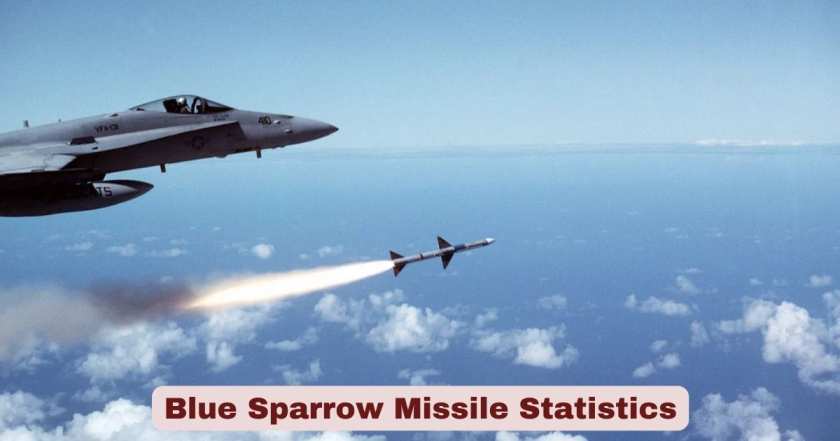
What Is the Blue Sparrow Missile?
The Blue Sparrow — designated Ankor Cahol (אנקור כחול) in Hebrew — is an Israeli medium-range air-launched ballistic missile (ALBM) produced by Rafael Advanced Defense Systems, measuring 6.51 meters (21.4 ft) in length, weighing 1,900 kilograms (4,200 lb), and capable of reaching targets at ranges up to 2,000 kilometers (1,200 miles) on a high ballistic trajectory that briefly carries the weapon beyond the dense atmosphere before a steep, quasi-vertical re-entry at extreme velocity. Originally conceived and fielded as the middle tier of Israel’s three-variant Sparrow target missile family — alongside the smaller Black Sparrow (4.85 m / 1,275 kg, simulating Scud-B class threats) and the larger Silver Sparrow (8.39 m / 3,130 kg, simulating Shahab-3 class intermediate-range ballistic missiles) — the Blue Sparrow was designed and built to replicate the altitude, velocity, thermal signature, and radar cross-section of Scud-C/D class and Iranian Shahab-series medium-range ballistic missiles during live-fire testing of Israel’s Arrow anti-ballistic missile (ABM) defense system, giving Israeli and American missile defense engineers a credible, repeatable, air-launched surrogate target capable of flying the exact trajectory profiles that Israel’s Arrow interceptors would eventually need to defeat in actual combat. The program was developed by Rafael with joint participation from Raytheon and formal support from the U.S. Missile Defense Agency (MDA), the Israel Missile Defense Organization (IMDO), and the Directorate of Defense Research and Development (DDR&D) — a tri-agency sponsorship reflected in the IMDO, MDA, and DDR&D logos clearly visible on production Blue Sparrow airframes in official IAF imagery.
The missile employs single-stage solid rocket propulsion and carries a modular payload section at its nose that, in the original test configuration, accommodates inert, instrumented, water-filled, or high-explosive (HE) warheads interchangeably within the same external envelope — a modularity that designers included to replicate different threat warhead mass properties during testing but that simultaneously created the technical foundation for operational offensive employment. The Divert and Attitude Control System (DACS) installed on the re-entry vehicle uses small lateral thrusters to maneuver the warhead section in the terminal phase, replicating the behavior of maneuvering Iranian ballistic missile warheads that Israel’s defense systems must be capable of defeating — and, in an offensive context, making the weapon significantly harder to intercept itself.
The Blue Sparrow’s transition from dedicated test asset to operational strike weapon is one of the most significant doctrinal evolutions in Israeli air power in the past decade. The Financial Times reported experts identifying Blue Sparrow — specifically from its spent rocket booster remnants recovered in Al-Azizia, Wasit Province, Iraq (approximately 100 kilometers from the Iranian border) — as the weapon employed in Israel’s April 2024 strikes on Iran, the first publicly documented operational use of an air-launched ballistic missile by the Israeli Air Force (IAF) in combat. The operational logic is straightforward: an IAF F-15D or F-15I launching a Blue Sparrow from Iraqi or Syrian airspace can send its warhead 2,000 km into Iran’s interior at velocities that compress adversary radar detection and intercept response time to seconds, while the launching aircraft — itself potentially hundreds of kilometers away — turns and exits the threat envelope before Iranian air defenses can calculate an intercept geometry. Blue Sparrow was used in 2024 and the related Black Sparrow variant in the initial standoff attacks of the 2026 Iran War — while Army Recognition (March 2026) and open-source intelligence analysts documented Blue Sparrow-series booster debris recovered in western Iraq and parts of Syria in the days following the February 28, 2026 opening of Operation Epic Fury, consistent with prior documented pattern of employment and suggesting operational Sparrow-family missiles participated in the opening strike waves of the 2026 Iran conflict.
Blue Sparrow Missile (Israel) 2026 — Key Facts
| # | Blue Sparrow Key Fact | Details |
|---|---|---|
| 1 | 6.51 m Length, 1,900 kg — Middle Variant of Israel’s Three-Missile Sparrow Family | The Blue Sparrow measures 6.51 meters (21.4 ft) in length and weighs 1,900 kg (4,200 lb) — the mid-tier variant between the Black Sparrow (4.85 m / 1,275 kg) and Silver Sparrow (8.39 m / 3,130 kg) — confirmed by Wikipedia – Sparrow target missile and GlobalSecurity |
| 2 | 2,000 km Range on High Ballistic Trajectory — Israel to Iran Without Refueling | The Blue Sparrow carries a confirmed range of 2,000 km (1,200 miles) on a high ballistic trajectory — sufficient to reach virtually any target inside Iran when launched from an Israeli F-15 at optimal altitude, as confirmed by Wikipedia – Sparrow target missile and Army Recognition, March 2026 |
| 3 | Financial Times Experts Identify Blue Sparrow Booster Debris in Iraq After April 2024 Iran Strikes | The Financial Times reported experts identifying the Blue Sparrow as the weapon used in Israel’s April 2024 strikes on Iran — from spent booster remnants recovered in Al-Azizia, Wasit Province, Iraq, approximately 100 km from the Iranian border — the first publicly documented operational use of the system |
| 4 | Blue Sparrow-Series Booster Debris Found in Western Iraq and Syria — February 28, 2026 | Following the February 28, 2026 opening of Operation Epic Fury, open-source intelligence analysts documented debris consistent with Blue Sparrow-series boosters recovered in western Iraq and parts of Syria — consistent with prior 2024 and 2025 documented operational employment pattern (Army Recognition; Defence-Blog; Army Recognition, March 2026) |
| 5 | Single-Stage Solid Rocket Propulsion + Separable Re-Entry Vehicle — Booster Falls Away After Stage Separation | The Blue Sparrow uses single-stage solid rocket propulsion to boost a separable re-entry vehicle that continues to target independently — the spent booster section falls to the ground after separation, which is precisely the hardware recovered in Iraq following 2024 and 2026 strikes (OSMP; Wikipedia; GlobalSecurity) |
| 6 | DACS Maneuvering Re-Entry Vehicle — Simulates and Mirrors Iranian Maneuvering Warheads | The Blue Sparrow re-entry vehicle is equipped with a Divert and Attitude Control System (DACS) — small lateral rocket thrusters enabling trajectory adjustments in the terminal phase — both replicating Iranian maneuvering warhead behavior for Arrow testing and making the weapon significantly harder to intercept in offensive use (Islamic World News; GlobalSecurity) |
| 7 | Modular Warhead: Inert, HE, or Water-Filled — Same External Envelope | The Blue Sparrow carries a modular payload section accommodating inert, high-explosive (HE), or water-filled warheads interchangeably within the same external dimensions — originally enabling different mass simulation during ABM tests; providing operational flexibility when adapted for offensive strike (Rafael Sparrow PDF; OSMP; GlobalSecurity) |
| 8 | Launched from IAF F-15D / F-15I at Altitude — Apogee ~100 km | The Blue Sparrow is air-launched from IAF Boeing F-15D / F-15I fighters — the first public image of the system showed an F-15D carrying it in July 2007 — it follows a high ballistic arc reaching an apogee of approximately 100 km, briefly exiting the atmosphere before re-entry (Astronautix; The Aviationist, December 2020; GlobalSecurity) |
| 9 | First Blue Sparrow Test: April 15, 2008 — Arrow 2 Block-4 Simulated Intercept | The Blue Sparrow’s first confirmed test occurred on April 15, 2008 — launched from an IAF F-15 at 90,000 feet (27.5 km), simulating a Scud-C/D threat for Arrow 2 Block-4 evaluation; the Arrow system successfully detected and made a simulated intercept (Medium – Prajesh Majumdar; Islamic World News; missilery.info) |
| 10 | December 2020 — Blue Sparrow Launched in David’s Sling Multi-Layer ABM Test | In December 2020, an IAF F-15D launched a Blue Sparrow as part of a multi-system David’s Sling, Arrow, and Iron Dome integrated test — the first combined interception capabilities assessment of Israel’s entire layered air defense network (The Aviationist, December 17, 2020; Wikipedia – Sparrow target missile) |
| 11 | Manufactured by Rafael Under Joint Program with Raytheon and Three Co-Sponsors | The Blue Sparrow is manufactured by Rafael Advanced Defense Systems under a joint program with Raytheon (USA) — co-sponsored by the U.S. Missile Defense Agency (MDA), Israel Missile Defense Organization (IMDO), and Directorate of Defense Research and Development (DDR&D) — all three logos visible on production airframes (OSMP; The Aviationist; Rafael official) |
| 12 | Wikipedia (March 5, 2026): Blue Sparrow Used in 2024 Strikes; Black Sparrow Used in 2026 Iran War | Wikipedia’s Sparrow target missile article (updated March 5, 2026) explicitly records: Blue Sparrow used in 2024 Iran attacks; Black Sparrow used in 2026 Iran War initial standoff attacks — the first published encyclopedic confirmation of the operational use timeline for the entire Sparrow family |
| 13 | Golden Horizon — Classified F-15I-Launched Derivative of Silver Sparrow — Leaked by NSA/NGA Document | A classified document from the NSA and National Geospatial-Intelligence Agency (NGA), published on Telegram by an Iran-linked channel in October 2024, referred to Golden Horizon — assessed by analysts as a heavier, F-15I-launched derivative of the Silver Sparrow capable of carrying HE, canister, nuclear, or bunker-busting warheads (SOFREP; GlobalSecurity) |
| 14 | ROCKS Missile: Weaponized Black Sparrow — Rafael’s Exported ALBM Derived from Same Family | Rafael’s ROCKS missile — unveiled at Aero India 2019 and confirmed as a direct development of the Black Sparrow — is a Mach 3 air-to-surface ALBM with 300–500 mile range, 3 m CEP, INS/GPS guidance, EO seeker, and anti-radiation homing — the most visible public export derivative of the Sparrow weapons family (Rafael official; Islamic World News; SOFREP) |
| 15 | No IDF or DoD Official Confirmation of 2026 Operational Use — Debris Evidence Assessed as Consistent, Not Conclusive | As of March 6, 2026, neither the Israel Defense Forces nor the U.S. Department of Defense has publicly confirmed which specific munitions were used in the February 28, 2026 strikes — the debris evidence from Iraq and Syria is assessed by open-source analysts as consistent with Blue Sparrow-series hardware but not independently forensically confirmed (Army Recognition; Bolt Flight; Defence Talks, March 2026) |
Source: Wikipedia – Sparrow target missile, updated March 5, 2026; Financial Times – experts identify Blue Sparrow booster in April 2024 Iran strike, 2024; Army Recognition – Israel May Have Employed Blue Sparrow Air-Launched Missiles in Early Waves of Iran Strike Campaign, March 2026; Defence-Blog – Israel reportedly uses Blue Sparrow missile in Iran strike, February 2026
These Blue Sparrow missile key facts for 2026 trace a weapons system that began as a sophisticated missile defense test tool and ended the year — by every available open-source indicator — as an operational precision-strike weapon employed in one of the most consequential air campaigns in Middle Eastern history. The identification of Blue Sparrow booster debris in Iraq following the April 2024 Iran strikes was the inflection point: it confirmed that Israel had adapted a system originally designed to help build its own missile defenses into an offensive weapon capable of penetrating the air defenses of the country those defenses were designed to protect against. The modular warhead section and the DACS maneuvering re-entry vehicle — both features included specifically to make the Blue Sparrow a more realistic and challenging test target for Arrow interceptors — turned out to be exactly the features that made the weapon most effective offensively: the modular section accepts a live HE warhead with no external changes, and the DACS maneuvering capability makes terminal-phase interception by Iranian air defenses substantially harder. The engineering designed to test Israel’s shields became part of Israel’s swords.
The December 2020 David’s Sling multi-layer test remains the most publicly documented use of the Blue Sparrow in its original testing role — with IAF images showing the F-15D carrying the recognizable orange-finned booster section that would later appear in Iraqi field photographs in April 2024. The continuity between those 2020 test images and the 2024 debris photographs is what allowed open-source analysts and experts to confirm the weapon’s identity without official acknowledgment from the IDF. The pattern repeated in 2026: the same booster geometry, the same flight corridor over Iraq, the same absence of official confirmation. Whether the 2026 employment involved Blue Sparrow specifically or the related Black Sparrow variant – the operational trajectory of the entire Sparrow family is now established: these weapons are dual-use assets that Israel has fielded as both the targets for its missile defenses and the instruments of its precision-strike doctrine simultaneously.
Blue Sparrow Missile 2026 — Full Technical Specifications
| Specification | Blue Sparrow (Ankor Cahol) | Comparison: Black Sparrow | Comparison: Silver Sparrow |
|---|---|---|---|
| Hebrew Name | Ankor Cahol (אנקור כחול) | Ankor Shahor | Ankor Kesef |
| Manufacturer | Rafael Advanced Defense Systems | Rafael | Rafael |
| Development Partner | Raytheon (USA) — joint program | Raytheon | Raytheon |
| Program Sponsors | MDA (USA) + IMDO (Israel) + DDR&D (Israel) | Same | Same |
| Length | 6.51 meters (21.4 ft) | 4.85 m (15.9 ft) | 8.39 m (27.5 ft) |
| Weight | 1,900 kg (4,200 lb) | 1,275 kg (2,811 lb) | 3,130 kg (6,900 lb) |
| Propulsion | Single-stage solid rocket motor | Single-stage solid | Single-stage solid |
| Range | 2,000 km (1,200 miles) — high ballistic trajectory | ~300 km (Scud-B class) | 1,500–2,000 km (Shahab-3 class) |
| Apogee | ~100 km (exo-atmospheric / edge of space) | Endo-atmospheric | ~100+ km |
| Speed / Terminal Velocity | Hypersonic — exact speed classified; re-enters at extreme velocity | High supersonic | Hypersonic |
| Trajectory | High ballistic arc — exo-atmospheric ascent; steep quasi-vertical re-entry | Ballistic | Ballistic |
| Separable Re-Entry Vehicle | Yes — booster falls away after stage separation | No | Yes |
| DACS Maneuver System | Yes — Divert and Attitude Control System on re-entry vehicle | No | Unknown |
| Guidance | Inertial Navigation System (INS) + GPS satellite navigation | INS + GPS | INS + GPS |
| Warhead — Test Config | Modular: inert / instrumented / water-filled | Same modular | Same modular |
| Warhead — Offensive Config | High-explosive (HE) fragmentation | HE (ROCKS variant) | HE / bunker-busting (Golden Horizon) |
| Threat Simulated | Scud-C/D class; Iranian Shahab-series medium-range ballistic missiles | Scud-B class | Shahab-3 class (1,500–2,000 km IRBM) |
| Launch Platform | IAF Boeing F-15D / F-15I Strike Eagle | F-15D / F-15I (also F-16i noted) | C-130 (test); F-15I (Golden Horizon derivative) |
| Operational Carriers | F-15D (testing); F-15I (strike operations) | F-15D; F-16i | C-130 (Silver Sparrow); F-15I (Golden Horizon) |
| First Image Released | July 2007 — IAF F-15D carrying Blue Sparrow | 1990s development | 2013 |
| First Test Flight | April 15, 2008 — Arrow 2 Block-4 simulated intercept | September 14, 2000 (Arrow AST-5) | September 2, 2013 |
| First Confirmed Combat Use | April 2024 — Israel strikes on Iran (Financial Times experts; Iraqi debris) | 2026 Iran War (Wikipedia, March 2026) | No confirmed combat use |
| Telemetry / FTS | Adjustable telemetry; radar transponders; Flight Termination System (FTS) | Same | Same |
| Warhead Options | Inert; high-explosive; water-filled; canister (Golden Horizon equivalent) | Inert; HE; water-filled | Inert; HE; nuclear (assessed) |
| Offensive Derivative | Blue Sparrow (direct operational adaptation) / Golden Horizon (heavier variant) | ROCKS missile | Golden Horizon |
| Export Status | Not publicly offered for export — ROCKS (Black Sparrow derivative) is the export product | Exported (France, others); ROCKS is export ALBM | No known export |
| Current Status | Operational — dual-use: ABM test target + confirmed offensive strike weapon | Operational — ABM test + 2026 offensive use | Operational — ABM test; no confirmed offensive use |
Source: Wikipedia – Sparrow target missile, updated March 5, 2026; GlobalSecurity – Sparrow Air-Launched BMD Targets; OSMP – Blue Sparrow series; Army Recognition – Israel May Have Employed Blue Sparrow ALBMs, March 2026; The Aviationist – Blue Sparrow test, December 17, 2020
The Blue Sparrow full technical specifications confirm a missile that occupies a unique dual-use niche with no direct equivalent in any other nation’s arsenal. Every other air-launched ballistic missile in any active inventory was designed from the outset to be a weapon — the Blue Sparrow was designed to be a target, and its transformation into a weapon was achieved primarily by replacing the inert test payload in the modular nose section with a live high-explosive warhead. The airframe, propulsion, guidance, and re-entry vehicle remained unchanged. This means the Blue Sparrow offensive variant carries none of the observable signatures of a purpose-built ALBM program: there are no new production facilities, no new contractor activity, no new export control notifications, and no new testing requirements that would trigger intelligence community attention. The weapon is simply a test missile with a warhead — and the modular nose section design ensures that the conversion is operationally seamless.
The DACS maneuvering re-entry vehicle deserves particular attention in the offensive context. When the Blue Sparrow was used in Arrow testing, the DACS was activated to simulate the evasive maneuvers that Iranian engineers were building into their own ballistic missile warheads to complicate Israeli interceptor targeting. The engineers at Rafael who designed the DACS knew exactly how to make a re-entry vehicle difficult to intercept — they built that knowledge into the Blue Sparrow to test whether Arrow could overcome it. When the Blue Sparrow flies offensively, that same DACS maneuverability works against Iranian air defense interceptors instead, exploiting decades of Israeli engineering investment in defeating exactly the kind of defensive system that Iran has deployed to protect its highest-value targets. The apogee of approximately 100 km — briefly beyond the atmosphere — further compresses the reaction window for Iranian air defense operators: a target that disappears from conventional radar coverage on ascent and reappears at hypersonic velocity on a near-vertical terminal trajectory from near space gives radar operators and interceptor batteries only seconds to generate a firing solution, far less time than a conventional cruise missile or stand-off glide bomb provides.
Blue Sparrow Missile 2026 — Combat & Operational History Statistics
| Event | Date | Details | Source |
|---|---|---|---|
| First Public Image Released | July 2007 | Israeli Ministry of Defense releases first image of IAF F-15D carrying Blue Sparrow target missile — formally introducing the system publicly | GlobalSecurity; The Aviationist |
| First Test Flight — Arrow 2 Block-4 | April 15, 2008 | Blue Sparrow launched from IAF F-15 at 90,000 ft (27.5 km); Arrow 2 successfully detected and made simulated intercept; missile split into multiple warheads during test | Medium – Arrow analysis; missilery.info; Islamic World News |
| Second Test — Arrow 2 Block-4 (First Successful) | April 7, 2009 | Blue Sparrow launched from IAF F-15 at approximately 1,000 km range over Mediterranean; Arrow 2 Block-4 successfully intercepted — after a September 2008 test of same scenario had failed | missilery.info; Islamic World News |
| Arrow 2 Block-4 Tracking Test | February 10, 2012 | Blue Sparrow detected and tracked by Super Green Pine radar; intercept solutions plotted and transferred to launch units — no actual interceptor launch; final tracking test before Block-4 system delivery | Wikipedia – Arrow missile family; missilery.info |
| December 2020 — David’s Sling Multi-Layer Test | December 2020 | IAF F-15D launches Blue Sparrow; David’s Sling, Arrow, and Iron Dome systems conduct first combined multi-layer interception test of Israel’s entire integrated air defense network; Blue Sparrow successfully engaged by David’s Sling interceptors | The Aviationist, December 17, 2020; Wikipedia – Sparrow target missile |
| April 2024 Israel Strikes on Iran | April 2024 | Blue Sparrow booster remnants recovered in Al-Azizia, Wasit Province, Iraq (~100 km from Iran border); Financial Times reports experts identifying Blue Sparrow as weapon used in Israeli strikes — first confirmed operational offensive use of the system | Financial Times, 2024; SOFREP; Wikipedia – Sparrow target missile |
| October 2024 Israel Strikes on Iran | October 2024 | Second round of Israel strikes on Iran; Blue Sparrow booster debris found in Salahuddin Province, Iraq — consistent with second confirmed operational employment | Islamic World News; SOFREP |
| NSA / NGA Document Leak | October 2024 | Classified NSA and NGA document published by Iran-linked Telegram channel identifies planned operational use of 40 ROCKS (radar-site suppression) and 16 Golden Sparrows (heavier Silver Sparrow derivative, various warhead options including nuclear and bunker-busting) in planned follow-on strike package | SOFREP; GlobalSecurity |
| February 28, 2026 — Operation Epic Fury Opening | February 28, 2026 | Open-source imagery shows rocket booster debris consistent with Blue Sparrow-series hardware in western Iraq and Syria; nighttime IAF F-15 departures documented on social media; Army Recognition and other analysts assess possible operational use of Blue Sparrow-family missiles in opening strike waves | Army Recognition, March 2026; Defence Talks; Bolt Flight; Defence-Blog |
Source: Financial Times – experts identify Blue Sparrow in April 2024 Iran strike, 2024; Wikipedia – Sparrow target missile, updated March 5, 2026; Wikipedia – Arrow missile family; The Aviationist – Blue Sparrow David’s Sling test, December 17, 2020; missilery.info – Arrow-2 test record; Army Recognition – Israel May Have Employed Blue Sparrow ALBMs
The Blue Sparrow combat and operational history statistics document a system that moved from test tool to combat weapon with minimal institutional friction precisely because the conversion required no new development, no new platform integration, and no new operational concept — only a warhead swap in a nose section designed from the beginning to be interchangeable. The April 2024 operational debut established the template: IAF F-15Is carry the missiles deep into Iraqi or Syrian airspace, release them at altitude on a pre-programmed ballistic trajectory, and exit the threat zone while the missiles continue to Iran under inertial and GPS guidance. The spent boosters — the only hardware that does not reach the target — fall onto Iraqi territory, where they become the evidence trail that analysts use to reconstruct the strike. Israel has never publicly confirmed any individual Sparrow-family employment; the entire operational use record rests on physical evidence and expert analysis of debris that no one in the Israeli government has contradicted. The pattern of employment in April 2024, October 2024, and the assessed February 2026 operations shows increasing integration of air-launched ballistic missiles into Israeli strike packages — from what appears to have been a limited inaugural use in April 2024 to what Army Recognition and multiple open-source analysts assessed as a significant opening-wave role in the February 28, 2026 campaign.
The NSA/NGA document leak of October 2024 — regardless of how it entered public circulation — provided the most specific public indication of Israeli operational planning around the Sparrow family, including planned allocation of specific numbers of ROCKS missiles for radar suppression and Golden Horizon-equivalent weapons for high-value fixed-target strikes in a planned follow-on operation. If those numbers are accurate, Israel had pre-positioned an air-launched ballistic missile arsenal of meaningful scale against a set of pre-planned Iranian targets well before the February 2026 escalation. The update of March 5, 2026 — recording Black Sparrow as the weapon used in the 2026 Iran War’s initial standoff attacks — is the first encyclopedic acknowledgment of which Sparrow variant was assessed as dominant in the 2026 strikes, suggesting that the heavier Blue Sparrow may have been complemented or partially replaced by the shorter-range, lighter Black Sparrow in the 2026 target set, possibly because the 2026 target list included more Iranian air defense batteries in Western Iran at closer range rather than the hardened infrastructure deeper inside the country targeted in 2024.
Blue Sparrow Missile 2026 — Sparrow Family Comparison & Derivatives
| System | Variant / Derivative | Range | Weight | Warhead / Use | Platform | Status |
|---|---|---|---|---|---|---|
| Black Sparrow | Original Sparrow variant — simulates Scud-B | ~300 km | 1,275 kg | Inert / HE; used in Arrow AST-5 (2000) and David’s Sling (2015); exported (France 2011 MBDA Aster 30 test) | F-15D; F-16i | Active — ABM test + 2026 combat confirmed (Wikipedia) |
| Blue Sparrow | Mid-range variant — simulates Scud-C/D / Shahab class | 2,000 km | 1,900 kg | Inert / HE / DACS maneuver RV; used Arrow 2 tests 2008–2012; David’s Sling 2020; April 2024 Iran strike confirmed (FT) | F-15D / F-15I | Active — dual-use: ABM test + offensive strike confirmed |
| Silver Sparrow | Long-range variant — simulates Shahab-3 IRBM | 1,500–2,000 km | 3,130 kg | Inert; Arrow 3 and block-5 testing; first test September 2, 2013 (detected by Russian radar at Armavir); no confirmed combat use | C-130 transport (test) | Active — ABM test only (no confirmed combat use) |
| ROCKS | Weaponized Black Sparrow — Rafael export ALBM | 300–500 km | ~1,275 kg class | HE penetrating / fragmentation; Mach 3; INS/GPS; EO seeker; anti-radiation homing; 3 m CEP | F-15I; F-16I | Active — unveiled Aero India 2019; offered for export |
| Golden Horizon | Assessed heavier Silver Sparrow derivative — F-15I launch | Classified | Larger than Silver Sparrow | Assessed: HE, canister, bunker-busting, or nuclear warhead options; for high-value / hardened targets | F-15I | Classified — referenced in October 2024 leaked NSA/NGA document |
Source: Wikipedia – Sparrow target missile, updated March 5, 2026; GlobalSecurity – Sparrow Air-Launched BMD Targets; SOFREP – Israel’s Secret Air Launched Ballistic Missiles Strike Iran, November 2024; Islamic World News – Military Knowledge: Sparrow Air-Launched Ballistic Missiles, November 2024; Rafael Advanced Defense Systems – ROCKS missile official; Rafael – Sparrow Targets PDF; The Aviationist, December 17, 2020
The Sparrow family comparison and derivatives table confirms a comprehensive Israeli air-launched ballistic missile ecosystem that spans short-range radar suppression (ROCKS / Black Sparrow), medium-range precision strike against hardened targets (Blue Sparrow), long-range strike against deeply buried or nuclear infrastructure (Golden Horizon / Silver Sparrow derivative), and ABM testing across all three tiers simultaneously. The overlap between the testing role and the offensive role is not accidental — it is the product of a deliberate Israeli doctrine that views the same missile’s flight characteristics as simultaneously useful for validating Arrow interceptor performance from the inside and for defeating Iranian air defenses from the outside.
The French Air Force’s 2011 live intercept of a Black Sparrow using the MBDA Aster 30 confirmed the export testing utility of the family, while simultaneously confirming that the booster signature and re-entry profile of Sparrow-family weapons are realistic enough to serve as credible surrogates for operational ballistic missiles in NATO member air defense evaluations. The ROCKS export program — with its INS/GPS guidance, EO terminal seeker, and anti-radiation homing capability — is the commercially visible face of a family whose higher-end offensive members remain entirely within Israeli operational classification. The Golden Horizon remains the most significant unconfirmed entry in the Sparrow lineage: if the October 2024 leaked document is accurate, Israel possesses a Silver Sparrow-class air-launched ballistic missile capable of F-15I deployment against the hardest class of buried targets in Iran — a capability that, if true, would represent the most consequential undisclosed development in the family’s history.
Disclaimer: This research report is compiled from publicly available sources. While reasonable efforts have been made to ensure accuracy, no representation or warranty, express or implied, is given as to the completeness or reliability of the information. We accept no liability for any errors, omissions, losses, or damages of any kind arising from the use of this report.